Cracking
Hydrocarbon
s
Anisa Chowdhury
Reference to the
Specification
Types of Cracking
Thermal
Cracking
Catalytic
Cracking
• High Temperatures
(up to 1000 C)
•High Pressures
(7000kPa)
• High Temperatures
(around 450 C)
• Slight Pressures
• Uses Zeolite
Catalyst
(compounds of aluminium/ silicon/oxygen)
Catalyst : - Speeds up Rate of Reaction
- Lowers Temperature and Pressure
= Cuts cost
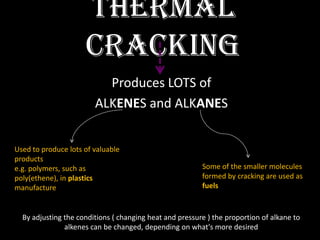
Thermal
Cracking
Produces LOTS of
ALKENES and ALKANES
By adjusting the conditions ( changing heat and pressure ) the proportion of alkane to
alkenes can be changed, depending on what's more desired
Used to produce lots of valuable
products
e.g. polymers, such as
poly(ethene), in plastics
manufacture
Some of the smaller molecules
formed by cracking are used as
fuels
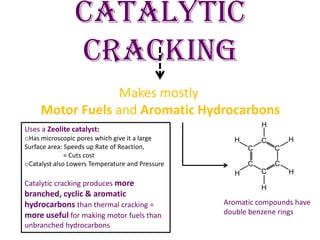
Catalytic
Cracking
Makes mostly
Motor Fuels and Aromatic Hydrocarbons
Aromatic compounds have
double benzene rings
Uses a Zeolite catalyst:
oHas microscopic pores which give it a large
Surface area: Speeds up Rate of Reaction,
= Cuts cost
oCatalyst also Lowers Temperature and Pressure
Catalytic cracking produces more
branched, cyclic & aromatic
hydrocarbons than thermal cracking =
more useful for making motor fuels than
unbranched hydrocarbons
Supply and
Demand• Greater Demand for Lighter Fractions (e.g.
Petrol) than for heavy fractions
• Fractional distillation can’t meet these
demands
• So Cracking converts heavy fractions into
lighter, more valuable, fractions e.g. petrol &
ethene
decane
ethene octane
e.g.
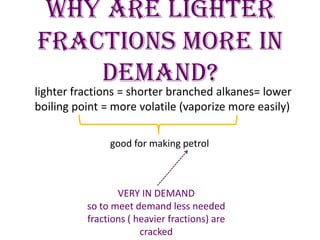
Why are lighter
fractions more in
demand?
lighter fractions = shorter branched alkanes= lower
boiling point = more volatile (vaporize more easily)
good for making petrol
VERY IN DEMAND
so to meet demand less needed
fractions ( heavier fractions) are
cracked
Thank
You for
Listenin

Cracking hydrocarbons

  • 1.
  • 2.
  • 4.
    Types of Cracking Thermal Cracking Catalytic Cracking •High Temperatures (up to 1000 C) •High Pressures (7000kPa) • High Temperatures (around 450 C) • Slight Pressures • Uses Zeolite Catalyst (compounds of aluminium/ silicon/oxygen) Catalyst : - Speeds up Rate of Reaction - Lowers Temperature and Pressure = Cuts cost
  • 5.
    Thermal Cracking Produces LOTS of ALKENESand ALKANES By adjusting the conditions ( changing heat and pressure ) the proportion of alkane to alkenes can be changed, depending on what's more desired Used to produce lots of valuable products e.g. polymers, such as poly(ethene), in plastics manufacture Some of the smaller molecules formed by cracking are used as fuels
  • 6.
    Catalytic Cracking Makes mostly Motor Fuelsand Aromatic Hydrocarbons Aromatic compounds have double benzene rings Uses a Zeolite catalyst: oHas microscopic pores which give it a large Surface area: Speeds up Rate of Reaction, = Cuts cost oCatalyst also Lowers Temperature and Pressure Catalytic cracking produces more branched, cyclic & aromatic hydrocarbons than thermal cracking = more useful for making motor fuels than unbranched hydrocarbons
  • 7.
    Supply and Demand• GreaterDemand for Lighter Fractions (e.g. Petrol) than for heavy fractions • Fractional distillation can’t meet these demands • So Cracking converts heavy fractions into lighter, more valuable, fractions e.g. petrol & ethene decane ethene octane e.g.
  • 8.
    Why are lighter fractionsmore in demand? lighter fractions = shorter branched alkanes= lower boiling point = more volatile (vaporize more easily) good for making petrol VERY IN DEMAND so to meet demand less needed fractions ( heavier fractions) are cracked
  • 9.