CPUCPU
ORGANISATIOORGANISATIO
NN
CPU (CPU (Central Processing UnitCentral Processing Unit))
Acts as the brain of computer.
Performs all the calculations & controls all the
components.
Carries out the instructions of a computer
program, performs the basic arithmetical,
logical, and input and output operations of the
system.
CPU Has Two MainCPU Has Two Main
ComponentsComponents
 Control Unit
(CU)
 Arithmetic &
Logic Unit (ALU)
Control UnitControl Unit
Selects program instructions & coordinates
their execution.
Regulates timing of processor.
Sends control signal to and receives control
signal from peripheral devices.
Acts as central nervous system for all other
components.
It obtains instruction from memory, interprets
the instruction & issues signals to the required
units to carry out the execution.
ALUALU
Actual execution of instruction takes place
in ALU.
It consists of a complicated set of logic
circuit, registers and accumulator to carry
out all operations.
Depends on the commands given by the
Control Unit.
RegistersRegisters
It holds data temporarily during the execution
of instruction.
They are a part of CPU.
Length of register = No. of bits in can store.
Two types -
 Special Purpose Registers
 General Purpose Registers
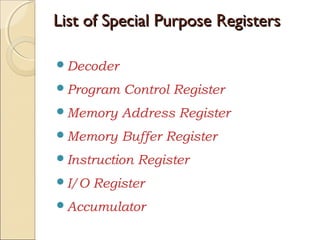
List of Special Purpose RegistersList of Special Purpose Registers
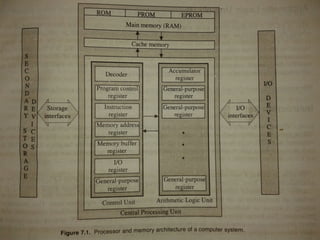
Decoder
Program Control Register
Memory Address Register
Memory Buffer Register
Instruction Register
I/O Register
Accumulator
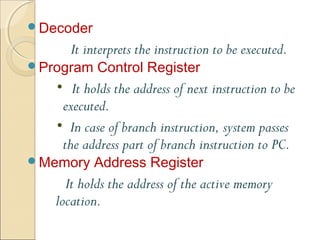
Decoder
It interprets the instruction to be executed.
Program Control Register
• It holds the address of next instruction to be
executed.
• In case of branch instruction, system passes
the address part of branch instruction to PC.
Memory Address Register
It holds the address of the active memory
location.
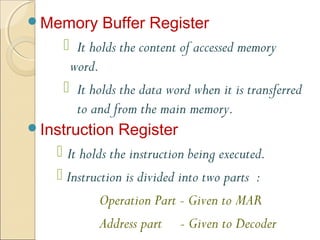
Memory Buffer Register
 It holds the content of accessed memory
word.
 It holds the data word when it is transferred
to and from the main memory.
Instruction Register
 It holds the instruction being executed.
 Instruction is divided into two parts :
Operation Part - Given to MAR
Address part - Given to Decoder
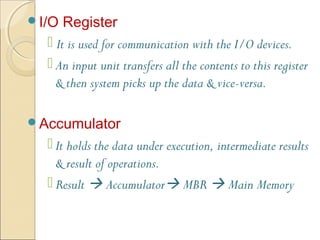
I/O Register
 It is used for communication with the I/O devices.
 An input unit transfers all the contents to this register
& then system picks up the data & vice-versa.
Accumulator
 It holds the data under execution, intermediate results
& result of operations.
 Result  Accumulator MBR  Main Memory
Main MemoryMain Memory
RAM (Random Access Memory)
Volatile Memory
Every file or application opened is placed
in RAM
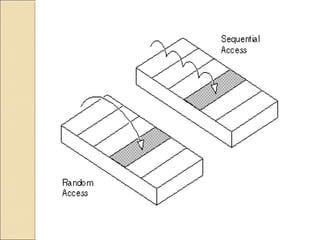
Uses Random Access Technique, i.e., the
data can be directly jumped to the middle if
necessary without having to read the data
sequentially.
ROM (Read Only Memory)ROM (Read Only Memory)
Non-volat ile Memory
The inst ruct ions are st or ed by
manuf act ur ers
Special programs are st ored
called mi cro-programs which
deal wit h low-level machine
f unct ions.
Types of ROM --
Cache MemoryCache Memory
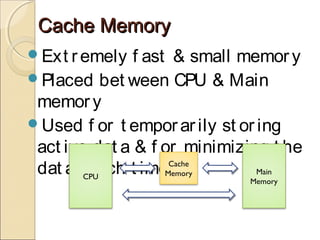
Ext remely f ast & small memory
Placed bet ween CPU & Main
memor y
Used f or t emporarily st or ing
act ive dat a & f or minimizing t he
dat a f et ch t imeCPU
Cache
Memory Main
Memory
Steps of Execution Of InstructionSteps of Execution Of Instruction
1 ) The CUtake s addre ss o f the ne xt instructio n
fro m the PC Re g iste r & re ads the instructio n
fro m co rre spo nding m e m o ry addre ss into the
Instructio n Re g iste r.
2) CUthe n se nds the o pe ratio n & addre ss part
to De co de r & MAR re spe ctive ly.
3) De co de r inte rpre ts the instructio n se nds
co m m and sig nals to the appro priate units to
carry o ut the task spe cifie d.
4) As the syste m e xe cute s e ach instructio n, it
lo ads the addre ss o f ne xt instructio n in PC
Re g iste r & re pe ats ste ps 1 to 4.
Thank You
Thank You

Cpu organisation

  • 1.
  • 2.
    CPU (CPU (CentralProcessing UnitCentral Processing Unit)) Acts as the brain of computer. Performs all the calculations & controls all the components. Carries out the instructions of a computer program, performs the basic arithmetical, logical, and input and output operations of the system.
  • 4.
    CPU Has TwoMainCPU Has Two Main ComponentsComponents  Control Unit (CU)  Arithmetic & Logic Unit (ALU)
  • 5.
    Control UnitControl Unit Selectsprogram instructions & coordinates their execution. Regulates timing of processor. Sends control signal to and receives control signal from peripheral devices. Acts as central nervous system for all other components. It obtains instruction from memory, interprets the instruction & issues signals to the required units to carry out the execution.
  • 6.
    ALUALU Actual execution ofinstruction takes place in ALU. It consists of a complicated set of logic circuit, registers and accumulator to carry out all operations. Depends on the commands given by the Control Unit.
  • 7.
    RegistersRegisters It holds datatemporarily during the execution of instruction. They are a part of CPU. Length of register = No. of bits in can store. Two types -  Special Purpose Registers  General Purpose Registers
  • 8.
    List of SpecialPurpose RegistersList of Special Purpose Registers Decoder Program Control Register Memory Address Register Memory Buffer Register Instruction Register I/O Register Accumulator
  • 9.
    Decoder It interprets theinstruction to be executed. Program Control Register • It holds the address of next instruction to be executed. • In case of branch instruction, system passes the address part of branch instruction to PC. Memory Address Register It holds the address of the active memory location.
  • 10.
    Memory Buffer Register It holds the content of accessed memory word.  It holds the data word when it is transferred to and from the main memory. Instruction Register  It holds the instruction being executed.  Instruction is divided into two parts : Operation Part - Given to MAR Address part - Given to Decoder
  • 11.
    I/O Register  Itis used for communication with the I/O devices.  An input unit transfers all the contents to this register & then system picks up the data & vice-versa. Accumulator  It holds the data under execution, intermediate results & result of operations.  Result  Accumulator MBR  Main Memory
  • 12.
    Main MemoryMain Memory RAM(Random Access Memory) Volatile Memory Every file or application opened is placed in RAM Uses Random Access Technique, i.e., the data can be directly jumped to the middle if necessary without having to read the data sequentially.
  • 14.
    ROM (Read OnlyMemory)ROM (Read Only Memory) Non-volat ile Memory The inst ruct ions are st or ed by manuf act ur ers Special programs are st ored called mi cro-programs which deal wit h low-level machine f unct ions. Types of ROM --
  • 15.
    Cache MemoryCache Memory Extremely f ast & small memory Placed bet ween CPU & Main memor y Used f or t emporarily st or ing act ive dat a & f or minimizing t he dat a f et ch t imeCPU Cache Memory Main Memory
  • 16.
    Steps of ExecutionOf InstructionSteps of Execution Of Instruction 1 ) The CUtake s addre ss o f the ne xt instructio n fro m the PC Re g iste r & re ads the instructio n fro m co rre spo nding m e m o ry addre ss into the Instructio n Re g iste r. 2) CUthe n se nds the o pe ratio n & addre ss part to De co de r & MAR re spe ctive ly. 3) De co de r inte rpre ts the instructio n se nds co m m and sig nals to the appro priate units to carry o ut the task spe cifie d. 4) As the syste m e xe cute s e ach instructio n, it lo ads the addre ss o f ne xt instructio n in PC Re g iste r & re pe ats ste ps 1 to 4.
  • 17.