(6.1)
Central Processing Unit Architecture
 Architecture overview
 Machine organization
– von Neumann
 Speeding up CPU operations
– multiple registers
– pipelining
– superscalar and VLIW
 CISC vs. RISC
(6.2)
Computer Architecture
 Major components of a computer
– Central Processing Unit (CPU)
– memory
– peripheral devices
 Architecture is concerned with
– internal structures of each
– interconnections
» speed and width
– relative speeds of components
 Want maximum execution speed
– Balance is often critical issue
(6.3)
Computer Architecture (continued)
 CPU
– performs arithmetic and logical operations
– synchronous operation
– may consider instruction set architecture
» how machine looks to a programmer
– detailed hardware design
(6.4)
Computer Architecture (continued)
 Memory
– stores programs and data
– organized as
» bit
» byte = 8 bits (smallest addressable location)
» word = 4 bytes (typically; machine dependent)
– instructions consist of operation codes and
addresses oprn
oprn
oprn
addr 1
addr 2
addr 3addr 2
addr 1
addr 1
(6.5)
Computer Architecture (continued)
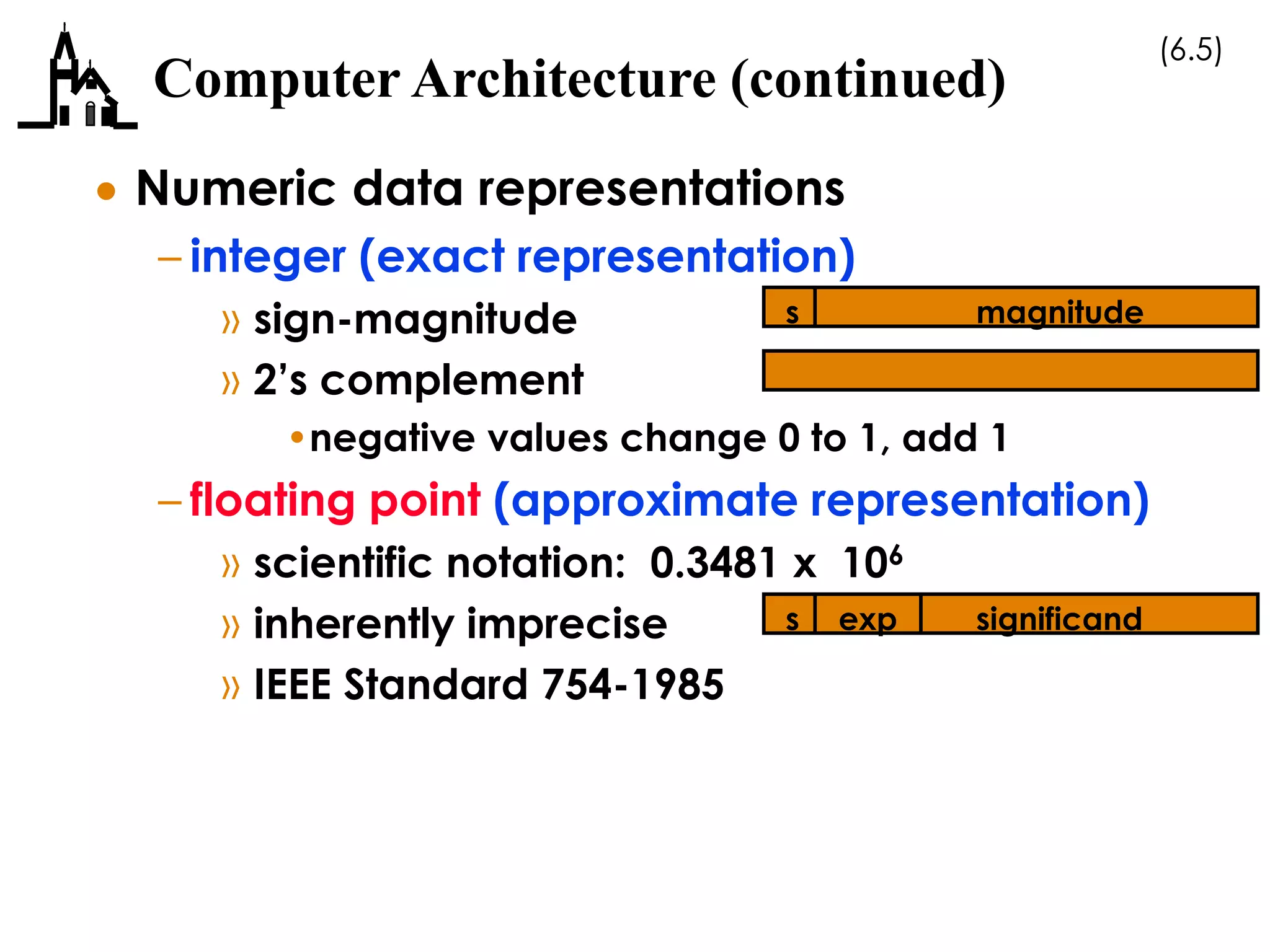
 Numeric data representations
– integer (exact representation)
» sign-magnitude
» 2’s complement
•negative values change 0 to 1, add 1
– floating point (approximate representation)
» scientific notation: 0.3481 x 10⁶
» inherently imprecise
» IEEE Standard 754-1985
s magnitude
s exp significand
(6.6)
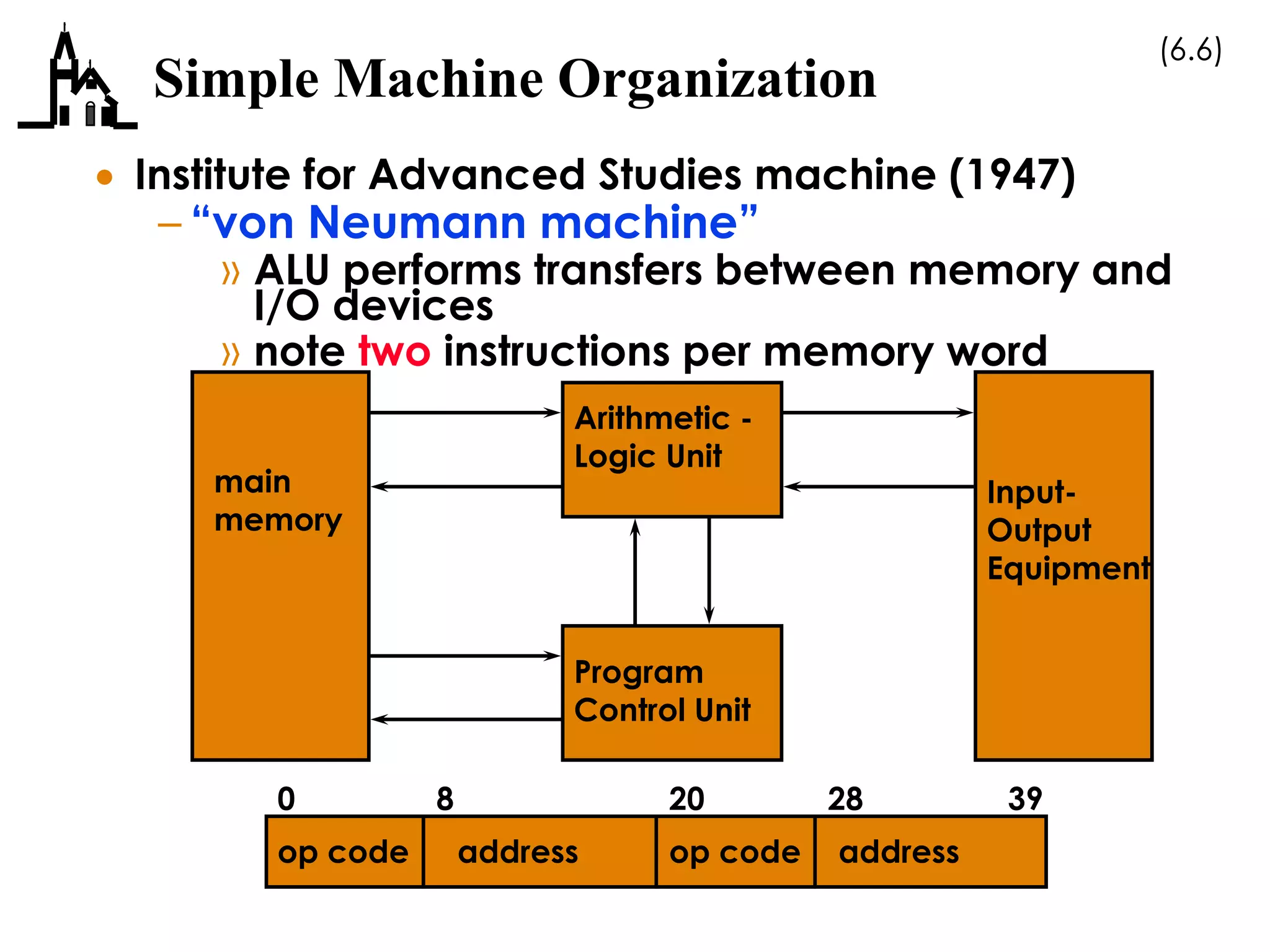
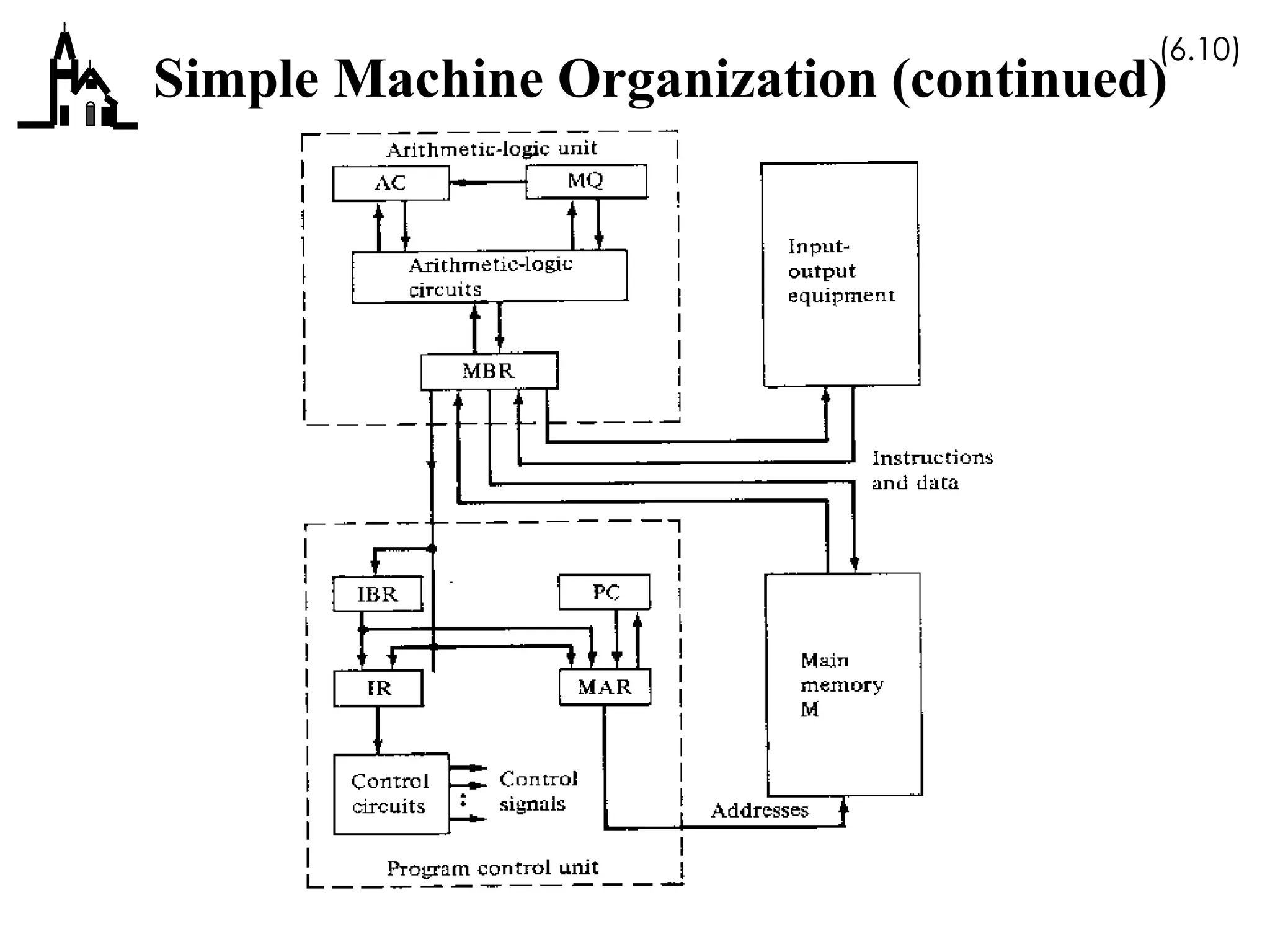
Simple Machine Organization
 Institute for Advanced Studies machine (1947)
– “von Neumann machine”
» ALU performs transfers between memory and
I/O devices
» note two instructions per memory word
main
memory
Input-
Output
Equipment
Arithmetic -
Logic Unit
Program
Control Unit
op code op codeaddress address
0 8 20 28 39
(6.7)
Simple Machine Organization (continued)
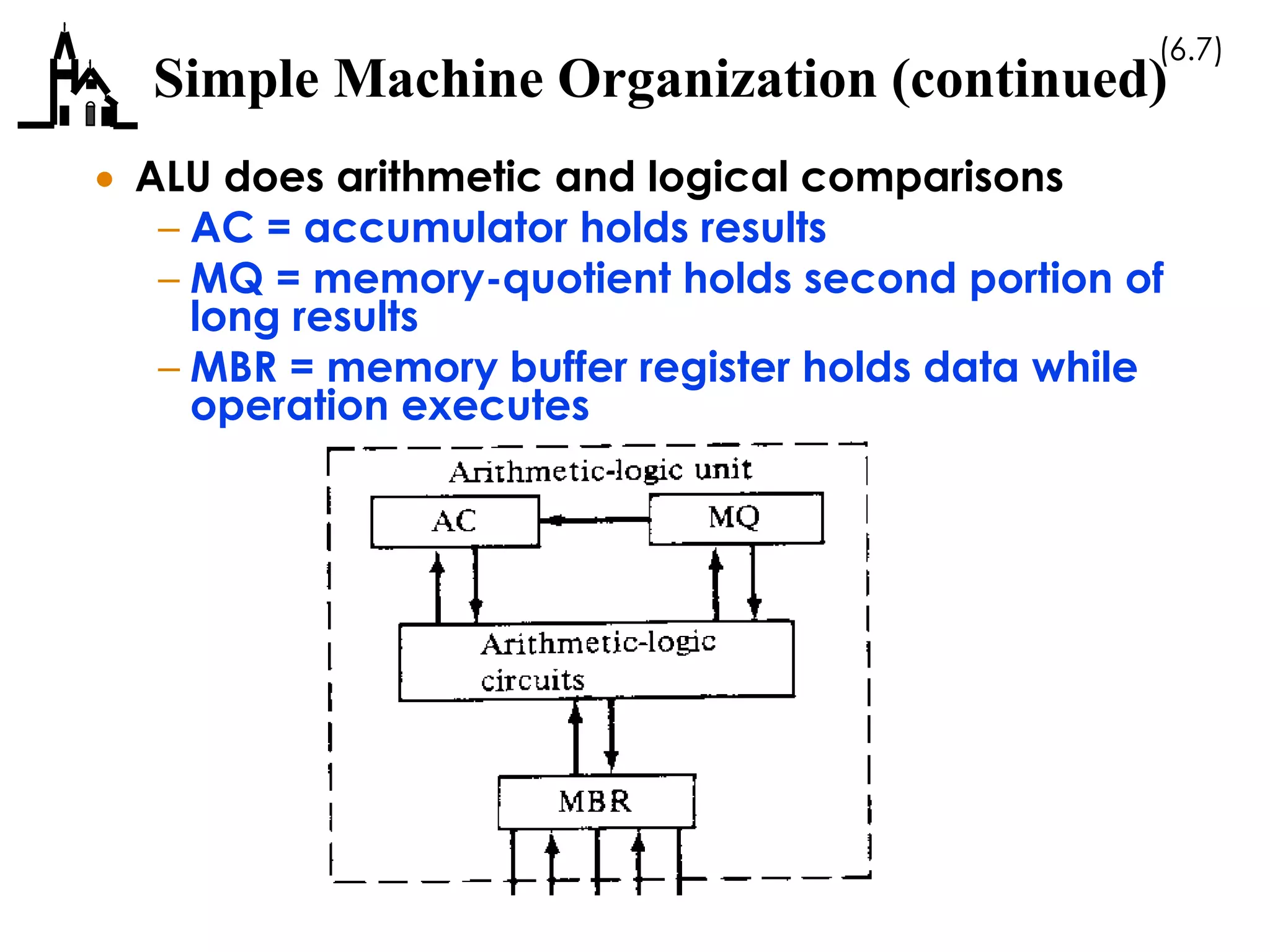
 ALU does arithmetic and logical comparisons
– AC = accumulator holds results
– MQ = memory-quotient holds second portion of
long results
– MBR = memory buffer register holds data while
operation executes
(6.8)
Simple Machine Organization (continued)
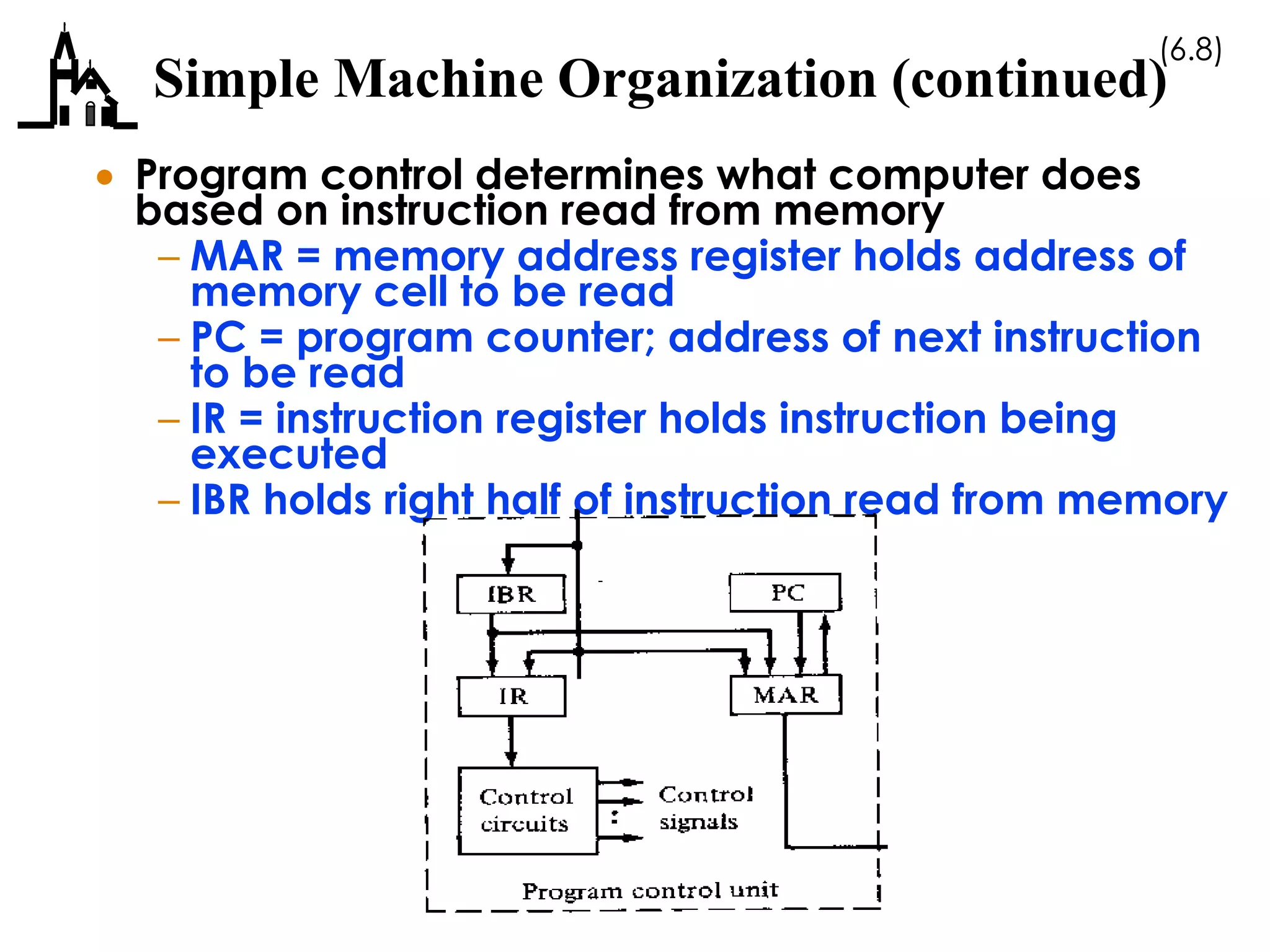
 Program control determines what computer does
based on instruction read from memory
– MAR = memory address register holds address of
memory cell to be read
– PC = program counter; address of next instruction
to be read
– IR = instruction register holds instruction being
executed
– IBR holds right half of instruction read from memory
(6.9)
Simple Machine Organization (continued)
 Machine operates on fetch-execute cycle
 Fetch
– PC MAR
– read M(MAR) into MBR
– copy left and right instructions into IR and IBR
 Execute
– address part of IR MAR
– read M(MAR) into MBR
– execute opcode
(6.10)
Simple Machine Organization (continued)
(6.11)
Architecture Families
 Before mid-60’s, every new machine had a
different instruction set architecture
– programs from previous generation didn’t run on
new machine
– cost of replacing software became too large
 IBM System/360 created family concept
– single instruction set architecture
– wide range of price and performance with same
software
 Performance improvements based on different
detailed implementations
– memory path width (1 byte to 8 bytes)
– faster, more complex CPU design
– greater I/O throughput and overlap
 “Software compatibility” now a major issue
– partially offset by high level language (HLL) software
(6.12)
Architecture Families
(6.13)
Multiple Register Machines
 Initially, machines had only a few registers
– 2 to 8 or 16 common
– registers more expensive than memory
 Most instructions operated between memory
locations
– results had to start from and end up in
memory, so fewer instructions
» although more complex
– means smaller programs and (supposedly)
faster execution
» fewer instructions and data to move between
memory and ALU
 But registers are much faster than memory
– 30 times faster
(6.14)
Multiple Register Machines (continued)
 Also, many operands are reused within a
short time
– waste time loading operand again the next
time it’s needed
 Depending on mix of instructions and
operand use, having many registers may
lead to less traffic to memory and faster
execution
 Most modern machines use a multiple
register architecture
– maximum number about 512, common
number 32 integer, 32 floating point
(6.15)
Pipelining
 One way to speed up CPU is to increase
clock rate
– limitations on how fast clock can run to
complete instruction
 Another way is to execute more than one
instruction at one time
(6.16)
Pipelining
 Pipelining breaks instruction execution down
into several stages
– put registers between stages to “buffer” data
and control
– execute one instruction
– as first starts second stage, execute second
instruction, etc.
– speedup same as number of stages as long as
pipe is full
(6.17)
Pipelining (continued)
 Consider an example with 6 stages
– FI = fetch instruction
– DI = decode instruction
– CO = calculate location of operand
– FO = fetch operand
– EI = execute instruction
– WO = write operand (store result)
(6.18)
Pipelining Example
 Executes 9 instructions in 14 cycles rather than 54 for
sequential execution
(6.19)
Pipelining (continued)
 Hazards to pipelining
– conditional jump
» instruction 3 branches to instruction 15
» pipeline must be flushed and restarted
– later instruction needs operand being
calculated by instruction still in pipeline
» pipeline stalls until result ready
(6.20)
Pipelining Problem Example
 Is this really a problem?
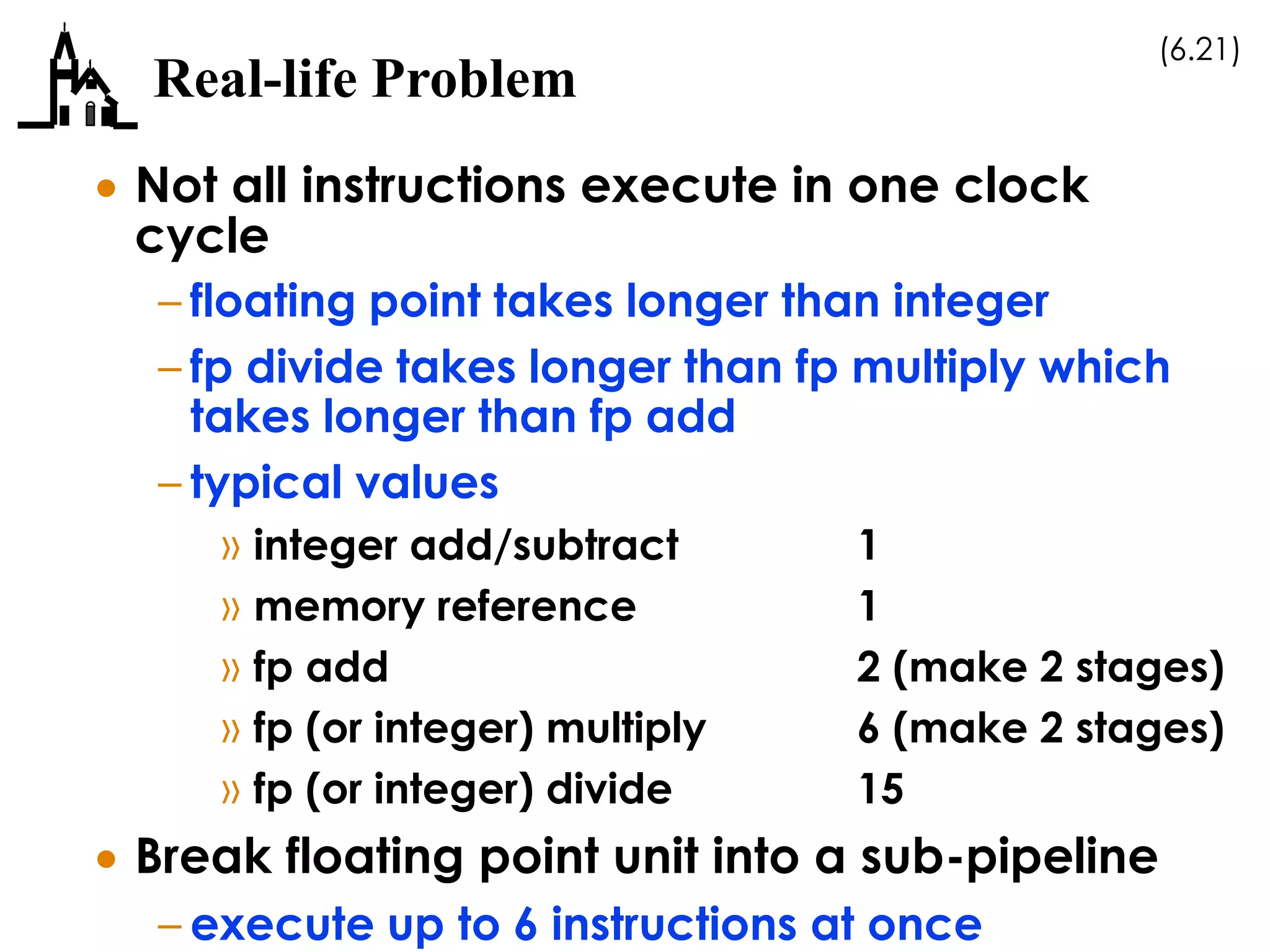
(6.21)
Real-life Problem
 Not all instructions execute in one clock
cycle
– floating point takes longer than integer
– fp divide takes longer than fp multiply which
takes longer than fp add
– typical values
» integer add/subtract 1
» memory reference 1
» fp add 2 (make 2 stages)
» fp (or integer) multiply 6 (make 2 stages)
» fp (or integer) divide 15
 Break floating point unit into a sub-pipeline
– execute up to 6 instructions at once
(6.22)
Pipelining (continued)
 This is not simple to implement
– note all 6 instructions could finish at the same
time!!
(6.23)
More Speedup
 Pipelined machines issue one instruction
each clock cycle
– how to speed up CPU even more?
 Issue more than one instruction per clock
cycle
(6.24)
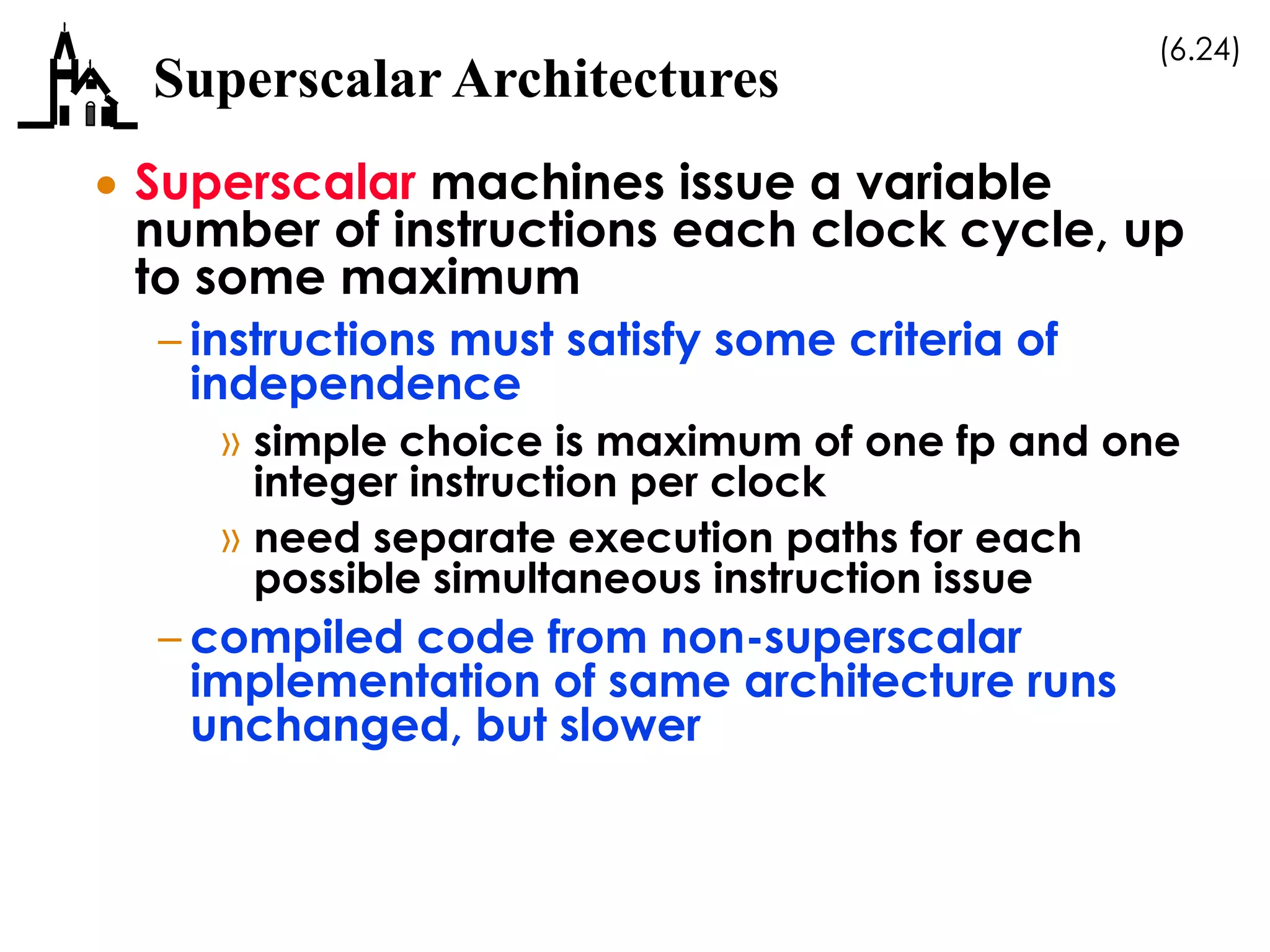
Superscalar Architectures
 Superscalar machines issue a variable
number of instructions each clock cycle, up
to some maximum
– instructions must satisfy some criteria of
independence
» simple choice is maximum of one fp and one
integer instruction per clock
» need separate execution paths for each
possible simultaneous instruction issue
– compiled code from non-superscalar
implementation of same architecture runs
unchanged, but slower
(6.25)
Superscalar Example
 Each instruction path may be pipelined
0 2 3 4 5 6 7 81 clock
(6.26)
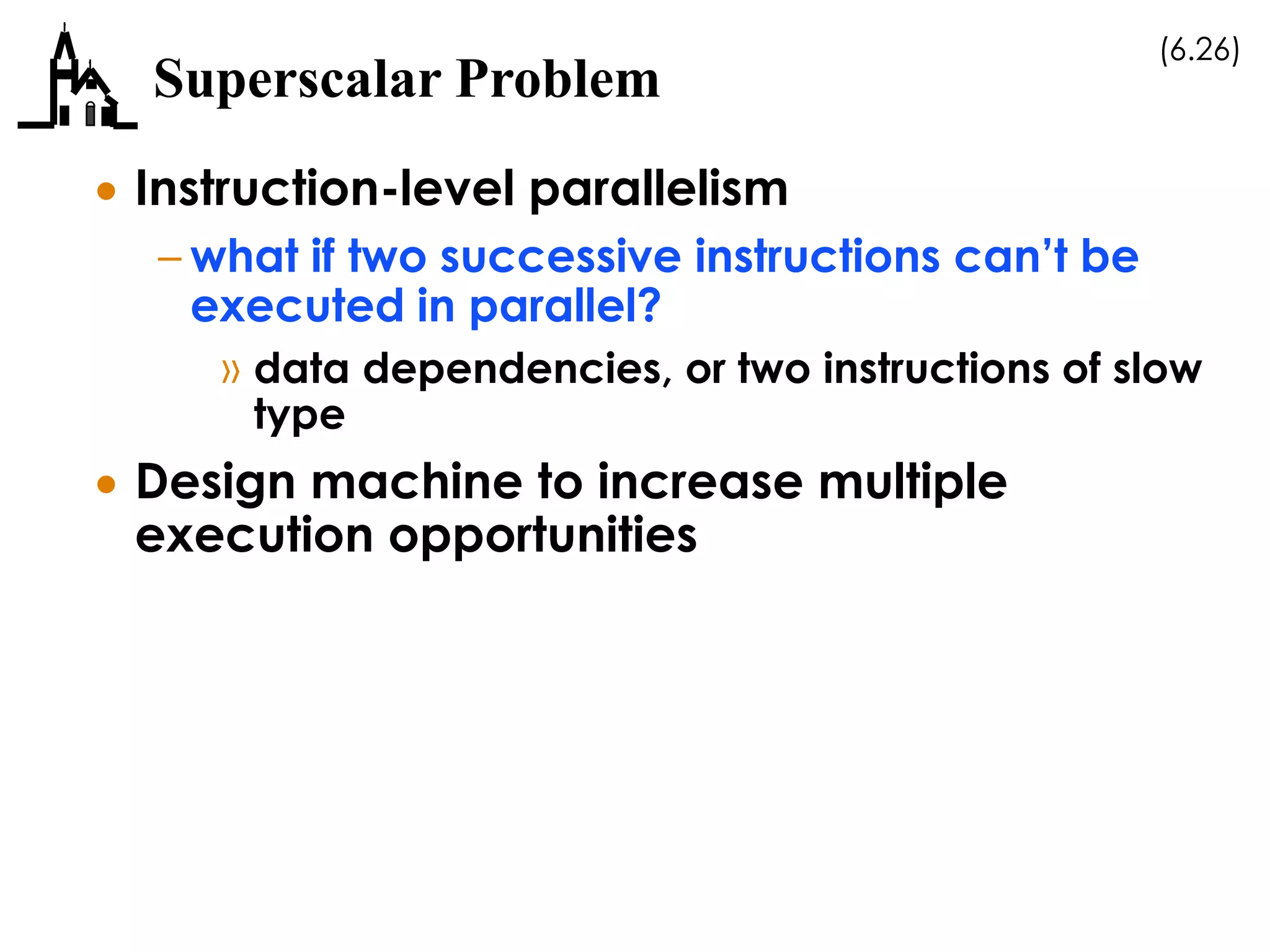
Superscalar Problem
 Instruction-level parallelism
– what if two successive instructions can’t be
executed in parallel?
» data dependencies, or two instructions of slow
type
 Design machine to increase multiple
execution opportunities
(6.27)
VLIW Architectures
 Very Long Instruction Word (VLIW)
architectures store several simple instructions
in one long instruction fetched from memory
– number and type are fixed
» e.g., 2 memory reference, 2 floating point, one
integer
– need one functional unit for each possible
instruction
» 2 fp units, 1 integer unit, 2 MBRs
» all run synchronized
– each instruction is stored in a single word
» requires wider memory communication paths
» many instructions may be empty, meaning
wasted code space
(6.28)
VLIW Example
Memory
Ref 1
Memory
Ref 2
FP 1 FP 2 Integer
LD F0, 0(R1) LD F6, 8(R1)
LD F10,
16(R1)
LD F14,
24(R1)
SB
R1,R1,#4
8
LD
F18,32(R1)
LD
F22,40(R1)
AD F4,F0,F2 AD F8,F6,F2
LD
F26,48(R1)
AD
F12,F10,F2
AD
F16,F14,F2
(6.29)
Instruction Level Parallelism
 Success of superscalar and VLIW machines
depends on number of instructions that occur
together that can be issued in parallel
– no dependencies
– no branches
 Compilers can help create parallelism
 Speculation techniques try to overcome
branch problems
– assume branch is taken
– execute instructions but don’t let them store
results until status of branch is known
(6.30)
CISC vs. RISC
 CISC = Complex Instruction Set Computer
 RISC = Reduced Instruction Set Computer
(6.31)
CISC vs. RISC (continued)
 Historically, machines tend to add features
over time
– instruction opcodes
» IBM 70X, 70X0 series went from 24 opcodes to
185 in 10 years
» same time performance increased 30 times
– addressing modes
– special purpose registers
 Motivations are to
– improve efficiency, since complex instructions
can be implemented in hardware and
execute faster
– make life easier for compiler writers
– support more complex higher-level languages
(6.32)
CISC vs. RISC
 Examination of actual code indicated many
of these features were not used
 RISC advocates proposed
– simple, limited instruction set
– large number of general purpose registers
» and mostly register operations
– optimized instruction pipeline
 Benefits should include
– faster execution of instructions commonly
used
– faster design and implementation
(6.33)
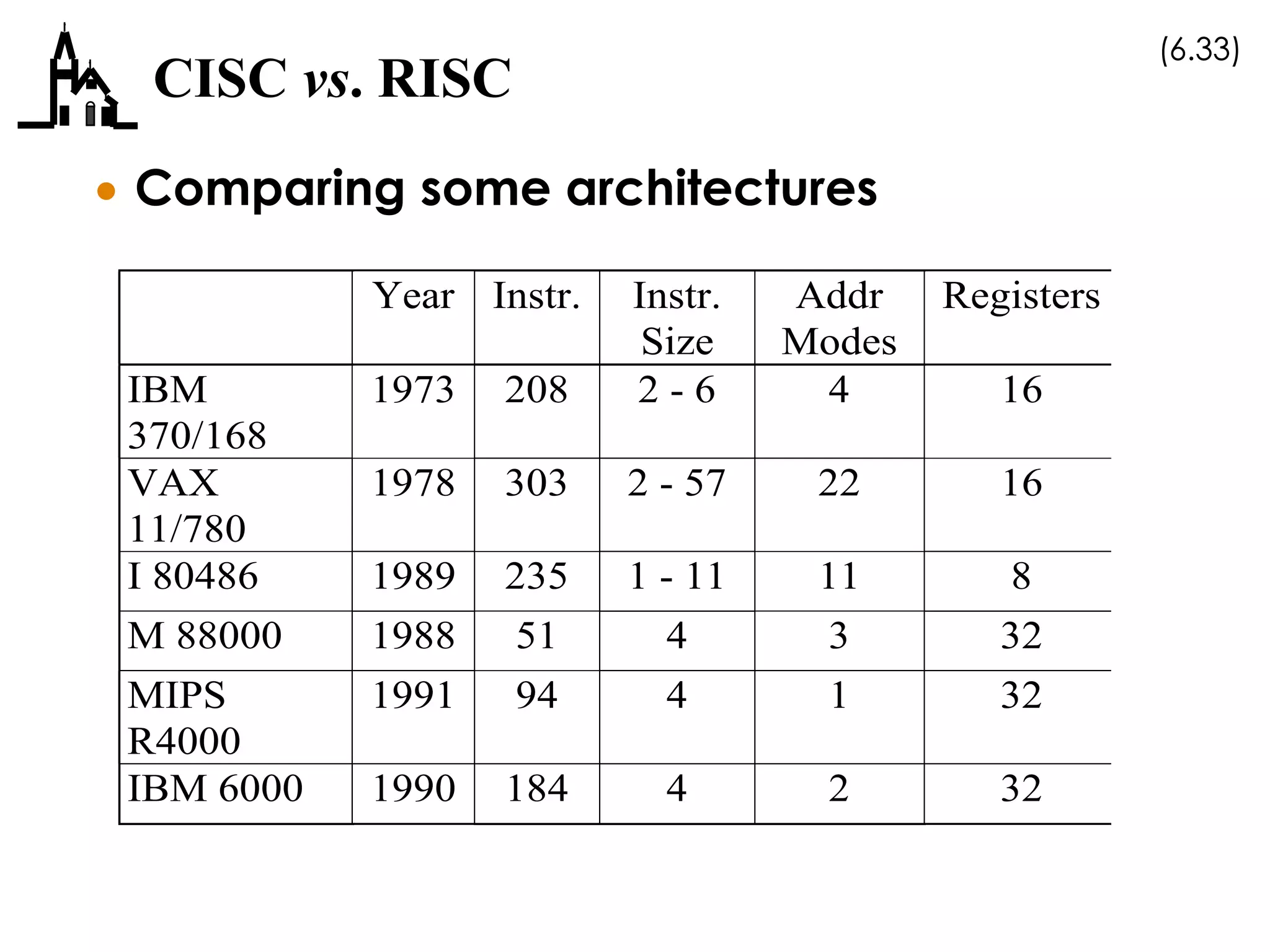
CISC vs. RISC
 Comparing some architectures
Year Instr. Instr.
Size
Addr
Modes
Registers
IBM
370/168
1973 208 2 - 6 4 16
VAX
11/780
1978 303 2 - 57 22 16
I 80486 1989 235 1 - 11 11 8
M 88000 1988 51 4 3 32
MIPS
R4000
1991 94 4 1 32
IBM 6000 1990 184 4 2 32
(6.34)
CISC vs. RISC
 Which approach is right?
 Typically, RISC takes about 1/5 the design
time
– but CISC have adopted RISC techniques

Cp uarch

  • 1.
    (6.1) Central Processing UnitArchitecture  Architecture overview  Machine organization – von Neumann  Speeding up CPU operations – multiple registers – pipelining – superscalar and VLIW  CISC vs. RISC
  • 2.
    (6.2) Computer Architecture  Majorcomponents of a computer – Central Processing Unit (CPU) – memory – peripheral devices  Architecture is concerned with – internal structures of each – interconnections » speed and width – relative speeds of components  Want maximum execution speed – Balance is often critical issue
  • 3.
    (6.3) Computer Architecture (continued) CPU – performs arithmetic and logical operations – synchronous operation – may consider instruction set architecture » how machine looks to a programmer – detailed hardware design
  • 4.
    (6.4) Computer Architecture (continued) Memory – stores programs and data – organized as » bit » byte = 8 bits (smallest addressable location) » word = 4 bytes (typically; machine dependent) – instructions consist of operation codes and addresses oprn oprn oprn addr 1 addr 2 addr 3addr 2 addr 1 addr 1
  • 5.
    (6.5) Computer Architecture (continued) Numeric data representations – integer (exact representation) » sign-magnitude » 2’s complement •negative values change 0 to 1, add 1 – floating point (approximate representation) » scientific notation: 0.3481 x 10⁶ » inherently imprecise » IEEE Standard 754-1985 s magnitude s exp significand
  • 6.
    (6.6) Simple Machine Organization Institute for Advanced Studies machine (1947) – “von Neumann machine” » ALU performs transfers between memory and I/O devices » note two instructions per memory word main memory Input- Output Equipment Arithmetic - Logic Unit Program Control Unit op code op codeaddress address 0 8 20 28 39
  • 7.
    (6.7) Simple Machine Organization(continued)  ALU does arithmetic and logical comparisons – AC = accumulator holds results – MQ = memory-quotient holds second portion of long results – MBR = memory buffer register holds data while operation executes
  • 8.
    (6.8) Simple Machine Organization(continued)  Program control determines what computer does based on instruction read from memory – MAR = memory address register holds address of memory cell to be read – PC = program counter; address of next instruction to be read – IR = instruction register holds instruction being executed – IBR holds right half of instruction read from memory
  • 9.
    (6.9) Simple Machine Organization(continued)  Machine operates on fetch-execute cycle  Fetch – PC MAR – read M(MAR) into MBR – copy left and right instructions into IR and IBR  Execute – address part of IR MAR – read M(MAR) into MBR – execute opcode
  • 10.
  • 11.
    (6.11) Architecture Families  Beforemid-60’s, every new machine had a different instruction set architecture – programs from previous generation didn’t run on new machine – cost of replacing software became too large  IBM System/360 created family concept – single instruction set architecture – wide range of price and performance with same software  Performance improvements based on different detailed implementations – memory path width (1 byte to 8 bytes) – faster, more complex CPU design – greater I/O throughput and overlap  “Software compatibility” now a major issue – partially offset by high level language (HLL) software
  • 12.
  • 13.
    (6.13) Multiple Register Machines Initially, machines had only a few registers – 2 to 8 or 16 common – registers more expensive than memory  Most instructions operated between memory locations – results had to start from and end up in memory, so fewer instructions » although more complex – means smaller programs and (supposedly) faster execution » fewer instructions and data to move between memory and ALU  But registers are much faster than memory – 30 times faster
  • 14.
    (6.14) Multiple Register Machines(continued)  Also, many operands are reused within a short time – waste time loading operand again the next time it’s needed  Depending on mix of instructions and operand use, having many registers may lead to less traffic to memory and faster execution  Most modern machines use a multiple register architecture – maximum number about 512, common number 32 integer, 32 floating point
  • 15.
    (6.15) Pipelining  One wayto speed up CPU is to increase clock rate – limitations on how fast clock can run to complete instruction  Another way is to execute more than one instruction at one time
  • 16.
    (6.16) Pipelining  Pipelining breaksinstruction execution down into several stages – put registers between stages to “buffer” data and control – execute one instruction – as first starts second stage, execute second instruction, etc. – speedup same as number of stages as long as pipe is full
  • 17.
    (6.17) Pipelining (continued)  Consideran example with 6 stages – FI = fetch instruction – DI = decode instruction – CO = calculate location of operand – FO = fetch operand – EI = execute instruction – WO = write operand (store result)
  • 18.
    (6.18) Pipelining Example  Executes9 instructions in 14 cycles rather than 54 for sequential execution
  • 19.
    (6.19) Pipelining (continued)  Hazardsto pipelining – conditional jump » instruction 3 branches to instruction 15 » pipeline must be flushed and restarted – later instruction needs operand being calculated by instruction still in pipeline » pipeline stalls until result ready
  • 20.
    (6.20) Pipelining Problem Example Is this really a problem?
  • 21.
    (6.21) Real-life Problem  Notall instructions execute in one clock cycle – floating point takes longer than integer – fp divide takes longer than fp multiply which takes longer than fp add – typical values » integer add/subtract 1 » memory reference 1 » fp add 2 (make 2 stages) » fp (or integer) multiply 6 (make 2 stages) » fp (or integer) divide 15  Break floating point unit into a sub-pipeline – execute up to 6 instructions at once
  • 22.
    (6.22) Pipelining (continued)  Thisis not simple to implement – note all 6 instructions could finish at the same time!!
  • 23.
    (6.23) More Speedup  Pipelinedmachines issue one instruction each clock cycle – how to speed up CPU even more?  Issue more than one instruction per clock cycle
  • 24.
    (6.24) Superscalar Architectures  Superscalarmachines issue a variable number of instructions each clock cycle, up to some maximum – instructions must satisfy some criteria of independence » simple choice is maximum of one fp and one integer instruction per clock » need separate execution paths for each possible simultaneous instruction issue – compiled code from non-superscalar implementation of same architecture runs unchanged, but slower
  • 25.
    (6.25) Superscalar Example  Eachinstruction path may be pipelined 0 2 3 4 5 6 7 81 clock
  • 26.
    (6.26) Superscalar Problem  Instruction-levelparallelism – what if two successive instructions can’t be executed in parallel? » data dependencies, or two instructions of slow type  Design machine to increase multiple execution opportunities
  • 27.
    (6.27) VLIW Architectures  VeryLong Instruction Word (VLIW) architectures store several simple instructions in one long instruction fetched from memory – number and type are fixed » e.g., 2 memory reference, 2 floating point, one integer – need one functional unit for each possible instruction » 2 fp units, 1 integer unit, 2 MBRs » all run synchronized – each instruction is stored in a single word » requires wider memory communication paths » many instructions may be empty, meaning wasted code space
  • 28.
    (6.28) VLIW Example Memory Ref 1 Memory Ref2 FP 1 FP 2 Integer LD F0, 0(R1) LD F6, 8(R1) LD F10, 16(R1) LD F14, 24(R1) SB R1,R1,#4 8 LD F18,32(R1) LD F22,40(R1) AD F4,F0,F2 AD F8,F6,F2 LD F26,48(R1) AD F12,F10,F2 AD F16,F14,F2
  • 29.
    (6.29) Instruction Level Parallelism Success of superscalar and VLIW machines depends on number of instructions that occur together that can be issued in parallel – no dependencies – no branches  Compilers can help create parallelism  Speculation techniques try to overcome branch problems – assume branch is taken – execute instructions but don’t let them store results until status of branch is known
  • 30.
    (6.30) CISC vs. RISC CISC = Complex Instruction Set Computer  RISC = Reduced Instruction Set Computer
  • 31.
    (6.31) CISC vs. RISC(continued)  Historically, machines tend to add features over time – instruction opcodes » IBM 70X, 70X0 series went from 24 opcodes to 185 in 10 years » same time performance increased 30 times – addressing modes – special purpose registers  Motivations are to – improve efficiency, since complex instructions can be implemented in hardware and execute faster – make life easier for compiler writers – support more complex higher-level languages
  • 32.
    (6.32) CISC vs. RISC Examination of actual code indicated many of these features were not used  RISC advocates proposed – simple, limited instruction set – large number of general purpose registers » and mostly register operations – optimized instruction pipeline  Benefits should include – faster execution of instructions commonly used – faster design and implementation
  • 33.
    (6.33) CISC vs. RISC Comparing some architectures Year Instr. Instr. Size Addr Modes Registers IBM 370/168 1973 208 2 - 6 4 16 VAX 11/780 1978 303 2 - 57 22 16 I 80486 1989 235 1 - 11 11 8 M 88000 1988 51 4 3 32 MIPS R4000 1991 94 4 1 32 IBM 6000 1990 184 4 2 32
  • 34.
    (6.34) CISC vs. RISC Which approach is right?  Typically, RISC takes about 1/5 the design time – but CISC have adopted RISC techniques