CS152: Computer Systems Architecture
Processor Microarchitecture
Sang-Woo Jun
Winter 2019
Large amount of material adapted from MIT 6.004, “Computation Structures”,
Morgan Kaufmann “Computer Organization and Design: The Hardware/Software Interface: RISC-V Edition”,
and CS 152 Slides by Isaac Scherson
Course outline
 Part 1: The Hardware-Software Interface
o What makes a ‘good’ processor?
o Assembly programming and conventions
 Part 2: Recap of digital design
o Combinational and sequential circuits
o How their restrictions influence processor design
 Part 3: Computer Architecture
o Simple and pipelined processors
o Computer Arithmetic
o Caches and the memory hierarchy
 Part 4: Computer Systems
o Operating systems, Virtual memory
How to build a computing machine?
 Pretend the computers we know and love have never existed
 We want to build an automatic computing machine to solve
mathematical problems
 Starting from (almost) scratch, where you have transistors and integrated
circuits but no existing microarchitecture
o No PC, no register files, no ALU
 How would you do it? Would it look similar to what we have now?
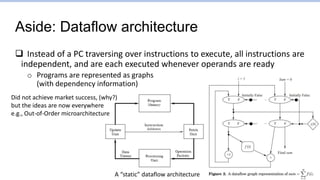
Aside: Dataflow architecture
 Instead of a PC traversing over instructions to execute, all instructions are
independent, and are each executed whenever operands are ready
o Programs are represented as graphs
(with dependency information)
A “static” dataflow architecture
Did not achieve market success, (why?)
but the ideas are now everywhere
e.g., Out-of-Order microarchitecture
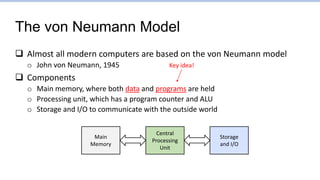
The von Neumann Model
 Almost all modern computers are based on the von Neumann model
o John von Neumann, 1945
 Components
o Main memory, where both data and programs are held
o Processing unit, which has a program counter and ALU
o Storage and I/O to communicate with the outside world
Central
Processing
Unit
Main
Memory
Storage
and I/O
Key idea!
Key Idea: Stored-Program Computer
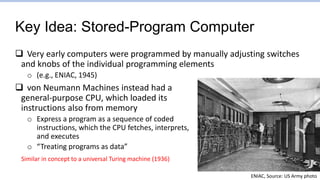
 Very early computers were programmed by manually adjusting switches
and knobs of the individual programming elements
o (e.g., ENIAC, 1945)
 von Neumann Machines instead had a
general-purpose CPU, which loaded its
instructions also from memory
o Express a program as a sequence of coded
instructions, which the CPU fetches, interprets,
and executes
o “Treating programs as data”
ENIAC, Source: US Army photo
Similar in concept to a universal Turing machine (1936)
von Neumann and Turing machine
 Turing machine is a mathematical model of computing machines
o Proven to be able to compute any mechanically computable functions
o Anything an algorithm can compute, it can compute
 Components include
o An infinite tape (like memory) and a header which can read/write a location
o A state transition diagram (like program) and a current location (like pc)
• State transition done according to current value in tape
 Only natural that computer designs
gravitate towards provably universal models
Source: Manolis Kamvysselis
Stored program computer, now what?
 Once we decide on the stored program computer paradigm
o With program counter (PC) pointing to encoded programs in memory
 Then it becomes an issue of deciding the programming abstraction
o Instruction set architecture, which we talked about
 Then, it becomes an issue of executing it quickly and efficiently
o Microarchitecture! – Improving performance/efficiency/etc while maintaining ISA
abstraction
o Which is the core of this class, starting now
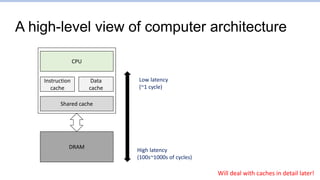
A high-level view of computer architecture
CPU
Instruction
cache
Data
cache
Shared cache
DRAM
Low latency
(~1 cycle)
High latency
(100s~1000s of cycles)
Will deal with caches in detail later!
Remember:
Super simplified processor operation
inst = mem[PC]
next_PC = PC + 4
if ( inst.type == STORE ) mem[rf[inst.arg1]] = rf[inst.arg2]
if ( inst.type == LOAD ) rf[inst.arg1] = mem[rf[inst.arg2]]
if ( inst.type == ALU ) rf[inst.arg1] = alu(inst.op, rf[inst.arg2], rf[inst.arg3])
if ( inst.type == COND ) next_PC = rf[inst.arg1]
PC = next_PC
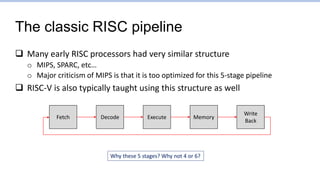
The classic RISC pipeline
Fetch Decode Execute Memory
Write
Back
 Many early RISC processors had very similar structure
o MIPS, SPARC, etc…
o Major criticism of MIPS is that it is too optimized for this 5-stage pipeline
 RISC-V is also typically taught using this structure as well
Why these 5 stages? Why not 4 or 6?
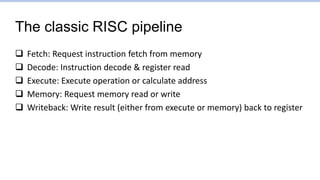
The classic RISC pipeline
 Fetch: Request instruction fetch from memory
 Decode: Instruction decode & register read
 Execute: Execute operation or calculate address
 Memory: Request memory read or write
 Writeback: Write result (either from execute or memory) back to register
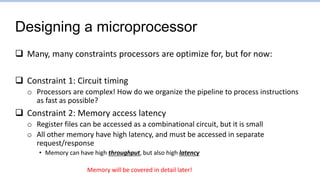
Designing a microprocessor
 Many, many constraints processors are optimize for, but for now:
 Constraint 1: Circuit timing
o Processors are complex! How do we organize the pipeline to process instructions
as fast as possible?
 Constraint 2: Memory access latency
o Register files can be accessed as a combinational circuit, but it is small
o All other memory have high latency, and must be accessed in separate
request/response
• Memory can have high throughput, but also high latency
Memory will be covered in detail later!
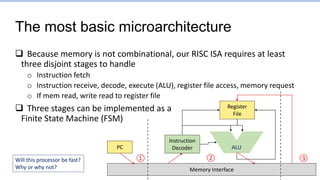
The most basic microarchitecture
PC
Memory Interface
Instruction
Decoder
Register
File
ALU
 Because memory is not combinational, our RISC ISA requires at least
three disjoint stages to handle
o Instruction fetch
o Instruction receive, decode, execute (ALU), register file access, memory request
o If mem read, write read to register file
 Three stages can be implemented as a
Finite State Machine (FSM)
① ② ③
Will this processor be fast?
Why or why not?
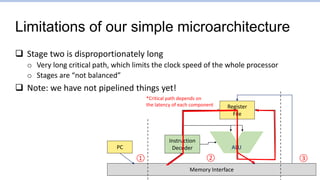
Limitations of our simple microarchitecture
 Stage two is disproportionately long
o Very long critical path, which limits the clock speed of the whole processor
o Stages are “not balanced”
 Note: we have not pipelined things yet!
PC
Memory Interface
Instruction
Decoder
Register
File
ALU
① ② ③
*Critical path depends on
the latency of each component
Limitations of our simple microarchitecture
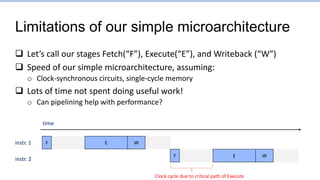
 Let’s call our stages Fetch(“F”), Execute(“E”), and Writeback (“W”)
 Speed of our simple microarchitecture, assuming:
o Clock-synchronous circuits, single-cycle memory
 Lots of time not spent doing useful work!
o Can pipelining help with performance?
time
instr. 1
instr. 2
F W
E
F W
E
Clock cycle due to critical path of Execute
F W
E
F W
E
Pipelined processor introduction
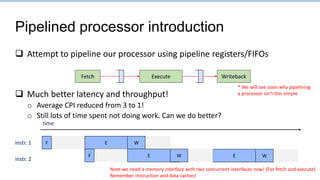
 Attempt to pipeline our processor using pipeline registers/FIFOs
 Much better latency and throughput!
o Average CPI reduced from 3 to 1!
o Still lots of time spent not doing work. Can we do better?
Fetch Writeback
Execute
time
instr. 1
instr. 2
F W
E
F W
E
* We will see soon why pipelining
a processor isn’t this simple
Note we need a memory interface with two concurrent interfaces now! (For fetch and execute)
Remember instruction and data caches!
Building a balanced pipeline
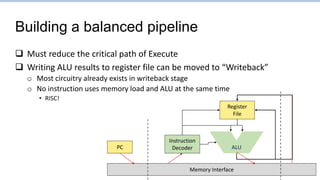
 Must reduce the critical path of Execute
 Writing ALU results to register file can be moved to “Writeback”
o Most circuitry already exists in writeback stage
o No instruction uses memory load and ALU at the same time
• RISC!
PC
Memory Interface
Instruction
Decoder
Register
File
ALU
Building a balanced pipeline
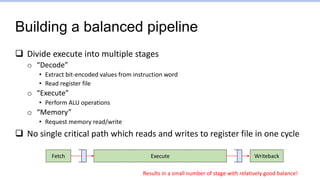
 Divide execute into multiple stages
o “Decode”
• Extract bit-encoded values from instruction word
• Read register file
o “Execute”
• Perform ALU operations
o “Memory”
• Request memory read/write
 No single critical path which reads and writes to register file in one cycle
Fetch Writeback
Decode Execute Memory
Results in a small number of stage with relatively good balance!
Execute
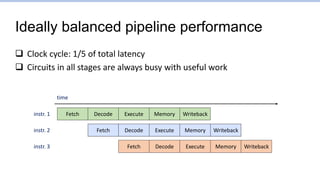
Ideally balanced pipeline performance
 Clock cycle: 1/5 of total latency
 Circuits in all stages are always busy with useful work
time
Fetch Writeback
Decode Execute Memory
Fetch Writeback
Decode Execute Memory
Fetch Writeback
Decode Execute Memory
instr. 1
instr. 2
instr. 3
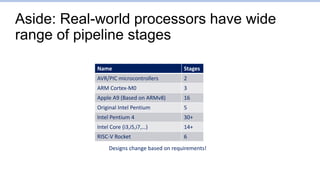
Aside: Real-world processors have wide
range of pipeline stages
Name Stages
AVR/PIC microcontrollers 2
ARM Cortex-M0 3
Apple A9 (Based on ARMv8) 16
Original Intel Pentium 5
Intel Pentium 4 30+
Intel Core (i3,i5,i7,…) 14+
RISC-V Rocket 6
Designs change based on requirements!
Achieving correct pipelining
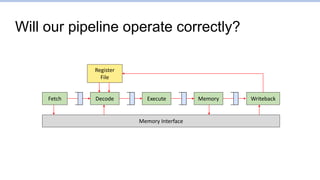
Will our pipeline operate correctly?
Fetch Writeback
Decode Execute Memory
Memory Interface
Register
File
A problematic example
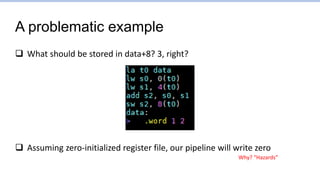
 What should be stored in data+8? 3, right?
 Assuming zero-initialized register file, our pipeline will write zero
Why? “Hazards”
Hazard #1:
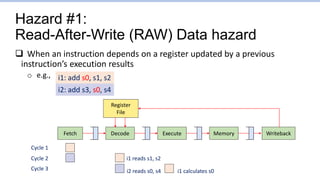
Read-After-Write (RAW) Data hazard
 When an instruction depends on a register updated by a previous
instruction’s execution results
o e.g.,
Fetch Writeback
Decode Execute Memory
i1: add s0, s1, s2
i2: add s3, s0, s4
Register
File
Cycle 1
Cycle 2
Cycle 3
i1 reads s1, s2
i2 reads s0, s4 i1 calculates s0
Hazard #1:
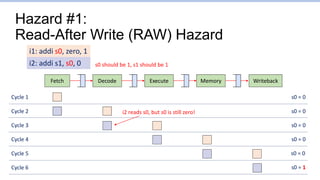
Read-After Write (RAW) Hazard
Fetch Writeback
Decode Execute Memory
i1: addi s0, zero, 1
i2: addi s1, s0, 0 s0 should be 1, s1 should be 1
Cycle 1 s0 = 0
Cycle 2 s0 = 0
Cycle 3 s0 = 0
Cycle 4 s0 = 0
Cycle 5 s0 = 0
Cycle 6 s0 = 1
i2 reads s0, but s0 is still zero!
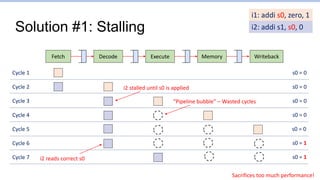
Solution #1: Stalling
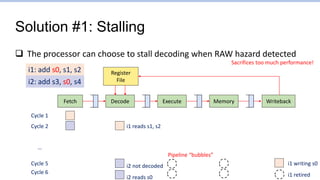
 The processor can choose to stall decoding when RAW hazard detected
Fetch Writeback
Decode Execute Memory
Register
File
Cycle 1
Cycle 2
Cycle 5
i1 reads s1, s2
i2 not decoded i1 writing s0
…
Cycle 6
i1: add s0, s1, s2
i2: add s3, s0, s4
i2 reads s0 i1 retired
Sacrifices too much performance!
Pipeline “bubbles”
Solution #1: Stalling
Fetch Writeback
Decode Execute Memory
i1: addi s0, zero, 1
i2: addi s1, s0, 0
Cycle 1 s0 = 0
Cycle 2 s0 = 0
Cycle 3 s0 = 0
Cycle 4 s0 = 0
Cycle 5 s0 = 0
Cycle 6 s0 = 1
i2 stalled until s0 is applied
Cycle 7 s0 = 1
“Pipeline bubble” – Wasted cycles
Sacrifices too much performance!
i2 reads correct s0
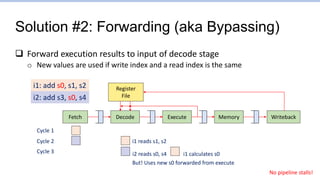
Solution #2: Forwarding (aka Bypassing)
 Forward execution results to input of decode stage
o New values are used if write index and a read index is the same
Fetch Writeback
Decode Execute Memory
Register
File
i1: add s0, s1, s2
i2: add s3, s0, s4
Cycle 1
Cycle 2
Cycle 3
i1 reads s1, s2
i2 reads s0, s4 i1 calculates s0
But! Uses new s0 forwarded from execute
No pipeline stalls!
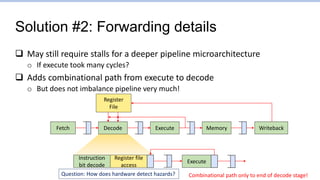
Solution #2: Forwarding details
 May still require stalls for a deeper pipeline microarchitecture
o If execute took many cycles?
 Adds combinational path from execute to decode
o But does not imbalance pipeline very much!
Fetch Writeback
Decode Execute Memory
Register
File
Instruction
bit decode
Register file
access
Execute
Combinational path only to end of decode stage!
Question: How does hardware detect hazards?
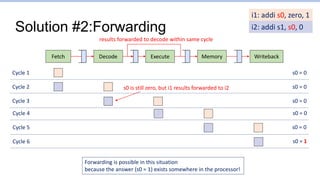
Solution #2:Forwarding
Fetch Writeback
Decode Execute Memory
i1: addi s0, zero, 1
i2: addi s1, s0, 0
Cycle 1 s0 = 0
Cycle 2 s0 = 0
Cycle 3 s0 = 0
s0 is still zero, but i1 results forwarded to i2
results forwarded to decode within same cycle
Cycle 4 s0 = 0
Cycle 5 s0 = 0
Cycle 6 s0 = 1
Forwarding is possible in this situation
because the answer (s0 = 1) exists somewhere in the processor!
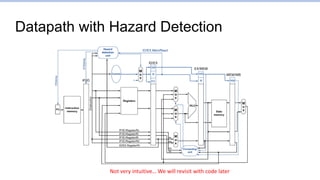
Datapath with Hazard Detection
Not very intuitive… We will revisit with code later
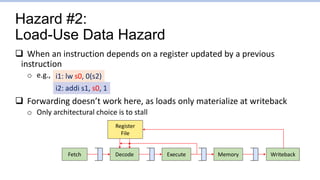
Hazard #2:
Load-Use Data Hazard
 When an instruction depends on a register updated by a previous
instruction
o e.g.,
 Forwarding doesn’t work here, as loads only materialize at writeback
o Only architectural choice is to stall
i1: lw s0, 0(s2)
i2: addi s1, s0, 1
Fetch Writeback
Decode Execute Memory
Register
File
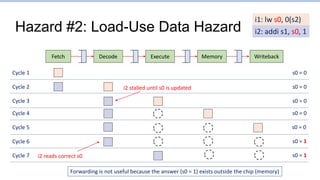
Hazard #2: Load-Use Data Hazard
Fetch Writeback
Decode Execute Memory
Cycle 1 s0 = 0
Cycle 2 s0 = 0
Cycle 3 s0 = 0
i2 stalled until s0 is updated
Forwarding is not useful because the answer (s0 = 1) exists outside the chip (memory)
i1: lw s0, 0(s2)
i2: addi s1, s0, 1
Cycle 4 s0 = 0
Cycle 5 s0 = 0
Cycle 6 s0 = 1
Cycle 7 s0 = 1
i2 reads correct s0
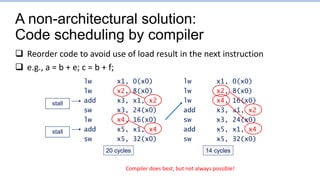
A non-architectural solution:
Code scheduling by compiler
 Reorder code to avoid use of load result in the next instruction
 e.g., a = b + e; c = b + f;
lw x1, 0(x0)
lw x2, 8(x0)
add x3, x1, x2
sw x3, 24(x0)
lw x4, 16(x0)
add x5, x1, x4
sw x5, 32(x0)
stall
stall
lw x1, 0(x0)
lw x2, 8(x0)
lw x4, 16(x0)
add x3, x1, x2
sw x3, 24(x0)
add x5, x1, x4
sw x5, 32(x0)
14 cycles
20 cycles
Compiler does best, but not always possible!
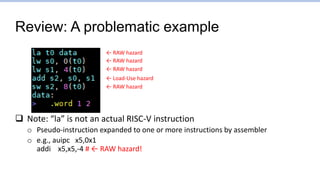
 Note: “la” is not an actual RISC-V instruction
o Pseudo-instruction expanded to one or more instructions by assembler
o e.g., auipc x5,0x1
addi x5,x5,-4 # ← RAW hazard!
Review: A problematic example
← RAW hazard
← RAW hazard
← Load-Use hazard
← RAW hazard
← RAW hazard
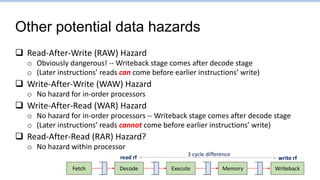
Other potential data hazards
 Read-After-Write (RAW) Hazard
o Obviously dangerous! -- Writeback stage comes after decode stage
o (Later instructions’ reads can come before earlier instructions’ write)
 Write-After-Write (WAW) Hazard
o No hazard for in-order processors
 Write-After-Read (WAR) Hazard
o No hazard for in-order processors -- Writeback stage comes after decode stage
o (Later instructions’ reads cannot come before earlier instructions’ write)
 Read-After-Read (RAR) Hazard?
o No hazard within processor
Fetch Writeback
Decode Execute Memory
read rf write rf
3 cycle difference
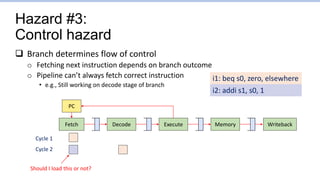
Hazard #3:
Control hazard
 Branch determines flow of control
o Fetching next instruction depends on branch outcome
o Pipeline can’t always fetch correct instruction
• e.g., Still working on decode stage of branch
Fetch Writeback
Decode Execute Memory
PC
i1: beq s0, zero, elsewhere
i2: addi s1, s0, 1
Cycle 1
Cycle 2
Should I load this or not?
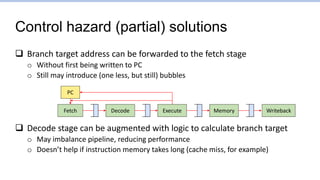
Control hazard (partial) solutions
 Branch target address can be forwarded to the fetch stage
o Without first being written to PC
o Still may introduce (one less, but still) bubbles
 Decode stage can be augmented with logic to calculate branch target
o May imbalance pipeline, reducing performance
o Doesn’t help if instruction memory takes long (cache miss, for example)
Fetch Writeback
Decode Execute Memory
PC
Aside: An awkward solution:
Branch delay slot
 In a 5-stage pipeline with forwarding, one branch hazard bubble is
injected in best scenario
 Original MIPS and SPARC processors included “branch delay slots”
o One instruction after branch instruction was executed regardless of branch results
o Compiler will do its best to find something to put there (if not, “nop”)
 Goal: Always fill pipeline with useful work
 Reality:
o Difficult to always fill slot
o Deeper pipelines meant one measly slot didn’t add much (Modern MIPS has 5+
cycles branch penalty!)
But once it’s added, it’s forever in the ISA…
One of the biggest criticisms of MIPS
Eight great ideas
 Design for Moore’s Law
 Use abstraction to simplify design
 Make the common case fast
 Performance via parallelism
 Performance via pipelining
 Performance via prediction
 Hierarchy of memories
 Dependability via redundancy
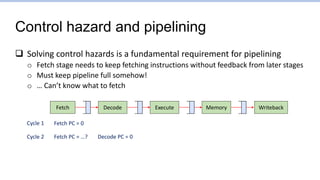
Control hazard and pipelining
 Solving control hazards is a fundamental requirement for pipelining
o Fetch stage needs to keep fetching instructions without feedback from later stages
o Must keep pipeline full somehow!
o … Can’t know what to fetch
Fetch Writeback
Decode Execute Memory
Cycle 1
Cycle 2
Fetch PC = 0
Fetch PC = …? Decode PC = 0
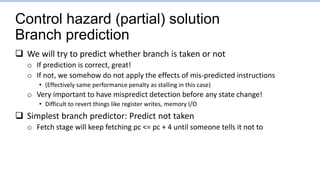
Control hazard (partial) solution
Branch prediction
 We will try to predict whether branch is taken or not
o If prediction is correct, great!
o If not, we somehow do not apply the effects of mis-predicted instructions
• (Effectively same performance penalty as stalling in this case)
o Very important to have mispredict detection before any state change!
• Difficult to revert things like register writes, memory I/O
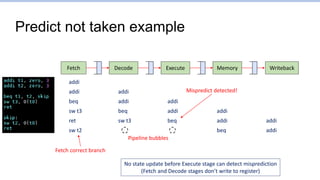
 Simplest branch predictor: Predict not taken
o Fetch stage will keep fetching pc <= pc + 4 until someone tells it not to
Predict not taken example
Fetch Writeback
Decode Execute Memory
addi
addi addi
addi addi
beq
addi addi
beq
sw t3
addi addi
beq
sw t3
ret
Pipeline bubbles
addi
beq
sw t2
Mispredict detected!
Fetch correct branch
No state update before Execute stage can detect misprediction
(Fetch and Decode stages don’t write to register)
How to handle mis-predictions?
 Implementations vary, each with pros and cons
o Sometimes, execute sends a combinational signal to all previous stages,
turning all instructions into a “nop”
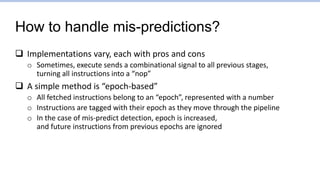
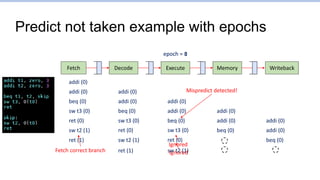
 A simple method is “epoch-based”
o All fetched instructions belong to an “epoch”, represented with a number
o Instructions are tagged with their epoch as they move through the pipeline
o In the case of mis-predict detection, epoch is increased,
and future instructions from previous epochs are ignored
Predict not taken example with epochs
Fetch Writeback
Decode Execute Memory
addi (0)
addi (0) addi (0)
addi (0) addi (0)
beq (0)
addi (0) addi (0)
beq (0)
sw t3 (0)
addi (0) addi (0)
beq (0)
sw t3 (0)
ret (0)
Mispredict detected!
Fetch correct branch
addi (0)
beq (0)
sw t2 (1) sw t3 (0)
ret (0)
epoch = 0
epoch = 1
Ignored
ret (1) beq (0)
sw t2 (1) ret (0)
Ignored
ret (1) sw t2 (1)
Some classes of branch predictors
 Static branch prediction
o Based on typical branch behavior
o Example: loop and if-statement branches
• Predict backward branches taken
• Predict forward branches not taken
 Dynamic branch prediction
o Hardware measures actual branch behavior
• e.g., record recent history (1-bit “taken” or “not taken”) of each branch
in a fixed size “branch history table”
o Assume future behavior will continue the trend
• When wrong, stall while re-fetching, and update history
Many many different methods, Lots of research, some even using neural networks!
Branch prediction and performance
 Effectiveness of branch predictors is crucial for performance
o Spoilers: On SPEC benchmarks, modern predictors routinely have 98+% accuracy
o Of course, less-optimized code may have much worse behavior
 Branch-heavy software performance depends on good match between
software pattern and branch prediction
o Some high-performance software optimized for branch predictors in target
hardware
o Or, avoid branches altogether! (Branchless code)
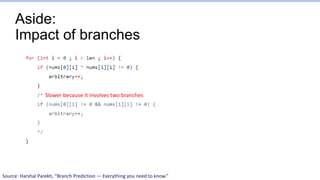
Aside:
Impact of branches
“[This code] takes ~12 seconds to run. But
on commenting line 15, not touching the
rest, the same code takes ~33 seconds to
run.”
“(running time may wary on different
machines, but the proportion will stay the
same).”
Source: Harshal Parekh, “Branch Prediction — Everything you need to know.”
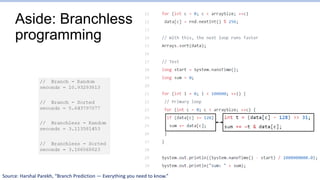
Aside:
Impact of branches
Source: Harshal Parekh, “Branch Prediction — Everything you need to know.”
Slower because it involves two branches
Aside: Branchless
programming
Source: Harshal Parekh, “Branch Prediction — Everything you need to know.”
Into details of pipelining!
Try for yourself!
 Up-to-date code in openlab
o /home/swjun/cs152/processor
o Copy to your own directory!
 Vim syntax files for Bluespec
o /home/swjun/cs152/vim-bsv
 Environment variables for Bluespec, etc
o /home/swjun/cs152/setup.sh
o Either run “source /home/swjun/cs152/setup.sh” or add to .bashrc
o Before you can run any bluespec binaries!
Try for yourself!
 Compiling and running the simulation
o “make”
o “./obj/bsim” – Stands for “bluesim”
o New login may require recompiling
• “make clean; make”
• Library differences between openlab instances
 Example execution:
$ ./obj/bsim
Answer for addr 1024 is 3
[0x00000000:0x0000] Fetching instruction count 0x0000
[0x00000001:0x0004] Fetching instruction count 0x0001
[0x00000001:0x0000] Decoding 0x40000293
[0x00000002:0x0008] Fetching instruction count 0x0002
[0x00000002:0x0004] Decoding 0x00300313
rf writing 00000400 to 5
[0x00000002:0x0000] Executing
[0x00000003:0x000c] Fetching instruction count 0x0003
[0x00000003:0x0008] Decoding 0x00300393
rf writing 00000003 to 6
[0x00000003:0x0004] Executing
[0x00000003:0x0000] Writeback writing 00000400 to 5
[0x00000004:0x0010] Fetching instruction count 0x0004
…
Cycle PC
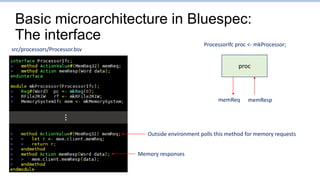
Basic microarchitecture in Bluespec:
The interface
…
Outside environment polls this method for memory requests
Memory responses
proc
ProcessorIfc proc <- mkProcessor;
memReq memResp
src/processors/Processor.bsv
Basic microarchitecture in Bluespec:
The stages
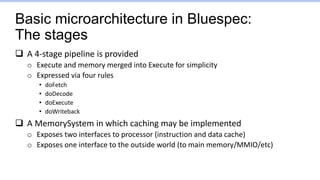
 A 4-stage pipeline is provided
o Execute and memory merged into Execute for simplicity
o Expressed via four rules
• doFetch
• doDecode
• doExecute
• doWriteback
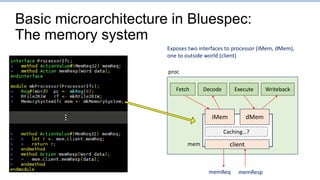
 A MemorySystem in which caching may be implemented
o Exposes two interfaces to processor (instruction and data cache)
o Exposes one interface to the outside world (to main memory/MMIO/etc)
Basic microarchitecture in Bluespec:
The memory system
…
memReq memResp
proc
client
iMem dMem
Caching…?
mem
Fetch Writeback
Decode Execute
Exposes two interfaces to processor (iMem, dMem),
one to outside world (client)
Basic microarchitecture in Bluespec:
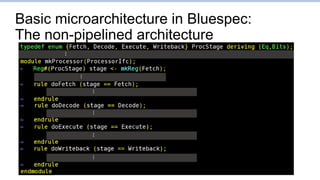
The non-pipelined architecture
 Let’s look at code!
o The finite-state-machine implementation
o src/processor/ProcessorFSM.bsv
 Notice: Only one stage executes at any cycle
o No instructions overlap
o Each instruction takes 3 cycles (4 if memory read) to finish
Basic microarchitecture in Bluespec:
The non-pipelined architecture
…
…
…
…
…
…
Basic microarchitecture in Bluespec:
The stages
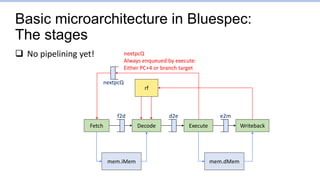
 No pipelining yet!
Fetch Writeback
Decode Execute
rf
mem.iMem mem.dMem
f2d d2e e2m
nextpcQ
nextpcQ
Always enqueued by execute:
Either PC+4 or branch target
Basic microarchitecture in Bluespec:
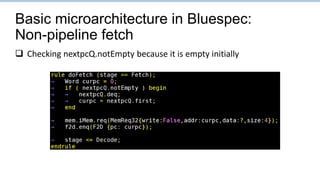
Non-pipeline fetch
 Checking nextpcQ.notEmpty because it is empty initially
Basic microarchitecture in Bluespec:
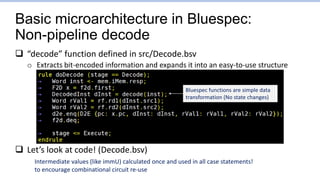
Non-pipeline decode
 “decode” function defined in src/Decode.bsv
o Extracts bit-encoded information and expands it into an easy-to-use structure
 Let’s look at code! (Decode.bsv)
Intermediate values (like immU) calculated once and used in all case statements!
to encourage combinational circuit re-use
Bluespec functions are simple data
transformation (No state changes)
Basic microarchitecture in Bluespec:
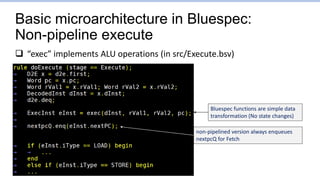
Non-pipeline execute
 “exec” implements ALU operations (in src/Execute.bsv)
Bluespec functions are simple data
transformation (No state changes)
non-pipelined version always enqueues
nextpcQ for Fetch
Basic microarchitecture in Bluespec:
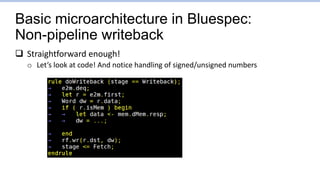
Non-pipeline writeback
 Straightforward enough!
o Let’s look at code! And notice handling of signed/unsigned numbers
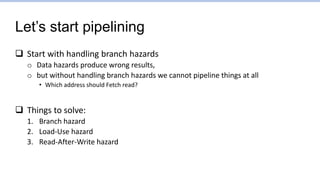
Let’s start pipelining
 Start with handling branch hazards
o Data hazards produce wrong results,
o but without handling branch hazards we cannot pipeline things at all
• Which address should Fetch read?
 Things to solve:
1. Branch hazard
2. Load-Use hazard
3. Read-After-Write hazard
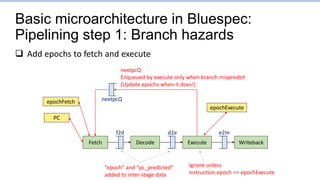
Basic microarchitecture in Bluespec:
Pipelining step 1: Branch hazards
 Add epochs to fetch and execute
Fetch Writeback
Decode Execute
PC
epochFetch
epochExecute
f2d d2e e2m
nextpcQ
nextpcQ
Enqueued by execute only when branch mispredict
(Update epochs when it does!)
“epoch” and “pc_predicted”
added to inter-stage data
Ignore unless
instruction.epoch == epochExecute
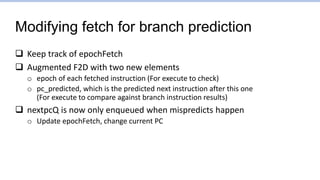
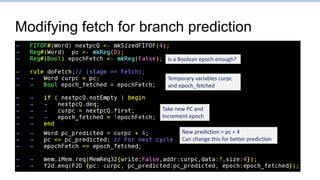
Modifying fetch for branch prediction
 Keep track of epochFetch
 Augmented F2D with two new elements
o epoch of each fetched instruction (For execute to check)
o pc_predicted, which is the predicted next instruction after this one
(For execute to compare against branch instruction results)
 nextpcQ is now only enqueued when mispredicts happen
o Update epochFetch, change current PC
Modifying fetch for branch prediction
Is a Boolean epoch enough?
Take new PC and
Increment epoch
New prediction = pc + 4
Can change this for better prediction
Temporary variables curpc
and epoch_fetched
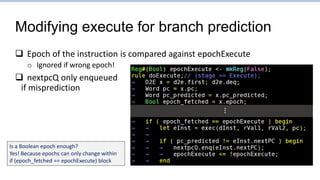
Modifying execute for branch prediction
 Epoch of the instruction is compared against epochExecute
o Ignored if wrong epoch!
 nextpcQ only enqueued
if misprediction
Is a Boolean epoch enough?
Yes! Because epochs can only change within
if (epoch_fetched == epochExecute) block
…
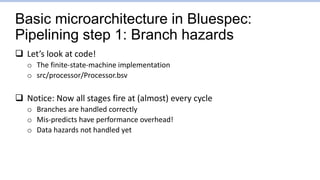
Basic microarchitecture in Bluespec:
Pipelining step 1: Branch hazards
 Let’s look at code!
o The finite-state-machine implementation
o src/processor/Processor.bsv
 Notice: Now all stages fire at (almost) every cycle
o Branches are handled correctly
o Mis-predicts have performance overhead!
o Data hazards not handled yet
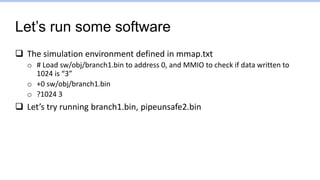
Let’s run some software
 The simulation environment defined in mmap.txt
o # Load sw/obj/branch1.bin to address 0, and MMIO to check if data written to
1024 is “3”
o +0 sw/obj/branch1.bin
o ?1024 3
 Let’s try running branch1.bin, pipeunsafe2.bin
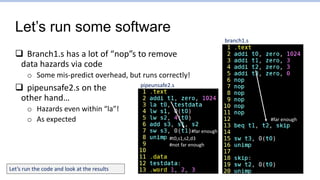
Let’s run some software
 Branch1.s has a lot of “nop”s to remove
data hazards via code
o Some mis-predict overhead, but runs correctly!
 pipeunsafe2.s on the
other hand…
o Hazards even within “la”!
o As expected
pipeunsafe2.s
branch1.s
#far enough
#t0,s1,s2,d3
#not far enough
#far enough
Let’s run the code and look at the results
Branch1.s: Points to focus on
…
[0x0000000a:0x0028] Fetching instruction count 0x000a
[0x0000000b:0x002c] Fetching instruction count 0x000b
[0x0000000b:0x0028] Decoding 0x00730663
[0x0000000c:0x0030] Fetching instruction count 0x000c
[0x0000000c:0x002c] Decoding 0x01c2a023
[0x0000000c:0x0028] detected misprediction, jumping to 0x00000034
[0x0000000c:0x0028] Executing
[0x0000000d:0x0034] Fetching instruction count 0x000d
[0x0000000d:0x0030] Decoding 0xc0001073
[0x0000000d:0x002c] ignoring mispredicted instruction
[0x0000000e:0x0034] Decoding 0x0072a023
[0x0000000e:0x0030] ignoring mispredicted instruction
[0x0000000f:0x0034] Mem write 0x00000003 to 0x00000400
[0x0000000f:0x0034] Executing
28: 00730663 beq x6,x7,34 <skip>
2c: 01c2a023 sw x28,0(x5)
30: c0001073 unimp
<skip>:
34: 0072a023 sw x7,0(x5)
mispredict discovered at cycle 0xc, execute stage of pc=0x28
mispredicted sw and unimp ignored at execute stage
(cycle=0xd and 0xe)
Cycle PC
Pipeunsafe2.s: Points to focus on
[0x00000001:0x0004] Fetching instruction count 0x0001
[0x00000002:0x0008] Fetching instruction count 0x0002
[0x00000002:0x0004] Decoding 0x00001297
[0x00000003:0x0008] Decoding 0xffc28293
[0x00000003:0x0004] rf writing 00001004 to 5
[0x00000003:0x0004] Executing
[0x00000004:0x0008] rf writing fffffffc to 5
[0x00000004:0x0008] Executing
[0x00000004:0x0004] Writeback writing 00001004 to 5
[0x00000005:0x0008] Writeback writing fffffffc to 5
4: 00001297 auipc x5,0x1
8: ffc28293 addi x5,x5,-4 # 1000 <testdata>
Assembler’s attempt to load 0x1000 to x5
Add pc+(1<<12) to x5, and subtract 4
addi reads 0 from x5 (RAW hazard)
And writes back -4 to x5
Things to solve
1. Branch hazard – Done!
2. Load-Use hazard – Stalling
3. Read-After-Write hazard – Stalling, Forwarding
Solving data hazards!
 Step 1: Stalling
o How to detect data hazards?
o The decode stage must know whether a previous instruction incurs data hazard
• Previous instruction in flight will write to a register I need to read from?
o Restriction: Detection must happen combinationally, within the decode cycle
• Otherwise, we will slow down the pipeline
 Step 2: Forwarding
o To be continued
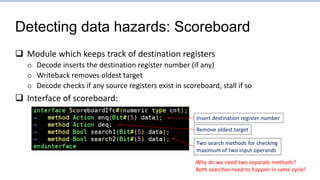
Detecting data hazards: Scoreboard
 Module which keeps track of destination registers
o Decode inserts the destination register number (if any)
o Writeback removes oldest target
o Decode checks if any source registers exist in scoreboard, stall if so
 Interface of scoreboard:
Insert destination register number
Remove oldest target
Two search methods for checking
maximum of two input operands
Why do we need two separate methods?
Both searches need to happen in same cycle!
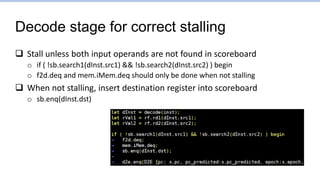
Decode stage for correct stalling
 Stall unless both input operands are not found in scoreboard
o if ( !sb.search1(dInst.src1) && !sb.search2(dInst.src2) ) begin
o f2d.deq and mem.iMem.deq should only be done when not stalling
 When not stalling, insert destination register into scoreboard
o sb.enq(dInst.dst)
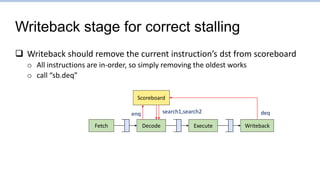
Writeback stage for correct stalling
 Writeback should remove the current instruction’s dst from scoreboard
o All instructions are in-order, so simply removing the oldest works
o call “sb.deq”
Fetch Writeback
Decode Execute
Scoreboard
deq
search1,search2
enq
Let’s run some benchmarks
[0x00000001:0x0004] Fetching instruction count 0x0001
[0x00000002:0x0008] Fetching instruction count 0x0002
[0x00000002:0x0004] Decoding 0x00001297
[0x00000003:0x0008] Decoding 0xffc28293
[0x00000003:0x0004] rf writing 00001004 to 5
[0x00000003:0x0004] Executing
[0x00000004:0x0008] rf writing fffffffc to 5
[0x00000004:0x0008] Executing
[0x00000004:0x0004] Writeback writing 00001004 to 5
[0x00000005:0x0008] Writeback writing fffffffc to 5
[0x00000001:0x0004] Fetching instruction count 0x0001
[0x00000002:0x0008] Fetching instruction count 0x0002
[0x00000002:0x0004] Decoding 0x00001297
[0x00000003:0x0008] Decode stalled -- 5 0
[0x00000003:0x0004] rf writing 00001004 to 5
[0x00000003:0x0004] Executing
[0x00000004:0x0008] Decode stalled -- 5 0
[0x00000004:0x0004] Writeback writing 00001004 to 5
[0x00000005:0x0008] Decoding 0xffc28293
[0x00000006:0x0008] rf writing 00001000 to 5
[0x00000006:0x0008] Executing
[0x00000007:0x0008] Writeback writing 00001000 to 5
4: 00001297 auipc x5,0x1
8: ffc28293 addi x5,x5,-4 # 1000 <testdata>
Assembler’s attempt to load 0x1000 to x5
Add pc+(1<<12) to x5, and subtract 4
Without stalling With stalling
Things to solve
1. Branch hazard – Done!
2. Load-Use hazard – Stalling
3. Read-After-Write hazard – Stalling, Forwarding
• Pipeline is correct already, but now to improve performance!
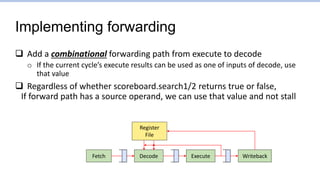
Implementing forwarding
 Add a combinational forwarding path from execute to decode
o If the current cycle’s execute results can be used as one of inputs of decode, use
that value
 Regardless of whether scoreboard.search1/2 returns true or false,
If forward path has a source operand, we can use that value and not stall
Fetch Writeback
Decode Execute
Register
File
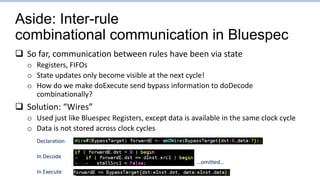
Aside: Inter-rule
combinational communication in Bluespec
 So far, communication between rules have been via state
o Registers, FIFOs
o State updates only become visible at the next cycle!
o How do we make doExecute send bypass information to doDecode
combinationally?
 Solution: “Wires”
o Used just like Bluespec Registers, except data is available in the same clock cycle
o Data is not stored across clock cycles
Declaration
In Decode
In Execute
…omitted…
Let’s run some benchmarks
0: 40000313 addi x6,x0,1024
4: 00001297 auipc x5,0x1
8: ffc28293 addi x5,x5,-4 # 1000 <testdata>
c: 0002a483 lw x9,0(x5)
10: 0042a903 lw x18,4(x5)
14: 012489b3 add x19,x9,x18
18: 01332023 sw x19,0(x6)
1c: c0001073 unimp
** SYSTEM: Memory write request at cycle 11
** Results CORRECT! Writing 3 to address 400
[0x0000000b:0x0018] Mem write 0x00000003 to 0x00000400
** SYSTEM: Memory write request at cycle 16
** Results CORRECT! Writing 3 to address 400
[0x00000010:0x0018] Mem write 0x00000003 to 0x00000400
With stalling
With forwarding Why 11? Why not 8?
(Instruction no. 7
2 pipeline stages to execute)
pipeunsafe2.s
Some more details of
current forwarding implementation
Fetch Writeback
Decode Execute
Register
File
…
[0x00000005:0x0010] Decode stalled -- 5 0
[0x00000005:0x0008] Writeback writing 00001000 to 5
[0x00000006:0x0010] Decoding 0x0042a903
[0x00000006:0x000c] Writeback writing 00000001 to 9
[0x00000007:0x0018] Fetching instruction count 0x0006
[0x00000007:0x0010] Mem read from 0x00001004
[0x00000007:0x0010] Executing
[0x00000007:0x0014] Decode stalled -- 9 18
[0x00000008:0x0014] Decode stalled -- 9 18
…
0: 40000313 addi x6,x0,1024
4: 00001297 auipc x5,0x1
8: ffc28293 addi x5,x5,-4
c: 0002a483 lw x9,0(x5)
10: 0042a903 lw x18,4(x5)
14: 012489b3 add x19,x9,x18
18: 01332023 sw x19,0(x6)
1c: c0001073 unimp
pipeunsafe2.s
Load-use hazard must stall
Why did this stall?
The three stalls increased cycle count from
ideal 8 to 11. Why did instruction 0x10 stall?
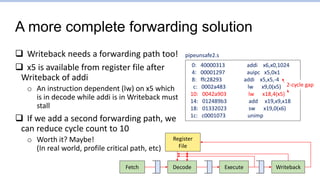
A more complete forwarding solution
 Writeback needs a forwarding path too!
 x5 is available from register file after
Writeback of addi
o An instruction dependent (lw) on x5 which
is in decode while addi is in Writeback must
stall
 If we add a second forwarding path, we
can reduce cycle count to 10
o Worth it? Maybe!
(In real world, profile critical path, etc)
Fetch Writeback
Decode Execute
Register
File
0: 40000313 addi x6,x0,1024
4: 00001297 auipc x5,0x1
8: ffc28293 addi x5,x5,-4
c: 0002a483 lw x9,0(x5)
10: 0042a903 lw x18,4(x5)
14: 012489b3 add x19,x9,x18
18: 01332023 sw x19,0(x6)
1c: c0001073 unimp
pipeunsafe2.s
2-cycle gap
Some more topics
 Branch predictors
 Microprogramming
 Superscalar
 SMT
 OoO…?

lec5 - The processor.pptx

  • 1.
    CS152: Computer SystemsArchitecture Processor Microarchitecture Sang-Woo Jun Winter 2019 Large amount of material adapted from MIT 6.004, “Computation Structures”, Morgan Kaufmann “Computer Organization and Design: The Hardware/Software Interface: RISC-V Edition”, and CS 152 Slides by Isaac Scherson
  • 2.
    Course outline  Part1: The Hardware-Software Interface o What makes a ‘good’ processor? o Assembly programming and conventions  Part 2: Recap of digital design o Combinational and sequential circuits o How their restrictions influence processor design  Part 3: Computer Architecture o Simple and pipelined processors o Computer Arithmetic o Caches and the memory hierarchy  Part 4: Computer Systems o Operating systems, Virtual memory
  • 3.
    How to builda computing machine?  Pretend the computers we know and love have never existed  We want to build an automatic computing machine to solve mathematical problems  Starting from (almost) scratch, where you have transistors and integrated circuits but no existing microarchitecture o No PC, no register files, no ALU  How would you do it? Would it look similar to what we have now?
  • 4.
    Aside: Dataflow architecture Instead of a PC traversing over instructions to execute, all instructions are independent, and are each executed whenever operands are ready o Programs are represented as graphs (with dependency information) A “static” dataflow architecture Did not achieve market success, (why?) but the ideas are now everywhere e.g., Out-of-Order microarchitecture
  • 5.
    The von NeumannModel  Almost all modern computers are based on the von Neumann model o John von Neumann, 1945  Components o Main memory, where both data and programs are held o Processing unit, which has a program counter and ALU o Storage and I/O to communicate with the outside world Central Processing Unit Main Memory Storage and I/O Key idea!
  • 6.
    Key Idea: Stored-ProgramComputer  Very early computers were programmed by manually adjusting switches and knobs of the individual programming elements o (e.g., ENIAC, 1945)  von Neumann Machines instead had a general-purpose CPU, which loaded its instructions also from memory o Express a program as a sequence of coded instructions, which the CPU fetches, interprets, and executes o “Treating programs as data” ENIAC, Source: US Army photo Similar in concept to a universal Turing machine (1936)
  • 7.
    von Neumann andTuring machine  Turing machine is a mathematical model of computing machines o Proven to be able to compute any mechanically computable functions o Anything an algorithm can compute, it can compute  Components include o An infinite tape (like memory) and a header which can read/write a location o A state transition diagram (like program) and a current location (like pc) • State transition done according to current value in tape  Only natural that computer designs gravitate towards provably universal models Source: Manolis Kamvysselis
  • 8.
    Stored program computer,now what?  Once we decide on the stored program computer paradigm o With program counter (PC) pointing to encoded programs in memory  Then it becomes an issue of deciding the programming abstraction o Instruction set architecture, which we talked about  Then, it becomes an issue of executing it quickly and efficiently o Microarchitecture! – Improving performance/efficiency/etc while maintaining ISA abstraction o Which is the core of this class, starting now
  • 9.
    A high-level viewof computer architecture CPU Instruction cache Data cache Shared cache DRAM Low latency (~1 cycle) High latency (100s~1000s of cycles) Will deal with caches in detail later!
  • 10.
    Remember: Super simplified processoroperation inst = mem[PC] next_PC = PC + 4 if ( inst.type == STORE ) mem[rf[inst.arg1]] = rf[inst.arg2] if ( inst.type == LOAD ) rf[inst.arg1] = mem[rf[inst.arg2]] if ( inst.type == ALU ) rf[inst.arg1] = alu(inst.op, rf[inst.arg2], rf[inst.arg3]) if ( inst.type == COND ) next_PC = rf[inst.arg1] PC = next_PC
  • 11.
    The classic RISCpipeline Fetch Decode Execute Memory Write Back  Many early RISC processors had very similar structure o MIPS, SPARC, etc… o Major criticism of MIPS is that it is too optimized for this 5-stage pipeline  RISC-V is also typically taught using this structure as well Why these 5 stages? Why not 4 or 6?
  • 12.
    The classic RISCpipeline  Fetch: Request instruction fetch from memory  Decode: Instruction decode & register read  Execute: Execute operation or calculate address  Memory: Request memory read or write  Writeback: Write result (either from execute or memory) back to register
  • 13.
    Designing a microprocessor Many, many constraints processors are optimize for, but for now:  Constraint 1: Circuit timing o Processors are complex! How do we organize the pipeline to process instructions as fast as possible?  Constraint 2: Memory access latency o Register files can be accessed as a combinational circuit, but it is small o All other memory have high latency, and must be accessed in separate request/response • Memory can have high throughput, but also high latency Memory will be covered in detail later!
  • 14.
    The most basicmicroarchitecture PC Memory Interface Instruction Decoder Register File ALU  Because memory is not combinational, our RISC ISA requires at least three disjoint stages to handle o Instruction fetch o Instruction receive, decode, execute (ALU), register file access, memory request o If mem read, write read to register file  Three stages can be implemented as a Finite State Machine (FSM) ① ② ③ Will this processor be fast? Why or why not?
  • 15.
    Limitations of oursimple microarchitecture  Stage two is disproportionately long o Very long critical path, which limits the clock speed of the whole processor o Stages are “not balanced”  Note: we have not pipelined things yet! PC Memory Interface Instruction Decoder Register File ALU ① ② ③ *Critical path depends on the latency of each component
  • 16.
    Limitations of oursimple microarchitecture  Let’s call our stages Fetch(“F”), Execute(“E”), and Writeback (“W”)  Speed of our simple microarchitecture, assuming: o Clock-synchronous circuits, single-cycle memory  Lots of time not spent doing useful work! o Can pipelining help with performance? time instr. 1 instr. 2 F W E F W E Clock cycle due to critical path of Execute
  • 17.
    F W E F W E Pipelinedprocessor introduction  Attempt to pipeline our processor using pipeline registers/FIFOs  Much better latency and throughput! o Average CPI reduced from 3 to 1! o Still lots of time spent not doing work. Can we do better? Fetch Writeback Execute time instr. 1 instr. 2 F W E F W E * We will see soon why pipelining a processor isn’t this simple Note we need a memory interface with two concurrent interfaces now! (For fetch and execute) Remember instruction and data caches!
  • 18.
    Building a balancedpipeline  Must reduce the critical path of Execute  Writing ALU results to register file can be moved to “Writeback” o Most circuitry already exists in writeback stage o No instruction uses memory load and ALU at the same time • RISC! PC Memory Interface Instruction Decoder Register File ALU
  • 19.
    Building a balancedpipeline  Divide execute into multiple stages o “Decode” • Extract bit-encoded values from instruction word • Read register file o “Execute” • Perform ALU operations o “Memory” • Request memory read/write  No single critical path which reads and writes to register file in one cycle Fetch Writeback Decode Execute Memory Results in a small number of stage with relatively good balance! Execute
  • 20.
    Ideally balanced pipelineperformance  Clock cycle: 1/5 of total latency  Circuits in all stages are always busy with useful work time Fetch Writeback Decode Execute Memory Fetch Writeback Decode Execute Memory Fetch Writeback Decode Execute Memory instr. 1 instr. 2 instr. 3
  • 21.
    Aside: Real-world processorshave wide range of pipeline stages Name Stages AVR/PIC microcontrollers 2 ARM Cortex-M0 3 Apple A9 (Based on ARMv8) 16 Original Intel Pentium 5 Intel Pentium 4 30+ Intel Core (i3,i5,i7,…) 14+ RISC-V Rocket 6 Designs change based on requirements!
  • 22.
  • 23.
    Will our pipelineoperate correctly? Fetch Writeback Decode Execute Memory Memory Interface Register File
  • 24.
    A problematic example What should be stored in data+8? 3, right?  Assuming zero-initialized register file, our pipeline will write zero Why? “Hazards”
  • 25.
    Hazard #1: Read-After-Write (RAW)Data hazard  When an instruction depends on a register updated by a previous instruction’s execution results o e.g., Fetch Writeback Decode Execute Memory i1: add s0, s1, s2 i2: add s3, s0, s4 Register File Cycle 1 Cycle 2 Cycle 3 i1 reads s1, s2 i2 reads s0, s4 i1 calculates s0
  • 26.
    Hazard #1: Read-After Write(RAW) Hazard Fetch Writeback Decode Execute Memory i1: addi s0, zero, 1 i2: addi s1, s0, 0 s0 should be 1, s1 should be 1 Cycle 1 s0 = 0 Cycle 2 s0 = 0 Cycle 3 s0 = 0 Cycle 4 s0 = 0 Cycle 5 s0 = 0 Cycle 6 s0 = 1 i2 reads s0, but s0 is still zero!
  • 27.
    Solution #1: Stalling The processor can choose to stall decoding when RAW hazard detected Fetch Writeback Decode Execute Memory Register File Cycle 1 Cycle 2 Cycle 5 i1 reads s1, s2 i2 not decoded i1 writing s0 … Cycle 6 i1: add s0, s1, s2 i2: add s3, s0, s4 i2 reads s0 i1 retired Sacrifices too much performance! Pipeline “bubbles”
  • 28.
    Solution #1: Stalling FetchWriteback Decode Execute Memory i1: addi s0, zero, 1 i2: addi s1, s0, 0 Cycle 1 s0 = 0 Cycle 2 s0 = 0 Cycle 3 s0 = 0 Cycle 4 s0 = 0 Cycle 5 s0 = 0 Cycle 6 s0 = 1 i2 stalled until s0 is applied Cycle 7 s0 = 1 “Pipeline bubble” – Wasted cycles Sacrifices too much performance! i2 reads correct s0
  • 29.
    Solution #2: Forwarding(aka Bypassing)  Forward execution results to input of decode stage o New values are used if write index and a read index is the same Fetch Writeback Decode Execute Memory Register File i1: add s0, s1, s2 i2: add s3, s0, s4 Cycle 1 Cycle 2 Cycle 3 i1 reads s1, s2 i2 reads s0, s4 i1 calculates s0 But! Uses new s0 forwarded from execute No pipeline stalls!
  • 30.
    Solution #2: Forwardingdetails  May still require stalls for a deeper pipeline microarchitecture o If execute took many cycles?  Adds combinational path from execute to decode o But does not imbalance pipeline very much! Fetch Writeback Decode Execute Memory Register File Instruction bit decode Register file access Execute Combinational path only to end of decode stage! Question: How does hardware detect hazards?
  • 31.
    Solution #2:Forwarding Fetch Writeback DecodeExecute Memory i1: addi s0, zero, 1 i2: addi s1, s0, 0 Cycle 1 s0 = 0 Cycle 2 s0 = 0 Cycle 3 s0 = 0 s0 is still zero, but i1 results forwarded to i2 results forwarded to decode within same cycle Cycle 4 s0 = 0 Cycle 5 s0 = 0 Cycle 6 s0 = 1 Forwarding is possible in this situation because the answer (s0 = 1) exists somewhere in the processor!
  • 32.
    Datapath with HazardDetection Not very intuitive… We will revisit with code later
  • 33.
    Hazard #2: Load-Use DataHazard  When an instruction depends on a register updated by a previous instruction o e.g.,  Forwarding doesn’t work here, as loads only materialize at writeback o Only architectural choice is to stall i1: lw s0, 0(s2) i2: addi s1, s0, 1 Fetch Writeback Decode Execute Memory Register File
  • 34.
    Hazard #2: Load-UseData Hazard Fetch Writeback Decode Execute Memory Cycle 1 s0 = 0 Cycle 2 s0 = 0 Cycle 3 s0 = 0 i2 stalled until s0 is updated Forwarding is not useful because the answer (s0 = 1) exists outside the chip (memory) i1: lw s0, 0(s2) i2: addi s1, s0, 1 Cycle 4 s0 = 0 Cycle 5 s0 = 0 Cycle 6 s0 = 1 Cycle 7 s0 = 1 i2 reads correct s0
  • 35.
    A non-architectural solution: Codescheduling by compiler  Reorder code to avoid use of load result in the next instruction  e.g., a = b + e; c = b + f; lw x1, 0(x0) lw x2, 8(x0) add x3, x1, x2 sw x3, 24(x0) lw x4, 16(x0) add x5, x1, x4 sw x5, 32(x0) stall stall lw x1, 0(x0) lw x2, 8(x0) lw x4, 16(x0) add x3, x1, x2 sw x3, 24(x0) add x5, x1, x4 sw x5, 32(x0) 14 cycles 20 cycles Compiler does best, but not always possible!
  • 36.
     Note: “la”is not an actual RISC-V instruction o Pseudo-instruction expanded to one or more instructions by assembler o e.g., auipc x5,0x1 addi x5,x5,-4 # ← RAW hazard! Review: A problematic example ← RAW hazard ← RAW hazard ← Load-Use hazard ← RAW hazard ← RAW hazard
  • 37.
    Other potential datahazards  Read-After-Write (RAW) Hazard o Obviously dangerous! -- Writeback stage comes after decode stage o (Later instructions’ reads can come before earlier instructions’ write)  Write-After-Write (WAW) Hazard o No hazard for in-order processors  Write-After-Read (WAR) Hazard o No hazard for in-order processors -- Writeback stage comes after decode stage o (Later instructions’ reads cannot come before earlier instructions’ write)  Read-After-Read (RAR) Hazard? o No hazard within processor Fetch Writeback Decode Execute Memory read rf write rf 3 cycle difference
  • 38.
    Hazard #3: Control hazard Branch determines flow of control o Fetching next instruction depends on branch outcome o Pipeline can’t always fetch correct instruction • e.g., Still working on decode stage of branch Fetch Writeback Decode Execute Memory PC i1: beq s0, zero, elsewhere i2: addi s1, s0, 1 Cycle 1 Cycle 2 Should I load this or not?
  • 39.
    Control hazard (partial)solutions  Branch target address can be forwarded to the fetch stage o Without first being written to PC o Still may introduce (one less, but still) bubbles  Decode stage can be augmented with logic to calculate branch target o May imbalance pipeline, reducing performance o Doesn’t help if instruction memory takes long (cache miss, for example) Fetch Writeback Decode Execute Memory PC
  • 40.
    Aside: An awkwardsolution: Branch delay slot  In a 5-stage pipeline with forwarding, one branch hazard bubble is injected in best scenario  Original MIPS and SPARC processors included “branch delay slots” o One instruction after branch instruction was executed regardless of branch results o Compiler will do its best to find something to put there (if not, “nop”)  Goal: Always fill pipeline with useful work  Reality: o Difficult to always fill slot o Deeper pipelines meant one measly slot didn’t add much (Modern MIPS has 5+ cycles branch penalty!) But once it’s added, it’s forever in the ISA… One of the biggest criticisms of MIPS
  • 41.
    Eight great ideas Design for Moore’s Law  Use abstraction to simplify design  Make the common case fast  Performance via parallelism  Performance via pipelining  Performance via prediction  Hierarchy of memories  Dependability via redundancy
  • 42.
    Control hazard andpipelining  Solving control hazards is a fundamental requirement for pipelining o Fetch stage needs to keep fetching instructions without feedback from later stages o Must keep pipeline full somehow! o … Can’t know what to fetch Fetch Writeback Decode Execute Memory Cycle 1 Cycle 2 Fetch PC = 0 Fetch PC = …? Decode PC = 0
  • 43.
    Control hazard (partial)solution Branch prediction  We will try to predict whether branch is taken or not o If prediction is correct, great! o If not, we somehow do not apply the effects of mis-predicted instructions • (Effectively same performance penalty as stalling in this case) o Very important to have mispredict detection before any state change! • Difficult to revert things like register writes, memory I/O  Simplest branch predictor: Predict not taken o Fetch stage will keep fetching pc <= pc + 4 until someone tells it not to
  • 44.
    Predict not takenexample Fetch Writeback Decode Execute Memory addi addi addi addi addi beq addi addi beq sw t3 addi addi beq sw t3 ret Pipeline bubbles addi beq sw t2 Mispredict detected! Fetch correct branch No state update before Execute stage can detect misprediction (Fetch and Decode stages don’t write to register)
  • 45.
    How to handlemis-predictions?  Implementations vary, each with pros and cons o Sometimes, execute sends a combinational signal to all previous stages, turning all instructions into a “nop”  A simple method is “epoch-based” o All fetched instructions belong to an “epoch”, represented with a number o Instructions are tagged with their epoch as they move through the pipeline o In the case of mis-predict detection, epoch is increased, and future instructions from previous epochs are ignored
  • 46.
    Predict not takenexample with epochs Fetch Writeback Decode Execute Memory addi (0) addi (0) addi (0) addi (0) addi (0) beq (0) addi (0) addi (0) beq (0) sw t3 (0) addi (0) addi (0) beq (0) sw t3 (0) ret (0) Mispredict detected! Fetch correct branch addi (0) beq (0) sw t2 (1) sw t3 (0) ret (0) epoch = 0 epoch = 1 Ignored ret (1) beq (0) sw t2 (1) ret (0) Ignored ret (1) sw t2 (1)
  • 47.
    Some classes ofbranch predictors  Static branch prediction o Based on typical branch behavior o Example: loop and if-statement branches • Predict backward branches taken • Predict forward branches not taken  Dynamic branch prediction o Hardware measures actual branch behavior • e.g., record recent history (1-bit “taken” or “not taken”) of each branch in a fixed size “branch history table” o Assume future behavior will continue the trend • When wrong, stall while re-fetching, and update history Many many different methods, Lots of research, some even using neural networks!
  • 48.
    Branch prediction andperformance  Effectiveness of branch predictors is crucial for performance o Spoilers: On SPEC benchmarks, modern predictors routinely have 98+% accuracy o Of course, less-optimized code may have much worse behavior  Branch-heavy software performance depends on good match between software pattern and branch prediction o Some high-performance software optimized for branch predictors in target hardware o Or, avoid branches altogether! (Branchless code)
  • 49.
    Aside: Impact of branches “[Thiscode] takes ~12 seconds to run. But on commenting line 15, not touching the rest, the same code takes ~33 seconds to run.” “(running time may wary on different machines, but the proportion will stay the same).” Source: Harshal Parekh, “Branch Prediction — Everything you need to know.”
  • 50.
    Aside: Impact of branches Source:Harshal Parekh, “Branch Prediction — Everything you need to know.” Slower because it involves two branches
  • 51.
    Aside: Branchless programming Source: HarshalParekh, “Branch Prediction — Everything you need to know.”
  • 52.
    Into details ofpipelining!
  • 53.
    Try for yourself! Up-to-date code in openlab o /home/swjun/cs152/processor o Copy to your own directory!  Vim syntax files for Bluespec o /home/swjun/cs152/vim-bsv  Environment variables for Bluespec, etc o /home/swjun/cs152/setup.sh o Either run “source /home/swjun/cs152/setup.sh” or add to .bashrc o Before you can run any bluespec binaries!
  • 54.
    Try for yourself! Compiling and running the simulation o “make” o “./obj/bsim” – Stands for “bluesim” o New login may require recompiling • “make clean; make” • Library differences between openlab instances  Example execution: $ ./obj/bsim Answer for addr 1024 is 3 [0x00000000:0x0000] Fetching instruction count 0x0000 [0x00000001:0x0004] Fetching instruction count 0x0001 [0x00000001:0x0000] Decoding 0x40000293 [0x00000002:0x0008] Fetching instruction count 0x0002 [0x00000002:0x0004] Decoding 0x00300313 rf writing 00000400 to 5 [0x00000002:0x0000] Executing [0x00000003:0x000c] Fetching instruction count 0x0003 [0x00000003:0x0008] Decoding 0x00300393 rf writing 00000003 to 6 [0x00000003:0x0004] Executing [0x00000003:0x0000] Writeback writing 00000400 to 5 [0x00000004:0x0010] Fetching instruction count 0x0004 … Cycle PC
  • 55.
    Basic microarchitecture inBluespec: The interface … Outside environment polls this method for memory requests Memory responses proc ProcessorIfc proc <- mkProcessor; memReq memResp src/processors/Processor.bsv
  • 56.
    Basic microarchitecture inBluespec: The stages  A 4-stage pipeline is provided o Execute and memory merged into Execute for simplicity o Expressed via four rules • doFetch • doDecode • doExecute • doWriteback  A MemorySystem in which caching may be implemented o Exposes two interfaces to processor (instruction and data cache) o Exposes one interface to the outside world (to main memory/MMIO/etc)
  • 57.
    Basic microarchitecture inBluespec: The memory system … memReq memResp proc client iMem dMem Caching…? mem Fetch Writeback Decode Execute Exposes two interfaces to processor (iMem, dMem), one to outside world (client)
  • 58.
    Basic microarchitecture inBluespec: The non-pipelined architecture  Let’s look at code! o The finite-state-machine implementation o src/processor/ProcessorFSM.bsv  Notice: Only one stage executes at any cycle o No instructions overlap o Each instruction takes 3 cycles (4 if memory read) to finish
  • 59.
    Basic microarchitecture inBluespec: The non-pipelined architecture … … … … … …
  • 60.
    Basic microarchitecture inBluespec: The stages  No pipelining yet! Fetch Writeback Decode Execute rf mem.iMem mem.dMem f2d d2e e2m nextpcQ nextpcQ Always enqueued by execute: Either PC+4 or branch target
  • 61.
    Basic microarchitecture inBluespec: Non-pipeline fetch  Checking nextpcQ.notEmpty because it is empty initially
  • 62.
    Basic microarchitecture inBluespec: Non-pipeline decode  “decode” function defined in src/Decode.bsv o Extracts bit-encoded information and expands it into an easy-to-use structure  Let’s look at code! (Decode.bsv) Intermediate values (like immU) calculated once and used in all case statements! to encourage combinational circuit re-use Bluespec functions are simple data transformation (No state changes)
  • 63.
    Basic microarchitecture inBluespec: Non-pipeline execute  “exec” implements ALU operations (in src/Execute.bsv) Bluespec functions are simple data transformation (No state changes) non-pipelined version always enqueues nextpcQ for Fetch
  • 64.
    Basic microarchitecture inBluespec: Non-pipeline writeback  Straightforward enough! o Let’s look at code! And notice handling of signed/unsigned numbers
  • 65.
    Let’s start pipelining Start with handling branch hazards o Data hazards produce wrong results, o but without handling branch hazards we cannot pipeline things at all • Which address should Fetch read?  Things to solve: 1. Branch hazard 2. Load-Use hazard 3. Read-After-Write hazard
  • 66.
    Basic microarchitecture inBluespec: Pipelining step 1: Branch hazards  Add epochs to fetch and execute Fetch Writeback Decode Execute PC epochFetch epochExecute f2d d2e e2m nextpcQ nextpcQ Enqueued by execute only when branch mispredict (Update epochs when it does!) “epoch” and “pc_predicted” added to inter-stage data Ignore unless instruction.epoch == epochExecute
  • 67.
    Modifying fetch forbranch prediction  Keep track of epochFetch  Augmented F2D with two new elements o epoch of each fetched instruction (For execute to check) o pc_predicted, which is the predicted next instruction after this one (For execute to compare against branch instruction results)  nextpcQ is now only enqueued when mispredicts happen o Update epochFetch, change current PC
  • 68.
    Modifying fetch forbranch prediction Is a Boolean epoch enough? Take new PC and Increment epoch New prediction = pc + 4 Can change this for better prediction Temporary variables curpc and epoch_fetched
  • 69.
    Modifying execute forbranch prediction  Epoch of the instruction is compared against epochExecute o Ignored if wrong epoch!  nextpcQ only enqueued if misprediction Is a Boolean epoch enough? Yes! Because epochs can only change within if (epoch_fetched == epochExecute) block …
  • 70.
    Basic microarchitecture inBluespec: Pipelining step 1: Branch hazards  Let’s look at code! o The finite-state-machine implementation o src/processor/Processor.bsv  Notice: Now all stages fire at (almost) every cycle o Branches are handled correctly o Mis-predicts have performance overhead! o Data hazards not handled yet
  • 71.
    Let’s run somesoftware  The simulation environment defined in mmap.txt o # Load sw/obj/branch1.bin to address 0, and MMIO to check if data written to 1024 is “3” o +0 sw/obj/branch1.bin o ?1024 3  Let’s try running branch1.bin, pipeunsafe2.bin
  • 72.
    Let’s run somesoftware  Branch1.s has a lot of “nop”s to remove data hazards via code o Some mis-predict overhead, but runs correctly!  pipeunsafe2.s on the other hand… o Hazards even within “la”! o As expected pipeunsafe2.s branch1.s #far enough #t0,s1,s2,d3 #not far enough #far enough Let’s run the code and look at the results
  • 73.
    Branch1.s: Points tofocus on … [0x0000000a:0x0028] Fetching instruction count 0x000a [0x0000000b:0x002c] Fetching instruction count 0x000b [0x0000000b:0x0028] Decoding 0x00730663 [0x0000000c:0x0030] Fetching instruction count 0x000c [0x0000000c:0x002c] Decoding 0x01c2a023 [0x0000000c:0x0028] detected misprediction, jumping to 0x00000034 [0x0000000c:0x0028] Executing [0x0000000d:0x0034] Fetching instruction count 0x000d [0x0000000d:0x0030] Decoding 0xc0001073 [0x0000000d:0x002c] ignoring mispredicted instruction [0x0000000e:0x0034] Decoding 0x0072a023 [0x0000000e:0x0030] ignoring mispredicted instruction [0x0000000f:0x0034] Mem write 0x00000003 to 0x00000400 [0x0000000f:0x0034] Executing 28: 00730663 beq x6,x7,34 <skip> 2c: 01c2a023 sw x28,0(x5) 30: c0001073 unimp <skip>: 34: 0072a023 sw x7,0(x5) mispredict discovered at cycle 0xc, execute stage of pc=0x28 mispredicted sw and unimp ignored at execute stage (cycle=0xd and 0xe) Cycle PC
  • 74.
    Pipeunsafe2.s: Points tofocus on [0x00000001:0x0004] Fetching instruction count 0x0001 [0x00000002:0x0008] Fetching instruction count 0x0002 [0x00000002:0x0004] Decoding 0x00001297 [0x00000003:0x0008] Decoding 0xffc28293 [0x00000003:0x0004] rf writing 00001004 to 5 [0x00000003:0x0004] Executing [0x00000004:0x0008] rf writing fffffffc to 5 [0x00000004:0x0008] Executing [0x00000004:0x0004] Writeback writing 00001004 to 5 [0x00000005:0x0008] Writeback writing fffffffc to 5 4: 00001297 auipc x5,0x1 8: ffc28293 addi x5,x5,-4 # 1000 <testdata> Assembler’s attempt to load 0x1000 to x5 Add pc+(1<<12) to x5, and subtract 4 addi reads 0 from x5 (RAW hazard) And writes back -4 to x5
  • 75.
    Things to solve 1.Branch hazard – Done! 2. Load-Use hazard – Stalling 3. Read-After-Write hazard – Stalling, Forwarding
  • 76.
    Solving data hazards! Step 1: Stalling o How to detect data hazards? o The decode stage must know whether a previous instruction incurs data hazard • Previous instruction in flight will write to a register I need to read from? o Restriction: Detection must happen combinationally, within the decode cycle • Otherwise, we will slow down the pipeline  Step 2: Forwarding o To be continued
  • 77.
    Detecting data hazards:Scoreboard  Module which keeps track of destination registers o Decode inserts the destination register number (if any) o Writeback removes oldest target o Decode checks if any source registers exist in scoreboard, stall if so  Interface of scoreboard: Insert destination register number Remove oldest target Two search methods for checking maximum of two input operands Why do we need two separate methods? Both searches need to happen in same cycle!
  • 78.
    Decode stage forcorrect stalling  Stall unless both input operands are not found in scoreboard o if ( !sb.search1(dInst.src1) && !sb.search2(dInst.src2) ) begin o f2d.deq and mem.iMem.deq should only be done when not stalling  When not stalling, insert destination register into scoreboard o sb.enq(dInst.dst)
  • 79.
    Writeback stage forcorrect stalling  Writeback should remove the current instruction’s dst from scoreboard o All instructions are in-order, so simply removing the oldest works o call “sb.deq” Fetch Writeback Decode Execute Scoreboard deq search1,search2 enq
  • 80.
    Let’s run somebenchmarks [0x00000001:0x0004] Fetching instruction count 0x0001 [0x00000002:0x0008] Fetching instruction count 0x0002 [0x00000002:0x0004] Decoding 0x00001297 [0x00000003:0x0008] Decoding 0xffc28293 [0x00000003:0x0004] rf writing 00001004 to 5 [0x00000003:0x0004] Executing [0x00000004:0x0008] rf writing fffffffc to 5 [0x00000004:0x0008] Executing [0x00000004:0x0004] Writeback writing 00001004 to 5 [0x00000005:0x0008] Writeback writing fffffffc to 5 [0x00000001:0x0004] Fetching instruction count 0x0001 [0x00000002:0x0008] Fetching instruction count 0x0002 [0x00000002:0x0004] Decoding 0x00001297 [0x00000003:0x0008] Decode stalled -- 5 0 [0x00000003:0x0004] rf writing 00001004 to 5 [0x00000003:0x0004] Executing [0x00000004:0x0008] Decode stalled -- 5 0 [0x00000004:0x0004] Writeback writing 00001004 to 5 [0x00000005:0x0008] Decoding 0xffc28293 [0x00000006:0x0008] rf writing 00001000 to 5 [0x00000006:0x0008] Executing [0x00000007:0x0008] Writeback writing 00001000 to 5 4: 00001297 auipc x5,0x1 8: ffc28293 addi x5,x5,-4 # 1000 <testdata> Assembler’s attempt to load 0x1000 to x5 Add pc+(1<<12) to x5, and subtract 4 Without stalling With stalling
  • 81.
    Things to solve 1.Branch hazard – Done! 2. Load-Use hazard – Stalling 3. Read-After-Write hazard – Stalling, Forwarding • Pipeline is correct already, but now to improve performance!
  • 82.
    Implementing forwarding  Adda combinational forwarding path from execute to decode o If the current cycle’s execute results can be used as one of inputs of decode, use that value  Regardless of whether scoreboard.search1/2 returns true or false, If forward path has a source operand, we can use that value and not stall Fetch Writeback Decode Execute Register File
  • 83.
    Aside: Inter-rule combinational communicationin Bluespec  So far, communication between rules have been via state o Registers, FIFOs o State updates only become visible at the next cycle! o How do we make doExecute send bypass information to doDecode combinationally?  Solution: “Wires” o Used just like Bluespec Registers, except data is available in the same clock cycle o Data is not stored across clock cycles Declaration In Decode In Execute …omitted…
  • 84.
    Let’s run somebenchmarks 0: 40000313 addi x6,x0,1024 4: 00001297 auipc x5,0x1 8: ffc28293 addi x5,x5,-4 # 1000 <testdata> c: 0002a483 lw x9,0(x5) 10: 0042a903 lw x18,4(x5) 14: 012489b3 add x19,x9,x18 18: 01332023 sw x19,0(x6) 1c: c0001073 unimp ** SYSTEM: Memory write request at cycle 11 ** Results CORRECT! Writing 3 to address 400 [0x0000000b:0x0018] Mem write 0x00000003 to 0x00000400 ** SYSTEM: Memory write request at cycle 16 ** Results CORRECT! Writing 3 to address 400 [0x00000010:0x0018] Mem write 0x00000003 to 0x00000400 With stalling With forwarding Why 11? Why not 8? (Instruction no. 7 2 pipeline stages to execute) pipeunsafe2.s
  • 85.
    Some more detailsof current forwarding implementation Fetch Writeback Decode Execute Register File … [0x00000005:0x0010] Decode stalled -- 5 0 [0x00000005:0x0008] Writeback writing 00001000 to 5 [0x00000006:0x0010] Decoding 0x0042a903 [0x00000006:0x000c] Writeback writing 00000001 to 9 [0x00000007:0x0018] Fetching instruction count 0x0006 [0x00000007:0x0010] Mem read from 0x00001004 [0x00000007:0x0010] Executing [0x00000007:0x0014] Decode stalled -- 9 18 [0x00000008:0x0014] Decode stalled -- 9 18 … 0: 40000313 addi x6,x0,1024 4: 00001297 auipc x5,0x1 8: ffc28293 addi x5,x5,-4 c: 0002a483 lw x9,0(x5) 10: 0042a903 lw x18,4(x5) 14: 012489b3 add x19,x9,x18 18: 01332023 sw x19,0(x6) 1c: c0001073 unimp pipeunsafe2.s Load-use hazard must stall Why did this stall? The three stalls increased cycle count from ideal 8 to 11. Why did instruction 0x10 stall?
  • 86.
    A more completeforwarding solution  Writeback needs a forwarding path too!  x5 is available from register file after Writeback of addi o An instruction dependent (lw) on x5 which is in decode while addi is in Writeback must stall  If we add a second forwarding path, we can reduce cycle count to 10 o Worth it? Maybe! (In real world, profile critical path, etc) Fetch Writeback Decode Execute Register File 0: 40000313 addi x6,x0,1024 4: 00001297 auipc x5,0x1 8: ffc28293 addi x5,x5,-4 c: 0002a483 lw x9,0(x5) 10: 0042a903 lw x18,4(x5) 14: 012489b3 add x19,x9,x18 18: 01332023 sw x19,0(x6) 1c: c0001073 unimp pipeunsafe2.s 2-cycle gap
  • 87.
    Some more topics Branch predictors  Microprogramming  Superscalar  SMT  OoO…?