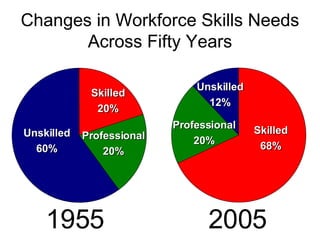
Changes in Workforce Skills Needs Across Fifty Years 1955 2005 Unskilled 60% Skilled 20% Professional 20% Skilled 68% Professional 20% Unskilled 12%
 
 
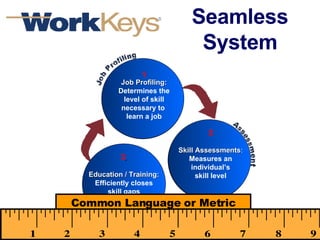
SeamlessSystem 1 Nipurntha Ki Janch: Vayakti ki nipurntha  ko mapna Perfil de trabalho: Determinar o nivel de habilidade para desempenhar um trabalho Instruction wise au point: Fermer avec competence Les lacunes d’habilite 1 Job Profiling: Determines the level of skill necessary to  learn a job 2 Skill Assessments : Measures an individual’s skill level 3   Education / Training: Efficiently closes skill gaps Common Language or Metric
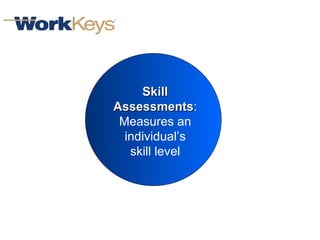
Skill Assessments : Measures an individual’s skill level
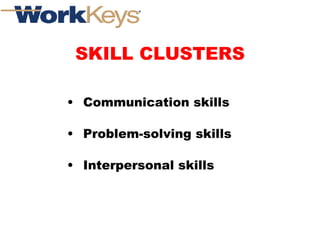
SKILL CLUSTERS Communication skills Problem-solving skills Interpersonal skills
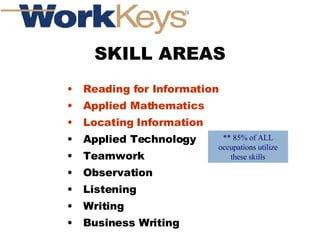
SKILL AREAS Reading for Information Applied Mathematics Locating Information Applied Technology Teamwork Observation Listening  Writing Business Writing ** 85% of ALL occupations utilize these skills
 
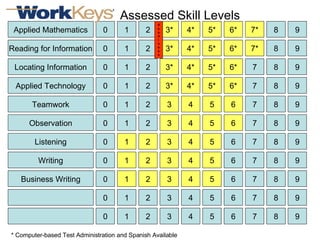
Applied Mathematics Reading for Information Locating Information Applied Technology Teamwork Observation Listening Writing Business Writing 0 1 2 3* 4* 5* 6* 7* 8 9 0 1 2 3* 4* 5* 6* 7* 8 9 0 1 2 3* 4* 5* 6* 7 8 9 0 1 2 3* 4* 5* 6* 7 8 9 0 1 2 3 4 5 6 7 8 9 0 1 2 3 4 5 6 7 8 9 0 1 2 3 4 5 6 7 8 9 0 1 2 3 4 5 6 7 8 9 0 1 2 3 4 5 6 7 8 9 0 1 2 3 4 5 6 7 8 9 0 1 2 3 4 5 6 7 8 9 Readiness * Computer-based Test Administration and Spanish Available Assessed Skill Levels
 
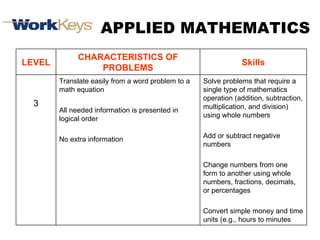
APPLIED MATHEMATICS Solve problems that require a single type of mathematics operation (addition, subtraction, multiplication, and division) using whole numbers Add or subtract negative numbers Change numbers from one form to another using whole numbers, fractions, decimals, or percentages Convert simple money and time units (e.g., hours to minutes Translate easily from a word problem to a math equation All needed information is presented in logical order No extra information 3 Skills CHARACTERISTICS OF PROBLEMS LEVEL
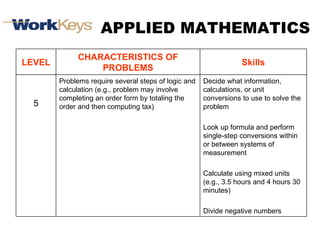
APPLIED MATHEMATICS Decide what information, calculations, or unit conversions to use to solve the problem Look up formula and perform single-step conversions within or between systems of measurement Calculate using mixed units (e.g., 3.5 hours and 4 hours 30 minutes) Divide negative numbers Problems require several steps of logic and calculation (e.g., problem may involve completing an order form by totaling the order and then computing tax) 5 Skills CHARACTERISTICS OF PROBLEMS LEVEL
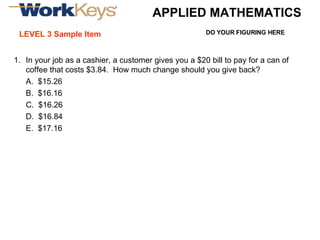
APPLIED MATHEMATICS LEVEL 3 Sample Item In your job as a cashier, a customer gives you a $20 bill to pay for a can of coffee that costs $3.84.  How much change should you give back? A.  $15.26 B.  $16.16 C.  $16.26 D.  $16.84 E.  $17.16 DO YOUR FIGURING HERE
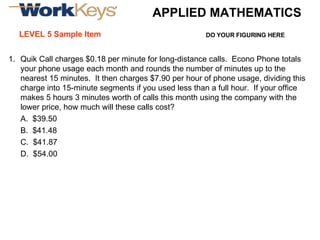
LEVEL 5 Sample Item Quik Call charges $0.18 per minute for long-distance calls.  Econo Phone totals your phone usage each month and rounds the number of minutes up to the nearest 15 minutes.  It then charges $7.90 per hour of phone usage, dividing this charge into 15-minute segments if you used less than a full hour.  If your office makes 5 hours 3 minutes worth of calls this month using the company with the lower price, how much will these calls cost? A.  $39.50 B.  $41.48 C.  $41.87 D.  $54.00 DO YOUR FIGURING HERE APPLIED MATHEMATICS
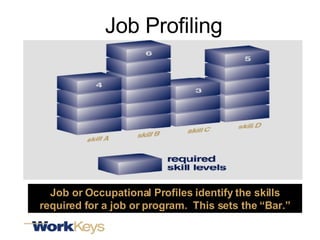
Job Profiling: Determines the level of skill necessary to  learn a job
 
 
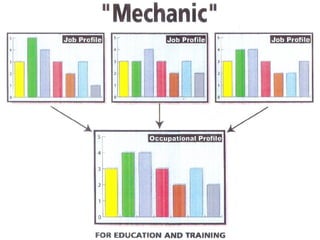
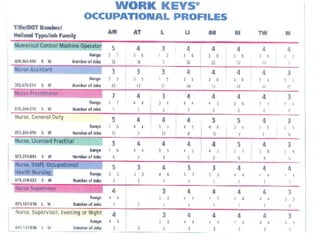
Job or Occupational Profiles identify the skills required for a job or program.  This sets the “Bar.” Job Profiling
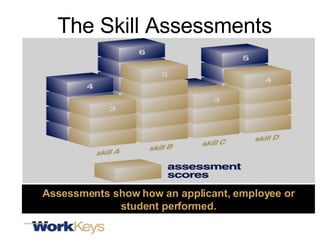
Assessments show how an applicant, employee or student performed. The Skill Assessments
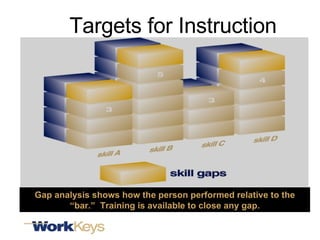
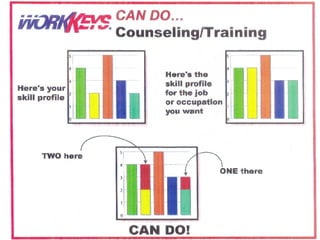
Gap analysis shows how the person performed relative to the “bar.”  Training is available to close any gap. Targets for Instruction
Targets for Instruction Efficiently closes  skill gaps
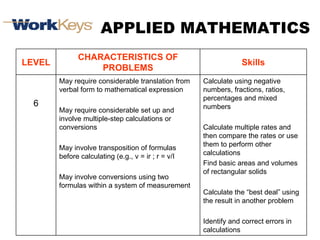
APPLIED MATHEMATICS Calculate using negative numbers, fractions, ratios, percentages and mixed numbers Calculate multiple rates and then compare the rates or use them to perform other calculations Find basic areas and volumes of rectangular solids  Calculate the “best deal” using the result in another problem  Identify and correct errors in calculations May require considerable translation from verbal form to mathematical expression May require considerable set up and involve multiple-step calculations or conversions May involve transposition of formulas before calculating (e.g., v = ir ; r = v/I May involve conversions using two formulas within a system of measurement 6 Skills CHARACTERISTICS OF PROBLEMS LEVEL


Covidien Dc Work Keys 101 2

  • 1.
  • 2.
    Changes in WorkforceSkills Needs Across Fifty Years 1955 2005 Unskilled 60% Skilled 20% Professional 20% Skilled 68% Professional 20% Unskilled 12%
  • 3.
  • 4.
  • 5.
    SeamlessSystem 1 NipurnthaKi Janch: Vayakti ki nipurntha ko mapna Perfil de trabalho: Determinar o nivel de habilidade para desempenhar um trabalho Instruction wise au point: Fermer avec competence Les lacunes d’habilite 1 Job Profiling: Determines the level of skill necessary to learn a job 2 Skill Assessments : Measures an individual’s skill level 3 Education / Training: Efficiently closes skill gaps Common Language or Metric
  • 6.
    Skill Assessments :Measures an individual’s skill level
  • 7.
    SKILL CLUSTERS Communicationskills Problem-solving skills Interpersonal skills
  • 8.
    SKILL AREAS Readingfor Information Applied Mathematics Locating Information Applied Technology Teamwork Observation Listening Writing Business Writing ** 85% of ALL occupations utilize these skills
  • 9.
  • 10.
    Applied Mathematics Readingfor Information Locating Information Applied Technology Teamwork Observation Listening Writing Business Writing 0 1 2 3* 4* 5* 6* 7* 8 9 0 1 2 3* 4* 5* 6* 7* 8 9 0 1 2 3* 4* 5* 6* 7 8 9 0 1 2 3* 4* 5* 6* 7 8 9 0 1 2 3 4 5 6 7 8 9 0 1 2 3 4 5 6 7 8 9 0 1 2 3 4 5 6 7 8 9 0 1 2 3 4 5 6 7 8 9 0 1 2 3 4 5 6 7 8 9 0 1 2 3 4 5 6 7 8 9 0 1 2 3 4 5 6 7 8 9 Readiness * Computer-based Test Administration and Spanish Available Assessed Skill Levels
  • 11.
  • 12.
    APPLIED MATHEMATICS Solveproblems that require a single type of mathematics operation (addition, subtraction, multiplication, and division) using whole numbers Add or subtract negative numbers Change numbers from one form to another using whole numbers, fractions, decimals, or percentages Convert simple money and time units (e.g., hours to minutes Translate easily from a word problem to a math equation All needed information is presented in logical order No extra information 3 Skills CHARACTERISTICS OF PROBLEMS LEVEL
  • 13.
    APPLIED MATHEMATICS Decidewhat information, calculations, or unit conversions to use to solve the problem Look up formula and perform single-step conversions within or between systems of measurement Calculate using mixed units (e.g., 3.5 hours and 4 hours 30 minutes) Divide negative numbers Problems require several steps of logic and calculation (e.g., problem may involve completing an order form by totaling the order and then computing tax) 5 Skills CHARACTERISTICS OF PROBLEMS LEVEL
  • 14.
    APPLIED MATHEMATICS LEVEL3 Sample Item In your job as a cashier, a customer gives you a $20 bill to pay for a can of coffee that costs $3.84. How much change should you give back? A. $15.26 B. $16.16 C. $16.26 D. $16.84 E. $17.16 DO YOUR FIGURING HERE
  • 15.
    LEVEL 5 SampleItem Quik Call charges $0.18 per minute for long-distance calls. Econo Phone totals your phone usage each month and rounds the number of minutes up to the nearest 15 minutes. It then charges $7.90 per hour of phone usage, dividing this charge into 15-minute segments if you used less than a full hour. If your office makes 5 hours 3 minutes worth of calls this month using the company with the lower price, how much will these calls cost? A. $39.50 B. $41.48 C. $41.87 D. $54.00 DO YOUR FIGURING HERE APPLIED MATHEMATICS
  • 16.
    Job Profiling: Determinesthe level of skill necessary to learn a job
  • 17.
  • 18.
  • 19.
    Job or OccupationalProfiles identify the skills required for a job or program. This sets the “Bar.” Job Profiling
  • 20.
    Assessments show howan applicant, employee or student performed. The Skill Assessments
  • 21.
    Gap analysis showshow the person performed relative to the “bar.” Training is available to close any gap. Targets for Instruction
  • 22.
    Targets for InstructionEfficiently closes skill gaps
  • 23.
    APPLIED MATHEMATICS Calculateusing negative numbers, fractions, ratios, percentages and mixed numbers Calculate multiple rates and then compare the rates or use them to perform other calculations Find basic areas and volumes of rectangular solids Calculate the “best deal” using the result in another problem Identify and correct errors in calculations May require considerable translation from verbal form to mathematical expression May require considerable set up and involve multiple-step calculations or conversions May involve transposition of formulas before calculating (e.g., v = ir ; r = v/I May involve conversions using two formulas within a system of measurement 6 Skills CHARACTERISTICS OF PROBLEMS LEVEL
  • 24.
  • 25.
  • 26.
  • 27.
  • 28.
  • 29.
  • 30.