Algorithm Development
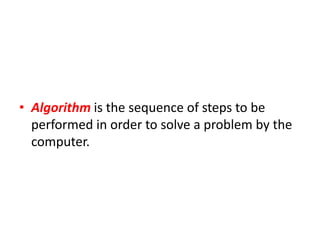
• Algorithm is the sequence of steps to be
  performed in order to solve a problem by the
  computer.
Properties of Algorithm
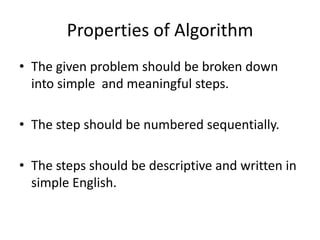
• The given problem should be broken down
  into simple and meaningful steps.

• The step should be numbered sequentially.

• The steps should be descriptive and written in
  simple English.
Advantages of Algorithms
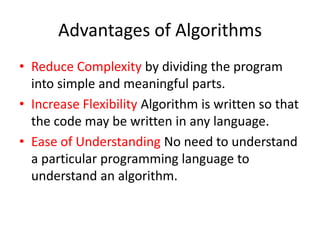
• Reduce Complexity by dividing the program
  into simple and meaningful parts.
• Increase Flexibility Algorithm is written so that
  the code may be written in any language.
• Ease of Understanding No need to understand
  a particular programming language to
  understand an algorithm.
How to write?
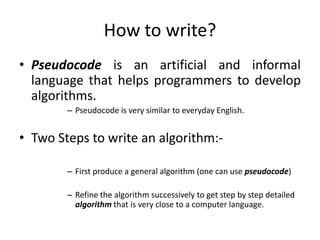
• Pseudocode is an artificial and informal
  language that helps programmers to develop
  algorithms.
        – Pseudocode is very similar to everyday English.


• Two Steps to write an algorithm:-

        – First produce a general algorithm (one can use pseudocode)

        – Refine the algorithm successively to get step by step detailed
          algorithm that is very close to a computer language.
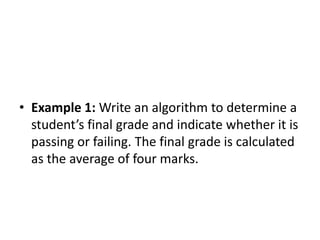
• Example 1: Write an algorithm to determine a
  student’s final grade and indicate whether it is
  passing or failing. The final grade is calculated
  as the average of four marks.
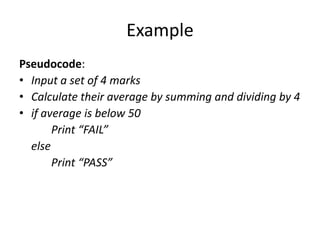
Example
Pseudocode:
• Input a set of 4 marks
• Calculate their average by summing and dividing by 4
• if average is below 50
       Print “FAIL”
  else
       Print “PASS”
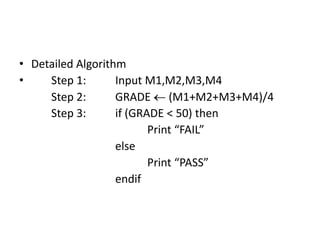
• Detailed Algorithm
•    Step 1:       Input M1,M2,M3,M4
     Step 2:       GRADE (M1+M2+M3+M4)/4
     Step 3:       if (GRADE < 50) then
                          Print “FAIL”
                   else
                          Print “PASS”
                   endif
• Write an algorithm to convert the length in
  feet to centimeter.
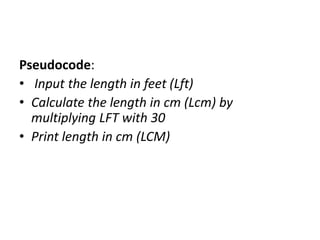
Pseudocode:
• Input the length in feet (Lft)
• Calculate the length in cm (Lcm) by
  multiplying LFT with 30
• Print length in cm (LCM)
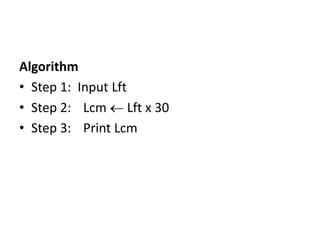
Algorithm
• Step 1: Input Lft
• Step 2: Lcm Lft x 30
• Step 3: Print Lcm
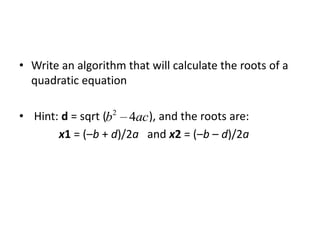
• Write an algorithm that will calculate the roots of a
  quadratic equation

• Hint: d = sqrt (b2 4ac ), and the roots are:
       x1 = (–b + d)/2a and x2 = (–b – d)/2a
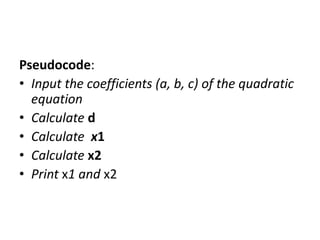
Pseudocode:
• Input the coefficients (a, b, c) of the quadratic
  equation
• Calculate d
• Calculate x1
• Calculate x2
• Print x1 and x2
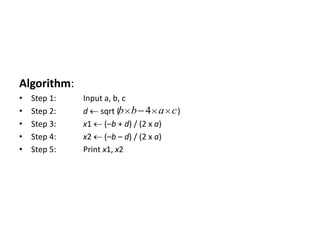
Algorithm:
•   Step 1:   Input a, b, c
•   Step 2:   d sqrt (b b 4 a c )
•   Step 3:   x1 (–b + d) / (2 x a)
•   Step 4:   x2 (–b – d) / (2 x a)
•   Step 5:   Print x1, x2
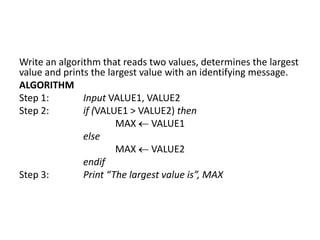
Write an algorithm that reads two values, determines the largest
value and prints the largest value with an identifying message.
ALGORITHM
Step 1:        Input VALUE1, VALUE2
Step 2:        if (VALUE1 > VALUE2) then
                       MAX VALUE1
               else
                       MAX VALUE2
               endif
Step 3:        Print “The largest value is”, MAX
Write an algorithm that reads three numbers and prints the value of
the largest number.

Step 1: Input N1, N2, N3
Step 2: if (N1>N2) then
             if (N1>N3) then
                  MAX N1       [N1>N2, N1>N3]
            else
                  MAX N3       [N3>N1>N2]
            endif
        else
            if (N2>N3) then
                  MAX N2       [N2>N1, N2>N3]
            else
                  MAX N3       [N3>N2>N1]
           endif
        endif
Step 3: Print “The largest number is”, MAX
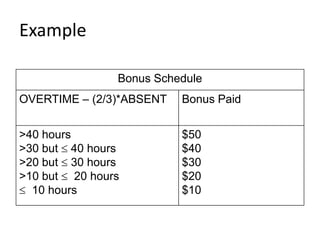
Example

               Bonus Schedule
OVERTIME – (2/3)*ABSENT   Bonus Paid


>40 hours                 $50
>30 but 40 hours          $40
>20 but 30 hours          $30
>10 but 20 hours          $20
  10 hours                $10
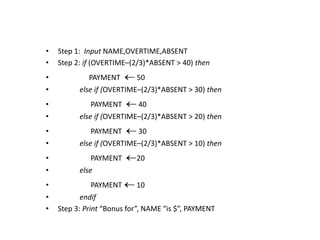
•   Step 1: Input NAME,OVERTIME,ABSENT
•   Step 2: if (OVERTIME–(2/3)*ABSENT > 40) then
•            PAYMENT       50
•         else if (OVERTIME–(2/3)*ABSENT > 30) then
•            PAYMENT        40
•         else if (OVERTIME–(2/3)*ABSENT > 20) then
•            PAYMENT        30
•         else if (OVERTIME–(2/3)*ABSENT > 10) then
•            PAYMENT       20
•         else
•            PAYMENT       10
•          endif
•   Step 3: Print “Bonus for”, NAME “is $”, PAYMENT
Assignment #1

Programming fundamentals lecture 2 of c

  • 1.
  • 2.
    • Algorithm isthe sequence of steps to be performed in order to solve a problem by the computer.
  • 3.
    Properties of Algorithm •The given problem should be broken down into simple and meaningful steps. • The step should be numbered sequentially. • The steps should be descriptive and written in simple English.
  • 4.
    Advantages of Algorithms •Reduce Complexity by dividing the program into simple and meaningful parts. • Increase Flexibility Algorithm is written so that the code may be written in any language. • Ease of Understanding No need to understand a particular programming language to understand an algorithm.
  • 5.
    How to write? •Pseudocode is an artificial and informal language that helps programmers to develop algorithms. – Pseudocode is very similar to everyday English. • Two Steps to write an algorithm:- – First produce a general algorithm (one can use pseudocode) – Refine the algorithm successively to get step by step detailed algorithm that is very close to a computer language.
  • 6.
    • Example 1:Write an algorithm to determine a student’s final grade and indicate whether it is passing or failing. The final grade is calculated as the average of four marks.
  • 7.
    Example Pseudocode: • Input aset of 4 marks • Calculate their average by summing and dividing by 4 • if average is below 50 Print “FAIL” else Print “PASS”
  • 8.
    • Detailed Algorithm • Step 1: Input M1,M2,M3,M4 Step 2: GRADE (M1+M2+M3+M4)/4 Step 3: if (GRADE < 50) then Print “FAIL” else Print “PASS” endif
  • 9.
    • Write analgorithm to convert the length in feet to centimeter.
  • 10.
    Pseudocode: • Input thelength in feet (Lft) • Calculate the length in cm (Lcm) by multiplying LFT with 30 • Print length in cm (LCM)
  • 11.
    Algorithm • Step 1:Input Lft • Step 2: Lcm Lft x 30 • Step 3: Print Lcm
  • 12.
    • Write analgorithm that will calculate the roots of a quadratic equation • Hint: d = sqrt (b2 4ac ), and the roots are: x1 = (–b + d)/2a and x2 = (–b – d)/2a
  • 13.
    Pseudocode: • Input thecoefficients (a, b, c) of the quadratic equation • Calculate d • Calculate x1 • Calculate x2 • Print x1 and x2
  • 14.
    Algorithm: • Step 1: Input a, b, c • Step 2: d sqrt (b b 4 a c ) • Step 3: x1 (–b + d) / (2 x a) • Step 4: x2 (–b – d) / (2 x a) • Step 5: Print x1, x2
  • 15.
    Write an algorithmthat reads two values, determines the largest value and prints the largest value with an identifying message. ALGORITHM Step 1: Input VALUE1, VALUE2 Step 2: if (VALUE1 > VALUE2) then MAX VALUE1 else MAX VALUE2 endif Step 3: Print “The largest value is”, MAX
  • 16.
    Write an algorithmthat reads three numbers and prints the value of the largest number. Step 1: Input N1, N2, N3 Step 2: if (N1>N2) then if (N1>N3) then MAX N1 [N1>N2, N1>N3] else MAX N3 [N3>N1>N2] endif else if (N2>N3) then MAX N2 [N2>N1, N2>N3] else MAX N3 [N3>N2>N1] endif endif Step 3: Print “The largest number is”, MAX
  • 17.
    Example Bonus Schedule OVERTIME – (2/3)*ABSENT Bonus Paid >40 hours $50 >30 but 40 hours $40 >20 but 30 hours $30 >10 but 20 hours $20 10 hours $10
  • 18.
    Step 1: Input NAME,OVERTIME,ABSENT • Step 2: if (OVERTIME–(2/3)*ABSENT > 40) then • PAYMENT 50 • else if (OVERTIME–(2/3)*ABSENT > 30) then • PAYMENT 40 • else if (OVERTIME–(2/3)*ABSENT > 20) then • PAYMENT 30 • else if (OVERTIME–(2/3)*ABSENT > 10) then • PAYMENT 20 • else • PAYMENT 10 • endif • Step 3: Print “Bonus for”, NAME “is $”, PAYMENT
  • 19.