

Instructor : Muhammad HarisAll Rights Reserved to Department of Computer Science – GCU Lahore
Programming Fundamentals
Consider this Example
 Determine status of a Student from
marks of two of his subjects and his
GPA
If either the marks for both of the subjects
are greater than 40 or GPA is greater than
2, he’s considered passed
Programming Fundamentals | Lecture-5 2
Programming Fundamentals | Lecture-5 3
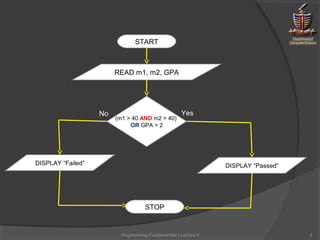
START
READ m1, m2, GPA
DISPLAY “Passed”
STOP
(m1 > 40 AND m2 > 40)
OR GPA > 2
YesNo
DISPLAY “Failed”
Another Example
 Determine whether a student has got
Grade A from his total marks and his
GPA
If marks are greater than 80 and less than
90 OR GPA is greater than 3.7 and less 3.8,
he will be graded as “A”
Programming Fundamentals | Lecture-5 4
Programming Fundamentals | Lecture-5 5
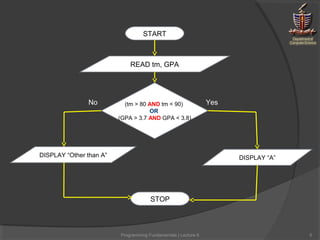
START
READ tm, GPA
DISPLAY “A”
STOP
(tm > 80 AND tm < 90)
OR
(GPA > 3.7 AND GPA < 3.8)
YesNo
DISPLAY “Other than A”
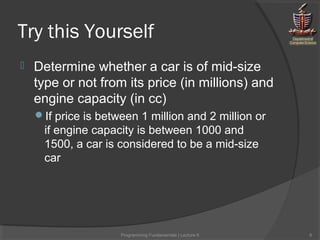
Try this Yourself
 Determine whether a car is of mid-size
type or not from its price (in millions) and
engine capacity (in cc)
If price is between 1 million and 2 million or
if engine capacity is between 1000 and
1500, a car is considered to be a mid-size
car
Programming Fundamentals | Lecture-5 6
Programming Fundamentals | Lecture-5 7
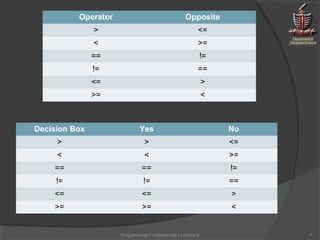
Decision Box Yes No
> > <=
< < >=
== == !=
!= != ==
<= <= >
>= >= <
Operator Opposite
> <=
< >=
== !=
!= ==
<= >
>= <
Decision leading to Decisions
 In real-world problems, it frequently
happens that result of a decision leads
to further decision making
 This way computer programs prove to
be much more useful
Programming Fundamentals | Lecture-5 8
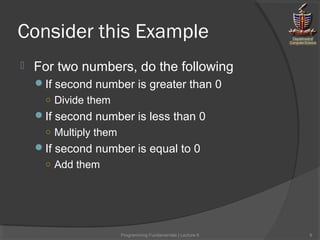
Consider this Example
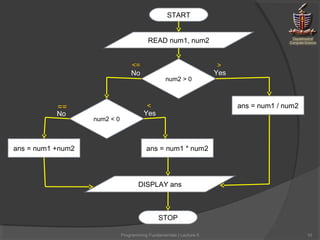
 For two numbers, do the following
If second number is greater than 0
○ Divide them
If second number is less than 0
○ Multiply them
If second number is equal to 0
○ Add them
Programming Fundamentals | Lecture-5 9
Programming Fundamentals | Lecture-5 10
START
READ num1, num2
DISPLAY ans
STOP
ans = num1 / num2
num2 > 0
YesNo
num2 < 0
ans = num1 * num2ans = num1 +num2
<= >
Yes
<
No
==
Another Example
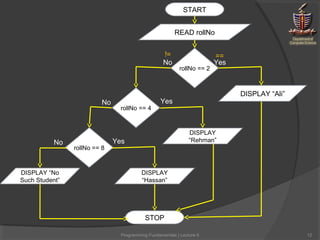
 For given roll number of a student,
display his name
Assume that there are only three students
(first three roll numbers of your section)
Programming Fundamentals | Lecture-5 11
Programming Fundamentals | Lecture-5 12
START
READ rollNo
DISPLAY “Ali”
STOP
rollNo == 2
YesNo
!= ==
Yes
<No
rollNo == 4
rollNo == 8
DISPLAY
“Rehman”
DISPLAY
“Hassan”
DISPLAY “No
Such Student”
YesNo
Try this Yourself
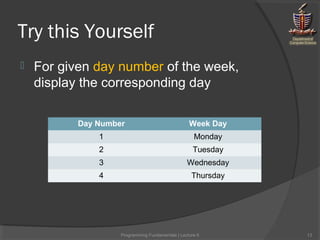
 For given day number of the week,
display the corresponding day
Programming Fundamentals | Lecture-5 13
Day Number Week Day
1 Monday
2 Tuesday
3 Wednesday
4 Thursday
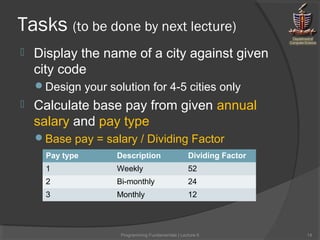
Tasks (to be done by next lecture)
 Display the name of a city against given
city code
Design your solution for 4-5 cities only
 Calculate base pay from given annual
salary and pay type
Base pay = salary / Dividing Factor
Programming Fundamentals | Lecture-5 14
Pay type Description Dividing Factor
1 Weekly 52
2 Bi-monthly 24
3 Monthly 12
Programming Fundamentals | Lecture-5 15
BE PREPARED
FOR
QUIZ
IN
NEXT LECTURE

Fundamental Programming Lect 5

  • 1.
    Instructor : MuhammadHarisAll Rights Reserved to Department of Computer Science – GCU Lahore Programming Fundamentals
  • 2.
    Consider this Example Determine status of a Student from marks of two of his subjects and his GPA If either the marks for both of the subjects are greater than 40 or GPA is greater than 2, he’s considered passed Programming Fundamentals | Lecture-5 2
  • 3.
    Programming Fundamentals |Lecture-5 3 START READ m1, m2, GPA DISPLAY “Passed” STOP (m1 > 40 AND m2 > 40) OR GPA > 2 YesNo DISPLAY “Failed”
  • 4.
    Another Example  Determinewhether a student has got Grade A from his total marks and his GPA If marks are greater than 80 and less than 90 OR GPA is greater than 3.7 and less 3.8, he will be graded as “A” Programming Fundamentals | Lecture-5 4
  • 5.
    Programming Fundamentals |Lecture-5 5 START READ tm, GPA DISPLAY “A” STOP (tm > 80 AND tm < 90) OR (GPA > 3.7 AND GPA < 3.8) YesNo DISPLAY “Other than A”
  • 6.
    Try this Yourself Determine whether a car is of mid-size type or not from its price (in millions) and engine capacity (in cc) If price is between 1 million and 2 million or if engine capacity is between 1000 and 1500, a car is considered to be a mid-size car Programming Fundamentals | Lecture-5 6
  • 7.
    Programming Fundamentals |Lecture-5 7 Decision Box Yes No > > <= < < >= == == != != != == <= <= > >= >= < Operator Opposite > <= < >= == != != == <= > >= <
  • 8.
    Decision leading toDecisions  In real-world problems, it frequently happens that result of a decision leads to further decision making  This way computer programs prove to be much more useful Programming Fundamentals | Lecture-5 8
  • 9.
    Consider this Example For two numbers, do the following If second number is greater than 0 ○ Divide them If second number is less than 0 ○ Multiply them If second number is equal to 0 ○ Add them Programming Fundamentals | Lecture-5 9
  • 10.
    Programming Fundamentals |Lecture-5 10 START READ num1, num2 DISPLAY ans STOP ans = num1 / num2 num2 > 0 YesNo num2 < 0 ans = num1 * num2ans = num1 +num2 <= > Yes < No ==
  • 11.
    Another Example  Forgiven roll number of a student, display his name Assume that there are only three students (first three roll numbers of your section) Programming Fundamentals | Lecture-5 11
  • 12.
    Programming Fundamentals |Lecture-5 12 START READ rollNo DISPLAY “Ali” STOP rollNo == 2 YesNo != == Yes <No rollNo == 4 rollNo == 8 DISPLAY “Rehman” DISPLAY “Hassan” DISPLAY “No Such Student” YesNo
  • 13.
    Try this Yourself For given day number of the week, display the corresponding day Programming Fundamentals | Lecture-5 13 Day Number Week Day 1 Monday 2 Tuesday 3 Wednesday 4 Thursday
  • 14.
    Tasks (to bedone by next lecture)  Display the name of a city against given city code Design your solution for 4-5 cities only  Calculate base pay from given annual salary and pay type Base pay = salary / Dividing Factor Programming Fundamentals | Lecture-5 14 Pay type Description Dividing Factor 1 Weekly 52 2 Bi-monthly 24 3 Monthly 12
  • 15.
    Programming Fundamentals |Lecture-5 15 BE PREPARED FOR QUIZ IN NEXT LECTURE

Editor's Notes

  • #10 Note: A decision box always leads to two paths, not more than two. But in this example you can see more than two paths. Hence one decision box is not sufficient to achieve this solution