THE LABOR MARKET
( with respect to Human Capital )


  Principle #7: People’s Skills
    Influence Their Income.


                                    1
Relative Income: Why?
$5 million


                $30,000

                          2
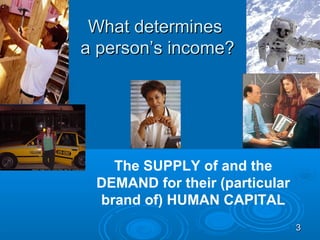
What determines
a person’s income?


   The SUPPLY of and the
 DEMAND for their (particular
 brand of) HUMAN CAPITAL
                                3
High or Low Incomes
   if you have High DEMAND with low supply then you get
    high income (wage rates)
   if you have Low DEMAND with high supply then you get
    low income (wage rates)
   the Wage Rate is the measurement of the relative
    scarcity of particular types of workers.
   If you want a high income you should develop skills and
    capabilities in high DEMAND low SUPPLY occupations.
    Make yourself stand out in the crowd.


                                                              4
to do: MAKE
   YOURSELF
   SCARCE!!!!

 Fine ~ now how would or
   should you go about
achieving this objective???


                              5
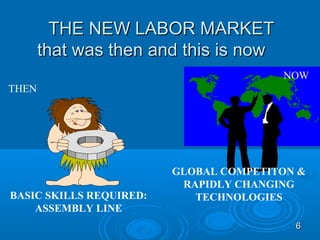
THE NEW LABOR MARKET
       that was then and this is now
                                        NOW
THEN


                         GLOBAL COMPETITON &
                          RAPIDLY CHANGING
BASIC SKILLS REQUIRED:      TECHNOLOGIES
    ASSEMBLY LINE
                                          6
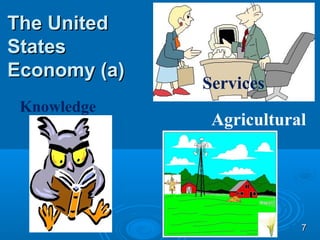
The United
States
Economy (a)
              Services
 Knowledge
               Agricultural


                          7
Information
                 The United
                   States
                Economy (b)

                  Imagination

Manufacturing


                                8
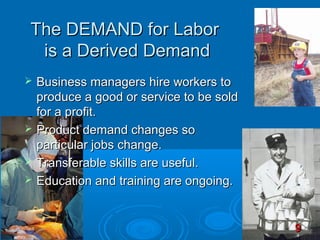
The DEMAND for Labor
 is a Derived Demand
   Business managers hire workers to
    produce a good or service to be sold
    for a profit.
   Product demand changes so
    particular jobs change.
   Transferable skills are useful.
   Education and training are ongoing.


                                           9
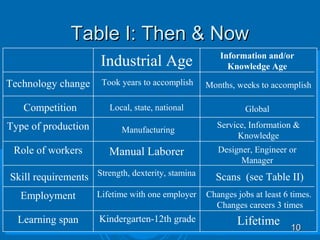
Table I: Then & Now
                                                     Information and/or
                      Industrial Age                   Knowledge Age

Technology change      Took years to accomplish   Months, weeks to accomplish

   Competition           Local, state, national              Global
Type of production                                   Service, Information &
                            Manufacturing
                                                           Knowledge
 Role of workers         Manual Laborer              Designer, Engineer or
                                                           Manager
Skill requirements Strength, dexterity, stamina     Scans (see Table II)
  Employment         Lifetime with one employer   Changes jobs at least 6 times.
                                                    Changes careers 3 times
  Learning span       Kindergarten-12th grade             Lifetime        10
The Demand for Labor
        is a Derived Demand

   Employers hire workers to help the
    business produce goods and services.
   If the value of the workers’ production is
    greater than the wage the workers are
    being paid then the employer will keep the
    workers. If the workers “production” value
    is less than their wages the workers won’t
    be kept.
                                                 11
The Principle of
      Exchange
Employers will hire workers if they
gain more from hiring the workers
than the value the employer gives
   up ~ via lost output ~ by not
         making the hire.


                                      12
CONSIDER


           13
…..so ~ he’s identified his
 “employment” problem ~
and what can we conclude
about your own particular
 and “special” situation?


                         14
( ceteris paribus )

  All other things
   “being equal”
You can count on your higher
  education leading to your
   higher lifetime income
                               15
Dreams Deferred [@ 2002]:
  Average Earnings & Education for Adults

 E   $120,000
 a   $100,000
 r    $80,000
 n                                                               Dropout
      $60,000                                                    High School
 i
 n    $40,000                                                    Some College
 g    $20,000                                                    Associate's
 s         $0                                                    Bachelor's
                                                                 Master's
                                Education
                                                                 Doctorate
                                                                 Professional

Source: U.S. Census Bureau, Statistical Abstract of the United States: 2004 - 2005
                                                                                     16
remember: if you want to
  make a good income you
should make yourself scarce.

   Develop marketable skills through:
       more education
    
        more training

   What skills are likely to be marketable?


                                               17
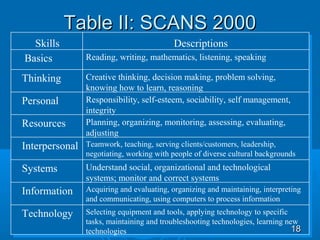
Table II: SCANS 2000
  Skills                                   Descriptions
Basics          Reading, writing, mathematics, listening, speaking

Thinking        Creative thinking, decision making, problem solving,
                knowing how to learn, reasoning
Personal        Responsibility, self-esteem, sociability, self management,
                integrity
Resources       Planning, organizing, monitoring, assessing, evaluating,
                adjusting
Interpersonal   Teamwork, teaching, serving clients/customers, leadership,
                negotiating, working with people of diverse cultural backgrounds
Systems         Understand social, organizational and technological
                systems; monitor and correct systems
Information     Acquiring and evaluating, organizing and maintaining, interpreting
                and communicating, using computers to process information
Technology      Selecting equipment and tools, applying technology to specific
                tasks, maintaining and troubleshooting technologies, learning new
                technologies                                                    18
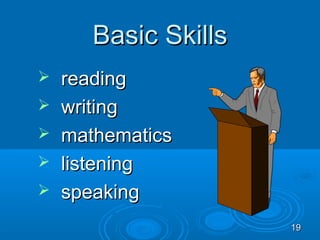
Basic Skills
   reading
   writing
   mathematics
   listening
   speaking
                      19
Thinking Skills
 reasoning
 visualizing
 creative thinking
 decision-making
 problem solving
 knowing how to learn


                         20
Personal Qualities
   responsibility
   self--esteem
   sociability
   integrity
   self-management


                         21
Resource Allocation
   planning
   organizing
   monitoring
   assessing
   evaluating
   adjusting

                      22
Interpersonal Skills
   team skills
   teaching
   leadership
   negotiating
   serving clients/customers
   working with people of diverse cultural
    backgrounds
                                          23
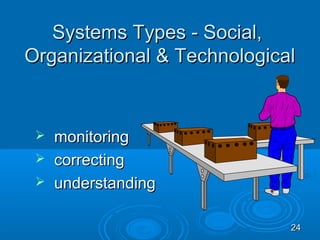
Systems Types - Social,
Organizational & Technological


  monitoring
  correcting
  understanding


                             24
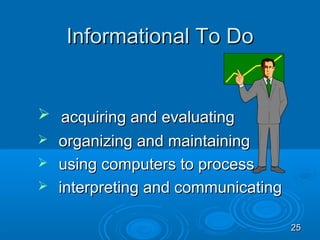
Informational To Do


 acquiring and evaluating
 organizing and maintaining
 using computers to process
 interpreting and communicating


                                   25
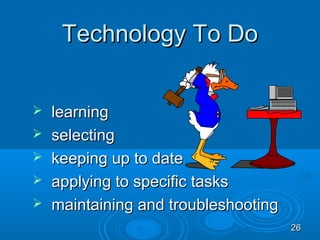
Technology To Do


   learning
   selecting
   keeping up to date
   applying to specific tasks
   maintaining and troubleshooting
                                      26
To compete in a
global economy
 you will need
   these skills
                  27
The Mirror: An Incredibly Powerful
   Package of Human Capital!


                               28
You are the only
  one who can
  develop your
human capital ~
    not your
  teachers nor
 your parents ~
   ONLY YOU
                   29
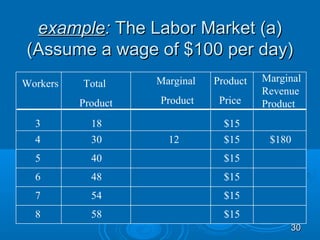
example: The Labor Market (a)
(Assume a wage of $100 per day)
                    Marginal   Product   Marginal
Workers   Total
                                         Revenue
          Product   Product     Price    Product
  3         18                   $15
  4         30        12         $15      $180
  5         40                   $15
  6         48                   $15
  7         54                   $15
  8         58                   $15
                                              30
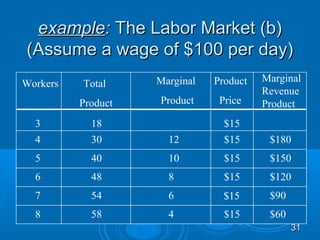
example: The Labor Market (b)
(Assume a wage of $100 per day)
                    Marginal   Product   Marginal
Workers   Total
                                         Revenue
          Product   Product     Price    Product
  3         18                   $15
  4         30        12         $15      $180
  5         40        10         $15      $150
  6         48        8          $15      $120
  7         54        6          $15      $90
  8         58        4          $15      $60
                                                31
The Marginal Principle
    in the Labor Market
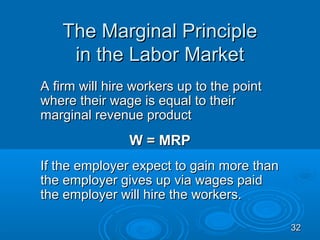
A firm will hire workers up to the point
where their wage is equal to their
marginal revenue product
                W = MRP
If the employer expect to gain more than
the employer gives up via wages paid
the employer will hire the workers.

                                           32
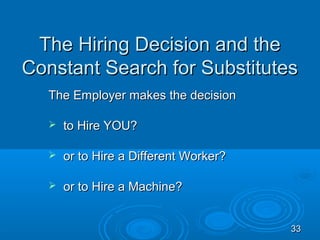
The Hiring Decision and the
Constant Search for Substitutes
  The Employer makes the decision

     to Hire YOU?

     or to Hire a Different Worker?

     or to Hire a Machine?


                                       33
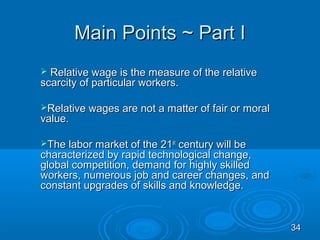
Main Points ~ Part I
 Relative wage is the measure of the relative
scarcity of particular workers.

Relative wages are not a matter of fair or moral
value.

The labor market of the 21st century will be
characterized by rapid technological change,
global competition, demand for highly skilled
workers, numerous job and career changes, and
constant upgrades of skills and knowledge.


                                                    34
Main Points ~ Part II
   The DEMAND for labor is a derived demand.
   Education and training improve human
    capital and increase peoples’ expected
    income.
   Relative wages are determined by SUPPLY
    and DEMAND.

[+]      High wages are earned by workers with very
    scarce human capital skills ~ thus there is a low
    SUPPLY of these workers with those “special” human
    capital skills and a high DEMAND for those same
    workers.


                                                         35
Main Points ~ Part III
[+]     Lower wages are earned by workers with less
“special” human capital skills ~ thus there is a higher
SUPPLY of workers with similar human capital and a
lower DEMAND for those workers.

[+]      Employers hire workers as long as the employer
expects to gain more than she gives up ~ thus as long as
the expected marginal revenue product of the worker is
greater than the wage the employee will be hired.


  REMEMBER YOU NEED TO
 MAKE YOURSELF SCARCE!!!!
                                                           36

Mpp#011+labor.&.human.capital.(36)

  • 1.
    THE LABOR MARKET (with respect to Human Capital ) Principle #7: People’s Skills Influence Their Income. 1
  • 2.
    Relative Income: Why? $5million $30,000 2
  • 3.
    What determines a person’sincome? The SUPPLY of and the DEMAND for their (particular brand of) HUMAN CAPITAL 3
  • 4.
    High or LowIncomes  if you have High DEMAND with low supply then you get high income (wage rates)  if you have Low DEMAND with high supply then you get low income (wage rates)  the Wage Rate is the measurement of the relative scarcity of particular types of workers.  If you want a high income you should develop skills and capabilities in high DEMAND low SUPPLY occupations. Make yourself stand out in the crowd. 4
  • 5.
    to do: MAKE YOURSELF SCARCE!!!! Fine ~ now how would or should you go about achieving this objective??? 5
  • 6.
    THE NEW LABORMARKET that was then and this is now NOW THEN GLOBAL COMPETITON & RAPIDLY CHANGING BASIC SKILLS REQUIRED: TECHNOLOGIES ASSEMBLY LINE 6
  • 7.
    The United States Economy (a) Services Knowledge Agricultural 7
  • 8.
    Information The United States Economy (b) Imagination Manufacturing 8
  • 9.
    The DEMAND forLabor is a Derived Demand  Business managers hire workers to produce a good or service to be sold for a profit.  Product demand changes so particular jobs change.  Transferable skills are useful.  Education and training are ongoing. 9
  • 10.
    Table I: Then& Now Information and/or Industrial Age Knowledge Age Technology change Took years to accomplish Months, weeks to accomplish Competition Local, state, national Global Type of production Service, Information & Manufacturing Knowledge Role of workers Manual Laborer Designer, Engineer or Manager Skill requirements Strength, dexterity, stamina Scans (see Table II) Employment Lifetime with one employer Changes jobs at least 6 times. Changes careers 3 times Learning span Kindergarten-12th grade Lifetime 10
  • 11.
    The Demand forLabor is a Derived Demand  Employers hire workers to help the business produce goods and services.  If the value of the workers’ production is greater than the wage the workers are being paid then the employer will keep the workers. If the workers “production” value is less than their wages the workers won’t be kept. 11
  • 12.
    The Principle of Exchange Employers will hire workers if they gain more from hiring the workers than the value the employer gives up ~ via lost output ~ by not making the hire. 12
  • 13.
  • 14.
    …..so ~ he’sidentified his “employment” problem ~ and what can we conclude about your own particular and “special” situation? 14
  • 15.
    ( ceteris paribus) All other things “being equal” You can count on your higher education leading to your higher lifetime income 15
  • 16.
    Dreams Deferred [@2002]: Average Earnings & Education for Adults E $120,000 a $100,000 r $80,000 n Dropout $60,000 High School i n $40,000 Some College g $20,000 Associate's s $0 Bachelor's Master's Education Doctorate Professional Source: U.S. Census Bureau, Statistical Abstract of the United States: 2004 - 2005 16
  • 17.
    remember: if youwant to make a good income you should make yourself scarce.  Develop marketable skills through:  more education  more training  What skills are likely to be marketable? 17
  • 18.
    Table II: SCANS2000 Skills Descriptions Basics Reading, writing, mathematics, listening, speaking Thinking Creative thinking, decision making, problem solving, knowing how to learn, reasoning Personal Responsibility, self-esteem, sociability, self management, integrity Resources Planning, organizing, monitoring, assessing, evaluating, adjusting Interpersonal Teamwork, teaching, serving clients/customers, leadership, negotiating, working with people of diverse cultural backgrounds Systems Understand social, organizational and technological systems; monitor and correct systems Information Acquiring and evaluating, organizing and maintaining, interpreting and communicating, using computers to process information Technology Selecting equipment and tools, applying technology to specific tasks, maintaining and troubleshooting technologies, learning new technologies 18
  • 19.
    Basic Skills  reading  writing  mathematics  listening  speaking 19
  • 20.
    Thinking Skills  reasoning visualizing  creative thinking  decision-making  problem solving  knowing how to learn 20
  • 21.
    Personal Qualities  responsibility  self--esteem  sociability  integrity  self-management 21
  • 22.
    Resource Allocation  planning  organizing  monitoring  assessing  evaluating  adjusting 22
  • 23.
    Interpersonal Skills  team skills  teaching  leadership  negotiating  serving clients/customers  working with people of diverse cultural backgrounds 23
  • 24.
    Systems Types -Social, Organizational & Technological  monitoring  correcting  understanding 24
  • 25.
    Informational To Do acquiring and evaluating  organizing and maintaining  using computers to process  interpreting and communicating 25
  • 26.
    Technology To Do  learning  selecting  keeping up to date  applying to specific tasks  maintaining and troubleshooting 26
  • 27.
    To compete ina global economy you will need these skills 27
  • 28.
    The Mirror: AnIncredibly Powerful Package of Human Capital! 28
  • 29.
    You are theonly one who can develop your human capital ~ not your teachers nor your parents ~ ONLY YOU 29
  • 30.
    example: The LaborMarket (a) (Assume a wage of $100 per day) Marginal Product Marginal Workers Total Revenue Product Product Price Product 3 18 $15 4 30 12 $15 $180 5 40 $15 6 48 $15 7 54 $15 8 58 $15 30
  • 31.
    example: The LaborMarket (b) (Assume a wage of $100 per day) Marginal Product Marginal Workers Total Revenue Product Product Price Product 3 18 $15 4 30 12 $15 $180 5 40 10 $15 $150 6 48 8 $15 $120 7 54 6 $15 $90 8 58 4 $15 $60 31
  • 32.
    The Marginal Principle in the Labor Market A firm will hire workers up to the point where their wage is equal to their marginal revenue product W = MRP If the employer expect to gain more than the employer gives up via wages paid the employer will hire the workers. 32
  • 33.
    The Hiring Decisionand the Constant Search for Substitutes The Employer makes the decision  to Hire YOU?  or to Hire a Different Worker?  or to Hire a Machine? 33
  • 34.
    Main Points ~Part I  Relative wage is the measure of the relative scarcity of particular workers. Relative wages are not a matter of fair or moral value. The labor market of the 21st century will be characterized by rapid technological change, global competition, demand for highly skilled workers, numerous job and career changes, and constant upgrades of skills and knowledge. 34
  • 35.
    Main Points ~Part II  The DEMAND for labor is a derived demand.  Education and training improve human capital and increase peoples’ expected income.  Relative wages are determined by SUPPLY and DEMAND. [+] High wages are earned by workers with very scarce human capital skills ~ thus there is a low SUPPLY of these workers with those “special” human capital skills and a high DEMAND for those same workers. 35
  • 36.
    Main Points ~Part III [+] Lower wages are earned by workers with less “special” human capital skills ~ thus there is a higher SUPPLY of workers with similar human capital and a lower DEMAND for those workers. [+] Employers hire workers as long as the employer expects to gain more than she gives up ~ thus as long as the expected marginal revenue product of the worker is greater than the wage the employee will be hired. REMEMBER YOU NEED TO MAKE YOURSELF SCARCE!!!! 36