St. George, Utah July 26, 2008
Tim Oliver Professional Stock Market Coach Trading stocks & options for 15 years [email_address]
Everything we discuss today is for educational purposes only.  We are not registered financial advisors.  Whenever we discuss stocks or options, there will be no buy, sell, or hold recommendations.
“ Only buy something that you'd be perfectly happy to hold if the market shut down for 10 years. “  Warren Buffet
 
Fundamental analysis  helps us to know  what   companies/stocks to buy or sell. Technical analysis  helps us to know  when   to buy and sell (chart reading).
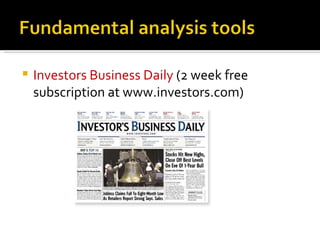
Investors Business Daily  (2 week free subscription at www.investors.com)
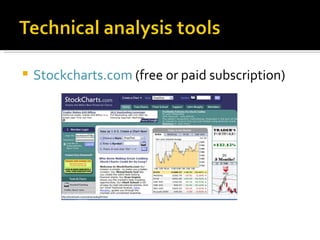
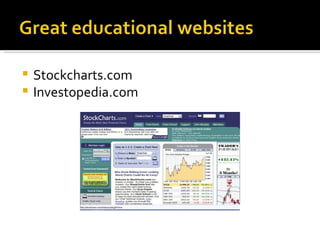
Stockcharts.com  (free or paid subscription)
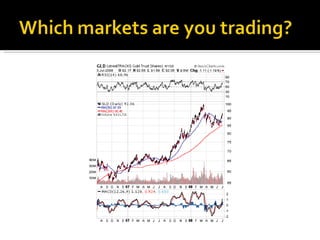
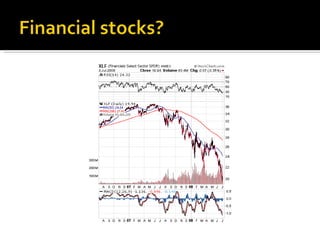
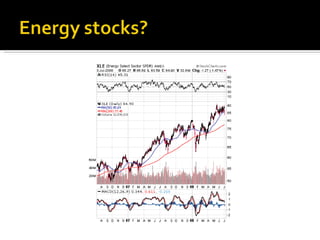
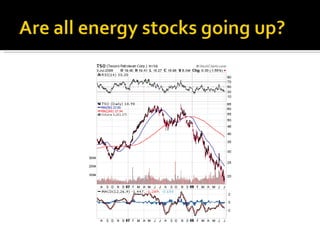
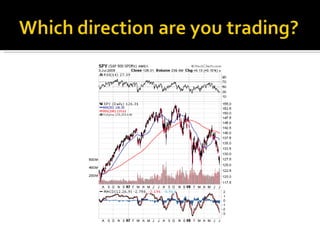
Which markets are you trading in? Which stocks are you trading? Which direction are you trading? Do you understand fundamental and technical analysis? Do you use proper risk management?


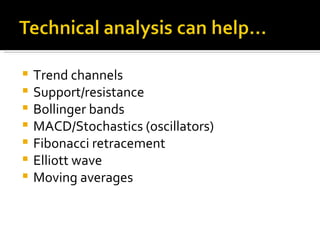
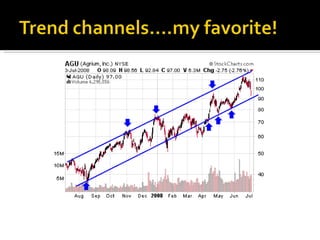
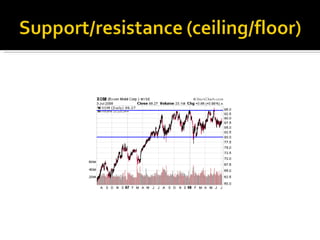
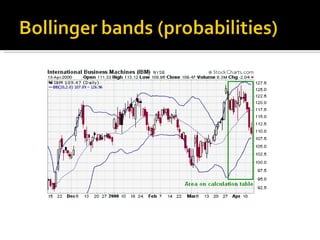
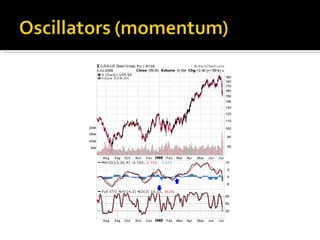
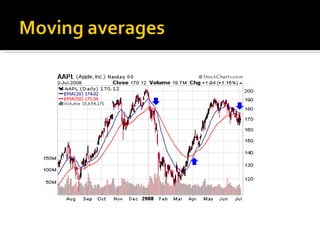
Trend channels Support/resistance Bollinger bands MACD/Stochastics (oscillators) Fibonacci retracement Elliott wave Moving averages


Stockcharts.com Investopedia.com
Money market funds CDs Real estate Bonds Mutual funds Education Stocks Put it under your mattress?
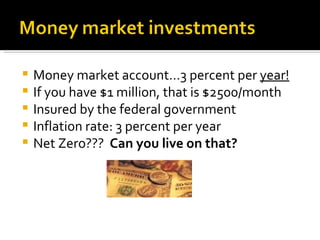
Money market account…3 percent per  year! If you have $1 million, that is $2500/month Insured by the federal government Inflation rate: 3 percent per year Net Zero???  Can you live on that?
 
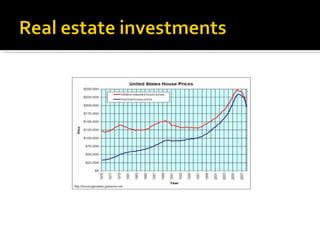
1 in every 118 households in  Las Vegas  had a  foreclosure  filing in May 2008. California  foreclosures  increased 72 percent  from May 2007 to May 2008 Arizona  had 1 in every 201 households filing foreclosures in May 2008 Sacramento , CA  home prices dropped 29%  this past year. Real estate doesn’t just go straight up…
 
 
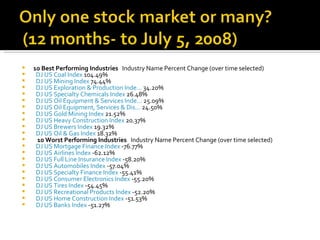
10 Best Performing Industries    Industry Name Percent Change (over time selected)       DJ US Coal Index  104.49%       DJ US Mining Index  74.44%       DJ US Exploration & Production Inde...  34.20%       DJ US Specialty Chemicals Index  26.48%       DJ US Oil Equipment & Services Inde...  25.09%       DJ US Oil Equipment, Services & Dis...  24.50%       DJ US Gold Mining Index  21.52%       DJ US Heavy Construction Index  20.37%       DJ US Brewers Index  19.32%       DJ US Oil & Gas Index  18.32%        10 Worst Performing Industries    Industry Name Percent Change (over time selected)       DJ US Mortgage Finance Index  -76.77%       DJ US Airlines Index  -62.12%       DJ US Full Line Insurance Index  -58.20%       DJ US Automobiles Index  -57.04%       DJ US Specialty Finance Index  -55.41%       DJ US Consumer Electronics Index  -55.20%       DJ US Tires Index  -54.45%       DJ US Recreational Products Index  -52.20%       DJ US Home Construction Index  -51.53%       DJ US Banks Index  -51.27% 
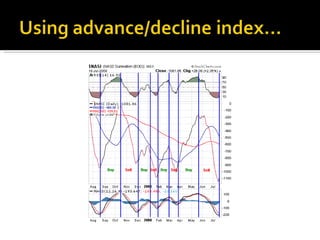
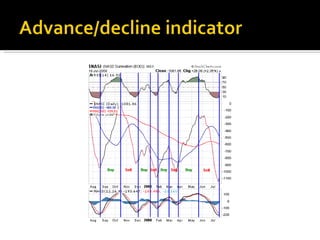
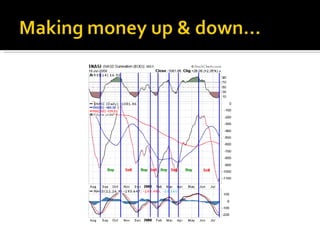
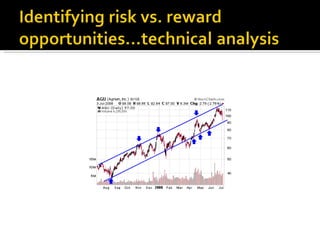
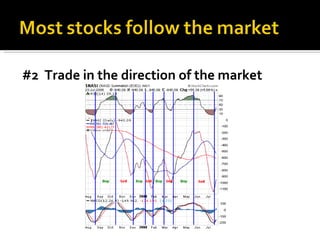
Most stocks follow the overall market, so use an  advance/decline indicator like $NASI. Trade the  strongest stocks  in the strongest sectors or   trade   ETFs (exchange traded funds). Identify  risk vs. reward  opportunities, using  technical analysis .
 
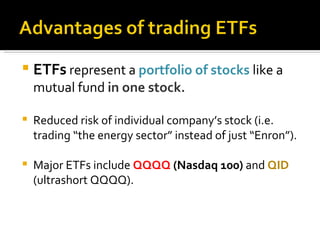
ETFs  represent a  portfolio of stocks  like a mutual fund  in one stock. Reduced risk of individual company’s stock (i.e. trading “the energy sector” instead of just “Enron”). Major ETFs include  QQQQ  (Nasdaq 100)  and  QID  (ultrashort QQQQ).
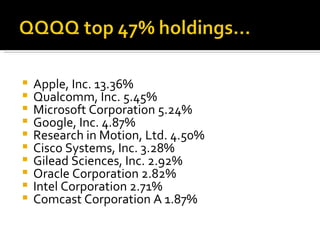
Apple, Inc. 13.36%  Qualcomm, Inc. 5.45%  Microsoft Corporation 5.24%  Google, Inc. 4.87%  Research in Motion, Ltd. 4.50%  Cisco Systems, Inc. 3.28%  Gilead Sciences, Inc. 2.92%  Oracle Corporation 2.82%  Intel Corporation 2.71%  Comcast Corporation A 1.87%
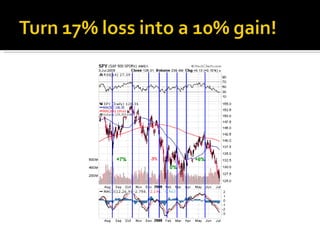
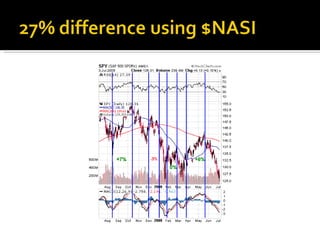
10% gain vs. 17% loss  on SPY (“the market”) Stay out when $NASI gives  sell   signal Be in the market  only  at optimal times
 
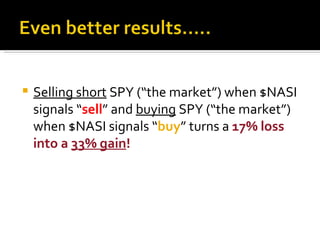
Selling short  SPY (“the market”) when $NASI signals “ sell ” and  buying  SPY (“the market”) when $NASI signals “ buy ” turns a  17% loss into a  33% gain !
 
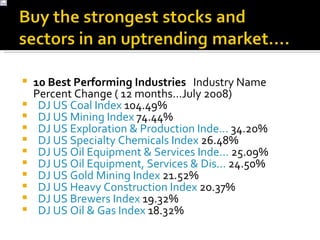
10 Best Performing Industries    Industry Name Percent Change ( 12 months…July 2008)    DJ US Coal Index  104.49%       DJ US Mining Index  74.44%       DJ US Exploration & Production Inde...  34.20%       DJ US Specialty Chemicals Index  26.48%       DJ US Oil Equipment & Services Inde...  25.09%       DJ US Oil Equipment, Services & Dis...  24.50%       DJ US Gold Mining Index  21.52%       DJ US Heavy Construction Index  20.37%       DJ US Brewers Index  19.32%       DJ US Oil & Gas Index  18.32%  
 
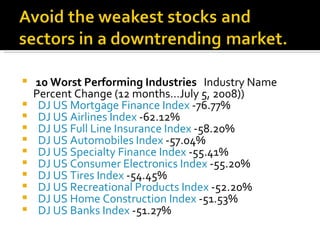
  10 Worst Performing Industries    Industry Name Percent Change (12 months…July 5, 2008))       DJ US Mortgage Finance Index  -76.77%       DJ US Airlines Index  -62.12%       DJ US Full Line Insurance Index  -58.20%       DJ US Automobiles Index  -57.04%       DJ US Specialty Finance Index  -55.41%       DJ US Consumer Electronics Index  -55.20%       DJ US Tires Index  -54.45%       DJ US Recreational Products Index  -52.20%       DJ US Home Construction Index  -51.53%       DJ US Banks Index  -51.27% 
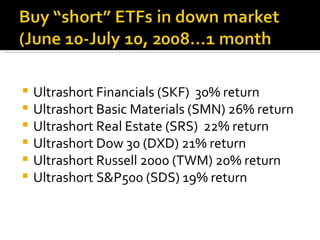
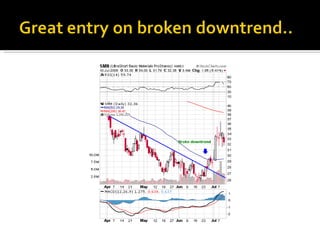
Ultrashort Financials (SKF)  30% return Ultrashort Basic Materials (SMN) 26% return Ultrashort Real Estate (SRS)  22% return Ultrashort Dow 30 (DXD) 21% return Ultrashort Russell 2000 (TWM) 20% return Ultrashort S&P500 (SDS) 19% return


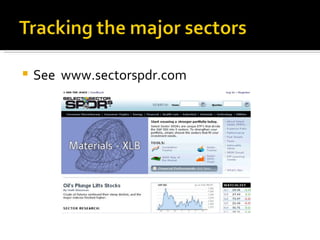
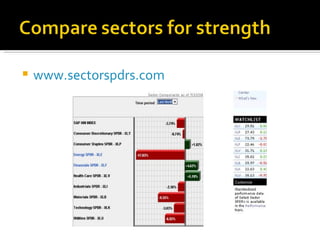
See  www.sectorspdr.com
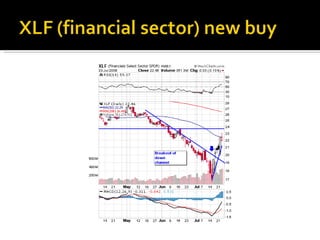
XLP- Consumer staples XLE-  Energy XLF-  Financial XLV-  Healthcare XLI-  Industrials XLB- Materials XLY-  Consumer discretionary XLK- Technology XLU- Utilities
 
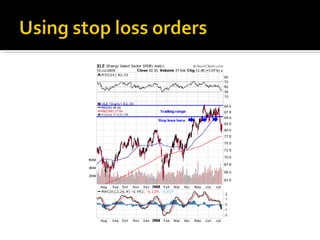
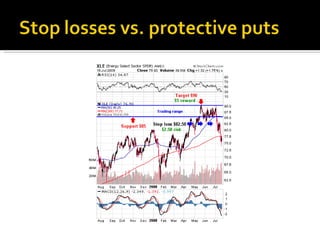
Protect your trade …in case you’re wrong. Use  stop losses  (automatic sell orders) just below support levels (the “floor”). Use  protective puts  (“buy insurance”) Portfolio management (know your limit).
 
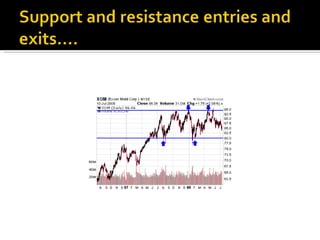
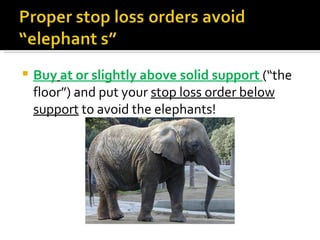
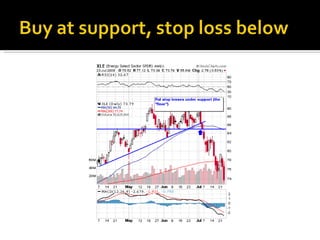
Buy   at or slightly above solid support  (“the floor”) and put your  stop loss order below support  to avoid the elephants!
 
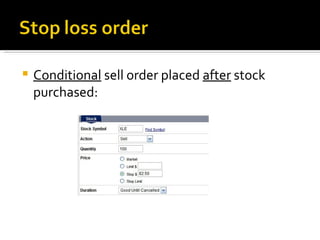
Conditional  sell order placed  after  stock purchased:
Risk/reward ratio  of 2 to 1 or better. Use  trailing stops  to lock in gains. The problem with  gapping stocks .
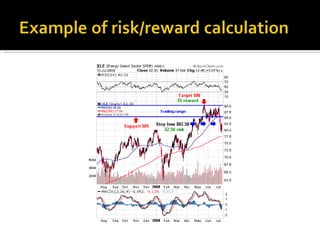
Define a  take-profit target , based on trend channels or resistance. (i.e. $25 target). Your  entry point  should be just above support. Determine how far your  entry point  is from your target.  (i.e. $20 entry is $5 away from the $25 target).  Using a  2 to 1 risk/reward ratio , your stop loss should be no lower than $17.5 ($2.50 away from $20).
 
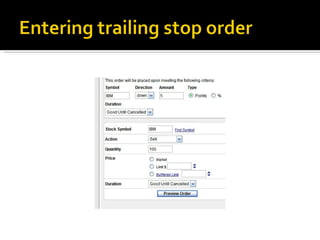
Useful for  locking in gains Primarily used when close to the target Either a $ amount or % amount Example:  A stock is nearing its $50 target (entry at $45), so the “hard” stop at $42.50 is cancelled.  In its place is a $2 trailing stop. When the stock drops $2, the trailing stop sell order will execute.
 
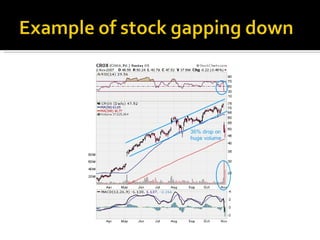
“ Gapping” refers to a stock that closes at one price and opens at another price. If the gap amount is substantial, then a stop loss may result in a  bigger loss  than originally planned for. Example:  A biotech stock closes at $22 on Friday and opens up at $12 on Monday (FDA denies a “blockbuster” drug).  Even if your stop loss is at $20, you may get filled on your sell order around $12.
 
Put options  are  insurance” contracts  that minimize your loss, if a stock goes down. Put options  give you the right to sell your stock at a  predetermined price .  Unlike stop loss orders,  protective put options   are effective when a stock gaps down significantly (“catastrophic” loss).
A  stop loss  is a trigger price for an automatic sell order at or below a certain price.  The only cost is the commission to sell the stock. Stop losses  may be  ineffective  for stocks that gap down significantly. A  protective put  is an option contract that acts as insurance.  The cost varies and there are several “deductible” levels. Protective puts   are highly effective for risk management, but there is an  upfront cost .
 
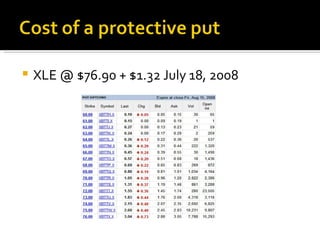
XLE @ $76.90 + $1.32 July 18, 2008
How much money allocated per trade? How much $$$$  risk  on each trade?  Your  risk  should be no more than  half  of your  realistic  target gain. Use a  proven   trading plan  (system)…follow your plan! SYSTEM  = “ S ave  Y our  S elf  T ime,  E nergy &  M oney”
 
Options involve risks and are not suitable for everyone. Option trading can be speculative in nature and carry substantial risk of loss. Only invest with  risk capital .  Standard Disclaimer
Used  properly , stock options may provide additional  income  and  protection  to your stock investments.
Buyers   of stock options  purchase  the  right  (not the obligation) to  buy stock (“call” options ) or  sell stock (“put” options)   at a predetermined  price  ($$) before a predetermined  time .
Analogy of land speculator (tie up property) Call buyer controls the underlying stock (i.e. IBM).  1 contract controls 100 shares of stock.  Buyers pay  a price  (premium). Predetermined “option to buy”  price  ( strike price ). Predetermined time   (expiration date).
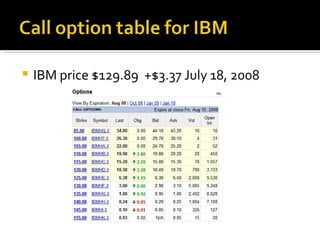
IBM price $129.89  +$3.37 July 18, 2008
One August  IBM $130 call contact  will cost a buyer $3.10 x 100 shares or  $310 .  For only  $310 , the buyer controls 100 shares of stock worth  $12,989 ! If IBM stock goes up only $1, an ATM (at the money option) is expected to increase about 50 cents.  That is a  16% return  ($50/$310).
Call  buyers  are  speculators   and the majority of options expire worthless!  Unlike the underlying stock, options have limited life. Call option  buyers   only  benefit if the underlying stock goes up in value   fast enough!   Option  buyers   ALWAYS  pay more than the real (“intrinsic”) value to begin with!
 
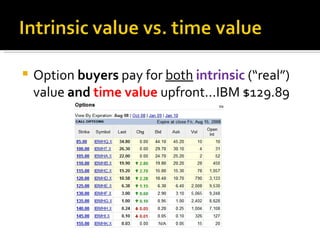
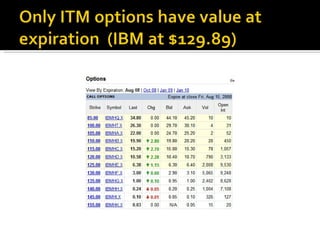
Option  buyers  pay   for  both   intrinsic  (“real”) value  and   time value  upfront...IBM $129.89
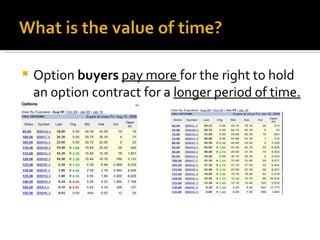
Option  buyers   pay more  for the right to hold an option contract for a  longer period of time.
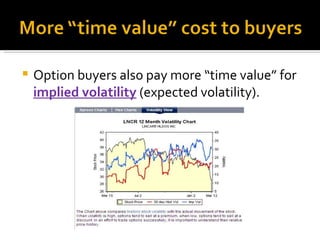
Option buyers also pay more “time value” for  implied volatility   (expected volatility).
An  ATM (“at the money”)  call option is the one with a strike price closest to the current price of the underlying stock. ITM (“in the money”)  call options are all the options with a  strike price less than the current value  of the underlying stock. OTM (“out of the money”)  call options are all options with a  strike price greater than the current value  of the underlying stock.
ITM (in the money) options  have  less than 10 times leverage  (1% move in an underlying stock with 10 times leverage increases the option 10%). ATM (at the money) options  have about  10 times leverage . OTM (out of the money) options  have up to  100+ times leverage !
OTM (out of the money) options  have the  least probability  of gaining intrinsic (real) value, so they are considered  extremely risky to buy. That is why OTM option  buyers  require such a large payback  if  they’re successful.
 
The buyer (“buy to open”) has the  right  to  BUY  the underlying stock at a certain price and pays a premium for that right. The seller (“sell to open” or “writer”) has an  obligation  to  SELL   the underlying stock at a certain price and  receives a premium  for that obligation.
Time value  (time and implied volatility) At expiration, there is  NO  time value left. The seller (call writer) may be  required  to deliver the stock at the agreed upon strike price if the stock is ITM at any time during the contract.
The  majority  of stock options expire worthless, meaning that the buyer loses and the seller keeps the money received upfront (premium). The option buyer risks only a small amount of money,  relative  to the obligation of the seller. Which one would you rather be?
The seller keeps the entire premium they were paid. Note:  The seller may be  called out  (required to deliver the stock at the strike price) if the stock moves higher than the strike price during the contract.
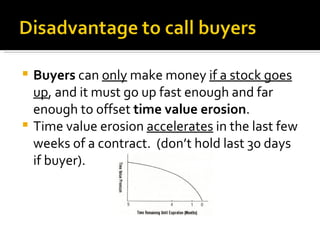
Buyers  can  only  make money  if a stock goes up , and it must go up fast enough and far enough to offset  time value erosion . Time value erosion  accelerates  in the last few weeks of a contract.  (don’t hold last 30 days if buyer).
Call writers  (“sell to open”) can make money if the underlying stock goes  down, sideways and even up !  (stock  must stay lower than break even….strike price plus premium received).
Sell  options that are  overvalued  (high time value/implied volatility). Sell  options that  expire in the next 30-60 days  to take advantage of the  high risk of buying short term call options .
Being the  seller  (“sell to open”) of a call option contract requires a relatively  large obligation , in exchange for a  nominal premium  brought in. If the seller does not own the underlying security, the option is considered  “uncovered” or “naked”. “ Naked” option approval must be received by your broker and is  considered the riskiest option trade by brokers  (brokers want to see funds).
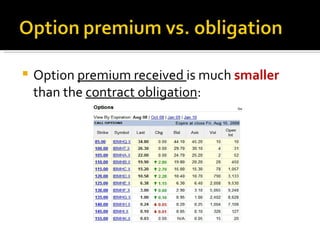
Option  premium received  is much  smaller   than the  contract obligation :
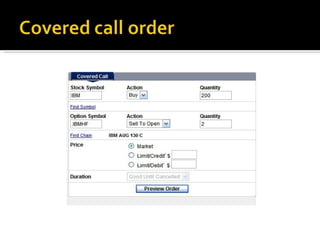
Writing (selling) a call option  contract while  simultaneously  owning  100 shares per option contract .  The underlying stock “covers” the obligation that the call writer takes on.
 
They provide  collateral  for your obligation. Now if the  stock goes up  and you’re “called out” (required to deliver stock at the strike price in the contract) you  make a gain on the stock  PLUS  you keep the option premium!  Covered calls reduce the breakeven cost of  the underlying stock.
With covered calls, you can have a  regular monthly income .  5-10% monthly target  includes stock appreciation and income from the covered call. Covered calls  are best used with stocks that are moving in a  sideways or uptrending direction  and are  not extremely volatile .
The option  strike price  limits  the upside potential of the underlying stock. The  stock may drop substantially ,  requiring the call writer to buy back the option before expiration .  In order to avoid having a naked option, the call must be bought back before the stock is sold.
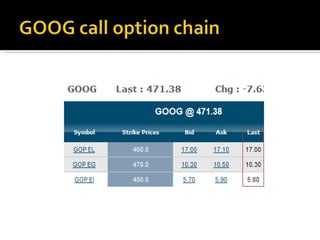
Buy the underlying security  (i.e. 100 shares of GOOG at $471.38) Sell a call option of the underlying stock (i.e. 1 GOOG call contract… GOP EI with a strike price of $480 @ $5.70) You would pay $47,138 to purchase 100 shares of GOOG and  receive a $570 credit in your account when you sell the option .
 
You  keep the $570 option premium  and  make up to $8.62 x100 shares ($862) more on the stock  (based on a gain from $471.38 to $480).  Since you will be required to deliver the stock at the $480 strike price,  if the stock price is above $480 at expiration , the  maximum gain on the stock is predetermined.
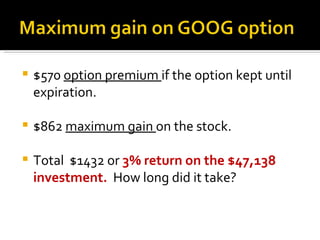
$570  option premium  if the option kept until expiration. $862  maximum gain  on the stock. Total  $1432 or  3% return on the $47,138 investment.   How long did it take?
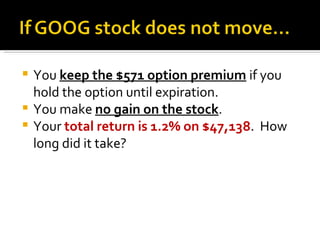
You  keep the $571 option premium   if you hold the option until expiration. You make  no gain on the stock . Your  total return is 1.2% on $47,138 .  How long did it take?
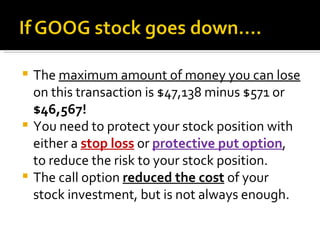
The  maximum amount of money you can lose  on this transaction is $47,138 minus $571 or  $46,567! You need to protect your stock position with either a  stop loss   or  protective put option , to reduce the risk to your stock position.  The call option  reduced the cost   of your stock investment, but is not always enough.
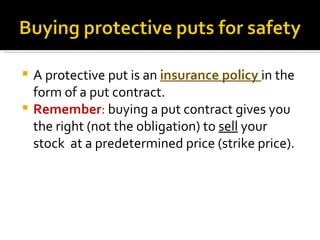
A protective put is an  insurance policy  in the form of a put contract. Remember :  buying a put contract gives you the right (not the obligation) to  sell  your stock  at a predetermined price (strike price).
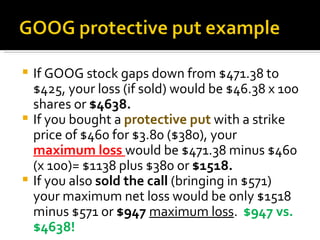
If GOOG stock gaps down from $471.38 to $425, your loss (if sold) would be $46.38 x 100 shares or  $4638. If you bought a  protective put  with a strike price of $460 for $3.80 ($380), your  maximum loss  would be $471.38 minus $460 (x 100)= $1138 plus $380 or  $1518. If you also  sold the call  (bringing in $571) your maximum net loss would be only $1518 minus $571 or  $947  maximum loss .  $947 vs. $4638!
You  limited  your catastrophic loss  with a  put option  (“insurance”) that was paid for by the  call option  you wrote.
Collars allow you to  pay for downside protection on a stock  (the protective put)  with the covered call premium . Collar strategies will be discussed later.
Buy  the stock at the same time that the call contract is written or… “ Leg in” to the trade by buying the stock “low” and writing the call contract when the stock is “high” to take advantage of the  higher option premium when the stock is at resistance.
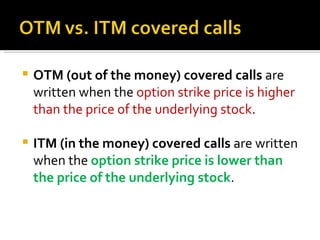
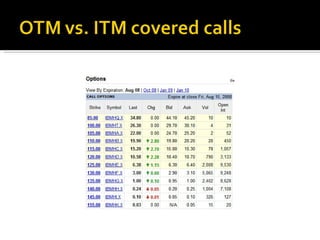
OTM (out of the money) covered calls  are written when the  option strike price is higher than the price of the underlying stock . ITM (in the money) covered calls  are written when the  option strike price is lower than the price of the underlying stock .
 
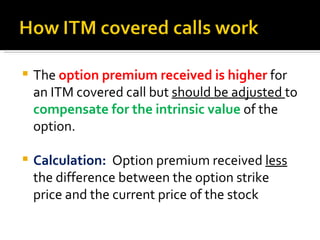
The  option premium received is higher  for an ITM covered call but  should be adjusted  to  compensate for the intrinsic value  of the option.  Calculation:  Option premium received  less  the difference between the option strike price and the current price of the stock
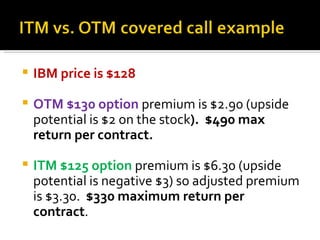
IBM price is $128 OTM $130 option  premium is $2.90 (upside potential is $2 on the stock ).  $490 max return per contract. ITM $125 option  premium is $6.30 (upside potential is negative $3) so adjusted premium is $3.30.  $330 maximum return per contract .
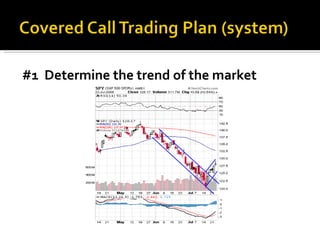
#1  Determine the trend of the market
#2  Trade in the direction of the market
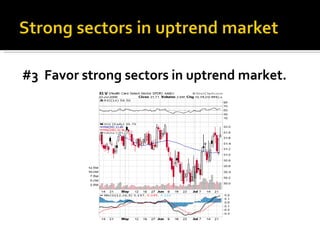
#3  Favor strong sectors in uptrend market.
www.sectorspdrs.com
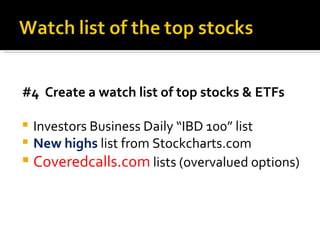
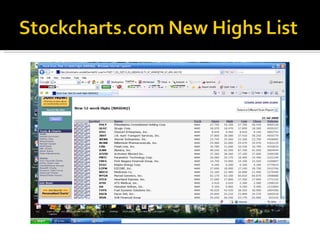
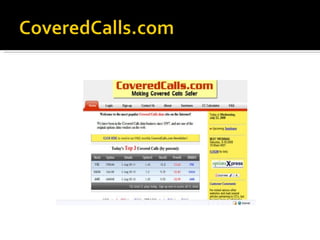
#4  Create a watch list of top stocks & ETFs Investors Business Daily “IBD 100” list New highs  list from Stockcharts.com Coveredcalls.com  lists (overvalued options)


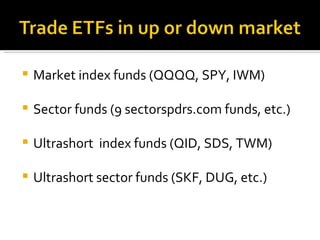
Market index funds (QQQQ, SPY, IWM) Sector funds (9 sectorspdrs.com funds, etc.) Ultrashort  index funds (QID, SDS, TWM) Ultrashort sector funds (SKF, DUG, etc.)
#5  Qualify stocks for possible trade Does the stock have options? Price  Average volume Volatility Trend
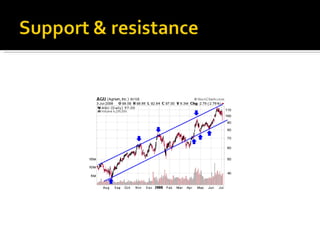
#6  Use technical analysis to find proper entry and exit points for stock purchase. Trend channels Support & resistance lines Moving averages Oscillators (bollinger bands, MACD, etc.)
 
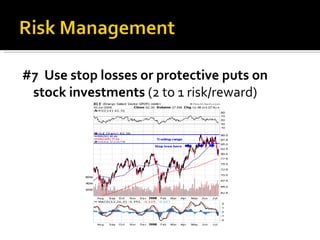
#7  Use stop losses or protective puts on stock investments  (2 to 1 risk/reward)
#8  Define your  maximum risk tolerance  per trade to determine # of shares to buy  100 share increments for covered calls  Example:  If your max. risk tolerance is $200 and your stop loss is $2 from entry, then you should buy no more than 100 shares.
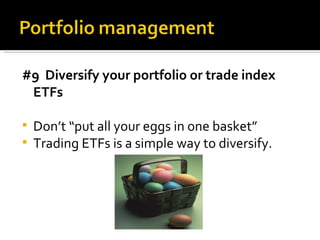
#9  Diversify your portfolio or trade index ETFs Don’t “put all your eggs in one basket” Trading ETFs is a simple way to diversify.
#10  Target 5-10% per month return Consult  CoveredCalls.com  for “overpriced” call options (“juiciest” premiums). Determine whether ITM (in the money) or OTM (out of the money) makes more sense. Use  collars  and other sophisticated strategies (more on this later).
Thank you for your participation. Wishing that you find a pot of gold at the end of the rainbow!

Covered call presentation

  • 1.
    St. George, UtahJuly 26, 2008
  • 2.
    Tim Oliver ProfessionalStock Market Coach Trading stocks & options for 15 years [email_address]
  • 3.
    Everything we discusstoday is for educational purposes only. We are not registered financial advisors. Whenever we discuss stocks or options, there will be no buy, sell, or hold recommendations.
  • 4.
    “ Only buysomething that you'd be perfectly happy to hold if the market shut down for 10 years. “ Warren Buffet
  • 5.
  • 6.
    Fundamental analysis helps us to know what companies/stocks to buy or sell. Technical analysis helps us to know when to buy and sell (chart reading).
  • 7.
    Investors Business Daily (2 week free subscription at www.investors.com)
  • 8.
    Stockcharts.com (freeor paid subscription)
  • 9.
    Which markets areyou trading in? Which stocks are you trading? Which direction are you trading? Do you understand fundamental and technical analysis? Do you use proper risk management?
  • 10.
  • 11.
  • 12.
  • 13.
  • 14.
  • 15.
  • 16.
  • 17.
  • 18.
  • 19.
  • 20.
  • 21.
    Trend channels Support/resistanceBollinger bands MACD/Stochastics (oscillators) Fibonacci retracement Elliott wave Moving averages
  • 22.
  • 23.
  • 24.
  • 25.
  • 26.
  • 27.
  • 28.
  • 29.
    Money market fundsCDs Real estate Bonds Mutual funds Education Stocks Put it under your mattress?
  • 30.
    Money market account…3percent per year! If you have $1 million, that is $2500/month Insured by the federal government Inflation rate: 3 percent per year Net Zero??? Can you live on that?
  • 31.
  • 32.
    1 in every118 households in Las Vegas had a foreclosure filing in May 2008. California foreclosures increased 72 percent from May 2007 to May 2008 Arizona had 1 in every 201 households filing foreclosures in May 2008 Sacramento , CA home prices dropped 29% this past year. Real estate doesn’t just go straight up…
  • 33.
  • 34.
  • 35.
    10 Best PerformingIndustries   Industry Name Percent Change (over time selected)      DJ US Coal Index 104.49%      DJ US Mining Index 74.44%      DJ US Exploration & Production Inde... 34.20%      DJ US Specialty Chemicals Index 26.48%      DJ US Oil Equipment & Services Inde... 25.09%      DJ US Oil Equipment, Services & Dis... 24.50%      DJ US Gold Mining Index 21.52%      DJ US Heavy Construction Index 20.37%      DJ US Brewers Index 19.32%      DJ US Oil & Gas Index 18.32%       10 Worst Performing Industries   Industry Name Percent Change (over time selected)      DJ US Mortgage Finance Index -76.77%      DJ US Airlines Index -62.12%      DJ US Full Line Insurance Index -58.20%      DJ US Automobiles Index -57.04%      DJ US Specialty Finance Index -55.41%      DJ US Consumer Electronics Index -55.20%      DJ US Tires Index -54.45%      DJ US Recreational Products Index -52.20%      DJ US Home Construction Index -51.53%      DJ US Banks Index -51.27% 
  • 36.
    Most stocks followthe overall market, so use an advance/decline indicator like $NASI. Trade the strongest stocks in the strongest sectors or trade ETFs (exchange traded funds). Identify risk vs. reward opportunities, using technical analysis .
  • 37.
  • 38.
    ETFs representa portfolio of stocks like a mutual fund in one stock. Reduced risk of individual company’s stock (i.e. trading “the energy sector” instead of just “Enron”). Major ETFs include QQQQ (Nasdaq 100) and QID (ultrashort QQQQ).
  • 39.
    Apple, Inc. 13.36% Qualcomm, Inc. 5.45% Microsoft Corporation 5.24% Google, Inc. 4.87% Research in Motion, Ltd. 4.50% Cisco Systems, Inc. 3.28% Gilead Sciences, Inc. 2.92% Oracle Corporation 2.82% Intel Corporation 2.71% Comcast Corporation A 1.87%
  • 40.
    10% gain vs.17% loss on SPY (“the market”) Stay out when $NASI gives sell signal Be in the market only at optimal times
  • 41.
  • 42.
    Selling short SPY (“the market”) when $NASI signals “ sell ” and buying SPY (“the market”) when $NASI signals “ buy ” turns a 17% loss into a 33% gain !
  • 43.
  • 44.
    10 Best PerformingIndustries   Industry Name Percent Change ( 12 months…July 2008)    DJ US Coal Index 104.49%      DJ US Mining Index 74.44%      DJ US Exploration & Production Inde... 34.20%      DJ US Specialty Chemicals Index 26.48%      DJ US Oil Equipment & Services Inde... 25.09%      DJ US Oil Equipment, Services & Dis... 24.50%      DJ US Gold Mining Index 21.52%      DJ US Heavy Construction Index 20.37%      DJ US Brewers Index 19.32%      DJ US Oil & Gas Index 18.32%  
  • 45.
  • 46.
      10 WorstPerforming Industries   Industry Name Percent Change (12 months…July 5, 2008))      DJ US Mortgage Finance Index -76.77%      DJ US Airlines Index -62.12%      DJ US Full Line Insurance Index -58.20%      DJ US Automobiles Index -57.04%      DJ US Specialty Finance Index -55.41%      DJ US Consumer Electronics Index -55.20%      DJ US Tires Index -54.45%      DJ US Recreational Products Index -52.20%      DJ US Home Construction Index -51.53%      DJ US Banks Index -51.27% 
  • 47.
    Ultrashort Financials (SKF) 30% return Ultrashort Basic Materials (SMN) 26% return Ultrashort Real Estate (SRS) 22% return Ultrashort Dow 30 (DXD) 21% return Ultrashort Russell 2000 (TWM) 20% return Ultrashort S&P500 (SDS) 19% return
  • 48.
  • 49.
  • 50.
  • 51.
  • 52.
  • 53.
    XLP- Consumer staplesXLE- Energy XLF- Financial XLV- Healthcare XLI- Industrials XLB- Materials XLY- Consumer discretionary XLK- Technology XLU- Utilities
  • 54.
  • 55.
    Protect your trade…in case you’re wrong. Use stop losses (automatic sell orders) just below support levels (the “floor”). Use protective puts (“buy insurance”) Portfolio management (know your limit).
  • 56.
  • 57.
    Buy at or slightly above solid support (“the floor”) and put your stop loss order below support to avoid the elephants!
  • 58.
  • 59.
    Conditional sellorder placed after stock purchased:
  • 60.
    Risk/reward ratio of 2 to 1 or better. Use trailing stops to lock in gains. The problem with gapping stocks .
  • 61.
    Define a take-profit target , based on trend channels or resistance. (i.e. $25 target). Your entry point should be just above support. Determine how far your entry point is from your target. (i.e. $20 entry is $5 away from the $25 target). Using a 2 to 1 risk/reward ratio , your stop loss should be no lower than $17.5 ($2.50 away from $20).
  • 62.
  • 63.
    Useful for locking in gains Primarily used when close to the target Either a $ amount or % amount Example: A stock is nearing its $50 target (entry at $45), so the “hard” stop at $42.50 is cancelled. In its place is a $2 trailing stop. When the stock drops $2, the trailing stop sell order will execute.
  • 64.
  • 65.
    “ Gapping” refersto a stock that closes at one price and opens at another price. If the gap amount is substantial, then a stop loss may result in a bigger loss than originally planned for. Example: A biotech stock closes at $22 on Friday and opens up at $12 on Monday (FDA denies a “blockbuster” drug). Even if your stop loss is at $20, you may get filled on your sell order around $12.
  • 66.
  • 67.
    Put options are insurance” contracts that minimize your loss, if a stock goes down. Put options give you the right to sell your stock at a predetermined price . Unlike stop loss orders, protective put options are effective when a stock gaps down significantly (“catastrophic” loss).
  • 68.
    A stoploss is a trigger price for an automatic sell order at or below a certain price. The only cost is the commission to sell the stock. Stop losses may be ineffective for stocks that gap down significantly. A protective put is an option contract that acts as insurance. The cost varies and there are several “deductible” levels. Protective puts are highly effective for risk management, but there is an upfront cost .
  • 69.
  • 70.
    XLE @ $76.90+ $1.32 July 18, 2008
  • 71.
    How much moneyallocated per trade? How much $$$$ risk on each trade? Your risk should be no more than half of your realistic target gain. Use a proven trading plan (system)…follow your plan! SYSTEM = “ S ave Y our S elf T ime, E nergy & M oney”
  • 72.
  • 73.
    Options involve risksand are not suitable for everyone. Option trading can be speculative in nature and carry substantial risk of loss. Only invest with risk capital . Standard Disclaimer
  • 74.
    Used properly, stock options may provide additional income and protection to your stock investments.
  • 75.
    Buyers of stock options purchase the right (not the obligation) to buy stock (“call” options ) or sell stock (“put” options) at a predetermined price ($$) before a predetermined time .
  • 76.
    Analogy of landspeculator (tie up property) Call buyer controls the underlying stock (i.e. IBM). 1 contract controls 100 shares of stock. Buyers pay a price (premium). Predetermined “option to buy” price ( strike price ). Predetermined time (expiration date).
  • 77.
    IBM price $129.89 +$3.37 July 18, 2008
  • 78.
    One August IBM $130 call contact will cost a buyer $3.10 x 100 shares or $310 . For only $310 , the buyer controls 100 shares of stock worth $12,989 ! If IBM stock goes up only $1, an ATM (at the money option) is expected to increase about 50 cents. That is a 16% return ($50/$310).
  • 79.
    Call buyers are speculators and the majority of options expire worthless! Unlike the underlying stock, options have limited life. Call option buyers only benefit if the underlying stock goes up in value fast enough! Option buyers ALWAYS pay more than the real (“intrinsic”) value to begin with!
  • 80.
  • 81.
    Option buyers pay for both intrinsic (“real”) value and time value upfront...IBM $129.89
  • 82.
    Option buyers pay more for the right to hold an option contract for a longer period of time.
  • 83.
    Option buyers alsopay more “time value” for implied volatility (expected volatility).
  • 84.
    An ATM(“at the money”) call option is the one with a strike price closest to the current price of the underlying stock. ITM (“in the money”) call options are all the options with a strike price less than the current value of the underlying stock. OTM (“out of the money”) call options are all options with a strike price greater than the current value of the underlying stock.
  • 85.
    ITM (in themoney) options have less than 10 times leverage (1% move in an underlying stock with 10 times leverage increases the option 10%). ATM (at the money) options have about 10 times leverage . OTM (out of the money) options have up to 100+ times leverage !
  • 86.
    OTM (out ofthe money) options have the least probability of gaining intrinsic (real) value, so they are considered extremely risky to buy. That is why OTM option buyers require such a large payback if they’re successful.
  • 87.
  • 88.
    The buyer (“buyto open”) has the right to BUY the underlying stock at a certain price and pays a premium for that right. The seller (“sell to open” or “writer”) has an obligation to SELL the underlying stock at a certain price and receives a premium for that obligation.
  • 89.
    Time value (time and implied volatility) At expiration, there is NO time value left. The seller (call writer) may be required to deliver the stock at the agreed upon strike price if the stock is ITM at any time during the contract.
  • 90.
    The majority of stock options expire worthless, meaning that the buyer loses and the seller keeps the money received upfront (premium). The option buyer risks only a small amount of money, relative to the obligation of the seller. Which one would you rather be?
  • 91.
    The seller keepsthe entire premium they were paid. Note: The seller may be called out (required to deliver the stock at the strike price) if the stock moves higher than the strike price during the contract.
  • 92.
    Buyers can only make money if a stock goes up , and it must go up fast enough and far enough to offset time value erosion . Time value erosion accelerates in the last few weeks of a contract. (don’t hold last 30 days if buyer).
  • 93.
    Call writers (“sell to open”) can make money if the underlying stock goes down, sideways and even up ! (stock must stay lower than break even….strike price plus premium received).
  • 94.
    Sell optionsthat are overvalued (high time value/implied volatility). Sell options that expire in the next 30-60 days to take advantage of the high risk of buying short term call options .
  • 95.
    Being the seller (“sell to open”) of a call option contract requires a relatively large obligation , in exchange for a nominal premium brought in. If the seller does not own the underlying security, the option is considered “uncovered” or “naked”. “ Naked” option approval must be received by your broker and is considered the riskiest option trade by brokers (brokers want to see funds).
  • 96.
    Option premiumreceived is much smaller than the contract obligation :
  • 97.
    Writing (selling) acall option contract while simultaneously owning 100 shares per option contract . The underlying stock “covers” the obligation that the call writer takes on.
  • 98.
  • 99.
    They provide collateral for your obligation. Now if the stock goes up and you’re “called out” (required to deliver stock at the strike price in the contract) you make a gain on the stock PLUS you keep the option premium! Covered calls reduce the breakeven cost of the underlying stock.
  • 100.
    With covered calls,you can have a regular monthly income . 5-10% monthly target includes stock appreciation and income from the covered call. Covered calls are best used with stocks that are moving in a sideways or uptrending direction and are not extremely volatile .
  • 101.
    The option strike price limits the upside potential of the underlying stock. The stock may drop substantially , requiring the call writer to buy back the option before expiration . In order to avoid having a naked option, the call must be bought back before the stock is sold.
  • 102.
    Buy the underlyingsecurity (i.e. 100 shares of GOOG at $471.38) Sell a call option of the underlying stock (i.e. 1 GOOG call contract… GOP EI with a strike price of $480 @ $5.70) You would pay $47,138 to purchase 100 shares of GOOG and receive a $570 credit in your account when you sell the option .
  • 103.
  • 104.
    You keepthe $570 option premium and make up to $8.62 x100 shares ($862) more on the stock (based on a gain from $471.38 to $480). Since you will be required to deliver the stock at the $480 strike price, if the stock price is above $480 at expiration , the maximum gain on the stock is predetermined.
  • 105.
    $570 optionpremium if the option kept until expiration. $862 maximum gain on the stock. Total $1432 or 3% return on the $47,138 investment. How long did it take?
  • 106.
    You keepthe $571 option premium if you hold the option until expiration. You make no gain on the stock . Your total return is 1.2% on $47,138 . How long did it take?
  • 107.
    The maximumamount of money you can lose on this transaction is $47,138 minus $571 or $46,567! You need to protect your stock position with either a stop loss or protective put option , to reduce the risk to your stock position. The call option reduced the cost of your stock investment, but is not always enough.
  • 108.
    A protective putis an insurance policy in the form of a put contract. Remember : buying a put contract gives you the right (not the obligation) to sell your stock at a predetermined price (strike price).
  • 109.
    If GOOG stockgaps down from $471.38 to $425, your loss (if sold) would be $46.38 x 100 shares or $4638. If you bought a protective put with a strike price of $460 for $3.80 ($380), your maximum loss would be $471.38 minus $460 (x 100)= $1138 plus $380 or $1518. If you also sold the call (bringing in $571) your maximum net loss would be only $1518 minus $571 or $947 maximum loss . $947 vs. $4638!
  • 110.
    You limited your catastrophic loss with a put option (“insurance”) that was paid for by the call option you wrote.
  • 111.
    Collars allow youto pay for downside protection on a stock (the protective put) with the covered call premium . Collar strategies will be discussed later.
  • 112.
    Buy thestock at the same time that the call contract is written or… “ Leg in” to the trade by buying the stock “low” and writing the call contract when the stock is “high” to take advantage of the higher option premium when the stock is at resistance.
  • 113.
    OTM (out ofthe money) covered calls are written when the option strike price is higher than the price of the underlying stock . ITM (in the money) covered calls are written when the option strike price is lower than the price of the underlying stock .
  • 114.
  • 115.
    The optionpremium received is higher for an ITM covered call but should be adjusted to compensate for the intrinsic value of the option. Calculation: Option premium received less the difference between the option strike price and the current price of the stock
  • 116.
    IBM price is$128 OTM $130 option premium is $2.90 (upside potential is $2 on the stock ). $490 max return per contract. ITM $125 option premium is $6.30 (upside potential is negative $3) so adjusted premium is $3.30. $330 maximum return per contract .
  • 117.
    #1 Determinethe trend of the market
  • 118.
    #2 Tradein the direction of the market
  • 119.
    #3 Favorstrong sectors in uptrend market.
  • 120.
  • 121.
    #4 Createa watch list of top stocks & ETFs Investors Business Daily “IBD 100” list New highs list from Stockcharts.com Coveredcalls.com lists (overvalued options)
  • 122.
  • 123.
  • 124.
  • 125.
    Market index funds(QQQQ, SPY, IWM) Sector funds (9 sectorspdrs.com funds, etc.) Ultrashort index funds (QID, SDS, TWM) Ultrashort sector funds (SKF, DUG, etc.)
  • 126.
    #5 Qualifystocks for possible trade Does the stock have options? Price Average volume Volatility Trend
  • 127.
    #6 Usetechnical analysis to find proper entry and exit points for stock purchase. Trend channels Support & resistance lines Moving averages Oscillators (bollinger bands, MACD, etc.)
  • 128.
  • 129.
    #7 Usestop losses or protective puts on stock investments (2 to 1 risk/reward)
  • 130.
    #8 Defineyour maximum risk tolerance per trade to determine # of shares to buy 100 share increments for covered calls Example: If your max. risk tolerance is $200 and your stop loss is $2 from entry, then you should buy no more than 100 shares.
  • 131.
    #9 Diversifyyour portfolio or trade index ETFs Don’t “put all your eggs in one basket” Trading ETFs is a simple way to diversify.
  • 132.
    #10 Target5-10% per month return Consult CoveredCalls.com for “overpriced” call options (“juiciest” premiums). Determine whether ITM (in the money) or OTM (out of the money) makes more sense. Use collars and other sophisticated strategies (more on this later).
  • 133.
    Thank you foryour participation. Wishing that you find a pot of gold at the end of the rainbow!