Management Control Systems
(MCS)
- Supriya Pendse
- Chartered Acountant, CPA
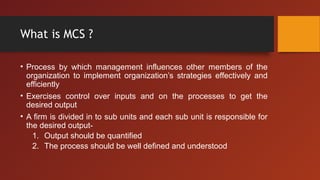
What is MCS ?
• Process by which management influences other members of the
organization to implement organization’s strategies effectively and
efficiently
• Exercises control over inputs and on the processes to get the
desired output
• A firm is divided in to sub units and each sub unit is responsible for
the desired output-
1. Output should be quantified
2. The process should be well defined and understood
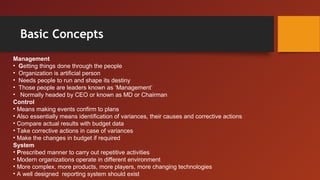
Basic Concepts
Management
• Getting things done through the people
• Organization is artificial person
• Needs people to run and shape its destiny
• Those people are leaders known as ‘Management’
• Normally headed by CEO or known as MD or Chairman
Control
• Means making events confirm to plans
• Also essentially means identification of variances, their causes and corrective actions
• Compare actual results with budget data
• Take corrective actions in case of variances
• Make the changes in budget if required
System
• Prescribed manner to carry out repetitive activities
• Modern organizations operate in different environment
• More complex, more products, more players, more changing technologies
• A well designed reporting system should exist
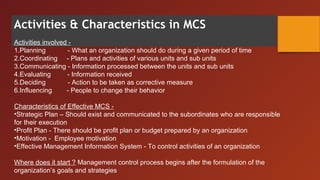
Activities & Characteristics in MCS
Activities involved -
1.Planning - What an organization should do during a given period of time
2.Coordinating - Plans and activities of various units and sub units
3.Communicating - Information processed between the units and sub units
4.Evaluating - Information received
5.Deciding - Action to be taken as corrective measure
6.Influencing - People to change their behavior
Characteristics of Effective MCS -
•Strategic Plan – Should exist and communicated to the subordinates who are responsible
for their execution
•Profit Plan - There should be profit plan or budget prepared by an organization
•Motivation - Employee motivation
•Effective Management Information System - To control activities of an organization
Where does it start ? Management control process begins after the formulation of the
organization’s goals and strategies
Understanding Strategies
What is Strategy -
•Determination of basic long term goals and objectives of organization
•Adoption of course of action
•Allocation of resources necessary for carrying out these goals
Role of Strategies in Business -
•Minimize risk – Require alternative strategy for contingencies
•Decision Making - Provide necessary guidance and direction (e.g. – bank’s internal policy)
•Achieve objectives - Direction and guidance to achieve growth, profitability, stability
•Facilitate Organizing – Resources required and broad targets to be achieved over period of time
•Control - Helps to control various functions
Organization can compare actual performance with targets
In case of deviations necessary action can be taken
•Motivation - Employees are motivated to put in their best performance in order to achieve desired
objectives
•Optimum use of resources - Available resources used to the maximum extent if strategies
are to be followed
Strategy formulation and Policies
Strategy Formulation -
1.Framing mission and objectives - Mission states the philosophy and purpose of organization
2.Analysis of Internal environment - Manpower, machineries, methods, money, procedures
and other resources
3.Analysis of External environment –Govt. policies, competition, types of customers,
technological development etc.
4.Gap analysis - Comparing present with desired future performance level
5.Framing alternative strategies
6.Choice of strategy - Select appropriate from the alternative strategies
Policies and Strategies -
•Policies are guidelines for decision making , can be delegated downwards in organization
•Effective for decision making to subordinates. Policy is concerned with course of action.
•It can be expressed or sometimes implied
•Strategies are plans that helps in achievement of organizational goals and objectives
•Cannot be delegated as it requires last minute executive decisions
•Strategies are concerned with uncertainties, competitive situations and risks for future date
•It is a specific statement which must be in writing in explicit terms
Strategy and Tactics
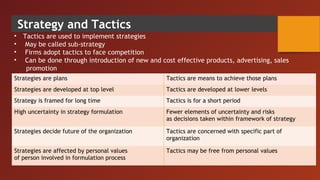
• Tactics are used to implement strategies
• May be called sub-strategy
• Firms adopt tactics to face competition
• Can be done through introduction of new and cost effective products, advertising, sales
promotion
Strategies are plans Tactics are means to achieve those plans
Strategies are developed at top level Tactics are developed at lower levels
Strategy is framed for long time Tactics is for a short period
High uncertainty in strategy formulation Fewer elements of uncertainty and risks
as decisions taken within framework of strategy
Strategies decide future of the organization Tactics are concerned with specific part of
organization
Strategies are affected by personal values
of person involved in formulation process, Tactics may be free from personal values
Strategies are plans Tactics are means to achieve those plans
Strategies are developed at top level Tactics are developed at lower levels
Strategy is framed for long time Tactics is for a short period
High uncertainty in strategy formulation Fewer elements of uncertainty and risks
as decisions taken within framework of strategy
Strategies decide future of the organization Tactics are concerned with specific part of
organization
Strategies are affected by personal values
of person involved in formulation process
Tactics may be free from personal values
Perspective of MCS
•Management control system lies between strategy formulation and operational control
•MCS has boundaries namely strategy formulation, operational control and financial control
•Out of these strategy formulation has been found to be least systematic
•Operational control most systematic
•Whereas Management control falling in between
•The strategy formulation focuses on the long run, operational control on short term operating activities
and management control lies in between.
•Strategy formulation is based on the rough approximations of the future, operational control makes
the use of current accurate data and management control lies in between.
•Each activity involves planning and control but there is a degree of variation. Planning is much more
important in strategy formulation, both planning and control processes are of equal importance in
management control. However the control process is much more important in operational control.
Strategy planning and Management control
Perspective of MCSCharacteristics Strategic Planning Management Control
Focus of plans On one aspect at a time On entire organization
Complexities Many variables, hence more complex Less complex
Structure Unstructured and irregular Definite pattern, set procedures
Nature of Information More external and unpredicted and
less accurate
Internal, historical and more
accurate
Communication of Information Relatively simple Relatively difficult
Purpose of Estimates Show expected results lead to desired results
Persons involved Top management Line and top management
No. of persons Small Large
Planning and Control Planning dominant but some control Emphasis on both planning and
control
Time Horizon Tends to be long Tends to be short
End result Policies and procedures Action within policies laid
Appraisal of job Extremely difficult Less difficult
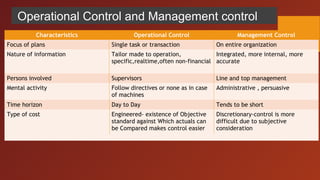
Operational Control and Management control
Perspective of MCSCharacteristics Operational Control Management Control
Focus of plans Single task or transaction On entire organization
Nature of information Tailor made to operation,
specific,realtime,often non-financial
Integrated, more internal, more
accurate
Persons involved Supervisors Line and top management
Mental activity Follow directives or none as in case
of machines
Administrative , persuasive
Time horizon Day to Day Tends to be short
Type of cost Engineered- existence of Objective
standard against Which actuals can
be Compared makes control easier
Discretionary-control is more
difficult due to subjective
consideration
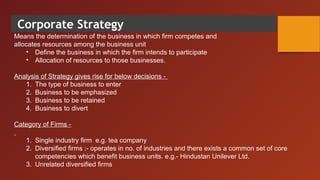
Corporate Strategy
Means the determination of the business in which firm competes and
allocates resources among the business unit
• Define the business in which the firm intends to participate
• Allocation of resources to those businesses.
Analysis of Strategy gives rise for below decisions -
1. The type of business to enter
2. Business to be emphasized
3. Business to be retained
4. Business to divert
Category of Firms -
1. Single industry firm e.g. tea company
2. Diversified firms :- operates in no. of industries and there exists a common set of core
competencies which benefit business units. e.g.- Hindustan Unilever Ltd.
3. Unrelated diversified firms
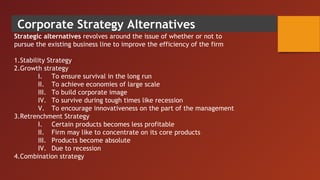
Corporate Strategy Alternatives
Strategic alternatives revolves around the issue of whether or not to
pursue the existing business line to improve the efficiency of the firm
1.Stability Strategy
2.Growth strategy
I. To ensure survival in the long run
II. To achieve economies of large scale
III. To build corporate image
IV. To survive during tough times like recession
V. To encourage innovativeness on the part of the management
3.Retrenchment Strategy
I. Certain products becomes less profitable
II. Firm may like to concentrate on its core products
III. Products become absolute
IV. Due to recession
4.Combination strategy
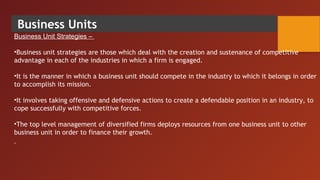
Business Units
Business Unit Strategies –
•Business unit strategies are those which deal with the creation and sustenance of competitive
advantage in each of the industries in which a firm is engaged.
•It is the manner in which a business unit should compete in the industry to which it belongs in order
to accomplish its mission.
 
•It involves taking offensive and defensive actions to create a defendable position in an industry, to
cope successfully with competitive forces.
 
•The top level management of diversified firms deploys resources from one business unit to other
business unit in order to finance their growth.
Business Units
Strategic Business Unit (SBU) –
•Created for multi product or multi-geographical area companies
•To manage effectively each of the products or group of products
Important Aspects of SBU –
Independent Management - Each SBU is managed like a separate company
Strategy - Each SBU formulates for itself a clearly defined strategy
However SBU strategy should be aligned with overall strategy of the organization
Resources - Each SBU has allocated resources in the form of physical, human and financial
depending upon its activities and contributions made by it to the organization
Intra competition - Each SBU competes with the other SBU in the same organization
Advantages of SBUs
Advantages of SBU –
1.Effective Management
2.Proper recognition
3.Employee motivation
4.Higher efficiency
5.Better customer service
6.Facilitates innovation
7.Improvement of corporate image
Boundaries
• Boundaries of Management Control Goals -
• Strategies are the plans to achieve organizational goals.
• MCS are tools to implement strategies.
• Goals of a corporation are determined by the CEO.
• The management control fits between strategy formulation and
task control in several aspects. Strategy formulation is least
systematic of the three, task control most systematic and
management control lies in between.
Boundaries of MCS
• Strategy formulation focuses on the long run, task control focuses on short run activities and
management control lies in between.
• Strategy formulation uses rough approximates of future, task control uses current accurate
data and management control lies in between.
• Each activity involves both planning and control but the emphasis varies with the type of activity.
• The planning process is much more important in strategy formulation, the control process is
much more important in task control and planning and control are of approximately equal
importance in management control.
• Management control does not necessarily require that all actions correspond to a predetermined
plan. The plans are based on circumstances believed to exist at time they are formulated. The
actions followed by the plan may no longer be approximate, if these circumstances are changed
at the time of implementation.
• The management control involves anticipating future conditions to ensure the organization’s
objectives are achieved.
• Thus confirming a budget is not necessarily good, and departure is also not necessarily bad.
• MCS help managers move an organization towards its strategic objectives.

Management control systems1 (mcs)

  • 1.
    Management Control Systems (MCS) -Supriya Pendse - Chartered Acountant, CPA
  • 2.
    What is MCS? • Process by which management influences other members of the organization to implement organization’s strategies effectively and efficiently • Exercises control over inputs and on the processes to get the desired output • A firm is divided in to sub units and each sub unit is responsible for the desired output- 1. Output should be quantified 2. The process should be well defined and understood
  • 3.
    Basic Concepts Management • Gettingthings done through the people • Organization is artificial person • Needs people to run and shape its destiny • Those people are leaders known as ‘Management’ • Normally headed by CEO or known as MD or Chairman Control • Means making events confirm to plans • Also essentially means identification of variances, their causes and corrective actions • Compare actual results with budget data • Take corrective actions in case of variances • Make the changes in budget if required System • Prescribed manner to carry out repetitive activities • Modern organizations operate in different environment • More complex, more products, more players, more changing technologies • A well designed reporting system should exist
  • 4.
    Activities & Characteristicsin MCS Activities involved - 1.Planning - What an organization should do during a given period of time 2.Coordinating - Plans and activities of various units and sub units 3.Communicating - Information processed between the units and sub units 4.Evaluating - Information received 5.Deciding - Action to be taken as corrective measure 6.Influencing - People to change their behavior Characteristics of Effective MCS - •Strategic Plan – Should exist and communicated to the subordinates who are responsible for their execution •Profit Plan - There should be profit plan or budget prepared by an organization •Motivation - Employee motivation •Effective Management Information System - To control activities of an organization Where does it start ? Management control process begins after the formulation of the organization’s goals and strategies
  • 5.
    Understanding Strategies What isStrategy - •Determination of basic long term goals and objectives of organization •Adoption of course of action •Allocation of resources necessary for carrying out these goals Role of Strategies in Business - •Minimize risk – Require alternative strategy for contingencies •Decision Making - Provide necessary guidance and direction (e.g. – bank’s internal policy) •Achieve objectives - Direction and guidance to achieve growth, profitability, stability •Facilitate Organizing – Resources required and broad targets to be achieved over period of time •Control - Helps to control various functions Organization can compare actual performance with targets In case of deviations necessary action can be taken •Motivation - Employees are motivated to put in their best performance in order to achieve desired objectives •Optimum use of resources - Available resources used to the maximum extent if strategies are to be followed
  • 6.
    Strategy formulation andPolicies Strategy Formulation - 1.Framing mission and objectives - Mission states the philosophy and purpose of organization 2.Analysis of Internal environment - Manpower, machineries, methods, money, procedures and other resources 3.Analysis of External environment –Govt. policies, competition, types of customers, technological development etc. 4.Gap analysis - Comparing present with desired future performance level 5.Framing alternative strategies 6.Choice of strategy - Select appropriate from the alternative strategies Policies and Strategies - •Policies are guidelines for decision making , can be delegated downwards in organization •Effective for decision making to subordinates. Policy is concerned with course of action. •It can be expressed or sometimes implied •Strategies are plans that helps in achievement of organizational goals and objectives •Cannot be delegated as it requires last minute executive decisions •Strategies are concerned with uncertainties, competitive situations and risks for future date •It is a specific statement which must be in writing in explicit terms
  • 7.
    Strategy and Tactics •Tactics are used to implement strategies • May be called sub-strategy • Firms adopt tactics to face competition • Can be done through introduction of new and cost effective products, advertising, sales promotion Strategies are plans Tactics are means to achieve those plans Strategies are developed at top level Tactics are developed at lower levels Strategy is framed for long time Tactics is for a short period High uncertainty in strategy formulation Fewer elements of uncertainty and risks as decisions taken within framework of strategy Strategies decide future of the organization Tactics are concerned with specific part of organization Strategies are affected by personal values of person involved in formulation process, Tactics may be free from personal values Strategies are plans Tactics are means to achieve those plans Strategies are developed at top level Tactics are developed at lower levels Strategy is framed for long time Tactics is for a short period High uncertainty in strategy formulation Fewer elements of uncertainty and risks as decisions taken within framework of strategy Strategies decide future of the organization Tactics are concerned with specific part of organization Strategies are affected by personal values of person involved in formulation process Tactics may be free from personal values
  • 8.
    Perspective of MCS •Managementcontrol system lies between strategy formulation and operational control •MCS has boundaries namely strategy formulation, operational control and financial control •Out of these strategy formulation has been found to be least systematic •Operational control most systematic •Whereas Management control falling in between •The strategy formulation focuses on the long run, operational control on short term operating activities and management control lies in between. •Strategy formulation is based on the rough approximations of the future, operational control makes the use of current accurate data and management control lies in between. •Each activity involves planning and control but there is a degree of variation. Planning is much more important in strategy formulation, both planning and control processes are of equal importance in management control. However the control process is much more important in operational control.
  • 9.
    Strategy planning andManagement control Perspective of MCSCharacteristics Strategic Planning Management Control Focus of plans On one aspect at a time On entire organization Complexities Many variables, hence more complex Less complex Structure Unstructured and irregular Definite pattern, set procedures Nature of Information More external and unpredicted and less accurate Internal, historical and more accurate Communication of Information Relatively simple Relatively difficult Purpose of Estimates Show expected results lead to desired results Persons involved Top management Line and top management No. of persons Small Large Planning and Control Planning dominant but some control Emphasis on both planning and control Time Horizon Tends to be long Tends to be short End result Policies and procedures Action within policies laid Appraisal of job Extremely difficult Less difficult
  • 10.
    Operational Control andManagement control Perspective of MCSCharacteristics Operational Control Management Control Focus of plans Single task or transaction On entire organization Nature of information Tailor made to operation, specific,realtime,often non-financial Integrated, more internal, more accurate Persons involved Supervisors Line and top management Mental activity Follow directives or none as in case of machines Administrative , persuasive Time horizon Day to Day Tends to be short Type of cost Engineered- existence of Objective standard against Which actuals can be Compared makes control easier Discretionary-control is more difficult due to subjective consideration
  • 11.
    Corporate Strategy Means thedetermination of the business in which firm competes and allocates resources among the business unit • Define the business in which the firm intends to participate • Allocation of resources to those businesses. Analysis of Strategy gives rise for below decisions - 1. The type of business to enter 2. Business to be emphasized 3. Business to be retained 4. Business to divert Category of Firms - 1. Single industry firm e.g. tea company 2. Diversified firms :- operates in no. of industries and there exists a common set of core competencies which benefit business units. e.g.- Hindustan Unilever Ltd. 3. Unrelated diversified firms
  • 12.
    Corporate Strategy Alternatives Strategicalternatives revolves around the issue of whether or not to pursue the existing business line to improve the efficiency of the firm 1.Stability Strategy 2.Growth strategy I. To ensure survival in the long run II. To achieve economies of large scale III. To build corporate image IV. To survive during tough times like recession V. To encourage innovativeness on the part of the management 3.Retrenchment Strategy I. Certain products becomes less profitable II. Firm may like to concentrate on its core products III. Products become absolute IV. Due to recession 4.Combination strategy
  • 13.
    Business Units Business UnitStrategies – •Business unit strategies are those which deal with the creation and sustenance of competitive advantage in each of the industries in which a firm is engaged. •It is the manner in which a business unit should compete in the industry to which it belongs in order to accomplish its mission.   •It involves taking offensive and defensive actions to create a defendable position in an industry, to cope successfully with competitive forces.   •The top level management of diversified firms deploys resources from one business unit to other business unit in order to finance their growth.
  • 14.
    Business Units Strategic BusinessUnit (SBU) – •Created for multi product or multi-geographical area companies •To manage effectively each of the products or group of products Important Aspects of SBU – Independent Management - Each SBU is managed like a separate company Strategy - Each SBU formulates for itself a clearly defined strategy However SBU strategy should be aligned with overall strategy of the organization Resources - Each SBU has allocated resources in the form of physical, human and financial depending upon its activities and contributions made by it to the organization Intra competition - Each SBU competes with the other SBU in the same organization
  • 15.
    Advantages of SBUs Advantagesof SBU – 1.Effective Management 2.Proper recognition 3.Employee motivation 4.Higher efficiency 5.Better customer service 6.Facilitates innovation 7.Improvement of corporate image
  • 16.
    Boundaries • Boundaries ofManagement Control Goals - • Strategies are the plans to achieve organizational goals. • MCS are tools to implement strategies. • Goals of a corporation are determined by the CEO. • The management control fits between strategy formulation and task control in several aspects. Strategy formulation is least systematic of the three, task control most systematic and management control lies in between.
  • 17.
    Boundaries of MCS •Strategy formulation focuses on the long run, task control focuses on short run activities and management control lies in between. • Strategy formulation uses rough approximates of future, task control uses current accurate data and management control lies in between. • Each activity involves both planning and control but the emphasis varies with the type of activity. • The planning process is much more important in strategy formulation, the control process is much more important in task control and planning and control are of approximately equal importance in management control. • Management control does not necessarily require that all actions correspond to a predetermined plan. The plans are based on circumstances believed to exist at time they are formulated. The actions followed by the plan may no longer be approximate, if these circumstances are changed at the time of implementation. • The management control involves anticipating future conditions to ensure the organization’s objectives are achieved. • Thus confirming a budget is not necessarily good, and departure is also not necessarily bad. • MCS help managers move an organization towards its strategic objectives.