Presentation prepared for IFA 11TH GLOBAL CONFERENCE ON AGEING
28 May – 1 June 2012, Prague, Czech Republic


Support for caregivers in Slovenia: Interplay of transition and ageing


Valentina Hlebec (valentina.hlebec@fdv.uni-lj.si)
University of Ljubljana, Faculty of Social Sciences, Slovenia
Overview
  1. About Slovenia
  2. Origins of Slovenian welfare system and care system
  3. Who are the pensioners
  4. Services and rights
       a. (In)Formal home care (Leave of absence for family member, Family attendant,
          Personal assistant)
       b. Home social care
       c. Home medical care
       d. Cash benefits and allowances (Income support for pensioners, The assistance
          and attendance allowance, Financial social assistance, Exempts from
          payments of the services)
       e. Institutional care
  5. Users’ perspective
  6. Conclusions
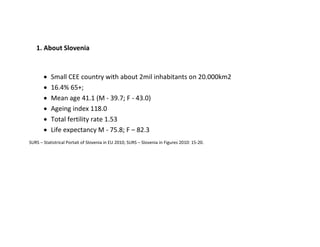
1. About Slovenia


          Small CEE country with about 2mil inhabitants on 20.000km2
          16.4% 65+;
          Mean age 41.1 (M - 39.7; F - 43.0)
          Ageing index 118.0
          Total fertility rate 1.53
          Life expectancy M - 75.8; F – 82.3
SURS – Statistrical Portait of Slovenia in EU 2010; SURS – Slovenia in Figures 2010: 15-20.
2. Origins of Slovenian welfare system and care system


The Slovenian welfare system today is the outcome of a series of gradual changes in the
last 20 years.


Its origins can be traced to the 1950s and the development of the Yugoslav welfare
system (see Kolarič, 1990 and 1992; Kolarič et al., 2009), based on the compulsory
payment of contributions by employees and enterprises to cover risks of income loss
(including old age) and all contributions for education, childcare, care for older people
etc.
Components:
- The public sector (a well developed and regionally dispersed network of public (state)
  institutions with formally organised professional services - homes for the care of older
  and community nursing),
- The informal sector (largely based on strong value orientations, normative
  expectations and emotional closeness within family and informal networks) was
  ignored by the state and therefore not supported by policy measures,
- The “gray” sector (employees in public institutions and organisations who were
  offering services for direct (illegal) payment).


Major development in the quantity and quality of new services during the last 20 years
is in the area of home care.


Family members (partner and children) have legal obligation to provide (also
financially) for dependent partner or parent.
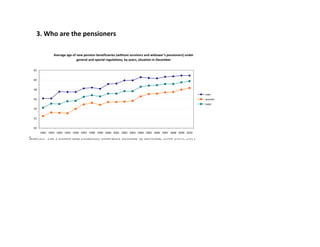
3. Who are the pensioners

               Average age of new pension beneficiaries (without survivors and widower’s pensioners) under
                              general and special regulations, by years, situation in December

  62


  60


  58
                                                                                                             men
  56                                                                                                         women
                                                                                                             total
  54


  52


  50
       1992 1993 1994 1995 1996 1997 1998 1999 2000 2001 2002 2003 2004 2005 2006 2007 2008 2009 2010

Sources: The Pension and Disability Insurance Institute of Slovenia, 2004 2010, 2011
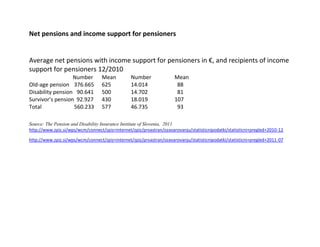
Net pensions and income support for pensioners


Average net pensions with income support for pensioners in €, and recipients of income
support for pensioners 12/2010
                  Number           Mean          Number               Mean
Old-age pension 376.665            625           14.014                88
Disability pension 90.641          500           14.702                81
Survivor's pension 92.927          430           18.019               107
Total             560.233          577           46.735                93

Source: The Pension and Disability Insurance Institute of Slovenia, 2011
http://www.zpiz.si/wps/wcm/connect/zpiz+internet/zpiz/prvastran/ozavarovanju/statisticnipodatki/statisticni+pregled+2010-12

http://www.zpiz.si/wps/wcm/connect/zpiz+internet/zpiz/prvastran/ozavarovanju/statisticnipodatki/statisticni+pregled+2011-07
 (a) (In)Formal Home care (Leave of absence for family member, Family attendant,
    Personal assistant)


  1. Leave of absence for employed family member (informal carer)

The Health Care and Health Insurance Act (1992) offers an opportunity for family
members to take care of a close family member. They are eligible for wage
compensation (80%) for 7 days, exceptionally for 14 days, but only for people who are
living in the same household.
2. Family attendant

The Social Security Act (2004; MDDSZ, 2006a; Amendment to the Social Security Act,
1992) defines a possibility for a family member to become a family attendant with the
right to partial payment for lost income at the minimum wage level (521 EUR in 2006;
1.349 cases, 981 family attendants were family members) or to a proportional part of
payment for lost income in the case of part-time work and full pension and disability
insurance contributions covered.
The tasks of the family attendants are:
   - personal care, health care, social care, homemaking.

   - Evaluation for eligibility is done by the local Centre for social work and Disability
     Commission at Pension and Disability Insurance Fund.
   - Centre for social work is responsible for monitoring the care provided and has to
     prepare annual reports. Social inspection also inspects the work of family
     attendants.
   - Family attendants are financed through municipality budget.
(The Social Security Act (2004; MDDSZ, 2006a; Amendment to the Social Security Act, 1992), Hlebec 2010, Prevodnik Rupel, Ogorevc,
2010: 7-8, 14).
3. Programme of personal assistance

Currently is financed as a project. 70% of organizations used disability status as criteria
for eligibility. Different services were performed.

Financial means are not ensured, most programmes were financed trough Employment
office (80%), some receive support of the municipalities or Ministry for Labour, Family
and Social Affairs.

In the first six months of 2007 there were 705 users of these programs (29% aged 65+).

(Prevodnik Rupel, Ogorevc, 2010: 8, 16).
(b) Home social care


            A new service, developed in first half of 1990s. It is a social assistance
  service intended to improve the quality of life of older people living at home who
  are unable to care for themselves due to old age or illness and whose family cannot
  provide them with sufficient care. It was developed to cut the number of waiting
  applicants for old people’s homes and to improve the quality of life of those living
  at home. Home social care encompasses Homemaking , Help with basic daily tasks
  with personal hygiene, Maintaining social contacts


 An individual is eligible for up to 4 hours of care per day or a maximum of 20 hours
  per week in residential municipality.
 Evaluation for eligibility is done by local centre for social work.
 The financial burden of the service is carried by the municipality which by law is
  obliged to cover at least 50% of the cost of the service. The state reduces the price
  of the service by contributing to the labour costs of the service provider. Users pay
  the remaining costs of the service (which may be up to 50% of the total costs). In
  2010 65% of the costs were covered by municipalities, 22% by users and 13% by
  central state budget (active employment policy). The active employment policy
  project ended in November 2011.
 The number of users is increasing from 2875 in 2003 to 6575 in 2010.
 Average price paid by user varies considerably across municipalities (was 4.42 EUR
  on average in 2010).
 In 2008 the difference in price between private (4.99EUR) and public (4.15EUR)
  providers was considerable.
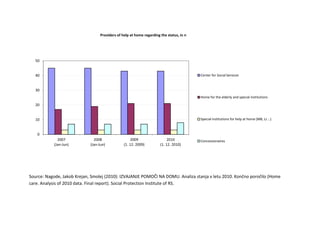
Providers of help at home regarding the status, in n


   50


   40                                                                                     Center for Social Services


   30
                                                                                          Home for the elderly and special institutions

   20


   10                                                                                     Special institutions for help at home (MB, LJ …)


    0
             2007              2008                   2009                  2010          Concessionaires
           (Jan-Jun)         (Jan-Jun)           (1. 12. 2009)         (1. 12. 2010)


Source: Nagode, Jakob Krejan, Smolej (2010): IZVAJANJE POMOČI NA DOMU. Analiza stanja v letu 2010. Končno poročilo (Home
care. Analysis of 2010 data. Final report). Social Protection Institute of RS.
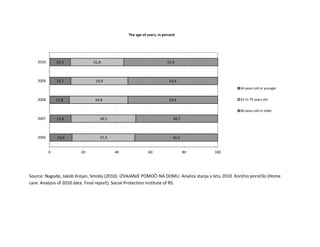
The age of users, in percent


    2010       12,4           31,8                                    55,9


    2009       12,7            33,9                                    53,4
                                                                                                    64 years old or younger


    2008       11,8            34,8                                    53,4                         65 to 79 years old


                                                                                                    80 years old or older

    2007       12,8              38,5                                     48,7


    2006       13,4              37,3                                    49,3


           0            20              40                 60                    80     100


Source: Nagode, Jakob Krejan, Smolej (2010): IZVAJANJE POMOČI NA DOMU. Analiza stanja v letu 2010. Končno poročilo (Home
care. Analysis of 2010 data. Final report). Social Protection Institute of RS.
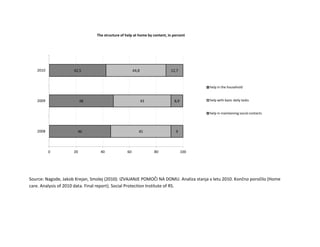
The structure of help at home by content, in percent


   2010              42,5                              44,8                12,7


                                                                                         help in the household


   2009                   48                                  43             8,9         help with basic daily tasks


                                                                                         help in maintaining social contacts


   2008                46                                 45                  9


          0          20           40              60               80              100


Source: Nagode, Jakob Krejan, Smolej (2010): IZVAJANJE POMOČI NA DOMU. Analiza stanja v letu 2010. Končno poročilo (Home
care. Analysis of 2010 data. Final report). Social Protection Institute of RS.
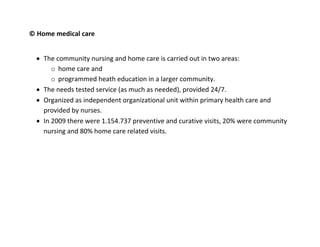
© Home medical care


   The community nursing and home care is carried out in two areas:
       o home care and
       o programmed heath education in a larger community.
   The needs tested service (as much as needed), provided 24/7.
   Organized as independent organizational unit within primary health care and
    provided by nurses.
   In 2009 there were 1.154.737 preventive and curative visits, 20% were community
    nursing and 80% home care related visits.
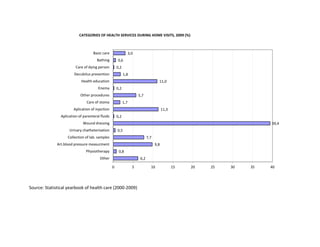
CATEGORIES OF HEALTH SERVICES DURING HOME VISITS, 2009 (%)


                                    Basic care                    3,0
                                       Bathing        0,6
                         Care of dying person         0,2
                        Decubitus prevention                1,8
                             Health education                                          11,0
                                       Enema          0,2
                            Other procedures                            5,7
                                Care of stoma               1,7
                        Aplication of injection                                            11,3
                Aplication of parenteral fluids       0,2
                              Wound dressing                                                                               39,4
                     Urinary chatheterisation         0,5
                    Collection of lab. samples                                 7,7
              Art.blood pressure measurment                                          9,8
                                Physiotherapy          0,8
                                        Other                            6,2

                                                  0                 5            10               15   20   25   30   35   40


Source: Statistical yearbook of health care (2000-2009)
 (d) Cash benefits and allowances (Income support for pensioners, The assistance
    and attendance allowance, Financial social assistance, Exempts from payments of
    the services)


  1. The assistance and attendance allowance

The assistance and attendance allowance is a monthly cash benefit based on criteria
defined by Pension and disability act (criteria: ability to satisfy basic (and most of) life
needs, pensioners, blind or weak sighted or immobile). Act does not define the
monitoring of use of the benefit although it assumes the benefit will be used for
acquiring help in ADL.

Evaluation for eligibility is done by the Pension and Disability Fund physician.
The amounts (February 2009) of Attendance and Allowance Supplement depend on the
base on which it is calculated:
  - It is equal to the base for the most severe cases (24-hour supervision of relatives
     and compulsory help of a professional) - 398 EUR (422 cases).
  - It equals to 70% of the base for blind and immobile for fulfilling all basic life needs –
     279 EUR (11.318 cases).
  - It amounts to 50% of the base for fulfilling all basic life needs for persons who need
     help in most of their basic needs or are sight impaired – 139 EUR (17.378 cases).

Among 29.800 recipients in February 2009, 657 recipients received other amounts
(Prevodnik Rupel, Ogorevc, 2010: 4-6, 14).
2. Financial social assistance

Social Security Act defines social help in cash as financial means for meeting minimal
living needs for survival (minimal wage). The amount of financial social assistance = the
sum of minimal incomes to which individual eligible person or family members are
entitled – actual incomes of all the family members. In December 2006 the share of the
older people (65+) among recipients of financial social assistance was 2.8% (1.548)
recipients.

Evaluation for eligibility is done by the local centre for social work.

The Social Security Act (2004; MDDSZ, 2006a; Amendment to the Social Security Act,
1992), Prevodnik Rupel, Ogorevc, 2010: 11).
3. Exempts from payment of the services

- The border of social security is set as an amount of money that has to remain in the
  hands of the user of the service after the payment of the services (all kinds of long
  term care services). The ability to pay is the maximum amount up to which the user
  is able to pay.
- Family members (partner and children) have legal obligation to financially provide
  for dependent partner or parent.
- For owners of the real estate properties the issuing of the written order on
  exemption from payment contains the inhibition on alienation or burdening of this
  real estate to the credit of the municipality which finances the institutional care of
  the user.
- In the case of home care services, the inhibition on alienation or burdening is not
  done for permanent residence of the user.
- The exempts from payment are evaluated by local Centre for Social Work. The
  difference is paid by municipality. (Prevodnik Rupel, Ogorevc, 2010: 13).
4. Users’ perspective

- Many services and rights
- Information not available in one place
- Different entry points
- Long procedures
- Some services universal and financed by state budget while others available only
  for additional payment (mostly newly developed services)
- Large regional differences
- Large differences across municipalities
- Freedom of choice?
5. Conclusions


- The system of LTC is evolving (however, currently very fragmented and perhaps not
  so efficient)
- Poor access to services owing to fragmentation of services, different entry points
  and long procedures
- Lack of data – only official reports available as secondary data (Statistical yearbooks
  and reports at Institute for Social Protection)
- Lack of data base with data about different services at one place
- Lack of harmonization (services organized at different level and therefore data
  collected at different level – unit of observation?)
- No systematic data about users and about users perspectives (satisfaction with
  services, subjective assessments of needs)
- No systematic and official standards of quality of services

4 hlebec ifa-prague_2012_presentation

  • 1.
    Presentation prepared forIFA 11TH GLOBAL CONFERENCE ON AGEING 28 May – 1 June 2012, Prague, Czech Republic Support for caregivers in Slovenia: Interplay of transition and ageing Valentina Hlebec (valentina.hlebec@fdv.uni-lj.si) University of Ljubljana, Faculty of Social Sciences, Slovenia
  • 2.
    Overview 1.About Slovenia 2. Origins of Slovenian welfare system and care system 3. Who are the pensioners 4. Services and rights a. (In)Formal home care (Leave of absence for family member, Family attendant, Personal assistant) b. Home social care c. Home medical care d. Cash benefits and allowances (Income support for pensioners, The assistance and attendance allowance, Financial social assistance, Exempts from payments of the services) e. Institutional care 5. Users’ perspective 6. Conclusions
  • 3.
    1. About Slovenia  Small CEE country with about 2mil inhabitants on 20.000km2  16.4% 65+;  Mean age 41.1 (M - 39.7; F - 43.0)  Ageing index 118.0  Total fertility rate 1.53  Life expectancy M - 75.8; F – 82.3 SURS – Statistrical Portait of Slovenia in EU 2010; SURS – Slovenia in Figures 2010: 15-20.
  • 4.
    2. Origins ofSlovenian welfare system and care system The Slovenian welfare system today is the outcome of a series of gradual changes in the last 20 years. Its origins can be traced to the 1950s and the development of the Yugoslav welfare system (see Kolarič, 1990 and 1992; Kolarič et al., 2009), based on the compulsory payment of contributions by employees and enterprises to cover risks of income loss (including old age) and all contributions for education, childcare, care for older people etc.
  • 5.
    Components: - The publicsector (a well developed and regionally dispersed network of public (state) institutions with formally organised professional services - homes for the care of older and community nursing), - The informal sector (largely based on strong value orientations, normative expectations and emotional closeness within family and informal networks) was ignored by the state and therefore not supported by policy measures, - The “gray” sector (employees in public institutions and organisations who were offering services for direct (illegal) payment). Major development in the quantity and quality of new services during the last 20 years is in the area of home care. Family members (partner and children) have legal obligation to provide (also financially) for dependent partner or parent.
  • 6.
    3. Who arethe pensioners Average age of new pension beneficiaries (without survivors and widower’s pensioners) under general and special regulations, by years, situation in December 62 60 58 men 56 women total 54 52 50 1992 1993 1994 1995 1996 1997 1998 1999 2000 2001 2002 2003 2004 2005 2006 2007 2008 2009 2010 Sources: The Pension and Disability Insurance Institute of Slovenia, 2004 2010, 2011
  • 7.
    Net pensions andincome support for pensioners Average net pensions with income support for pensioners in €, and recipients of income support for pensioners 12/2010 Number Mean Number Mean Old-age pension 376.665 625 14.014 88 Disability pension 90.641 500 14.702 81 Survivor's pension 92.927 430 18.019 107 Total 560.233 577 46.735 93 Source: The Pension and Disability Insurance Institute of Slovenia, 2011 http://www.zpiz.si/wps/wcm/connect/zpiz+internet/zpiz/prvastran/ozavarovanju/statisticnipodatki/statisticni+pregled+2010-12 http://www.zpiz.si/wps/wcm/connect/zpiz+internet/zpiz/prvastran/ozavarovanju/statisticnipodatki/statisticni+pregled+2011-07
  • 8.
     (a) (In)FormalHome care (Leave of absence for family member, Family attendant, Personal assistant) 1. Leave of absence for employed family member (informal carer) The Health Care and Health Insurance Act (1992) offers an opportunity for family members to take care of a close family member. They are eligible for wage compensation (80%) for 7 days, exceptionally for 14 days, but only for people who are living in the same household.
  • 9.
    2. Family attendant TheSocial Security Act (2004; MDDSZ, 2006a; Amendment to the Social Security Act, 1992) defines a possibility for a family member to become a family attendant with the right to partial payment for lost income at the minimum wage level (521 EUR in 2006; 1.349 cases, 981 family attendants were family members) or to a proportional part of payment for lost income in the case of part-time work and full pension and disability insurance contributions covered. The tasks of the family attendants are: - personal care, health care, social care, homemaking. - Evaluation for eligibility is done by the local Centre for social work and Disability Commission at Pension and Disability Insurance Fund. - Centre for social work is responsible for monitoring the care provided and has to prepare annual reports. Social inspection also inspects the work of family attendants. - Family attendants are financed through municipality budget. (The Social Security Act (2004; MDDSZ, 2006a; Amendment to the Social Security Act, 1992), Hlebec 2010, Prevodnik Rupel, Ogorevc, 2010: 7-8, 14).
  • 10.
    3. Programme ofpersonal assistance Currently is financed as a project. 70% of organizations used disability status as criteria for eligibility. Different services were performed. Financial means are not ensured, most programmes were financed trough Employment office (80%), some receive support of the municipalities or Ministry for Labour, Family and Social Affairs. In the first six months of 2007 there were 705 users of these programs (29% aged 65+). (Prevodnik Rupel, Ogorevc, 2010: 8, 16).
  • 11.
    (b) Home socialcare  A new service, developed in first half of 1990s. It is a social assistance service intended to improve the quality of life of older people living at home who are unable to care for themselves due to old age or illness and whose family cannot provide them with sufficient care. It was developed to cut the number of waiting applicants for old people’s homes and to improve the quality of life of those living at home. Home social care encompasses Homemaking , Help with basic daily tasks with personal hygiene, Maintaining social contacts  An individual is eligible for up to 4 hours of care per day or a maximum of 20 hours per week in residential municipality.  Evaluation for eligibility is done by local centre for social work.
  • 12.
     The financialburden of the service is carried by the municipality which by law is obliged to cover at least 50% of the cost of the service. The state reduces the price of the service by contributing to the labour costs of the service provider. Users pay the remaining costs of the service (which may be up to 50% of the total costs). In 2010 65% of the costs were covered by municipalities, 22% by users and 13% by central state budget (active employment policy). The active employment policy project ended in November 2011.  The number of users is increasing from 2875 in 2003 to 6575 in 2010.  Average price paid by user varies considerably across municipalities (was 4.42 EUR on average in 2010).  In 2008 the difference in price between private (4.99EUR) and public (4.15EUR) providers was considerable.
  • 13.
    Providers of helpat home regarding the status, in n 50 40 Center for Social Services 30 Home for the elderly and special institutions 20 10 Special institutions for help at home (MB, LJ …) 0 2007 2008 2009 2010 Concessionaires (Jan-Jun) (Jan-Jun) (1. 12. 2009) (1. 12. 2010) Source: Nagode, Jakob Krejan, Smolej (2010): IZVAJANJE POMOČI NA DOMU. Analiza stanja v letu 2010. Končno poročilo (Home care. Analysis of 2010 data. Final report). Social Protection Institute of RS.
  • 14.
    The age ofusers, in percent 2010 12,4 31,8 55,9 2009 12,7 33,9 53,4 64 years old or younger 2008 11,8 34,8 53,4 65 to 79 years old 80 years old or older 2007 12,8 38,5 48,7 2006 13,4 37,3 49,3 0 20 40 60 80 100 Source: Nagode, Jakob Krejan, Smolej (2010): IZVAJANJE POMOČI NA DOMU. Analiza stanja v letu 2010. Končno poročilo (Home care. Analysis of 2010 data. Final report). Social Protection Institute of RS.
  • 15.
    The structure ofhelp at home by content, in percent 2010 42,5 44,8 12,7 help in the household 2009 48 43 8,9 help with basic daily tasks help in maintaining social contacts 2008 46 45 9 0 20 40 60 80 100 Source: Nagode, Jakob Krejan, Smolej (2010): IZVAJANJE POMOČI NA DOMU. Analiza stanja v letu 2010. Končno poročilo (Home care. Analysis of 2010 data. Final report). Social Protection Institute of RS.
  • 16.
    © Home medicalcare  The community nursing and home care is carried out in two areas: o home care and o programmed heath education in a larger community.  The needs tested service (as much as needed), provided 24/7.  Organized as independent organizational unit within primary health care and provided by nurses.  In 2009 there were 1.154.737 preventive and curative visits, 20% were community nursing and 80% home care related visits.
  • 17.
    CATEGORIES OF HEALTHSERVICES DURING HOME VISITS, 2009 (%) Basic care 3,0 Bathing 0,6 Care of dying person 0,2 Decubitus prevention 1,8 Health education 11,0 Enema 0,2 Other procedures 5,7 Care of stoma 1,7 Aplication of injection 11,3 Aplication of parenteral fluids 0,2 Wound dressing 39,4 Urinary chatheterisation 0,5 Collection of lab. samples 7,7 Art.blood pressure measurment 9,8 Physiotherapy 0,8 Other 6,2 0 5 10 15 20 25 30 35 40 Source: Statistical yearbook of health care (2000-2009)
  • 18.
     (d) Cashbenefits and allowances (Income support for pensioners, The assistance and attendance allowance, Financial social assistance, Exempts from payments of the services) 1. The assistance and attendance allowance The assistance and attendance allowance is a monthly cash benefit based on criteria defined by Pension and disability act (criteria: ability to satisfy basic (and most of) life needs, pensioners, blind or weak sighted or immobile). Act does not define the monitoring of use of the benefit although it assumes the benefit will be used for acquiring help in ADL. Evaluation for eligibility is done by the Pension and Disability Fund physician.
  • 19.
    The amounts (February2009) of Attendance and Allowance Supplement depend on the base on which it is calculated: - It is equal to the base for the most severe cases (24-hour supervision of relatives and compulsory help of a professional) - 398 EUR (422 cases). - It equals to 70% of the base for blind and immobile for fulfilling all basic life needs – 279 EUR (11.318 cases). - It amounts to 50% of the base for fulfilling all basic life needs for persons who need help in most of their basic needs or are sight impaired – 139 EUR (17.378 cases). Among 29.800 recipients in February 2009, 657 recipients received other amounts (Prevodnik Rupel, Ogorevc, 2010: 4-6, 14).
  • 20.
    2. Financial socialassistance Social Security Act defines social help in cash as financial means for meeting minimal living needs for survival (minimal wage). The amount of financial social assistance = the sum of minimal incomes to which individual eligible person or family members are entitled – actual incomes of all the family members. In December 2006 the share of the older people (65+) among recipients of financial social assistance was 2.8% (1.548) recipients. Evaluation for eligibility is done by the local centre for social work. The Social Security Act (2004; MDDSZ, 2006a; Amendment to the Social Security Act, 1992), Prevodnik Rupel, Ogorevc, 2010: 11).
  • 21.
    3. Exempts frompayment of the services - The border of social security is set as an amount of money that has to remain in the hands of the user of the service after the payment of the services (all kinds of long term care services). The ability to pay is the maximum amount up to which the user is able to pay. - Family members (partner and children) have legal obligation to financially provide for dependent partner or parent. - For owners of the real estate properties the issuing of the written order on exemption from payment contains the inhibition on alienation or burdening of this real estate to the credit of the municipality which finances the institutional care of the user. - In the case of home care services, the inhibition on alienation or burdening is not done for permanent residence of the user. - The exempts from payment are evaluated by local Centre for Social Work. The difference is paid by municipality. (Prevodnik Rupel, Ogorevc, 2010: 13).
  • 22.
    4. Users’ perspective -Many services and rights - Information not available in one place - Different entry points - Long procedures - Some services universal and financed by state budget while others available only for additional payment (mostly newly developed services) - Large regional differences - Large differences across municipalities - Freedom of choice?
  • 23.
    5. Conclusions - Thesystem of LTC is evolving (however, currently very fragmented and perhaps not so efficient) - Poor access to services owing to fragmentation of services, different entry points and long procedures - Lack of data – only official reports available as secondary data (Statistical yearbooks and reports at Institute for Social Protection) - Lack of data base with data about different services at one place - Lack of harmonization (services organized at different level and therefore data collected at different level – unit of observation?) - No systematic data about users and about users perspectives (satisfaction with services, subjective assessments of needs) - No systematic and official standards of quality of services