COUNTER CURRENT
MECHANISM
Dhayanithi.C
CONTENTS
Osmolarity and diffusion
Osmosis & osmotic pressure
Structure of nephron
Counter current mechanism
Counter current multiplier and exchanger
Functions of ADH
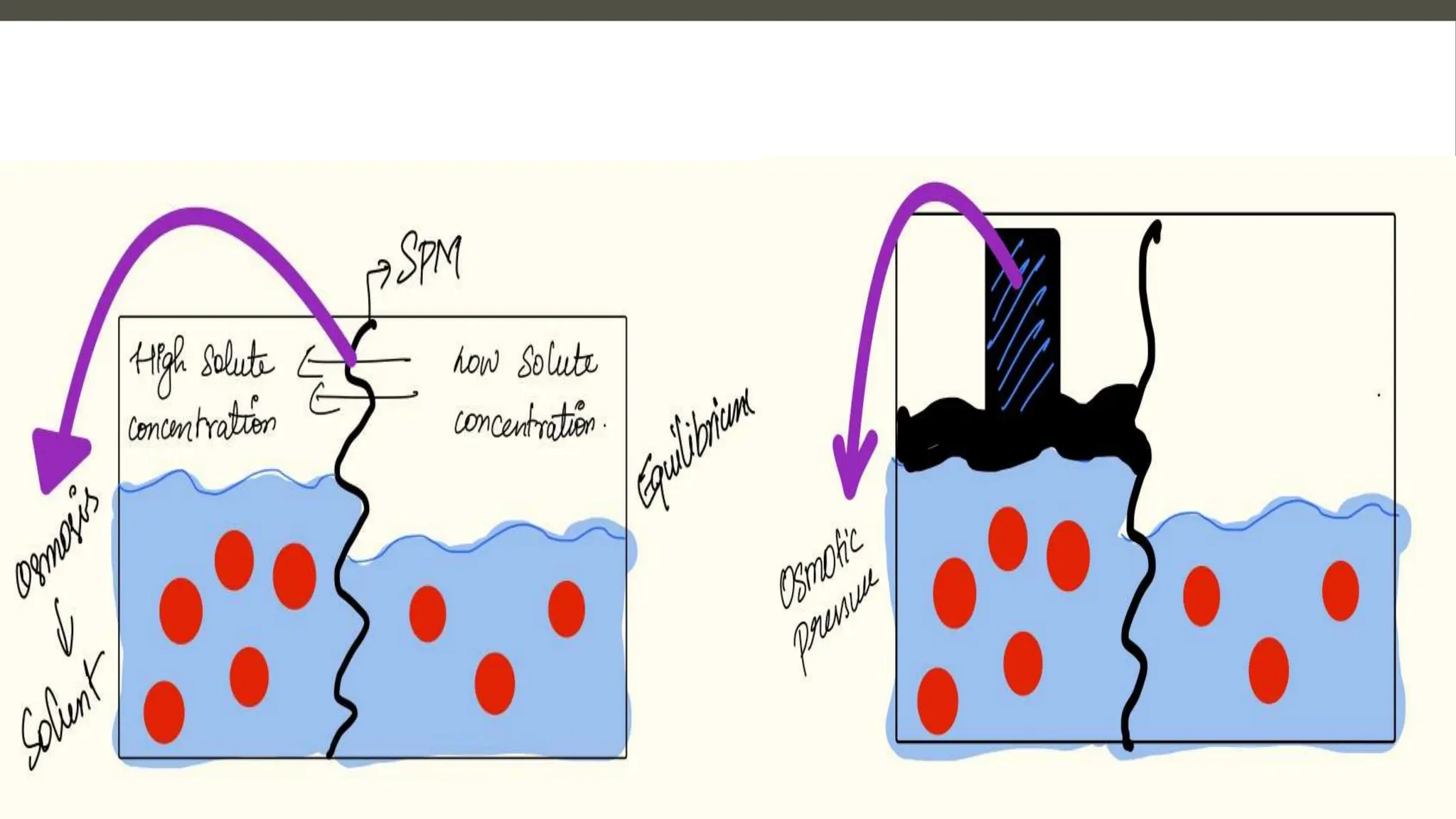
OSMOSIS & OSMOTIC PRESSURE
the movement of water(solvent) from a region of high
water concentration through a semipermeable
membrane to a region of low concentration of water
It is a passive transport.
OSMOTIC PRESSURE
Osmotic pressure is the minimum amount of pressure
needed to prevent a pure solvent from flowing into a
solution across a semipermeable membrane.
OSMOLARITY & DIFFUSION
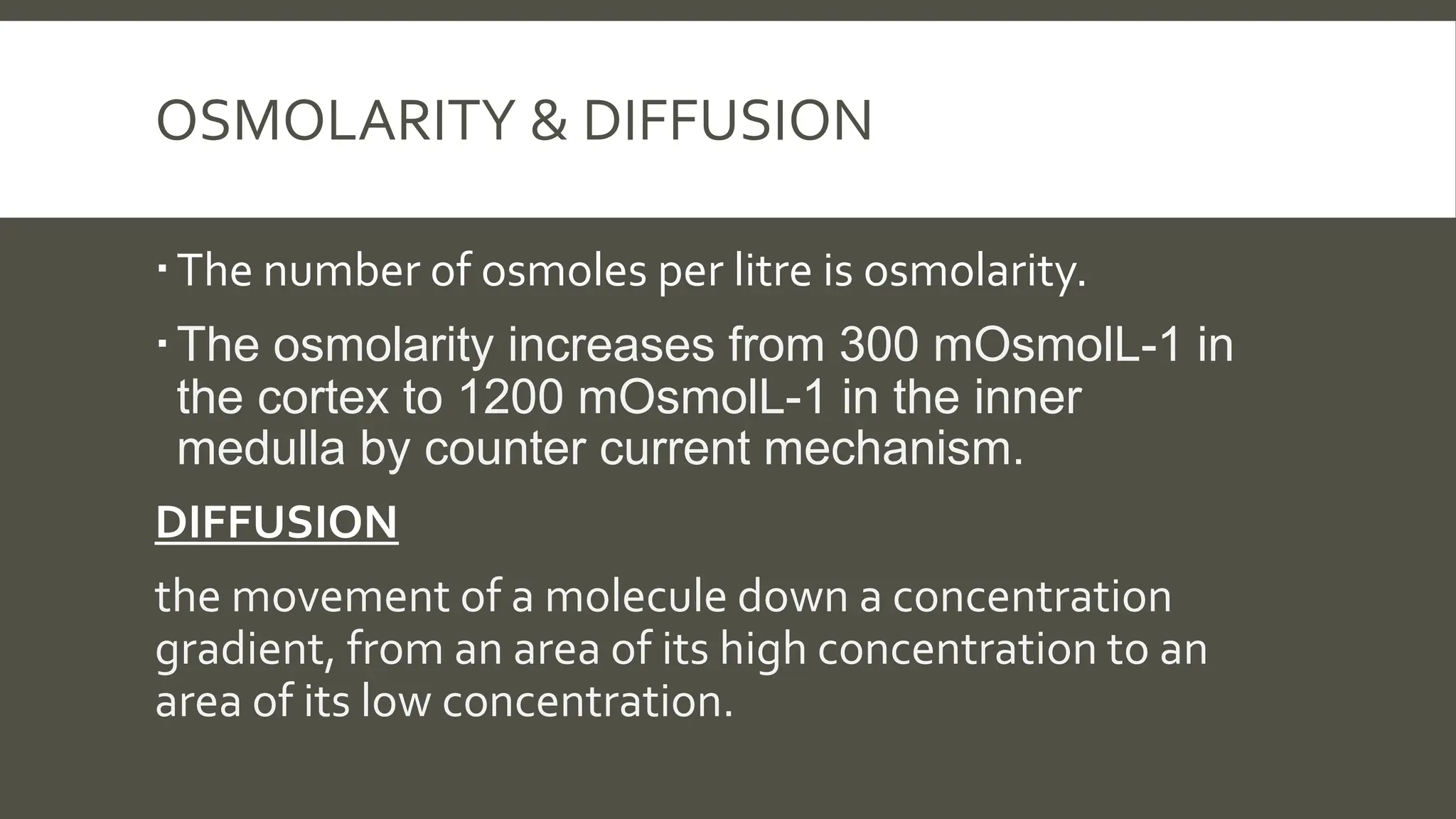
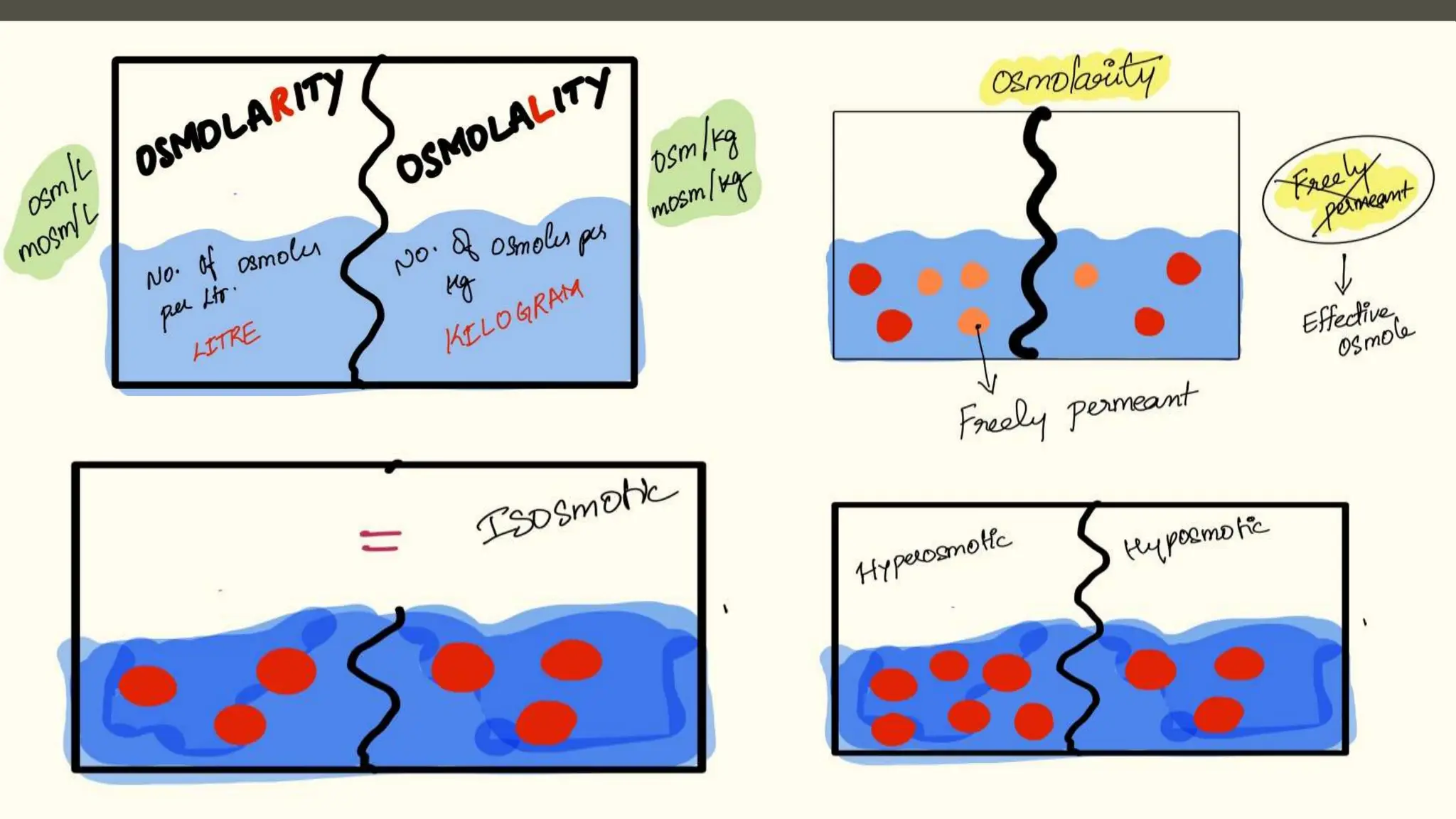
The number of osmoles per litre is osmolarity.
The osmolarity increases from 300 mOsmolL-1 in
the cortex to 1200 mOsmolL-1 in the inner
medulla by counter current mechanism.
DIFFUSION
the movement of a molecule down a concentration
gradient, from an area of its high concentration to an
area of its low concentration.
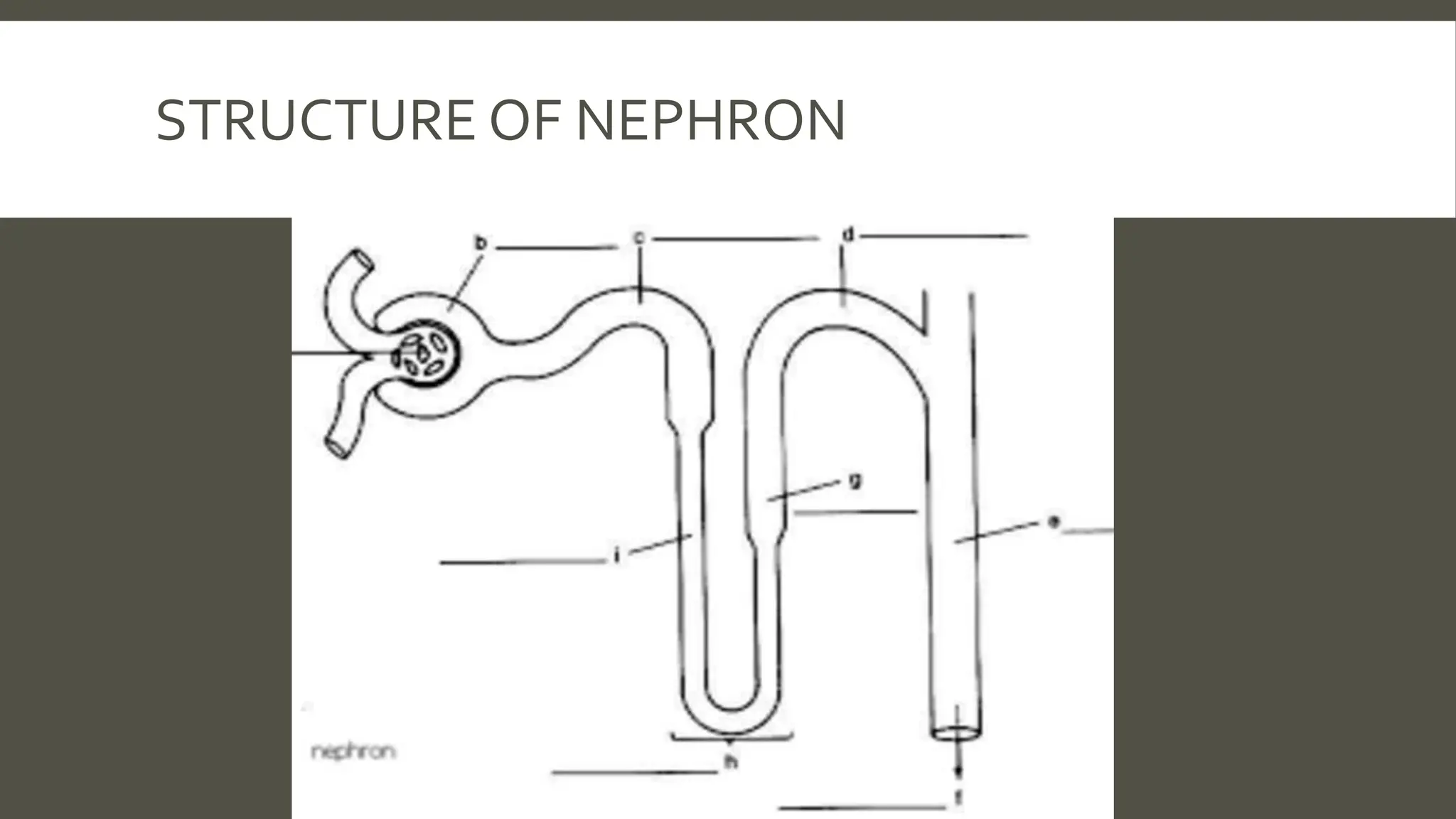
STRUCTURE OF NEPHRON
PCT
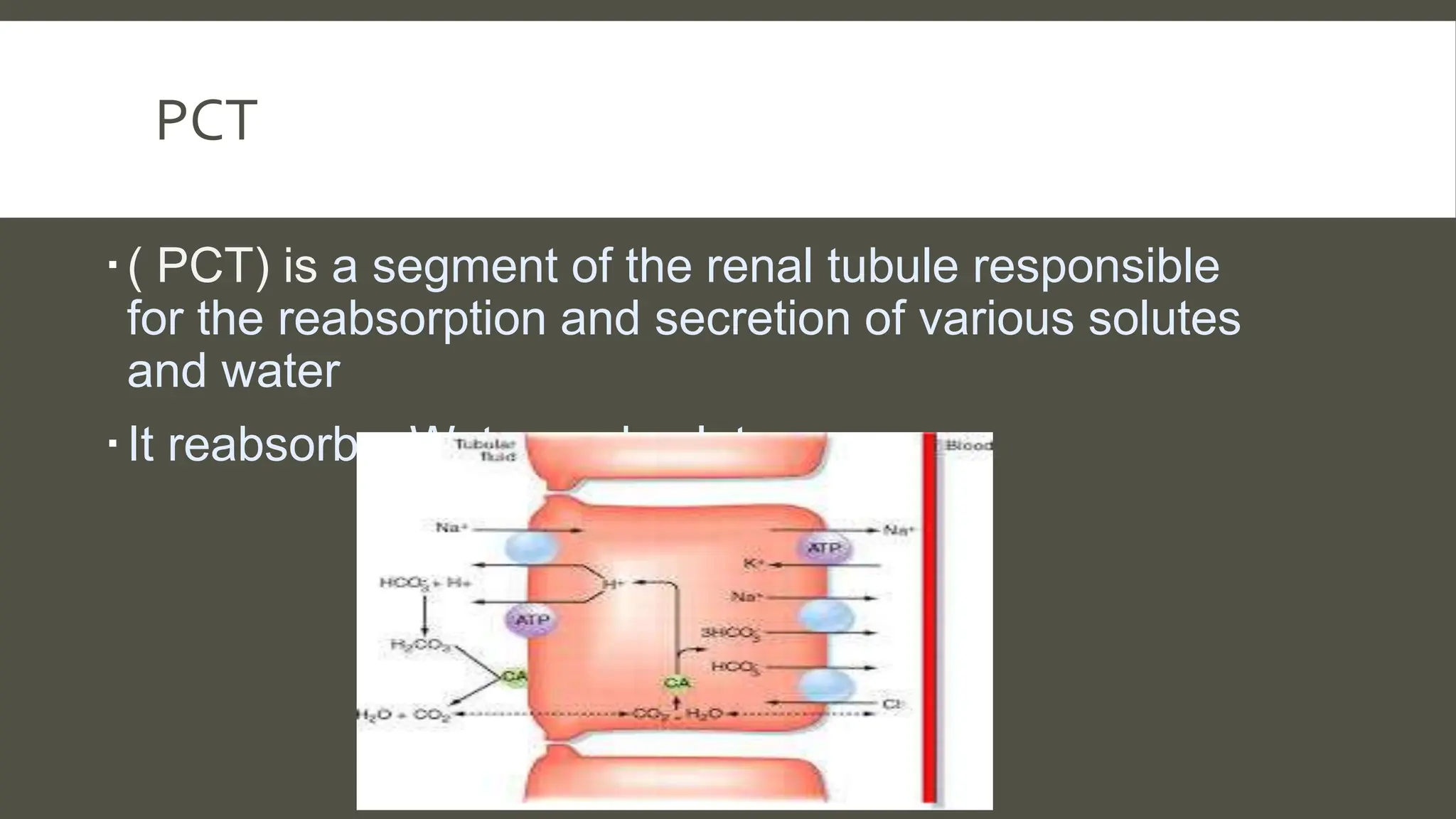
( PCT) is a segment of the renal tubule responsible
for the reabsorption and secretion of various solutes
and water
It reabsorbs Water and solutes
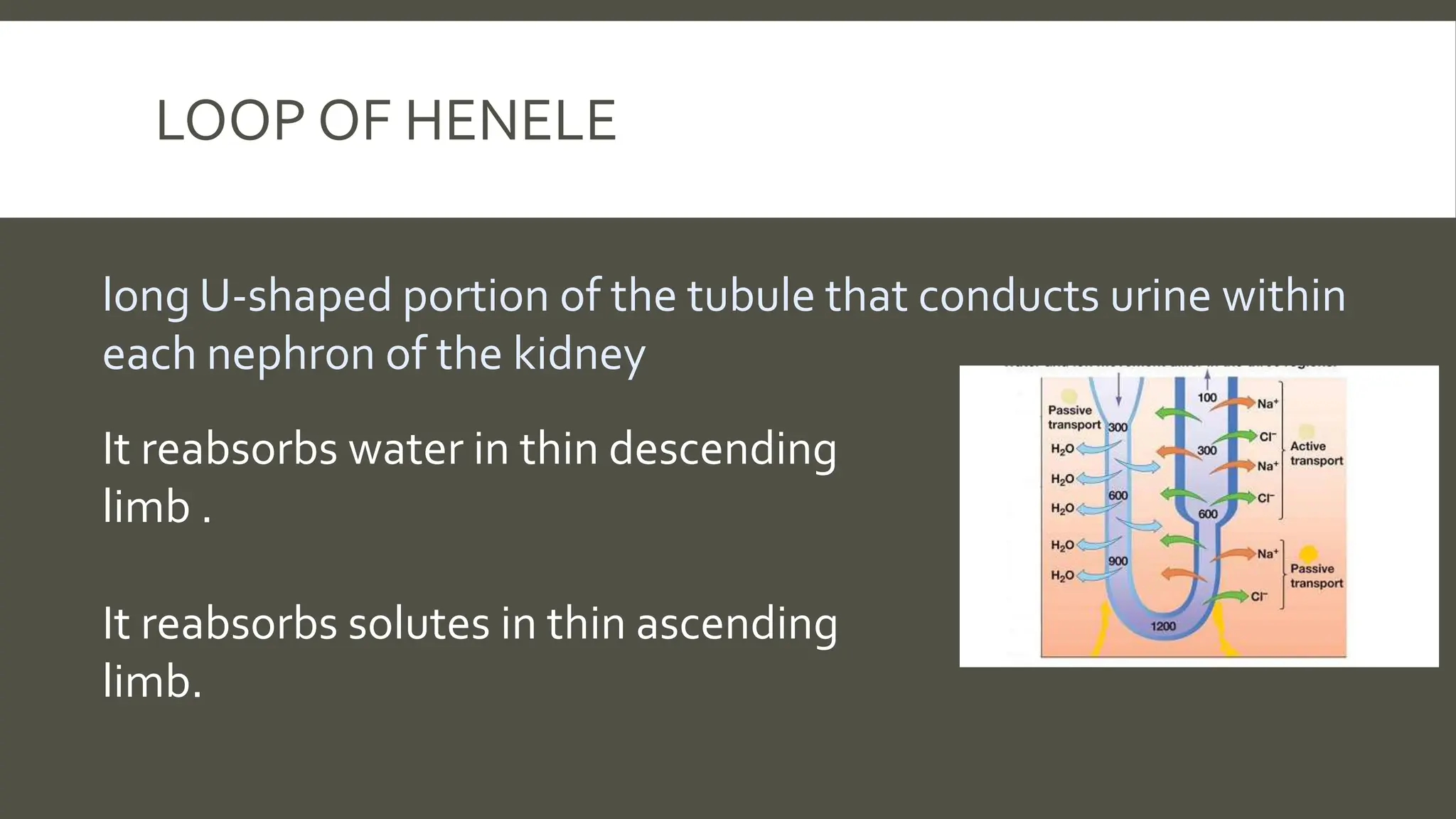
LOOP OF HENELE
long U-shaped portion of the tubule that conducts urine within
each nephron of the kidney
It reabsorbs water in thin descending
limb .
It reabsorbs solutes in thin ascending
limb.
DCT & CD
DCT
a short nephron segment, interposed between
the macula densa and collecting duct
CD
 reabsorb sodium and chloride across the apical membrane
COUNTER CURRENT MECHANISM?
The countercurrent mechanism is a mechanism in which
the exchange of two fluids can take place from one
direction to another with their concentrations.
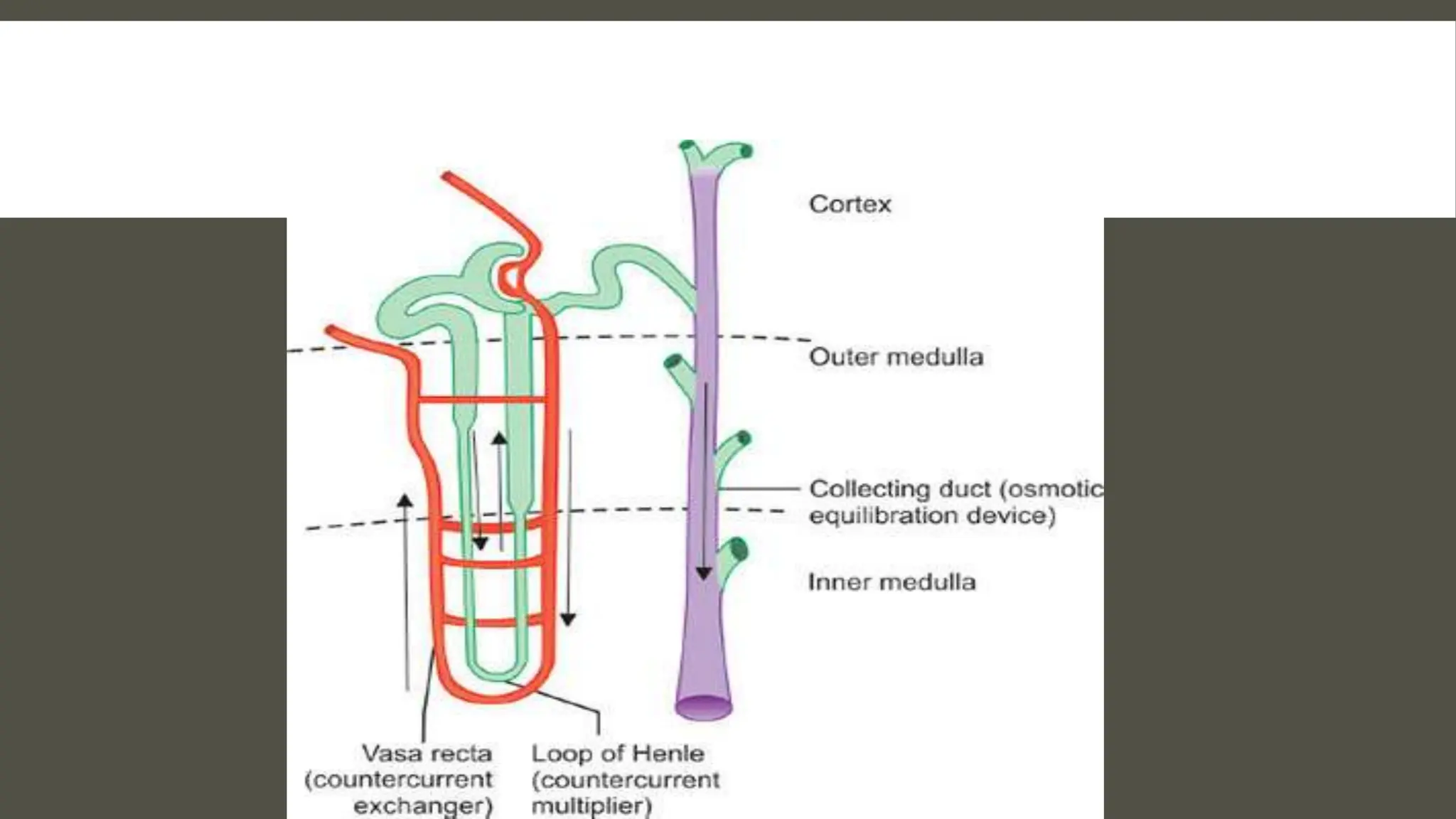
Osmolality gradient is created by LOH -- CC multiplier
This is maintained by vasa recta - -> counter current
exchanger.
CD acts as osmotic equilibrating device.
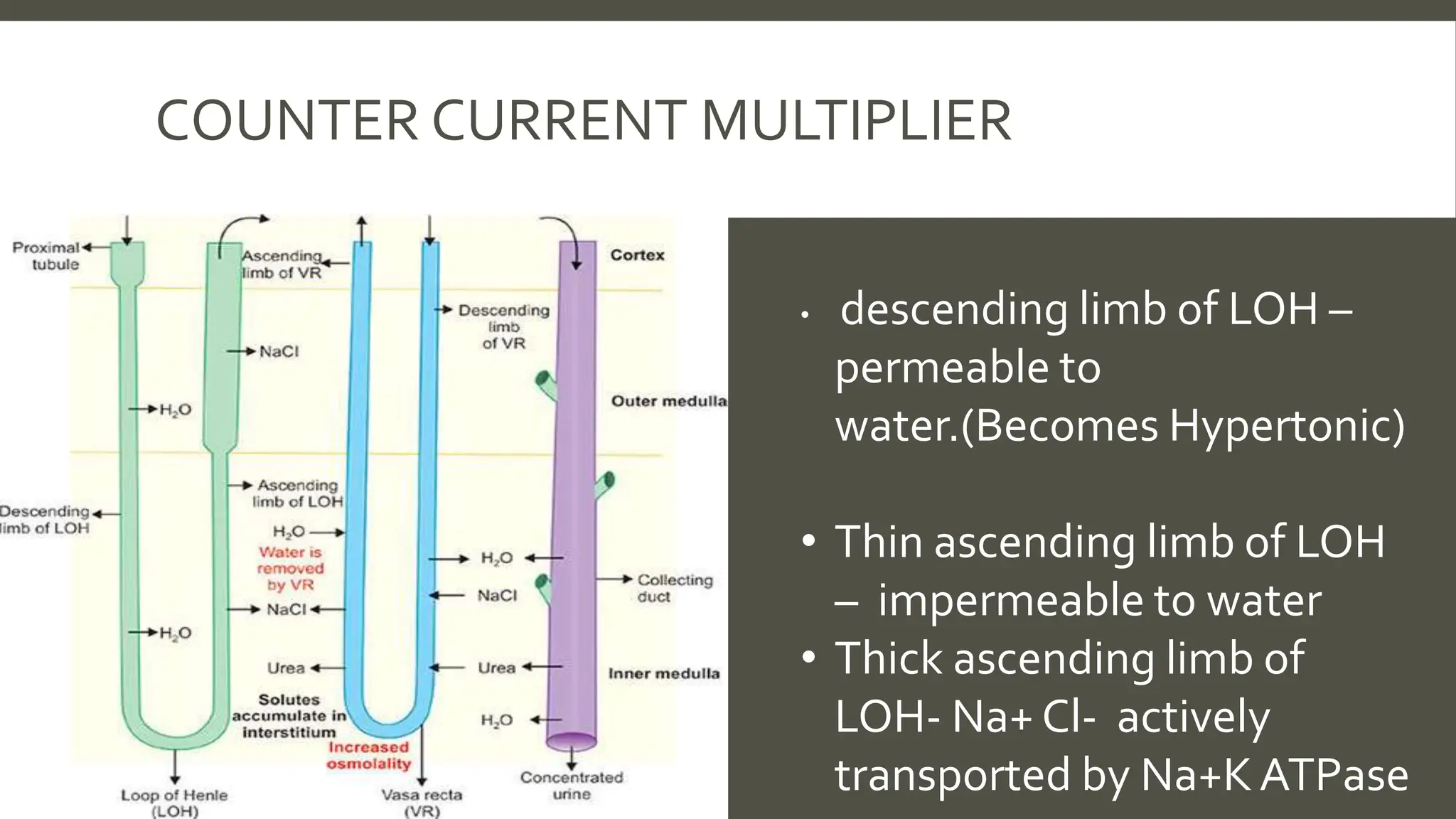
COUNTER CURRENT MULTIPLIER
• descending limb of LOH –
permeable to
water.(Becomes Hypertonic)
• Thin ascending limb of LOH
– impermeable to water
• Thick ascending limb of
LOH- Na+ Cl- actively
transported by Na+KATPase
ROLE OF CD
 It is permeable to water and urea.(it becomes Hypertonic).
 Urea transporters helps in movement of Urea in CD.
 UT-A1 (influenced by ADH).
 UT-A2 (acts on PCT)
 Inner medullary part of CD is permeable to urea
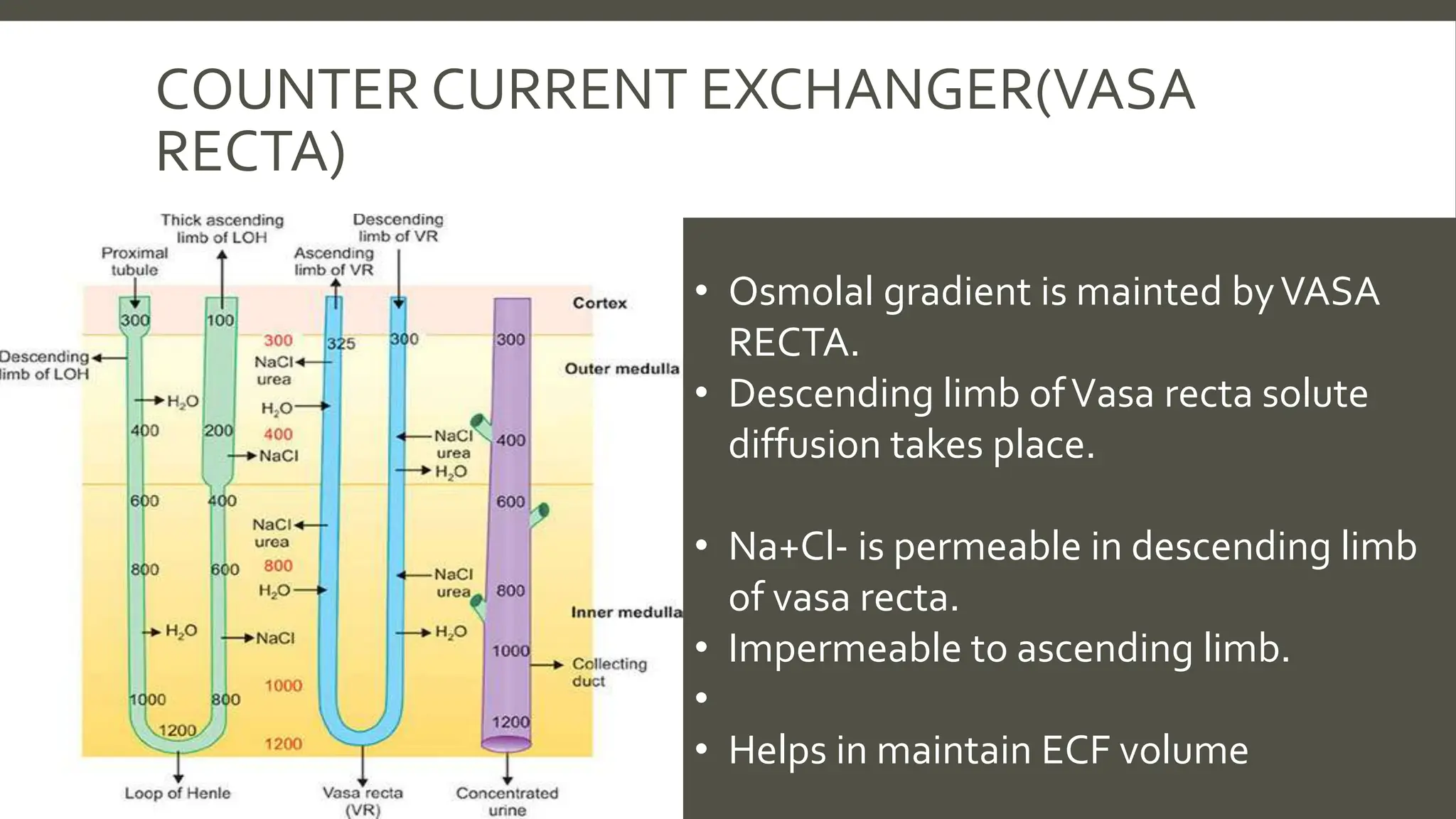
COUNTER CURRENT EXCHANGER(VASA
RECTA)
• Osmolal gradient is mainted byVASA
RECTA.
• Descending limb ofVasa recta solute
diffusion takes place.
• Na+Cl- is permeable in descending limb
of vasa recta.
• Impermeable to ascending limb.
•
• Helps in maintain ECF volume
NET- EFFECT
 In LOH water comes out of descending limb into interstitium & solutes come out
of ascending limb. (vice- versa happens in vasa recta)
 The longer LOH accumulates more solutes across its length from outer layers into
Deeper layers of medulla,Thus osmolality increases along the length of LOH
 Higher osmolality in the medullary interstitium further enhanced by diffusion of
urea from the CD.
 Water moves out passively from CD but it is removed by vasa recta from
interstitium.
 Deeper portion of medulla- osmolality 1200-1400 mOsm/kg of H2O is maintained
THANKYOU…

Counter current mechanism multiplier and exchanger

  • 1.
  • 2.
    CONTENTS Osmolarity and diffusion Osmosis& osmotic pressure Structure of nephron Counter current mechanism Counter current multiplier and exchanger Functions of ADH
  • 3.
    OSMOSIS & OSMOTICPRESSURE the movement of water(solvent) from a region of high water concentration through a semipermeable membrane to a region of low concentration of water It is a passive transport. OSMOTIC PRESSURE Osmotic pressure is the minimum amount of pressure needed to prevent a pure solvent from flowing into a solution across a semipermeable membrane.
  • 5.
    OSMOLARITY & DIFFUSION Thenumber of osmoles per litre is osmolarity. The osmolarity increases from 300 mOsmolL-1 in the cortex to 1200 mOsmolL-1 in the inner medulla by counter current mechanism. DIFFUSION the movement of a molecule down a concentration gradient, from an area of its high concentration to an area of its low concentration.
  • 7.
  • 8.
    PCT ( PCT) isa segment of the renal tubule responsible for the reabsorption and secretion of various solutes and water It reabsorbs Water and solutes
  • 9.
    LOOP OF HENELE longU-shaped portion of the tubule that conducts urine within each nephron of the kidney It reabsorbs water in thin descending limb . It reabsorbs solutes in thin ascending limb.
  • 10.
    DCT & CD DCT ashort nephron segment, interposed between the macula densa and collecting duct CD  reabsorb sodium and chloride across the apical membrane
  • 12.
    COUNTER CURRENT MECHANISM? Thecountercurrent mechanism is a mechanism in which the exchange of two fluids can take place from one direction to another with their concentrations. Osmolality gradient is created by LOH -- CC multiplier This is maintained by vasa recta - -> counter current exchanger. CD acts as osmotic equilibrating device.
  • 13.
    COUNTER CURRENT MULTIPLIER •descending limb of LOH – permeable to water.(Becomes Hypertonic) • Thin ascending limb of LOH – impermeable to water • Thick ascending limb of LOH- Na+ Cl- actively transported by Na+KATPase
  • 14.
    ROLE OF CD It is permeable to water and urea.(it becomes Hypertonic).  Urea transporters helps in movement of Urea in CD.  UT-A1 (influenced by ADH).  UT-A2 (acts on PCT)  Inner medullary part of CD is permeable to urea
  • 15.
    COUNTER CURRENT EXCHANGER(VASA RECTA) •Osmolal gradient is mainted byVASA RECTA. • Descending limb ofVasa recta solute diffusion takes place. • Na+Cl- is permeable in descending limb of vasa recta. • Impermeable to ascending limb. • • Helps in maintain ECF volume
  • 16.
    NET- EFFECT  InLOH water comes out of descending limb into interstitium & solutes come out of ascending limb. (vice- versa happens in vasa recta)  The longer LOH accumulates more solutes across its length from outer layers into Deeper layers of medulla,Thus osmolality increases along the length of LOH  Higher osmolality in the medullary interstitium further enhanced by diffusion of urea from the CD.  Water moves out passively from CD but it is removed by vasa recta from interstitium.  Deeper portion of medulla- osmolality 1200-1400 mOsm/kg of H2O is maintained
  • 17.