COUNTERCURRENT
EXCHANGE
ZAINAB PIRZADA
ROLL NO-093
COUNTER CURRENT EXCHANGE:
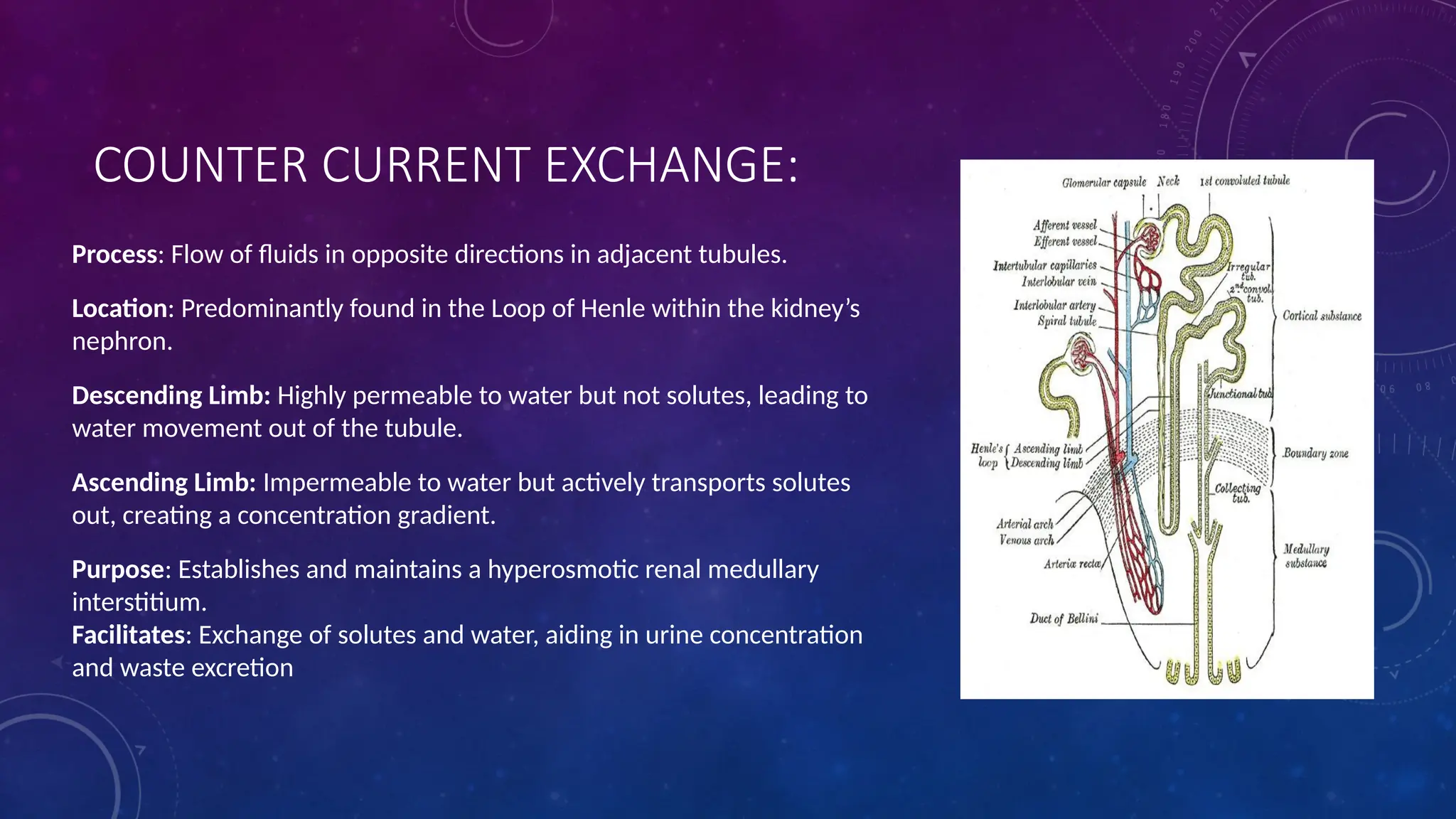
Process: Flow of fluids in opposite directions in adjacent tubules.
Location: Predominantly found in the Loop of Henle within the kidney’s
nephron.
Descending Limb: Highly permeable to water but not solutes, leading to
water movement out of the tubule.
Ascending Limb: Impermeable to water but actively transports solutes
out, creating a concentration gradient.
Purpose: Establishes and maintains a hyperosmotic renal medullary
interstitium.
Facilitates: Exchange of solutes and water, aiding in urine concentration
and waste excretion
COUNTER CURRENT MECHANISM PRODUCES A
HYPEROSMOTIC RENAL MEDULLARY INTERSTITIUM
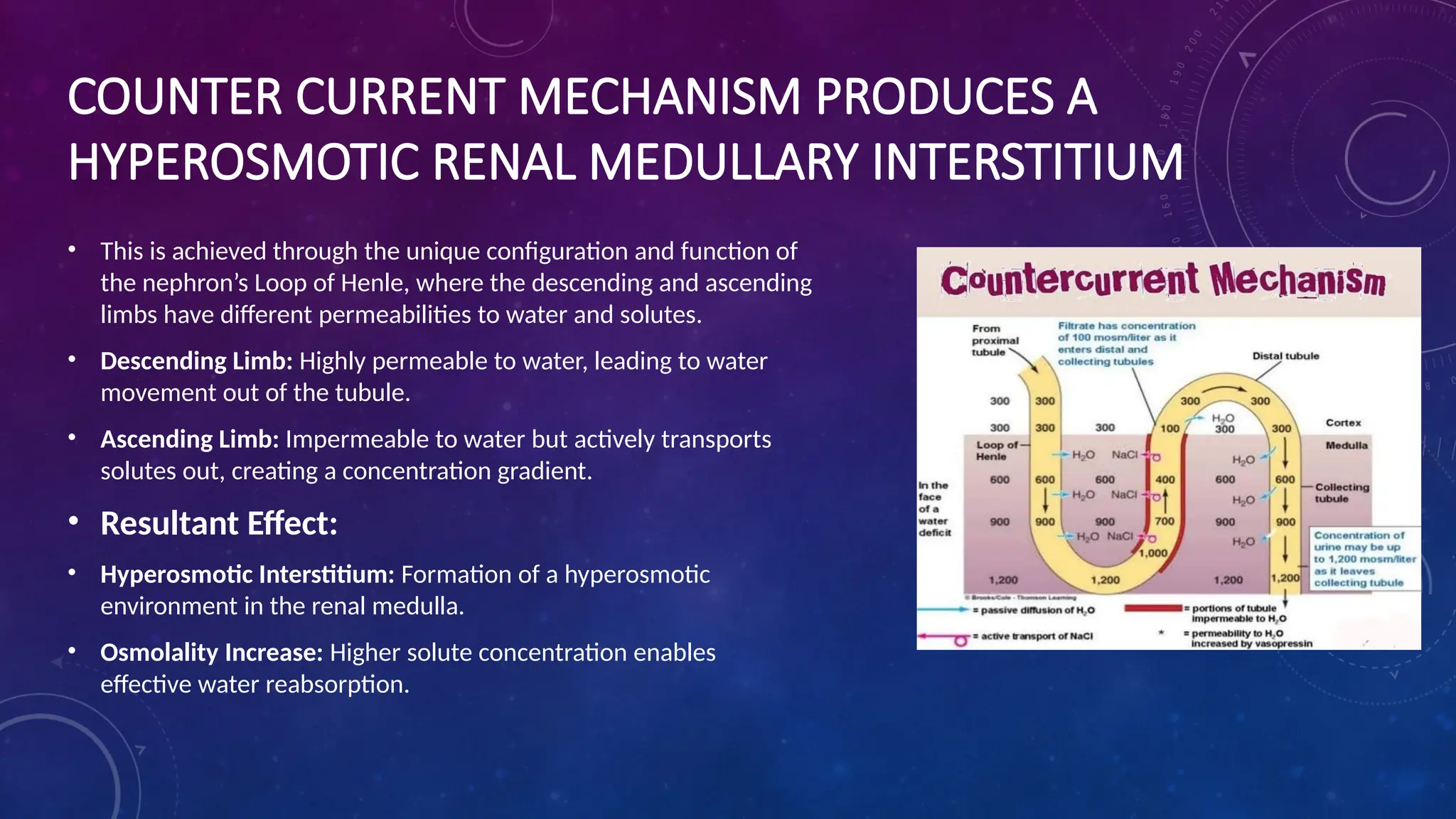
• This is achieved through the unique configuration and function of
the nephron’s Loop of Henle, where the descending and ascending
limbs have different permeabilities to water and solutes.
• Descending Limb: Highly permeable to water, leading to water
movement out of the tubule.
• Ascending Limb: Impermeable to water but actively transports
solutes out, creating a concentration gradient.
• Resultant Effect:
• Hyperosmotic Interstitium: Formation of a hyperosmotic
environment in the renal medulla.
• Osmolality Increase: Higher solute concentration enables
effective water reabsorption.
SPECIAL CHARACTERISTIC OF LOOP OF HENLE THAT CAUSE
SOLUTES TO BE TRAPPED IN THE RENAL MEDULLA
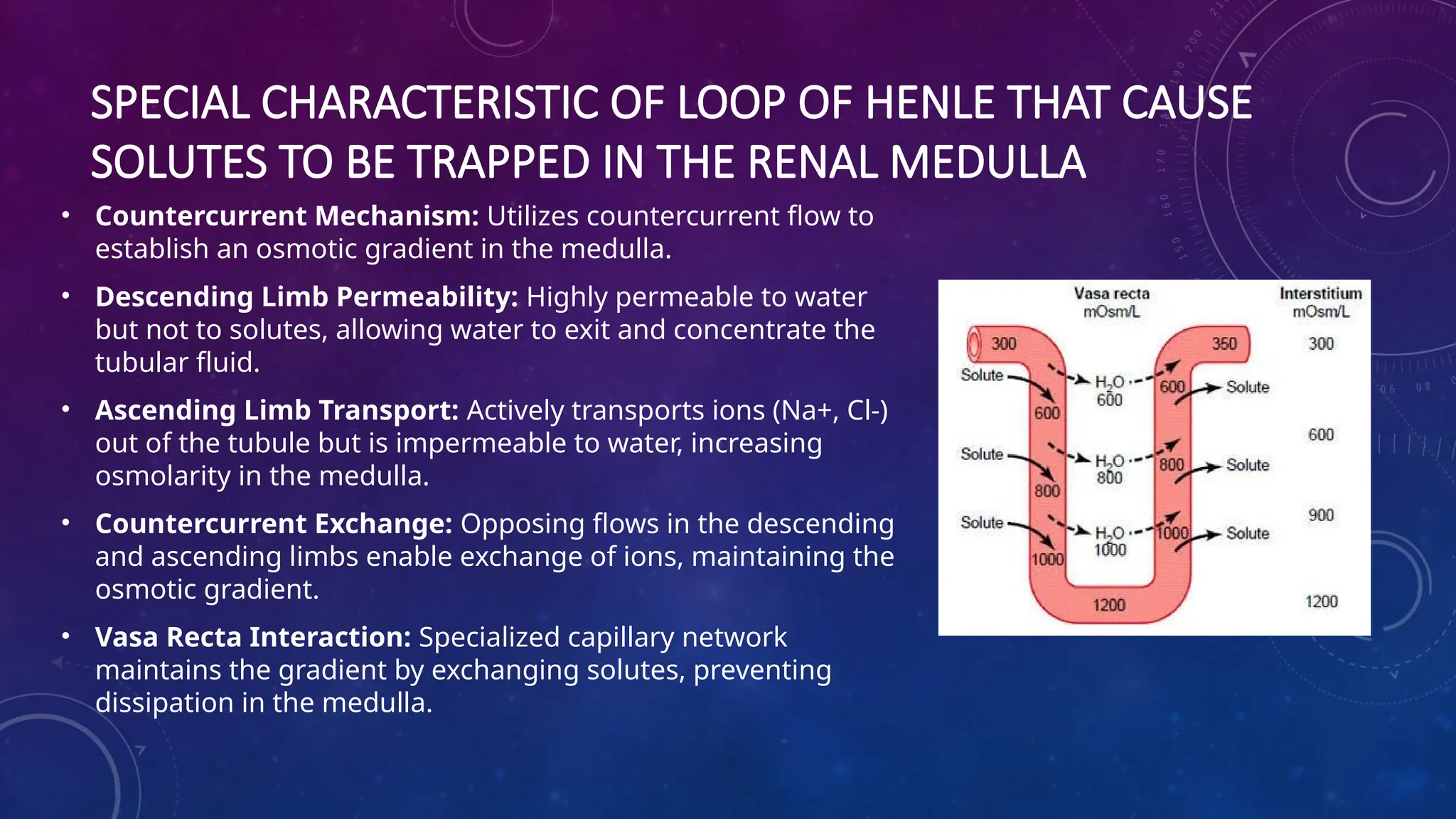
• Countercurrent Mechanism: Utilizes countercurrent flow to
establish an osmotic gradient in the medulla.
• Descending Limb Permeability: Highly permeable to water
but not to solutes, allowing water to exit and concentrate the
tubular fluid.
• Ascending Limb Transport: Actively transports ions (Na+, Cl-)
out of the tubule but is impermeable to water, increasing
osmolarity in the medulla.
• Countercurrent Exchange: Opposing flows in the descending
and ascending limbs enable exchange of ions, maintaining the
osmotic gradient.
• Vasa Recta Interaction: Specialized capillary network
maintains the gradient by exchanging solutes, preventing
dissipation in the medulla.
STEPS INVOLVED IN CAUSING HYPEROSMOTIC RENAL
MEDULLARY INTERSTITIUM
• Countercurrent multiplication:
• Loop of Henle actively transports sodium and chloride ions to the interstitium, creating a
concentration gradient.
• Water reabsorption:
• Filtrate, passing through the descending limb, loses water to the hyperosmotic interstitium,
concentrating the filtrate.
• ADH regulation:
• Antidiuretic hormone (ADH) enhances collecting duct permeability, aiding more water
reabsorption, further concentrating urine and sustaining the hyperosmotic medullary
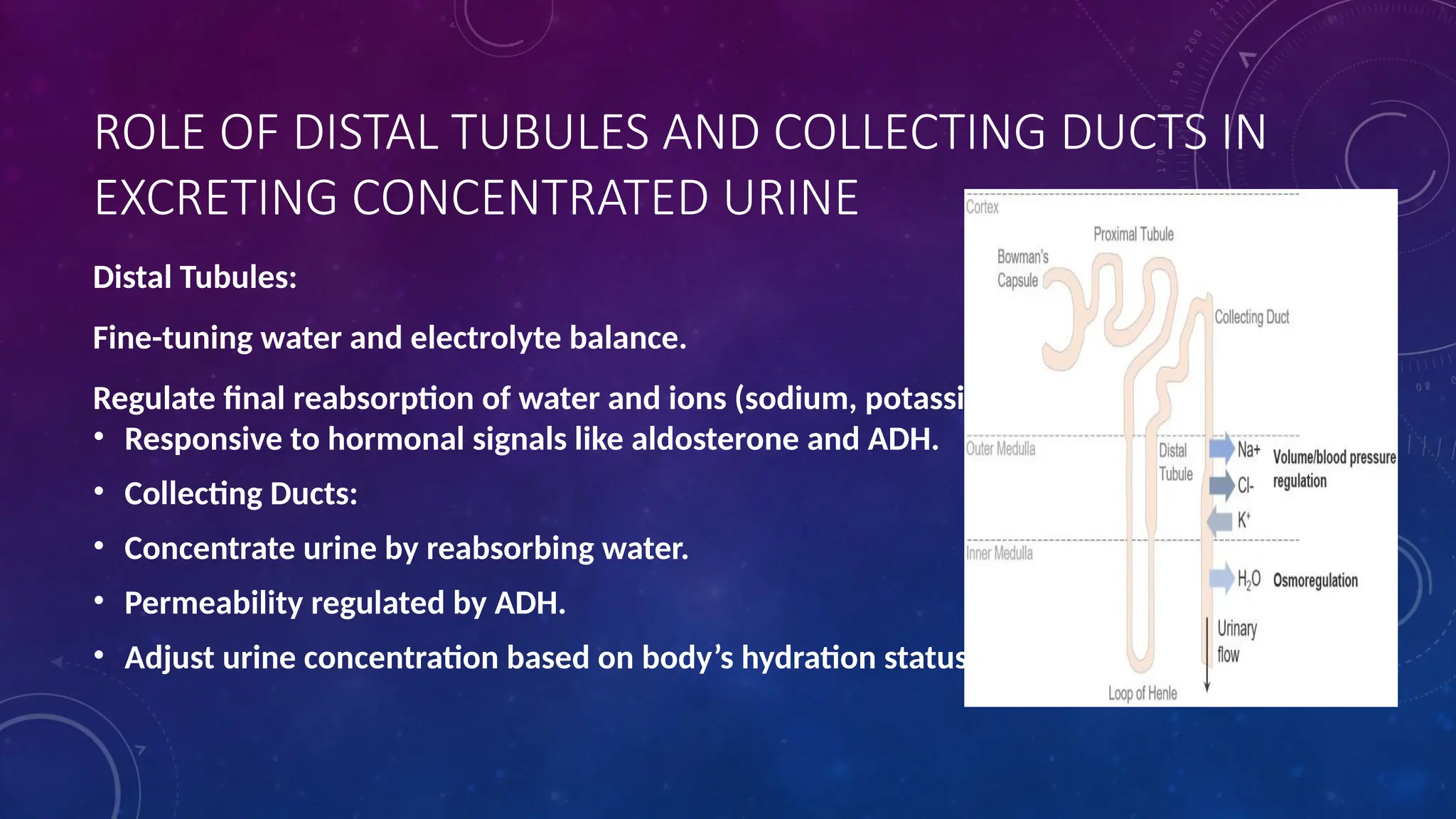
ROLE OF DISTAL TUBULES AND COLLECTING DUCTS IN
EXCRETING CONCENTRATED URINE
Distal Tubules:
Fine-tuning water and electrolyte balance.
Regulate final reabsorption of water and ions (sodium, potassium, calcium).
• Responsive to hormonal signals like aldosterone and ADH.
• Collecting Ducts:
• Concentrate urine by reabsorbing water.
• Permeability regulated by ADH.
• Adjust urine concentration based on body’s hydration status.

Countercurrent Exchange Presentation counter.pptx

  • 1.
  • 2.
    COUNTER CURRENT EXCHANGE: Process:Flow of fluids in opposite directions in adjacent tubules. Location: Predominantly found in the Loop of Henle within the kidney’s nephron. Descending Limb: Highly permeable to water but not solutes, leading to water movement out of the tubule. Ascending Limb: Impermeable to water but actively transports solutes out, creating a concentration gradient. Purpose: Establishes and maintains a hyperosmotic renal medullary interstitium. Facilitates: Exchange of solutes and water, aiding in urine concentration and waste excretion
  • 3.
    COUNTER CURRENT MECHANISMPRODUCES A HYPEROSMOTIC RENAL MEDULLARY INTERSTITIUM • This is achieved through the unique configuration and function of the nephron’s Loop of Henle, where the descending and ascending limbs have different permeabilities to water and solutes. • Descending Limb: Highly permeable to water, leading to water movement out of the tubule. • Ascending Limb: Impermeable to water but actively transports solutes out, creating a concentration gradient. • Resultant Effect: • Hyperosmotic Interstitium: Formation of a hyperosmotic environment in the renal medulla. • Osmolality Increase: Higher solute concentration enables effective water reabsorption.
  • 4.
    SPECIAL CHARACTERISTIC OFLOOP OF HENLE THAT CAUSE SOLUTES TO BE TRAPPED IN THE RENAL MEDULLA • Countercurrent Mechanism: Utilizes countercurrent flow to establish an osmotic gradient in the medulla. • Descending Limb Permeability: Highly permeable to water but not to solutes, allowing water to exit and concentrate the tubular fluid. • Ascending Limb Transport: Actively transports ions (Na+, Cl-) out of the tubule but is impermeable to water, increasing osmolarity in the medulla. • Countercurrent Exchange: Opposing flows in the descending and ascending limbs enable exchange of ions, maintaining the osmotic gradient. • Vasa Recta Interaction: Specialized capillary network maintains the gradient by exchanging solutes, preventing dissipation in the medulla.
  • 5.
    STEPS INVOLVED INCAUSING HYPEROSMOTIC RENAL MEDULLARY INTERSTITIUM • Countercurrent multiplication: • Loop of Henle actively transports sodium and chloride ions to the interstitium, creating a concentration gradient. • Water reabsorption: • Filtrate, passing through the descending limb, loses water to the hyperosmotic interstitium, concentrating the filtrate. • ADH regulation: • Antidiuretic hormone (ADH) enhances collecting duct permeability, aiding more water reabsorption, further concentrating urine and sustaining the hyperosmotic medullary
  • 6.
    ROLE OF DISTALTUBULES AND COLLECTING DUCTS IN EXCRETING CONCENTRATED URINE Distal Tubules: Fine-tuning water and electrolyte balance. Regulate final reabsorption of water and ions (sodium, potassium, calcium). • Responsive to hormonal signals like aldosterone and ADH. • Collecting Ducts: • Concentrate urine by reabsorbing water. • Permeability regulated by ADH. • Adjust urine concentration based on body’s hydration status.