lecture; yaxye
presentation; cost effectiveness analysis
group ; three(3)
GROUP MEMPER
 Craxamaan maxamed cali
 Hoodo cali
 Naziim csalaan
 Zaki claahi axmed
cost-
effectiveness
analysis
CONTENTS
 Definition Cost-effectiveness analysis (CEA)
 Purpose of cost effectiveness analysis
 How is CEA different from Cost-Benefit Analysis?
 When and why is CEA useful
 constitutes a cost
 How to use cost effectiveness analysis
 CEA APPLLICATIONS
 References
COST-EFFECTIVENESS ANALYSIS (CEA)
 is a form of economic analysis that compares the
relative costs and outcomes (effects) of different
courses of action. Cost-effectiveness analysis is
distinct from cost–benefit analysis, which assigns a
monetary value to the measure of effect.
 Cost-effectiveness analysis is often used in the
field of health services, where it may be
inappropriate to monetize health effect.
 Cost-effectiveness analysis
has been defined by the National Institute
for Health and Clinical Excellence (NICE)
as an economic study design in which
consequences of different interventions
are measured using a single outcome,
usually in ‘natural’ units (for example,
life-years gained, deaths avoided, heart
attacks avoided or cases detected).
PURPOSE OF COST EFFECTIVENESS ANALYSIS
 To identify exclude programe that is wasting
resources.
 To provide general information on the relative costs
and health benefits of different alternatives.
 To evalute the interventions in terms of efficacy
(cost effective ratio) absolute health gain and
affordability (absolute cost).
HOW IS CEA DIFFERENT FROM COST-
BENEFIT ANALYSIS?
 Outcomes
 • CBA: Ratio of costs of program to all identified
outcomes (benefits)
 • CEA: Ratio of costs of program to one defined
outcome (benefit)
 EXAMPLE: • Ratio of cost of education program
as a ratio to its impact on learning, physical and
mental health, household bargaining power, future
labour market outcomes, intergenerational well-
being
 • Ratio of cost of education program as a ratio to its
impact on learning
WHEN AND WHY IS CEA USEFUL?
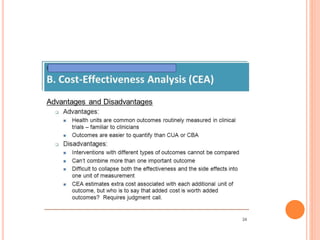
 Good option when there is one key specific
outcome of interest, which is often the case in
policy
 • CBA requires quantifying outcomes that are
difficult to quantify (controversial)
 CEA can allows comparison of multiple programs
by comparing impact in terms of one outcome
across schemes
 • Helps with decision making, particularly under
a fixed budget (i.e., which will give the most impact
for the least cost?)
WHAT CONSTITUTES A COST?
 Costs are seen differently from different
points of view. In economics the notion of
cost is based on the value that would be
gained from using resources elsewhere –
referred to as the opportunity cost.
 In cost-effectiveness analysis it is
conventional to distinguish between the
direct costs and indirect or productivity
costs associated with the intervention, as well
as what are termed intangibles, which,
although they may be difficult to quantify, are
often consequences of the intervention and
should be included in the cost profile.
● Direct costs: Medical: drugs; staff time;
equipment. Patient: transport; out-of pocket
expenses.
● Productivity costs: production losses;
other uses of time.
● Intangibles: pain; suffering; adverse
effects.
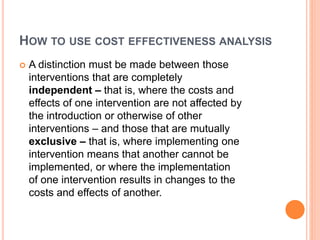
HOW TO USE COST EFFECTIVENESS ANALYSIS
 A distinction must be made between those
interventions that are completely
independent – that is, where the costs and
effects of one intervention are not affected by
the introduction or otherwise of other
interventions – and those that are mutually
exclusive – that is, where implementing one
intervention means that another cannot be
implemented, or where the implementation
of one intervention results in changes to the
costs and effects of another.
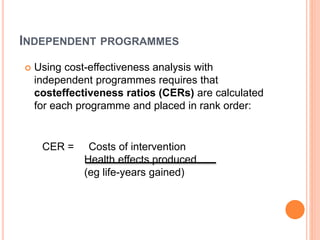
INDEPENDENT PROGRAMMES
 Using cost-effectiveness analysis with
independent programmes requires that
costeffectiveness ratios (CERs) are calculated
for each programme and placed in rank order:
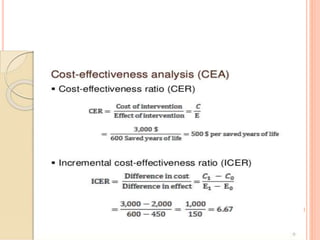
CER = Costs of intervention
Health effects produced
(eg life-years gained)
Programm
e
Costs (£)
[C]
Effects
(life-years
gained)
[E]
Increment
al cost
[∆C]
Increment
al effect
[∆E]
ICER
[∆C/∆E]
P1 125,000 1,300 125,000 1,300 96.15
P2 100,000 1,500 –25,000 200 –125
P3 160,000 2,000 60,000 500 120
P4 140,000 2,200 –20,000 200 –100
P5 170,000 2,600 30,000 400 75
Incremental cost-effectiveness ratios
Mutually exclusive interventions
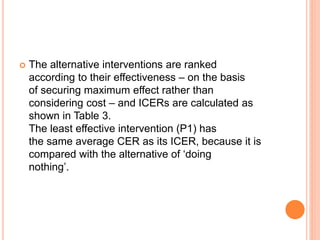
 The alternative interventions are ranked
according to their effectiveness – on the basis
of securing maximum effect rather than
considering cost – and ICERs are calculated as
shown in Table 3.
The least effective intervention (P1) has
the same average CER as its ICER, because it is
compared with the alternative of ‘doing
nothing’.
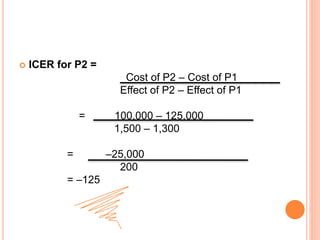
 ICER for P2 =
Cost of P2 – Cost of P1
Effect of P2 – Effect of P1
= 100,000 – 125,000
1,500 – 1,300
= –25,000
200
= –125
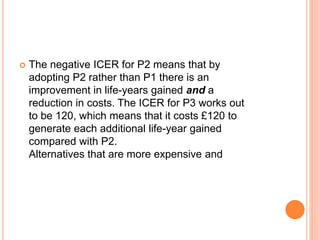
 The negative ICER for P2 means that by
adopting P2 rather than P1 there is an
improvement in life-years gained and a
reduction in costs. The ICER for P3 works out
to be 120, which means that it costs £120 to
generate each additional life-year gained
compared with P2.
Alternatives that are more expensive and
CEA APPLLICATIONS
 Planning and management .
 Policy and decision making.
 Resource allocation.
 In health services; when it’s inappropriate to
monetize health effect..
 Used in different study designs .
 Not the only criteria for decision making.
REFERENCES
 Tengs TO, Adams ME, Pliskin JS, et al. (June 1995).
"Five-hundred life-saving interventions and their cost-
effectiveness". Risk Anal. 15 (3): 369–
90. doi:10.1111/j.1539-
6924.1995.tb00330.x. PMID 7604170.
 Jump up^ Bell CM, Urbach DR, Ray JG, et al. (March
2006). "Bias in published cost effectiveness studies:
systematic review". BMJ. 332 (7543): 699–
703. doi:10.1136/bmj.38737.607558.80. PMC 1410902 .
PMID 16495332.
 Jump up^ Pekka Tuominen, Francesco Reda, Waled
Dawoud, Bahaa Elboshy, Ghada Elshafei, Abdelazim
Negm: Economic Appraisal of Energy Efficiency in
Buildings Using Cost-effectiveness Assessment.
Procedia Economics and Finance, Volume 21, 2015,
Pages
thanks

Cost effectiveness analysis

  • 1.
    lecture; yaxye presentation; costeffectiveness analysis group ; three(3)
  • 2.
    GROUP MEMPER  Craxamaanmaxamed cali  Hoodo cali  Naziim csalaan  Zaki claahi axmed
  • 3.
  • 4.
    CONTENTS  Definition Cost-effectivenessanalysis (CEA)  Purpose of cost effectiveness analysis  How is CEA different from Cost-Benefit Analysis?  When and why is CEA useful  constitutes a cost  How to use cost effectiveness analysis  CEA APPLLICATIONS  References
  • 5.
    COST-EFFECTIVENESS ANALYSIS (CEA) is a form of economic analysis that compares the relative costs and outcomes (effects) of different courses of action. Cost-effectiveness analysis is distinct from cost–benefit analysis, which assigns a monetary value to the measure of effect.  Cost-effectiveness analysis is often used in the field of health services, where it may be inappropriate to monetize health effect.
  • 6.
     Cost-effectiveness analysis hasbeen defined by the National Institute for Health and Clinical Excellence (NICE) as an economic study design in which consequences of different interventions are measured using a single outcome, usually in ‘natural’ units (for example, life-years gained, deaths avoided, heart attacks avoided or cases detected).
  • 7.
    PURPOSE OF COSTEFFECTIVENESS ANALYSIS  To identify exclude programe that is wasting resources.  To provide general information on the relative costs and health benefits of different alternatives.  To evalute the interventions in terms of efficacy (cost effective ratio) absolute health gain and affordability (absolute cost).
  • 8.
    HOW IS CEADIFFERENT FROM COST- BENEFIT ANALYSIS?  Outcomes  • CBA: Ratio of costs of program to all identified outcomes (benefits)  • CEA: Ratio of costs of program to one defined outcome (benefit)  EXAMPLE: • Ratio of cost of education program as a ratio to its impact on learning, physical and mental health, household bargaining power, future labour market outcomes, intergenerational well- being  • Ratio of cost of education program as a ratio to its impact on learning
  • 9.
    WHEN AND WHYIS CEA USEFUL?  Good option when there is one key specific outcome of interest, which is often the case in policy  • CBA requires quantifying outcomes that are difficult to quantify (controversial)  CEA can allows comparison of multiple programs by comparing impact in terms of one outcome across schemes  • Helps with decision making, particularly under a fixed budget (i.e., which will give the most impact for the least cost?)
  • 10.
    WHAT CONSTITUTES ACOST?  Costs are seen differently from different points of view. In economics the notion of cost is based on the value that would be gained from using resources elsewhere – referred to as the opportunity cost.
  • 11.
     In cost-effectivenessanalysis it is conventional to distinguish between the direct costs and indirect or productivity costs associated with the intervention, as well as what are termed intangibles, which, although they may be difficult to quantify, are often consequences of the intervention and should be included in the cost profile.
  • 12.
    ● Direct costs:Medical: drugs; staff time; equipment. Patient: transport; out-of pocket expenses. ● Productivity costs: production losses; other uses of time. ● Intangibles: pain; suffering; adverse effects.
  • 13.
    HOW TO USECOST EFFECTIVENESS ANALYSIS  A distinction must be made between those interventions that are completely independent – that is, where the costs and effects of one intervention are not affected by the introduction or otherwise of other interventions – and those that are mutually exclusive – that is, where implementing one intervention means that another cannot be implemented, or where the implementation of one intervention results in changes to the costs and effects of another.
  • 14.
    INDEPENDENT PROGRAMMES  Usingcost-effectiveness analysis with independent programmes requires that costeffectiveness ratios (CERs) are calculated for each programme and placed in rank order: CER = Costs of intervention Health effects produced (eg life-years gained)
  • 15.
    Programm e Costs (£) [C] Effects (life-years gained) [E] Increment al cost [∆C] Increment aleffect [∆E] ICER [∆C/∆E] P1 125,000 1,300 125,000 1,300 96.15 P2 100,000 1,500 –25,000 200 –125 P3 160,000 2,000 60,000 500 120 P4 140,000 2,200 –20,000 200 –100 P5 170,000 2,600 30,000 400 75 Incremental cost-effectiveness ratios Mutually exclusive interventions
  • 16.
     The alternativeinterventions are ranked according to their effectiveness – on the basis of securing maximum effect rather than considering cost – and ICERs are calculated as shown in Table 3. The least effective intervention (P1) has the same average CER as its ICER, because it is compared with the alternative of ‘doing nothing’.
  • 17.
     ICER forP2 = Cost of P2 – Cost of P1 Effect of P2 – Effect of P1 = 100,000 – 125,000 1,500 – 1,300 = –25,000 200 = –125
  • 18.
     The negativeICER for P2 means that by adopting P2 rather than P1 there is an improvement in life-years gained and a reduction in costs. The ICER for P3 works out to be 120, which means that it costs £120 to generate each additional life-year gained compared with P2. Alternatives that are more expensive and
  • 21.
    CEA APPLLICATIONS  Planningand management .  Policy and decision making.  Resource allocation.  In health services; when it’s inappropriate to monetize health effect..  Used in different study designs .  Not the only criteria for decision making.
  • 22.
    REFERENCES  Tengs TO,Adams ME, Pliskin JS, et al. (June 1995). "Five-hundred life-saving interventions and their cost- effectiveness". Risk Anal. 15 (3): 369– 90. doi:10.1111/j.1539- 6924.1995.tb00330.x. PMID 7604170.  Jump up^ Bell CM, Urbach DR, Ray JG, et al. (March 2006). "Bias in published cost effectiveness studies: systematic review". BMJ. 332 (7543): 699– 703. doi:10.1136/bmj.38737.607558.80. PMC 1410902 . PMID 16495332.  Jump up^ Pekka Tuominen, Francesco Reda, Waled Dawoud, Bahaa Elboshy, Ghada Elshafei, Abdelazim Negm: Economic Appraisal of Energy Efficiency in Buildings Using Cost-effectiveness Assessment. Procedia Economics and Finance, Volume 21, 2015, Pages
  • 23.