Quality Use
of Medicine
Guided By-
Hemakshi Chaudhari mam
Asst. Professor
Dept of Clinical Pharmacy
Presented By:
Aishwarya Dhole and
Dnyaneshwari Mate
M. Pharmacy (Clinical Pharmacy)
First Year Sem 2nd
R C PATEL INTITUTE OF PHARMACEUTICAL EDUCATION AND RESEARCH, SHIRPUR
Contents
 Introduction to QUM
 Definition
 Principles of QUM
 Key Partners & Responsibilities of Partners
 Building Blocks in QUM
 Evaluation Process in QUM
 Cost effective prescribing
INTRODUCTION
 Quality Use of medicine (QUM) is one of the central objective of
Australia's National Medicines Policy.
 Stimulated by the World Health Organization (WHO), countries
around the world are implementing national medicinal drug policies to
ensure the availability of essential, affordable drugs of acceptable quality,
safety and efficacy.
 Australia began to develop aspects of the National Medicines Policy as
early as the 1950s. By the 1990s a comprehensive policy was in place,
and in December 1999, a formal policy document entitled Australia’s
National Medicines Policy(DHAC 1999) was launched.
 This Document Describe the National Strategy For QUM in
Australia, set up a approach and Principle necessary to achieve
QUM in Australia.
 Healthcare Consumers, Health Practitioners and educators,
Healthcare facilities, the medicine industries, the media,
healthcare funders, purchasers, and governments together work
on framework of QUM.
 The term Quality use of medicines is used by the Australian
government as part of their policies on effective and correct uses
of medicine and access to appropriate medicines.
DEFINITION
Quality Use of Medicine (QUM) means-
 Management options are selected wisely.
 considering the place of medicines in treating illness
and maintaining health, and
 recognising that there may be better ways than
medicine to manage many disorders.
 Suitable medicines are chosen if medicine is considered necessary so
that the best available option is selected.
 the individual
 the clinical condition
 risks and benefits
 dosage and length of treatment
 any co-existing conditions
 other therapies
 monitoring considerations
 costs for the individual, the community and the health system as a
whole.
 Medicines are used safely and effectively so that consumers get the best
possible health outcomes.
 monitoring outcomes,
 minimising misuse, over-use and under-use, and
 improving people’s ability to solve problems related to medication,
such as negative effects or managing multiple medications.
This definition of QUM applies equally to decisions about medication
use by individuals and decisions that affect the health of the
population.
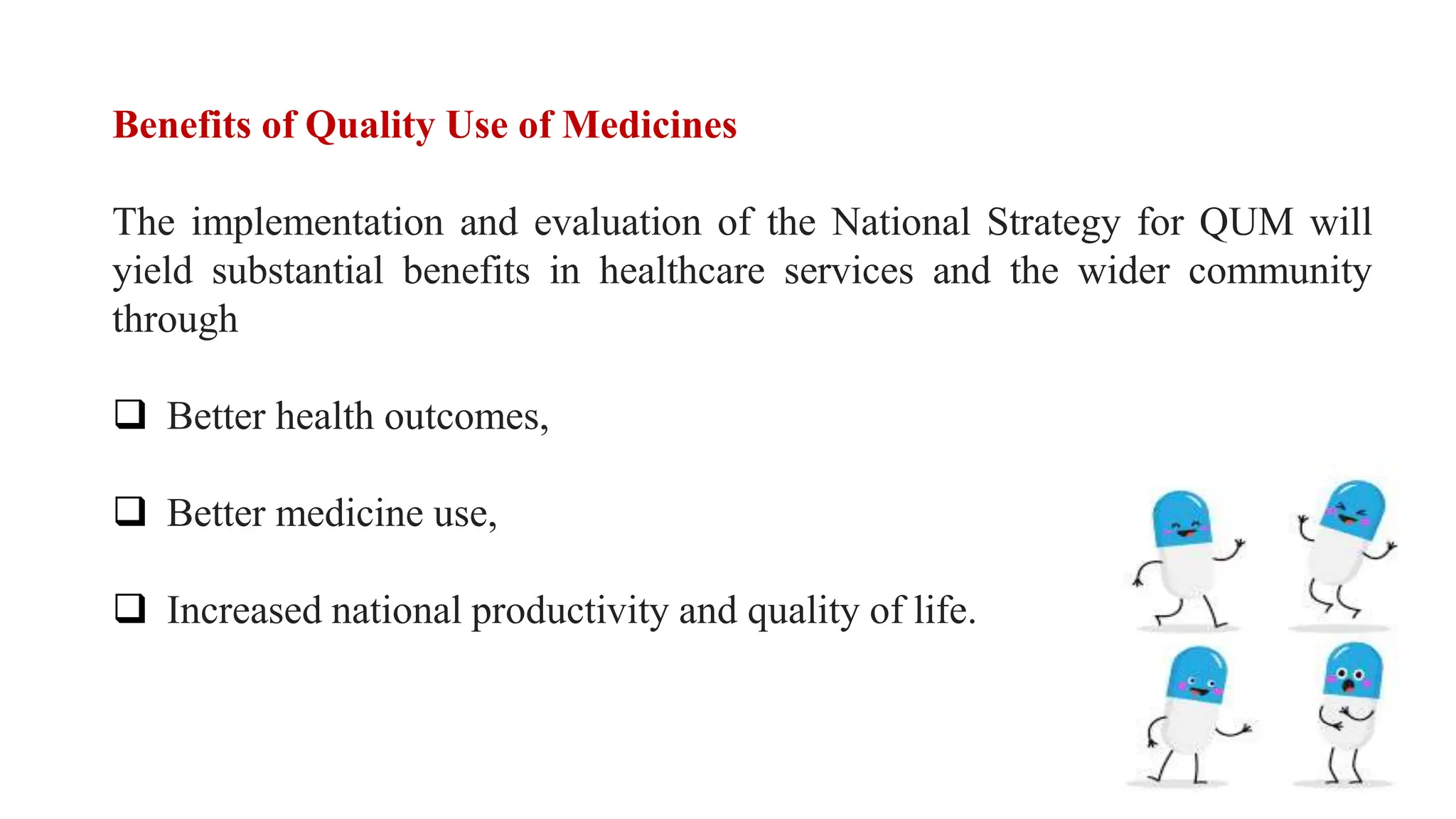
Benefits of Quality Use of Medicines
The implementation and evaluation of the National Strategy for QUM will
yield substantial benefits in healthcare services and the wider community
through
 Better health outcomes,
 Better medicine use,
 Increased national productivity and quality of life.
PRINCIPLES
The five principles underlying the National Strategy were developed in
consultation with all partners and recognise the problems Australia currently
faces in achieving QUM. They are:
• The primacy of consumers
The National Strategy recognises both the central role consumers play in
attaining QUM and the wisdom of their experience.
• Partnership
Active and respectful partnerships are essential to achieving QUM in
Australia.
• Consultative, collaborative, multi-disciplinary activity
To attain QUM, activities must be consultative, collaborative and
multidisciplinary. Therefore, key partners must be involved at all stages in
designing, implementing and evaluating QUM programs. At the local
level, the value of the healthcare team in achieving QUM needs to be
promoted and consumers recognised as active members.
• Support for existing activity
Wherever possible, initiatives within and across all groups need to be
stimulated and supported, and support given to existing groups that are
already developing initiatives. Actions taken to improve QUM should heed
the ethical and legal rights, obligations and responsibilities of all partners.
• Systems-based approaches
To achieve QUM it is necessary to adopt systems-based
approaches that will:
 develop behaviours that support QUM; and
 create a supportive environment that encourages
QUM.
Any undertaking related to QUM should reflect these five
principles.
Key Partners
 Consumers of medicine
 Those who prescribe, clinicians
 Health educators
 Health and age related facilities
 Medicines industries
 Media
 Healthcare funders and purchasers,
 Commonwealth, state, territory, local governments.
Responsibilities of Key Partners-
1. Health care consumers are responsible for:
• asking for and utilising objective information, resources and services to
make decisions and take actions that enable medicines, when they are
required, to be chosen and used wisely;
• becoming more aware of the risks and benefits of medicines, the
possibility of non-drug options and the importance of a healthy life-style
• developing skills and confidence to use medicines appropriately and
seeking help to solve problems when they arise; and
• becoming more aware of the place of medicines in the broader context of
health services and society.
2. Health practitioners and educators are responsible for:
• assisting people in making informed decisions and learning more about
health issues and health care through information, education and discussion;
• becoming more aware of the risks and benefits of medicines, the possibility
of non-drug options and the importance of a healthy life-style
• utilising objective information, resources and services to make decisions
and take actions that enable medicines, when required, to be chosen and
used wisely;
• continually developing knowledge and skills to use medicines appropriately;
and
• becoming more aware of the place of medicines within society.
3. Health and aged-care facilities are responsible for:
• providing facilities, systems, training opportunities and structures that support staff,
health practitioners and consumers in using medicines wisely and that avoid medication
errors.
4. Medicines industries are responsible for:
• continuing to develop safe and effective products to prevent, treat and cure illness or
maintain health;
• marketing and promoting products in a way that facilitates quality of use;
• providing good quality, accurate, balanced information and education services that are
conducive to QUM; and
• discouraging information and education activities that are not conducive to QUM.
5.The media are responsible for:
• Ethical and responsible reporting on health care issues;
• Reporting on medicines accurately and attempting to have errors corrected if they occur
• Being aware of the variety of available information sources on medicines and the
limitations of each source;
• Being aware of the impact of media reports on the use of medicines in the community
• Being aware of issues relevant to the broad context of medicines use, including risks of
medicine use, non-drug alternatives and the cost of medicine use to individuals and
society; and
• Encouraging dissemination of messages that enhance the quality of medication use.
6. Health care funders and purchasers are responsible for:
• Funding or purchasing services that support qum and
•Providing appropriate funding mechanisms that give consumers and health
practitioners incentives to support qum.
7. Governments, their agencies and committees are responsible for:
• Developing and implementing the national strategy for qum
• Coordinating relevant government programs and
•Investigating and developing appropriate structures, funding mechanisms, legislation
and environments that support qum.
Building Blocks
The six building blocks that support QUM are based on evidence and
expert opinion about interventions, regulatory efforts and programs to
improve medication use. They are:
1. Policy Development and Implementation
QUM principles need to be incorporated into other health-related policies
and legislation at Commonwealth, State and Territory levels and their
adoption monitored.
2. facilitation and coordination of QUM initiatives
3. Provision of objective information and assurance of ethical promotion of
medicines
This information should be:
 Balanced and accurate
 Informed by evidence and based on agreed standards
 Available in a timely manner
 Accessible and understandable by users
 Provided in a variety of forms suitable for users
 Independently sourced and free of any advertising
 Relevant to the wants and needs of users
 Evaluated for its usefulness, acceptability and effectiveness
4. Education and Training
training provides the prerequisite knowledge and skills to support QUM. It should
occur within a QUM framework as this allows the role of medicines in health to be
discussed. Education is equally important for the general public and health
practitioners
5. Provision of services and Appropriate Interventions
We need to develop effective QUM services and interventions that:
 contribute to better quality care and health outcomes;
 support health professionals and consumers in their decision-making and
actions
 recognise the heterogeneity and diversity.
6. Strategic research, Evaluation and Routine Data Collection
 Evaluation should sit within a quality improvement cycle, with the results
used to refine and improve practice.
 Routine datasets must be established to assist in evaluation, including a
comprehensive pharmacoepidemiologic database that is patient-linked and
contains information on medication use by age, gender and reason for use.
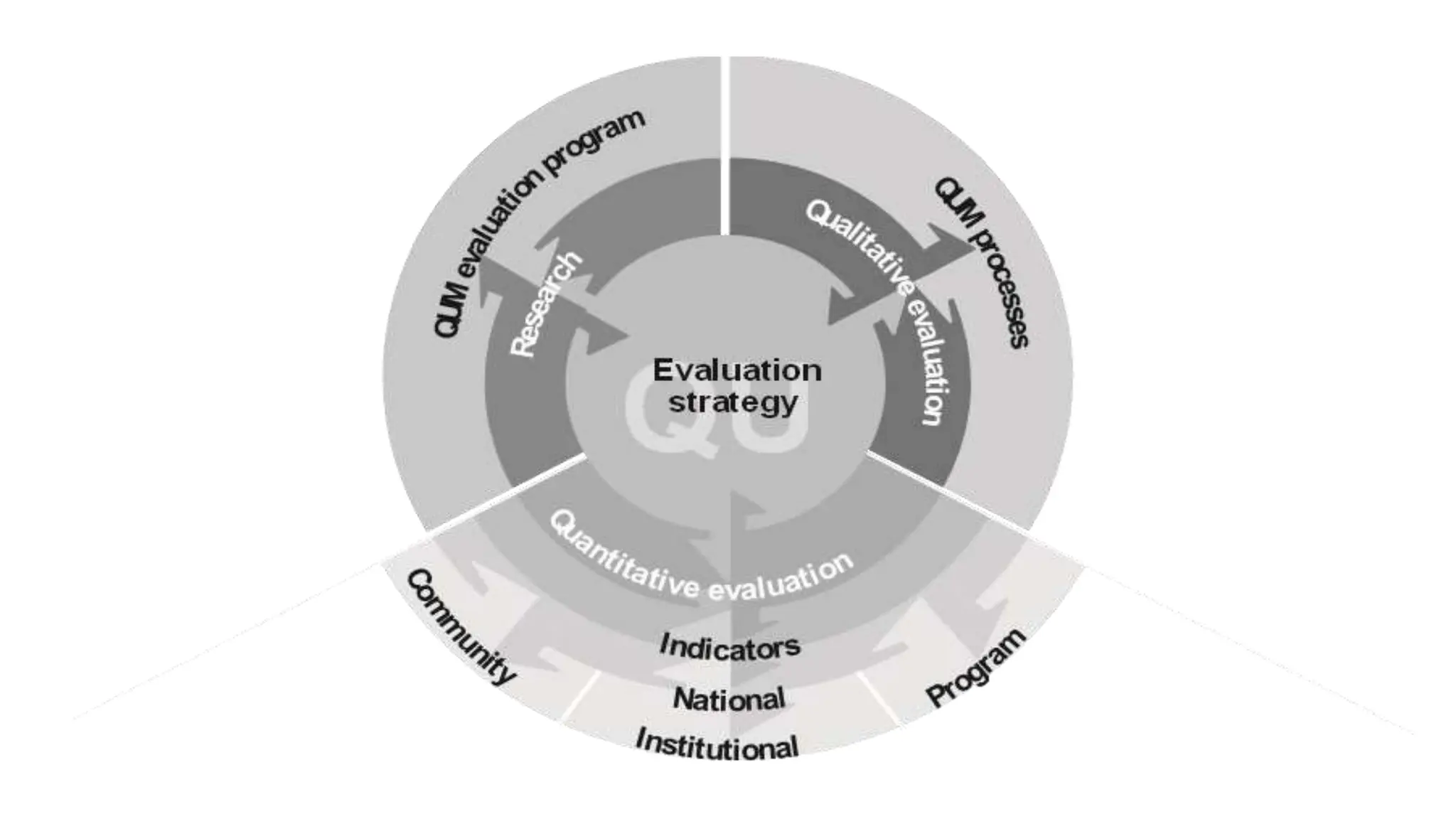
Evaluation of QUM
A comprehensive evaluation strategy mirrors the conceptual framework for implementing the
national strategy. In keeping with the nation that implementing the national strategy will
initiate change at a number of levels, the evaluation strategy includes evaluation mechanisms at
the community, institutional (NSWTAG 1997, 1998) and national (DHSH 1995) levels.
Thus national evaluation is designed to provide an overview of progress towards QUM in
australia resulting from the combination of initiatives implemented by many groups. It uses
indicators that:
• Provide quantitative data on the implementation of initiatives and their immediate effects,
as measured by changes in attitudes, knowledge, skills, and behaviour (DHSH 1995)
• Determine progress made towards the strategy’s goal, as measured by changes in health
outcomes associated with medication use and
• Can be used at the community and institutional (NSWTAG 1997, 1998) levels as part of a
quality improvement program around service delivery.
Other evaluation components have been designed for different elements of
the National Strategy:
• ongoing programs have their own evaluation component to facilitate and
inform future program development;
• research projects relevant to QUM are assessed to identify successful
projects and move towards implementing sustainable national and local
programs; and
• a qualitative analysis has been designed to enhance understanding of the
successful processes surrounding strategy development and
implementation.
Cost Effective Prescribing
Cost-effective prescribing is prescribing medication that is both
clinically and economically appropriate for a condition.
At present, NICE generally only approves new drugs if they cost
less than around £30,000 per quality-adjusted life year (QALY).
To assess what is economically appropriate we must ask how well
the medicine or treatment works in relation to how much it costs
the NHS — does it represent value for money?
 Prescribing budgets make up a significant amount of primary
care organization spend in primary care. As prescribing costs are
now within an overall cash limit, this means that if for example a
primary care organization (PCO) overspends on its prescribing
budget, it will have to make savings in other parts. Likewise, if a
PCO were to underspend on its prescribing budget, there would
be more money available to spend on other areas.
 Increases in generic prescribing, reviews of repeat prescriptions
and a greater willingness not to prescribe are all ways GPs can
increase the cost-effectiveness of prescribing individually every
day.
 Information services Knowledge and recommendations of appropriate OTC medications
can decrease the cost of medications to patients and PCO budgets.
 A number of policy initiatives have also been introduced that attempt to contain
prescribing costs.
 These include provision of prescribing analysis and cost (PACT) data.
 The equivalent of PACT in Scotland is the Scottish Prescribing Agency (SPA) and in
Northern Ireland it is Northern Ireland Prescribing Prices Information (NIPPI).
 PACT data are issued every three months by the Prescription Pricing Authority, which
processes all dispensed NHS prescriptions. It provides summaries of GPs’ individual and
practice prescribing. This information can be used to audit prescribing practices.
 Scripswitch is a computer program that runs within EMIS to suggest a cost-effective
version of the drug you prescribe.
Reference
https://www1.health.gov.au/internet/main/publishing.nsf/Content/EEA5B39AA0A63F18CA257BF0001DAE0
8/$File/National-Strategy-for-Quality-Use-of-Medicines.pdf
https://www.slideshare.net/ibrahimlecturer/quality-use-of-medicine
https://www.powershow.com/view1/de246-
ZDc1Z/Quality_Use_of_Medicines_in_powerpoint_ppt_presentation

Introduction to Quality use of medicine.pptx

  • 1.
    Quality Use of Medicine GuidedBy- Hemakshi Chaudhari mam Asst. Professor Dept of Clinical Pharmacy Presented By: Aishwarya Dhole and Dnyaneshwari Mate M. Pharmacy (Clinical Pharmacy) First Year Sem 2nd R C PATEL INTITUTE OF PHARMACEUTICAL EDUCATION AND RESEARCH, SHIRPUR
  • 2.
    Contents  Introduction toQUM  Definition  Principles of QUM  Key Partners & Responsibilities of Partners  Building Blocks in QUM  Evaluation Process in QUM  Cost effective prescribing
  • 3.
    INTRODUCTION  Quality Useof medicine (QUM) is one of the central objective of Australia's National Medicines Policy.  Stimulated by the World Health Organization (WHO), countries around the world are implementing national medicinal drug policies to ensure the availability of essential, affordable drugs of acceptable quality, safety and efficacy.  Australia began to develop aspects of the National Medicines Policy as early as the 1950s. By the 1990s a comprehensive policy was in place, and in December 1999, a formal policy document entitled Australia’s National Medicines Policy(DHAC 1999) was launched.
  • 4.
     This DocumentDescribe the National Strategy For QUM in Australia, set up a approach and Principle necessary to achieve QUM in Australia.  Healthcare Consumers, Health Practitioners and educators, Healthcare facilities, the medicine industries, the media, healthcare funders, purchasers, and governments together work on framework of QUM.  The term Quality use of medicines is used by the Australian government as part of their policies on effective and correct uses of medicine and access to appropriate medicines.
  • 5.
    DEFINITION Quality Use ofMedicine (QUM) means-  Management options are selected wisely.  considering the place of medicines in treating illness and maintaining health, and  recognising that there may be better ways than medicine to manage many disorders.
  • 6.
     Suitable medicinesare chosen if medicine is considered necessary so that the best available option is selected.  the individual  the clinical condition  risks and benefits  dosage and length of treatment  any co-existing conditions  other therapies  monitoring considerations  costs for the individual, the community and the health system as a whole.
  • 7.
     Medicines areused safely and effectively so that consumers get the best possible health outcomes.  monitoring outcomes,  minimising misuse, over-use and under-use, and  improving people’s ability to solve problems related to medication, such as negative effects or managing multiple medications. This definition of QUM applies equally to decisions about medication use by individuals and decisions that affect the health of the population.
  • 8.
    Benefits of QualityUse of Medicines The implementation and evaluation of the National Strategy for QUM will yield substantial benefits in healthcare services and the wider community through  Better health outcomes,  Better medicine use,  Increased national productivity and quality of life.
  • 9.
    PRINCIPLES The five principlesunderlying the National Strategy were developed in consultation with all partners and recognise the problems Australia currently faces in achieving QUM. They are: • The primacy of consumers The National Strategy recognises both the central role consumers play in attaining QUM and the wisdom of their experience. • Partnership Active and respectful partnerships are essential to achieving QUM in Australia.
  • 10.
    • Consultative, collaborative,multi-disciplinary activity To attain QUM, activities must be consultative, collaborative and multidisciplinary. Therefore, key partners must be involved at all stages in designing, implementing and evaluating QUM programs. At the local level, the value of the healthcare team in achieving QUM needs to be promoted and consumers recognised as active members. • Support for existing activity Wherever possible, initiatives within and across all groups need to be stimulated and supported, and support given to existing groups that are already developing initiatives. Actions taken to improve QUM should heed the ethical and legal rights, obligations and responsibilities of all partners.
  • 11.
    • Systems-based approaches Toachieve QUM it is necessary to adopt systems-based approaches that will:  develop behaviours that support QUM; and  create a supportive environment that encourages QUM. Any undertaking related to QUM should reflect these five principles.
  • 12.
    Key Partners  Consumersof medicine  Those who prescribe, clinicians  Health educators  Health and age related facilities  Medicines industries  Media  Healthcare funders and purchasers,  Commonwealth, state, territory, local governments.
  • 13.
    Responsibilities of KeyPartners- 1. Health care consumers are responsible for: • asking for and utilising objective information, resources and services to make decisions and take actions that enable medicines, when they are required, to be chosen and used wisely; • becoming more aware of the risks and benefits of medicines, the possibility of non-drug options and the importance of a healthy life-style • developing skills and confidence to use medicines appropriately and seeking help to solve problems when they arise; and • becoming more aware of the place of medicines in the broader context of health services and society.
  • 14.
    2. Health practitionersand educators are responsible for: • assisting people in making informed decisions and learning more about health issues and health care through information, education and discussion; • becoming more aware of the risks and benefits of medicines, the possibility of non-drug options and the importance of a healthy life-style • utilising objective information, resources and services to make decisions and take actions that enable medicines, when required, to be chosen and used wisely; • continually developing knowledge and skills to use medicines appropriately; and • becoming more aware of the place of medicines within society.
  • 15.
    3. Health andaged-care facilities are responsible for: • providing facilities, systems, training opportunities and structures that support staff, health practitioners and consumers in using medicines wisely and that avoid medication errors. 4. Medicines industries are responsible for: • continuing to develop safe and effective products to prevent, treat and cure illness or maintain health; • marketing and promoting products in a way that facilitates quality of use; • providing good quality, accurate, balanced information and education services that are conducive to QUM; and • discouraging information and education activities that are not conducive to QUM.
  • 16.
    5.The media areresponsible for: • Ethical and responsible reporting on health care issues; • Reporting on medicines accurately and attempting to have errors corrected if they occur • Being aware of the variety of available information sources on medicines and the limitations of each source; • Being aware of the impact of media reports on the use of medicines in the community • Being aware of issues relevant to the broad context of medicines use, including risks of medicine use, non-drug alternatives and the cost of medicine use to individuals and society; and • Encouraging dissemination of messages that enhance the quality of medication use.
  • 17.
    6. Health carefunders and purchasers are responsible for: • Funding or purchasing services that support qum and •Providing appropriate funding mechanisms that give consumers and health practitioners incentives to support qum. 7. Governments, their agencies and committees are responsible for: • Developing and implementing the national strategy for qum • Coordinating relevant government programs and •Investigating and developing appropriate structures, funding mechanisms, legislation and environments that support qum.
  • 18.
    Building Blocks The sixbuilding blocks that support QUM are based on evidence and expert opinion about interventions, regulatory efforts and programs to improve medication use. They are: 1. Policy Development and Implementation QUM principles need to be incorporated into other health-related policies and legislation at Commonwealth, State and Territory levels and their adoption monitored. 2. facilitation and coordination of QUM initiatives
  • 19.
    3. Provision ofobjective information and assurance of ethical promotion of medicines This information should be:  Balanced and accurate  Informed by evidence and based on agreed standards  Available in a timely manner  Accessible and understandable by users  Provided in a variety of forms suitable for users  Independently sourced and free of any advertising  Relevant to the wants and needs of users  Evaluated for its usefulness, acceptability and effectiveness
  • 20.
    4. Education andTraining training provides the prerequisite knowledge and skills to support QUM. It should occur within a QUM framework as this allows the role of medicines in health to be discussed. Education is equally important for the general public and health practitioners 5. Provision of services and Appropriate Interventions We need to develop effective QUM services and interventions that:  contribute to better quality care and health outcomes;  support health professionals and consumers in their decision-making and actions  recognise the heterogeneity and diversity.
  • 21.
    6. Strategic research,Evaluation and Routine Data Collection  Evaluation should sit within a quality improvement cycle, with the results used to refine and improve practice.  Routine datasets must be established to assist in evaluation, including a comprehensive pharmacoepidemiologic database that is patient-linked and contains information on medication use by age, gender and reason for use.
  • 22.
    Evaluation of QUM Acomprehensive evaluation strategy mirrors the conceptual framework for implementing the national strategy. In keeping with the nation that implementing the national strategy will initiate change at a number of levels, the evaluation strategy includes evaluation mechanisms at the community, institutional (NSWTAG 1997, 1998) and national (DHSH 1995) levels. Thus national evaluation is designed to provide an overview of progress towards QUM in australia resulting from the combination of initiatives implemented by many groups. It uses indicators that: • Provide quantitative data on the implementation of initiatives and their immediate effects, as measured by changes in attitudes, knowledge, skills, and behaviour (DHSH 1995) • Determine progress made towards the strategy’s goal, as measured by changes in health outcomes associated with medication use and • Can be used at the community and institutional (NSWTAG 1997, 1998) levels as part of a quality improvement program around service delivery.
  • 23.
    Other evaluation componentshave been designed for different elements of the National Strategy: • ongoing programs have their own evaluation component to facilitate and inform future program development; • research projects relevant to QUM are assessed to identify successful projects and move towards implementing sustainable national and local programs; and • a qualitative analysis has been designed to enhance understanding of the successful processes surrounding strategy development and implementation.
  • 25.
    Cost Effective Prescribing Cost-effectiveprescribing is prescribing medication that is both clinically and economically appropriate for a condition. At present, NICE generally only approves new drugs if they cost less than around £30,000 per quality-adjusted life year (QALY). To assess what is economically appropriate we must ask how well the medicine or treatment works in relation to how much it costs the NHS — does it represent value for money?
  • 26.
     Prescribing budgetsmake up a significant amount of primary care organization spend in primary care. As prescribing costs are now within an overall cash limit, this means that if for example a primary care organization (PCO) overspends on its prescribing budget, it will have to make savings in other parts. Likewise, if a PCO were to underspend on its prescribing budget, there would be more money available to spend on other areas.  Increases in generic prescribing, reviews of repeat prescriptions and a greater willingness not to prescribe are all ways GPs can increase the cost-effectiveness of prescribing individually every day.
  • 27.
     Information servicesKnowledge and recommendations of appropriate OTC medications can decrease the cost of medications to patients and PCO budgets.  A number of policy initiatives have also been introduced that attempt to contain prescribing costs.  These include provision of prescribing analysis and cost (PACT) data.  The equivalent of PACT in Scotland is the Scottish Prescribing Agency (SPA) and in Northern Ireland it is Northern Ireland Prescribing Prices Information (NIPPI).  PACT data are issued every three months by the Prescription Pricing Authority, which processes all dispensed NHS prescriptions. It provides summaries of GPs’ individual and practice prescribing. This information can be used to audit prescribing practices.  Scripswitch is a computer program that runs within EMIS to suggest a cost-effective version of the drug you prescribe.
  • 28.