
By
T Mohen Chander
The key attribute of a successful company
employee is being «results-oriented».
A valuable employee is able to act
according to the circumstances, pursue the
results, neither postponing the solution
of issues nor multiplying bureaucracy
Expectations of Industries from Management Students
Building a Bridge between Industry & Management Institutes
Professionalism — to possess unique and
up-to-date knowledge and have the
capability to apply this knowledge; one's
own competent vision and opinion; as well
as the capability to achieve results
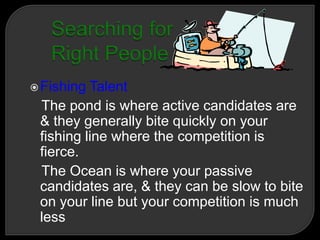
Fishing Talent
The pond is where active candidates are
& they generally bite quickly on your
fishing line where the competition is
fierce.
The Ocean is where your passive
candidates are, & they can be slow to bite
on your line but your competition is much
less
to make proposals on new projects,
optimize functions and business
processes; show desire to participate
in project and work groups; and contribute
to performance improvement
Knowledge Traits
Full knowledge of the
discipline &
specializations
Analytical Mind
Quick decision making
capabilities
to achieve results within the set timeframe;
to be ready to bear responsibility for failure
to fulfill duties; to effectively balance
personal objectives/results and the
objectives/results of the company
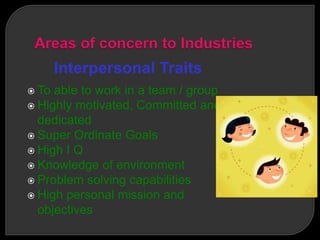
Interpersonal Traits
 To able to work in a team / group
 Highly motivated, Committed and
dedicated
 Super Ordinate Goals
 High I Q
 Knowledge of environment
 Problem solving capabilities
 High personal mission and
objectives
to find non-routine solutions —
to be internal entrepreneurs of the
Company, generating new solutions and
projects outside the range of standard
duties, job functions or business based
on either a new combination of traditional
approaches and processes or their non-
standard application.
 involvement in the activities of the
company and its brand; avoidance
of destructive negative criticism and
readiness to participate in solution
of company problems. All employees and
managers are obliged to use company
assets only for improvement and
development
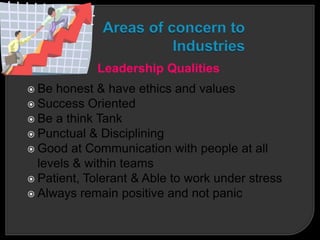
Leadership Qualities
 Be honest & have ethics and values
 Success Oriented
 Be a think Tank
 Punctual & Disciplining
 Good at Communication with people at all
levels & within teams
 Patient, Tolerant & Able to work under stress
 Always remain positive and not panic
Readiness to participate in cross-functional
teams and projects; giving positive and
effective response to the requests of co-
workers from other company divisions;
readiness to share information. Efforts
to establish barriers between divisions,
competition for information and status,
influence on functional divisions,
Leadership Qualities
 Able to manage conflict
 Ability to assess needs
 Ability to create a vision
 Ability to focus the resources
 Ability to track and measure performance
 Constantly on the move and moving among
the whole team
 Able to Understand the importance of change
management
 internal job rotation and to consistently promote the
employees to more responsible positions in the company.
 The promotion is based on performance assessment,
experience and knowledge of the up-to-date technologies and
business practice, as well as the employee's personal qualities
and interests.
 The employee's promotion within the company is planned and
recorded in the individual career development plan.
 The Top Reserve individual career plan system (200 middle
and senior management level employees) is supervised by the
People Council which consists of the First Level Team
managers and presided by the Chief Executive Officer.
Career development plans of other
employees are managed by the
HR departments and line managers.
Career plans of the management are
based on an assessment determining the
employee's competency development level
and goal reaching performance.
Assessment results shall
be communicated to the employees
in a one-on-one meeting.
 The company shall set clear and reasonable
work objectives which shall be communicated
to the employee by the manager. Metrics
shall be developed for each objective
to assess the achievements. The
contributions toward achieving personal work
goals, as well as the result of the employee's
work contributions in his/her own
work/business unit in general, shall also
be appraised.
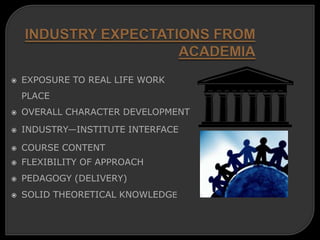
 EXPOSURE TO REAL LIFE WORK
PLACE
 OVERALL CHARACTER DEVELOPMENT
 INDUSTRY—INSTITUTE INTERFACE
 COURSE CONTENT
 FLEXIBILITY OF APPROACH
 PEDAGOGY (DELIVERY)
 SOLID THEORETICAL KNOWLEDGE
 The fixed base salary is a compensation for
fulfillment of functional duties associated with
the employee's position and his/her area
of responsibility. The agreements between
employee and the company concerning the
amount of fixed base salary is formalized
in an employment contract. The employee's
base salary can be changed as a result
of an employee appraisal, qualification
requirements adjustment, employee
assessment,
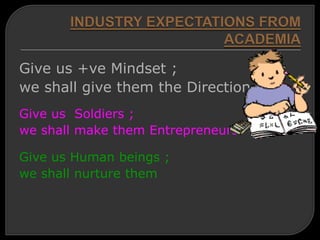
Give us +ve Mindset ;
we shall give them the Direction
Give us Soldiers ;
we shall make them Entrepreneurs
Give us Human beings ;
we shall nurture them
 variable incentive is
 generated on the basis
 of the achievement of
 specific planned goals
 and associated metrics
 which add value to and
 increase efficiency of the
 company. The company
 shall use all available
 forms of incentives,
 as well as tools of both
 monetary and non-monetary motivation
 The employees' social benefits package
is determined by the Labor Code and current
collective bargaining agreements. The
company provides additional voluntary
medical insurance and parity pension plans.
 The social benefits package is set for each
corporate branch office and/or subsidiary with
due account of region-specific features and
is formalized in collective bargaining
agreements.
Professional skills
development courses.
Participation in seminars
and training programs,
including corporate ones
 For example, participation in competency-
improvement
 training courses.
Opportunity to take part in distance
learning programs
 Do things differently (Out of the Box)
 Experimentation - Risk taking Abilities
 Positive Attitude
 Excellent Communication/Presentation Skills
 Mobility & Flexibility - Change Management
 Practical Approach
 Good Interpersonal Skills
 Continuous Learning Ability
 Adaptability
Professional skills development courses.
Participation in seminars and training
programs, including corporate ones.
Distance learning programs
Bench Strength programs
 external training opportunities
 Shed Ego - Positive Mindset
 WE Approach
 Be ready to do Dirty Jobs
 Have Tolerance to Frustration
 Go to People
 Keep sound health
 Keep Smiling
 Be a Cash Card
Send in your feed back to
Mail : mohen63@gmail.com
Mob: 9003535787
it : www.comeongetgoing.com

Corporate expectations

  • 1.
  • 2.
    The key attributeof a successful company employee is being «results-oriented». A valuable employee is able to act according to the circumstances, pursue the results, neither postponing the solution of issues nor multiplying bureaucracy
  • 3.
    Expectations of Industriesfrom Management Students Building a Bridge between Industry & Management Institutes
  • 4.
    Professionalism — topossess unique and up-to-date knowledge and have the capability to apply this knowledge; one's own competent vision and opinion; as well as the capability to achieve results
  • 5.
    Fishing Talent The pondis where active candidates are & they generally bite quickly on your fishing line where the competition is fierce. The Ocean is where your passive candidates are, & they can be slow to bite on your line but your competition is much less
  • 6.
    to make proposalson new projects, optimize functions and business processes; show desire to participate in project and work groups; and contribute to performance improvement
  • 7.
    Knowledge Traits Full knowledgeof the discipline & specializations Analytical Mind Quick decision making capabilities
  • 8.
    to achieve resultswithin the set timeframe; to be ready to bear responsibility for failure to fulfill duties; to effectively balance personal objectives/results and the objectives/results of the company
  • 9.
    Interpersonal Traits  Toable to work in a team / group  Highly motivated, Committed and dedicated  Super Ordinate Goals  High I Q  Knowledge of environment  Problem solving capabilities  High personal mission and objectives
  • 10.
    to find non-routinesolutions — to be internal entrepreneurs of the Company, generating new solutions and projects outside the range of standard duties, job functions or business based on either a new combination of traditional approaches and processes or their non- standard application.
  • 11.
     involvement inthe activities of the company and its brand; avoidance of destructive negative criticism and readiness to participate in solution of company problems. All employees and managers are obliged to use company assets only for improvement and development
  • 12.
    Leadership Qualities  Behonest & have ethics and values  Success Oriented  Be a think Tank  Punctual & Disciplining  Good at Communication with people at all levels & within teams  Patient, Tolerant & Able to work under stress  Always remain positive and not panic
  • 13.
    Readiness to participatein cross-functional teams and projects; giving positive and effective response to the requests of co- workers from other company divisions; readiness to share information. Efforts to establish barriers between divisions, competition for information and status, influence on functional divisions,
  • 14.
    Leadership Qualities  Ableto manage conflict  Ability to assess needs  Ability to create a vision  Ability to focus the resources  Ability to track and measure performance  Constantly on the move and moving among the whole team  Able to Understand the importance of change management
  • 15.
     internal jobrotation and to consistently promote the employees to more responsible positions in the company.  The promotion is based on performance assessment, experience and knowledge of the up-to-date technologies and business practice, as well as the employee's personal qualities and interests.  The employee's promotion within the company is planned and recorded in the individual career development plan.  The Top Reserve individual career plan system (200 middle and senior management level employees) is supervised by the People Council which consists of the First Level Team managers and presided by the Chief Executive Officer.
  • 16.
    Career development plansof other employees are managed by the HR departments and line managers. Career plans of the management are based on an assessment determining the employee's competency development level and goal reaching performance. Assessment results shall be communicated to the employees in a one-on-one meeting.
  • 17.
     The companyshall set clear and reasonable work objectives which shall be communicated to the employee by the manager. Metrics shall be developed for each objective to assess the achievements. The contributions toward achieving personal work goals, as well as the result of the employee's work contributions in his/her own work/business unit in general, shall also be appraised.
  • 18.
     EXPOSURE TOREAL LIFE WORK PLACE  OVERALL CHARACTER DEVELOPMENT  INDUSTRY—INSTITUTE INTERFACE  COURSE CONTENT  FLEXIBILITY OF APPROACH  PEDAGOGY (DELIVERY)  SOLID THEORETICAL KNOWLEDGE
  • 19.
     The fixedbase salary is a compensation for fulfillment of functional duties associated with the employee's position and his/her area of responsibility. The agreements between employee and the company concerning the amount of fixed base salary is formalized in an employment contract. The employee's base salary can be changed as a result of an employee appraisal, qualification requirements adjustment, employee assessment,
  • 20.
    Give us +veMindset ; we shall give them the Direction Give us Soldiers ; we shall make them Entrepreneurs Give us Human beings ; we shall nurture them
  • 21.
     variable incentiveis  generated on the basis  of the achievement of  specific planned goals  and associated metrics  which add value to and  increase efficiency of the  company. The company  shall use all available  forms of incentives,  as well as tools of both  monetary and non-monetary motivation
  • 22.
     The employees'social benefits package is determined by the Labor Code and current collective bargaining agreements. The company provides additional voluntary medical insurance and parity pension plans.  The social benefits package is set for each corporate branch office and/or subsidiary with due account of region-specific features and is formalized in collective bargaining agreements.
  • 23.
    Professional skills development courses. Participationin seminars and training programs, including corporate ones  For example, participation in competency- improvement  training courses. Opportunity to take part in distance learning programs
  • 24.
     Do thingsdifferently (Out of the Box)  Experimentation - Risk taking Abilities  Positive Attitude  Excellent Communication/Presentation Skills  Mobility & Flexibility - Change Management  Practical Approach  Good Interpersonal Skills  Continuous Learning Ability  Adaptability
  • 25.
    Professional skills developmentcourses. Participation in seminars and training programs, including corporate ones. Distance learning programs Bench Strength programs
  • 26.
    Bench Strength programs external training opportunities
  • 27.
     Shed Ego- Positive Mindset  WE Approach  Be ready to do Dirty Jobs  Have Tolerance to Frustration  Go to People  Keep sound health  Keep Smiling  Be a Cash Card
  • 28.
    Send in yourfeed back to Mail : mohen63@gmail.com Mob: 9003535787 it : www.comeongetgoing.com