A Project on Induction & Performance Review Methodology for Graduate Engineering Trainees.
1
A Project on Induction &
Performance Review
Methodology for Graduate
Engineering Trainees.
Project Research & Compilation done by:
Debdeep Ghosh, Assistant Manager, Nicco Ventures Limited.
For Doosan Infracore
A Project on Induction & Performance Review Methodology for Graduate Engineering Trainees.
2
INDEX
1. Induction
1.1 Definition
1.2 Objective / Importance of Successful Induction
1.3 Do`s & Don’ts of InDuctIon
1.4 Contents of induction / Checklists
1.5 Best Practices
2. Performance Review
2.1 Definition
2.2 Objective
2.3 Advantages of Performance Review
2.3 Types of Performance Review & Choosing What suits your Company
3. Blending Induction with performance Review
(Suggested methodology for Graduate Engineering Trainees)
4. Glossary
4.1 Sample Induction Manual / Contents
4.2 Sample Best (Innovative) Practice for Induction
4.3 Sample Performance Review Matrix
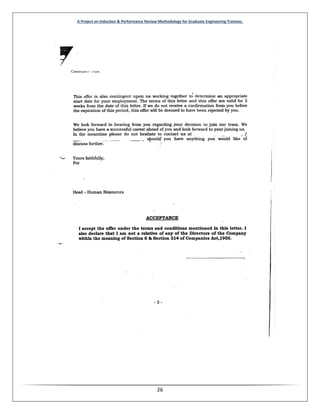
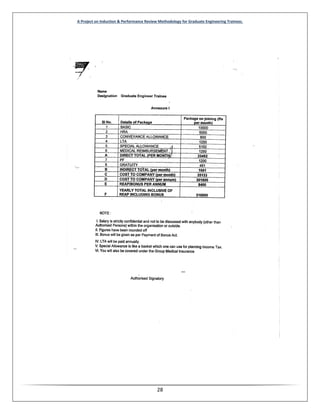
4.5 Sample Offer Letter Copy - 1 (Engineering Industry Specific)
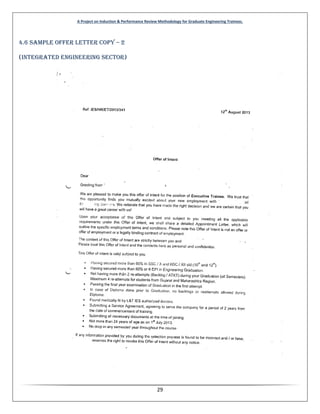
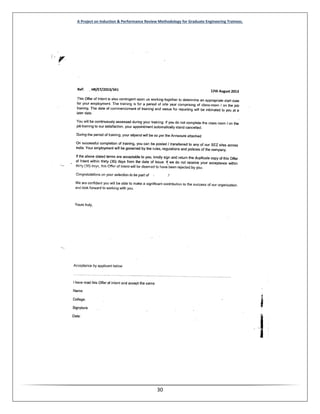
4.6 Sample Offer Letter Copy – 2 (Integrated Engineering Sector)
A Project on Induction & Performance Review Methodology for Graduate Engineering Trainees.
3
1. Induction
1.1 Definition of Induction
Induction of Employee is the first step towards gaining an employees' commitment, Induction is aimed at
introducing the job and organization to the recruit and him or her to the organization. Induction involves
orientation and training of the employee in the organizational culture, and showing how he or she is
interconnected to (and interdependent on) everyone else in the organization. "Business Dictionary.com"
The new employee’s first contact with his or her physical and human working environment is extremely
important, since it will condition his or her relationship with the company. The employee must feel supported
and important. The first person he or she will meet is the immediate supervisor, who should present the
corporate profile in addition to providing information on the organization’s background, values, clientele,
services offered, staff, and expected behavior.
The immediate superior will also specify the newcomer’s role. The points listed below should be covered
during this meeting.
1. The company, its history and products, process of production and major operations involved in his job.
2. The significance of the job with all necessary information about it including job training and job hazards.
3. Structure of the organization and the functions of various departments.
4. Employee’s own department and job, and how he fits into the organization.
5. Personnel policy and sources of information.
6. Company policies, practices, objectives and regulations.
7. Terms and conditions of service, amenities and welfare facilities.
8. Rules and regulations governing hours of work and over-time, safety and accident prevention, holidays and
vacations, methods of reporting, tardiness and, absenteeism.
9. Grievances procedure and discipline handling.
10. Social benefits and recreation services.
11. Opportunities, promotions, transfer, suggestion schemes and job satisfaction.
A Project on Induction & Performance Review Methodology for Graduate Engineering Trainees.
4
1.2 Objective / importance of successful Induction
It is process of bringing/introducing/familiarizing a new recruit into the oraginsation. This program familiarizes
the new employee about the culture, accepted practices and performance standards of the oraginsation.
It has been proved in one of the survey conducted by the Centre for Creative Leadership (headquartered in
Greensboro, North Carolina, US), that a fresh hire does not met the expectation of an organisation for the first
few months. The issue of productivity of new hires has to be defined individually by every organisation. Fresh
hires are able to learn the process as quickly as possible if the induction efforts are right and they can be very
productive if their induction is been done in an proper manner.
An employee has to work with fellow employees and his supervisor. For this he must know them, the way they
work and also the policies and practices of the organization so that he may integrate himself with the
enterprise. Any neglect in the area of induction and orientation may lead to high labour turnover, confusion,
wasted time and expenditure.
An induction programme consists primarily of three steps:
General orientation by the staff: It gives necessary general information about the history and the operations
of the firm. The purpose is to help an employee to build up some pride and interest in the organization.
Specific orientation by the job supervisor: The employee is shown the department and his place of work; the
location of facilities and is told about the organization’s specific practices and customs. The purpose is to
enable the employee to adjust with his work and environment.
Follow-up orientation by either the personnel department or the supervisor: This is conducted within one
week to six months of the initial induction and by a foreman or a specialist. The purpose is to find out whether
the employee is reasonably well satisfied with him. Through personal talks, guidance and counselling efforts
are made to remove the difficulties experienced by the newcomer.
A Project on Induction & Performance Review Methodology for Graduate Engineering Trainees.
5
1.3 InDuctIon Do s & Don’t s
Involvement in Induction programs (should be’s )
Induction program must/should include all the aspects of the organization and present for the awareness of
the new employee. Like emergency procedures, facilities, safety issues, right’s of the employee, what to be
paid, no harassment, equal opportunity, grievance procedures, employee responsibilities, times, conduct
standards, job function, dress requirements, organisational structure, what it does, how they fit in, who is
their Manager, the functions of different departments, how the employee will be managed, what the
performance management process will involve, and his/her role in that process, are the few concern areas
during an Induction program.
Induction should be conducted on the first day of the new recruit from the gate of the organization itself. For
induction only higher management or Head of HR or Senior should be addressing the new entrant. It should
also involve the employees of the new entrant department. An effective induction helps a new employee feel
assured and comfortable in the new environment, which is critical for early uptake in the new role. Induction
should always be interactive. It also provides an opportunity to the new entrant to engrain the original values
and ethics as well as the style of functioning. Escorting an new entrant will be one of the best and most
impactful induction step. It should always be interesting and must hold the attention of the new employee.
Involvement in Induction programs (not be’s )
First of all Induction program must not/ should not include much of theoretical part. Bad induction leads to
stress and de-motivation. Arriving for a new job a bad induction can leave a new starter worried, anxious and
unable to perform their duties. More work for longer as the new entrant struggles to become an effective
member. It increases the workload, all the wrong messages given to the new starter and can damage long-
term implications.
Signs of bad Induction program are Too Short – during induction a new entrant should just not give the mobile
numbers or small brief as always remember either a person should have or should not have knowledge, half
knowledge leads to disaster. Too Hasty – A ten minutes brisk walk and making him familiarizing about the exit
or entry should not be the part of induction. Too Boring – All the theoretical and long presentation with high
figures involved is a bad sign of induction. Impersonal – Avoid hours of speeches and presentations and
voluminous policy manuals or information packages. Too personal – It should not be related to the complete
life cycle of a new entrant. Neglectful – whosoever takes the induction should have complete knowledge of
the new entrant participation the induction program, Isolated and embarrassing.
A Project on Induction & Performance Review Methodology for Graduate Engineering Trainees.
6
1.4 Contents of induction / Checklists
Necessarily induction training will have to include some fairly dry subjects, so anything you can do to inject
interest, variety, different formats and experiences will greatly improve the overall induction process. There
are lots of ideas for illustrating concepts and theories relating to induction training on the acronyms page
(warning: contains adult content), and also the stories page.
Induction training must include the following elements:
General training relating to the organisation, including values and philosophy as well as structure and history,
etc.
Mandatory training relating to health and safety and other essential or legal areas.
Job training relating to the role that the new starter will be performing.
Training evaluation, entailing confirmation of understanding, and feedback about the quality and response to
the training.
And while not strictly part of the induction training stage, it's also helpful to refer to and discuss personal
strengths and personal development wishes and aspirations, so that people see they are valued as individuals
with their own unique potential, rather than just being a name and a function. This is part of making the job
more meaningful for people - making people feel special and valued - and the sooner this can be done the
better.
1.5 Best Practices
CIPD states that 22% of new employees leave their organization within the first six months. Although there
could be many reasons for this, a strong possibility may be due to the fact that employees could not integrate
well with the organization. Employees might have had questions that the induction program failed to address,
leaving room for ambiguity or misinterpretation.
Typically, employees leave when they don’t see any bright future for themselves in the organization. Many a
time these perceptions could be false and can be avoided through effective induction training where
employees can be given an effective orientation about the organization’s vision and mission and how
employee progression fits into their plan.
Below are some of the best practices that could be useful to deliver a productive induction training program
for new hires.
1. Early engagement: Engage with the new recruits even before they join by sending them welcome messages
and key action points to be followed once they are part of the organization. Once an employee has accepted
the job offer, it is a good idea to communicate with the employee welcoming him or her onboard. Links to
A Project on Induction & Performance Review Methodology for Graduate Engineering Trainees.
7
online resources that give basic information about the organization can be shared so that employees can get
an idea about their future workplace. Online links, videos or short modules can provide information about the
organization’s vision, mission, culture and press reviews. This way, new hires will feel wanted and have a fair
idea about the organization even before they report for their jobs.
2. Blended solution: New hire training can be broadly divided into orientation training and induction training.
Orientation training is generally given on the first day when the employee reports to work. This needs to be
given face to face and typically covers information about existing physical amenities, timings, security details
and peer introductions. Other aspects such as essential organizational information, HR, employee progression
and job-specific information can be done using the online medium. This way, employees are not intimidated
with too much information right on the first day or during the limited timeframe of a face-to-face interaction.
3. Training as a process and NOT an event: The objective of training is not information sharing but effective
assimilation of knowledge. To achieve this purpose, divide the online training material into independent
modules so that they can be completed over a set period of time. This provides flexibility and freedom to
employees to take up learning at their own pace and convenience. Training will NOT be a one-off event where
a large amount of information is attempted to be shared with participants.
4. Independent but inter-dependent bite-sized modules: In addition to the flexibility that is provided to
training managers in terms of building and assigning course units, smaller modules offer flexibility to learners
in terms of learning at their own pace. They are also likely to understand and assimilate the shared
information better when it is presented in smaller chunks. Therefore, ensure that training modules are
segregated according to the topics in small bite-sized modules for better assimilation and retention. The
advantage of having such independent units is that once developed, the units can be re-used to compile
induction training for different audiences within the organization. For example, Terms and Conditions and
Leave Policy could be common across the organization but employee progression may be different. Thus,
training managers can build and assign units based on the target audiences.
5. Allocation of training time: Often, organizations that assign online training modules to their new hires, fail
to allot dedicated time slots for the purpose. Employees are expected to squeeze in some time off their
scheduled work for completing courses. All they are given is a deadline before which the training needs to be
completed. This puts extra burden on employees and also earns their resentment. Provide dedicated time to
employees for online learning-such as 30 minutes after lunch or at the end of the day based on the
organization’s timelines.
6. Tracking and assignments: It is important that the courses that are being attempted by new hires are
tracked at the module level. This provides valuable feedback about the quality and success of the induction
program. Additionally, it is good to have assignments at the end of each unit and quizzes at the end of each
module for formative and summative assessments. Have tracking facility and assignments at the end of each
module to monitor employee progress in addition to giving feedback on the training in general.
A Project on Induction & Performance Review Methodology for Graduate Engineering Trainees.
8
7. Evaluation: Induction training cannot be a one-way information dissemination forum. Seek feedback from
new hires to ensure training is purposeful and that it attains the objectives. It is also a good idea to monitor
employee turnover, which might have a bearing on the quality of the induction program. These might give
valuable tips to amend or alter the approach towards future induction training programs.
Corporate induction training is being increasingly identified as one of the valuable methods for employee
retention. Many organizations recognize the need to make it an extended online program instead of a one-off
event that is organized more to fulfill mandatory HR requirements. In this context, what do you have to say
with respect to the tips offered above? Do share your thoughts.
A Project on Induction & Performance Review Methodology for Graduate Engineering Trainees.
9
2. Performance Review
2.1 Definition of Performance Review
Performance Review is the systematic evaluation of the performance of employees and to understand the
abilities of a person for further growth and development.
Performance appraisal is generally done in systematic ways which are as follows:
The supervisors measure the pay of employees and compare it with targets and plans.
The supervisor analyses the factors behind work performances of employees.
The employers are in position to guide the employees for a better performance.
2.2 Objectives of Performance REVIEW
Performance Review can be done with following objectives in mind:
To maintain records in order to determine compensation packages, wage structure, salaries raises, etc.
To identify the strengths and weaknesses of employees to place right men on right job.
To maintain and assess the potential present in a person for further growth and development.
To provide a feedback to employees regarding their performance and related status.
It serves as a basis for influencing working habits of the employees.
To review and retain the promotional and other training programmes.
2.3 Advantages of Performance Review
It is said that performance review is an investment for the company which can be justified by following
advantages:
Promotion: Performance Appraisal helps the supervisors to chalk out the promotion programmes for efficient
employees. In this regards, inefficient workers can be dismissed or demoted in case.
Compensation: Performance Appraisal helps in chalking out compensation packages for employees. Merit
rating is possible through performance appraisal. Performance Appraisal tries to give worth to a performance.
A Project on Induction & Performance Review Methodology for Graduate Engineering Trainees.
10
Compensation packages which includes bonus, high salary rates, extra benefits, allowances and pre-requisites
are dependent on performance appraisal. The criteria should be merit rather than seniority.
Employees Development: The systematic procedure of performance appraisal helps the supervisors to frame
training policies and programmes. It helps to analyse strengths and weaknesses of employees so that new jobs
can be designed for efficient employees. It also helps in framing future development programmes.
Selection Validation: Performance Appraisal helps the supervisors to understand the validity and importance
of the selection procedure. The supervisors come to know the validity and thereby the strengths and
weaknesses of selection procedure. Future changes in selection methods can be made in this regard.
Communication: For an organization, effective communication between employees and employers is very
important. Through performance appraisal, communication can be sought for in the following ways:
Through performance review, the employers can understand and accept skills of subordinates.
The subordinates can also understand and create a trust and confidence in superiors.
It develops the spirit of work and boosts the morale of employees.
All the above factors ensure effective communication.
Motivation: Performance appraisal serves as a motivation tool. Through evaluating performance of
employees, a person’s efficiency can be determined if the targets are achieved. This very well motivates a
person for better job and helps him to improve his performance in the future.
2.4 Types of Performance Review & Choosing What suits your Company
Many appraisal types exist; from traditional to trendy, simple to complex, highly structured to open-ended.
Some of these types have been shown to work ‘better’ but the reality is that appraisal types and systems
should be as unique to a company as possible. If you are searching for an employee appraisal method that
provides meaningful data, ensure that no matter what – it suits the culture of your workplace and we
recommend that you keep it as simple as it can be.
Here is a great overview of the most popular and common appraisal methods for a variety of business models.
To begin, we must first analyze the parties involved with the various appraisal methods. Overall, performance
appraisals can be set up to incorporate feedback from 3 different sources2:
 Feedback from the employee being evaluated
 Feedback from the manager/supervisor
 Feedback from other stakeholders (peers, customers etc.)
A Project on Induction & Performance Review Methodology for Graduate Engineering Trainees.
11
EMPLOYEE FEEDBACK:
Self-Evaluation Method
Self evaluations are a great way to kick-off reviews. A self-evaluation is when the employee is asked to judge
their own performance against predetermined criteria. The advantage of this kind of an appraisal is that the
employee is allowed to give his input into his performance appraisal, and the company can use this self-
appraisal along with the standard appraisal to give a more rounded employee review. The disadvantage is that
an employee may not be able to evaluate their own performance objectively, giving himself an artificially high
performance grade and making the self-appraisal less valuable1. Employee self-evaluations help to demystify
the appraisal process and can provide interesting insight into gaps between employee and manager ratings.
Self appraisals also help to ensure that employees have read and hopefully have analyzed every corner of their
performance.
Journaling
Technically, employees should be encouraged to keep ongoing journal notes to document performance
milestones and use those to support their self-assessments; however, technology is causing this process to
shift as employees can now use instant feedback tools within appraisal systems to send performance notes
directly to their manager’s library of notes.
MANAGER FEEDBACK:
Management By Objectives
This method, often called MBO, is designed to include employees in the goal-setting process and define
“success” by measuring accomplishments against a clearly established set of objectives. If managers and
employees begin the year by working together to list these objectives, the end-of-year appraisal can simply
compare each goal with its final outcome. This method is simple, clear, and empowers employees in the goal
setting process but it disregards non-goal-related success metrics.
Graphic Rating Scales
This is probably the most common. Using this method, a supervisor rates an employee on a numerical scale for
a defined set of behaviors, traits, competencies, or completed projects. This method gains points for simplicity
and functionality, but it only works well if both managers and employees share the same understanding of
each point on the scale (for example, on a scale of one to ten, is an “average” performance given a mid-range
rating or the lowest rating?) or if the rating categories focus on ‘traits’ rather than ‘behaviour’. For more
information about rating scales, see The Traditional Rating Scales: Needs Improvement
A Project on Induction & Performance Review Methodology for Graduate Engineering Trainees.
12
Weighted Checklist Method
A weighted checklist presents the evaluator with a set of yes or no questions that each carry a predetermined
value. Questions may include, for example, “Does the employee follow directions carefully?” or “Does the
employee make frequent mistakes?” The numerical value of each answer is then added and applied to an
overall determination of his or her success. These kinds of questions must be both worded and weighted
carefully or the results can become confusing. But when properly executed, the method is clear and allows
easy comparison between each employee and the next.
Paired Comparison Analysis
This option relies on a grid that presents numerical values for each employee based on an established set of
criteria. After the values are collected, they can be reviewed against other values presented in the same
format and affected by the same factors. This method can be complex and labor intensive if done manually,
but it allows the kinds of apple-and-orange comparisons that often present philosophical challenges to HR
managers who need to standardize evaluation methods across groups of employees facing very different
tasks.
Essay Evaluation Method
The Essay method is the grandfather of methods. This method provides managers with an open-ended
opportunity to describe an employee’s strengths and weaknesses in short essays. Essay evaluations give
supervisors a chance to assess behaviors within a complex context, but it removes some of the easy
comparability of the paired-comparison method above and leaves a lot of room for confusion. Essay
Evaluations are very unstructured and are often riddled with bias. If this was one of the first methods used to
evaluate performance – it is no wonder why evaluations have been given a bad rep. There is still a place for
essays, but in a different form. Today’s essays are shorter, specific, and usually used to support a rating.
Critical Incident Method
Like the essay method above, the critical incident method allows supervisors to describe an employee’s
excellent or poor response to situations arising during the year in question. This method keeps answers open-
ended, flexible, multi-dimensional, and respectful of context. But it also resists standardization and
comparison, and if the incidents aren’t recorded and discussed as they occur, a subjective assessment made
weeks or months later may have limited value.
OUTSIDE (360) FEEDBACK:
A Project on Induction & Performance Review Methodology for Graduate Engineering Trainees.
13
Gathering feedback from multiple sources is a great way to ensure employees are rated fairly and accurately.
360 feedback incorporates data from peers, supervisors and even outside parties like customers and suppliers.
This broad feedback can provide a multi-dimensional picture of performance that can cancel the influence of
bias or outlying data points. The goal is to paint an accurate picture of employees strengths and weaknesses.
360 feedback can be collected to gauge performance but can also be executed solely for development (often
the case with leadership/executive 360’s).
There are two types of 360 feedback that can be incorporated into appraisals:
Structured 360 Feedback
This 360 method gathers appraisal information from an employee’s peers and direct reports as well as his or
her supervisor in a very structured manner. This method traditionally involves the formal collection of
information from many people using a survey. This method can be expensive and time consuming to execute
depending on a company’s delivery. If you are looking for an appraisal software system, ensure that the one
you choose has an integrated survey tools for conducting 360 surveys and incorporating the results into the
reviews. This cuts back on cost and gives companies the control over executing as many custom 360’s as
desired.
Unstructured 360 Feedback
The impact of using Unstructured feedback is relatively new in the appraisal world and is making a huge
difference in performance management and business success. Unstructured feedback is typically being
collected year-round via technology-enabled appraisals where comments, journal notes, and feedback are
collected as it happens. This type of feedback serves as a summary of performance throughout the cycle and is
greatly increasing the accuracy of appraisals as managers have access to a library of notes to help support
evaluation decisions
A winning appraisal strategy is the one that best suits your organization
A Project on Induction & Performance Review Methodology for Graduate Engineering Trainees.
14
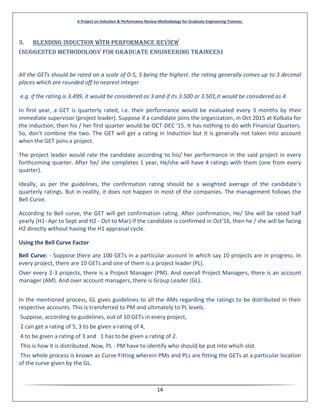
3. Blending Induction with performance Review
(Suggested methodology for Graduate Engineering Trainees)
All the GETs should be rated on a scale of 0-5, 5 being the highest. the rating generally comes up to 3 decimal
places which are rounded off to nearest integer
e.g. if the rating is 3.499, it would be considered as 3 and if its 3.500 or 3.501,it would be considered as 4.
In first year, a GET is quarterly rated, i.e. their performance would be evaluated every 3 months by their
immediate supervisor (project leader). Suppose if a candidate joins the organization, in Oct 2015 at Kolkata for
the Induction, then his / her first quarter would be OCT-DEC '15. It has nothing to do with Financial Quarters.
So, don't combine the two. The GET will get a rating in Induction but it is generally not taken into account
when the GET joins a project.
The project leader would rate the candidate according to his/ her performance in the said project in every
forthcoming quarter. After he/ she completes 1 year, He/she will have 4 ratings with them (one from every
quarter).
Ideally, as per the guidelines, the confirmation rating should be a weighted average of the candidate`s
quarterly ratings. But in reality, it does not happen in most of the companies. The management follows the
Bell Curve.
According to Bell curve, the GET will get confirmation rating. After confirmation, He/ She will be rated half
yearly (H1- Apr to Sept and H2 - Oct to Mar).If the candidate is confirmed in Oct'16, then he / she will be facing
H2 directly without having the H1 appraisal cycle.
Using the Bell Curve Factor
Bell Curve: - Suppose there are 100 GETs in a particular account in which say 10 projects are in progress. In
every project, there are 10 GETs and one of them is a project leader (PL).
Over every 2-3 projects, there is a Project Manager (PM). And overall Project Managers, there is an account
manager (AM). And over account managers, there is Group Leader (GL).
In the mentioned process, GL gives guidelines to all the AMs regarding the ratings to be distributed in their
respective accounts. This is transferred to PM and ultimately to PL levels.
Suppose, according to guidelines, out of 10 GETs in every project,
2 can get a rating of 5, 3 to be given a rating of 4,
4 to be given a rating of 3 and 1 has to be given a rating of 2.
This is how it is distributed. Now, PL - PM have to identify who should be put into which slot.
This whole process is known as Curve Fitting wherein PMs and PLs are fitting the GETs at a particular location
of the curve given by the GL.
A Project on Induction & Performance Review Methodology for Graduate Engineering Trainees.
15
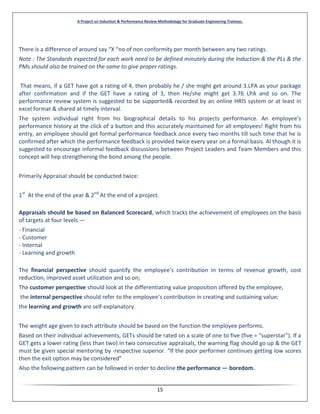
There is a difference of around say “X “no of non conformity per month between any two ratings.
Note : The Standards expected for each work need to be defined minutely during the Induction & the PLs & the
PMs should also be trained on the same to give proper ratings.
That means, if a GET have got a rating of 4, then probably he / she might get around 3.LPA as your package
after confirmation and if the GET have a rating of 3, then He/she might get 3.76 LPA and so on. The
performance review system is suggested to be supported& recorded by an online HRIS system or at least in
excel format & shared at timely interval.
The system individual right from his biographical details to his projects performance. An employee's
performance history at the click of a button and this accurately maintained for all employees! Right from his
entry, an employee should get formal performance feedback once every two months till such time that he is
confirmed after which the performance feedback is provided twice every year on a formal basis. Al though it is
suggested to encourage informal feedback discussions between Project Leaders and Team Members and this
concept will hep strengthening the bond among the people.
Primarily Appraisal should be conducted twice:
1st
At the end of the year & 2nd
At the end of a project.
Appraisals should be based on Balanced Scorecard, which tracks the achievement of employees on the basis
of targets at four levels —
- Financial
- Customer
- Internal
- Learning and growth
The financial perspective should quantify the employee’s contribution in terms of revenue growth, cost
reduction, improved asset utilization and so on;
The customer perspective should look at the differentiating value proposition offered by the employee;
the internal perspective should refer to the employee’s contribution in creating and sustaining value;
the learning and growth are self-explanatory.
The weight age given to each attribute should be based on the function the employee performs.
Based on their individual achievements, GETs should be rated on a scale of one to five (five = “superstar”). If a
GET gets a lower rating (less than two) in two consecutive appraisals, the warning flag should go up & the GET
must be given special mentoring by -respective superior. “If the poor performer continues getting low scores
then the exit option may be considered”
Also the following pattern can be followed in order to decline the performance — boredom.
A Project on Induction & Performance Review Methodology for Graduate Engineering Trainees.
16
- If an GET works for more than two years on the same project, typically either their performance dips or
they leave the organization.
- To avoid that, GETs should be shuffled between projects every 18 months or so.
- Motivation & Performance is directly related, thus “Performance drops if motivation drops”
At the heart of an employee's satisfaction lies the fact that his performance is being appreciated and
recognized, Thus the performance management system should metamorphose in such a way so it that
emphasizes objectivity and a system that mandates performance evaluation against pre-determined criteria.
- What deserves special mention is the active participation of the senior management in the
determination of guidelines for the performance appraisal process. The process should ensure “ buy in “ of
the employees since the guidelines for the rating system and its conversion into money terms is not
unilaterally decided by HR but is a consensus of a cross functional team with representation from all levels.
A Project on Induction & Performance Review Methodology for Graduate Engineering Trainees.
17
4.0 GLOSSARY
4.1 Sample Induction Manual / Contents
Ideally the Induction Manual should have a detailed layout of the following :
- Org Structure
- General HR Policies:
- Recruitment Policy
- Training & Development Policy
- Performance Apprasisal Policy
- Leave Policy
- Travel Policy
- Local Conveyance policy
- Mobile Policy
It should also include other HR Policies that your organization follows :
- Induction for New Employees
- Probationary Period
- Office Hours
- Lunch Period
- Break Periods
- Permission during Work Hours
- Personnel Files
- Personal Data Changes
- Dress Code
- Employment Termination
- Safety
A Project on Induction & Performance Review Methodology for Graduate Engineering Trainees.
18
- Health Related Issues
- Insurance on Personal Effects
- Supplies; Expenditures; Obligating the Company
- Expense Reimbursement
- Parking
- Visitors in the Work Place
- Absence without Notice
- Sexual Harassment
- Telephone Usage
- Public Image
- Smoking
- Substance Abuse
- Internet Usage
Miscellaneous Topics: -
- Nepotism
- Personal Appearance
- Privacy of Records
A Project on Induction & Performance Review Methodology for Graduate Engineering Trainees.
19
4.2 Sample Best (Innovative) Practice for Induction
Indian companies using innovative ways of employee inductions to make its brand-new employees learn.
Yes bank greeted its new employees with drum beating session provided a stress buster and other various
activities conducted to add experiential learning, rather than induction programme merely focusing on PPTs
and lectures on organisational culture, etiquettes and opportunities.
At NTPC (National Thermal Power Corporation), induction is serious business. The one-year programme takes
them through six months each of classroom and on-the-job training with several initiatives to make them
bond together such as two-week theatre workshop by the National School of Drama. Corporation also does a
lot of fun things such has theatre workshops for dramas , cultural programmes for graduate engineers as they
are called to participate in workshop and stage dramas on various issues and hosting of dinner by top
management to help them come together as they come from different parts of the country.
Boston Consulting Group's (BCG) India office, offered layered induction programme for new employees, which
includes various informal dinner to interact with each other as new Johnnies are from different parts of the
country.
A Project on Induction & Performance Review Methodology for Graduate Engineering Trainees.
20
4.3 Sample Performance Review Matrix
With growth, every company needs to inevitably add more managers, more heads, more leaders, basically a
larger workforce. This creates a frantic need to hire fast and more importantly the need to hire
the right people. But in this urgency of recruitment drives, it’s extremely important to take hiring decisions
with utmost care and caution, because the people that you hire, especially in top positions, will directly impact
how fast/successfully you will grow. However, it’s not always easy to gauge the competency of a candidate
from the interview(s) itself, right? So, we don’t have a choice but to weigh your options and give people a
chance to prove their mettle – which brings you to the often controversial “Performance Review” cycles, KRA
lists, and the appraisal meetings at the end of the year. But what about the time in between, those months
when results weren’t met, targets weren’t achieved?
This melee of talent acquisition and talent management problems have often put us in a position where we
thought we had hired the “ideal person” but things didn’t go as planned – when we reviewed things at the end
of the year(s). The expectations in terms of output and performance just weren’t met.. Find that win-win
balance, get that motivation engine started.
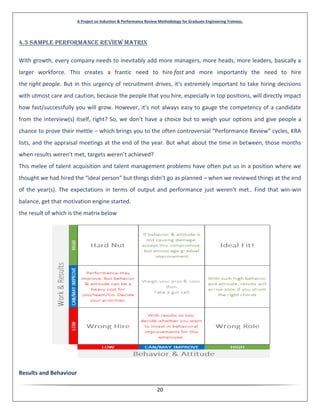
the result of which is the matrix below
Results and Behaviour
A Project on Induction & Performance Review Methodology for Graduate Engineering Trainees.
21
I feel that people and their performance on the job, can always be categorized into 2 broad categories –
Results, Behaviour. There is nothing that can slip out of these categories, if you list down the things you expect
the employee to achieve in the job.
Results mean how far the employee has been able to achieve the goals or KRAs that were set when you hired
him. The factors in this category would be more objective in nature, or quantifiable with numbers or
accomplishments. For instance, targets achieved, calls made, features launched, bugs solved, issues resolved,
communication skills, writing abilities, domain knowledge, etc.
Behaviour, on the other hand, includes the work ethic of the individual, his equation with teammates, ability
to adapt to the work culture, attitude on the job and towards the company’s vision, ability to understand the
larger goal, skill to lead or be lead, etc.
Under any circumstances, Results alone can never be enough to judge or decide if someone has been
competent on their job or not. Sometimes the employee may need time to grasp the change around him and
with a little support will be a better performer in the future. This means, Results as well as Behaviour, both go
hand-in-hand when it comes to looking at the employee’s performance holistically. One cannot be evaluated
without the other, else you’re bound to get a 2D evaluation.
This is where the above performance matrix helps me look at things more clearly – it practically works like a
magician’s Crystal Ball. It gives more clarity to the employee on where she stands, when looked at in a
combination of Results + Behaviour, and where is improvement needed. It also serves as a guide to the
employer on what to expect from the employee in the future.
When should the employee be evaluated?
Just using the matrix is not going to solve the problem for you. I’ve learned that having annual reviews, is
actually counter productive overall to all parties involved. Why? Let me explain:
A. the employee could have done so much to improve, if only she knew earlier what’s on your mind.
B. the company would have saved so much money, while waiting for magic to happen.
C. lack of communication could probably deteriorate the situation or leave no more time to either parties,
when the evaluation is eventually done.
D. classic case of, should-have, could-have, what-if, etc. Now it’s too late!
A Project on Induction & Performance Review Methodology for Graduate Engineering Trainees.
22
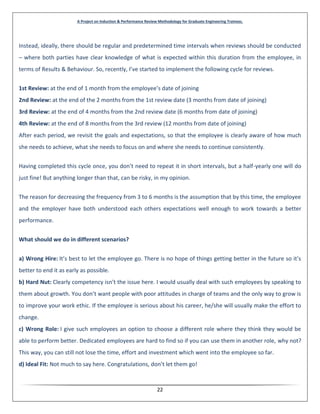
Instead, ideally, there should be regular and predetermined time intervals when reviews should be conducted
– where both parties have clear knowledge of what is expected within this duration from the employee, in
terms of Results & Behaviour. So, recently, I’ve started to implement the following cycle for reviews.
1st Review: at the end of 1 month from the employee’s date of joining
2nd Review: at the end of the 2 months from the 1st review date (3 months from date of joining)
3rd Review: at the end of 4 months from the 2nd review date (6 months from date of joining)
4th Review: at the end of 8 months from the 3rd review (12 months from date of joining)
After each period, we revisit the goals and expectations, so that the employee is clearly aware of how much
she needs to achieve, what she needs to focus on and where she needs to continue consistently.
Having completed this cycle once, you don’t need to repeat it in short intervals, but a half-yearly one will do
just fine! But anything longer than that, can be risky, in my opinion.
The reason for decreasing the frequency from 3 to 6 months is the assumption that by this time, the employee
and the employer have both understood each others expectations well enough to work towards a better
performance.
What should we do in different scenarios?
a) Wrong Hire: It’s best to let the employee go. There is no hope of things getting better in the future so it’s
better to end it as early as possible.
b) Hard Nut: Clearly competency isn’t the issue here. I would usually deal with such employees by speaking to
them about growth. You don’t want people with poor attitudes in charge of teams and the only way to grow is
to improve your work ethic. If the employee is serious about his career, he/she will usually make the effort to
change.
c) Wrong Role: I give such employees an option to choose a different role where they think they would be
able to perform better. Dedicated employees are hard to find so if you can use them in another role, why not?
This way, you can still not lose the time, effort and investment which went into the employee so far.
d) Ideal Fit: Not much to say here. Congratulations, don’t let them go!
A Project on Induction & Performance Review Methodology for Graduate Engineering Trainees.
23
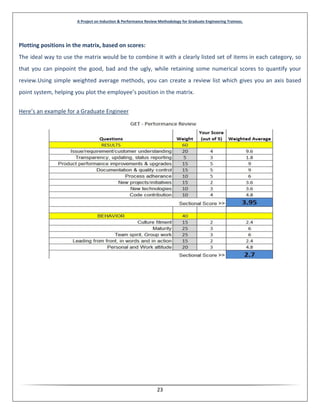
Plotting positions in the matrix, based on scores:
The ideal way to use the matrix would be to combine it with a clearly listed set of items in each category, so
that you can pinpoint the good, bad and the ugly, while retaining some numerical scores to quantify your
review.Using simple weighted average methods, you can create a review list which gives you an axis based
point system, helping you plot the employee’s position in the matrix.
Here’s an example for a Graduate Engineer
A Project on Induction & Performance Review Methodology for Graduate Engineering Trainees.
24
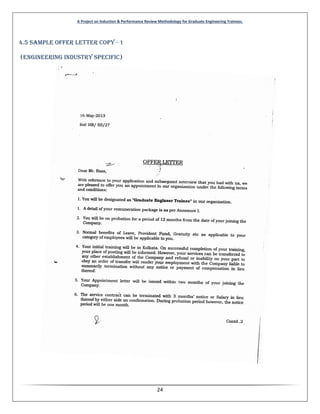
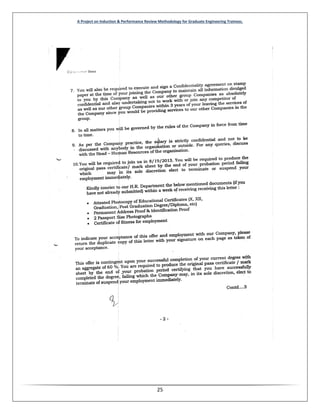
4.5 Sample Offer Letter Copy - 1
(Engineering Industry Specific)
A Project on Induction & Performance Review Methodology for Graduate Engineering Trainees.
25
A Project on Induction & Performance Review Methodology for Graduate Engineering Trainees.
26
A Project on Induction & Performance Review Methodology for Graduate Engineering Trainees.
27
A Project on Induction & Performance Review Methodology for Graduate Engineering Trainees.
28
A Project on Induction & Performance Review Methodology for Graduate Engineering Trainees.
29
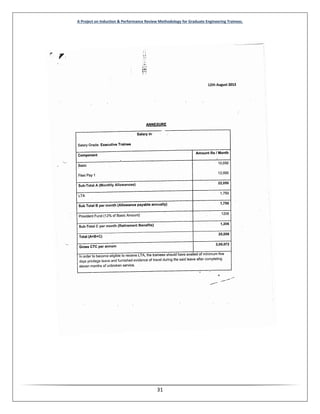
4.6 Sample Offer Letter Copy – 2
(Integrated Engineering Sector)
A Project on Induction & Performance Review Methodology for Graduate Engineering Trainees.
30
A Project on Induction & Performance Review Methodology for Graduate Engineering Trainees.
31
A Project on Induction & Performance Review Methodology for Graduate Engineering Trainees.
32
Thanks for patient reading, Hope this will help you in your Endeavour.
In Case you want to leave a comment on the same, please get back to: debdeep@niccoventures.com
Or Call at + 91 9831415675

A Project on Induction & Performance Review for Freshers

  • 1.
    A Project onInduction & Performance Review Methodology for Graduate Engineering Trainees. 1 A Project on Induction & Performance Review Methodology for Graduate Engineering Trainees. Project Research & Compilation done by: Debdeep Ghosh, Assistant Manager, Nicco Ventures Limited. For Doosan Infracore
  • 2.
    A Project onInduction & Performance Review Methodology for Graduate Engineering Trainees. 2 INDEX 1. Induction 1.1 Definition 1.2 Objective / Importance of Successful Induction 1.3 Do`s & Don’ts of InDuctIon 1.4 Contents of induction / Checklists 1.5 Best Practices 2. Performance Review 2.1 Definition 2.2 Objective 2.3 Advantages of Performance Review 2.3 Types of Performance Review & Choosing What suits your Company 3. Blending Induction with performance Review (Suggested methodology for Graduate Engineering Trainees) 4. Glossary 4.1 Sample Induction Manual / Contents 4.2 Sample Best (Innovative) Practice for Induction 4.3 Sample Performance Review Matrix 4.5 Sample Offer Letter Copy - 1 (Engineering Industry Specific) 4.6 Sample Offer Letter Copy – 2 (Integrated Engineering Sector)
  • 3.
    A Project onInduction & Performance Review Methodology for Graduate Engineering Trainees. 3 1. Induction 1.1 Definition of Induction Induction of Employee is the first step towards gaining an employees' commitment, Induction is aimed at introducing the job and organization to the recruit and him or her to the organization. Induction involves orientation and training of the employee in the organizational culture, and showing how he or she is interconnected to (and interdependent on) everyone else in the organization. "Business Dictionary.com" The new employee’s first contact with his or her physical and human working environment is extremely important, since it will condition his or her relationship with the company. The employee must feel supported and important. The first person he or she will meet is the immediate supervisor, who should present the corporate profile in addition to providing information on the organization’s background, values, clientele, services offered, staff, and expected behavior. The immediate superior will also specify the newcomer’s role. The points listed below should be covered during this meeting. 1. The company, its history and products, process of production and major operations involved in his job. 2. The significance of the job with all necessary information about it including job training and job hazards. 3. Structure of the organization and the functions of various departments. 4. Employee’s own department and job, and how he fits into the organization. 5. Personnel policy and sources of information. 6. Company policies, practices, objectives and regulations. 7. Terms and conditions of service, amenities and welfare facilities. 8. Rules and regulations governing hours of work and over-time, safety and accident prevention, holidays and vacations, methods of reporting, tardiness and, absenteeism. 9. Grievances procedure and discipline handling. 10. Social benefits and recreation services. 11. Opportunities, promotions, transfer, suggestion schemes and job satisfaction.
  • 4.
    A Project onInduction & Performance Review Methodology for Graduate Engineering Trainees. 4 1.2 Objective / importance of successful Induction It is process of bringing/introducing/familiarizing a new recruit into the oraginsation. This program familiarizes the new employee about the culture, accepted practices and performance standards of the oraginsation. It has been proved in one of the survey conducted by the Centre for Creative Leadership (headquartered in Greensboro, North Carolina, US), that a fresh hire does not met the expectation of an organisation for the first few months. The issue of productivity of new hires has to be defined individually by every organisation. Fresh hires are able to learn the process as quickly as possible if the induction efforts are right and they can be very productive if their induction is been done in an proper manner. An employee has to work with fellow employees and his supervisor. For this he must know them, the way they work and also the policies and practices of the organization so that he may integrate himself with the enterprise. Any neglect in the area of induction and orientation may lead to high labour turnover, confusion, wasted time and expenditure. An induction programme consists primarily of three steps: General orientation by the staff: It gives necessary general information about the history and the operations of the firm. The purpose is to help an employee to build up some pride and interest in the organization. Specific orientation by the job supervisor: The employee is shown the department and his place of work; the location of facilities and is told about the organization’s specific practices and customs. The purpose is to enable the employee to adjust with his work and environment. Follow-up orientation by either the personnel department or the supervisor: This is conducted within one week to six months of the initial induction and by a foreman or a specialist. The purpose is to find out whether the employee is reasonably well satisfied with him. Through personal talks, guidance and counselling efforts are made to remove the difficulties experienced by the newcomer.
  • 5.
    A Project onInduction & Performance Review Methodology for Graduate Engineering Trainees. 5 1.3 InDuctIon Do s & Don’t s Involvement in Induction programs (should be’s ) Induction program must/should include all the aspects of the organization and present for the awareness of the new employee. Like emergency procedures, facilities, safety issues, right’s of the employee, what to be paid, no harassment, equal opportunity, grievance procedures, employee responsibilities, times, conduct standards, job function, dress requirements, organisational structure, what it does, how they fit in, who is their Manager, the functions of different departments, how the employee will be managed, what the performance management process will involve, and his/her role in that process, are the few concern areas during an Induction program. Induction should be conducted on the first day of the new recruit from the gate of the organization itself. For induction only higher management or Head of HR or Senior should be addressing the new entrant. It should also involve the employees of the new entrant department. An effective induction helps a new employee feel assured and comfortable in the new environment, which is critical for early uptake in the new role. Induction should always be interactive. It also provides an opportunity to the new entrant to engrain the original values and ethics as well as the style of functioning. Escorting an new entrant will be one of the best and most impactful induction step. It should always be interesting and must hold the attention of the new employee. Involvement in Induction programs (not be’s ) First of all Induction program must not/ should not include much of theoretical part. Bad induction leads to stress and de-motivation. Arriving for a new job a bad induction can leave a new starter worried, anxious and unable to perform their duties. More work for longer as the new entrant struggles to become an effective member. It increases the workload, all the wrong messages given to the new starter and can damage long- term implications. Signs of bad Induction program are Too Short – during induction a new entrant should just not give the mobile numbers or small brief as always remember either a person should have or should not have knowledge, half knowledge leads to disaster. Too Hasty – A ten minutes brisk walk and making him familiarizing about the exit or entry should not be the part of induction. Too Boring – All the theoretical and long presentation with high figures involved is a bad sign of induction. Impersonal – Avoid hours of speeches and presentations and voluminous policy manuals or information packages. Too personal – It should not be related to the complete life cycle of a new entrant. Neglectful – whosoever takes the induction should have complete knowledge of the new entrant participation the induction program, Isolated and embarrassing.
  • 6.
    A Project onInduction & Performance Review Methodology for Graduate Engineering Trainees. 6 1.4 Contents of induction / Checklists Necessarily induction training will have to include some fairly dry subjects, so anything you can do to inject interest, variety, different formats and experiences will greatly improve the overall induction process. There are lots of ideas for illustrating concepts and theories relating to induction training on the acronyms page (warning: contains adult content), and also the stories page. Induction training must include the following elements: General training relating to the organisation, including values and philosophy as well as structure and history, etc. Mandatory training relating to health and safety and other essential or legal areas. Job training relating to the role that the new starter will be performing. Training evaluation, entailing confirmation of understanding, and feedback about the quality and response to the training. And while not strictly part of the induction training stage, it's also helpful to refer to and discuss personal strengths and personal development wishes and aspirations, so that people see they are valued as individuals with their own unique potential, rather than just being a name and a function. This is part of making the job more meaningful for people - making people feel special and valued - and the sooner this can be done the better. 1.5 Best Practices CIPD states that 22% of new employees leave their organization within the first six months. Although there could be many reasons for this, a strong possibility may be due to the fact that employees could not integrate well with the organization. Employees might have had questions that the induction program failed to address, leaving room for ambiguity or misinterpretation. Typically, employees leave when they don’t see any bright future for themselves in the organization. Many a time these perceptions could be false and can be avoided through effective induction training where employees can be given an effective orientation about the organization’s vision and mission and how employee progression fits into their plan. Below are some of the best practices that could be useful to deliver a productive induction training program for new hires. 1. Early engagement: Engage with the new recruits even before they join by sending them welcome messages and key action points to be followed once they are part of the organization. Once an employee has accepted the job offer, it is a good idea to communicate with the employee welcoming him or her onboard. Links to
  • 7.
    A Project onInduction & Performance Review Methodology for Graduate Engineering Trainees. 7 online resources that give basic information about the organization can be shared so that employees can get an idea about their future workplace. Online links, videos or short modules can provide information about the organization’s vision, mission, culture and press reviews. This way, new hires will feel wanted and have a fair idea about the organization even before they report for their jobs. 2. Blended solution: New hire training can be broadly divided into orientation training and induction training. Orientation training is generally given on the first day when the employee reports to work. This needs to be given face to face and typically covers information about existing physical amenities, timings, security details and peer introductions. Other aspects such as essential organizational information, HR, employee progression and job-specific information can be done using the online medium. This way, employees are not intimidated with too much information right on the first day or during the limited timeframe of a face-to-face interaction. 3. Training as a process and NOT an event: The objective of training is not information sharing but effective assimilation of knowledge. To achieve this purpose, divide the online training material into independent modules so that they can be completed over a set period of time. This provides flexibility and freedom to employees to take up learning at their own pace and convenience. Training will NOT be a one-off event where a large amount of information is attempted to be shared with participants. 4. Independent but inter-dependent bite-sized modules: In addition to the flexibility that is provided to training managers in terms of building and assigning course units, smaller modules offer flexibility to learners in terms of learning at their own pace. They are also likely to understand and assimilate the shared information better when it is presented in smaller chunks. Therefore, ensure that training modules are segregated according to the topics in small bite-sized modules for better assimilation and retention. The advantage of having such independent units is that once developed, the units can be re-used to compile induction training for different audiences within the organization. For example, Terms and Conditions and Leave Policy could be common across the organization but employee progression may be different. Thus, training managers can build and assign units based on the target audiences. 5. Allocation of training time: Often, organizations that assign online training modules to their new hires, fail to allot dedicated time slots for the purpose. Employees are expected to squeeze in some time off their scheduled work for completing courses. All they are given is a deadline before which the training needs to be completed. This puts extra burden on employees and also earns their resentment. Provide dedicated time to employees for online learning-such as 30 minutes after lunch or at the end of the day based on the organization’s timelines. 6. Tracking and assignments: It is important that the courses that are being attempted by new hires are tracked at the module level. This provides valuable feedback about the quality and success of the induction program. Additionally, it is good to have assignments at the end of each unit and quizzes at the end of each module for formative and summative assessments. Have tracking facility and assignments at the end of each module to monitor employee progress in addition to giving feedback on the training in general.
  • 8.
    A Project onInduction & Performance Review Methodology for Graduate Engineering Trainees. 8 7. Evaluation: Induction training cannot be a one-way information dissemination forum. Seek feedback from new hires to ensure training is purposeful and that it attains the objectives. It is also a good idea to monitor employee turnover, which might have a bearing on the quality of the induction program. These might give valuable tips to amend or alter the approach towards future induction training programs. Corporate induction training is being increasingly identified as one of the valuable methods for employee retention. Many organizations recognize the need to make it an extended online program instead of a one-off event that is organized more to fulfill mandatory HR requirements. In this context, what do you have to say with respect to the tips offered above? Do share your thoughts.
  • 9.
    A Project onInduction & Performance Review Methodology for Graduate Engineering Trainees. 9 2. Performance Review 2.1 Definition of Performance Review Performance Review is the systematic evaluation of the performance of employees and to understand the abilities of a person for further growth and development. Performance appraisal is generally done in systematic ways which are as follows: The supervisors measure the pay of employees and compare it with targets and plans. The supervisor analyses the factors behind work performances of employees. The employers are in position to guide the employees for a better performance. 2.2 Objectives of Performance REVIEW Performance Review can be done with following objectives in mind: To maintain records in order to determine compensation packages, wage structure, salaries raises, etc. To identify the strengths and weaknesses of employees to place right men on right job. To maintain and assess the potential present in a person for further growth and development. To provide a feedback to employees regarding their performance and related status. To provide a feedback to employees regarding their performance and related status. It serves as a basis for influencing working habits of the employees. To review and retain the promotional and other training programmes. 2.3 Advantages of Performance Review It is said that performance review is an investment for the company which can be justified by following advantages: Promotion: Performance Appraisal helps the supervisors to chalk out the promotion programmes for efficient employees. In this regards, inefficient workers can be dismissed or demoted in case. Compensation: Performance Appraisal helps in chalking out compensation packages for employees. Merit rating is possible through performance appraisal. Performance Appraisal tries to give worth to a performance.
  • 10.
    A Project onInduction & Performance Review Methodology for Graduate Engineering Trainees. 10 Compensation packages which includes bonus, high salary rates, extra benefits, allowances and pre-requisites are dependent on performance appraisal. The criteria should be merit rather than seniority. Employees Development: The systematic procedure of performance appraisal helps the supervisors to frame training policies and programmes. It helps to analyse strengths and weaknesses of employees so that new jobs can be designed for efficient employees. It also helps in framing future development programmes. Selection Validation: Performance Appraisal helps the supervisors to understand the validity and importance of the selection procedure. The supervisors come to know the validity and thereby the strengths and weaknesses of selection procedure. Future changes in selection methods can be made in this regard. Communication: For an organization, effective communication between employees and employers is very important. Through performance appraisal, communication can be sought for in the following ways: Through performance review, the employers can understand and accept skills of subordinates. The subordinates can also understand and create a trust and confidence in superiors. It develops the spirit of work and boosts the morale of employees. All the above factors ensure effective communication. Motivation: Performance appraisal serves as a motivation tool. Through evaluating performance of employees, a person’s efficiency can be determined if the targets are achieved. This very well motivates a person for better job and helps him to improve his performance in the future. 2.4 Types of Performance Review & Choosing What suits your Company Many appraisal types exist; from traditional to trendy, simple to complex, highly structured to open-ended. Some of these types have been shown to work ‘better’ but the reality is that appraisal types and systems should be as unique to a company as possible. If you are searching for an employee appraisal method that provides meaningful data, ensure that no matter what – it suits the culture of your workplace and we recommend that you keep it as simple as it can be. Here is a great overview of the most popular and common appraisal methods for a variety of business models. To begin, we must first analyze the parties involved with the various appraisal methods. Overall, performance appraisals can be set up to incorporate feedback from 3 different sources2:  Feedback from the employee being evaluated  Feedback from the manager/supervisor  Feedback from other stakeholders (peers, customers etc.)
  • 11.
    A Project onInduction & Performance Review Methodology for Graduate Engineering Trainees. 11 EMPLOYEE FEEDBACK: Self-Evaluation Method Self evaluations are a great way to kick-off reviews. A self-evaluation is when the employee is asked to judge their own performance against predetermined criteria. The advantage of this kind of an appraisal is that the employee is allowed to give his input into his performance appraisal, and the company can use this self- appraisal along with the standard appraisal to give a more rounded employee review. The disadvantage is that an employee may not be able to evaluate their own performance objectively, giving himself an artificially high performance grade and making the self-appraisal less valuable1. Employee self-evaluations help to demystify the appraisal process and can provide interesting insight into gaps between employee and manager ratings. Self appraisals also help to ensure that employees have read and hopefully have analyzed every corner of their performance. Journaling Technically, employees should be encouraged to keep ongoing journal notes to document performance milestones and use those to support their self-assessments; however, technology is causing this process to shift as employees can now use instant feedback tools within appraisal systems to send performance notes directly to their manager’s library of notes. MANAGER FEEDBACK: Management By Objectives This method, often called MBO, is designed to include employees in the goal-setting process and define “success” by measuring accomplishments against a clearly established set of objectives. If managers and employees begin the year by working together to list these objectives, the end-of-year appraisal can simply compare each goal with its final outcome. This method is simple, clear, and empowers employees in the goal setting process but it disregards non-goal-related success metrics. Graphic Rating Scales This is probably the most common. Using this method, a supervisor rates an employee on a numerical scale for a defined set of behaviors, traits, competencies, or completed projects. This method gains points for simplicity and functionality, but it only works well if both managers and employees share the same understanding of each point on the scale (for example, on a scale of one to ten, is an “average” performance given a mid-range rating or the lowest rating?) or if the rating categories focus on ‘traits’ rather than ‘behaviour’. For more information about rating scales, see The Traditional Rating Scales: Needs Improvement
  • 12.
    A Project onInduction & Performance Review Methodology for Graduate Engineering Trainees. 12 Weighted Checklist Method A weighted checklist presents the evaluator with a set of yes or no questions that each carry a predetermined value. Questions may include, for example, “Does the employee follow directions carefully?” or “Does the employee make frequent mistakes?” The numerical value of each answer is then added and applied to an overall determination of his or her success. These kinds of questions must be both worded and weighted carefully or the results can become confusing. But when properly executed, the method is clear and allows easy comparison between each employee and the next. Paired Comparison Analysis This option relies on a grid that presents numerical values for each employee based on an established set of criteria. After the values are collected, they can be reviewed against other values presented in the same format and affected by the same factors. This method can be complex and labor intensive if done manually, but it allows the kinds of apple-and-orange comparisons that often present philosophical challenges to HR managers who need to standardize evaluation methods across groups of employees facing very different tasks. Essay Evaluation Method The Essay method is the grandfather of methods. This method provides managers with an open-ended opportunity to describe an employee’s strengths and weaknesses in short essays. Essay evaluations give supervisors a chance to assess behaviors within a complex context, but it removes some of the easy comparability of the paired-comparison method above and leaves a lot of room for confusion. Essay Evaluations are very unstructured and are often riddled with bias. If this was one of the first methods used to evaluate performance – it is no wonder why evaluations have been given a bad rep. There is still a place for essays, but in a different form. Today’s essays are shorter, specific, and usually used to support a rating. Critical Incident Method Like the essay method above, the critical incident method allows supervisors to describe an employee’s excellent or poor response to situations arising during the year in question. This method keeps answers open- ended, flexible, multi-dimensional, and respectful of context. But it also resists standardization and comparison, and if the incidents aren’t recorded and discussed as they occur, a subjective assessment made weeks or months later may have limited value. OUTSIDE (360) FEEDBACK:
  • 13.
    A Project onInduction & Performance Review Methodology for Graduate Engineering Trainees. 13 Gathering feedback from multiple sources is a great way to ensure employees are rated fairly and accurately. 360 feedback incorporates data from peers, supervisors and even outside parties like customers and suppliers. This broad feedback can provide a multi-dimensional picture of performance that can cancel the influence of bias or outlying data points. The goal is to paint an accurate picture of employees strengths and weaknesses. 360 feedback can be collected to gauge performance but can also be executed solely for development (often the case with leadership/executive 360’s). There are two types of 360 feedback that can be incorporated into appraisals: Structured 360 Feedback This 360 method gathers appraisal information from an employee’s peers and direct reports as well as his or her supervisor in a very structured manner. This method traditionally involves the formal collection of information from many people using a survey. This method can be expensive and time consuming to execute depending on a company’s delivery. If you are looking for an appraisal software system, ensure that the one you choose has an integrated survey tools for conducting 360 surveys and incorporating the results into the reviews. This cuts back on cost and gives companies the control over executing as many custom 360’s as desired. Unstructured 360 Feedback The impact of using Unstructured feedback is relatively new in the appraisal world and is making a huge difference in performance management and business success. Unstructured feedback is typically being collected year-round via technology-enabled appraisals where comments, journal notes, and feedback are collected as it happens. This type of feedback serves as a summary of performance throughout the cycle and is greatly increasing the accuracy of appraisals as managers have access to a library of notes to help support evaluation decisions A winning appraisal strategy is the one that best suits your organization
  • 14.
    A Project onInduction & Performance Review Methodology for Graduate Engineering Trainees. 14 3. Blending Induction with performance Review (Suggested methodology for Graduate Engineering Trainees) All the GETs should be rated on a scale of 0-5, 5 being the highest. the rating generally comes up to 3 decimal places which are rounded off to nearest integer e.g. if the rating is 3.499, it would be considered as 3 and if its 3.500 or 3.501,it would be considered as 4. In first year, a GET is quarterly rated, i.e. their performance would be evaluated every 3 months by their immediate supervisor (project leader). Suppose if a candidate joins the organization, in Oct 2015 at Kolkata for the Induction, then his / her first quarter would be OCT-DEC '15. It has nothing to do with Financial Quarters. So, don't combine the two. The GET will get a rating in Induction but it is generally not taken into account when the GET joins a project. The project leader would rate the candidate according to his/ her performance in the said project in every forthcoming quarter. After he/ she completes 1 year, He/she will have 4 ratings with them (one from every quarter). Ideally, as per the guidelines, the confirmation rating should be a weighted average of the candidate`s quarterly ratings. But in reality, it does not happen in most of the companies. The management follows the Bell Curve. According to Bell curve, the GET will get confirmation rating. After confirmation, He/ She will be rated half yearly (H1- Apr to Sept and H2 - Oct to Mar).If the candidate is confirmed in Oct'16, then he / she will be facing H2 directly without having the H1 appraisal cycle. Using the Bell Curve Factor Bell Curve: - Suppose there are 100 GETs in a particular account in which say 10 projects are in progress. In every project, there are 10 GETs and one of them is a project leader (PL). Over every 2-3 projects, there is a Project Manager (PM). And overall Project Managers, there is an account manager (AM). And over account managers, there is Group Leader (GL). In the mentioned process, GL gives guidelines to all the AMs regarding the ratings to be distributed in their respective accounts. This is transferred to PM and ultimately to PL levels. Suppose, according to guidelines, out of 10 GETs in every project, 2 can get a rating of 5, 3 to be given a rating of 4, 4 to be given a rating of 3 and 1 has to be given a rating of 2. This is how it is distributed. Now, PL - PM have to identify who should be put into which slot. This whole process is known as Curve Fitting wherein PMs and PLs are fitting the GETs at a particular location of the curve given by the GL.
  • 15.
    A Project onInduction & Performance Review Methodology for Graduate Engineering Trainees. 15 There is a difference of around say “X “no of non conformity per month between any two ratings. Note : The Standards expected for each work need to be defined minutely during the Induction & the PLs & the PMs should also be trained on the same to give proper ratings. That means, if a GET have got a rating of 4, then probably he / she might get around 3.LPA as your package after confirmation and if the GET have a rating of 3, then He/she might get 3.76 LPA and so on. The performance review system is suggested to be supported& recorded by an online HRIS system or at least in excel format & shared at timely interval. The system individual right from his biographical details to his projects performance. An employee's performance history at the click of a button and this accurately maintained for all employees! Right from his entry, an employee should get formal performance feedback once every two months till such time that he is confirmed after which the performance feedback is provided twice every year on a formal basis. Al though it is suggested to encourage informal feedback discussions between Project Leaders and Team Members and this concept will hep strengthening the bond among the people. Primarily Appraisal should be conducted twice: 1st At the end of the year & 2nd At the end of a project. Appraisals should be based on Balanced Scorecard, which tracks the achievement of employees on the basis of targets at four levels — - Financial - Customer - Internal - Learning and growth The financial perspective should quantify the employee’s contribution in terms of revenue growth, cost reduction, improved asset utilization and so on; The customer perspective should look at the differentiating value proposition offered by the employee; the internal perspective should refer to the employee’s contribution in creating and sustaining value; the learning and growth are self-explanatory. The weight age given to each attribute should be based on the function the employee performs. Based on their individual achievements, GETs should be rated on a scale of one to five (five = “superstar”). If a GET gets a lower rating (less than two) in two consecutive appraisals, the warning flag should go up & the GET must be given special mentoring by -respective superior. “If the poor performer continues getting low scores then the exit option may be considered” Also the following pattern can be followed in order to decline the performance — boredom.
  • 16.
    A Project onInduction & Performance Review Methodology for Graduate Engineering Trainees. 16 - If an GET works for more than two years on the same project, typically either their performance dips or they leave the organization. - To avoid that, GETs should be shuffled between projects every 18 months or so. - Motivation & Performance is directly related, thus “Performance drops if motivation drops” At the heart of an employee's satisfaction lies the fact that his performance is being appreciated and recognized, Thus the performance management system should metamorphose in such a way so it that emphasizes objectivity and a system that mandates performance evaluation against pre-determined criteria. - What deserves special mention is the active participation of the senior management in the determination of guidelines for the performance appraisal process. The process should ensure “ buy in “ of the employees since the guidelines for the rating system and its conversion into money terms is not unilaterally decided by HR but is a consensus of a cross functional team with representation from all levels.
  • 17.
    A Project onInduction & Performance Review Methodology for Graduate Engineering Trainees. 17 4.0 GLOSSARY 4.1 Sample Induction Manual / Contents Ideally the Induction Manual should have a detailed layout of the following : - Org Structure - General HR Policies: - Recruitment Policy - Training & Development Policy - Performance Apprasisal Policy - Leave Policy - Travel Policy - Local Conveyance policy - Mobile Policy It should also include other HR Policies that your organization follows : - Induction for New Employees - Probationary Period - Office Hours - Lunch Period - Break Periods - Permission during Work Hours - Personnel Files - Personal Data Changes - Dress Code - Employment Termination - Safety
  • 18.
    A Project onInduction & Performance Review Methodology for Graduate Engineering Trainees. 18 - Health Related Issues - Insurance on Personal Effects - Supplies; Expenditures; Obligating the Company - Expense Reimbursement - Parking - Visitors in the Work Place - Absence without Notice - Sexual Harassment - Telephone Usage - Public Image - Smoking - Substance Abuse - Internet Usage Miscellaneous Topics: - - Nepotism - Personal Appearance - Privacy of Records
  • 19.
    A Project onInduction & Performance Review Methodology for Graduate Engineering Trainees. 19 4.2 Sample Best (Innovative) Practice for Induction Indian companies using innovative ways of employee inductions to make its brand-new employees learn. Yes bank greeted its new employees with drum beating session provided a stress buster and other various activities conducted to add experiential learning, rather than induction programme merely focusing on PPTs and lectures on organisational culture, etiquettes and opportunities. At NTPC (National Thermal Power Corporation), induction is serious business. The one-year programme takes them through six months each of classroom and on-the-job training with several initiatives to make them bond together such as two-week theatre workshop by the National School of Drama. Corporation also does a lot of fun things such has theatre workshops for dramas , cultural programmes for graduate engineers as they are called to participate in workshop and stage dramas on various issues and hosting of dinner by top management to help them come together as they come from different parts of the country. Boston Consulting Group's (BCG) India office, offered layered induction programme for new employees, which includes various informal dinner to interact with each other as new Johnnies are from different parts of the country.
  • 20.
    A Project onInduction & Performance Review Methodology for Graduate Engineering Trainees. 20 4.3 Sample Performance Review Matrix With growth, every company needs to inevitably add more managers, more heads, more leaders, basically a larger workforce. This creates a frantic need to hire fast and more importantly the need to hire the right people. But in this urgency of recruitment drives, it’s extremely important to take hiring decisions with utmost care and caution, because the people that you hire, especially in top positions, will directly impact how fast/successfully you will grow. However, it’s not always easy to gauge the competency of a candidate from the interview(s) itself, right? So, we don’t have a choice but to weigh your options and give people a chance to prove their mettle – which brings you to the often controversial “Performance Review” cycles, KRA lists, and the appraisal meetings at the end of the year. But what about the time in between, those months when results weren’t met, targets weren’t achieved? This melee of talent acquisition and talent management problems have often put us in a position where we thought we had hired the “ideal person” but things didn’t go as planned – when we reviewed things at the end of the year(s). The expectations in terms of output and performance just weren’t met.. Find that win-win balance, get that motivation engine started. the result of which is the matrix below Results and Behaviour
  • 21.
    A Project onInduction & Performance Review Methodology for Graduate Engineering Trainees. 21 I feel that people and their performance on the job, can always be categorized into 2 broad categories – Results, Behaviour. There is nothing that can slip out of these categories, if you list down the things you expect the employee to achieve in the job. Results mean how far the employee has been able to achieve the goals or KRAs that were set when you hired him. The factors in this category would be more objective in nature, or quantifiable with numbers or accomplishments. For instance, targets achieved, calls made, features launched, bugs solved, issues resolved, communication skills, writing abilities, domain knowledge, etc. Behaviour, on the other hand, includes the work ethic of the individual, his equation with teammates, ability to adapt to the work culture, attitude on the job and towards the company’s vision, ability to understand the larger goal, skill to lead or be lead, etc. Under any circumstances, Results alone can never be enough to judge or decide if someone has been competent on their job or not. Sometimes the employee may need time to grasp the change around him and with a little support will be a better performer in the future. This means, Results as well as Behaviour, both go hand-in-hand when it comes to looking at the employee’s performance holistically. One cannot be evaluated without the other, else you’re bound to get a 2D evaluation. This is where the above performance matrix helps me look at things more clearly – it practically works like a magician’s Crystal Ball. It gives more clarity to the employee on where she stands, when looked at in a combination of Results + Behaviour, and where is improvement needed. It also serves as a guide to the employer on what to expect from the employee in the future. When should the employee be evaluated? Just using the matrix is not going to solve the problem for you. I’ve learned that having annual reviews, is actually counter productive overall to all parties involved. Why? Let me explain: A. the employee could have done so much to improve, if only she knew earlier what’s on your mind. B. the company would have saved so much money, while waiting for magic to happen. C. lack of communication could probably deteriorate the situation or leave no more time to either parties, when the evaluation is eventually done. D. classic case of, should-have, could-have, what-if, etc. Now it’s too late!
  • 22.
    A Project onInduction & Performance Review Methodology for Graduate Engineering Trainees. 22 Instead, ideally, there should be regular and predetermined time intervals when reviews should be conducted – where both parties have clear knowledge of what is expected within this duration from the employee, in terms of Results & Behaviour. So, recently, I’ve started to implement the following cycle for reviews. 1st Review: at the end of 1 month from the employee’s date of joining 2nd Review: at the end of the 2 months from the 1st review date (3 months from date of joining) 3rd Review: at the end of 4 months from the 2nd review date (6 months from date of joining) 4th Review: at the end of 8 months from the 3rd review (12 months from date of joining) After each period, we revisit the goals and expectations, so that the employee is clearly aware of how much she needs to achieve, what she needs to focus on and where she needs to continue consistently. Having completed this cycle once, you don’t need to repeat it in short intervals, but a half-yearly one will do just fine! But anything longer than that, can be risky, in my opinion. The reason for decreasing the frequency from 3 to 6 months is the assumption that by this time, the employee and the employer have both understood each others expectations well enough to work towards a better performance. What should we do in different scenarios? a) Wrong Hire: It’s best to let the employee go. There is no hope of things getting better in the future so it’s better to end it as early as possible. b) Hard Nut: Clearly competency isn’t the issue here. I would usually deal with such employees by speaking to them about growth. You don’t want people with poor attitudes in charge of teams and the only way to grow is to improve your work ethic. If the employee is serious about his career, he/she will usually make the effort to change. c) Wrong Role: I give such employees an option to choose a different role where they think they would be able to perform better. Dedicated employees are hard to find so if you can use them in another role, why not? This way, you can still not lose the time, effort and investment which went into the employee so far. d) Ideal Fit: Not much to say here. Congratulations, don’t let them go!
  • 23.
    A Project onInduction & Performance Review Methodology for Graduate Engineering Trainees. 23 Plotting positions in the matrix, based on scores: The ideal way to use the matrix would be to combine it with a clearly listed set of items in each category, so that you can pinpoint the good, bad and the ugly, while retaining some numerical scores to quantify your review.Using simple weighted average methods, you can create a review list which gives you an axis based point system, helping you plot the employee’s position in the matrix. Here’s an example for a Graduate Engineer
  • 24.
    A Project onInduction & Performance Review Methodology for Graduate Engineering Trainees. 24 4.5 Sample Offer Letter Copy - 1 (Engineering Industry Specific)
  • 25.
    A Project onInduction & Performance Review Methodology for Graduate Engineering Trainees. 25
  • 26.
    A Project onInduction & Performance Review Methodology for Graduate Engineering Trainees. 26
  • 27.
    A Project onInduction & Performance Review Methodology for Graduate Engineering Trainees. 27
  • 28.
    A Project onInduction & Performance Review Methodology for Graduate Engineering Trainees. 28
  • 29.
    A Project onInduction & Performance Review Methodology for Graduate Engineering Trainees. 29 4.6 Sample Offer Letter Copy – 2 (Integrated Engineering Sector)
  • 30.
    A Project onInduction & Performance Review Methodology for Graduate Engineering Trainees. 30
  • 31.
    A Project onInduction & Performance Review Methodology for Graduate Engineering Trainees. 31
  • 32.
    A Project onInduction & Performance Review Methodology for Graduate Engineering Trainees. 32 Thanks for patient reading, Hope this will help you in your Endeavour. In Case you want to leave a comment on the same, please get back to: debdeep@niccoventures.com Or Call at + 91 9831415675