Introduction to Copywriting Francis Cox Copywriter
Introduction to Copywriting What is a copywriter? Copywritten materials Features and benefits Headlines Writing clear copy Writing to sell What you need to know before you write The writing process The copywriting business
What is a copywriter? A sales person in print form
What is a copywriter? A sales person in writing
What is a copywriter? A sales person behind a keyboard
What is a copywriter? A copywriter is  not  an artist or an entertainer
What is a copywriter? Persuading people to change their behaviour Reinforcing existing behaviour Ultimately to make money (but not always) Selling
Copywritten materials
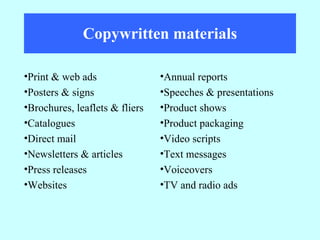
Copywritten materials Annual reports Speeches & presentations Product shows Product packaging Video scripts Text messages Voiceovers TV and radio ads Print & web ads Posters & signs Brochures, leaflets & fliers Catalogues Direct mail Newsletters & articles Press releases Websites
Features and benefits
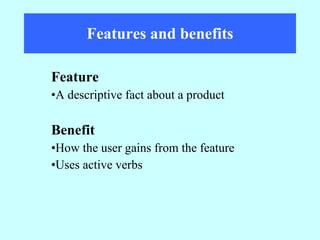
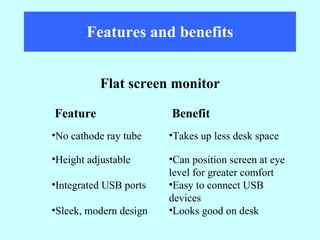
Features and benefits Feature A descriptive fact about a product Benefit How the user gains from the feature Uses active verbs
Features and benefits Flat screen monitor Looks good on desk Sleek, modern design Easy to connect USB devices Integrated USB ports Can position screen at eye level for greater comfort Height adjustable Takes up less desk space No cathode ray tube Benefit Feature
Features and benefits 
Sales copy Get attention Communicate Persuade
Headlines
Headlines Get attention Select the audience Deliver a complete message Draw the reader in 
Headlines Who is the customer? What are the important features of the product? Why will the customer want to buy the product? What is the main sales message? Write several alternative headlines 
Headlines Use attention getting words Free How to… Why Sale Quick Easy Bargain Last chance Guarantee Results Proven
Headlines Headline + Visual = Concept
Headlines State the proposition directly
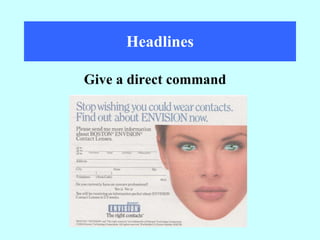
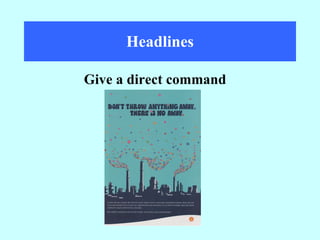
Headlines Give a direct command
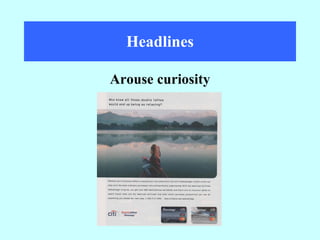
Headlines Arouse curiosity
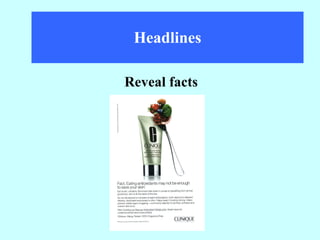
Headlines Reveal facts
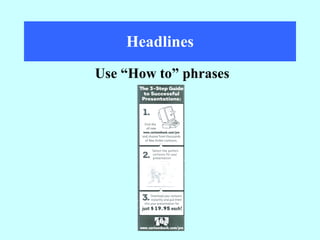
Headlines Use “How to” phrases
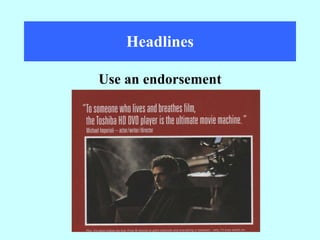
Headlines Use an endorsement
Headlines Ask a question Want to make £ 15,000 in a day?
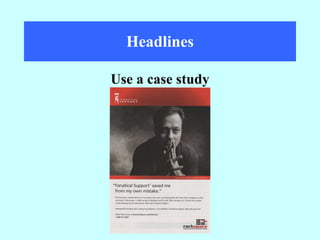
Headlines Use a case study
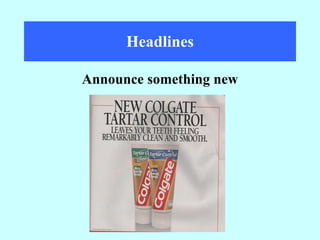
Headlines Announce something new
Headlines Focus on a USP
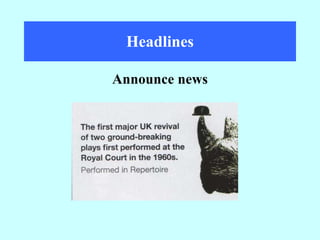
Headlines Announce news
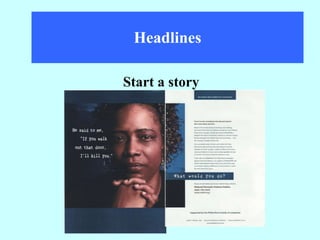
Headlines Start a story
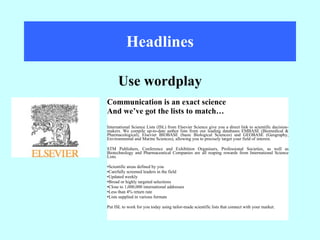
Headlines Communication is an exact science And we’ve got the lists to match…   International Science Lists (ISL) from Elsevier Science give you a direct link to scientific decision-makers. We compile up-to-date author lists from our leading databases EMBASE (Biomedical & Pharmacological), Elsevier BIOBASE (basic Biological Sciences) and GEOBASE (Geography, Environmental and Marine Sciences), allowing you to precisely target your field of interest. STM Publishers, Conference and Exhibition Organisers, Professional Societies, as well as Biotechnology and Pharmaceutical Companies are all reaping rewards from International Science Lists. Scientific areas defined by you Carefully screened leaders in the field Updated weekly Broad or highly targeted selections Close to 1,000,000 international addresses Less than 4% return rate Lists supplied in various formats Put ISL to work for you today using tailor-made scientific lists that connect with your market. Use wordplay
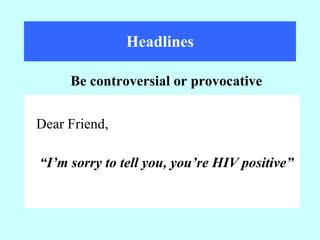
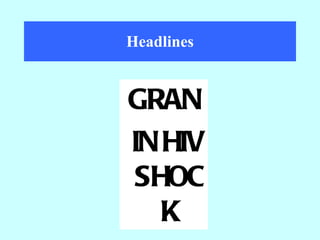
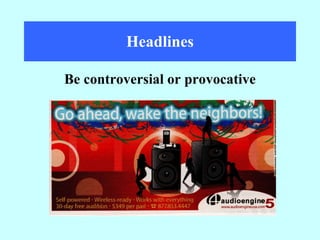
Headlines Dear Friend, “ I’m sorry to tell you, you’re HIV positive” Be controversial or provocative
GRAN IN HIV SHOCK Headlines
Headlines Be controversial or provocative
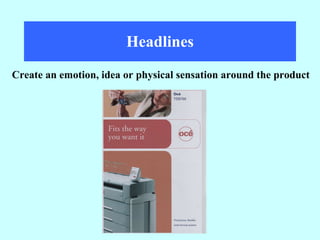
Headlines Create an emotion, idea or physical sensation around the product
Writing clear copy
Writing clear copy Use “you”, “us” and “we You’re writing for people
Writing clear copy Primary sales message Secondary sales messages Tell them what you’re going to tell them,  tell them, then tell them what you’ve told  them Organize your sales points
Writing clear copy Use subheads Make it easy to read Break copy into short sections
Writing clear copy 14 to 16 words preferably 20 to 25 words is permissible Vary sentence length Use short sentences
Writing clear copy Avoid pompous words or fancy phrases Big words make the writer feel important Use simple words
Writing clear copy Win, success, happy, love, secret, peace, pain, luxury, adventure, fingertips, delight, worry, safe, secure, special, save, live, breathe, smooth, kill, sorry, wake…… Use dynamic words with strong physical or emotional associations
Writing clear copy Unless 95% of your audience will  understand Avoid technical jargon
Writing clear copy Synergy Solutions Sustainable Needs Avoid clichés or overused words
Writing clear copy Cut out unnecessary words and verbose  phrases You can’t say everything Be concise
Writing clear copy Avoid vague language Give figures Use concrete examples Be specific
Writing clear copy Don’t spend time “warming up” Start selling from the first line Get straight to the point
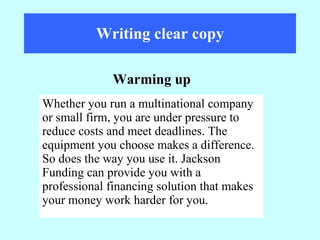
Writing clear copy Whether you run a multinational company or small firm, you are under pressure to reduce costs and meet deadlines. The equipment you choose makes a difference. So does the way you use it. Jackson Funding can provide you with a professional financing solution that makes your money work harder for you. Warming up
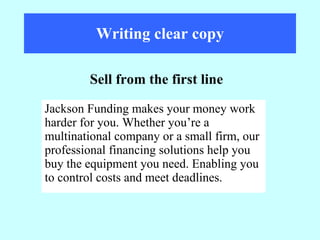
Writing clear copy Jackson Funding makes your money work harder for you. Whether you’re a multinational company or a small firm, our professional financing solutions help you buy the equipment you need. Enabling you to control costs and meet deadlines.  Sell from the first line
Writing clear copy Use colloquial expressions Use contractions Use “you”, “we”, “they” Imagine yourself speaking the copy Write in a friendly conversational style
Writing clear copy Use plurals Rewrite to avoid references to gender Alternate “he” and “she” Avoid sexist language
Tricks of the trade
Tricks of the trade “ Car insurance you can rely on” “ Chocolate mousse you’ll make room for” Gives copy an informal tone End with a preposition
Tricks of the trade “ And no wonder.” “ But there’s more.” Adds drama Use sentence fragments
Tricks of the trade “ And”, “or”, “but”, “for” Easy transitions Break up long sentences Begin sentences with conjunctions
Tricks of the trade Changes pace Keeps reader alert Use one-sentence paragraphs
Tricks of the trade Use bullets, breakers, numbers
Tricks of the trade Underlining Bold type Highlight colour Italics Boxed copy Use graphic formats for emphasis
Writing to sell
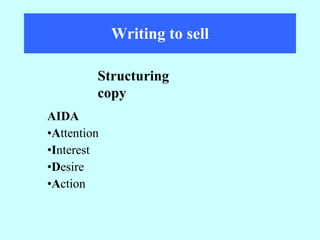
Writing to sell AIDA A ttention I nterest D esire A ction Structuring copy
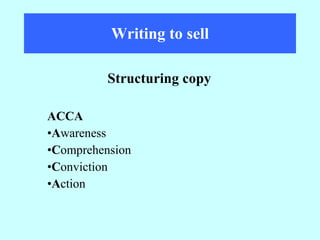
Writing to sell ACCA A wareness C omprehension C onviction A ction Structuring copy
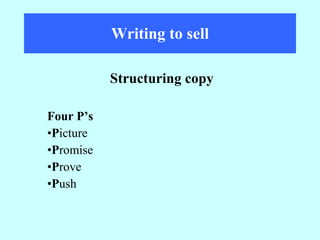
Writing to sell Four P’s P icture P romise P rove P ush Structuring copy
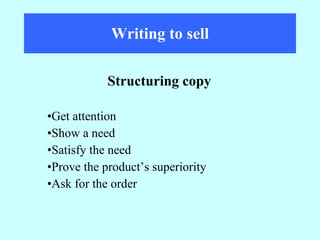
Writing to sell Get attention Show a need Satisfy the need Prove the product’s superiority Ask for the order Structuring copy
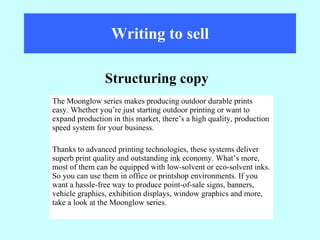
Writing to sell The Moonglow series makes producing outdoor durable prints easy. Whether you’re just starting outdoor printing or want to expand production in this market, there’s a high quality, production speed system for your business.  Thanks to advanced printing technologies, these systems deliver superb print quality and outstanding ink economy. What’s more, most of them can be equipped with low-solvent or eco-solvent inks. So you can use them in office or printshop environments. If you want a hassle-free way to produce point-of-sale signs, banners, vehicle graphics, exhibition displays, window graphics and more, take a look at the Moonglow series. Structuring copy
Writing to sell Describe a process Show before and after Use a chronological sequence Cause and effect From most to least important Structuring copy
Writing to sell Dramatize a minor product difference Dramatize the benefit Dramatize a minor product flaw Dramatize the name or package Build brand personalities Create an emotion, idea or physical  sensation around the product Creating a USP
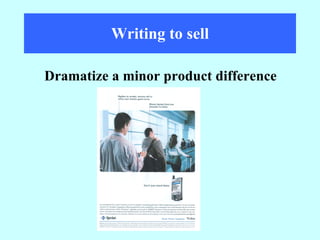
Writing to sell Dramatize a minor product difference
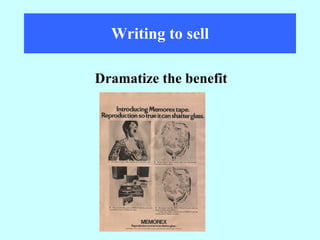
Writing to sell Dramatize the benefit
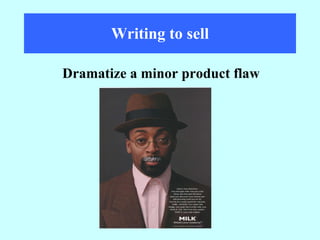
Writing to sell Dramatize a minor product flaw
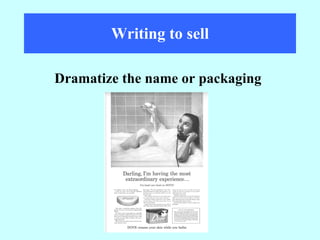
Writing to sell Dramatize the name or packaging
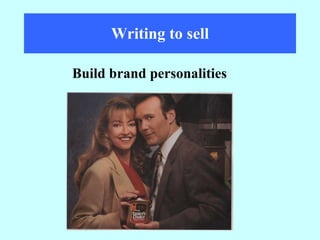
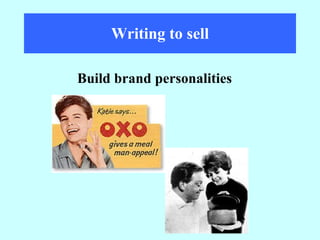
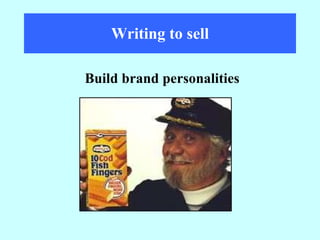
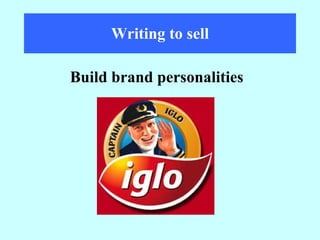
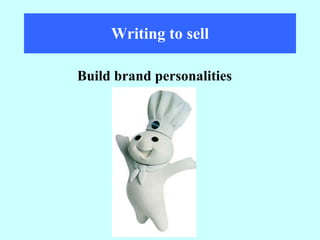
Writing to sell Build brand personalities
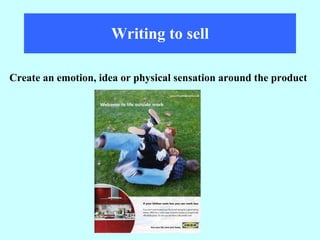
Writing to sell Create an emotion, idea or physical sensation around the product
Writing to sell Tailor copy to the target group(s) Writer about features and benefits  important to the customer  not  the  advertiser Think as a consumer Know your customer
Writing to sell Depends on: Product Target group Purpose of the copy Copy length
Writing to sell Does the copy fulfill the promise of the  headline? Do the headline and the visual work  together? Is the copy interesting? Is it easy to read? Copywriter’s checklist
Writing to sell Is it persuasive? Is it concise? Is it relevant? Does it flow smoothly? Does it call for action? Copywriter’s checklist
Writing to sell Have you used dynamic, persuasive  language? Can you edit out unnecessary words? Is the copy accurate? Is the tone and language consistent? Have you included all the information the  customer needs? Copywriter’s checklist
Before you start writing
Before you start writing Get all the information you can Speeches & presentations Internal documents Marketing plans Competitors’ literature Previous ads Brochures Websites Annual reports Technical papers
Before you start writing What are the features and benefits? What’s the most important benefit? Is it a new product or improvements to an  old one? How does it differ from the competition? If it’s not different, what attributes can be  highlighted? Ask questions about the product
Before you start writing Applications? What problems does it solve? How is positioned against competing  products? How does it work? How reliable is it? Ask questions about the product
Before you start writing How efficient is it? How economical is it? How much does it cost? Does it have any defects or restrictions? Is it easy to use? Ask questions about the product
Before you start writing Is it environmentally friendly? Is it easy to maintain? Any testimonials? What materials, sizes and models? What’s the buying process? Ask questions about the product
Before you start writing Any after-sales service or support? Is it guaranteed? Has it won any awards? Ask questions about the product
Before you start writing Is the target group external, internal or both? Who will buy the product? Who will use the product? Why do they need the product? What does the product do for them? Ask questions about the target group
Before you start writing Why do they need the product now? What is the customer’s main concern? What type of person is it being sold to? What motivates the buyer? How does the target group characterize itself? Ask questions about the target group
Before you start writing What is its place in the selling process? Generate inquiries? Generate sales? Warm up prospects? Generate web traffic? Find out the objective of the copy
Before you start writing Provide news or product information? Maintain contact with customers and  prospects? Build brand recognition? Develop company image? Find out the objective of the copy
Before you start writing Marketing tool for sales people? Does it have to work with other copy? What’s the call to action? Find out the objective of the copy
Before you start writing Style guide? British or American English? Will it be translated? How informal should it be? Suggestions for visuals? Ask questions about copy style
Before you start writing Existing or new visuals? Will it be personalized? Will colour be used? Examples of copy the client likes? Outline first? Ask questions about copy style
The writing process
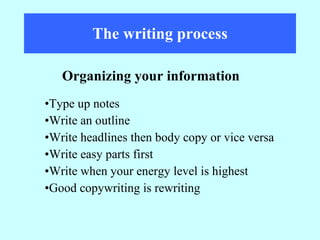
The writing process Type up notes Write an outline Write headlines then body copy or vice versa Write easy parts first Write when your energy level is highest Good copywriting is rewriting Organizing your information
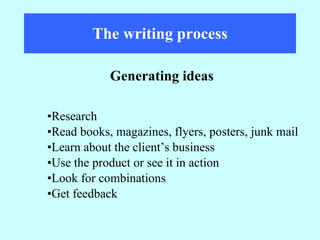
The writing process Research Read books, magazines, flyers, posters, junk mail Learn about the client’s business Use the product or see it in action Look for combinations Get feedback Generating ideas
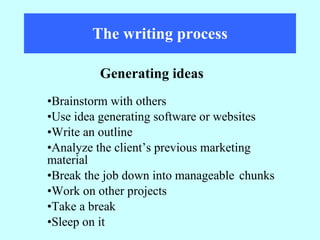
The writing process Brainstorm with others Use idea generating software or websites Write an outline Analyze the client’s previous marketing  material Break the job down into manageable  chunks Work on other projects Take a break Sleep on it Generating ideas
The copywriting business
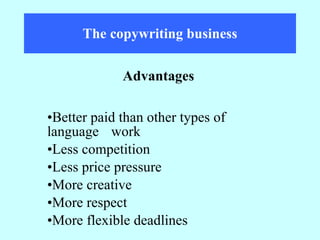
The copywriting business Better paid than other types of  language  work Less competition  Less price pressure More creative  More respect More flexible deadlines Advantages
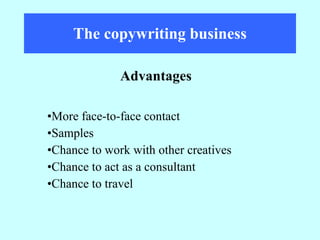
The copywriting business More face-to-face contact Samples Chance to work with other creatives Chance to act as a consultant Chance to travel Advantages
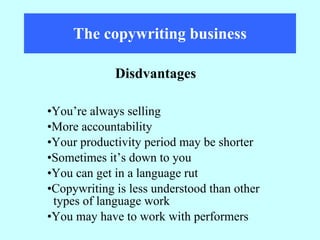
The copywriting business You’re always selling More accountability Your productivity period may be shorter Sometimes it’s down to you You can get in a language rut Copywriting is less understood than other  types of language work You may have to work with performers Disdvantages
The copywriting business Project briefing or introductory  meeting? What’s the product or industry? What are the deliverables? What’s the deadline? Research the company Before the meeting
The copywriting business Dress smartly Ask questions about the project Listen Don’t rush to show your samples Be a consultant During an introductory meeting
The copywriting business Take notes or record the session Get all the information you can  Ask questions about the product Ask questions about the target group Find out the objective of the copy Ask about copy style During a briefing
The copywriting business Analyze the client Take note of key words and concepts Is any further marketing material required? Who are the project decision-makers? Agree price Find out who to bill Agree terms During a briefing
The copywriting business Daily rate, hourly rate or project fee? Price
The copywriting business Cost estimate Revisions Travel Bookkeeping Telephone Meals Hotels Terms and conditions Briefing Meetings Research  Interviews Brainstorming Outline Writing
The copywriting business Not getting a clear briefing  Not identifying the correct benefit for the  target group Writing “clever” headlines that don’t  contribute to the sales message Using creative ideas that confuse or don’t  contribute to the sales message Common mistakes
The copywriting business Using lengthy sentences, clichés, big  words or technical jargon Not getting to the point fast enough Writing vague copy Organizing the information poorly Not getting a formal go-ahead before  starting work Common mistakes
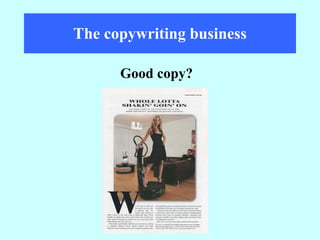
The copywriting business Good copy?
The copywriting business Disagreement on how to approach the project  Disagreement on the working relationship Unrealistic deadlines Your price is too high The client’s people are uncooperative   Common problems
The copywriting business The client doesn’t like your copy Late payment The client refuses to pay The client cancels the job Underestimating the amount of work  involved Common problems
The copywriting business Be confident, polite and positive Manage expectations Remember it’s a two-way street Educate your clients Emphasize your commitment to quality Managing clients
The copywriting business Keep it on a business footing Never load yourself to capacity Rush jobs are not a way of life There are very few genuine emergencies just a  lot of bad planning Only compromise with long-standing  clients Managing clients
The copywriting business Never miss a deadline Comply with administrative procedures Anticipate potential problems Always say thank you Ask when the assignment is finished Managing clients
Finally Read other people’s copywriting  Keep up with the language  Stay abreast of popular culture Be aware of changing trends Lighten up Have fun

Introduction To Copywriting Presentation

  • 1.
    Introduction to CopywritingFrancis Cox Copywriter
  • 2.
    Introduction to CopywritingWhat is a copywriter? Copywritten materials Features and benefits Headlines Writing clear copy Writing to sell What you need to know before you write The writing process The copywriting business
  • 3.
    What is acopywriter? A sales person in print form
  • 4.
    What is acopywriter? A sales person in writing
  • 5.
    What is acopywriter? A sales person behind a keyboard
  • 6.
    What is acopywriter? A copywriter is not an artist or an entertainer
  • 7.
    What is acopywriter? Persuading people to change their behaviour Reinforcing existing behaviour Ultimately to make money (but not always) Selling
  • 8.
  • 9.
    Copywritten materials Annualreports Speeches & presentations Product shows Product packaging Video scripts Text messages Voiceovers TV and radio ads Print & web ads Posters & signs Brochures, leaflets & fliers Catalogues Direct mail Newsletters & articles Press releases Websites
  • 10.
  • 11.
    Features and benefitsFeature A descriptive fact about a product Benefit How the user gains from the feature Uses active verbs
  • 12.
    Features and benefitsFlat screen monitor Looks good on desk Sleek, modern design Easy to connect USB devices Integrated USB ports Can position screen at eye level for greater comfort Height adjustable Takes up less desk space No cathode ray tube Benefit Feature
  • 13.
    Features and benefits
  • 14.
    Sales copy Getattention Communicate Persuade
  • 15.
  • 16.
    Headlines Get attentionSelect the audience Deliver a complete message Draw the reader in 
  • 17.
    Headlines Who isthe customer? What are the important features of the product? Why will the customer want to buy the product? What is the main sales message? Write several alternative headlines 
  • 18.
    Headlines Use attentiongetting words Free How to… Why Sale Quick Easy Bargain Last chance Guarantee Results Proven
  • 19.
    Headlines Headline +Visual = Concept
  • 20.
    Headlines State theproposition directly
  • 21.
    Headlines Give adirect command
  • 22.
    Headlines Give adirect command
  • 23.
  • 24.
  • 25.
    Headlines Use “Howto” phrases
  • 26.
    Headlines Use anendorsement
  • 27.
    Headlines Ask aquestion Want to make £ 15,000 in a day?
  • 28.
    Headlines Use acase study
  • 29.
  • 30.
  • 31.
  • 32.
  • 33.
    Headlines Communication isan exact science And we’ve got the lists to match… International Science Lists (ISL) from Elsevier Science give you a direct link to scientific decision-makers. We compile up-to-date author lists from our leading databases EMBASE (Biomedical & Pharmacological), Elsevier BIOBASE (basic Biological Sciences) and GEOBASE (Geography, Environmental and Marine Sciences), allowing you to precisely target your field of interest. STM Publishers, Conference and Exhibition Organisers, Professional Societies, as well as Biotechnology and Pharmaceutical Companies are all reaping rewards from International Science Lists. Scientific areas defined by you Carefully screened leaders in the field Updated weekly Broad or highly targeted selections Close to 1,000,000 international addresses Less than 4% return rate Lists supplied in various formats Put ISL to work for you today using tailor-made scientific lists that connect with your market. Use wordplay
  • 34.
    Headlines Dear Friend,“ I’m sorry to tell you, you’re HIV positive” Be controversial or provocative
  • 35.
    GRAN IN HIVSHOCK Headlines
  • 36.
  • 37.
    Headlines Create anemotion, idea or physical sensation around the product
  • 38.
  • 39.
    Writing clear copyUse “you”, “us” and “we You’re writing for people
  • 40.
    Writing clear copyPrimary sales message Secondary sales messages Tell them what you’re going to tell them, tell them, then tell them what you’ve told them Organize your sales points
  • 41.
    Writing clear copyUse subheads Make it easy to read Break copy into short sections
  • 42.
    Writing clear copy14 to 16 words preferably 20 to 25 words is permissible Vary sentence length Use short sentences
  • 43.
    Writing clear copyAvoid pompous words or fancy phrases Big words make the writer feel important Use simple words
  • 44.
    Writing clear copyWin, success, happy, love, secret, peace, pain, luxury, adventure, fingertips, delight, worry, safe, secure, special, save, live, breathe, smooth, kill, sorry, wake…… Use dynamic words with strong physical or emotional associations
  • 45.
    Writing clear copyUnless 95% of your audience will understand Avoid technical jargon
  • 46.
    Writing clear copySynergy Solutions Sustainable Needs Avoid clichés or overused words
  • 47.
    Writing clear copyCut out unnecessary words and verbose phrases You can’t say everything Be concise
  • 48.
    Writing clear copyAvoid vague language Give figures Use concrete examples Be specific
  • 49.
    Writing clear copyDon’t spend time “warming up” Start selling from the first line Get straight to the point
  • 50.
    Writing clear copyWhether you run a multinational company or small firm, you are under pressure to reduce costs and meet deadlines. The equipment you choose makes a difference. So does the way you use it. Jackson Funding can provide you with a professional financing solution that makes your money work harder for you. Warming up
  • 51.
    Writing clear copyJackson Funding makes your money work harder for you. Whether you’re a multinational company or a small firm, our professional financing solutions help you buy the equipment you need. Enabling you to control costs and meet deadlines. Sell from the first line
  • 52.
    Writing clear copyUse colloquial expressions Use contractions Use “you”, “we”, “they” Imagine yourself speaking the copy Write in a friendly conversational style
  • 53.
    Writing clear copyUse plurals Rewrite to avoid references to gender Alternate “he” and “she” Avoid sexist language
  • 54.
  • 55.
    Tricks of thetrade “ Car insurance you can rely on” “ Chocolate mousse you’ll make room for” Gives copy an informal tone End with a preposition
  • 56.
    Tricks of thetrade “ And no wonder.” “ But there’s more.” Adds drama Use sentence fragments
  • 57.
    Tricks of thetrade “ And”, “or”, “but”, “for” Easy transitions Break up long sentences Begin sentences with conjunctions
  • 58.
    Tricks of thetrade Changes pace Keeps reader alert Use one-sentence paragraphs
  • 59.
    Tricks of thetrade Use bullets, breakers, numbers
  • 60.
    Tricks of thetrade Underlining Bold type Highlight colour Italics Boxed copy Use graphic formats for emphasis
  • 61.
  • 62.
    Writing to sellAIDA A ttention I nterest D esire A ction Structuring copy
  • 63.
    Writing to sellACCA A wareness C omprehension C onviction A ction Structuring copy
  • 64.
    Writing to sellFour P’s P icture P romise P rove P ush Structuring copy
  • 65.
    Writing to sellGet attention Show a need Satisfy the need Prove the product’s superiority Ask for the order Structuring copy
  • 66.
    Writing to sellThe Moonglow series makes producing outdoor durable prints easy. Whether you’re just starting outdoor printing or want to expand production in this market, there’s a high quality, production speed system for your business. Thanks to advanced printing technologies, these systems deliver superb print quality and outstanding ink economy. What’s more, most of them can be equipped with low-solvent or eco-solvent inks. So you can use them in office or printshop environments. If you want a hassle-free way to produce point-of-sale signs, banners, vehicle graphics, exhibition displays, window graphics and more, take a look at the Moonglow series. Structuring copy
  • 67.
    Writing to sellDescribe a process Show before and after Use a chronological sequence Cause and effect From most to least important Structuring copy
  • 68.
    Writing to sellDramatize a minor product difference Dramatize the benefit Dramatize a minor product flaw Dramatize the name or package Build brand personalities Create an emotion, idea or physical sensation around the product Creating a USP
  • 69.
    Writing to sellDramatize a minor product difference
  • 70.
    Writing to sellDramatize the benefit
  • 71.
    Writing to sellDramatize a minor product flaw
  • 72.
    Writing to sellDramatize the name or packaging
  • 73.
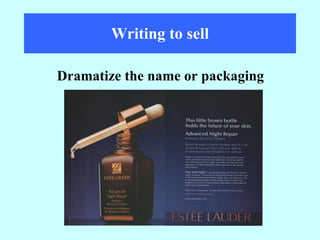
    Writing to sellDramatize the name or packaging
  • 74.
    Writing to sellBuild brand personalities
  • 75.
    Writing to sellBuild brand personalities
  • 76.
    Writing to sellBuild brand personalities
  • 77.
    Writing to sellBuild brand personalities
  • 78.
    Writing to sellBuild brand personalities
  • 79.
    Writing to sellCreate an emotion, idea or physical sensation around the product
  • 80.
    Writing to sellTailor copy to the target group(s) Writer about features and benefits important to the customer not the advertiser Think as a consumer Know your customer
  • 81.
    Writing to sellDepends on: Product Target group Purpose of the copy Copy length
  • 82.
    Writing to sellDoes the copy fulfill the promise of the headline? Do the headline and the visual work together? Is the copy interesting? Is it easy to read? Copywriter’s checklist
  • 83.
    Writing to sellIs it persuasive? Is it concise? Is it relevant? Does it flow smoothly? Does it call for action? Copywriter’s checklist
  • 84.
    Writing to sellHave you used dynamic, persuasive language? Can you edit out unnecessary words? Is the copy accurate? Is the tone and language consistent? Have you included all the information the customer needs? Copywriter’s checklist
  • 85.
  • 86.
    Before you startwriting Get all the information you can Speeches & presentations Internal documents Marketing plans Competitors’ literature Previous ads Brochures Websites Annual reports Technical papers
  • 87.
    Before you startwriting What are the features and benefits? What’s the most important benefit? Is it a new product or improvements to an old one? How does it differ from the competition? If it’s not different, what attributes can be highlighted? Ask questions about the product
  • 88.
    Before you startwriting Applications? What problems does it solve? How is positioned against competing products? How does it work? How reliable is it? Ask questions about the product
  • 89.
    Before you startwriting How efficient is it? How economical is it? How much does it cost? Does it have any defects or restrictions? Is it easy to use? Ask questions about the product
  • 90.
    Before you startwriting Is it environmentally friendly? Is it easy to maintain? Any testimonials? What materials, sizes and models? What’s the buying process? Ask questions about the product
  • 91.
    Before you startwriting Any after-sales service or support? Is it guaranteed? Has it won any awards? Ask questions about the product
  • 92.
    Before you startwriting Is the target group external, internal or both? Who will buy the product? Who will use the product? Why do they need the product? What does the product do for them? Ask questions about the target group
  • 93.
    Before you startwriting Why do they need the product now? What is the customer’s main concern? What type of person is it being sold to? What motivates the buyer? How does the target group characterize itself? Ask questions about the target group
  • 94.
    Before you startwriting What is its place in the selling process? Generate inquiries? Generate sales? Warm up prospects? Generate web traffic? Find out the objective of the copy
  • 95.
    Before you startwriting Provide news or product information? Maintain contact with customers and prospects? Build brand recognition? Develop company image? Find out the objective of the copy
  • 96.
    Before you startwriting Marketing tool for sales people? Does it have to work with other copy? What’s the call to action? Find out the objective of the copy
  • 97.
    Before you startwriting Style guide? British or American English? Will it be translated? How informal should it be? Suggestions for visuals? Ask questions about copy style
  • 98.
    Before you startwriting Existing or new visuals? Will it be personalized? Will colour be used? Examples of copy the client likes? Outline first? Ask questions about copy style
  • 99.
  • 100.
    The writing processType up notes Write an outline Write headlines then body copy or vice versa Write easy parts first Write when your energy level is highest Good copywriting is rewriting Organizing your information
  • 101.
    The writing processResearch Read books, magazines, flyers, posters, junk mail Learn about the client’s business Use the product or see it in action Look for combinations Get feedback Generating ideas
  • 102.
    The writing processBrainstorm with others Use idea generating software or websites Write an outline Analyze the client’s previous marketing material Break the job down into manageable chunks Work on other projects Take a break Sleep on it Generating ideas
  • 103.
  • 104.
    The copywriting businessBetter paid than other types of language work Less competition Less price pressure More creative More respect More flexible deadlines Advantages
  • 105.
    The copywriting businessMore face-to-face contact Samples Chance to work with other creatives Chance to act as a consultant Chance to travel Advantages
  • 106.
    The copywriting businessYou’re always selling More accountability Your productivity period may be shorter Sometimes it’s down to you You can get in a language rut Copywriting is less understood than other types of language work You may have to work with performers Disdvantages
  • 107.
    The copywriting businessProject briefing or introductory meeting? What’s the product or industry? What are the deliverables? What’s the deadline? Research the company Before the meeting
  • 108.
    The copywriting businessDress smartly Ask questions about the project Listen Don’t rush to show your samples Be a consultant During an introductory meeting
  • 109.
    The copywriting businessTake notes or record the session Get all the information you can Ask questions about the product Ask questions about the target group Find out the objective of the copy Ask about copy style During a briefing
  • 110.
    The copywriting businessAnalyze the client Take note of key words and concepts Is any further marketing material required? Who are the project decision-makers? Agree price Find out who to bill Agree terms During a briefing
  • 111.
    The copywriting businessDaily rate, hourly rate or project fee? Price
  • 112.
    The copywriting businessCost estimate Revisions Travel Bookkeeping Telephone Meals Hotels Terms and conditions Briefing Meetings Research Interviews Brainstorming Outline Writing
  • 113.
    The copywriting businessNot getting a clear briefing Not identifying the correct benefit for the target group Writing “clever” headlines that don’t contribute to the sales message Using creative ideas that confuse or don’t contribute to the sales message Common mistakes
  • 114.
    The copywriting businessUsing lengthy sentences, clichés, big words or technical jargon Not getting to the point fast enough Writing vague copy Organizing the information poorly Not getting a formal go-ahead before starting work Common mistakes
  • 115.
  • 116.
    The copywriting businessDisagreement on how to approach the project Disagreement on the working relationship Unrealistic deadlines Your price is too high The client’s people are uncooperative Common problems
  • 117.
    The copywriting businessThe client doesn’t like your copy Late payment The client refuses to pay The client cancels the job Underestimating the amount of work involved Common problems
  • 118.
    The copywriting businessBe confident, polite and positive Manage expectations Remember it’s a two-way street Educate your clients Emphasize your commitment to quality Managing clients
  • 119.
    The copywriting businessKeep it on a business footing Never load yourself to capacity Rush jobs are not a way of life There are very few genuine emergencies just a lot of bad planning Only compromise with long-standing clients Managing clients
  • 120.
    The copywriting businessNever miss a deadline Comply with administrative procedures Anticipate potential problems Always say thank you Ask when the assignment is finished Managing clients
  • 121.
    Finally Read otherpeople’s copywriting Keep up with the language Stay abreast of popular culture Be aware of changing trends Lighten up Have fun