COPY WRITING
(Advertising)
R.S.Thilini Rajaguru
Assistant Lecturer
Department of Languages and communication studies,
Faculty of Communication and Business Studies,
Trincomalee Campus,
Eastern University,
Sri Lanka.
2018
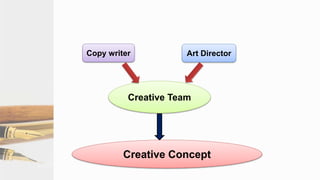
Creative Team
Copy writer Art Director
Creative Concept
Copywriting and the Creative Plan
Copywriting is the process of expressing the value and benefits a brand
has to offer via written or verbal descriptions together in coherent sent
ences.
A creative plan is the guideline that specifies the message elements of
advertising copy
(Main product claim, creative devices, media that will be used,
Special creative needs a product or service might have)
Copy writer
 Copy writer Should have a Creative Talent.
 Copy writers are able to comprehend and then incorporate the compl
exities of marketing strategies, consumer behaviors and advertising
strategies into a brief yet powerful communication.
 They must do in such away that the copy does not interfere with but
rather enhances the visual aspects of the messages.
Some elements should be consider in
composing a creative plan
 Target market
 The product features to be emphasized
 The benefits a user receives from the features
 The media will be used and the running time of the advertisement
 The suggested mood or tone for the ad
 The ways in which mood and atmosphere will be achieved in the ad
 The production budget for the ad
These considerations are subjected be to change
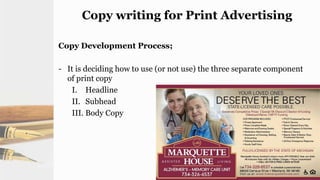
Copy writing for Print Advertising
Copy Development Process;
- It is deciding how to use (or not use) the three separate component
of print copy
I. Headline
II. Subhead
III. Body Copy
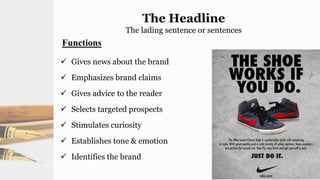
The Headline
The lading sentence or sentences
Functions
 Gives news about the brand
 Emphasizes brand claims
 Gives advice to the reader
 Selects targeted prospects
 Stimulates curiosity
 Establishes tone & emotion
 Identifies the brand
The Headline
 Be persuasive
 Appeal to self-interest
 Inject maximum information
 Limit to five-eight words
 Include the brand name
 Entice to read body copy
 Entice to examine visuals
 Never rely upon body copy
 Keep it simple & familiar
Guidelines
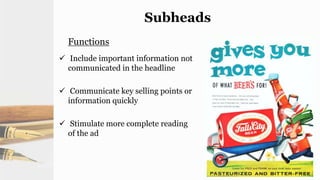
Subheads
Functions
 Include important information not
communicated in the headline
 Communicate key selling points or
information quickly
 Stimulate more complete reading
of the ad
The Body Copy
Textual component of an advertisement, more complete s
tory of a brand
Functions
 Reinforces the headline and subhead.
 Compatible with and gains strength from the visual.
 Interesting to the reader.
 The most elaborate body copy will probably be ineffective
Techniques for preparing body copy
 Straight-line copy – Explain in straightforward terms why a reader will benefit from
use of a brand.
 Dialogue – Deliver the selling points of a message to the audience through a
character or characters in the ad.
 Testimonial – Uses dialogue as if the spokesperson is a having one-sided
conversation with the reader through the body copy. Often used in slice-of-life
messages.
 Narrative – Displays a series of statements about a brand.
 Direct response copy – The copywriter is trying to highlight the urgency of acting
immediately.
Guidelines for writing Body Copy
 Use present tense whenever possible – Casting brand claims in the past or future
reduces their credibility and timeliness.
 Use singular nouns and verbs – Using plural nouns and verbs simply reduces the
focus on the item or brand attribute being touted and makes the ad less personal.
 Use active verbs – The passive form of a verb does little to stimulate excitement or
interest.
 Use familiar words and phrases – Familiar words can seem common and
ordinary, The challenge is familiar and comfortable to the reader.
 Vary sentence and paragraph length – It increase the interest and visual impact.
That can make an ad more inviting and readable.
 Involve the reader – Copy that impress the reader as having been written
specifically for him or her reduces the chances of the ad being perceived as a
generalized, mass communication.
 Provide support for the unbelievable – Brand may have features of functions that
the reader finds hard to believe. Without proper support of claims, the brand will lose
its credibility and therefore its relevance to the consumer.
 Avoid clichés and superlatives – Don’t use superlatives ( best, superior,
unbeatable)
Writing Radio Copy
Formats
 Music – One use of music is to write a song or jingle in an attempt to
communicate in an attention getting and memorable fashion. On
occasion, an existing tune can be used, and the copy is fit to its meter
and rhythm.
 Dialog – It is difficult to make narrative copy for short period of time
for radio ad ( typically 15 to 60 seconds) , Therefore Can write dialogues
with humor.
 Announcement - The announcer reads important product
information a sit has been prepared by the copy writer.
Announcement is the prevalent technique for live radio spots delivered
by disc jockeys or news commentators.
 Celebrity announcer – Having a famous person or persons deliver
the copy is alleged to increase the attention paid to a radio ad.
Guidelines for writing a Radio Copy
 Use familiar language
 Use short words and sentences
 Stimulate the imagination
 Repeat the product name
 Stress the main selling points
 Use sound and music carefully
 Tailor the copy to the time, place, and specific audience
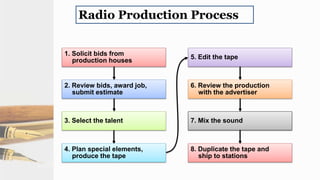
Radio Production Process
8. Duplicate the tape and
ship to stations
7. Mix the sound
6. Review the production
with the advertiser
5. Edit the tape
1. Solicit bids from
production houses
4. Plan special elements,
produce the tape
3. Select the talent
2. Review bids, award job,
submit estimate
Chapter 12: Copywriting 18
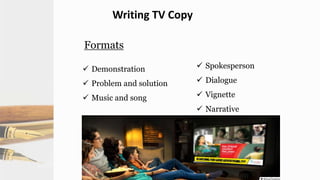
Writing TV Copy
Formats
 Demonstration
 Problem and solution
 Music and song
 Spokesperson
 Dialogue
 Vignette
 Narrative
Guidelines for writing TV copy
 Use the video
 Support the video
 Coordinate the audio with the video
 Entertain but sell the product
 Be flexible
 Use copy judiciously
 Reflect the brand’s personality and image
 Build campaigns
Copywriting for Cyberspace
 Internet has its own style, feel, and writing
 It is a medium where audience has a different meaning than
in traditional media
• Audience often comes directly to ads
• Other ads pop up
• Audience is active
• Cyber copy is often direct response
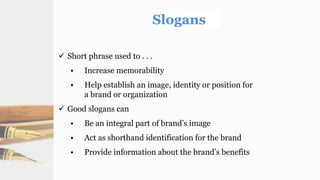
 Short phrase used to . . .
• Increase memorability
• Help establish an image, identity or position for
a brand or organization
 Good slogans can
• Be an integral part of brand’s image
• Act as shorthand identification for the brand
• Provide information about the brand’s benefits
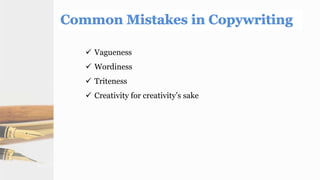
 Vagueness
 Wordiness
 Triteness
 Creativity for creativity’s sake
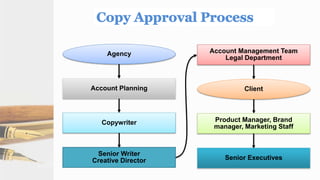
Senior Executives
Product Manager, Brand
manager, Marketing Staff
Client
Account Management Team
Legal Department
Agency
Senior Writer
Creative Director
Copywriter
Account Planning
END

Copy writing by thilini rajaguru

  • 1.
    COPY WRITING (Advertising) R.S.Thilini Rajaguru AssistantLecturer Department of Languages and communication studies, Faculty of Communication and Business Studies, Trincomalee Campus, Eastern University, Sri Lanka. 2018
  • 2.
    Creative Team Copy writerArt Director Creative Concept
  • 3.
    Copywriting and theCreative Plan Copywriting is the process of expressing the value and benefits a brand has to offer via written or verbal descriptions together in coherent sent ences. A creative plan is the guideline that specifies the message elements of advertising copy (Main product claim, creative devices, media that will be used, Special creative needs a product or service might have)
  • 4.
    Copy writer  Copywriter Should have a Creative Talent.  Copy writers are able to comprehend and then incorporate the compl exities of marketing strategies, consumer behaviors and advertising strategies into a brief yet powerful communication.  They must do in such away that the copy does not interfere with but rather enhances the visual aspects of the messages.
  • 5.
    Some elements shouldbe consider in composing a creative plan  Target market  The product features to be emphasized  The benefits a user receives from the features  The media will be used and the running time of the advertisement  The suggested mood or tone for the ad  The ways in which mood and atmosphere will be achieved in the ad  The production budget for the ad These considerations are subjected be to change
  • 6.
    Copy writing forPrint Advertising Copy Development Process; - It is deciding how to use (or not use) the three separate component of print copy I. Headline II. Subhead III. Body Copy
  • 7.
    The Headline The ladingsentence or sentences Functions  Gives news about the brand  Emphasizes brand claims  Gives advice to the reader  Selects targeted prospects  Stimulates curiosity  Establishes tone & emotion  Identifies the brand
  • 8.
    The Headline  Bepersuasive  Appeal to self-interest  Inject maximum information  Limit to five-eight words  Include the brand name  Entice to read body copy  Entice to examine visuals  Never rely upon body copy  Keep it simple & familiar Guidelines
  • 9.
    Subheads Functions  Include importantinformation not communicated in the headline  Communicate key selling points or information quickly  Stimulate more complete reading of the ad
  • 10.
    The Body Copy Textualcomponent of an advertisement, more complete s tory of a brand Functions  Reinforces the headline and subhead.  Compatible with and gains strength from the visual.  Interesting to the reader.  The most elaborate body copy will probably be ineffective
  • 11.
    Techniques for preparingbody copy  Straight-line copy – Explain in straightforward terms why a reader will benefit from use of a brand.  Dialogue – Deliver the selling points of a message to the audience through a character or characters in the ad.  Testimonial – Uses dialogue as if the spokesperson is a having one-sided conversation with the reader through the body copy. Often used in slice-of-life messages.  Narrative – Displays a series of statements about a brand.  Direct response copy – The copywriter is trying to highlight the urgency of acting immediately.
  • 12.
    Guidelines for writingBody Copy  Use present tense whenever possible – Casting brand claims in the past or future reduces their credibility and timeliness.  Use singular nouns and verbs – Using plural nouns and verbs simply reduces the focus on the item or brand attribute being touted and makes the ad less personal.  Use active verbs – The passive form of a verb does little to stimulate excitement or interest.  Use familiar words and phrases – Familiar words can seem common and ordinary, The challenge is familiar and comfortable to the reader.
  • 13.
     Vary sentenceand paragraph length – It increase the interest and visual impact. That can make an ad more inviting and readable.  Involve the reader – Copy that impress the reader as having been written specifically for him or her reduces the chances of the ad being perceived as a generalized, mass communication.  Provide support for the unbelievable – Brand may have features of functions that the reader finds hard to believe. Without proper support of claims, the brand will lose its credibility and therefore its relevance to the consumer.  Avoid clichés and superlatives – Don’t use superlatives ( best, superior, unbeatable)
  • 14.
    Writing Radio Copy Formats Music – One use of music is to write a song or jingle in an attempt to communicate in an attention getting and memorable fashion. On occasion, an existing tune can be used, and the copy is fit to its meter and rhythm.  Dialog – It is difficult to make narrative copy for short period of time for radio ad ( typically 15 to 60 seconds) , Therefore Can write dialogues with humor.
  • 15.
     Announcement -The announcer reads important product information a sit has been prepared by the copy writer. Announcement is the prevalent technique for live radio spots delivered by disc jockeys or news commentators.  Celebrity announcer – Having a famous person or persons deliver the copy is alleged to increase the attention paid to a radio ad.
  • 16.
    Guidelines for writinga Radio Copy  Use familiar language  Use short words and sentences  Stimulate the imagination  Repeat the product name  Stress the main selling points  Use sound and music carefully  Tailor the copy to the time, place, and specific audience
  • 17.
    Radio Production Process 8.Duplicate the tape and ship to stations 7. Mix the sound 6. Review the production with the advertiser 5. Edit the tape 1. Solicit bids from production houses 4. Plan special elements, produce the tape 3. Select the talent 2. Review bids, award job, submit estimate
  • 18.
    Chapter 12: Copywriting18 Writing TV Copy Formats  Demonstration  Problem and solution  Music and song  Spokesperson  Dialogue  Vignette  Narrative
  • 19.
    Guidelines for writingTV copy  Use the video  Support the video  Coordinate the audio with the video  Entertain but sell the product  Be flexible  Use copy judiciously  Reflect the brand’s personality and image  Build campaigns
  • 20.
    Copywriting for Cyberspace Internet has its own style, feel, and writing  It is a medium where audience has a different meaning than in traditional media • Audience often comes directly to ads • Other ads pop up • Audience is active • Cyber copy is often direct response
  • 21.
     Short phraseused to . . . • Increase memorability • Help establish an image, identity or position for a brand or organization  Good slogans can • Be an integral part of brand’s image • Act as shorthand identification for the brand • Provide information about the brand’s benefits
  • 22.
     Vagueness  Wordiness Triteness  Creativity for creativity’s sake
  • 23.
    Senior Executives Product Manager,Brand manager, Marketing Staff Client Account Management Team Legal Department Agency Senior Writer Creative Director Copywriter Account Planning
  • 24.