By:- Abhishek Rajvanshi
Advertising?
• It is derived from Latin root ad verter, which
means “to attract attention to”.
• Advertising is the non-personal communication
of information.
• Any paid form of non-personal presentation
and promotion of ideas or products by an
identified sponsor through various media.
Advertising Objectives
Four Main objectives :-
• Inform
• Persuade
• Remind
• Reinforce
Advertising Objectives
Inform
• Let the people know.
• What the product is.
• Where it would be available.
• What problem it will solve.
• Informative advertising is most widely used in
introductory stage of the product because maximum
information is given when something is new
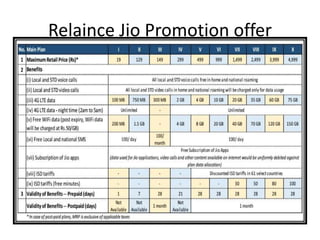
Eg:- Reliance jio sim
Relaince Jio Promotion offer
Advertising Objectives
Persuade
• Induce people to buy.
• As product grows increase in competition.
• Advertiser need to give more reasons to lure
customers.
• To establish superiority of product they follow
comparative advertising .
E.g.- Pepsodent claim that it fights germs 1.5 times
better than other brands, Captain cook salt persuaded
consumers by depicting how their salt is better than
Tata salt.
Advertising Objectives
Remind
• Kind of advertising is widespread with mature
products e.g. Amul butter.
• Products that are well past with their rapid
growth phases.
• Advertiser should keep reinforcing the central
message.
• Get more creative in ad execution for the
product liking.
Advertising Objectives
Reinforce
• Advertising seeks to convince current
consumers that they have made the right
choice.
• Key benefits and depicting satisfied costumers
of the brand.
• E.g, Maruti proclaims, “Virtually 2 out of 3
people who go to choose a car end up driving
home a Maruti.”
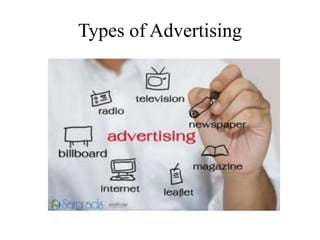
Types of Advertising
History
• In 1704 The first newspaper advertisement is
published in the Boston News-Letter. It was an
announcement for seeking a buyer for an estate
Oyster Bay, Long Island, NY, US.
• The world's first television advertisement was
broadcast July 1, 1941. The watchmaker
Bulova paid $4 for a placement on New York
station WNBT before a baseball game.
Types of advertisements
• Print
– Newspaper
– Magazine
– Directory
– Out door
– Transit
• Territory
– Local
– National
– International
• Media
– Television
– Radio
– Webcasting
– Cyber ads
– Direct mail
– Mobile
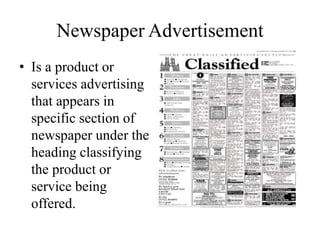
Newspaper Advertisement
• Is a product or
services advertising
that appears in
specific section of
newspaper under the
heading classifying
the product or
service being
offered.
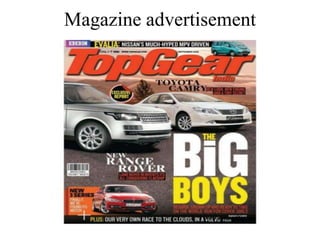
Magazine advertisement
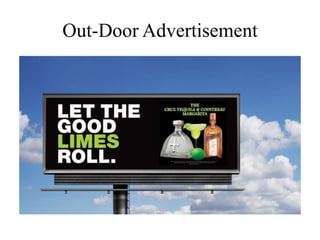
Out-Door Advertisement
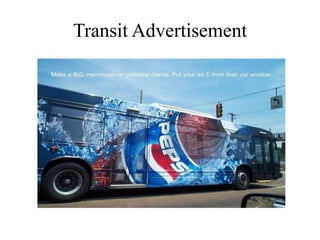
Transit Advertisement
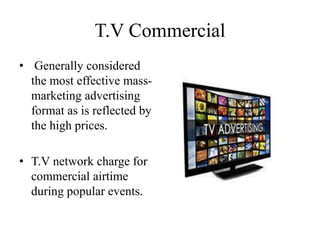
T.V Commercial
• Generally considered
the most effective mass-
marketing advertising
format as is reflected by
the high prices.
• T.V network charge for
commercial airtime
during popular events.
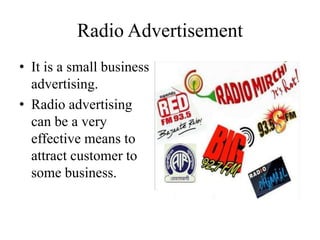
Radio Advertisement
• It is a small business
advertising.
• Radio advertising
can be a very
effective means to
attract customer to
some business.
Cyber advertisement
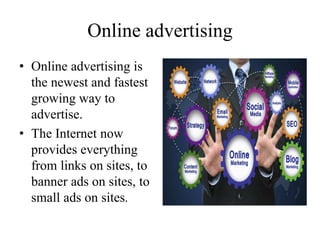
Online advertising
• Online advertising is
the newest and fastest
growing way to
advertise.
• The Internet now
provides everything
from links on sites, to
banner ads on sites, to
small ads on sites.
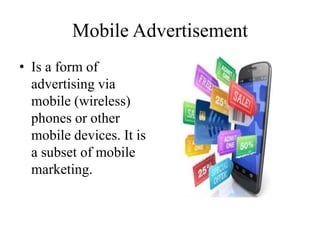
Mobile Advertisement
• Is a form of
advertising via
mobile (wireless)
phones or other
mobile devices. It is
a subset of mobile
marketing.
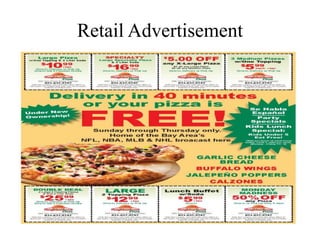
Retail Advertisement
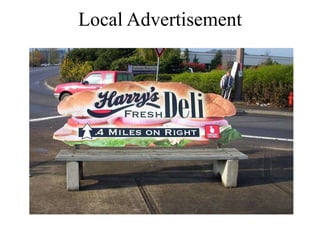
Local Advertisement
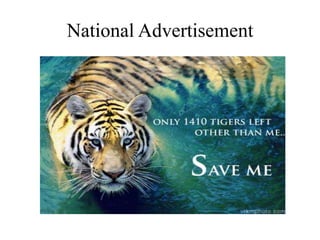
National Advertisement
• Geographically speaking national advertising’s
range is extended to the territorial limits of the
country.
• The advertiser use the national media to
inform the consumer about the product.
• The advertiser use the national local or
regional language but prefers the national
language.
National Advertisement
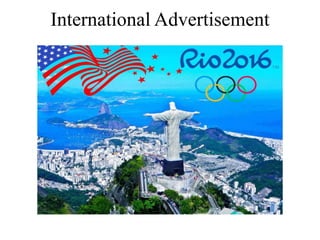
International Advertisement
Brand Advertising
• It is advertising with
a strong emphasis on
the company brand
(logo or company
name).
• Also known as
integrated marketing
communications
(IMC).
Non-Product Advertisement
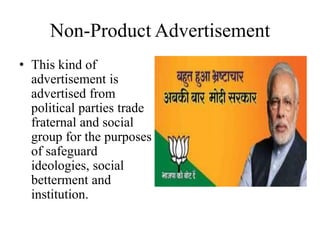
• This kind of
advertisement is
advertised from
political parties trade
fraternal and social
group for the purposes
of safeguard
ideologies, social
betterment and
institution.
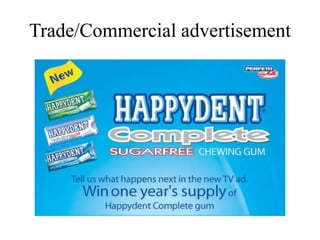
Trade/Commercial advertisement
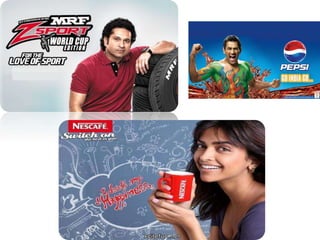
Celebrities Advertisement
• Although the audience is getting smarter and
smarter and the modern day consumer getting
immune to the exaggerated claims made in a
majority of advertisements.
• There exist a section of advertisers that still
bank upon celebrities and their popularity for
advertising their products.
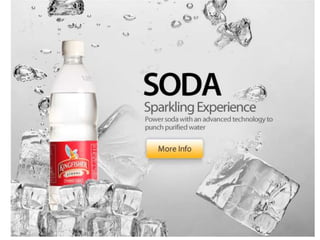
Surrogate Advertising
• Surrogate advertising is prominently seen in
cases where advertising a particular product is
banned by law.
• Advertisement for products like cigarettes or
alcohol which are injurious to heath are
prohibited by law in several countries and
hence these companies have to come up with
several other products that might have the
same brand name and indirectly remind people
of the cigarettes or beer bottles of the same
brand.
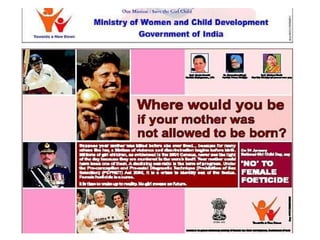
Public Service Advertisement
• Advertisement techniques use to promote
commercial goods and services can be used to
inform, educate and motivate the public about
non-commercial issues such as
HIV/AIDS, Political ideology and Energy
conservation.
Case Studies
• Mc-Donald’s
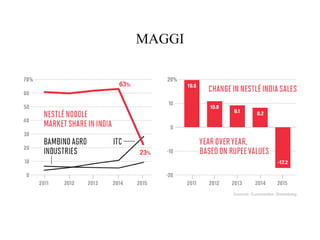
• Maggi
MCDONALD’S 1984 OLYMPICS
• Sporting events are great opportunities for themed marketing campaigns.
• The idea was simple: tap into America’s patriotic spirit by giving out free
food to McDonald’s customers when American athlete win medals in
certain events
• The campaign would be carried out through scratch cards, which were
distributed to McDonald’s customers with every item of food or drink they
bought at McDonald’s during the campaign.
• The scratch card would reveal the name of an Olympic event, and if the
US won a gold medal in that event you could claim a free Big Mac, for
silver you got free fries and bronze earned you a coke. The slogan was
simple: “When the US wins, you win.”
• No of medals At the 1984 Summer Olympics in Los Angeles Competitors
Gold-83,Silver-61,Bronze-30,Total=174
MAGGI
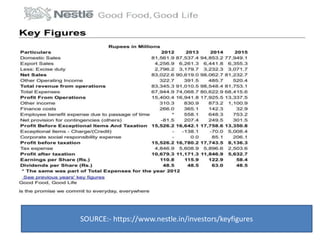
SOURCE:- https://www.nestle.in/investors/keyfigures
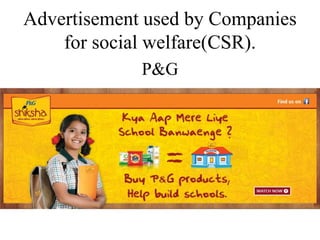
Advertisement used by Companies
for social welfare(CSR).
P&G
Advertisement used by Companies for
social welfare.
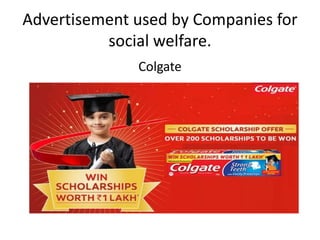
Colgate
Advertisement used by Companies for
social welfare
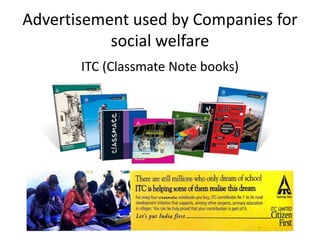
ITC (Classmate Note books)
Advertisement used by Companies for
social welfare
Google -Internet Saathi
• Google India partnered with Tata Trusts and Intel to launch ‘Internet
Saathi in July 2015.
• Transforming lives of women through digital education with initial role
out of program from West Bengal in Purulia district.
• Only one third of India’s Online Users are women.
• Growth rate of women internet users is only 27 % in rural India.
• In the last 10 months, Google India has been active in villages across
five states in India, namely, Andhra Pradesh, Gujarat, Jharkhand,
Madhya Pradesh and Rajasthan, and is expanding the programme to
four new states -- Assam, Tripura, Uttar Pradesh and West Bengal.
Thanking You.
Q & A?

Advertising

  • 1.
  • 2.
    Advertising? • It isderived from Latin root ad verter, which means “to attract attention to”. • Advertising is the non-personal communication of information. • Any paid form of non-personal presentation and promotion of ideas or products by an identified sponsor through various media.
  • 4.
    Advertising Objectives Four Mainobjectives :- • Inform • Persuade • Remind • Reinforce
  • 5.
    Advertising Objectives Inform • Letthe people know. • What the product is. • Where it would be available. • What problem it will solve. • Informative advertising is most widely used in introductory stage of the product because maximum information is given when something is new Eg:- Reliance jio sim
  • 6.
  • 7.
    Advertising Objectives Persuade • Inducepeople to buy. • As product grows increase in competition. • Advertiser need to give more reasons to lure customers. • To establish superiority of product they follow comparative advertising . E.g.- Pepsodent claim that it fights germs 1.5 times better than other brands, Captain cook salt persuaded consumers by depicting how their salt is better than Tata salt.
  • 8.
    Advertising Objectives Remind • Kindof advertising is widespread with mature products e.g. Amul butter. • Products that are well past with their rapid growth phases. • Advertiser should keep reinforcing the central message. • Get more creative in ad execution for the product liking.
  • 9.
    Advertising Objectives Reinforce • Advertisingseeks to convince current consumers that they have made the right choice. • Key benefits and depicting satisfied costumers of the brand. • E.g, Maruti proclaims, “Virtually 2 out of 3 people who go to choose a car end up driving home a Maruti.”
  • 10.
  • 11.
    History • In 1704The first newspaper advertisement is published in the Boston News-Letter. It was an announcement for seeking a buyer for an estate Oyster Bay, Long Island, NY, US. • The world's first television advertisement was broadcast July 1, 1941. The watchmaker Bulova paid $4 for a placement on New York station WNBT before a baseball game.
  • 12.
    Types of advertisements •Print – Newspaper – Magazine – Directory – Out door – Transit • Territory – Local – National – International • Media – Television – Radio – Webcasting – Cyber ads – Direct mail – Mobile
  • 13.
    Newspaper Advertisement • Isa product or services advertising that appears in specific section of newspaper under the heading classifying the product or service being offered.
  • 14.
  • 16.
  • 17.
  • 18.
    T.V Commercial • Generallyconsidered the most effective mass- marketing advertising format as is reflected by the high prices. • T.V network charge for commercial airtime during popular events.
  • 19.
    Radio Advertisement • Itis a small business advertising. • Radio advertising can be a very effective means to attract customer to some business.
  • 20.
  • 21.
    Online advertising • Onlineadvertising is the newest and fastest growing way to advertise. • The Internet now provides everything from links on sites, to banner ads on sites, to small ads on sites.
  • 23.
    Mobile Advertisement • Isa form of advertising via mobile (wireless) phones or other mobile devices. It is a subset of mobile marketing.
  • 24.
  • 25.
  • 26.
    National Advertisement • Geographicallyspeaking national advertising’s range is extended to the territorial limits of the country. • The advertiser use the national media to inform the consumer about the product. • The advertiser use the national local or regional language but prefers the national language.
  • 27.
  • 28.
  • 29.
    Brand Advertising • Itis advertising with a strong emphasis on the company brand (logo or company name). • Also known as integrated marketing communications (IMC).
  • 30.
    Non-Product Advertisement • Thiskind of advertisement is advertised from political parties trade fraternal and social group for the purposes of safeguard ideologies, social betterment and institution.
  • 31.
  • 32.
    Celebrities Advertisement • Althoughthe audience is getting smarter and smarter and the modern day consumer getting immune to the exaggerated claims made in a majority of advertisements. • There exist a section of advertisers that still bank upon celebrities and their popularity for advertising their products.
  • 34.
    Surrogate Advertising • Surrogateadvertising is prominently seen in cases where advertising a particular product is banned by law. • Advertisement for products like cigarettes or alcohol which are injurious to heath are prohibited by law in several countries and hence these companies have to come up with several other products that might have the same brand name and indirectly remind people of the cigarettes or beer bottles of the same brand.
  • 36.
    Public Service Advertisement •Advertisement techniques use to promote commercial goods and services can be used to inform, educate and motivate the public about non-commercial issues such as HIV/AIDS, Political ideology and Energy conservation.
  • 38.
  • 39.
    MCDONALD’S 1984 OLYMPICS •Sporting events are great opportunities for themed marketing campaigns. • The idea was simple: tap into America’s patriotic spirit by giving out free food to McDonald’s customers when American athlete win medals in certain events • The campaign would be carried out through scratch cards, which were distributed to McDonald’s customers with every item of food or drink they bought at McDonald’s during the campaign. • The scratch card would reveal the name of an Olympic event, and if the US won a gold medal in that event you could claim a free Big Mac, for silver you got free fries and bronze earned you a coke. The slogan was simple: “When the US wins, you win.” • No of medals At the 1984 Summer Olympics in Los Angeles Competitors Gold-83,Silver-61,Bronze-30,Total=174
  • 40.
  • 41.
  • 42.
    Advertisement used byCompanies for social welfare(CSR). P&G
  • 43.
    Advertisement used byCompanies for social welfare. Colgate
  • 44.
    Advertisement used byCompanies for social welfare ITC (Classmate Note books)
  • 45.
    Advertisement used byCompanies for social welfare Google -Internet Saathi • Google India partnered with Tata Trusts and Intel to launch ‘Internet Saathi in July 2015. • Transforming lives of women through digital education with initial role out of program from West Bengal in Purulia district. • Only one third of India’s Online Users are women. • Growth rate of women internet users is only 27 % in rural India. • In the last 10 months, Google India has been active in villages across five states in India, namely, Andhra Pradesh, Gujarat, Jharkhand, Madhya Pradesh and Rajasthan, and is expanding the programme to four new states -- Assam, Tripura, Uttar Pradesh and West Bengal.
  • 46.