








Engaging Learners through Active
Instruction and Assessment
Sarah Steiner and Elizabeth Marcus
for ALA eLearning Solutions
November 14, 2018
By the end of this session, you will be
ready to…
Create a welcoming
class environment
Use inclusive interactive
exercises
Empower and challenge
students to take the lead
How often do you struggle to
engage with a class?
• Never
• Every now and then
• Often
• Almost every time
https://flic.kr/p/q1W7nH
How much have you taught?
• I’m new! Less than a year.
• Semi-new! A year to three years.
• More advanced. I’ve been teaching
for years but want some new ideas.
https://flic.kr/p/65qg2W
Inspiration for This Session
https://flic.kr/p/c9GQay
Quickly create a welcoming
environment
https://flic.kr/p/4yGXc
Early Communication
https://pixabay.com/en/flower-hands-giving-give-gift-8539/
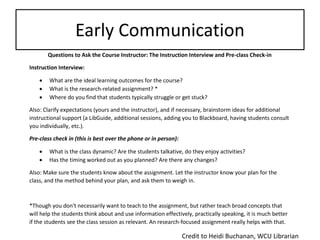
Early Communication
Credit to Heidi Buchanan, WCU Librarian
Questions to Ask the Course Instructor: The Instruction Interview and Pre-class Check-in
Instruction Interview:
 What are the ideal learning outcomes for the course?
 What is the research-related assignment? *
 Where do you find that students typically struggle or get stuck?
Also: Clarify expectations (yours and the instructor), and if necessary, brainstorm ideas for additional
instructional support (a LibGuide, additional sessions, adding you to Blackboard, having students consult
you individually, etc.).
Pre-class check in (this is best over the phone or in person):
 What is the class dynamic? Are the students talkative, do they enjoy activities?
 Has the timing worked out as you planned? Are there any changes?
Also: Make sure the students know about the assignment. Let the instructor know your plan for the
class, and the method behind your plan, and ask them to weigh in.
*Though you don't necessarily want to teach to the assignment, but rather teach broad concepts that
will help the students think about and use information effectively, practically speaking, it is much better
if the students see the class session as relevant. An research-focused assignment really helps with that.
Connection and Empathy
http://www.flickr.com/photos/fischerfotos/7454634022//
Immediate Assessment
http://www.flickr.com/photos/fischerfotos/7454634022//
Immediate Assessment
http://www.flickr.com/photos/fischerfotos/7454634022//
Immediate Assessment
http://www.flickr.com/photos/fischerfotos/7454634022//
Acknowledge and Validate
https://pixabay.com/en/hot-air-balloons-floating-fun-1984308/
Show Vulnerability
https://pixabay.com/en/animal-world-bird-nature-songbird-3213947/
Supportive Learning
https://pixabay.com/en/climbing-alpspitze-head-824376/
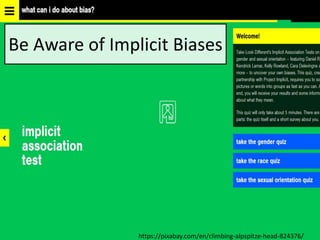
Be Aware of Implicit Biases
https://pixabay.com/en/climbing-alpspitze-head-824376/
Enthusiasm!!
https://pixabay.com/en/woman-umbrella-floating-jumping-1245817/
What Are You Doing To Set
Students at Ease?
https://flic.kr/p/MMdKS
What Questions Do You Have?
Create Appropriate Challenge
https://flic.kr/p/aqgFJE
Create Appropriate Challenge
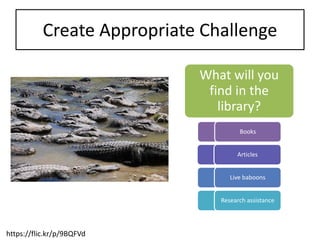
What will you
find in the
library?
Books
Articles
Live baboons
Research assistance
https://flic.kr/p/9BQFVd
Extrinsic versus intrinsic motivation
https://flic.kr/p/sfUKwD
Empower Them
https://flic.kr/p/53kGFW
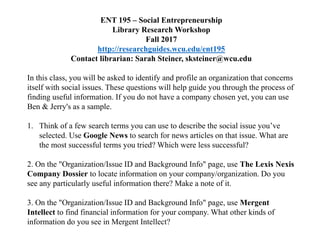
ENT 195 – Social Entrepreneurship
Library Research Workshop
Fall 2017
http://researchguides.wcu.edu/ent195
Contact librarian: Sarah Steiner, sksteiner@wcu.edu
In this class, you will be asked to identify and profile an organization that concerns
itself with social issues. These questions will help guide you through the process of
finding useful information. If you do not have a company chosen yet, you can use
Ben & Jerry's as a sample.
1. Think of a few search terms you can use to describe the social issue you’ve
selected. Use Google News to search for news articles on that issue. What are
the most successful terms you tried? Which were less successful?
2. On the "Organization/Issue ID and Background Info" page, use The Lexis Nexis
Company Dossier to locate information on your company/organization. Do you
see any particularly useful information there? Make a note of it.
3. On the "Organization/Issue ID and Background Info" page, use Mergent
Intellect to find financial information for your company. What other kinds of
information do you see in Mergent Intellect?
Demonstrate Value
https://flic.kr/p/25aMvV1/
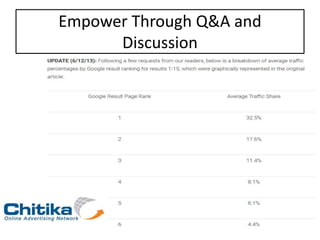
Empower Through Q&A and
Discussion
Empower Through Feedback
https://flic.kr/p/cYA2Xj
Empower Through Feedback
1. Find out why they did what
they did/tried
2. Acknowledge the effort or
logic without judging
3. Ask them or their group
what else they might try
4. Offer an alternative
solution or suggestion
1. “Tell me about how you started”
or “What was your thought
process?”
2. “Sure, I see your logic” or “I see
what you did there—that makes
sense.”
3. “What else stuck out to you as a
possible option?”
4. “This resource/link isn’t the best
for your needs because X. Try
doing the same thing in
PsycINFO and you’ll get article
content rather than book and
video content.”
https://flic.kr/p/cYA2Xj
Give Them Opportunities to Engage
https://flic.kr/p/9nEJXe
Think Pair Share or Small Group Work
https://flic.kr/p/mogAMP
Recap
http://www.flickr.com/photos/fischerfotos/7454634022//
• Help them feel welcome through…
• Early contact
• Validating language
• Connection and empathy
• Display of vulnerability (through stories)
• Challenge and empower them
• Give them multiple opportunities to engage with peers
and content
• Know and demonstrate the value of course content
Thank you! Questions?
http://www.flickr.com/photos/yeimaya/1740196
Email us at sksteiner@wcu.edu
and emarcus@wcu.edu
References
• Ambrose, Susan, et. al. How Learning Works: Seven Research-Based Principles for Smart Teaching. 2010.
• Bailey, Becky A. Easy to Love, Difficult to Discipline. William Morrow, 2001.
• Christophel, D.M. “The Relationship Among Teacher Immediacy Behaviors, Student Motivation, and Learning.”
Communication Education 39 (1990): 323-40.
• Eccles, Jacquelynne S., and Allan Wigfield. "Motivational Beliefs, Values, and Goals." Annual Review of
Psychology, vol. 53, 2002, pp. 109-32. ProQuest,
http://proxy195.nclive.org/login?url=https://search.proquest.com/docview/205754091?accountid=14968.
• Estepp, C.M., and T.G. Roberts. “Teacher Immediacy and Professor/Student Rapport as Predictors of Motivation
and Engagement.” NACTA Journal, vol. 59, no. 1, 155–163.
• Florian, L., and M. Beaton. "Inclusive Pedagogy in Action: Getting it Right for Every Child." International Journal
of Inclusive Education, vol. 22, no. 8, 2018, pp. 870-884.
• Ford, Martin E. Motivating Humans: Goals, Emotions, and Personal Agency Beliefs. Newbury Park, Calif: Sage
Publications, 1992. Print.
• Gilchrist-Petty, E. S. “Unraveling Complexities in the Teacher-Student Relationship: Perceptions of Immediacy,
Credibility, and Learning.” Carolinas Communication Annual, 2017, vol. 33, pp. 45–61.
• Goebel, Barbara L., and Delores R. Brown. "Age Differences In Motivation Related To Maslow's Need Hierarchy."
Developmental Psychology 17.6 (1981): 809-815. PsycARTICLES.
• Harvard University, Project Implicit. https://implicit.harvard.edu/implicit/takeatest.html
• Huddy, S. “Vulnerability in the Classroom: Instructor’s Ability to Build Trust Impacts the Student’s Learning
Experience.” International Journal of Education Research, Fall 2015, vol. 10, no. 2, pp. 96–103.
• Inala, Padma, and Andrew Walsh. Active Learning Techniques for Librarians. 2010.
• Jacobson, Trudi E. and Lijuan Xu. Motivating Students in Information Literacy Classes. 2004.
• Jimison, D. L. Increasing Faculty-Student Communication Through Email Messaging to Improve the Success of
Online Students. (2013). Available from ProQuest Central.
References
• Kapur, Manu. "Productive Failure." Cognition and Instruction, vol. 26, no. 3, 2008, pp. 379-425.
• Kapur, M., and K. Bielaczyc. "Designing for Productive Failure." Journal of the Learning Sciences, vol. 21, no. 1,
2012, pp. 45-83.
• Marcus, Elizabeth. (2015, November 18). “Picture perfect: Transforming the library tour with Instagram”
[Webinar]. In the Florida Library Webinars series by the Tampa Bay Library Consortium. Retrieved from
https://floridalibrarywebinars.org/events/picture-perfect-transforming-the-library-tour-with-instagram-2/
• Mortimore, Jeffrey M. and Amanda Wall. Motivating African-American Students Through Information Literacy
Instruction: Exploring the Link Between Encouragement and Academic Self-Concept. Reference Librarian
January/March 2009 (50.1): 29-42.
• MTV’s Look Different Implicit Association Test. http://www.lookdifferent.org/what-can-i-do/implicit-association-test
• Patrick, Brian C. Jennifer Hisley, and Toni Kempler. “’What’s Everybody So Excited About?’ The Effects of Teacher
Enthusiasm on Student Intrinsic Motivation and Vitality.” Journal of Experimental Education 68.3 (2000): 217-36.
ERIC.
• PBS Video. The Motivation Breakthrough: Secrets to Turning On the Tuned-Out Child. Presented by Richard
Lavoie. 2008.
• Scott, Kim. Radical Candor: Be a Kick-Ass Boss without Losing Your Humanity. St. Martin’s Press, 2017.
• Spotlight on Student Engagement, Motivation, and Achievement. Eds. Caroline T. Chauncey and Nancy Walser.
2009.
• Student Motivation: The Culture and Context of Learning. Eds. Farideh Salili, Ghi-yue Chiu, Ying-yi Hong. 2001.
• Sullo, Bob. Activating the Desire to Learn. 2007.
• Thompson, Simon, and Ronald M. Rapee. "The Effect of Situational Structure on the Social Performance of
Socially Anxious and Non-Anxious Participants." Journal of Behavior Therapy and Experimental Psychiatry, vol.
33, no. 2, 2002, pp. 91-102.
• Walker Tileston, Donna. What Every Teacher Should Know About Student Motivation, 2nd edition. 2010.
• Zhang, Q. “Assessing the Effects of Instructor Enthusiasm on Classroom Engagement, Learning Goal Orientation,
and Academic Self-Efficacy.” Communication Teacher, vol. 28, no. 1, pp. 44–56.

Engaging Learners through Active Instruction and Assessment

  • 1.
    Engaging Learners throughActive Instruction and Assessment Sarah Steiner and Elizabeth Marcus for ALA eLearning Solutions November 14, 2018
  • 2.
    By the endof this session, you will be ready to… Create a welcoming class environment Use inclusive interactive exercises Empower and challenge students to take the lead
  • 3.
    How often doyou struggle to engage with a class? • Never • Every now and then • Often • Almost every time https://flic.kr/p/q1W7nH
  • 4.
    How much haveyou taught? • I’m new! Less than a year. • Semi-new! A year to three years. • More advanced. I’ve been teaching for years but want some new ideas. https://flic.kr/p/65qg2W
  • 5.
    Inspiration for ThisSession https://flic.kr/p/c9GQay
  • 6.
    Quickly create awelcoming environment https://flic.kr/p/4yGXc
  • 7.
  • 8.
    Early Communication Credit toHeidi Buchanan, WCU Librarian Questions to Ask the Course Instructor: The Instruction Interview and Pre-class Check-in Instruction Interview:  What are the ideal learning outcomes for the course?  What is the research-related assignment? *  Where do you find that students typically struggle or get stuck? Also: Clarify expectations (yours and the instructor), and if necessary, brainstorm ideas for additional instructional support (a LibGuide, additional sessions, adding you to Blackboard, having students consult you individually, etc.). Pre-class check in (this is best over the phone or in person):  What is the class dynamic? Are the students talkative, do they enjoy activities?  Has the timing worked out as you planned? Are there any changes? Also: Make sure the students know about the assignment. Let the instructor know your plan for the class, and the method behind your plan, and ask them to weigh in. *Though you don't necessarily want to teach to the assignment, but rather teach broad concepts that will help the students think about and use information effectively, practically speaking, it is much better if the students see the class session as relevant. An research-focused assignment really helps with that.
  • 9.
  • 10.
  • 11.
  • 12.
  • 13.
  • 14.
  • 15.
  • 16.
    Be Aware ofImplicit Biases https://pixabay.com/en/climbing-alpspitze-head-824376/
  • 17.
  • 18.
    What Are YouDoing To Set Students at Ease? https://flic.kr/p/MMdKS What Questions Do You Have?
  • 19.
  • 20.
    Create Appropriate Challenge Whatwill you find in the library? Books Articles Live baboons Research assistance https://flic.kr/p/9BQFVd
  • 21.
    Extrinsic versus intrinsicmotivation https://flic.kr/p/sfUKwD
  • 22.
  • 24.
    ENT 195 –Social Entrepreneurship Library Research Workshop Fall 2017 http://researchguides.wcu.edu/ent195 Contact librarian: Sarah Steiner, sksteiner@wcu.edu In this class, you will be asked to identify and profile an organization that concerns itself with social issues. These questions will help guide you through the process of finding useful information. If you do not have a company chosen yet, you can use Ben & Jerry's as a sample. 1. Think of a few search terms you can use to describe the social issue you’ve selected. Use Google News to search for news articles on that issue. What are the most successful terms you tried? Which were less successful? 2. On the "Organization/Issue ID and Background Info" page, use The Lexis Nexis Company Dossier to locate information on your company/organization. Do you see any particularly useful information there? Make a note of it. 3. On the "Organization/Issue ID and Background Info" page, use Mergent Intellect to find financial information for your company. What other kinds of information do you see in Mergent Intellect?
  • 25.
  • 26.
    Empower Through Q&Aand Discussion
  • 27.
  • 28.
    Empower Through Feedback 1.Find out why they did what they did/tried 2. Acknowledge the effort or logic without judging 3. Ask them or their group what else they might try 4. Offer an alternative solution or suggestion 1. “Tell me about how you started” or “What was your thought process?” 2. “Sure, I see your logic” or “I see what you did there—that makes sense.” 3. “What else stuck out to you as a possible option?” 4. “This resource/link isn’t the best for your needs because X. Try doing the same thing in PsycINFO and you’ll get article content rather than book and video content.” https://flic.kr/p/cYA2Xj
  • 29.
    Give Them Opportunitiesto Engage https://flic.kr/p/9nEJXe
  • 32.
    Think Pair Shareor Small Group Work https://flic.kr/p/mogAMP
  • 33.
    Recap http://www.flickr.com/photos/fischerfotos/7454634022// • Help themfeel welcome through… • Early contact • Validating language • Connection and empathy • Display of vulnerability (through stories) • Challenge and empower them • Give them multiple opportunities to engage with peers and content • Know and demonstrate the value of course content
  • 34.
  • 35.
    References • Ambrose, Susan,et. al. How Learning Works: Seven Research-Based Principles for Smart Teaching. 2010. • Bailey, Becky A. Easy to Love, Difficult to Discipline. William Morrow, 2001. • Christophel, D.M. “The Relationship Among Teacher Immediacy Behaviors, Student Motivation, and Learning.” Communication Education 39 (1990): 323-40. • Eccles, Jacquelynne S., and Allan Wigfield. "Motivational Beliefs, Values, and Goals." Annual Review of Psychology, vol. 53, 2002, pp. 109-32. ProQuest, http://proxy195.nclive.org/login?url=https://search.proquest.com/docview/205754091?accountid=14968. • Estepp, C.M., and T.G. Roberts. “Teacher Immediacy and Professor/Student Rapport as Predictors of Motivation and Engagement.” NACTA Journal, vol. 59, no. 1, 155–163. • Florian, L., and M. Beaton. "Inclusive Pedagogy in Action: Getting it Right for Every Child." International Journal of Inclusive Education, vol. 22, no. 8, 2018, pp. 870-884. • Ford, Martin E. Motivating Humans: Goals, Emotions, and Personal Agency Beliefs. Newbury Park, Calif: Sage Publications, 1992. Print. • Gilchrist-Petty, E. S. “Unraveling Complexities in the Teacher-Student Relationship: Perceptions of Immediacy, Credibility, and Learning.” Carolinas Communication Annual, 2017, vol. 33, pp. 45–61. • Goebel, Barbara L., and Delores R. Brown. "Age Differences In Motivation Related To Maslow's Need Hierarchy." Developmental Psychology 17.6 (1981): 809-815. PsycARTICLES. • Harvard University, Project Implicit. https://implicit.harvard.edu/implicit/takeatest.html • Huddy, S. “Vulnerability in the Classroom: Instructor’s Ability to Build Trust Impacts the Student’s Learning Experience.” International Journal of Education Research, Fall 2015, vol. 10, no. 2, pp. 96–103. • Inala, Padma, and Andrew Walsh. Active Learning Techniques for Librarians. 2010. • Jacobson, Trudi E. and Lijuan Xu. Motivating Students in Information Literacy Classes. 2004. • Jimison, D. L. Increasing Faculty-Student Communication Through Email Messaging to Improve the Success of Online Students. (2013). Available from ProQuest Central.
  • 36.
    References • Kapur, Manu."Productive Failure." Cognition and Instruction, vol. 26, no. 3, 2008, pp. 379-425. • Kapur, M., and K. Bielaczyc. "Designing for Productive Failure." Journal of the Learning Sciences, vol. 21, no. 1, 2012, pp. 45-83. • Marcus, Elizabeth. (2015, November 18). “Picture perfect: Transforming the library tour with Instagram” [Webinar]. In the Florida Library Webinars series by the Tampa Bay Library Consortium. Retrieved from https://floridalibrarywebinars.org/events/picture-perfect-transforming-the-library-tour-with-instagram-2/ • Mortimore, Jeffrey M. and Amanda Wall. Motivating African-American Students Through Information Literacy Instruction: Exploring the Link Between Encouragement and Academic Self-Concept. Reference Librarian January/March 2009 (50.1): 29-42. • MTV’s Look Different Implicit Association Test. http://www.lookdifferent.org/what-can-i-do/implicit-association-test • Patrick, Brian C. Jennifer Hisley, and Toni Kempler. “’What’s Everybody So Excited About?’ The Effects of Teacher Enthusiasm on Student Intrinsic Motivation and Vitality.” Journal of Experimental Education 68.3 (2000): 217-36. ERIC. • PBS Video. The Motivation Breakthrough: Secrets to Turning On the Tuned-Out Child. Presented by Richard Lavoie. 2008. • Scott, Kim. Radical Candor: Be a Kick-Ass Boss without Losing Your Humanity. St. Martin’s Press, 2017. • Spotlight on Student Engagement, Motivation, and Achievement. Eds. Caroline T. Chauncey and Nancy Walser. 2009. • Student Motivation: The Culture and Context of Learning. Eds. Farideh Salili, Ghi-yue Chiu, Ying-yi Hong. 2001. • Sullo, Bob. Activating the Desire to Learn. 2007. • Thompson, Simon, and Ronald M. Rapee. "The Effect of Situational Structure on the Social Performance of Socially Anxious and Non-Anxious Participants." Journal of Behavior Therapy and Experimental Psychiatry, vol. 33, no. 2, 2002, pp. 91-102. • Walker Tileston, Donna. What Every Teacher Should Know About Student Motivation, 2nd edition. 2010. • Zhang, Q. “Assessing the Effects of Instructor Enthusiasm on Classroom Engagement, Learning Goal Orientation, and Academic Self-Efficacy.” Communication Teacher, vol. 28, no. 1, pp. 44–56.

Editor's Notes

  • #3 1. quickly create welcoming environments where students feel comfortable speaking, sharing missteps, and detailing accomplishments; (E) 2. use principles of inclusive pedagogy to create customized and effective active learning exercises; and (S) 3. empower students to take leadership roles in their learning experiences.
  • #4 We are going to ask everyone a couple questions about your instruction experience and give you a minute to respond to the poll. Read Question and Answer Choices Struggling to engage students in class can be a common challenge. We may be really excited about a learning activity or research theme and imagine that student will be excited as well…but they’re not. These situations can be really discouraging and demotivating for us. So, today we are going to touch on a number of evidence-based approaches and share ways in which we apply them with groups and individuals. 1) If you have successfully used strategies we mention, we would love to hear about it in the chat. We’ll recap your comments at certain points in the presentation. Special note: you will notice a variety of images or photographs throughout the presentation. These images are all creative commons licensed and the image links are displayed on each slide. ONCE THE RESPONSES COME: Short recap of results. At end—we all have certain difficult classes. We don’t have a magic bullet but hopefully these approaches will allow you to engage with students more often than not.
  • #5 Here is a second question related to your instruction experience….we’ll give you about a minute to respond. Read Question and Answer Choices We are hoping to share practical teaching techniques that are helpful for anyone, whether you are new or have been teaching for a while and may be stuck or burnt out and need new ideas. Personally, I have been teaching for about 10 years- in the beginning only 3-4 classes per semester while working at HL (thanks to RIS) while in library school P-T and in the last view years averaging about 40 classes in fall semester. But, I always love to try new teaching strategies to enhance student experience and participation. ONCE THE RESPONSES COME: Short recap of results.
  • #6 We have also struggled! Sarah—I felt like I was really struggling to connect in a bit of a mid-career slump period, so I started looking in earnest at some ways to build student motivation to learn. Elizabeth- Inspiration came from success of library orientation Instagram activity- I will talk a little about this a little more later in the presentation.
  • #7 First, we want to focus on factors that create a welcoming environment Your first few minutes are a critical time to bond with students! (evidence) Research shows that you can create quick bonds with people with a handful of relatively simple actions, often labeled as a concept called teacher immediacy. (Estepp and Roberts) (Gilchrist-Petty) Some of these actions include using individual’s names in discussions when feasible, being non-judgmental, being comfortable with yourself (and your failings, whatever they may be), being open and willing to disclose personal information are all key. These strategies build trust and comfort and can create the kind of learning environment where students feel more comfortable opening up either in the class period or with you in later consultations. So, we’re going to share several ideas with you that are built on these ideas, and we hope one will seem appealing for you to test out!
  • #8 In-person students- Initiating conversation at the beginning of class an obvious form of early communication, but there are other ways to contact students before a library instruction session. Brief visit to your class before their library instruction session.- class vibe and personality- may determine which class activities or engagement approaches you decide to use IEP Example- Curriculum Mapping Observation Obtain student roster and research topic list- This will help you start connecting names with topics to better connect with students in class. IEP Example Student orientation and campus information fairs- This method is a bit more serendipitous but can be a great way to meet students by chance to connect with them before their instruction session- Recalibrate Your Compass Example Online students Email in advance- More dependable method of communication for online students vs. in-person students. Include introduction video for a personal touch. Embed in online courses and introduce yourself- ENG 202- Lob with a Librarian- Introductions and share research ideas- more emails and calls than ever!
  • #9 Example: Pre-Class Questionnaire for the Instructor- From one of our RIS Colleagues, Heidi Buchanan List several questions that are crucial to ensuring that you have the information required to personalize the class to student information needs (learning outcomes, assignment information, etc.) Offer additional instruction support- Blackboard Admin. Pre-class check in (a week before over the phone or in person)- Ask instructor about class personality, assignment progress- Example ENG 101- Paul Worley You don’t have to teach to the assignment but early and frequent communication with the instructor can help you avoid any surprises or unexpected changes in student information needs.
  • #10 Connect one-on-one by chatting casually with folks as they come in in person—or in the online chat if you are in a web course. Casual talking points- Keep in mind what is going on at that time in the semester- - 5th week grades, midterms, fall break, campus event, etc. (Example: USI: “How are your first few weeks of class going?” “I was always overwhelmed when first reviewing the course schedule, thinking, how am I going to get all of this done? but my nerves settled after I realizing the assignments build on each other) - Student’s major, other classes, etc. - Won’t have time to talk with everyone…that’s ok, some may not interested in chatting immediately. Ex: Early morning class Still be friendly, approachable, and other students will be open to chatting later during class - Avoid reviewing notes, hiding behind podium, browsing social media. Some students may reveal that they are stressed about class or other life happenings. - Listen and validate feelings first. - If you feel worried about them and think they may need help, offer information for various campus services. - If someone reveals a more serious problem, be prepared with information about your campus’ counseling or psychological services and offer to connect the student to that office.
  • #11 If you feel anxious about making small talk without structure, but still want to connect with students, you may find it helpful to conduct an assessment right away. So, I am going to discuss several successful assessment approaches that we have used in the past.
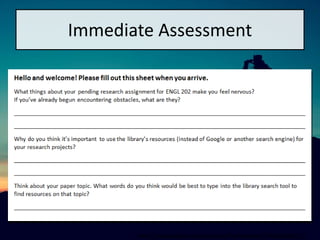
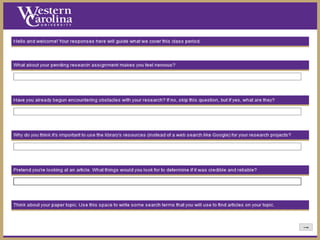
  • #12 This is an example of a print assessment questionnaire that Sarah has given to students in the past while they are arriving to class. This method may seem old-fashioned with all of the new online quiz and polling tools available, but it is still a very effective medium that opens many doors for one-on-one interactions and quick relationship building with students. These questions are friendly and low-stress. but give you several pieces of critical information. They are also specific enough to gather where students are in their information literacy journey. Asking verbal questions like “What are you struggling with?” usually doesn’t result in helpful feedback because students may not know how to articulate their struggles or may be too shy to share their struggles with the class. As students fill out the form, walk around and provide positive feedback or ask questions. You can usually see trends of where students are struggling and prepare to direct class activities or discussion to those topics in the session. This is assessment method is particularly helpful if you feel anxious about making small talk—this gives you something specific to talk about.
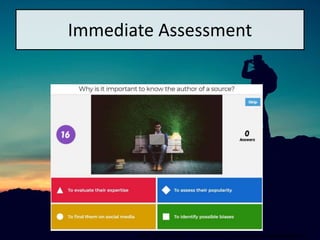
  • #13 Example questions from WRCS Kahoot Quiz about Authority. Kahoot is a free game-based online learning tool often used in middle schools and high schools for formative assessment. The nostalgia factor makes this platform very popular with my students. There are many similar tools available online for free like Socrative, Poll Everywhere, and FlipQuiz (like Jeopardy). - Hunter Library’s Research and Instruction Services (RIS) department created a depository of Kahoot quizzes based our instruction goals for WCU’s English Composition as well as the ACRL Framework. (Frame- Authority is Contextual) - The depository includes pre-quizzes and post-quizzes, used at the beginning and end of class for formative and summative assessment. This assessment method provides you with a more general overview of student IL knowledge as questions are answered and results are displayed on the screen. You can watch for trends in missed answers, and make a mental note to address that concept in your instruction. Kahoot also generates full reports that you can export as Excel documents and evaluate in great detail after class. This exercise is very fast paced and requires short descriptions of why certain answers may be correct or incorrect- So it is helpful to prepare what the business world calls “elevator speeches for each answer result ( Example Red and Green answers above) We will share our quizzes with you in Google Docs link.
  • #14 Another way to engage students and build a welcoming environment is to acknowledge and validate student efforts, successes or struggles. So, for example, if you decide to give students a print assessment questionnaire, you have an opportunity to walk around and address people individually about what’s on their paper. Sarah will announce that she’s going to do this and even make a little joke about it to give students a heads up and put them at ease. As you walk around, say brief and supportive things about what each person is writing. This is a chance for you to validate their experiences and show non-judgment. Examples: “Yes, I’m glad you mentioned that, we’ll definitely talk about it.” “That’s a great question—it’s a confusing process when you start.” “That’s a fascinating topic—I think you’ll find a lot of fun stuff on that.” We’ll talk a bit later about how to maintain that air of non-judgment when you get a volunteer who has an incorrect answer.
  • #15 - Another ways to cultivate a welcoming environment for students is to be willing to show your own vulnerability (favorite) - One way to do this to share personal information through classe example. This can quickly build rapport with others. A way to do this is to share stories about yourself that show how you have struggled with class-relevant topics. - Personal stories or storytelling are powerful educational tools, so don’t be afraid of them. - You want to carefully weigh how much information to share (as not to lose the class’ interest or get off topic) as well as how personal you want to get with that information (you may not want to talk about a recent surgery for example). - Examples: ENG 101- Jen Harris- Family Share Trait assignment. My example- Vasovagal Syncope- Fainting- considered sharing a YouTube Video to spark interest. - Use the formal name of condition to build a class discussion on subject terms and controlled vocabulary- that they may find more relevant peer-reviewed sources on a topic by using the formal name. Another way to show vulnerability to students is to mention your own information evaluation fails: to demonstrate that the information landscape is truly difficult to navigate for ALL of us. They may secretly be thinking that they know it all and don’t need your help learning how to find or evaluate information, and your stories can crack that perception. That we empathize with the difficulties, not looking down from high in perfection. - Elizabeth- Hurricane Florence example: Was actually photograph from Hurricane Ike in Texas in September 2008, in a report about receding waters. - Emotions! Anger that situation was being exploited or exaggerated when we had been prepping for days, everyone in the state was on edge, and some folks were in real danger. Misspellings and typos as an education moment: If you make one accidentally (or on purpose), run the search and show what happens! Say, look, I misspelled this and didn’t get what I was hoping for. If you find you’re getting very few hits on a topic, always check the spelling. - If you have any examples, share them in chat! We’d love to hear them.
  • #16 In using all of these techniques, we want to create a environment based on supportive learning. As was mentioned earlier, empathy is key in building this type or learning environment, where students feel comfortable sharing because they trust you Remember that you’re working with either children or adolescents--or even adults--who are in a potentially new and overwhelming environment, and they may be feeling nervous or unsure of themselves. We aren’t out to create a SAFE environment where nobody gets challenged, but we do want to create a SUPPORTIVE learning environment where people know their mistakes are a natural and expected part of the research process, and not something to feel shy about. We create this environment by doing all the things we just mentioned. Acknowledging struggles, sharing personal examples, connecting individually, treating everyone with respect and empathy.
  • #17 - One specific way to create that supportive learning environment and keep with the spirit of inclusive pedagogy, is to recognize that each person in our classes is unique. - To be as sensitive to their needs as possible and reduce our unintentional marginalization of different groups, we need to be aware of our own implicit biases. - There are free implicit bias tests available online. - MTV and Harvard university both have interesting implicit bias tests, if you’d like to take them. Both are linked in our works cited pages. You may also attend student advocacy trainings through your institution or professional organizations for ideas on how to incorporate inclusive pedagogy practically. Example: First-Generation College Student Advocacy Program
  • #18 Okay, our last point for how you can light up your first few minutes of class and set you up for success is to show. ENTHUSIAISM. Your excitement for a topic shows through and inspires others. Have you ever noticed students perk up when you get really jazzed about something? Example: LNAP Can you remember a time when someone who was bored or tired taught you? Maybe not, because you might have forgotten it… or you recall it as being a poor use of your time. How can you find or rekindle enthusiasm if you are very tired, having a bad day, or having a period of burnout? First, be kind to yourself, because you’ll never be able to perk up all the time. We all have bad days, and it’s a thing to accept. --Is there an article on getting in an enthusiastic headspace for teaching on a bad day? We’re thinking of more than having a coffee. Remind yourself of why you are doing this and why you chose this profession Remind yourself of the big picture vision of the import of information literacy Turn nerves into enthusiasm because nerves are contagious, too!
  • #20 Challenge is also key! It may seem counterintuitive, but people are motivated by challenges, if the environment is right. Everyone is a little bit different with regard to what motivates them, but there are some strong similarities.
  • #21 To challenge learners, you must allow them to engage mentally in the problem rather than acting as the passive recipient of someone else’s expertise and knowledge—this approach is not only key to learning, but to the concept of inclusive and critical pedagogies. You can motivate them by finding the right balance of challenge. Somewhere between “your failure is imminent and there’s not much you can do to stop it”—like swimming through this alligator pit—and “this is so easy that you already know it all and don’t even need to pay attention.” We want the students to taste success—but in order for that success to come with that pleasant sense of victory, they need to feel like their brains are challenged. Otherwise it’s just boring. Manu Kapur and the idea of “productive failure”—the more you struggle to master something, the better you retain it. Instead of giving them an exercise that they definitely know all the answers to—because you’ve taught them or because they can be solved with basic logic, let them struggle and figure things out themselves. Participants who bring much skill to the table and in many cases, just need to shift extant frames of understanding to fit the library setting. “Kapur has identified three conditions that promote this kind of beneficial struggle. First, choose problems to work on that “challenge but do not frustrate.” Second, provide learners with opportunities to explain and elaborate on what they’re doing. Third, give learners the chance to compare and contrast good and bad solutions to the problems. “ (http://ideas.time.com/2012/04/25/why-floundering-is-good/) The key is to let them know that the struggle is a key part of the learning process, not an irritation to be overcome or faulty/sloppy planning. Praise them for sharing their struggles and for coming up with creative solutions. Allow them to share the solutions with each other in groups.
  • #22 By challenging them, you activate that desire to learn and build intrinsic versus extrinsic motivation. We are extrinsically motivated when we do something to earn a reward or avoid punishment. In my case, I might show up for work because of extrinsic motivators—I might get fired or reprimanded if I stop showing up for work, and I will run out of leave time and not get a paycheck. In the case of students, they are extrinsically motivated by the idea of an A or an F, or maybe that piece of candy. When we’re intrinsically motivated, we do something because we find it personally rewarding. We do the activity because we see value in it, not because it’s going to get us a reward.
  • #23  Empowering students to take the lead is another great way to keep them engaged and learning, so that your time with them is valuable. On days when my classes have gone especially poorly, I often realize that it’s because I put too much pressure on myself to divine what the students would need instead of finding useful ways to ask them what they needed and then respond to those expressed needs. There’s still room for me to introduce the topics I think are key, but I as instructor don’t have to do all the heavy lifting.
  • #24 We have lots of ideas to help you empower learners. One way to empower them is the early questionnaire we showed you earlier. This is an online version. Give them this and a few minutes, and then see what trends shake out. This is a friendly information literacy assessment in addition to a way to help me structure class. The ones who are information literate answer in the way we hope they will, and the ones who are lost or confused demonstrate it in their answers even if they won’t state it upon prompting. We don’t need to call them out on wrong answers in the moment (in fact, it may be best to let them struggle and learn themselves), but we can make sure to address misconceptions we see before they leave.
  • #25 You can also establish value through exercises which guide them through the resources with their own topics. This approach allows them to see the real-world applications of their efforts. This is an exercise that I used in a business class where the students had to identify and profile an organization that concerns itself with social issues, then find a bunch of information about that organization. Give them a very rough introduction, then let them search on their own and figure things out. You may be wondering how you can find the right level of challenge. It takes some testing. This exercise is one I’ve tailored over time to be an appropriate level of challenge for the students with whom I work. I have had it easier and more difficult, and this was in the right range to keep them engaged. It was very much a trial and error approach, and that’s okay. If you’re new to running your classes like this, you may be surprised by how difficult it is to write questions that students interpret in the way you mean. If you can get a small test audience before you roll out a new exercise, that’s awesome—it can often show you disconnects between your phrasing and student understanding. Keep notes on what goes well and what doesn’t, and if at all feasible, I try to your assignments immediately after the class while issues are fresh in your mind.
  • #26 I especially like that example because the work they were doing was something they’d use after graduation. One thing it’s easy to leave out is communication of the value of the session(s). What is it? Maybe help them to complete an assignment. Maybe to help them pass the class or graduate. Also to help them succeed in all of their professional and personal conversations in life. When thinking about the value of the session, relate it to their short term goals, their long term goals, their professional goals, and their personal goals. This sort of exploration demonstrates the “instrumental value” of our session. Something has instrumental value if it helps you achieve another goal or goals. This is one we play on a lot—this class today will help you to complete your assignments in this class, others like it, and ultimately to be a more competent WHATEVER YOU WANT TO BE WHEN YOU GRADUATE. Eccles and Wigfield. I often say: “what do you think you’d like to be when you graduate?” A journalist… business owner… teacher… no matter what career you choose, you will need to know how to find and critically evaluate information, then use it ethically. Increasingly I see sample exercises where librarians are using real-life scenarios.
  • #27 You can also empower and challenge them in a pleasant and constructive way through discussion and the way you ask questions. You can sometimes use your role as leader to highlight relevant frames of reference they already know, and show how they’ll need to adapt their understanding of it for this different environment. For example, if they are searching in Google, if they don’t see the result we want in the first few, what do we do? Don’t tear that approach down—it works! It’s efficient! But they also need to know that it probably isn’t going to work in a library resource, and that they need to look past the first few results. (As cited in this study) You could also compare their review efforts to walking into a party where everyone is having conversations about a topic that is new to them. Let’s say it’s the psychological effects of social media on college students. One group is talking about how it impacts anxiety, another depression. One is talking about treatment, another about gender, another about socioeconomic status or regional variations. They will need to visit many of these conversations before they are ready to join in and contribute.
  • #28 We also sometimes will find ourselves in a place where we have to give supportive but still honest feedback—even that can be empowering. When something goes wrong, they may have this inner voice telling them they are stupid or can’t do it or whatever—you can empower them to continue trying by acknowledging the struggles without judgment.
  • #29 This is a bit contrived in structure because you won’t necessarily do these all or do them in this order, but if you have these four tools in your kit, you’ll hopefully be set for most contingencies. Let’s pretend for a moment that I’ve asked students to find peer reviewed articles on their topic and explore what struggles and successes they encounter. One student is frustrated because they have chosen the catalog search instead of our discovery tool or specific database. They say, I thought about my search terms and now searching and searching but I don’t know what I’m looking at and they all seem really broad. I practice this. I feel like a giant nerd, but whatever. I read a couple books recently that hit on this point (Easy to Love, Difficult to Discipline and Radical Candor) and they hit on this point and even said make sure you practice talking to yourself this way, especially if you are critical of your own mistakes. It’ll reframe the way you think about them in your own mind, then it’ll be easier to project that outward in your classes or individual interactions with students. Also, if folks are really tentative, you can share a story about a time YOU made a relevant mistake and show empathy for yourself.
  • #30 We also want to give them as many opportunities as possible to engage. This idea has been coded into all the things we’ve spoken about so far, but we wanted to call it out specifically. They can engage with their brains, with you, with each other, and also to engage their bodies by moving around a little. Why is this important and effective? Several reasons which I’ll unpack quickly. By encouraging them to engage with their brains, you promote critical thinking and retention. 2. If you let them engage with each other, Also allows you to leverage peer-instruction, popularized by Eric Mazur—research indicates this may be more effective than lecture. 3. . Another part of motivational theory is the idea that we are always choosing what we will do based on its value. We need to do whatever we can to increase the relative value of the instruction, and one way to do that is to nest goals. If you challenge them intellectually, you can activate a learning goal. If you let them work with peers, a social goal. If you give them feedback that they find helpful and supportive, an affective learning goal. Ford 1992 book called Motivating Humans
  • #31 Instagram—also allows them to get up and move around. Elizabeth talk about this one 
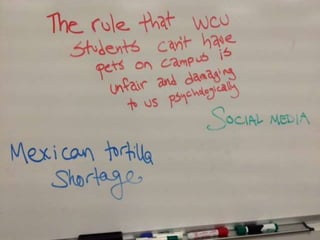
  • #32 Another exercise I love to do is to have each student brainstorm what keywords they’re going to use to search in our QuickSearch, and then write the terms up on the white board. I give them five minutes to run the search and review the first couple of pages of results. Then, I pick a topic which I know is going to have issues, given the selected keywords. I let them know they are welcome to modify their keywords if things don’t go well, but encourage them to look through at least ten results before they do. I say—this seems super interesting! Did you have any trouble with it? They almost always say yes: Social media: too much stuff, not on topic Pets on campus: I got nothing Mexican tortilla shortage: I got nothing Do you have any thoughts on how you might modify the search to get things that are on topic? Let them answer or open it up! Social media: This is a great way to search for books, with more broad search terms, but with articles, we can add another term or two to limit this down. So, we could put social media and self esteem. Mexican tortilla shortage is my favorite story, and I use it a lot. I said, this one is fascinating, can you tell me a bit more about it? She says, in Mexico, farmers are selling a lot of their corn to folks in the USA to make ethanol fuel. It’s driving up the price of corn in mexico, so people can’t afford to buy it to make tortillas. So it’s leading to a tortilla shortage. You can also use various exercises to give them a safe, anonymous or semi-anonymous way to demonstrate their understanding. If you detect issues, you can address them.
  • #33 Think pair-share exercises are an awesome way to let them lead. Them them brainstorm, work with a peer to consider searches, and you walk around and ask helpful questions. Embrace your role as helpful questioner, not lecturer. As they encounter hangups, tell them they are normal, and ask if one member of the team feels comfortable sharing with the group. If they are not, ask permission to share it. To diminish speaking anxiety they may have, ask one person per group or area of the class to share an example rather than making everyone speak. More will open up with time, in many cases.
  • #34 Elizabeth will do this one