Lynn Swannell 2014
Laws created to protect authors and artists 
who create “original” works 
Original works can only be copied, 
performed in public, or published by the 
creator - unless they give permission to 
someone else to do this 
That’s what it means to have the 
right to copy (copyright)
Australian copyright law is contained in a 
piece of federal legislation called: 
The Copyright Act 1968 
Amendments were made to this Act in 2000 
to take into account the use of digital 
technologies
Works that have not been written or 
recorded (your stories, if they are not 
written down, are not protected by copyright 
law) 
Ideas, procedures, methods, discoveries 
Works that contain no original authorship (for 
example: standard calendars, height and 
weight charts, tape measures and rulers, 
etc.) 
Lists of data (such as the telephone book) 
Items within the ‘public domain’ – generally 
70 years after the death of the creator 
Facts
Students are exempted from 
some of this through the use of 
”FAIR DEALING” 
for educational purposes
“Fair Dealing” exceptions allow students 
to use copyright works for their studies, 
within limits 
That means that students can reproduce a 
limited amount of copyright material for 
the purposes of research or study
Sometimes, it is hard to know how 
much of a copyrighted work you can 
use. 
The following guidelines may help 
when knowing what is ‘fair dealing’
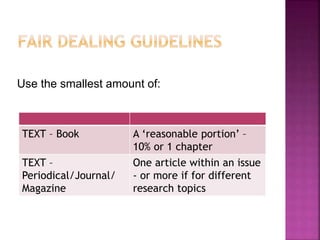
Use the smallest amount of: 
TEXT – Book A ‘reasonable portion’ – 
10% or 1 chapter 
TEXT – 
Periodical/Journal/ 
Magazine 
One article within an issue 
- or more if for different 
research topics
If a work is published in electronic 
form, a reasonable portion is not 
more than 10% of the work, or one 
chapter if applicable 
Images used should preferably be 
those with Creative Commons 
Licenses and always cited
Some works are considered to be in the PUBLIC 
DOMAIN and therefore are able to be used 
without gaining permission under the following 
circumstances: 
If it is more than 70 years since the creator’s death 
and copyright has therefore expired 
Copyright has been forfeited by the creator/owner 
Copyright does not apply 
However it must still be ‘cited’ and attributed 
to the creator within a bibliography
Some PUBLIC DOMAIN WORKS include: 
Shakespeare’s plays 
Jane Austen novels 
The Bible 
Music by classical composers such as Mozart, 
Beethoven, Bach 
Project Gutenberg – source of books in the public 
domain
‘About the licences’ (n.d.) (Internet) http://creativecommons.org.au/learn-more/ 
licences accessed 29 May 2011 
‘Copyright – Cyberbee’ (n.d.) (Internet) 
http://www.cyberbee.com/cb_copyright.swf accessed 28 May 2011 
‘Copyright information for students’ (2010) (Internet) 
http://www.education.vic.gov.au/management/governance/copyright/scho 
ols/infostudents.htm accessed 28 May 2011 
‘Copyright, privacy and cyber ethics’ (n.d.) (Interent) 
http://debsplace.wikispaces.com/Copyright,+Privacy+%26+Cyber+Ethics 
accessed 30 May 2011 
‘Smart copying’ (n.d.) (Interent) http://www.smartcopying.edu.au/scw/go 
accessed 29 May 2011

Copyright and fair dealing

  • 1.
  • 2.
    Laws created toprotect authors and artists who create “original” works Original works can only be copied, performed in public, or published by the creator - unless they give permission to someone else to do this That’s what it means to have the right to copy (copyright)
  • 3.
    Australian copyright lawis contained in a piece of federal legislation called: The Copyright Act 1968 Amendments were made to this Act in 2000 to take into account the use of digital technologies
  • 4.
    Works that havenot been written or recorded (your stories, if they are not written down, are not protected by copyright law) Ideas, procedures, methods, discoveries Works that contain no original authorship (for example: standard calendars, height and weight charts, tape measures and rulers, etc.) Lists of data (such as the telephone book) Items within the ‘public domain’ – generally 70 years after the death of the creator Facts
  • 5.
    Students are exemptedfrom some of this through the use of ”FAIR DEALING” for educational purposes
  • 6.
    “Fair Dealing” exceptionsallow students to use copyright works for their studies, within limits That means that students can reproduce a limited amount of copyright material for the purposes of research or study
  • 7.
    Sometimes, it ishard to know how much of a copyrighted work you can use. The following guidelines may help when knowing what is ‘fair dealing’
  • 8.
    Use the smallestamount of: TEXT – Book A ‘reasonable portion’ – 10% or 1 chapter TEXT – Periodical/Journal/ Magazine One article within an issue - or more if for different research topics
  • 9.
    If a workis published in electronic form, a reasonable portion is not more than 10% of the work, or one chapter if applicable Images used should preferably be those with Creative Commons Licenses and always cited
  • 10.
    Some works areconsidered to be in the PUBLIC DOMAIN and therefore are able to be used without gaining permission under the following circumstances: If it is more than 70 years since the creator’s death and copyright has therefore expired Copyright has been forfeited by the creator/owner Copyright does not apply However it must still be ‘cited’ and attributed to the creator within a bibliography
  • 11.
    Some PUBLIC DOMAINWORKS include: Shakespeare’s plays Jane Austen novels The Bible Music by classical composers such as Mozart, Beethoven, Bach Project Gutenberg – source of books in the public domain
  • 12.
    ‘About the licences’(n.d.) (Internet) http://creativecommons.org.au/learn-more/ licences accessed 29 May 2011 ‘Copyright – Cyberbee’ (n.d.) (Internet) http://www.cyberbee.com/cb_copyright.swf accessed 28 May 2011 ‘Copyright information for students’ (2010) (Internet) http://www.education.vic.gov.au/management/governance/copyright/scho ols/infostudents.htm accessed 28 May 2011 ‘Copyright, privacy and cyber ethics’ (n.d.) (Interent) http://debsplace.wikispaces.com/Copyright,+Privacy+%26+Cyber+Ethics accessed 30 May 2011 ‘Smart copying’ (n.d.) (Interent) http://www.smartcopying.edu.au/scw/go accessed 29 May 2011