Copyright/Fair Use
     Guidelines for Educators


"Certain materials are included under the fair use exemption
of the U.S. Copyright Law and have been prepared according
 to the multimedia fair use guidelines and are restricted from
                         further use."
6.3 Notice of Use Restrictions

Educators and students are advised that they must
include on the opening screen of their multimedia
 program and any accompanying print material a
                 notice that says:

 "Certain materials are included under the fair use
  exemption of the U.S. Copyright Law and have
been prepared according to the multimedia fair use
  guidelines and are restricted from further use."
What is Copyright?
    The legal right granted to an author, composer,
   playwright, publisher, or distributor to exclusive
   publication, production, sale, or distribution of a
      literary, musical, dramatic, or artistic work.

The purpose of these guidelines is to provide guidance
 on the application of fair use principles by educators,
scholars and students who develop multimedia projects
  using portions of copyrighted works under fair use
     rather than by seeking authorization for non-
             commercial educational uses.
Disclaimer:
 These guidelines are not legally binding.
      They represent an agreed upon
interpretation of the fair use provisions of
  the Copyright Act. Only the courts can
    decide whether a particular use of a
 copyrighted work falls within the fair use
 exception. The Copyright Office and the
U.S. Patent and Trademark Office endorse
             these guidelines.
What should everyone know about
           copyright?


Work is protected from the moment the pen
meets the paper
No registration with the Library of Congress is
required for protection
No “©” is required
We are all rights holders!
IF YOU BREAK THE LAW, YOU ARE LIABLE,
          NOT THE SCHOOL…


  THE SCHOOL PROVIDES INFORMATION
 AND INSTRUCTION ON COPYRIGHT LAW &
              FAIR USE…
Statutory Exceptions


Fair Use (§107)
Libraries and Archives (§108)
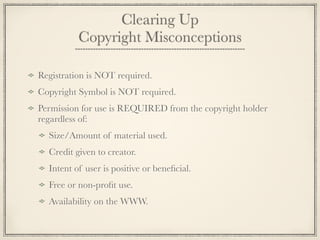
Clearing Up
         Copyright Misconceptions

Registration is NOT required.
Copyright Symbol is NOT required.
Permission for use is REQUIRED from the copyright holder
regardless of:
  Size/Amount of material used.
  Credit given to creator.
  Intent of user is positive or beneficial.
  Free or non-profit use.
  Availability on the WWW.
What is Copyright?


Copyright laws grant exclusive rights to the
owners of an original work


Such as:
  Literary, musical, artistic
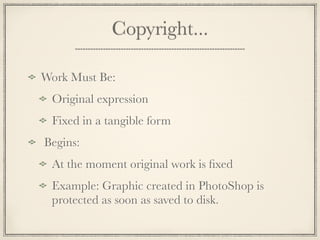
Copyright...

Work Must Be:
 Original expression
 Fixed in a tangible form
Begins:
 At the moment original work is fixed
 Example: Graphic created in PhotoShop is
 protected as soon as saved to disk.
Non-Protected Works
         Cannot be Copyrighted


Ideas
Facts
Titles
Names
Short Phrases
“FAIR USE”
  LETS YOU USE OTHERS’ WORKS…

Sometimes, it’s free. SOMETIMES YOU MUST PAY
                        A FEE.


            Sometimes you need to
       ask for permission…ahead of time.


NO HIGHER AUTHORITY CAN DIRECT YOU
        TO BREAK THE LAW.
Recent Legislation

1997 - jail time was added for willful
infringement
Digital Millennium Copyright Act passed into
law, October 1998 - DMCA
Sonny Bono Term Extension - 20 years
Technology, Education and Copyright Harmonization
Act, 2002 - TEACH
Digital Millennium Copyright Act


Passed 1998
Publishing to the Web is the SAME as
publishing a book.
All of the print regulations apply!
All “things” online are protected by copyright!
The Copyright Term Extension Act or the Sonny Bono
          Copyright Term Extension Act
The Copyright Term Extension Act (CTEA) of 1998
 extended copyright terms in the United States by 20
  years. The Copyright would last for the life of the
    author plus 50 years, or 75 years for a work of
 corporate authorship. The Act extended these terms
  to life of the author plus 70 years and for works of
corporate authorship to 120 years after creation or 95
years after publication, whichever endpoint is earlier.
  Copyright protection for works published prior to
 January 1, 1978 was increased by 20 years to a total
         of 95 years from their publication date.
The Copyright Term Extension Act or the Sonny Bono
    Copyright Term Extension Act, Continued..

This law, also known as the, as the Mickey Mouse Protection
Act, effectively "froze" the advancement date of the public
domain in the United States for works covered by the older
fixed term copyright rules. Under this Act, additional works
made in 1923 or afterwards that were still copyrighted in 1998
will not enter the public domain until 2019 or afterward
(depending on the date of the product) unless the owner of the
copyright releases them into the public domain prior to that
or if the copyright gets extended again
Public Domain


Non-Protected Works
Anything published before 1923
Federal Government Works
What is Fair Use?

Four Factors from §107 of the 1976 Copyright Act:
    Purpose – education vs. commercial
    Nature – fact vs. fiction
    Amount – and substantiality
    Effect – on market or value
Student Use:

   Students may perform and display their own
  educational multimedia projects created under
 Section 2 of these guidelines for educational uses
in the course for which they were created and may
  use them in their own portfolios as examples of
their academic work for later personal uses such as
        job and graduate school interviews
Fair Use v. “fair use”


Fair Use is merely a defense against accusations
of infringement
The public believes “fair use” is something
positive -- a set of behaviors that are generally
permitted
Fair Use Qualifications:
Limitations on the specific rights of copyright owners

    Criticism
      (film clip during a review)
    Comment
      (satire: 2 Live Crew/Roy Orbison)
    News Reporting
    Scholarship
    Research
    Teaching
Print Media

For educational use, a teacher may make a single copy of a
chapter, article, short story, etc.
Multiple Copies may be made for a class (1 per student) *if it
meets the spontaneity test.
  The inspiration to use the materials MUST have occurred
  close to the use…prevented purchase or permission.
Copying must *not substitute for a purchase.
  Does not allow for reproduction of consumables:
     Workbooks, study guides, etc.
Videos

You may use a videotaped version of a broadcast for 10 school
days.
Retain a videotaped copy of a program for 45 days (evaluation
purposes)---after which it must be erased.
Some channels grant unique rights to educators---check with
them directly. (Discovery, History, PBS, etc)
May make an archival copy of videos that you have purchased.
Media Specialists may not record a program without
instruction---a teacher *must request it.
There are 'Fair Use' Limitations, the first of which is:
               4.2 Portion Limitations

     Portion limitations mean the amount of a
  copyrighted work that can reasonably be used in
    educational multimedia projects under these
 guidelines regardless of the original medium from
      which the copyrighted works are taken.
4.2.1 Motion Media

  Up to 10% or 3 minutes, whichever is less, in the
  aggregate of a copyrighted motion.... media work
   may be reproduced or otherwise incorporated


                 4.2.2 Text Material

  Up to 10% or 1000 words, whichever is less, in the
aggregate of a copyrighted work...... consisting of text
      material may be reproduced or otherwise
                    incorporated
4.2.3 Music, Lyrics, and Music Video

  Up to 10%, but in no event more than 30 seconds, of the
  music and lyrics from an individual musical work (or in
   the aggregate of extracts from an individual work),....


              4.2.4 Illustrations and Photographs

     The reproduction or incorporation of photographs and
 illustrations is more difficult to define with regard to fair use
  because fair use usually precludes the use of an entire work.
  Under these guidelines a photograph or illustration may be
 used in its entirety but no more than 5 images by an artist or
photographer may be reproduced or otherwise incorporated....

Copyright and fair use

  • 1.
    Copyright/Fair Use Guidelines for Educators "Certain materials are included under the fair use exemption of the U.S. Copyright Law and have been prepared according to the multimedia fair use guidelines and are restricted from further use."
  • 2.
    6.3 Notice ofUse Restrictions Educators and students are advised that they must include on the opening screen of their multimedia program and any accompanying print material a notice that says: "Certain materials are included under the fair use exemption of the U.S. Copyright Law and have been prepared according to the multimedia fair use guidelines and are restricted from further use."
  • 3.
    What is Copyright? The legal right granted to an author, composer, playwright, publisher, or distributor to exclusive publication, production, sale, or distribution of a literary, musical, dramatic, or artistic work. The purpose of these guidelines is to provide guidance on the application of fair use principles by educators, scholars and students who develop multimedia projects using portions of copyrighted works under fair use rather than by seeking authorization for non- commercial educational uses.
  • 4.
    Disclaimer: These guidelinesare not legally binding. They represent an agreed upon interpretation of the fair use provisions of the Copyright Act. Only the courts can decide whether a particular use of a copyrighted work falls within the fair use exception. The Copyright Office and the U.S. Patent and Trademark Office endorse these guidelines.
  • 5.
    What should everyoneknow about copyright? Work is protected from the moment the pen meets the paper No registration with the Library of Congress is required for protection No “©” is required We are all rights holders!
  • 6.
    IF YOU BREAKTHE LAW, YOU ARE LIABLE, NOT THE SCHOOL… THE SCHOOL PROVIDES INFORMATION AND INSTRUCTION ON COPYRIGHT LAW & FAIR USE…
  • 7.
    Statutory Exceptions Fair Use(§107) Libraries and Archives (§108)
  • 8.
    Clearing Up Copyright Misconceptions Registration is NOT required. Copyright Symbol is NOT required. Permission for use is REQUIRED from the copyright holder regardless of: Size/Amount of material used. Credit given to creator. Intent of user is positive or beneficial. Free or non-profit use. Availability on the WWW.
  • 9.
    What is Copyright? Copyrightlaws grant exclusive rights to the owners of an original work Such as: Literary, musical, artistic
  • 10.
    Copyright... Work Must Be: Original expression Fixed in a tangible form Begins: At the moment original work is fixed Example: Graphic created in PhotoShop is protected as soon as saved to disk.
  • 11.
    Non-Protected Works Cannot be Copyrighted Ideas Facts Titles Names Short Phrases
  • 12.
    “FAIR USE” LETS YOU USE OTHERS’ WORKS… Sometimes, it’s free. SOMETIMES YOU MUST PAY A FEE. Sometimes you need to ask for permission…ahead of time. NO HIGHER AUTHORITY CAN DIRECT YOU TO BREAK THE LAW.
  • 13.
    Recent Legislation 1997 -jail time was added for willful infringement Digital Millennium Copyright Act passed into law, October 1998 - DMCA Sonny Bono Term Extension - 20 years Technology, Education and Copyright Harmonization Act, 2002 - TEACH
  • 14.
    Digital Millennium CopyrightAct Passed 1998 Publishing to the Web is the SAME as publishing a book. All of the print regulations apply! All “things” online are protected by copyright!
  • 15.
    The Copyright TermExtension Act or the Sonny Bono Copyright Term Extension Act The Copyright Term Extension Act (CTEA) of 1998 extended copyright terms in the United States by 20 years. The Copyright would last for the life of the author plus 50 years, or 75 years for a work of corporate authorship. The Act extended these terms to life of the author plus 70 years and for works of corporate authorship to 120 years after creation or 95 years after publication, whichever endpoint is earlier. Copyright protection for works published prior to January 1, 1978 was increased by 20 years to a total of 95 years from their publication date.
  • 16.
    The Copyright TermExtension Act or the Sonny Bono Copyright Term Extension Act, Continued.. This law, also known as the, as the Mickey Mouse Protection Act, effectively "froze" the advancement date of the public domain in the United States for works covered by the older fixed term copyright rules. Under this Act, additional works made in 1923 or afterwards that were still copyrighted in 1998 will not enter the public domain until 2019 or afterward (depending on the date of the product) unless the owner of the copyright releases them into the public domain prior to that or if the copyright gets extended again
  • 17.
    Public Domain Non-Protected Works Anythingpublished before 1923 Federal Government Works
  • 18.
    What is FairUse? Four Factors from §107 of the 1976 Copyright Act: Purpose – education vs. commercial Nature – fact vs. fiction Amount – and substantiality Effect – on market or value
  • 19.
    Student Use: Students may perform and display their own educational multimedia projects created under Section 2 of these guidelines for educational uses in the course for which they were created and may use them in their own portfolios as examples of their academic work for later personal uses such as job and graduate school interviews
  • 20.
    Fair Use v.“fair use” Fair Use is merely a defense against accusations of infringement The public believes “fair use” is something positive -- a set of behaviors that are generally permitted
  • 21.
    Fair Use Qualifications: Limitationson the specific rights of copyright owners Criticism (film clip during a review) Comment (satire: 2 Live Crew/Roy Orbison) News Reporting Scholarship Research Teaching
  • 23.
    Print Media For educationaluse, a teacher may make a single copy of a chapter, article, short story, etc. Multiple Copies may be made for a class (1 per student) *if it meets the spontaneity test. The inspiration to use the materials MUST have occurred close to the use…prevented purchase or permission. Copying must *not substitute for a purchase. Does not allow for reproduction of consumables: Workbooks, study guides, etc.
  • 24.
    Videos You may usea videotaped version of a broadcast for 10 school days. Retain a videotaped copy of a program for 45 days (evaluation purposes)---after which it must be erased. Some channels grant unique rights to educators---check with them directly. (Discovery, History, PBS, etc) May make an archival copy of videos that you have purchased. Media Specialists may not record a program without instruction---a teacher *must request it.
  • 25.
    There are 'FairUse' Limitations, the first of which is: 4.2 Portion Limitations Portion limitations mean the amount of a copyrighted work that can reasonably be used in educational multimedia projects under these guidelines regardless of the original medium from which the copyrighted works are taken.
  • 26.
    4.2.1 Motion Media Up to 10% or 3 minutes, whichever is less, in the aggregate of a copyrighted motion.... media work may be reproduced or otherwise incorporated 4.2.2 Text Material Up to 10% or 1000 words, whichever is less, in the aggregate of a copyrighted work...... consisting of text material may be reproduced or otherwise incorporated
  • 27.
    4.2.3 Music, Lyrics,and Music Video Up to 10%, but in no event more than 30 seconds, of the music and lyrics from an individual musical work (or in the aggregate of extracts from an individual work),.... 4.2.4 Illustrations and Photographs The reproduction or incorporation of photographs and illustrations is more difficult to define with regard to fair use because fair use usually precludes the use of an entire work. Under these guidelines a photograph or illustration may be used in its entirety but no more than 5 images by an artist or photographer may be reproduced or otherwise incorporated....

Editor's Notes

  • #13 Only the owner can copy distribute perform display or make a derivative work. And not very much for not very long.
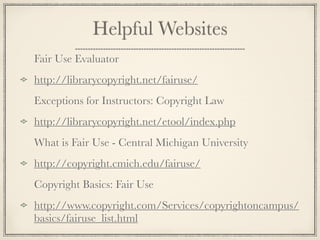
  • #30 in a nutshell... it for educational purpose does not equal fair use. 10% is not always fair. out of print doesn ’ t mean out of copyright. www is not public domain.
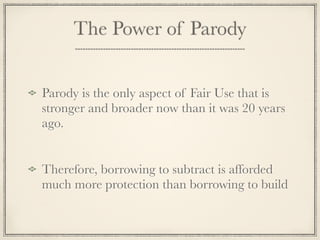
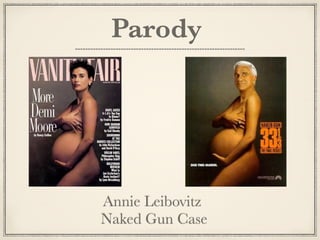
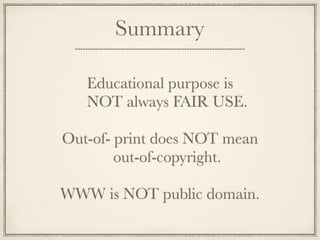
  • #48 Campbell vs. Acuff-Rose, Everyready vs. Adolph Coors, Liebovitz vs. naked gun In general, "parody" is a work that takes some of the original work and comments on the original work, usually in a satirical manner. The creator of the original work may not like it, but it is fair use, even if done for profit.