Fair Use
                 Of Copyrighted Materials
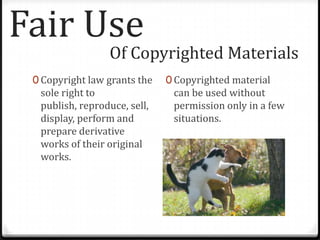
 0 Copyright law grants the   0 Copyrighted material
  sole right to                can be used without
  publish, reproduce, sell,    permission only in a few
  display, perform and         situations.
  prepare derivative
  works of their original
  works.
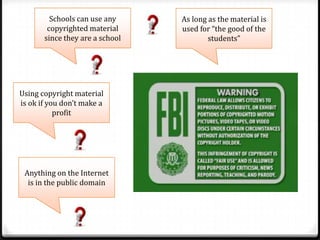
Schools can use any     As long as the material is
        copyrighted material     used for “the good of the
       since they are a school           students”


Using copyright material
is ok if you don’t make a
           profit


 Anything on the Internet
  is in the public domain
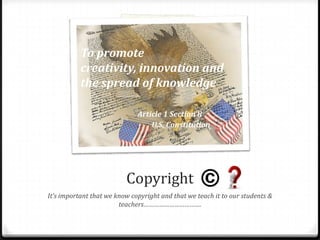
To promote
           creativity, innovation and
           the spread of knowledge

                              Article 1 Section 8
                                  U.S. Constitution


                          Copyright
It’s important that we know copyright and that we teach it to our students &
                        teachers…………………………….
Copyright is the legal right granted to an author, a
     composer, a playwright, a publisher, or a
              distributor to exclusive
publication, prodruction, sale, or distribution of a
   literary, musical, dramatic, or artistic work.
Public Domain
        How it Works                     In Public Domain

0 Creative material that              0 Expiration of copyright
 are not protected by                 0 Failure to renew
 intellectual property                  copyright
 laws such as                         0 Dedication-The owner
 copyright, trademark or                deliberately places it in
 patent laws                            the public domain.
 No copyright protection available for the following type of
 work: Facts, Ideas/Theories, Short Phrases, U.S.
 Government Works
What is protected?

         0 Works that are original
         0 Works that are written
          or recorded in a fixed
          form: Research
          Projects, Writings you
          produce,
Fair Use
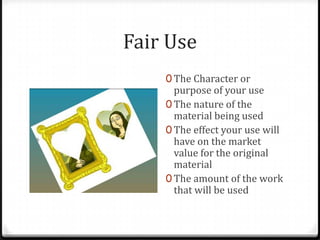
    0 The Character or
      purpose of your use
    0 The nature of the
      material being used
    0 The effect your use will
      have on the market
      value for the original
      material
    0 The amount of the work
      that will be used
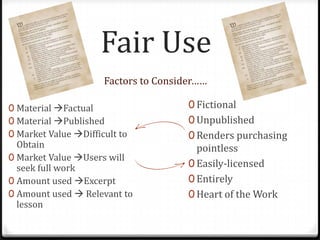
Fair Use
                      Factors to Consider……

0 Material Factual                    0 Fictional
0 Material Published                  0 Unpublished
0 Market Value Difficult to           0 Renders purchasing
  Obtain                                 pointless
0 Market Value Users will
  seek full work                       0 Easily-licensed
0 Amount used Excerpt                 0 Entirely
0 Amount used  Relevant to            0 Heart of the Work
  lesson
In Education
0 Section II0 of copyright   0 When working on a
 law allows public            research you must either
 education to display or      be fair or you must have
 perform copyrighted          permission. Also, be sure
 material as long as it
 occurs during face-to-       to always cite materials
 face teaching, the           you do use
 material has been            appropriately.
 lawfully obtained, and
 there is no profit being
 made
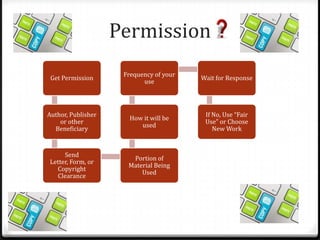
Permission
                     Frequency of your
 Get Permission                          Wait for Response
                           use


Author, Publisher                         If No, Use “Fair
                       How it will be
    or other                              Use” or Choose
                          used
  Beneficiary                                New Work


     Send
                       Portion of
Letter, Form, or
                      Material Being
  Copyright
                          Used
  Clearance
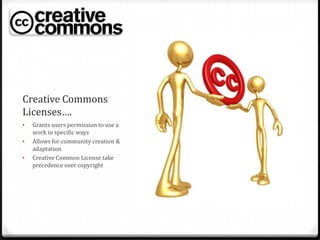
Creative Commons
Licenses….
•   Grants users permission to use a
    work in specific ways
•   Allows for community creation &
    adaptation
•   Creative Common License take
    precedence over copyright
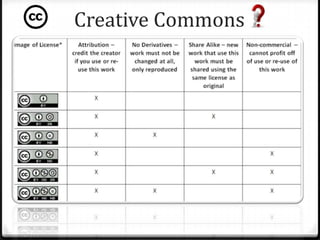
Creative Commons
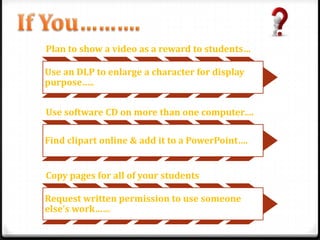
Plan to show a video as a reward to students…

Use an DLP to enlarge a character for display
purpose…..


Use software CD on more than one computer….

Find clipart online & add it to a PowerPoint….


Copy pages for all of your students

Request written permission to use someone
else’s work……
Think About…………
Work Cited
Colourbox. (2012, 01 01). Colourbox. Retrieved 01 29, 2012, from
http://www.colourbox.com/media/2652959

Commons, C. (2012, 01 01). Creative Commons. Retrieved 01 29, 2012, from http://creativecommons.org/about

Commons, W. (2008, 02 20). Wikimedia Commons. Retrieved 01 29, 2012, from LuMaxArt Gold
Guys:http://commons.wikimedia.org/wiki/File:LuMaxArt_Gold_Guys_With_Creative_Commons_Symbol. Jpg

course, C. C. (2001, 01 01). Copyright Crash course. Retrieved 01 29, 2012, from http://copyright.lib.utexas.edu/

Dreamstime. (2000, 01 01). Dreamstime. Retrieved 01 29, 2012, from
http://www.dreamstime.com/royalty-free-stock-photography-word-copyright-image16575807

Future US, I. (2012, 01 01). MaximumPC. Retrieved 01 29, 2012, from
http://www.maximumpc.com/article/features/byte_rights_we_cant_afford_no_education

Photos, R. F. (2006, 01 01). 123RF. Retrieved 01 29, 2012, from http://www.123rf.com/photo_9467256_3d-
small-thinking-person-leant-against-a-red-question-3d-image-isolated-white-background.html

Salon. (1999, 06 14). The Web's Plagiarism Police. Retrieved 01 29, 2012, from
http://www.salon.com/1999/06/14/plagiarism/

6340_NoeGranado_Copyright

  • 3.
    Fair Use Of Copyrighted Materials 0 Copyright law grants the 0 Copyrighted material sole right to can be used without publish, reproduce, sell, permission only in a few display, perform and situations. prepare derivative works of their original works.
  • 4.
    Schools can useany As long as the material is copyrighted material used for “the good of the since they are a school students” Using copyright material is ok if you don’t make a profit Anything on the Internet is in the public domain
  • 5.
    To promote creativity, innovation and the spread of knowledge Article 1 Section 8 U.S. Constitution Copyright It’s important that we know copyright and that we teach it to our students & teachers…………………………….
  • 6.
    Copyright is thelegal right granted to an author, a composer, a playwright, a publisher, or a distributor to exclusive publication, prodruction, sale, or distribution of a literary, musical, dramatic, or artistic work.
  • 7.
    Public Domain How it Works In Public Domain 0 Creative material that 0 Expiration of copyright are not protected by 0 Failure to renew intellectual property copyright laws such as 0 Dedication-The owner copyright, trademark or deliberately places it in patent laws the public domain. No copyright protection available for the following type of work: Facts, Ideas/Theories, Short Phrases, U.S. Government Works
  • 8.
    What is protected? 0 Works that are original 0 Works that are written or recorded in a fixed form: Research Projects, Writings you produce,
  • 9.
    Fair Use 0 The Character or purpose of your use 0 The nature of the material being used 0 The effect your use will have on the market value for the original material 0 The amount of the work that will be used
  • 10.
    Fair Use Factors to Consider…… 0 Material Factual 0 Fictional 0 Material Published 0 Unpublished 0 Market Value Difficult to 0 Renders purchasing Obtain pointless 0 Market Value Users will seek full work 0 Easily-licensed 0 Amount used Excerpt 0 Entirely 0 Amount used  Relevant to 0 Heart of the Work lesson
  • 11.
    In Education 0 SectionII0 of copyright 0 When working on a law allows public research you must either education to display or be fair or you must have perform copyrighted permission. Also, be sure material as long as it occurs during face-to- to always cite materials face teaching, the you do use material has been appropriately. lawfully obtained, and there is no profit being made
  • 12.
    Permission Frequency of your Get Permission Wait for Response use Author, Publisher If No, Use “Fair How it will be or other Use” or Choose used Beneficiary New Work Send Portion of Letter, Form, or Material Being Copyright Used Clearance
  • 13.
    Creative Commons Licenses…. • Grants users permission to use a work in specific ways • Allows for community creation & adaptation • Creative Common License take precedence over copyright
  • 14.
  • 15.
    Plan to showa video as a reward to students… Use an DLP to enlarge a character for display purpose….. Use software CD on more than one computer…. Find clipart online & add it to a PowerPoint…. Copy pages for all of your students Request written permission to use someone else’s work……
  • 16.
  • 18.
    Work Cited Colourbox. (2012,01 01). Colourbox. Retrieved 01 29, 2012, from http://www.colourbox.com/media/2652959 Commons, C. (2012, 01 01). Creative Commons. Retrieved 01 29, 2012, from http://creativecommons.org/about Commons, W. (2008, 02 20). Wikimedia Commons. Retrieved 01 29, 2012, from LuMaxArt Gold Guys:http://commons.wikimedia.org/wiki/File:LuMaxArt_Gold_Guys_With_Creative_Commons_Symbol. Jpg course, C. C. (2001, 01 01). Copyright Crash course. Retrieved 01 29, 2012, from http://copyright.lib.utexas.edu/ Dreamstime. (2000, 01 01). Dreamstime. Retrieved 01 29, 2012, from http://www.dreamstime.com/royalty-free-stock-photography-word-copyright-image16575807 Future US, I. (2012, 01 01). MaximumPC. Retrieved 01 29, 2012, from http://www.maximumpc.com/article/features/byte_rights_we_cant_afford_no_education Photos, R. F. (2006, 01 01). 123RF. Retrieved 01 29, 2012, from http://www.123rf.com/photo_9467256_3d- small-thinking-person-leant-against-a-red-question-3d-image-isolated-white-background.html Salon. (1999, 06 14). The Web's Plagiarism Police. Retrieved 01 29, 2012, from http://www.salon.com/1999/06/14/plagiarism/