Title 17 United States Code Annotated  Section 107 § 107.  Limitations on exclusive rights: Fair use   Notwithstanding the provisions of sections 106 and 106A, the fair use of a copyrighted work, including such use by reproduction in copies or phonorecords or by any other means specified by that section, for purposes such as criticism, comment, news reporting, teaching (including multiple copies for classroom use), scholarship, or research, is not an infringement of copyright. In determining whether the use made of a work in any particular case is a fair use the factors to be considered shall include--  (1) the purpose and character of the use, including whether such use is of a commercial nature or is for nonprofit educational purposes;  (2) the nature of the copyrighted work;  (3) the amount and substantiality of the portion used in relation to the copyrighted work as a whole; and  (4) the effect of the use upon the potential market for or value of the copyrighted work.  The fact that a work is unpublished shall not itself bar a finding of fair use if such finding is made upon consideration of all the above factors.  Remember:  ignorance of the law is no defense!
Here is a brief synopsis of  FAIR USE  for Copyright protected materials: Text:  up to 10% or 1,000 words, whichever is less If a poem is less than 250 words and is printed on not more than two pages, it may be copied in its entirety, if it is longer, only 250 words may be copied.  An unfinished line may be finished, if the 250 words falls in the middle of a line. If a complete article, story or essay is less than 2,500 words, it may be copied in its entirety.  Plays, novels, or letters, 1,000 words or 10% of the whole, whichever is less, may be copied.  No matter the length of the work 500 words may be copied even if that exceeds 10% of the whole with the exception of picture books due to their brevity. Audio:  up to 10%, but not more than 30 seconds Images:  not more than five images by the same artist or photographer Video:  up to 10% or three minutes, whichever is less Numerical data:  up to 10% or 2500 fields or cell entries, whichever is less Educators may use their multimedia projects and materials for educational purposes for a period of up to two years after the first instructional use in class.  Beyond that period they must acquire permission of the holders of each copyrighted portion. Teachers may copy a single copy  for their own use  of: A chapter of a book An article from a periodical or newspaper A short story, essay or poem A chart, graph, diagram, drawing, cartoon, picture from a book, periodical, or newspaper. When using copyright protected materials, you must give credit to the author, artist or creator from whom each item is borrowed. You may  NOT  copy workbooks or works that are “consumable”. From:  Instructional Media and Technologies for Learning , Robert Heinich, editor.  Merrill Prentice Hall, Columbus, Ohio:  1993, page 249. Copyright for Schools: a Practical Guide , Third Edition, Carol Simpson.  Linworth Publishing, Inc., Worthington, Ohio:  2001, pages 23,25.
BEST SOURCES These books have many forms to copy and use.  They are made just for schools, so the information is very appropriate, and they also have very lengthy and comprehensive bibliographies with many books and web sites. Simpson, Carol.  Copyright for Schools:  A Practical Guide Third Edition.  Worthington, Ohio ,  Linworth Publishing, Inc., 2001. Inglis, Kari, ed.  Ohio Media Spectrum:  Quality Library Media Programs, Information Power for Ohio Schools.  Columbus, Ohio, The Ohio Educational Library/Media Association, 1999. www.loc.gov/copyright   This site has good explanations and much usable information. GOOD SOURCES Besenjak, Cheryl.  Copyright Plain and Simple Second Edition.  Franklin Lakes, NJ, Career Press, 2001. Fishman, Stephen.  The Copyright Handbook:  How to Protect and Use Written Works Fifth Edition.  Berkely, CA, 2000. Heinich, Robert, ed.  Instructional Media and Technologies for Learning.   Columbus, Ohio, Merrill Prentice Hall, 1993. Litman, Jessica.  Digital Copyright.   Amherst, NY, Prometheus Books, 2001. Strong, William S.  The Copyright Book:  A Practical Guide Fifth Edition.   Cambridge, Massachusetts, The MIT Press, 1999. www.copyright.gov This site has circulars with useful information about copyright. www.bitlaw.com/copyright/scope.html www.lii.org Librarians’ Index to the Internet set up and maintained by the Library of California. www.templeton.com   This site was set up by a lawyer and is easy to read. www.benedict.com   This site was set up by a lawyer. www.cyberBee.com   This is a good site to introduce the idea of copyright and plagiarism to children. http://ericir.syr.edu   This is the site for the LM_NET Archives.  It is LOADED with information. www.lexisnexis.com   This is a lawyers’ pay site where the law is available in full. www.plagiarism.org More related material.
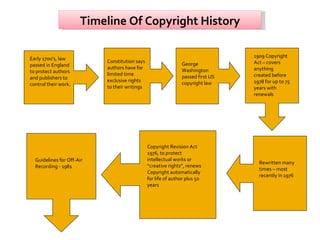
Timeline Of Copyright History Early 1700’s, law passed in England to protect authors and publishers to control their work.   Constitution says authors have for limited time exclusive rights to their writings   George Washington passed first US copyright law  1909 Copyright Act – covers anything created before 1978 for up to 75 years with renewals   Rewritten many times – most recently in 1976   Copyright Revision Act 1976, to protect intellectual works or “creative rights”, renews Copyright automatically for life of author plus 50 years   Guidelines for Off-Air Recording - 1981
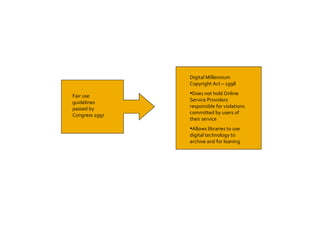
Fair use guidelines passed by Congress 1997  Digital Millennium Copyright Act – 1998   Does not hold Online Service Providers responsible for violations committed by users of their service Allows libraries to use digital technology to archive and for loaning
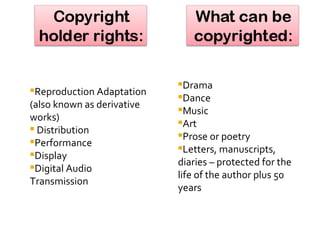
Reproduction Adaptation (also known as derivative works) Distribution Performance Display Digital Audio Transmission   Drama Dance Music Art Prose or poetry Letters, manuscripts, diaries – protected for the life of the author plus 50 years  
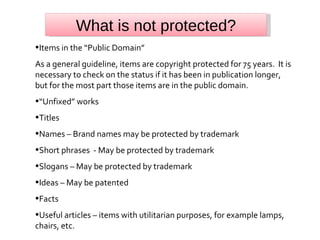
What is not protected? Items in the “Public Domain” As a general guideline, items are copyright protected for 75 years.  It is necessary to check on the status if it has been in publication longer, but for the most part those items are in the public domain. “ Unfixed” works Titles Names – Brand names may be protected by trademark Short phrases  - May be protected by trademark Slogans – May be protected by trademark Ideas – May be patented Facts Useful articles – items with utilitarian purposes, for example lamps, chairs, etc.
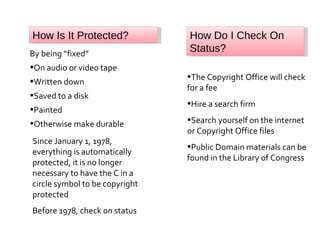
How Is It Protected? By being “fixed” On audio or video tape Written down Saved to a disk Painted Otherwise make durable Since January 1, 1978, everything is automatically protected, it is no longer necessary to have the C in a circle symbol to be copyright protected Before 1978, check on status How Do I Check On Status? The Copyright Office will check for a fee Hire a search firm Search yourself on the internet or Copyright Office files Public Domain materials can be found in the Library of Congress
   How do I use copyright protected materials? Must meet 4 conditions for Fair Use: Be a criticism or parody News reporting (summary of an article or address) Classroom teaching (reproduce a portion of a work to illustrate a lesson) Scholarship or research (university applications) Law does not specify how many words or minutes constitute fair use Guidelines endorsed by Congress in 1976 for education – multiple copies Must be brief Spontaneous (inspiration for use would not allow time for permission) No more than nine instances of multiple copies per semester Copyright notice on each copy Copying does not substitute for purchase Students cannot be charged more than copying fees
Audio/Visual Use Must be A non-profit educational institution Only students and teachers present during presentation Takes place in a classroom or instructional place Directly related to lesson-at-hand Showing is made from a legally acquired copy Can be owned by the school, the teacher or student or a student’s parent, borrowed from a library, rented from a video store or taped off-air following those guidelines.
Beware Infringement! Librarians have been named in suits, Principals as administrative leaders are presumed to be aware of activities in the school. Protect your school by: Posting signs by copy machines Label videos Do not loan equipment to those who you know are planning to pirate Certainly, do not show them how Have a strong copyright policy Make sure staff are trained a responsible Give in-service training
Be brief when using copyright protected materials – use only the material you need to make your point. Be aware of the law! Remember: ignorance of the law is no defense When in doubt . . . don’t use it!  Find something else you are sure of. Penalties range from $750 to $30,000 per infringement

Copyright & Fair Use

  • 1.
    Title 17 UnitedStates Code Annotated Section 107 § 107. Limitations on exclusive rights: Fair use   Notwithstanding the provisions of sections 106 and 106A, the fair use of a copyrighted work, including such use by reproduction in copies or phonorecords or by any other means specified by that section, for purposes such as criticism, comment, news reporting, teaching (including multiple copies for classroom use), scholarship, or research, is not an infringement of copyright. In determining whether the use made of a work in any particular case is a fair use the factors to be considered shall include-- (1) the purpose and character of the use, including whether such use is of a commercial nature or is for nonprofit educational purposes; (2) the nature of the copyrighted work; (3) the amount and substantiality of the portion used in relation to the copyrighted work as a whole; and (4) the effect of the use upon the potential market for or value of the copyrighted work. The fact that a work is unpublished shall not itself bar a finding of fair use if such finding is made upon consideration of all the above factors. Remember: ignorance of the law is no defense!
  • 2.
    Here is abrief synopsis of FAIR USE for Copyright protected materials: Text: up to 10% or 1,000 words, whichever is less If a poem is less than 250 words and is printed on not more than two pages, it may be copied in its entirety, if it is longer, only 250 words may be copied. An unfinished line may be finished, if the 250 words falls in the middle of a line. If a complete article, story or essay is less than 2,500 words, it may be copied in its entirety. Plays, novels, or letters, 1,000 words or 10% of the whole, whichever is less, may be copied. No matter the length of the work 500 words may be copied even if that exceeds 10% of the whole with the exception of picture books due to their brevity. Audio: up to 10%, but not more than 30 seconds Images: not more than five images by the same artist or photographer Video: up to 10% or three minutes, whichever is less Numerical data: up to 10% or 2500 fields or cell entries, whichever is less Educators may use their multimedia projects and materials for educational purposes for a period of up to two years after the first instructional use in class. Beyond that period they must acquire permission of the holders of each copyrighted portion. Teachers may copy a single copy for their own use of: A chapter of a book An article from a periodical or newspaper A short story, essay or poem A chart, graph, diagram, drawing, cartoon, picture from a book, periodical, or newspaper. When using copyright protected materials, you must give credit to the author, artist or creator from whom each item is borrowed. You may NOT copy workbooks or works that are “consumable”. From: Instructional Media and Technologies for Learning , Robert Heinich, editor. Merrill Prentice Hall, Columbus, Ohio: 1993, page 249. Copyright for Schools: a Practical Guide , Third Edition, Carol Simpson. Linworth Publishing, Inc., Worthington, Ohio: 2001, pages 23,25.
  • 3.
    BEST SOURCES Thesebooks have many forms to copy and use. They are made just for schools, so the information is very appropriate, and they also have very lengthy and comprehensive bibliographies with many books and web sites. Simpson, Carol. Copyright for Schools: A Practical Guide Third Edition. Worthington, Ohio , Linworth Publishing, Inc., 2001. Inglis, Kari, ed. Ohio Media Spectrum: Quality Library Media Programs, Information Power for Ohio Schools. Columbus, Ohio, The Ohio Educational Library/Media Association, 1999. www.loc.gov/copyright This site has good explanations and much usable information. GOOD SOURCES Besenjak, Cheryl. Copyright Plain and Simple Second Edition. Franklin Lakes, NJ, Career Press, 2001. Fishman, Stephen. The Copyright Handbook: How to Protect and Use Written Works Fifth Edition. Berkely, CA, 2000. Heinich, Robert, ed. Instructional Media and Technologies for Learning. Columbus, Ohio, Merrill Prentice Hall, 1993. Litman, Jessica. Digital Copyright. Amherst, NY, Prometheus Books, 2001. Strong, William S. The Copyright Book: A Practical Guide Fifth Edition. Cambridge, Massachusetts, The MIT Press, 1999. www.copyright.gov This site has circulars with useful information about copyright. www.bitlaw.com/copyright/scope.html www.lii.org Librarians’ Index to the Internet set up and maintained by the Library of California. www.templeton.com This site was set up by a lawyer and is easy to read. www.benedict.com This site was set up by a lawyer. www.cyberBee.com This is a good site to introduce the idea of copyright and plagiarism to children. http://ericir.syr.edu This is the site for the LM_NET Archives. It is LOADED with information. www.lexisnexis.com This is a lawyers’ pay site where the law is available in full. www.plagiarism.org More related material.
  • 4.
    Timeline Of CopyrightHistory Early 1700’s, law passed in England to protect authors and publishers to control their work. Constitution says authors have for limited time exclusive rights to their writings George Washington passed first US copyright law 1909 Copyright Act – covers anything created before 1978 for up to 75 years with renewals Rewritten many times – most recently in 1976 Copyright Revision Act 1976, to protect intellectual works or “creative rights”, renews Copyright automatically for life of author plus 50 years Guidelines for Off-Air Recording - 1981
  • 5.
    Fair use guidelinespassed by Congress 1997 Digital Millennium Copyright Act – 1998 Does not hold Online Service Providers responsible for violations committed by users of their service Allows libraries to use digital technology to archive and for loaning
  • 6.
    Reproduction Adaptation (alsoknown as derivative works) Distribution Performance Display Digital Audio Transmission Drama Dance Music Art Prose or poetry Letters, manuscripts, diaries – protected for the life of the author plus 50 years  
  • 7.
    What is notprotected? Items in the “Public Domain” As a general guideline, items are copyright protected for 75 years. It is necessary to check on the status if it has been in publication longer, but for the most part those items are in the public domain. “ Unfixed” works Titles Names – Brand names may be protected by trademark Short phrases - May be protected by trademark Slogans – May be protected by trademark Ideas – May be patented Facts Useful articles – items with utilitarian purposes, for example lamps, chairs, etc.
  • 8.
    How Is ItProtected? By being “fixed” On audio or video tape Written down Saved to a disk Painted Otherwise make durable Since January 1, 1978, everything is automatically protected, it is no longer necessary to have the C in a circle symbol to be copyright protected Before 1978, check on status How Do I Check On Status? The Copyright Office will check for a fee Hire a search firm Search yourself on the internet or Copyright Office files Public Domain materials can be found in the Library of Congress
  • 9.
       How doI use copyright protected materials? Must meet 4 conditions for Fair Use: Be a criticism or parody News reporting (summary of an article or address) Classroom teaching (reproduce a portion of a work to illustrate a lesson) Scholarship or research (university applications) Law does not specify how many words or minutes constitute fair use Guidelines endorsed by Congress in 1976 for education – multiple copies Must be brief Spontaneous (inspiration for use would not allow time for permission) No more than nine instances of multiple copies per semester Copyright notice on each copy Copying does not substitute for purchase Students cannot be charged more than copying fees
  • 10.
    Audio/Visual Use Mustbe A non-profit educational institution Only students and teachers present during presentation Takes place in a classroom or instructional place Directly related to lesson-at-hand Showing is made from a legally acquired copy Can be owned by the school, the teacher or student or a student’s parent, borrowed from a library, rented from a video store or taped off-air following those guidelines.
  • 11.
    Beware Infringement! Librarianshave been named in suits, Principals as administrative leaders are presumed to be aware of activities in the school. Protect your school by: Posting signs by copy machines Label videos Do not loan equipment to those who you know are planning to pirate Certainly, do not show them how Have a strong copyright policy Make sure staff are trained a responsible Give in-service training
  • 12.
    Be brief whenusing copyright protected materials – use only the material you need to make your point. Be aware of the law! Remember: ignorance of the law is no defense When in doubt . . . don’t use it! Find something else you are sure of. Penalties range from $750 to $30,000 per infringement