The Ethical Use of
Electronic Media.
  Guilford County SciVis
         V103.03
Computer Ethics
   Resources such as images and text
    on the Internet are copyrighted.
   Plagiarism (using something that
    you did not create) is a serious
    offense covered in the Copyright Law
    of 1976. Plagiarism items can include
    literary, dramatic, and musical
    works.
   Copying of software without
    purchasing it is illegal and is a
    punishable offense.
Copyright LAWS and Terms
   Copyright is a form of
    protection provided by the
    laws of the United States
    (title 17, U.S. Code) to the
    authors of “original
    works of authorship,”
    including literary,
    dramatic, musical, artistic,
    and certain other
    intellectual works.
Copyright LAWS and Terms
   This protection is available to both published
    and unpublished works. Section 106 of the
    1976 Copyright Act generally gives the owner
    of copyright the exclusive right to do and to
    authorize others to do the following:
      To reproduce the work in copies or
       phonorecords.
      To prepare derivative works based upon
       the work.
      To distribute copies or phonorecords of the
       work to the public by sale or other transfer
       of ownership, or by rental, lease, or
       lending.
Copyright LAWS and Terms
   To perform the work publicly, in the case of
    literary, musical, dramatic, and choreographic
    works, pantomimes, and motion pictures, and
    other audiovisual works.
   To display the copyrighted work publicly, in
    the case of literary, musical, dramatic, and
    choreographic works, pantomimes, and pictorial,
    graphic, or sculptural works, including the
    individual images of a motion picture or other
    audiovisual work.
   In the case of sound recordings, to perform
    the work publicly by means of a digital audio
    transmission.
Plagiarism
   Plagiarism includes a
    range of actions from
    failure to properly cite
    works to wholesale
    cheating. A student who
    plagiarizes may do so
    unintentionally or with
    purposeful deliberation.
    Listed below are some
    common forms of
    plagiarism.
Plagiarism (continued)
   Buying a paper from a research service and
    turning it in as yours.
   Turning in another student’s work without that
    student’s knowledge and claiming it as yours.
   Turning in a paper a peer has written for you.
   Copying a paper from a source text like a book or
    the Internet without proper acknowledgment.
   Copying materials from a source text, supplying
    proper documentation, but leaving out quotation
    marks.
   Paraphrasing materials from a source text
    without giving appropriate documentation.
Plagiarism (continued)
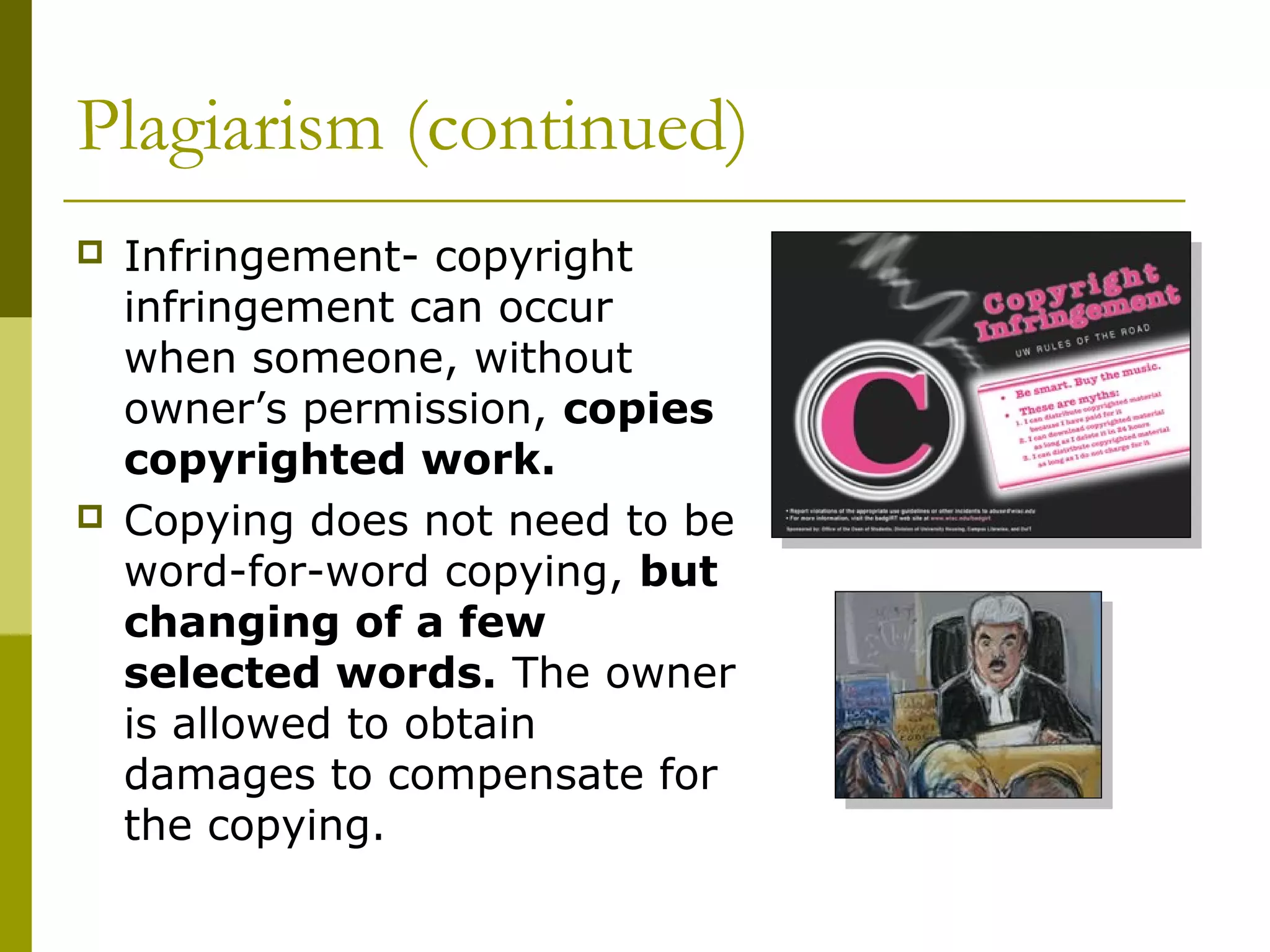
   Infringement- copyright
    infringement can occur
    when someone, without
    owner’s permission, copies
    copyrighted work.
   Copying does not need to be
    word-for-word copying, but
    changing of a few
    selected words. The owner
    is allowed to obtain
    damages to compensate for
    the copying.
Plagiarism (continued)
   Trademarks are familiar names
    and symbols that have become
    associated with quality, reliability,
    and/or fame. That’s why people
    and companies spend millions of
    dollars protecting these images.
   A way of protecting is through a
    registered trademark. Registration
    of a trademark is a legal title to a
    symbol or idea in the same way as
    a deed is title to a piece of
    property.
Fair Use Limit
   Fair use - the acceptable boundaries to which a
    person may use copyrighted material without
    obtaining the owner’s permission.
      Music - 10% or 30 seconds of a song
       whichever is less.
      Video - 10% or 3 minutes of a video whichever
       is less.
   Be aware of the condition “whichever is less.” In
    order to use 30 seconds of a song, your song
    must be 5 minutes in length and most popular
    songs are only 3 to 3 ½ minutes.
   Give credit for clips and videos in the bibliography
    of your project.
Acceptable Use of School Computers
     The person named in the account should be the
      only one to access that account.
     Tampering is not permitted on school
      computers.
     The use of school computers is only for
      academic work and cannot be used to play non-
      academic games or for any fraudulent activity.
     Personal e-mail and instant messenger are
      unacceptable.
The End

Computer ethics

  • 1.
    The Ethical Useof Electronic Media. Guilford County SciVis V103.03
  • 2.
    Computer Ethics  Resources such as images and text on the Internet are copyrighted.  Plagiarism (using something that you did not create) is a serious offense covered in the Copyright Law of 1976. Plagiarism items can include literary, dramatic, and musical works.  Copying of software without purchasing it is illegal and is a punishable offense.
  • 3.
    Copyright LAWS andTerms  Copyright is a form of protection provided by the laws of the United States (title 17, U.S. Code) to the authors of “original works of authorship,” including literary, dramatic, musical, artistic, and certain other intellectual works.
  • 4.
    Copyright LAWS andTerms  This protection is available to both published and unpublished works. Section 106 of the 1976 Copyright Act generally gives the owner of copyright the exclusive right to do and to authorize others to do the following:  To reproduce the work in copies or phonorecords.  To prepare derivative works based upon the work.  To distribute copies or phonorecords of the work to the public by sale or other transfer of ownership, or by rental, lease, or lending.
  • 5.
    Copyright LAWS andTerms  To perform the work publicly, in the case of literary, musical, dramatic, and choreographic works, pantomimes, and motion pictures, and other audiovisual works.  To display the copyrighted work publicly, in the case of literary, musical, dramatic, and choreographic works, pantomimes, and pictorial, graphic, or sculptural works, including the individual images of a motion picture or other audiovisual work.  In the case of sound recordings, to perform the work publicly by means of a digital audio transmission.
  • 6.
    Plagiarism  Plagiarism includes a range of actions from failure to properly cite works to wholesale cheating. A student who plagiarizes may do so unintentionally or with purposeful deliberation. Listed below are some common forms of plagiarism.
  • 7.
    Plagiarism (continued)  Buying a paper from a research service and turning it in as yours.  Turning in another student’s work without that student’s knowledge and claiming it as yours.  Turning in a paper a peer has written for you.  Copying a paper from a source text like a book or the Internet without proper acknowledgment.  Copying materials from a source text, supplying proper documentation, but leaving out quotation marks.  Paraphrasing materials from a source text without giving appropriate documentation.
  • 8.
    Plagiarism (continued)  Infringement- copyright infringement can occur when someone, without owner’s permission, copies copyrighted work.  Copying does not need to be word-for-word copying, but changing of a few selected words. The owner is allowed to obtain damages to compensate for the copying.
  • 9.
    Plagiarism (continued)  Trademarks are familiar names and symbols that have become associated with quality, reliability, and/or fame. That’s why people and companies spend millions of dollars protecting these images.  A way of protecting is through a registered trademark. Registration of a trademark is a legal title to a symbol or idea in the same way as a deed is title to a piece of property.
  • 10.
    Fair Use Limit  Fair use - the acceptable boundaries to which a person may use copyrighted material without obtaining the owner’s permission.  Music - 10% or 30 seconds of a song whichever is less.  Video - 10% or 3 minutes of a video whichever is less.  Be aware of the condition “whichever is less.” In order to use 30 seconds of a song, your song must be 5 minutes in length and most popular songs are only 3 to 3 ½ minutes.  Give credit for clips and videos in the bibliography of your project.
  • 11.
    Acceptable Use ofSchool Computers  The person named in the account should be the only one to access that account.  Tampering is not permitted on school computers.  The use of school computers is only for academic work and cannot be used to play non- academic games or for any fraudulent activity.  Personal e-mail and instant messenger are unacceptable.
  • 12.