COPYRIGHTS
What is copyright? ©
• It is “original works of authorship fixed in
any tangible medium of expression, now
known or later developed, from which they
can be perceived, reproduced, or otherwise
communicated, either directly or with the
aid of a machine or device.” (Section 102
Copyright Act, “Subject matter of
copyright: In general.”)
WHAT IS COPYRIGHT
INFRINGEMENT?
• The unauthorized use of copyrighted
material in a manner that violates one of the
copyright owner’s exclusive rights.
WHAT IS PROTECTED?
• Literary works
• Musical works, including the words
• Dramatic works including the
accompanying music
• Pantomimes and choreographic works
• Pictorial, graphic, and sculptural works
• Motion pictures and other audiovisual
works
• Sound recordings
• Architectural works
WHAT IS NOT PROTECTED?
• Titles (trademarks)
• Names(trademark)
• Short phrase(trademark)
• Slogans(trademark)
• Familiar symbols or designs(™)
• Listing of ingredients
• Ideas
WHAT IS NOT PROTECTED?
• Procedures
• Methods
• Systems processes
• Concepts
• Principles
• Discoveries
• Works consisting of information that is
common property and containing no
original authorship: calendars, height charts,
rulers
HOW LONG DOES
COPYRIGHT LAST?
• Single author created after Jan 1, 1978:
author’s life plus 70 years
• Joint authors created after Jan 1, 1978: the
last surviving author, plus 70 years
• Created before Jan 1, 1978: if copyright
was obtained, 28 years. If renewed, 47
additional years for a total of 75 years
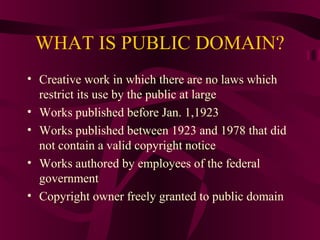
WHAT IS PUBLIC DOMAIN?
• Creative work in which there are no laws which
restrict its use by the public at large
• Works published before Jan. 1,1923
• Works published between 1923 and 1978 that did
not contain a valid copyright notice
• Works authored by employees of the federal
government
• Copyright owner freely granted to public domain
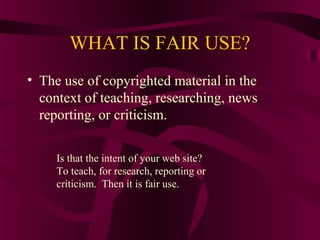
WHAT IS FAIR USE?
• The use of copyrighted material in the
context of teaching, researching, news
reporting, or criticism.
Is that the intent of your web site?
To teach, for research, reporting or
criticism. Then it is fair use.
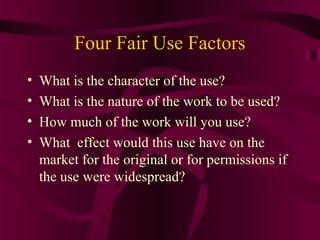
Four Fair Use Factors
• What is the character of the use?
• What is the nature of the work to be used?
• How much of the work will you use?
• What effect would this use have on the
market for the original or for permissions if
the use were widespread?
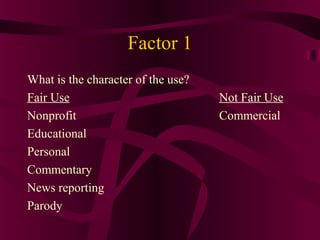
Factor 1
What is the character of the use?
Fair Use Not Fair Use
Nonprofit Commercial
Educational
Personal
Commentary
News reporting
Parody
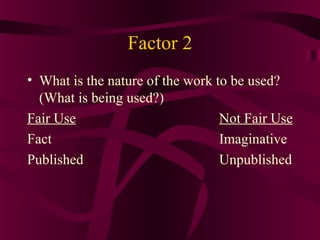
Factor 2
• What is the nature of the work to be used?
(What is being used?)
Fair Use Not Fair Use
Fact Imaginative
Published Unpublished
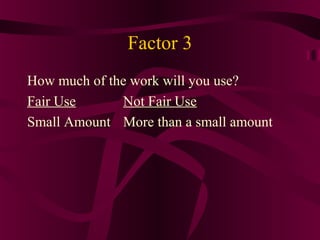
Factor 3
How much of the work will you use?
Fair Use Not Fair Use
Small Amount More than a small amount
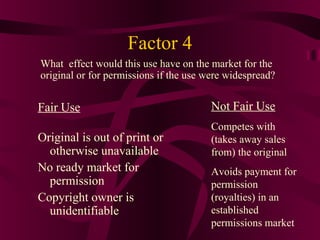
Factor 4
Fair Use
Original is out of print or
otherwise unavailable
No ready market for
permission
Copyright owner is
unidentifiable
Not Fair Use
Competes with
(takes away sales
from) the original
Avoids payment for
permission
(royalties) in an
established
permissions market
What effect would this use have on the market for the
original or for permissions if the use were widespread?
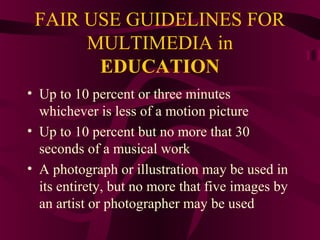
FAIR USE GUIDELINES FOR
MULTIMEDIA in
EDUCATION
• Up to 10 percent or three minutes
whichever is less of a motion picture
• Up to 10 percent but no more that 30
seconds of a musical work
• A photograph or illustration may be used in
its entirety, but no more that five images by
an artist or photographer may be used
ASK FOR PERMISSION
• When the intended use is for commercial
purposes.
• When you use the materials repeatedly.
• When you want to use a work in its entirety.
How to get permission?
Sample letter at:
http://www.umuc.edu/library/sample.html
• Date
• Material Permissions Department
Hypothetical Book Company
400 Any Street
City, State Zip Code
• Dear Sir/Madam:
• I would like permission to copy the following for continued use in
_____________________.
• Title:Learning in College, Second EditionCopyright:Hypothetical Book
Company, 1970, 1972Author:John DoeMaterial to be duplicated:Chapters
5, 6, and 15 (photocopy enclosed)Number of Copies:500 Distribution:The
material will be distributed to students in my classes and they will pay only
the cost of the photocopyingType of Reprint:Photocopy Use:The chapters are
to be used as supplementary teaching materials.
• I have enclosed a self-addressed stamped envelope for your convenience in
replying to this request.
• Sincerely, Faculty Member
References
“Copyright Crash Course for the Classroom”
Texas Computer Education Association State
Conference
February 8, 2002
Tom Brawley
tbrawley@esc4.net

Copy right2

  • 1.
  • 2.
    What is copyright?© • It is “original works of authorship fixed in any tangible medium of expression, now known or later developed, from which they can be perceived, reproduced, or otherwise communicated, either directly or with the aid of a machine or device.” (Section 102 Copyright Act, “Subject matter of copyright: In general.”)
  • 3.
    WHAT IS COPYRIGHT INFRINGEMENT? •The unauthorized use of copyrighted material in a manner that violates one of the copyright owner’s exclusive rights.
  • 4.
    WHAT IS PROTECTED? •Literary works • Musical works, including the words • Dramatic works including the accompanying music • Pantomimes and choreographic works • Pictorial, graphic, and sculptural works • Motion pictures and other audiovisual works • Sound recordings • Architectural works
  • 5.
    WHAT IS NOTPROTECTED? • Titles (trademarks) • Names(trademark) • Short phrase(trademark) • Slogans(trademark) • Familiar symbols or designs(™) • Listing of ingredients • Ideas
  • 6.
    WHAT IS NOTPROTECTED? • Procedures • Methods • Systems processes • Concepts • Principles • Discoveries • Works consisting of information that is common property and containing no original authorship: calendars, height charts, rulers
  • 7.
    HOW LONG DOES COPYRIGHTLAST? • Single author created after Jan 1, 1978: author’s life plus 70 years • Joint authors created after Jan 1, 1978: the last surviving author, plus 70 years • Created before Jan 1, 1978: if copyright was obtained, 28 years. If renewed, 47 additional years for a total of 75 years
  • 8.
    WHAT IS PUBLICDOMAIN? • Creative work in which there are no laws which restrict its use by the public at large • Works published before Jan. 1,1923 • Works published between 1923 and 1978 that did not contain a valid copyright notice • Works authored by employees of the federal government • Copyright owner freely granted to public domain
  • 9.
    WHAT IS FAIRUSE? • The use of copyrighted material in the context of teaching, researching, news reporting, or criticism. Is that the intent of your web site? To teach, for research, reporting or criticism. Then it is fair use.
  • 10.
    Four Fair UseFactors • What is the character of the use? • What is the nature of the work to be used? • How much of the work will you use? • What effect would this use have on the market for the original or for permissions if the use were widespread?
  • 11.
    Factor 1 What isthe character of the use? Fair Use Not Fair Use Nonprofit Commercial Educational Personal Commentary News reporting Parody
  • 12.
    Factor 2 • Whatis the nature of the work to be used? (What is being used?) Fair Use Not Fair Use Fact Imaginative Published Unpublished
  • 13.
    Factor 3 How muchof the work will you use? Fair Use Not Fair Use Small Amount More than a small amount
  • 14.
    Factor 4 Fair Use Originalis out of print or otherwise unavailable No ready market for permission Copyright owner is unidentifiable Not Fair Use Competes with (takes away sales from) the original Avoids payment for permission (royalties) in an established permissions market What effect would this use have on the market for the original or for permissions if the use were widespread?
  • 15.
    FAIR USE GUIDELINESFOR MULTIMEDIA in EDUCATION • Up to 10 percent or three minutes whichever is less of a motion picture • Up to 10 percent but no more that 30 seconds of a musical work • A photograph or illustration may be used in its entirety, but no more that five images by an artist or photographer may be used
  • 16.
    ASK FOR PERMISSION •When the intended use is for commercial purposes. • When you use the materials repeatedly. • When you want to use a work in its entirety.
  • 17.
    How to getpermission? Sample letter at: http://www.umuc.edu/library/sample.html • Date • Material Permissions Department Hypothetical Book Company 400 Any Street City, State Zip Code • Dear Sir/Madam: • I would like permission to copy the following for continued use in _____________________. • Title:Learning in College, Second EditionCopyright:Hypothetical Book Company, 1970, 1972Author:John DoeMaterial to be duplicated:Chapters 5, 6, and 15 (photocopy enclosed)Number of Copies:500 Distribution:The material will be distributed to students in my classes and they will pay only the cost of the photocopyingType of Reprint:Photocopy Use:The chapters are to be used as supplementary teaching materials. • I have enclosed a self-addressed stamped envelope for your convenience in replying to this request. • Sincerely, Faculty Member
  • 18.
    References “Copyright Crash Coursefor the Classroom” Texas Computer Education Association State Conference February 8, 2002 Tom Brawley tbrawley@esc4.net