WHAT TO KNOW IN
COPYREADING?
COPYREADING
The process of arranging, correcting,
and selecting the quality and type of a
news.
It is also called copyediting.
COPY
Is the typewritten materials sent to
the linotypist to be typeset. It may
be a news story, a feature
article, an editorial, or a literary
piece.
THE JOB OF THE COPYREADER
The Copyreader – Is a very important person
on the newspaper job, etc.
 He corrects grammatical errors, errors in
style, and typographical errors.
 He keeps out damaging statements or
derogatory statements – those are libelous
and harmful to anyone’s reputation.
 He also writes the headlines.
In Copyreading a news report, the
copyreader should see to it that it begins with
the proper lead and that this lead contains the
most important facts. He sees to it that the
paragraph are arranged according to
decreasing importance following the involved
pyramid structure. He kills or eliminates
words that tend to editorialize. He crosses out
redundant words and verbal deadwood.
Characteristics of a good
copyreader :
It has been said that a good copyreader
must posses certain qualities. He or she must
have the eye of an eagle and the touch of a
butterfly.
PREPARING THE COPY
In preparing the copy, the reporter should:
1. Use a typewriter or a computer – never
submitting it in long hand.
2. Type on one side of the sheet only and
double the space.
3. Begin his story (for news) about three
inches from the top of the page.
4. Indent deeply – at least five spaces – the
beginning of each paragraph.
5. Identify on the first page the story with a
slugline – the name of the paper, words
identifying the story like “Fire”, or “Student
election”; the reporter and the date.
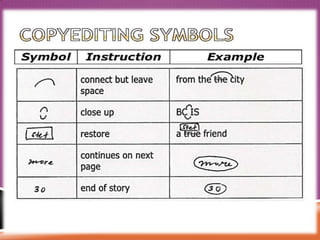
6. Type the word “More” at the bottom of
each page except the last, where he has to
indicate the end of the story with a “30” or
# mark.
DUTIES OF A COPYREADER
1. Straighten out ungrammatical constructions.
2. Shorten sentences and tighten paragraphs.
3. See that the paper’s style requirements are
strictly followed.
4. Check names, addresses, titles, designations,
identifications, figures, etc.
5. Rewrite the story completely if its poorly
written.
6. Rewrite the lead or the first few paragraphs
whenever necessary, but must never tamper with
the facts unless he is sure of his corrections.
7. Delete all opinion, speculations, and statements
which are without attribution or sources.
8. Watch out for slanting or any attempt to present
the story in a subtly biased way.
9. Watch out for libelous statements.
10. Recheck figures and totals.
11. Cross out adjectives which tend to make a story
sound over – written.
12. Cut a story to size or to the required length if
need be.
13. Check attributions and see to it that they are
properly identified.
14. Challenge facts, claims, or reports when they
sound anomalous, illogical, and incredible.
15. Check sluglines and paging sequences.
16. Write headlines.
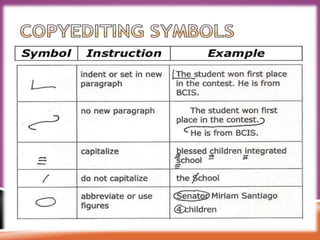
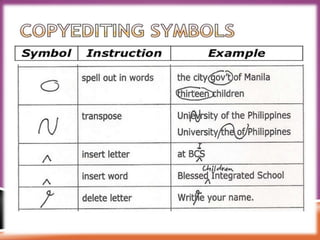
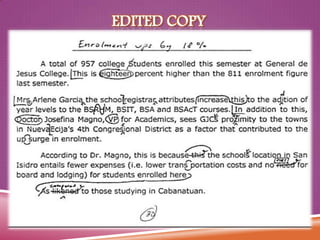
EDITED COPY
THANK YOU FOR LISTENING ! 
ACEBUCHE, NESTEVE F.
BSED II – A

Copyreading

  • 2.
    WHAT TO KNOWIN COPYREADING?
  • 3.
    COPYREADING The process ofarranging, correcting, and selecting the quality and type of a news. It is also called copyediting.
  • 4.
    COPY Is the typewrittenmaterials sent to the linotypist to be typeset. It may be a news story, a feature article, an editorial, or a literary piece.
  • 5.
    THE JOB OFTHE COPYREADER The Copyreader – Is a very important person on the newspaper job, etc.  He corrects grammatical errors, errors in style, and typographical errors.  He keeps out damaging statements or derogatory statements – those are libelous and harmful to anyone’s reputation.  He also writes the headlines.
  • 6.
    In Copyreading anews report, the copyreader should see to it that it begins with the proper lead and that this lead contains the most important facts. He sees to it that the paragraph are arranged according to decreasing importance following the involved pyramid structure. He kills or eliminates words that tend to editorialize. He crosses out redundant words and verbal deadwood.
  • 7.
    Characteristics of agood copyreader : It has been said that a good copyreader must posses certain qualities. He or she must have the eye of an eagle and the touch of a butterfly.
  • 8.
    PREPARING THE COPY Inpreparing the copy, the reporter should: 1. Use a typewriter or a computer – never submitting it in long hand. 2. Type on one side of the sheet only and double the space. 3. Begin his story (for news) about three inches from the top of the page.
  • 9.
    4. Indent deeply– at least five spaces – the beginning of each paragraph. 5. Identify on the first page the story with a slugline – the name of the paper, words identifying the story like “Fire”, or “Student election”; the reporter and the date. 6. Type the word “More” at the bottom of each page except the last, where he has to indicate the end of the story with a “30” or # mark.
  • 10.
    DUTIES OF ACOPYREADER 1. Straighten out ungrammatical constructions. 2. Shorten sentences and tighten paragraphs. 3. See that the paper’s style requirements are strictly followed. 4. Check names, addresses, titles, designations, identifications, figures, etc. 5. Rewrite the story completely if its poorly written.
  • 11.
    6. Rewrite thelead or the first few paragraphs whenever necessary, but must never tamper with the facts unless he is sure of his corrections. 7. Delete all opinion, speculations, and statements which are without attribution or sources. 8. Watch out for slanting or any attempt to present the story in a subtly biased way. 9. Watch out for libelous statements. 10. Recheck figures and totals.
  • 12.
    11. Cross outadjectives which tend to make a story sound over – written. 12. Cut a story to size or to the required length if need be. 13. Check attributions and see to it that they are properly identified. 14. Challenge facts, claims, or reports when they sound anomalous, illogical, and incredible. 15. Check sluglines and paging sequences. 16. Write headlines.
  • 18.
  • 19.
    THANK YOU FORLISTENING !  ACEBUCHE, NESTEVE F. BSED II – A