Feature Story
• A feature story is an article in a
newspaper, a magazine, or a
news website that is not meant
to report breaking news, but to
take an in-depth look at issues
behind a news story, often
concentrating on background
events, persons or
circumstances.
Characteristics
of the Feature
Article
Characteristics of the
Feature Article
Variety of subject matter
Variety of tone
Variety in form and style
Usually more entertaining more
often than it forms, instructs or
advises
Factual and requires reporting
Well-organized
Rarely begins with a summary lead
Uses the novelty lead more often.
Usually strikes the keynote in the
opening sentence.
The writer strives to give the
reader a first-hand sensation by
reconstructing the original as
closely as possible.
Length of the story
May or may not be timely
Literary
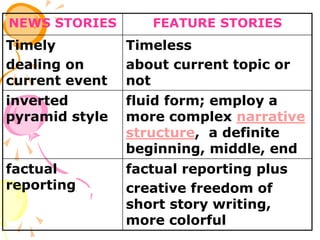
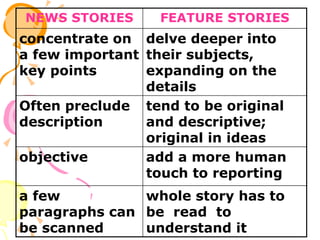
NEWS STORIES FEATURE STORIES
Timely
dealing on
current event
Timeless
about current topic or
not
inverted
pyramid style
fluid form; employ a
more complex narrative
structure, a definite
beginning, middle, end
factual
reporting
factual reporting plus
creative freedom of
short story writing,
more colorful
NEWS STORIES FEATURE STORIES
concentrate on
a few important
key points
delve deeper into
their subjects,
expanding on the
details
Often preclude
description
tend to be original
and descriptive;
original in ideas
objective add a more human
touch to reporting
a few
paragraphs can
be scanned
whole story has to
be read to
understand it
Kinds of
Feature
Articles
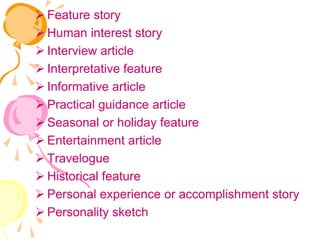
 Feature story
 Human interest story
 Interview article
 Interpretative feature
 Informative article
 Practical guidance article
 Seasonal or holiday feature
 Entertainment article
 Travelogue
 Historical feature
 Personal experience or accomplishment story
 Personality sketch
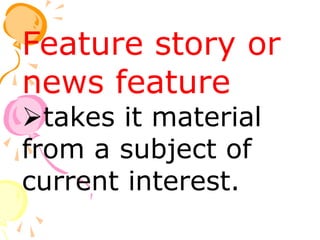
Feature story or
news feature
takes it material
from a subject of
current interest.
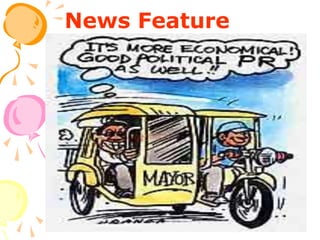
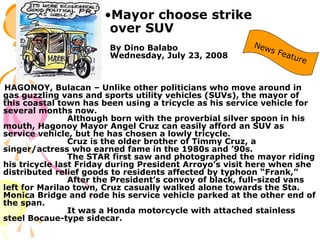
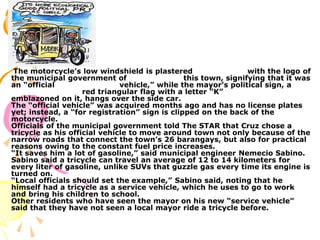
News Feature
•Mayor choose strike
over SUV
By Dino Balabo
Wednesday, July 23, 2008
HAGONOY, Bulacan – Unlike other politicians who move around in
gas guzzling vans and sports utility vehicles (SUVs), the mayor of
this coastal town has been using a tricycle as his service vehicle for
several months now.
Although born with the proverbial silver spoon in his
mouth, Hagonoy Mayor Angel Cruz can easily afford an SUV as
service vehicle, but he has chosen a lowly tricycle.
Cruz is the older brother of Timmy Cruz, a
singer/actress who earned fame in the 1980s and ’90s.
The STAR first saw and photographed the mayor riding
his tricycle last Friday during President Arroyo’s visit here when she
distributed relief goods to residents affected by typhoon “Frank,”
After the President’s convoy of black, full-sized vans
left for Marilao town, Cruz casually walked alone towards the Sta.
Monica Bridge and rode his service vehicle parked at the other end of
the span.
It was a Honda motorcycle with attached stainless
steel Bocaue-type sidecar.
The motorcycle’s low windshield is plastered with the logo of
the municipal government of this town, signifying that it was
an “official vehicle,” while the mayor’s political sign, a
red triangular flag with a letter “K”
emblazoned on it, hangs over the side car.
The “official vehicle” was acquired months ago and has no license plates
yet; instead, a “for registration” sign is clipped on the back of the
motorcycle.
Officials of the municipal government told The STAR that Cruz chose a
tricycle as his official vehicle to move around town not only because of the
narrow roads that connect the town’s 26 barangays, but also for practical
reasons owing to the constant fuel price increases.
“It saves him a lot of gasoline,” said municipal engineer Nemecio Sabino.
Sabino said a tricycle can travel an average of 12 to 14 kilometers for
every liter of gasoline, unlike SUVs that guzzle gas every time its engine is
turned on.
“Local officials should set the example,” Sabino said, noting that he
himself had a tricycle as a service vehicle, which he uses to go to work
and bring his children to school.
Other residents who have seen the mayor on his new “service vehicle”
said that they have not seen a local mayor ride a tricycle before.
Human Interest Story
•Has its origin in some minor
happening that merits
attention only because of
some dramatic, humorous,
tragic, odd, or sensational
angle caught by an alert
imaginative reporter.
Interview Article
•May be further
classified according to
purpose and
emphasis.
Interpretative Feature
•Instructs, informs, makes
clear to the reader the
background and
significance of social,
economic, political
problems and other
problems of everyday life.
Informative Article
• May deal with scientific
facts presented in non-
technical language, or
some interesting or
useful facts in other
areas.
Practical
Guidance Article
•“how to do it”
feature is usually
meant to inform.
Seasonal or
Holiday Feature
•Presented from some
new angle on an old
theme or with some
fresh insight or
information.
Entertainment
Article
•The aim of such articles is to
provide the best source of
entertainment to the people
who never get interest in the
articles reading.
Travelogue
•includes detailed
information about travel.
Travelogue writing is most
effective accompanied by
illustrations such as
photographs or brochures.
Personal Experience
or Accomplishment
Story
•Deal with an unusual
experience. Unusual
hobbies make good
subjects for the school
paper.
Personality
Sketch
• brings out some
distinctive trait or traits
of a well-known
personality.
Sources of
Feature –article
Ideas
Sources of Feature –article
Ideas
• News
• Magazine articles
• Books
• File of ideas
• Scrapbooks
• Experience
• Special events like anniversaries,
holidays
• Advertisements
• Casual conversation
• Travel
• Familiar places
• Fads
• Interview
• Observation
• Imagination
• Speeches
• T.V., radio
• Movies
• Files of old materials like bulletins
• Museum
• Casual conversation
How to keep
reader’s
interest
How to keep reader’s
interest
• Choose an interesting subject
• Decide your purpose and keep it in
mind as you write.
• Use special devices to pinpoint
highlights.
• Be specific
• Use specific vivid words
• Get the reader involved.
• Use quotations
• Use analogies
• Use vivid, fresh figure of speech.
Writing the
Feature
•The Lead
•The Body
•The Conclusion
The Lead
The beginning of the feature story
must pull the reader in. The first
sentence must make the reader
want to read the second sentence.
The lead may or may not contain a
hook, a detail that draws in the
reader’s attention.
Types
of
Lead
Types of Lead
• News Summary Lead
• Distinctive Incident Lead
• Quotation Lead
• Short Sentence Lead
• Question Lead
• Contrast Lead
• Analogy Lead
• Picture Lead
• Janus-faced Lead
–Body-
– Should utilize the quote transition formula.
Use a variety of relevant sources.
– Example: if the feature is on a specific
person, interview their family, friends, etc.
– After you have written the lead, you need a
structure in which to place the information.
A structure is an organizational pattern the
writer uses to synthesize, that is to
establish relationships between relevant
pieces of information.
Conclusion
Always completely tell the story—
have depth. Story should end with
a strong quote that draws the story
to a satisfying conclusion.
(Students should not attempt to
write their own conclusion or draw
a conclusion. Allow a primary
source quotation to bring the
feature to closure.)
Steps in
Writing
Feature Article
Steps in Writing Feature
Article
• Pick your subject.
• Limit your subject to specific area.
• Write a tentative title.
• Spotlight the main things you aim to do in the
feature.
• Pinpoint the highlights with specific details.
• Use devices and situations which will hold the
reader’s interest.
• Rewrite.
• Decide on your title.
• Prepare copy.
Characteristics
of a Good
Feature Writer
Characteristics of a Good
Feature Writer
The ability to write.
Creativity
Keen interest in life
A realization that in nearly every news
event there are possible feature stories.
Willingness to probe for feature stories
beneath the surface of everyday events.
An intellectual curiosity
Keen observation
DON’Ts
DON’Ts
Never:
Tell the reader what to do, e.g., “So the next time
you’re walking down Main Street, stop in at Bagel
Junction.” Nobody likes to be ordered around.
Use ellipses (…) in spoken quotes to indicate
omitted words. They are necessary when omitting
anything from written material, however.
Start a sentence with the word “Well,....” Leave
that to Ronald Reagan.
Don’ts
Use single quotation marks (‘like this’), unless you
are indicating a quote within a quote.
Indulge in comma splices, e.g., “He is graduating in
May, he doesn’t have a job yet.” One particular kind
of comma splice happens when you incorrectly use
“however” as a conjunction meaning the same thing
as “but,” e.g., “He is graduating in May, however, he
doesn’t have a job yet.” The correct way to do it
would be, “He is graduating in May. However, he
doesn’t have a job yet.” Or:
“He is graduating in May. He does not, however,
have a job yet.”
Don'ts
Knowingly use a cliché.
Used “amongst” or “whilst.”
Use the first-person singular (“I,” “me”) or
plural (“we,” “us” “our”), unless it’s a first-
person story. E.g., if you’re doing a profile of
Harris Ross, don’t write, “He knows more
about movies than anyone I’ve ever met,” even
if it’s true.
Use quotation marks to indicate a “funny”
word or expression (as opposed to a
quotation—something someone said).
Use dialect in your own writing’.
DON’Ts
Never:
•Use single quotation marks
(‘like this’), unless you are indicating a quote within
a quote.
•Indulge in comma splices, e.g., “He is graduating in
May, he doesn’t have a job yet.” One particular kind
of comma splice happens when you incorrectly use
“however” as a conjunction meaning the same thing
as “but,” e.g., “He is graduating in May, however, he
doesn’t have a job yet.” The correct way to do it
would be, “He is graduating in May. However, he
doesn’t have a job yet.” Or: “He is graduating in
May. He does not, however, have a job yet.
DON’Ts
Never:
Knowingly use a cliché.
Used “amongst” or “whilst.”
Use the first-person singular (“I,” “me”)
or plural (“we,” “us” “our”), unless it’s a
first-person story. E.g., if you’re doing a
profile of Harris Ross, don’t write, “He
knows more about movies than anyone
I’ve ever met,” even if it’s true.
Use quotation marks to indicate a
“funny” word or expression (as opposed
to a quotation—something someone
said).
DON’Ts
Never:
•Commit dangling modifiers, e.g.,
“Being a journalism professor, McKay Jenkins’s
life has had its share of surprises.” McKay
Jenkins’s life is not a journalism professor.
•Invoke stereotypes about people of any age
group, gender, race, religion, nationality,
occupation, ethnic group, or hair color—even if
you’re only bringing up the stereotype to prove
it wrong. Your goal is to write about people as
individuals, not as types.
10 Steps to Becoming a
Better Writer
by Brian Clark
• Write.
• Write more.
• Write even more.
• Write even more than that.
• Write when you don’t want to.
• Write when you do.
• Write when you have something to say.
• Write when you don’t.
• Write every day.
• Keep writing.
Feature Articles