COPYRIGHT AND
 COPYWRONG
 “Respect Copyright,
 Celebrate Creativity”
US Constitution

• Article I, Section 8, Clause 8 gave
  Congress the power to enact laws “To
  promote the progress of science and
  useful arts, by securing for limited times to
  authors and inventors the exclusive right
  to their respective writings and
  discoveries.”
Purpose

• to give the creator control and a monopoly
  on royalties for a period of time promotes
  creativity
Current Copyright Law

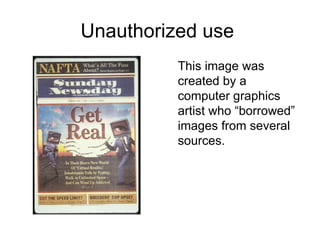
• Copyright Revision Act of 1976
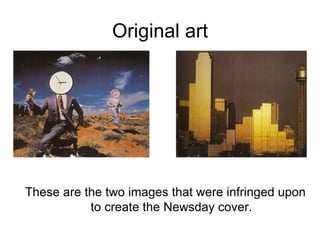
    [effective January 1, 1978]
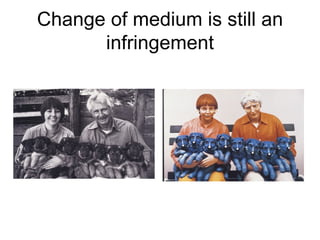
How Copyright protects works


• Copyright protects "original works of authorship"
  that are fixed in "a tangible form of expression."
  The fixed form does not have to be directly
  perceptible so long as it can be communicated
  with the aid of a machine or other device.
What is protected?
• literary works (e.g., all text, including computer
  software);
• musical works;
• dramatic works;
• pantomimes and choreographic works;
• pictorial, graphic, and sculptural works;
• motion pictures and other audiovisual works;
• sound recordings;
• architectural works.
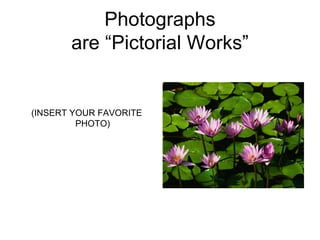
Photographs
       are “Pictorial Works”


(INSERT YOUR FAVORITE
         PHOTO)
What is not protected?
• ideas, concepts, or discoveries;
• titles, names, short phrases, and slogans;
• works that are not fixed in a tangible form of
  expression such as improvised speech or dance;
• works consisting entirely of information that is
  commonly available and contains no originality;
• anything written or created by the US
  government.
What rights does the owner
             control?
Rights to:
• make copies of the work;
• distribute copies of the work;
• perform the work publicly (such as for plays, film,
  or music);
• display the work publicly (such as for artwork, or
  any material used on the internet or television);
  and
• make “derivative works” (including making
  modifications, adaptations or other new uses of
  a work, or translating the work to another
  media).
Limitations
• the "Fair Use" doctrine allows limited copying of
  copyrighted works for educational and research
  purposes. The copyright law provides that
  reproduction "for purposes such as criticism,
  news reporting, teaching (including multiple
  copies for classroom use), scholarship, or
  research" is not an infringement of copyright.
What is Fair Use

• class handouts of very short excerpts from a
  book;
• quoting for purposes of reporting the news or
  criticizing or commenting on a particular work of
  art, writing, speech or scholarship.
What is not Fair Use

• using a photograph or other image to illustrate a
  newsworthy story (because the subject of the
  story is newsworthy it does not make the image
  newsworthy)
Example of Fair Use

• class studying an artist using samples to critique
  and analyze his/her work;
• making a collage for a school project;
• manipulating an image to learn Photoshop or
  other software.
Who owns copyright

• a freelance artist who created the copyrighted
  work;
• an employer who hires employees who create
  copyrighted works as part of their job.
How to transfer rights

• in writing and signed by the party transferring the
  rights
What is infringement?
• use of whole or part of an image without
  permission;
• use beyond the scope of a license;
• adapting an image without permission
  (art rendering, collage);
• asking another photographer to recreate the
  image.
Unauthorized use
          This image was
          created by a
          computer graphics
          artist who “borrowed”
          images from several
          sources.
Original art


These are the two images that were infringed upon
           to create the Newsday cover.
Change of medium is still an
      infringement
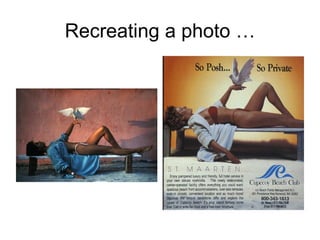
Recreating a photo …
Who is responsible?

• the company that directly infringed;
• employees who participated in the infringement
  or should have supervised;
• anyone who publishes the infringing image
  whether they had knowledge or not.
How to avoid infringement

• obtain a license for all the uses that will be
  needed;
• obtain a license to create a derivative image;
• obtain an art rendering or art reference license
  to change the medium.
How to license
      Royalty Free                Rights Managed
• May use same image          • License limited to
  for many uses without         particular use and
  additional license            time period - may
  -restrictions still apply     request and pay for
• No exclusive use              some exclusive use
  available
Read the license terms for
information on your rights
Popular Copyright Myths
• if it’s on the internet it is in the public domain and
  therefore free;
• if there is no copyright notice, I can use the
  image;
• if I alter the image I don’t need permission;
• if I don’t profit from it, I can use it;
• if I only use a part of the image I don’t need
  permission.
Why should anyone care?
• substantial monetary damages can be awarded
  (actual damages; profits)
• statutory damages ($750-$30,000 and up to
  $150,000 if the infringement was willful)
• the infringing use enjoined;
• attorney’s fees
BE CREATIVE...and respect
       copyright
Pac acop ed

Pac acop ed

  • 1.
    COPYRIGHT AND COPYWRONG “Respect Copyright, Celebrate Creativity”
  • 2.
    US Constitution • ArticleI, Section 8, Clause 8 gave Congress the power to enact laws “To promote the progress of science and useful arts, by securing for limited times to authors and inventors the exclusive right to their respective writings and discoveries.”
  • 3.
    Purpose • to givethe creator control and a monopoly on royalties for a period of time promotes creativity
  • 4.
    Current Copyright Law •Copyright Revision Act of 1976 [effective January 1, 1978]
  • 5.
    How Copyright protectsworks • Copyright protects "original works of authorship" that are fixed in "a tangible form of expression." The fixed form does not have to be directly perceptible so long as it can be communicated with the aid of a machine or other device.
  • 6.
    What is protected? •literary works (e.g., all text, including computer software); • musical works; • dramatic works; • pantomimes and choreographic works; • pictorial, graphic, and sculptural works; • motion pictures and other audiovisual works; • sound recordings; • architectural works.
  • 7.
    Photographs are “Pictorial Works” (INSERT YOUR FAVORITE PHOTO)
  • 8.
    What is notprotected? • ideas, concepts, or discoveries; • titles, names, short phrases, and slogans; • works that are not fixed in a tangible form of expression such as improvised speech or dance; • works consisting entirely of information that is commonly available and contains no originality; • anything written or created by the US government.
  • 9.
    What rights doesthe owner control? Rights to: • make copies of the work; • distribute copies of the work; • perform the work publicly (such as for plays, film, or music); • display the work publicly (such as for artwork, or any material used on the internet or television); and • make “derivative works” (including making modifications, adaptations or other new uses of a work, or translating the work to another media).
  • 10.
    Limitations • the "FairUse" doctrine allows limited copying of copyrighted works for educational and research purposes. The copyright law provides that reproduction "for purposes such as criticism, news reporting, teaching (including multiple copies for classroom use), scholarship, or research" is not an infringement of copyright.
  • 11.
    What is FairUse • class handouts of very short excerpts from a book; • quoting for purposes of reporting the news or criticizing or commenting on a particular work of art, writing, speech or scholarship.
  • 12.
    What is notFair Use • using a photograph or other image to illustrate a newsworthy story (because the subject of the story is newsworthy it does not make the image newsworthy)
  • 13.
    Example of FairUse • class studying an artist using samples to critique and analyze his/her work; • making a collage for a school project; • manipulating an image to learn Photoshop or other software.
  • 14.
    Who owns copyright •a freelance artist who created the copyrighted work; • an employer who hires employees who create copyrighted works as part of their job.
  • 15.
    How to transferrights • in writing and signed by the party transferring the rights
  • 16.
    What is infringement? •use of whole or part of an image without permission; • use beyond the scope of a license; • adapting an image without permission (art rendering, collage); • asking another photographer to recreate the image.
  • 17.
    Unauthorized use This image was created by a computer graphics artist who “borrowed” images from several sources.
  • 18.
    Original art These arethe two images that were infringed upon to create the Newsday cover.
  • 19.
    Change of mediumis still an infringement
  • 20.
  • 21.
    Who is responsible? •the company that directly infringed; • employees who participated in the infringement or should have supervised; • anyone who publishes the infringing image whether they had knowledge or not.
  • 22.
    How to avoidinfringement • obtain a license for all the uses that will be needed; • obtain a license to create a derivative image; • obtain an art rendering or art reference license to change the medium.
  • 23.
    How to license Royalty Free Rights Managed • May use same image • License limited to for many uses without particular use and additional license time period - may -restrictions still apply request and pay for • No exclusive use some exclusive use available
  • 24.
    Read the licenseterms for information on your rights
  • 25.
    Popular Copyright Myths •if it’s on the internet it is in the public domain and therefore free; • if there is no copyright notice, I can use the image; • if I alter the image I don’t need permission; • if I don’t profit from it, I can use it; • if I only use a part of the image I don’t need permission.
  • 26.
    Why should anyonecare? • substantial monetary damages can be awarded (actual damages; profits) • statutory damages ($750-$30,000 and up to $150,000 if the infringement was willful) • the infringing use enjoined; • attorney’s fees
  • 27.

Editor's Notes

  • #3 Source of copyright law is found in the constitution. It permits Congress to make laws to protect and enforce copyright.
  • #4 All creators, including photographers and illustrators are entitled to be paid if their work is used, commercially or otherwise. This encourages creativity and makes more images available for use.
  • #5 Under the current law, copyright attaches upon creation. It is a federal system, which means that the same law applies in every state. A significant change from the prior act is that the creator is presumed the owner in most situations.
  • #8 Add examples of images to enhance the program. This is just a “clip art” filler from PowerPoint
  • #9 Remind the audience that other laws may protect these categories, for example, short phrases could have trademark protection.
  • #10 These rights are exclusive to the owner and permission is needed Copyright is like owning a bundle of sticks (like pick up sticks). You can give different users different rights. The same image can be used on a magazine cover, in an advertisement or incorporated in a documentary film, for example.
  • #11 This is a defense to infringement and is limited in scope. If a use qualifies as fair use is decided by the courts, which balance various factors, and is decided on a case by case basis. If you are unsure if your use is “fair use”, it is safer to ask for permission
  • #13 If you want an example, when a celebrity dies, the death is newsworthy, but any photograph of them is only descriptive and must be licensed. However, if a famous artist’s dies, the news media could show a few samples of his or her most recognized artworks without permission.
  • #14 What you can do in a school environment to learn design is different to what you can do in a commercial environment where you make designs for profit
  • #15 Just because a company pays a freelance artist to create an image, does not transfer copyright ownership.
  • #18 FPG v Newsday. FPG brought and action against Newsday, one of the first cases filed involving the creation of an image using computer manipulation and software. The employee combined elements from various images to create a digital work. The case was settled in an amount that included attorney’s fees.
  • #19 Left: photo by James Porto; Right: photo by Joseph Viesti- These images were cropped, flopped and combined but the original artist could still recognize his work as the main elements were retained
  • #20 Koons v. Art Rogers Sculpture artist Jeff Koons lost this copyright infringement case. The artiss asserted it was fair use to change a photograph into a 3 dimensional work without obtaining a license. The court disagreed finding that substantial copyrightable elements were borrowed despite the change in medium.
  • #21 Photo on left used as comp to create photo on right Unauthorized copying of “copyrightable” elements even though the model was different Same pose, composition, subjects-note that even the bench is the same and the hand with white dove is in same position, shirt draped in a similar manner Ask audience-Do you think this is an infringement?
  • #25 Remember when licensing images online, that you are bound by all the terms on a “click-wrap” agreement, whether you read them or not
  • #26 Public Domain is very misunderstood-since 1978 copyright attaches upon creation. Cannot assume that any work on the internet is public domain The formality of copyright notice is no longer required under US law and never required in most foreign countries, one cannot assume that any work without notice can be used. Altering an image is an exclusive right of the copyright owner and requires permission almost all the time. Any unauthorized use is an infringement whether you profit or not
  • #27 Copyright Lawsuits are expensive to defend, In addition you may ruin a client relationship if the client receives a letter from a lawyer asking it to “cease and desist” all use Advertising campaigns are expensive, and you don’t want to be embarrassed.