Goals for our students:
• Understand global citizenship as consumers
of fashion
• Empower ways of change
• Offer STEM lesson plans and other learning
activities
• See the environmental issues related to fast fashion
• Understand health risks from clothing
manufacturing
Historic Highlights of Fashion in America
1940s
1950s
1960s
1970s
1980s
1990s
2000s
From home sewing to global manufacturing
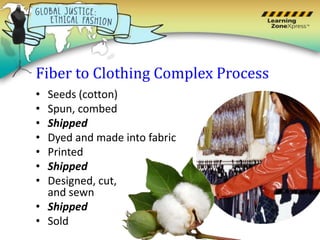
Fiber to Clothing Complex Process
• Seeds (cotton)
• Spun, combed
• Shipped
• Dyed and made into fabric
• Printed
• Shipped
• Designed, cut,
and sewn
• Shipped
• Sold
Fast Fashion
WHO?
Retailers with rapid turnaround of runway styles at low prices to
“create” a consumer demand.
WHAT?
Trendy styles at low cost.
WHERE?
Online and shopping centers.
WHEN?
Frequent (sometimes daily) clothing, shoes, and accessory purchases.
WHY?
More disposable income and new trends to enjoy!
Fast Fashion Brands
• Zara
• H&M
• Topshop
• Forever 21
• Urban Outfitters
• United Colors of
Benetton
• Rue21
• Shasa
• Mango
• GAP
• Wet Seal
• Charlotte Russe
Fast Fashion
• Term used by retailers to describe designs
that move from the runway to the clothing
stores quickly in order to capture current
fashion trends.
• Designed and manufactured quickly and
cheaply to allow consumers to buy trendy
styles at a lower price.
Fast Fashion = Disposable?
• Fast fashion is associated with disposable
fashion
Delivers designed product to a mass market at
relatively low prices
Fabric and construction quality is low and
often doesn’t withstand washing
Issues with Fast Fashion:
• CAUSES
Sweatshops opposed in US and moved to
second and third world countries
• PROBLEMS
Companies pay cheapest wage
Creates unsafe working conditions
Explore Lives of Garment Workers
Li Na – China
Sadia – Bangladesh
Ledye – Honduras
Mary – United States
Environmental Impact
• Every step in clothing production harms
different parts of the ecosystem
Pollution and destruction of terrestrial and
aquatic habitats
Release of toxic and greenhouse gases into the
atmosphere
Claudio, Luz (2007). “Waste Couture: Environmental Impact of the
Clothing Industry”. Environmental Health Perspective: A449-A454.
Environmental Damages:
• CAUSES
Fast fashion demands
cause exhaust and
chemical outputs to rise
Shipping for cheapest
manufacturing
Pesticides, bleach,
formaldehyde to prevent
bugs and preserve fabric
• PROBLEMS
Pollution from
increased
exhaust
Oil usage
High water
usage
http://www.patagonia.com/us/footprint
Health
Risks
• PROBLEMS
Carcinogens in
dye and fabric
Flammable
Skin and lung
sensitivities
• CAUSES
Fibers made from oil
Cheaper dyes
Chemicals added
Slow Fashion Movement
• The slow fashion movement has arisen in
opposition to fast fashion, blaming it for:
Pollution (both in the production of clothes
and in the decay of synthetic fabrics)
Shoddy workmanship
Emphasizing very brief trends over classic style
Benefits of Buying Fair Trade
Sustainable Fashion
• Environmental
 Decrease pollutants and water use
• Social
 Help communities where goods are made
• Economic
 Workers earn fair wages
 Consumers understand processes with transparency
Best known for certification in coffee, Fair Trade is a market-based
approach to improving the lives of farmers and workers, protecting the
environment, and delivering quality and safety. At its core, Fair Trade puts
people at the center of sustainability.
Ethical Fashion Brands
• American Apparel
• amour vert
• Artisans du Monde
• CommonThreadz
• Everlane
• Fair Indigo
• Global Girlfriend
• Global Mamas
• green 3
• Handwork of India
• HAE Now
• IOWEYOU
• Indigenous Designs
• Maggie’s Organics
• Mata Traders
• Nally & Millie
• Neon Buddha
• Oak73
• Oliberté
• Osmium
• PACT
• Patagonia
• People Tree
• prAna
• Rodale’s
• Splendid
• Synergy Organic
Clothing
• Threads 4 Thought
• Tompkins Point
Apparel
Embrace Global Citizenship
• What can we do?
Source from same country
Pay living wage/buy
fair trade
Sign onto safety
agreements
Find solutions to reuse
clothing
Find solutions for
environmental damage
Curriculum can…
• Raise awareness of unethical practices
• Inform consumers
• Offer solutions to the problem
• Change the future, change the world!
Empower Students in Ways of Change!
• Consumer voice
• Giving voice to workers, fair wages
and safe workplace
accommodations
• Locally made
• Water reduction
• Knowledge is power:
understand ethical issues
of fast fashion
• Alternative materials:
organic cotton, banana fibers,
water bottles, or recycling
Overwhelmed? Start with one thing.
• Read a label, research a company
• Choose your leading cause
• Communicate with concerns to companies
• Recycle and reduce current
clothing consumption
• Swap, reuse,
shop resale
• Support Fair Trade
companies that aid
your cause
• Spread the word!
Learn More
www.fairtradeusa.org
Learn how Fair Trade improves lives
www.triplepundit.com
5 Things You May Not Know About Fair Trade
Apparel
www.matatraders.com
Mata Traders: Fair Trade Fashion
Inspire STEM Lessons
1. How could you help lower chemical outputs?
2. How could you decrease water usage?
3. What organic materials could we use to cut
chemicals in dyes?
4. What technology might help cut down on
shipping inefficiency?
Free Resources from Learning ZoneXpress
• Global Justice: Ethical Fashion PowerPoint
• Learning Activities
Consumer Cares Activity
Behind the Label Activity
Where Does the Money Go Activity
Textile lab: Experimenting with Fibers
and Prints
All available for download on our blog:
facsalive.com

Global justice final

  • 2.
    Goals for ourstudents: • Understand global citizenship as consumers of fashion • Empower ways of change • Offer STEM lesson plans and other learning activities • See the environmental issues related to fast fashion • Understand health risks from clothing manufacturing
  • 3.
    Historic Highlights ofFashion in America 1940s 1950s 1960s 1970s 1980s 1990s 2000s From home sewing to global manufacturing
  • 4.
    Fiber to ClothingComplex Process • Seeds (cotton) • Spun, combed • Shipped • Dyed and made into fabric • Printed • Shipped • Designed, cut, and sewn • Shipped • Sold
  • 5.
    Fast Fashion WHO? Retailers withrapid turnaround of runway styles at low prices to “create” a consumer demand. WHAT? Trendy styles at low cost. WHERE? Online and shopping centers. WHEN? Frequent (sometimes daily) clothing, shoes, and accessory purchases. WHY? More disposable income and new trends to enjoy!
  • 6.
    Fast Fashion Brands •Zara • H&M • Topshop • Forever 21 • Urban Outfitters • United Colors of Benetton • Rue21 • Shasa • Mango • GAP • Wet Seal • Charlotte Russe
  • 7.
    Fast Fashion • Termused by retailers to describe designs that move from the runway to the clothing stores quickly in order to capture current fashion trends. • Designed and manufactured quickly and cheaply to allow consumers to buy trendy styles at a lower price.
  • 8.
    Fast Fashion =Disposable? • Fast fashion is associated with disposable fashion Delivers designed product to a mass market at relatively low prices Fabric and construction quality is low and often doesn’t withstand washing
  • 9.
    Issues with FastFashion: • CAUSES Sweatshops opposed in US and moved to second and third world countries • PROBLEMS Companies pay cheapest wage Creates unsafe working conditions
  • 10.
    Explore Lives ofGarment Workers Li Na – China Sadia – Bangladesh Ledye – Honduras Mary – United States
  • 11.
    Environmental Impact • Everystep in clothing production harms different parts of the ecosystem Pollution and destruction of terrestrial and aquatic habitats Release of toxic and greenhouse gases into the atmosphere Claudio, Luz (2007). “Waste Couture: Environmental Impact of the Clothing Industry”. Environmental Health Perspective: A449-A454.
  • 12.
    Environmental Damages: • CAUSES Fastfashion demands cause exhaust and chemical outputs to rise Shipping for cheapest manufacturing Pesticides, bleach, formaldehyde to prevent bugs and preserve fabric • PROBLEMS Pollution from increased exhaust Oil usage High water usage
  • 13.
  • 14.
    Health Risks • PROBLEMS Carcinogens in dyeand fabric Flammable Skin and lung sensitivities • CAUSES Fibers made from oil Cheaper dyes Chemicals added
  • 15.
    Slow Fashion Movement •The slow fashion movement has arisen in opposition to fast fashion, blaming it for: Pollution (both in the production of clothes and in the decay of synthetic fabrics) Shoddy workmanship Emphasizing very brief trends over classic style
  • 16.
    Benefits of BuyingFair Trade Sustainable Fashion • Environmental  Decrease pollutants and water use • Social  Help communities where goods are made • Economic  Workers earn fair wages  Consumers understand processes with transparency Best known for certification in coffee, Fair Trade is a market-based approach to improving the lives of farmers and workers, protecting the environment, and delivering quality and safety. At its core, Fair Trade puts people at the center of sustainability.
  • 17.
    Ethical Fashion Brands •American Apparel • amour vert • Artisans du Monde • CommonThreadz • Everlane • Fair Indigo • Global Girlfriend • Global Mamas • green 3 • Handwork of India • HAE Now • IOWEYOU • Indigenous Designs • Maggie’s Organics • Mata Traders • Nally & Millie • Neon Buddha • Oak73 • Oliberté • Osmium • PACT • Patagonia • People Tree • prAna • Rodale’s • Splendid • Synergy Organic Clothing • Threads 4 Thought • Tompkins Point Apparel
  • 18.
    Embrace Global Citizenship •What can we do? Source from same country Pay living wage/buy fair trade Sign onto safety agreements Find solutions to reuse clothing Find solutions for environmental damage
  • 19.
    Curriculum can… • Raiseawareness of unethical practices • Inform consumers • Offer solutions to the problem • Change the future, change the world!
  • 20.
    Empower Students inWays of Change! • Consumer voice • Giving voice to workers, fair wages and safe workplace accommodations • Locally made • Water reduction • Knowledge is power: understand ethical issues of fast fashion • Alternative materials: organic cotton, banana fibers, water bottles, or recycling
  • 21.
    Overwhelmed? Start withone thing. • Read a label, research a company • Choose your leading cause • Communicate with concerns to companies • Recycle and reduce current clothing consumption • Swap, reuse, shop resale • Support Fair Trade companies that aid your cause • Spread the word!
  • 22.
    Learn More www.fairtradeusa.org Learn howFair Trade improves lives www.triplepundit.com 5 Things You May Not Know About Fair Trade Apparel www.matatraders.com Mata Traders: Fair Trade Fashion
  • 23.
    Inspire STEM Lessons 1.How could you help lower chemical outputs? 2. How could you decrease water usage? 3. What organic materials could we use to cut chemicals in dyes? 4. What technology might help cut down on shipping inefficiency?
  • 24.
    Free Resources fromLearning ZoneXpress • Global Justice: Ethical Fashion PowerPoint • Learning Activities Consumer Cares Activity Behind the Label Activity Where Does the Money Go Activity Textile lab: Experimenting with Fibers and Prints All available for download on our blog: facsalive.com

Editor's Notes

  • #4 Read aloud and guess which pictures portray each period of clothing trends. Fashion has changed greatly over the last 75 years. In the 1940s, most people had a seamstress in the family or in town. They may have brought old curtains, feed sacks, or blankets to the seamstress to make skirts, spring dresses and winter coats. Sewing focused on practicality emphasizing durability, resourcefulness and style. Sustainability was a way of life and frivolity was out of the question. In the 1950s, fashion saw patterns and trends emerge with greater volume. World War II had ended and petroleum was available to a country whose economy needed to keep manufacturing levels high. New fibers were created out of petroleum and new fabrics such as polyester were more easily and economically manufactured. With new fabrics and time to design, new styles a sense of fashion rushed to meet a booming social scene. Cocktail attire reigned supreme. The 60s continued to change patterns and roll out new styles. Personal sewing machines, affordable fabrics, and mod lifestyles reflected a growing sense of empowerment and creativity. Fashion moved into ready to wear department stores by mass quantities. This meant not only could you attain a style by having your family member or tailor create it, but now you could go to the store and find your size right on the rack - ready made and ready to wear! The 1970s cemented a revolution. Fabrics and styles offered comfort as the United States divided over war and women demanded equality. Supply met demand and women’s pants no longer turned heads in surprise. Blue jeans took over the trends and styles were made to fit a lifestyle of contemplation, relaxation, and protest. Manufacturing is able to increase production due to innovations in plant pesticides, chemicals, and automated systems. In the 1980s, fashion celebrated our economic boom and personal independence with a party flair. Some consumers demanded “Made in the USA” to uphold their values and support the economy. This emphasis grew out of a sense of patriotism. Women had entered the workforce and fashion reflected intentions to attain the professional appearance of their male counterparts. The number of malls had doubled and shopping opportunities now abounded. In the 90s, fashion found a new level of comfort as focus shifted from national support to individual needs trusting the country was stable. As disposable income and inherited wealth were on the rise, consumer spending rose. Fashion took advantage becoming more cheaply made to feed trends rather than durability. The consumer had become educated to the ways of manufacturing and resistance rose against American sweatshops. In 2000, brought the new millennium and manufacturing moved overseas to avoid local sweatshop policy. Clothing became increasingly affordable with styles varying and change more often. Now, with the internet and technological advances, manufacturing abilities are erupting. Companies are able to shop around for the cheapest labor and materials as well as the most lax environmental policies. Clothing companies move production often and ship parts from around the globe.
  • #6 Average American purchases doubled in 20 years to 68 new clothing items annually in 2010. For more information, read The End of Fashion, Mass Marketing of the Clothing Business by Teri Agins and Overdressed: The Shockingly High Cost of Cheap Fashion by Elizabeth L. Cline
  • #8 Fast fashion clothing collections are based on the most recent fashion trends presented at Fashion Week in both the spring and the autumn of every year. These trends are designed and manufactured quickly and cheaply to allow the mainstream consumer to buy current clothing styles at a lower price. This philosophy of quick manufacturing at an affordable price is used in large retailers such as H&M, Forever 21, Zara, and Topshop.
  • #11 What concerns do each of these women face in their lives? Suggest comparisons to the students’ lives pointing out access to education, processed foods, balanced diets, safety and savings for future possibilities. Ponder health care situations with the class. Meet Sadia, a garment factory worker from Bangladesh. The garment industry makes up 96% of the Bangladesh economy. Sadia is making $0.94 per hour and she works hard to accumulate 75 hours per week. She lives in a hut with her three children and they sleep on straw mats. Sadia’s family eats mostly rice and are severely undernourished. Sadia’s mother and aunts work in the factory with her and they’ve been asking for more money for 30 years. likes having so many friends and neighbors at work around her and hopes they can all make a little more money so they can afford school for their children and a few more vegetables for their family meals each week. Sadia does not dream of leaving the way she lives and is reasonably happy. She feels she would be happier if she didn’t worry about her kids being hungry. Sadia worries each day about the factory environment as her cough worsens and she has friends who were injured in a large factory collapse that killed 1,000 women. Meet Mary, a seamstress at Clothing USA factory. Mary lives in a small apartment with her two kids. Her ex-husband works at the hospital laundry. They balance shifts as he works four 12-hour shifts each week and she works 9 am to 7 pm five days a week. She makes $16.15 an hour, which is barely adequate to meet the basic needs of her family, especially in a big city like New York. Mary drops the kids off at school in the morning and her mom watches them after school. Since she works long shifts at the factory and isn’t home for meals, she leaves them options like pizza and macaroni and cheese to make for dinner. Meet Li Na, a garment worker in China. Li Na lives in the factory dormitory and works 12 hour days 6 days a week. She does not plan to marry and at $1.68 per hour sends what she can home to support her parents. Meet Ledye, a manager at a fair trade company cooperative of seamstresses in Honduras. Ledye makes $2.15 an hour and has company assistance to send her kids to school. This company trained Ledye in the sewing trade, provides breaks, works with her to accommodate hours for her family, and has moved her to the manager position. Ledye lives in a hut compound with shelter and beds. She and her friends eat balanced meals with vegetables, fruits, meat, bread and rice. The company brings doctors as well as clean water systems to the community. For more information: Made in China: Women Factory Workers in Global Workplace by PUN Ngai “Southern California is hotbed for wage theft in garment industry” by Tiffany Hsu and Chris Kirkham, Los Angeles Times, November 15, 2014 - http://www.latimes.com/business/la-fi-wage-theft-20141114-story.html#page=1 See www.lizalig.com for more of Ledye’s story
  • #12 These problems are only exacerbated by fast fashion in developed countries, particularly the United States, which imports more than 1 billion garments annually from China alone.
  • #18 Patagonia had 10 Fair Trade Certified styles in Fall 2014