WHAT IS LAW?
INTRODUCTION TO LAW
1
LAW012
NOR AKHMAL HASMIN
1
a) Definition of law
- general definition
- definition given by jurists
b) Function of law
c) Different perspectives of law
TOPIC OUTLINE
2
WHAT IS LAW?????
- What is law as a definition
3
General definition:
• No specific definition on what is LAW – many interpretations of
law according to belief, value, custom etc.
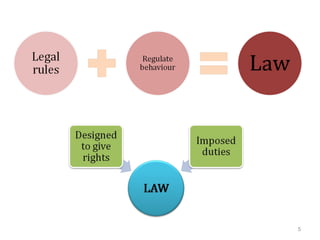
• Law is a system of rules where it guides and directs our
activities in much of day to day life (framework of life) – our life
is built upon the foundation of legal rules.
• Law is a set of rules that guide our conduct in society and
enforceable by public agency – everyone has to follow or
otherwise they have to face sanctions or penalty as
consequences of its breach.
• GENERAL RULE OF CONDUCT.
• Oxford English Dictionary:
“ The body of enacted or customary rules recognised by
community as binding.”
4
5
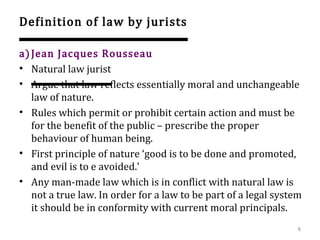
Definition of law by jurists
a)Jean Jacques Rousseau
• Natural law jurist
• Argue that law reflects essentially moral and unchangeable
law of nature.
• Rules which permit or prohibit certain action and must be
for the benefit of the public – prescribe the proper
behaviour of human being.
• First principle of nature ‘good is to be done and promoted,
and evil is to e avoided.’
• Any man-made law which is in conflict with natural law is
not a true law. In order for a law to be part of a legal system
it should be in conformity with current moral principals.
6
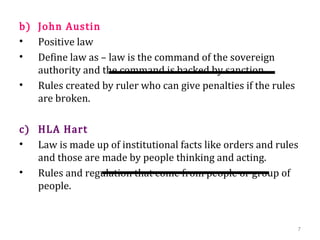
b) John Austin
• Positive law
• Define law as – law is the command of the sovereign
authority and the command is backed by sanction.
• Rules created by ruler who can give penalties if the rules
are broken.
c) HLA Hart
• Law is made up of institutional facts like orders and rules
and those are made by people thinking and acting.
• Rules and regulation that come from people or group of
people.
7
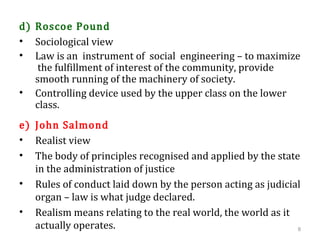
d) Roscoe Pound
• Sociological view
• Law is an instrument of social engineering – to maximize
the fulfillment of interest of the community, provide
smooth running of the machinery of society.
• Controlling device used by the upper class on the lower
class.
e) John Salmond
• Realist view
• The body of principles recognised and applied by the state
in the administration of justice
• Rules of conduct laid down by the person acting as judicial
organ – law is what judge declared.
• Realism means relating to the real world, the world as it
actually operates. 8
 Administration of justice – what lawful and unlawful
 Granting powers to certain bodies/institutions
 Maintaining standard
 Maintenance of peace and social orders
 Resolving of disputes/conflicts
 Social control – prescribe punishment and remedies in the
event of breach.
 Social engineering/ construction
 Determination of legal personality
Functions of law
9
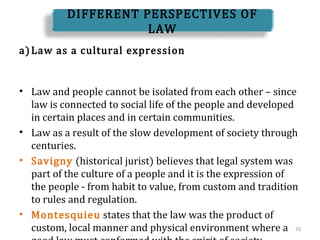
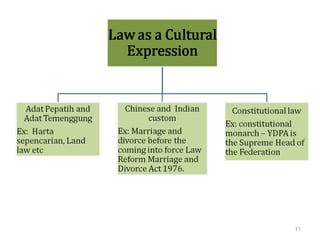
a)Law as a cultural expression
• Law and people cannot be isolated from each other – since
law is connected to social life of the people and developed
in certain places and in certain communities.
• Law as a result of the slow development of society through
centuries.
• Savigny (historical jurist) believes that legal system was
part of the culture of a people and it is the expression of
the people - from habit to value, from custom and tradition
to rules and regulation.
• Montesquieu states that the law was the product of
custom, local manner and physical environment where a
DIFFERENT PERSPECTIVES OF
LAW
10
11
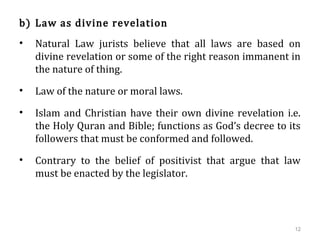
b) Law as divine revelation
• Natural Law jurists believe that all laws are based on
divine revelation or some of the right reason immanent in
the nature of thing.
• Law of the nature or moral laws.
• Islam and Christian have their own divine revelation i.e.
the Holy Quran and Bible; functions as God’s decree to its
followers that must be conformed and followed.
• Contrary to the belief of positivist that argue that law
must be enacted by the legislator.
12
c) Law as an instrument of government
• Law is intimately associated with the nature of the State –
because law is an expression of the will of the State i.e the
government.
Example : law introduced by the government must be
abide by the citizens – 6% GST.
• Marxism-Leninism - Law is used as the only tool of the
State to maintain and safeguard the interest of the
capitalist class, a dominant group in society.
• Malcolm Wood claims that law is but one a weapon in
massive political tool- combination of forces, actions and
inactivity. E.g. forces including repression, covert
practices, media manipulation, censorship etc. 13
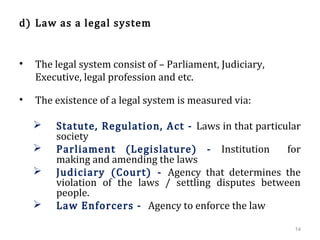
d) Law as a legal system
• The legal system consist of – Parliament, Judiciary,
Executive, legal profession and etc.
• The existence of a legal system is measured via:
 Statute, Regulation, Act - Laws in that particular
society
 Parliament (Legislature) - Institution for
making and amending the laws
 Judiciary (Court) - Agency that determines the
violation of the laws / settling disputes between
people.
 Law Enforcers - Agency to enforce the law
14
Several factors have contributed to the evolution of law.
a)Custom
• Based on the general usage of the family, clan or tribe –
shaped by the cooperative action of the whole community
and not by legislation or sovereign.
• Initially not law but when States recognizes the these
customary rules as binding, they acquire status of law.
b) Religion
• The Mohammedan Law – Quran and shariat
• Hindu law – Code of Manu
SOURCES OF LAW
15
c) Judicial decision
• Judge made law – related with the Common Law system.
d) Legislation
• Law enacted by the parliament – where sovereign power
will issue a decree concerning new matters.
Example: ISIS threat in Malaysia – lead to the passing of
POTA
• It considers as one of the most prolific and direct source
of law.
e) Scientific commentaries
• Discussion by the eminent jurists also modify and
developed law – express their opinions and
commentaries.
16
17
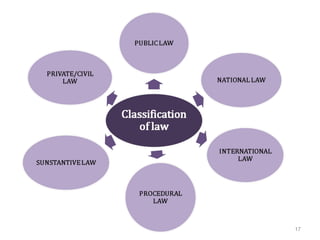
a) PUBLIC LAW
• The law that govern relationship between individual and
government.
• Includes:
a) Constitutional law
b) Criminal law
c) Administration law
b) PRIVATE LAW
• Governs the relationship between individuals -compensate the
injured parties, to recovered property and to enforce obligation.
• Includes:
a) Tort d) Trust
b) Contract
c) Family
18
c) SUNBSTANTIVE LAW
• Law that classifies right and responsibilities of individual
d) PROCEDURAL LAW
• Lays down the rules governing how things should be
done.
Example: How summon should be serve
How to arrest should be made
e) INTERNATIONAL LAW
• Law that covers a relation of country inter-se
d) NATIONAL LAW
• Law that governs a relation between states.
19
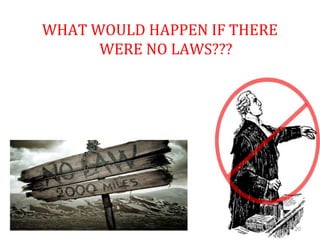
WHAT WOULD HAPPEN IF THERE
WERE NO LAWS???
20
21

1) what is law (1)

  • 1.
    WHAT IS LAW? INTRODUCTIONTO LAW 1 LAW012 NOR AKHMAL HASMIN 1
  • 2.
    a) Definition oflaw - general definition - definition given by jurists b) Function of law c) Different perspectives of law TOPIC OUTLINE 2
  • 3.
    WHAT IS LAW????? -What is law as a definition 3
  • 4.
    General definition: • Nospecific definition on what is LAW – many interpretations of law according to belief, value, custom etc. • Law is a system of rules where it guides and directs our activities in much of day to day life (framework of life) – our life is built upon the foundation of legal rules. • Law is a set of rules that guide our conduct in society and enforceable by public agency – everyone has to follow or otherwise they have to face sanctions or penalty as consequences of its breach. • GENERAL RULE OF CONDUCT. • Oxford English Dictionary: “ The body of enacted or customary rules recognised by community as binding.” 4
  • 5.
  • 6.
    Definition of lawby jurists a)Jean Jacques Rousseau • Natural law jurist • Argue that law reflects essentially moral and unchangeable law of nature. • Rules which permit or prohibit certain action and must be for the benefit of the public – prescribe the proper behaviour of human being. • First principle of nature ‘good is to be done and promoted, and evil is to e avoided.’ • Any man-made law which is in conflict with natural law is not a true law. In order for a law to be part of a legal system it should be in conformity with current moral principals. 6
  • 7.
    b) John Austin •Positive law • Define law as – law is the command of the sovereign authority and the command is backed by sanction. • Rules created by ruler who can give penalties if the rules are broken. c) HLA Hart • Law is made up of institutional facts like orders and rules and those are made by people thinking and acting. • Rules and regulation that come from people or group of people. 7
  • 8.
    d) Roscoe Pound •Sociological view • Law is an instrument of social engineering – to maximize the fulfillment of interest of the community, provide smooth running of the machinery of society. • Controlling device used by the upper class on the lower class. e) John Salmond • Realist view • The body of principles recognised and applied by the state in the administration of justice • Rules of conduct laid down by the person acting as judicial organ – law is what judge declared. • Realism means relating to the real world, the world as it actually operates. 8
  • 9.
     Administration ofjustice – what lawful and unlawful  Granting powers to certain bodies/institutions  Maintaining standard  Maintenance of peace and social orders  Resolving of disputes/conflicts  Social control – prescribe punishment and remedies in the event of breach.  Social engineering/ construction  Determination of legal personality Functions of law 9
  • 10.
    a)Law as acultural expression • Law and people cannot be isolated from each other – since law is connected to social life of the people and developed in certain places and in certain communities. • Law as a result of the slow development of society through centuries. • Savigny (historical jurist) believes that legal system was part of the culture of a people and it is the expression of the people - from habit to value, from custom and tradition to rules and regulation. • Montesquieu states that the law was the product of custom, local manner and physical environment where a DIFFERENT PERSPECTIVES OF LAW 10
  • 11.
  • 12.
    b) Law asdivine revelation • Natural Law jurists believe that all laws are based on divine revelation or some of the right reason immanent in the nature of thing. • Law of the nature or moral laws. • Islam and Christian have their own divine revelation i.e. the Holy Quran and Bible; functions as God’s decree to its followers that must be conformed and followed. • Contrary to the belief of positivist that argue that law must be enacted by the legislator. 12
  • 13.
    c) Law asan instrument of government • Law is intimately associated with the nature of the State – because law is an expression of the will of the State i.e the government. Example : law introduced by the government must be abide by the citizens – 6% GST. • Marxism-Leninism - Law is used as the only tool of the State to maintain and safeguard the interest of the capitalist class, a dominant group in society. • Malcolm Wood claims that law is but one a weapon in massive political tool- combination of forces, actions and inactivity. E.g. forces including repression, covert practices, media manipulation, censorship etc. 13
  • 14.
    d) Law asa legal system • The legal system consist of – Parliament, Judiciary, Executive, legal profession and etc. • The existence of a legal system is measured via:  Statute, Regulation, Act - Laws in that particular society  Parliament (Legislature) - Institution for making and amending the laws  Judiciary (Court) - Agency that determines the violation of the laws / settling disputes between people.  Law Enforcers - Agency to enforce the law 14
  • 15.
    Several factors havecontributed to the evolution of law. a)Custom • Based on the general usage of the family, clan or tribe – shaped by the cooperative action of the whole community and not by legislation or sovereign. • Initially not law but when States recognizes the these customary rules as binding, they acquire status of law. b) Religion • The Mohammedan Law – Quran and shariat • Hindu law – Code of Manu SOURCES OF LAW 15
  • 16.
    c) Judicial decision •Judge made law – related with the Common Law system. d) Legislation • Law enacted by the parliament – where sovereign power will issue a decree concerning new matters. Example: ISIS threat in Malaysia – lead to the passing of POTA • It considers as one of the most prolific and direct source of law. e) Scientific commentaries • Discussion by the eminent jurists also modify and developed law – express their opinions and commentaries. 16
  • 17.
  • 18.
    a) PUBLIC LAW •The law that govern relationship between individual and government. • Includes: a) Constitutional law b) Criminal law c) Administration law b) PRIVATE LAW • Governs the relationship between individuals -compensate the injured parties, to recovered property and to enforce obligation. • Includes: a) Tort d) Trust b) Contract c) Family 18
  • 19.
    c) SUNBSTANTIVE LAW •Law that classifies right and responsibilities of individual d) PROCEDURAL LAW • Lays down the rules governing how things should be done. Example: How summon should be serve How to arrest should be made e) INTERNATIONAL LAW • Law that covers a relation of country inter-se d) NATIONAL LAW • Law that governs a relation between states. 19
  • 20.
    WHAT WOULD HAPPENIF THERE WERE NO LAWS??? 20
  • 21.