Meiosis & Sexual
 Reproduction
Sexual Reproduction
►2  parents
► Exchange of DNA
► Offspring genetically different from parents
► Involves specialized sex cells (gametes)
► Creates diversity
Sexual Reproduction in Simple
         Organisms
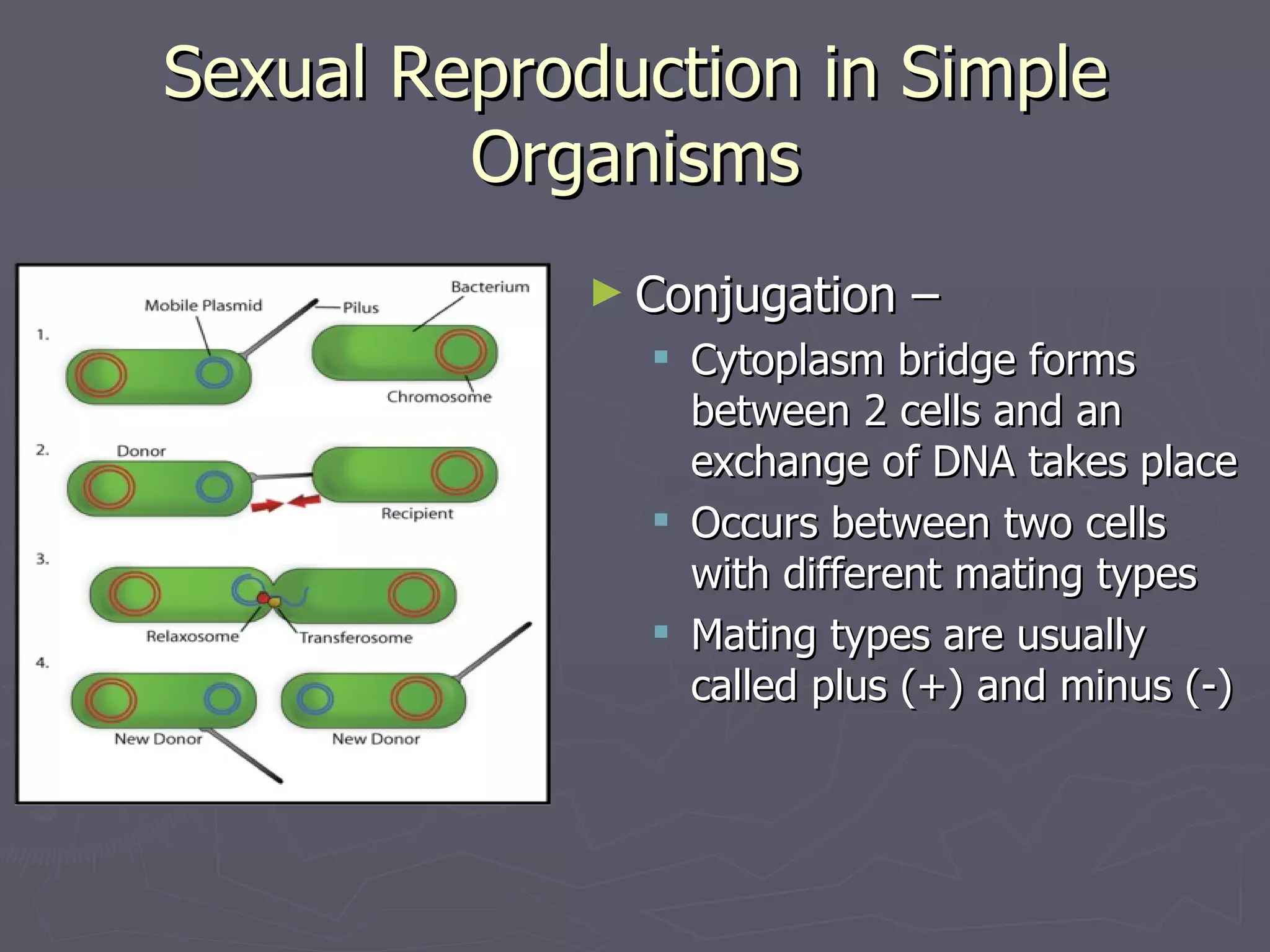
            ► Conjugation   –
               Cytoplasm bridge forms
                between 2 cells and an
                exchange of DNA takes place
               Occurs between two cells
                with different mating types
               Mating types are usually
                called plus (+) and minus (-)
Sexual Reproduction in Animals


► Each   parent produces a GAMETE
   Female gamete – egg
   Male gamete - sperm
► The   two gametes combine and produce a zygote
   Called fertilization
► Thezygote then divides by mitosis, grows and
 process begins again
   Zygote has the same number of chromosomes as the
    parents
Somatic cells vs. Gametes
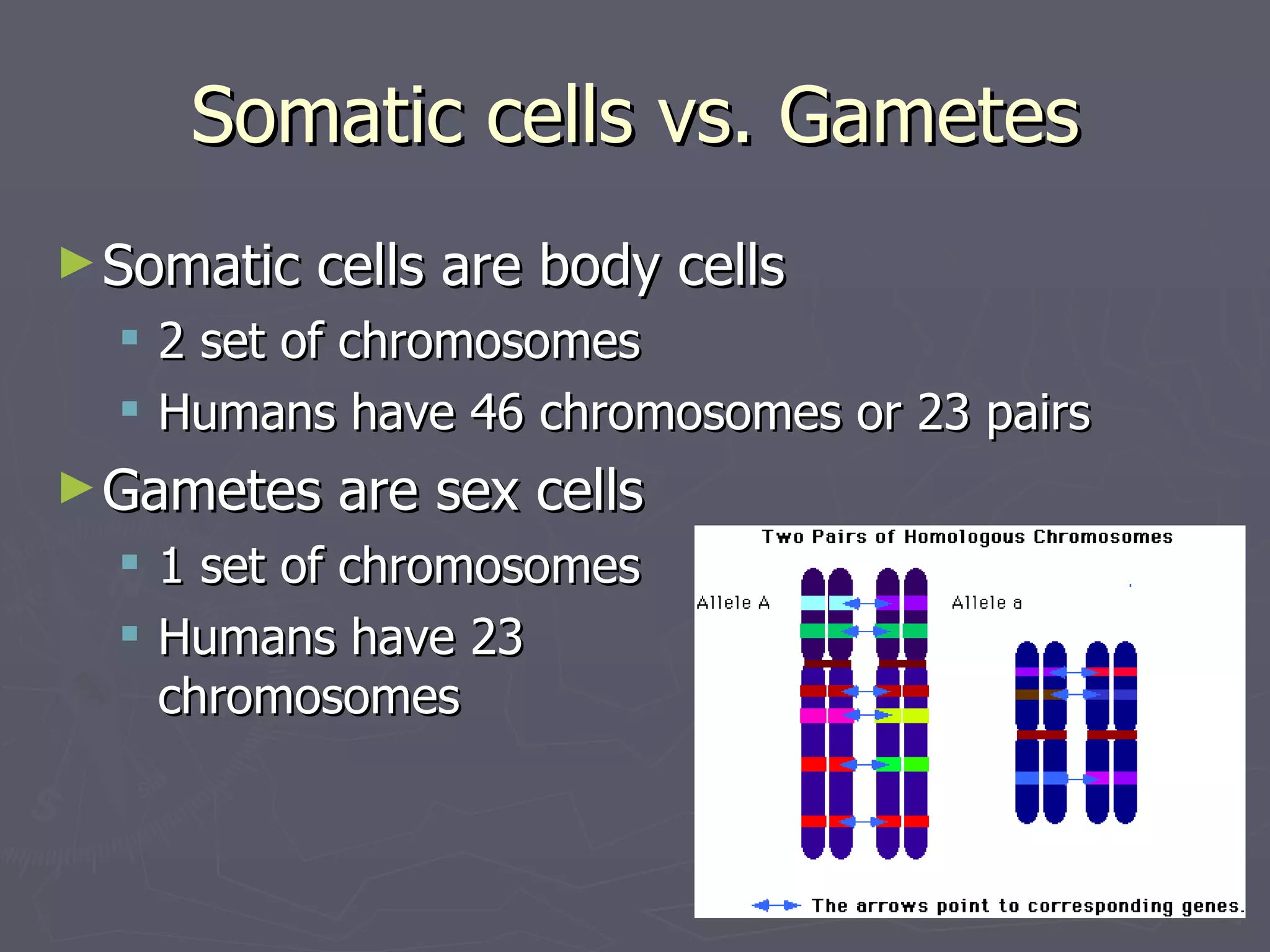
► Somatic   cells are body cells
     2 set of chromosomes
     Humans have 46 chromosomes or 23 pairs
► Gametes    are sex cells
   1 set of chromosomes
   Humans have 23
    chromosomes
How are gametes produced?
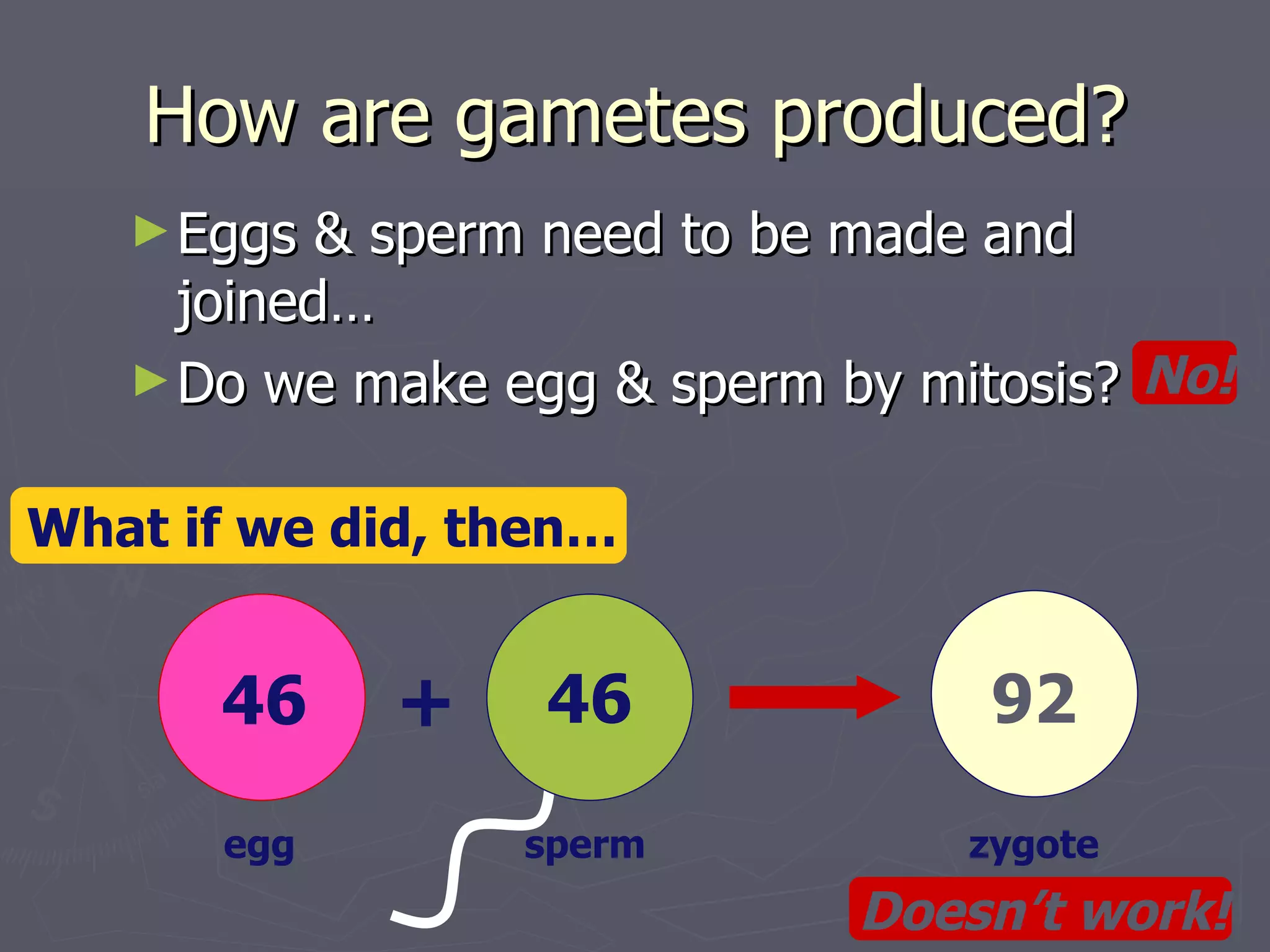
   ► Eggs  & sperm need to be made and
     joined…
   ► Do we make egg & sperm by mitosis? No!


What if we did, then…


      46     +    46              92

      egg        sperm           zygote
                             Doesn’t work!
diploid = 2 copies 2n   Human female karyotype


               46 chromosomes
               23 pairs


                                        XX
diploid = 2 copies 2n   Human male karyotype


              46 chromosomes
              23 pairs


                                 XY
Paired chromosomes
► Homologous  chromosomes
   both chromosomes of a pair carry “matching”
    genes
    ►control
           same inherited characters
    ►homologous = same information
    diploid
    2n         eye color   eye color
    2n = 4     (brown?)    (blue?)


                   homologous  double stranded
                   chromosomes homologous chromosomes
How do we make sperm & eggs?
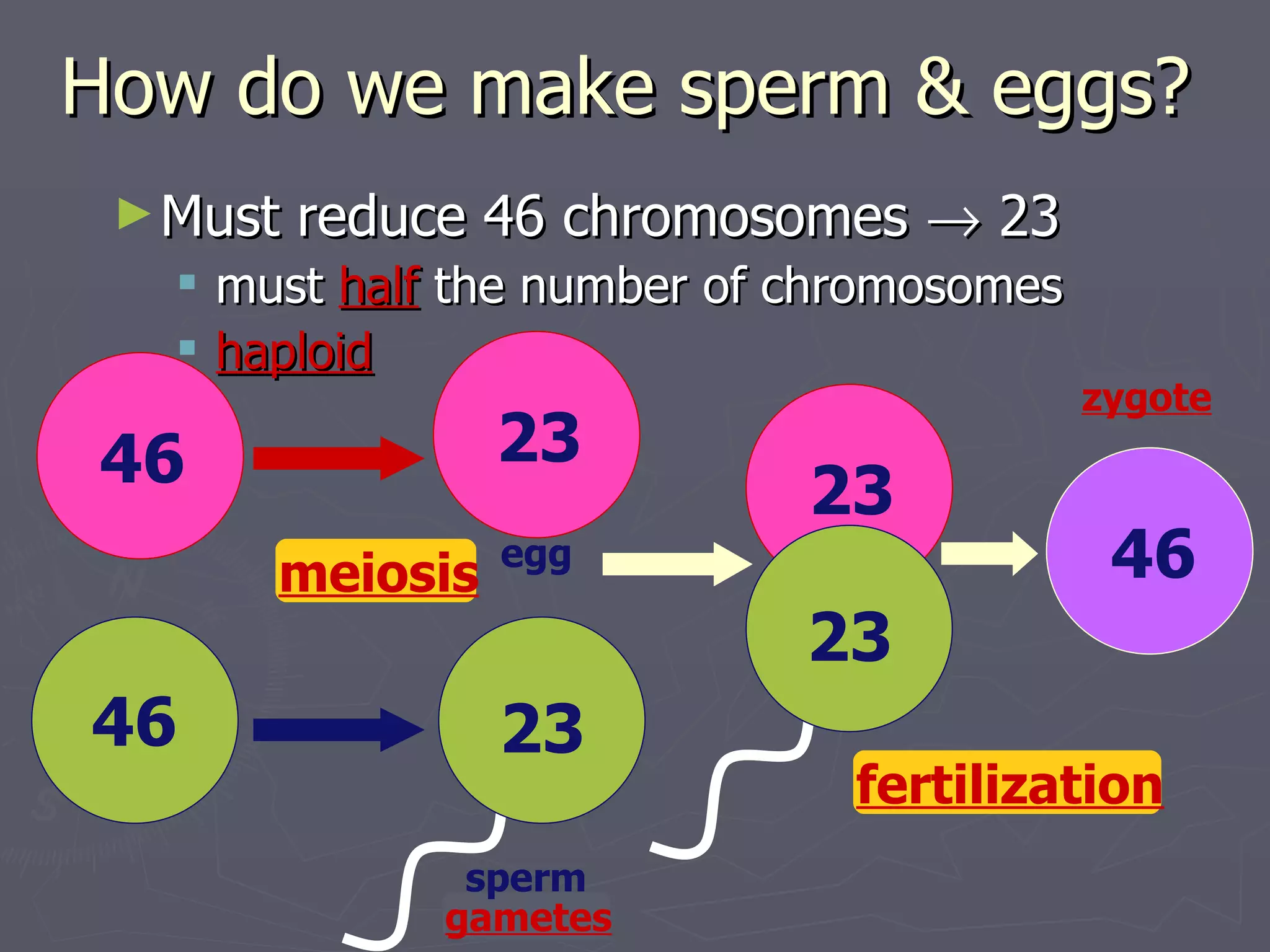
 ► Must   reduce 46 chromosomes → 23
    must half the number of chromosomes
    haploid
                                           zygote
46               23
                             23
       meiosis   egg                        46
                             23
46               23
                               fertilization
                sperm
               gametes
Meiosis makes sperm & eggs
► 46   chromosomes to 23 chromosomes
   half the number of chromosomes


          46                23
                            egg
                meiosis

          46                23
diploid                    sperm     haploid
Meiosis
► Specialcell division in sexually reproducing
  organisms
► Makes gametes
   Sperm & egg
► Reduction   division
     Reduce number of chromosomes
     2n  1n
     diploid  haploid
Interphase
     ► DNA   replicates
     ► Cell prepares for
       division
Prophase I
     ►   Homologous chromosomes
         pair up and form a tetrad
          This is called synapsis
     ►   Crossing over occurs
         during synapsis
          Homologous chromosomes
           exchange segments of DNA
Metaphase I
      ► Tetrads  line up at the
        equator.
      ► Centromeres attach
        chromosomes to the
        spindle fibers
Anaphase I
     ► Homologous
      chromosomes separate
      and move to the poles
        Called disjunctions
        Sister chromatids
         remain attached
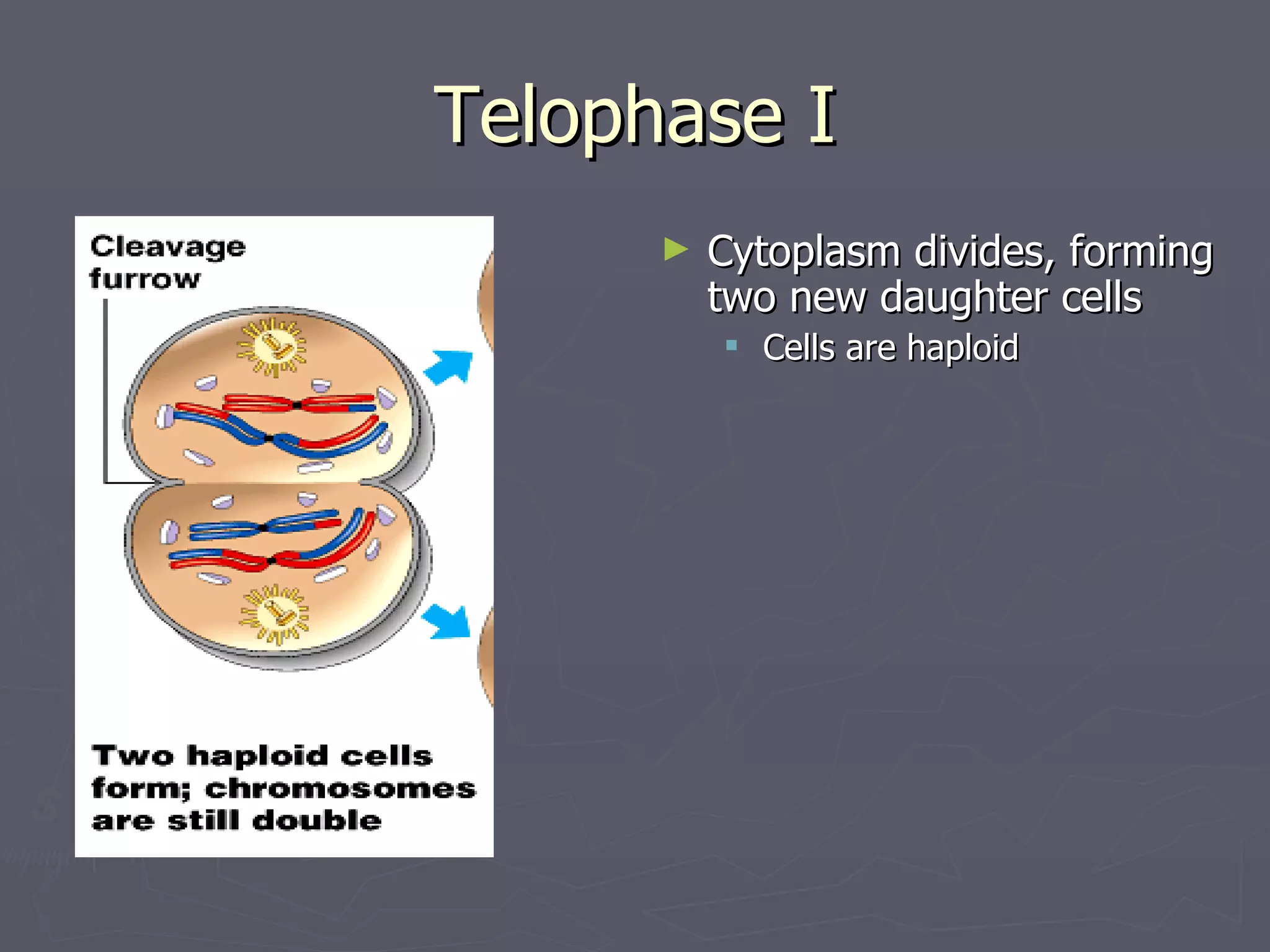
Telophase I
      ►   Cytoplasm divides, forming
          two new daughter cells
           Cells are haploid
Cytokinesis I
► Occurs   simultaneously with telophase I
   Forms 2 daughter cells
► Plantcells – cell plate
► Animal cells – cleavage furrow
► There is no further replication of
  genetic material prior to meiosis II
Prophase II
      ► Spindle  forms
      ► Sister chromatids
        move toward the
        equator
Metaphase II
      ► Sister chromatids line
        up at the equator
         Similar to mitosis
      ► Spindle fibers attach at
        the centromere
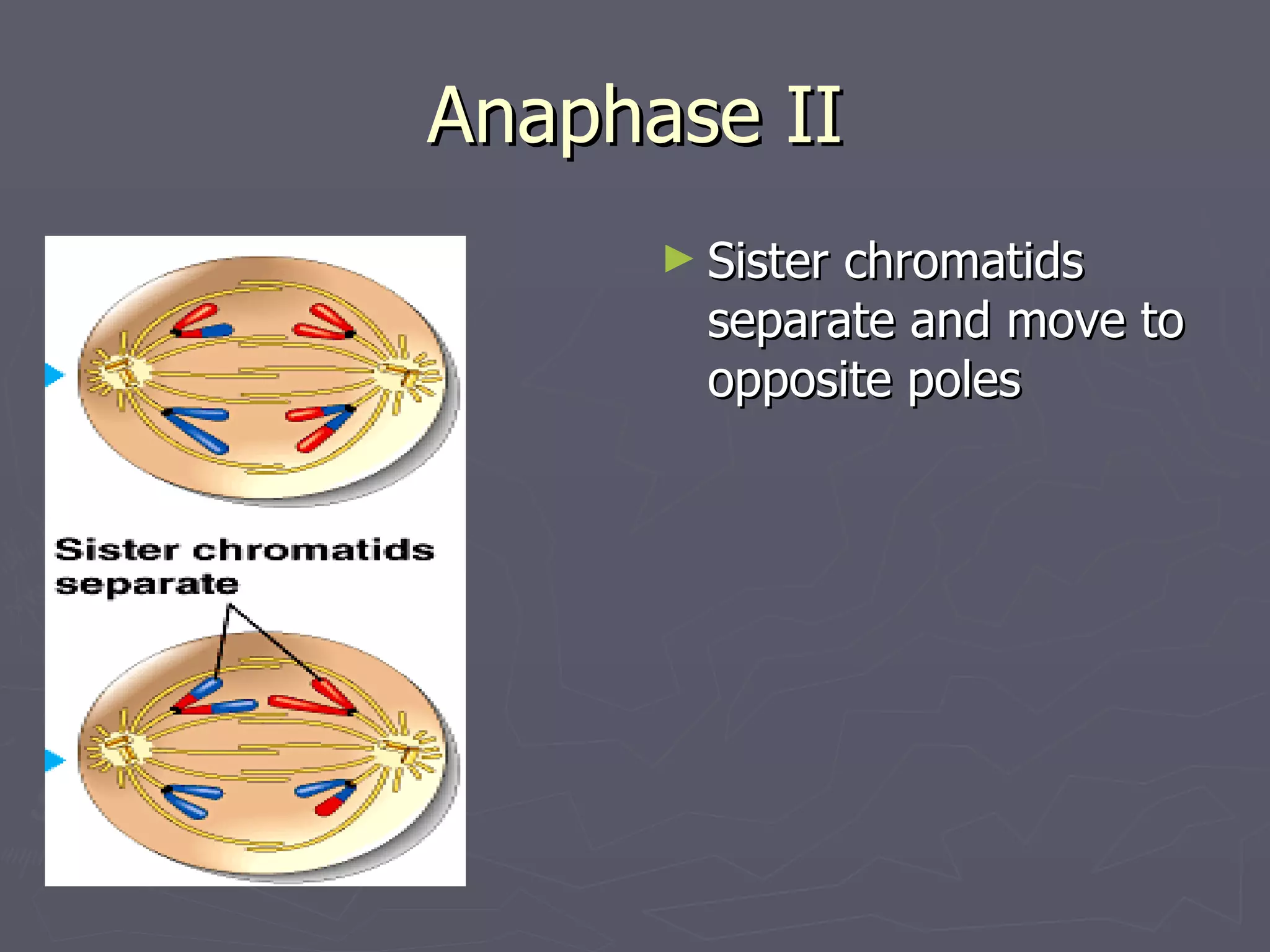
Anaphase II
      ► Sisterchromatids
        separate and move to
        opposite poles
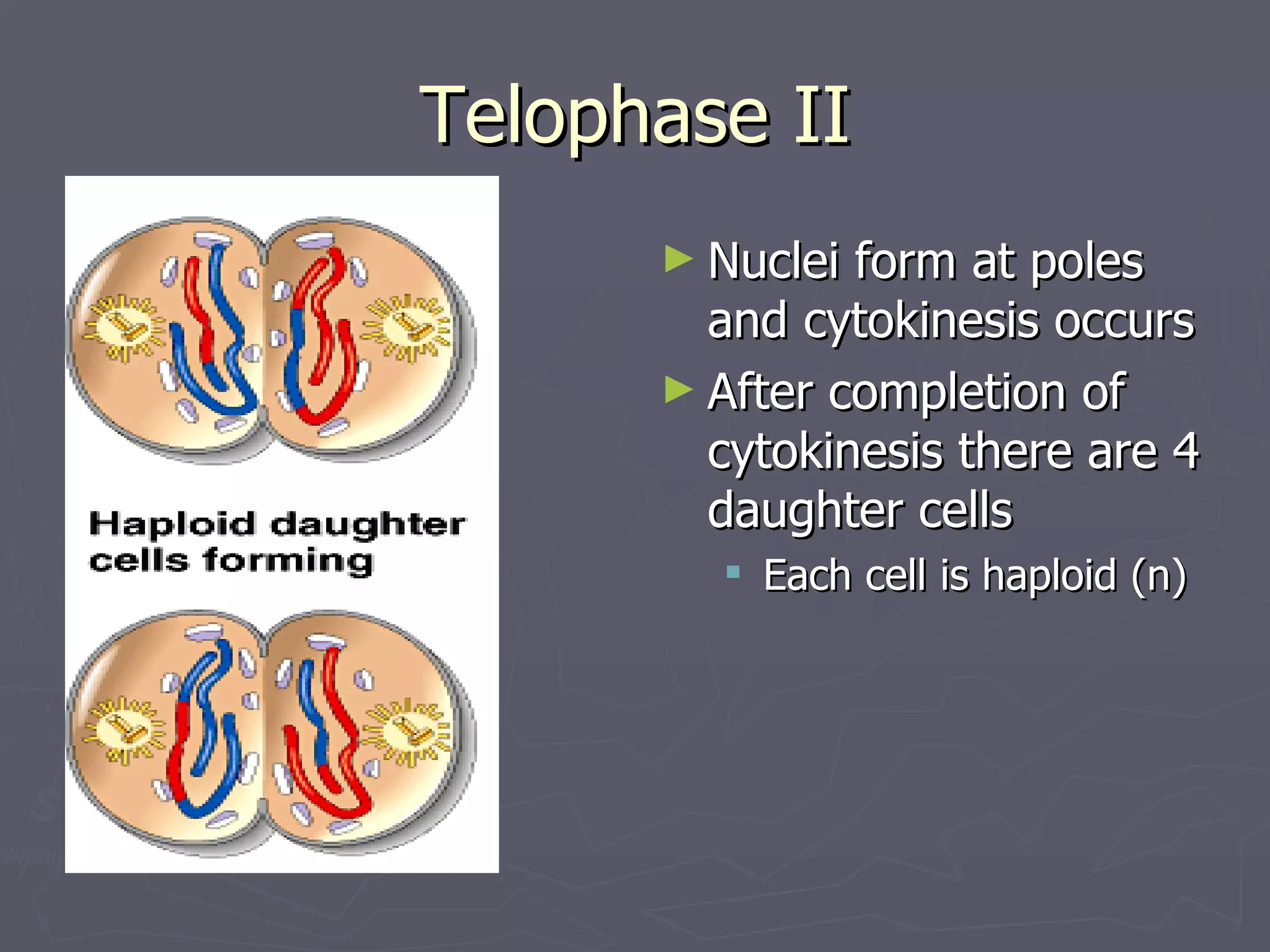
Telophase II
      ► Nuclei form at poles
        and cytokinesis occurs
      ► After completion of
        cytokinesis there are 4
        daughter cells
         Each cell is haploid (n)
double
            Meiosis 1 overview               stranded

   ► 1st                                  Divide 1
           division of meiosis
                Copy DNA     Line Up 1


4            prophase 1    metaphase 1
  chromosomes
                                          telophase 1
 diploid
 2n                                 2 chromosomes
                                     haploid
             gamete                  1n
Bye Bye 2
             Meiosis 2 overview
                                         telophase 2


         telophase 1      Line Up 2


                                            4
► 2nd   division of meiosis
   looks like mitosis   metaphase 2


     2 chromosomes
     haploid
     1n                       gametes
► Meiosis   Square Dance


                  Let’s Dance!!
Sexual reproduction lifecycle
                                             2 copies
                                             diploid
                                             2n
 1 copy                                                  1 copy
          fertilization                       meiosis
 haploid                                                 haploid
 1n                                                      1n
                          We’re mixing
                          things up here!
                          A good thing?
Putting it all together…
meiosis → fertilization → mitosis + development

            gametes


46             23                        46
                         23            46 46
     meiosis   egg                     46 4646
                         23             46 46
                                          46
46             23                        zygote
                      fertilization mitosis &
                                      mitosis
             sperm
                                    development
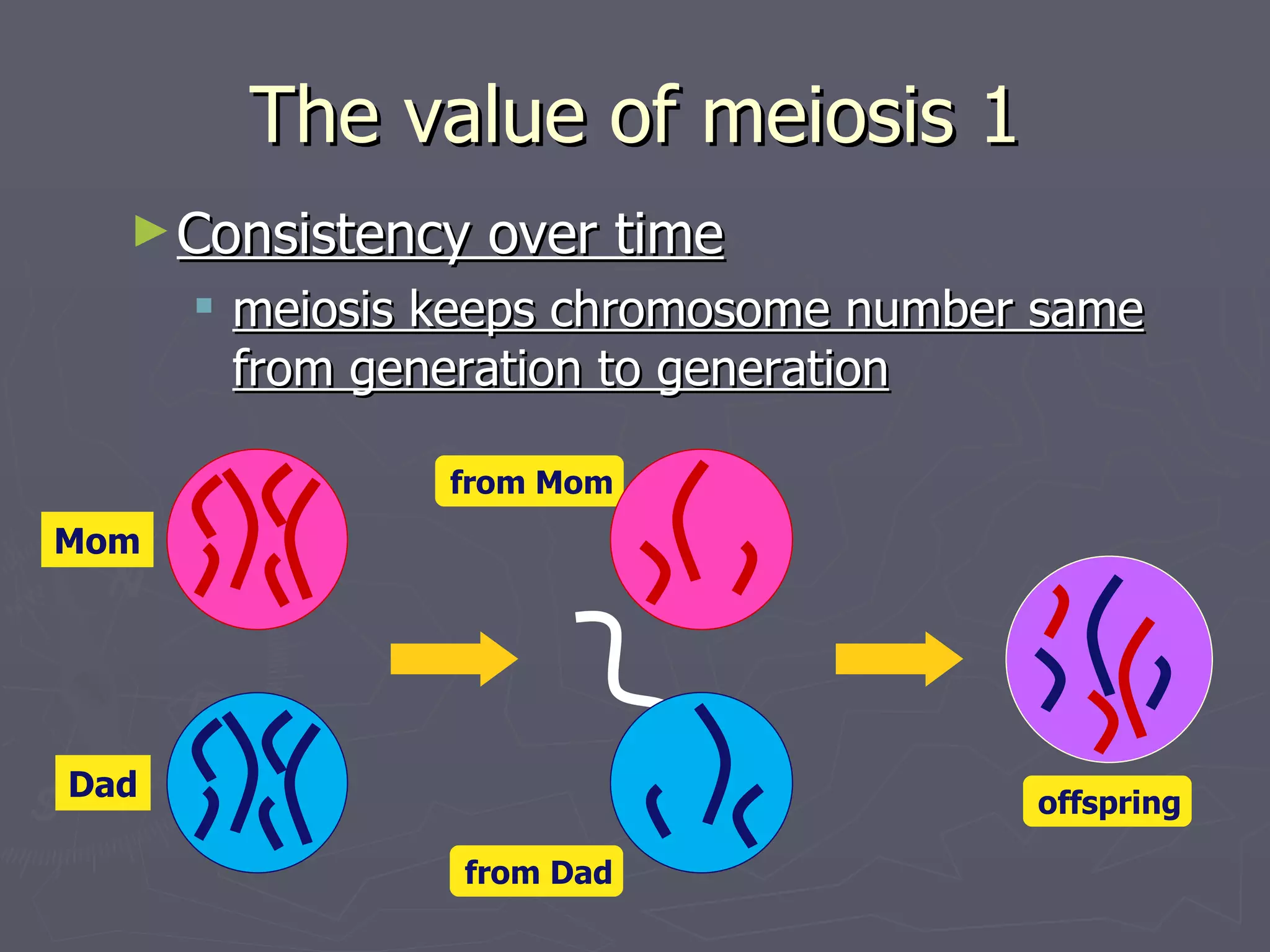
The value of meiosis 1
  ► Consistency   over time
       meiosis keeps chromosome number same
        from generation to generation

                from Mom
Mom


Dad                                    offspring

                from Dad
The value of meiosis 2                We’re
                                      mixing things
                                      up here!

  ► Change      over time
       meiosis introduces genetic variation
           ►gametes of offspring do not have
            same genes as gametes from parents
           ►new combinations of traits


from Dad                                       variation
from Mom


                   offspring

                               new gametes made by offspring
Fertilization
► Joining of the sperm & egg
► Internal Fertilization
     Gametes fuse inside the body of a female
     Occurs in many land animals
     Offspring have a better chance of survival
     Fewer offspring are produced
► External   Fertilization
     Gametes fuse outside the body of a female
     Occurs in many water animals
     Many offspring produced
     Fewer offspring survive
Fertilization
► Parthenogenesis
   Development of an unfertilized egg into an adult
    animal
   E.g. rotifers, some insects such as bees, wasps,
   E.g. Queen bee can produce fertilized or
    unfertilized eggs.
    ►Fertilized eggs become female workers
    ►Unfertilized eggs become male drones
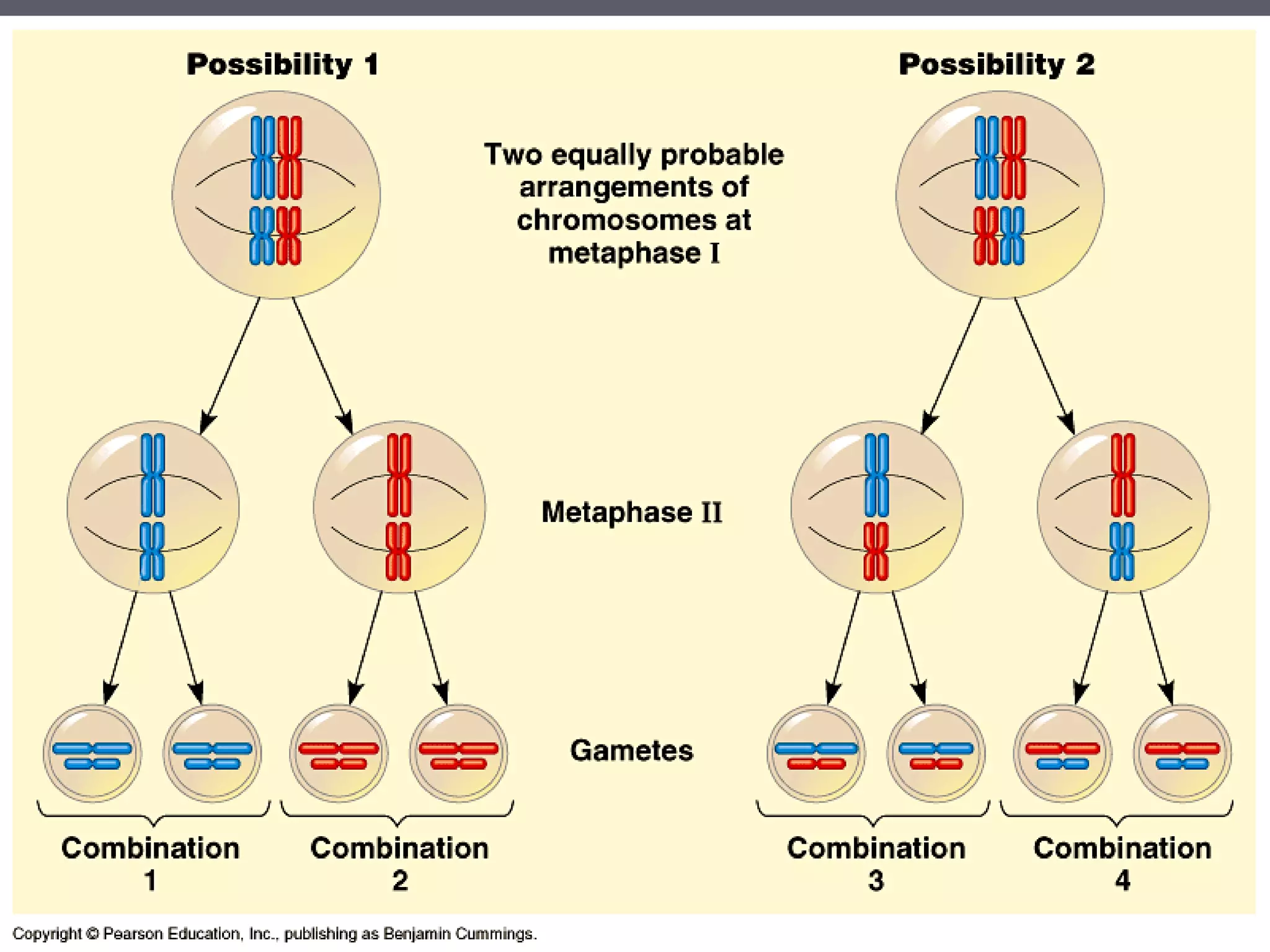
Independent Assortment
► Chromosomes   are separated
 and combined independently
 of each other during meiosis
   E.g. all your mom’s
    chromosomes don’t end up
    together in your gametes.
    They are randomly mixed.
Independent Assortment
► Independent
            assortment
 produces many different
 gametes
   In humans, n=23 so over 8
    million different gametes can
    be produced…
Crossing Over


► Occurs  in prophase I, during synapsis
► Homologous chromosomes twist and exchange
  pieces of genetic material
► This results in even more different gametes
The Key Difference Between Mitosis and Meiosis is
the Way Chromosomes Uniquely Pair and Align in
                    Meiosis


          Mitosis               The first (and
                                distinguishing)
                                division of meiosis
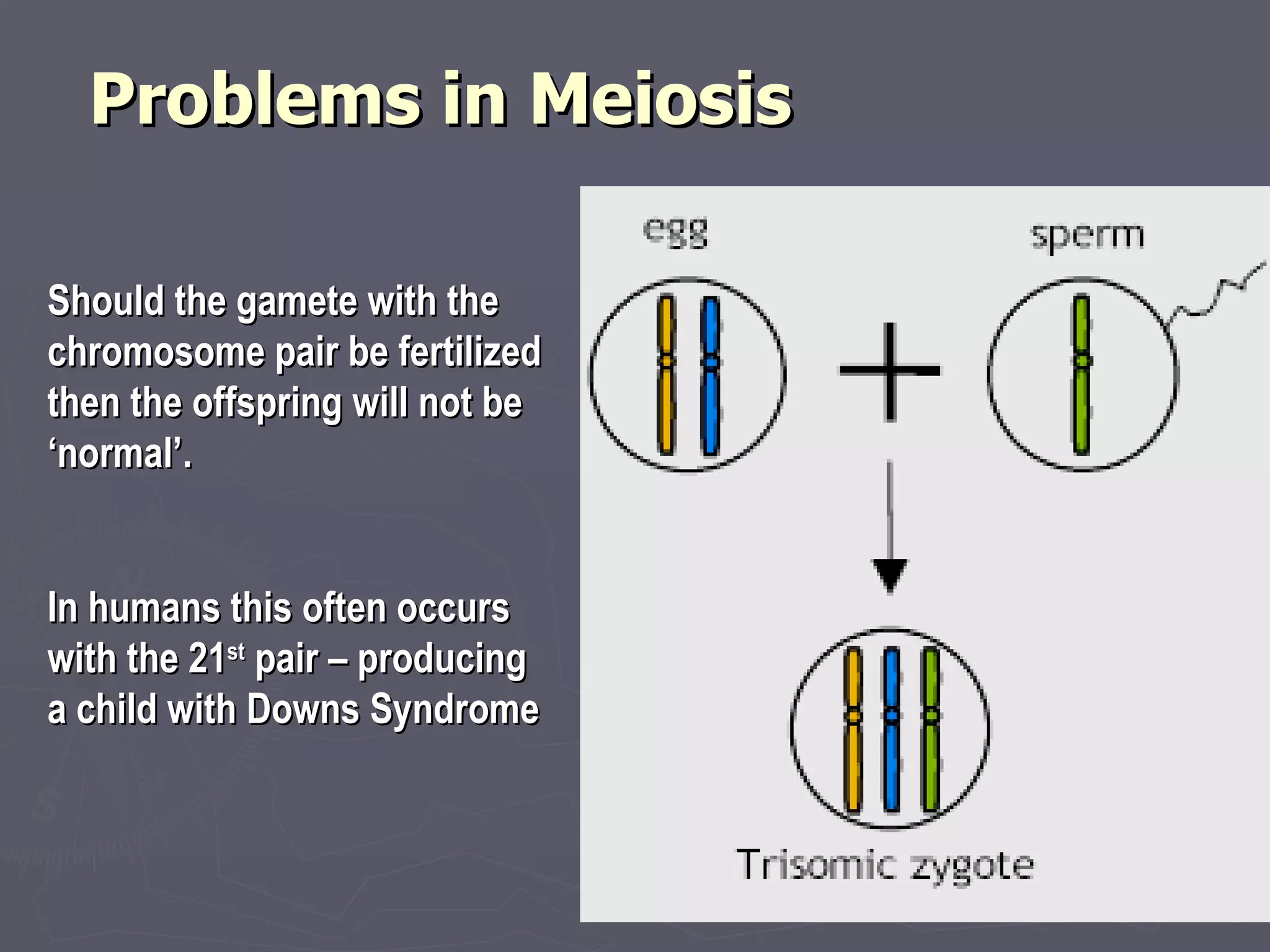
Problems in Meiosis
► Sometimes    chromosomes don’t separate
 properly
   This is called nondisjunction and result in a cell
    with too many or too few chromosomes
Problems in Meiosis
Problems in Meiosis

Should the gamete with the
chromosome pair be fertilized
then the offspring will not be
‘normal’.


In humans this often occurs
with the 21st pair – producing
a child with Downs Syndrome
Trisomy 21– Downs Syndrome
               Can you see the extra
               21st chromosome?
               Is this person male or
               female?

               •This picture of a person’s
               chromosomes is called a
               karyotype. The
               chromosomes are
               organized from largest to
               smallest.
               •How can karyotypes be
               helpful in identifying
               diseases?
Gametogenesis
► Gametes    develop within specialized organs
     Female gametes – egg cells
     Male gametes – sperm cells

   Female gonads – ovaries
   Male gonads - testes
Gametogenesis
►Gametogenesis  – the formation of
 gametes in the gonads
  Two types:
   ►Oogenesis   – formation of eggs by
    meiosis
   ►Spermatogenesis – formation of sperm
    by meiosis
Spermatogenesis


► Produces   4 haploid sperm
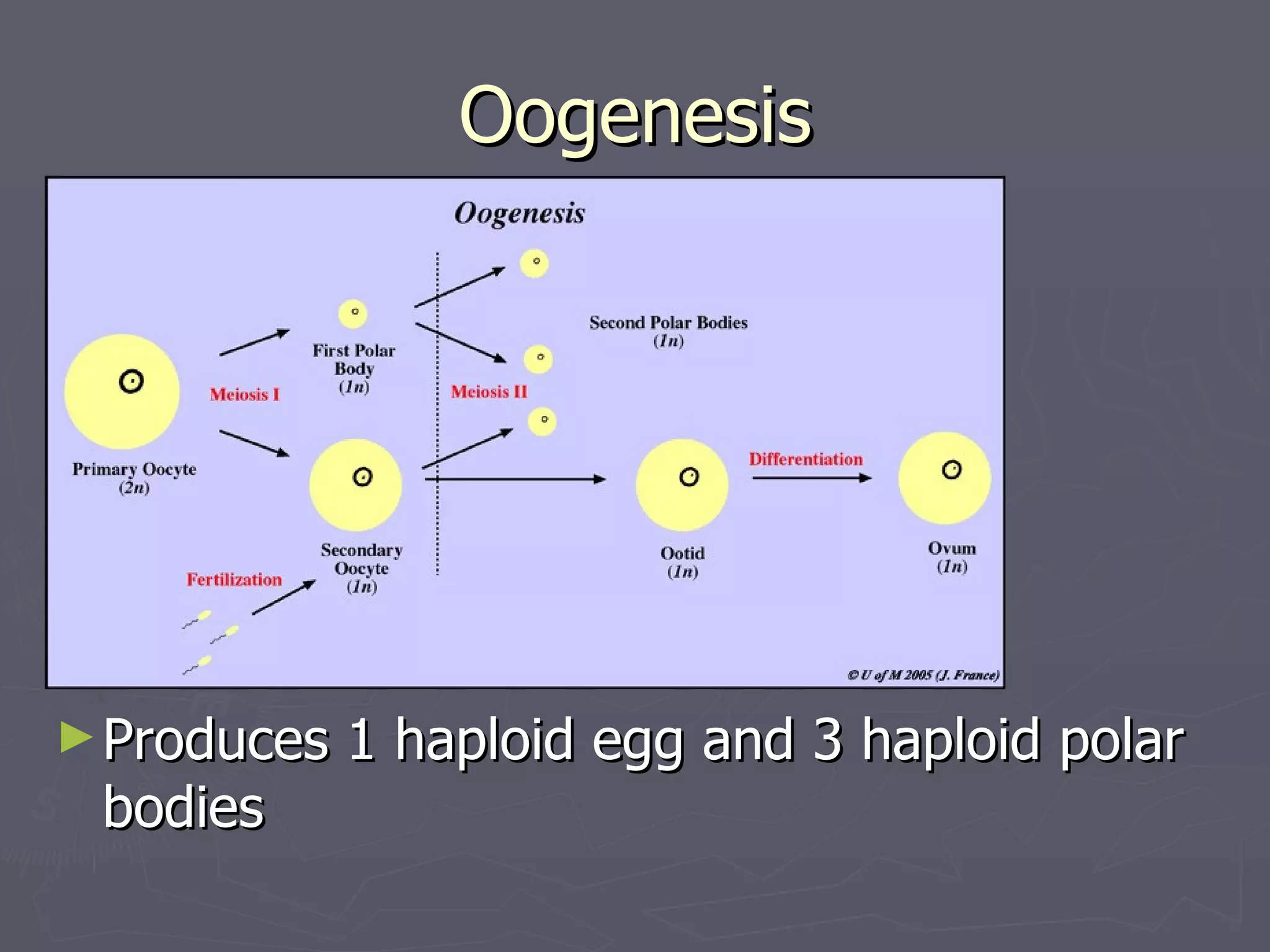
Oogenesis


► Produces   1 haploid egg and 3 haploid polar
 bodies
Hermaphrodites
► Hermaphrodites   have both testes and
 ovaries
   E.g. earthworm, snails, and hydra

Copy of meiosis2010

  • 1.
    Meiosis & Sexual Reproduction
  • 2.
    Sexual Reproduction ►2 parents ► Exchange of DNA ► Offspring genetically different from parents ► Involves specialized sex cells (gametes) ► Creates diversity
  • 3.
    Sexual Reproduction inSimple Organisms ► Conjugation –  Cytoplasm bridge forms between 2 cells and an exchange of DNA takes place  Occurs between two cells with different mating types  Mating types are usually called plus (+) and minus (-)
  • 4.
    Sexual Reproduction inAnimals ► Each parent produces a GAMETE  Female gamete – egg  Male gamete - sperm ► The two gametes combine and produce a zygote  Called fertilization ► Thezygote then divides by mitosis, grows and process begins again  Zygote has the same number of chromosomes as the parents
  • 5.
    Somatic cells vs.Gametes ► Somatic cells are body cells  2 set of chromosomes  Humans have 46 chromosomes or 23 pairs ► Gametes are sex cells  1 set of chromosomes  Humans have 23 chromosomes
  • 6.
    How are gametesproduced? ► Eggs & sperm need to be made and joined… ► Do we make egg & sperm by mitosis? No! What if we did, then… 46 + 46 92 egg sperm zygote Doesn’t work!
  • 7.
    diploid = 2copies 2n Human female karyotype 46 chromosomes 23 pairs XX
  • 8.
    diploid = 2copies 2n Human male karyotype 46 chromosomes 23 pairs XY
  • 9.
    Paired chromosomes ► Homologous chromosomes  both chromosomes of a pair carry “matching” genes ►control same inherited characters ►homologous = same information diploid 2n eye color eye color 2n = 4 (brown?) (blue?) homologous double stranded chromosomes homologous chromosomes
  • 10.
    How do wemake sperm & eggs? ► Must reduce 46 chromosomes → 23  must half the number of chromosomes  haploid zygote 46 23 23 meiosis egg 46 23 46 23 fertilization sperm gametes
  • 11.
    Meiosis makes sperm& eggs ► 46 chromosomes to 23 chromosomes  half the number of chromosomes 46 23 egg meiosis 46 23 diploid sperm haploid
  • 12.
    Meiosis ► Specialcell divisionin sexually reproducing organisms ► Makes gametes  Sperm & egg ► Reduction division  Reduce number of chromosomes  2n  1n  diploid  haploid
  • 13.
    Interphase ► DNA replicates ► Cell prepares for division
  • 14.
    Prophase I ► Homologous chromosomes pair up and form a tetrad  This is called synapsis ► Crossing over occurs during synapsis  Homologous chromosomes exchange segments of DNA
  • 15.
    Metaphase I ► Tetrads line up at the equator. ► Centromeres attach chromosomes to the spindle fibers
  • 16.
    Anaphase I ► Homologous chromosomes separate and move to the poles  Called disjunctions  Sister chromatids remain attached
  • 17.
    Telophase I ► Cytoplasm divides, forming two new daughter cells  Cells are haploid
  • 18.
    Cytokinesis I ► Occurs simultaneously with telophase I  Forms 2 daughter cells ► Plantcells – cell plate ► Animal cells – cleavage furrow ► There is no further replication of genetic material prior to meiosis II
  • 19.
    Prophase II ► Spindle forms ► Sister chromatids move toward the equator
  • 20.
    Metaphase II ► Sister chromatids line up at the equator  Similar to mitosis ► Spindle fibers attach at the centromere
  • 21.
    Anaphase II ► Sisterchromatids separate and move to opposite poles
  • 22.
    Telophase II ► Nuclei form at poles and cytokinesis occurs ► After completion of cytokinesis there are 4 daughter cells  Each cell is haploid (n)
  • 23.
    double Meiosis 1 overview stranded ► 1st Divide 1 division of meiosis Copy DNA Line Up 1 4 prophase 1 metaphase 1 chromosomes telophase 1  diploid  2n  2 chromosomes  haploid gamete  1n
  • 24.
    Bye Bye 2 Meiosis 2 overview telophase 2 telophase 1 Line Up 2 4 ► 2nd division of meiosis  looks like mitosis metaphase 2  2 chromosomes  haploid  1n gametes
  • 25.
    ► Meiosis Square Dance Let’s Dance!!
  • 26.
    Sexual reproduction lifecycle  2 copies  diploid  2n  1 copy  1 copy fertilization meiosis  haploid  haploid  1n  1n We’re mixing things up here! A good thing?
  • 27.
    Putting it alltogether… meiosis → fertilization → mitosis + development gametes 46 23 46 23 46 46 meiosis egg 46 4646 23 46 46 46 46 23 zygote fertilization mitosis & mitosis sperm development
  • 28.
    The value ofmeiosis 1 ► Consistency over time  meiosis keeps chromosome number same from generation to generation from Mom Mom Dad offspring from Dad
  • 29.
    The value ofmeiosis 2 We’re mixing things up here! ► Change over time  meiosis introduces genetic variation ►gametes of offspring do not have same genes as gametes from parents ►new combinations of traits from Dad variation from Mom offspring new gametes made by offspring
  • 30.
    Fertilization ► Joining ofthe sperm & egg ► Internal Fertilization  Gametes fuse inside the body of a female  Occurs in many land animals  Offspring have a better chance of survival  Fewer offspring are produced ► External Fertilization  Gametes fuse outside the body of a female  Occurs in many water animals  Many offspring produced  Fewer offspring survive
  • 31.
    Fertilization ► Parthenogenesis  Development of an unfertilized egg into an adult animal  E.g. rotifers, some insects such as bees, wasps,  E.g. Queen bee can produce fertilized or unfertilized eggs. ►Fertilized eggs become female workers ►Unfertilized eggs become male drones
  • 32.
    Independent Assortment ► Chromosomes are separated and combined independently of each other during meiosis  E.g. all your mom’s chromosomes don’t end up together in your gametes. They are randomly mixed.
  • 33.
    Independent Assortment ► Independent assortment produces many different gametes  In humans, n=23 so over 8 million different gametes can be produced…
  • 35.
    Crossing Over ► Occurs in prophase I, during synapsis ► Homologous chromosomes twist and exchange pieces of genetic material ► This results in even more different gametes
  • 37.
    The Key DifferenceBetween Mitosis and Meiosis is the Way Chromosomes Uniquely Pair and Align in Meiosis Mitosis The first (and distinguishing) division of meiosis
  • 39.
    Problems in Meiosis ►Sometimes chromosomes don’t separate properly  This is called nondisjunction and result in a cell with too many or too few chromosomes
  • 40.
  • 41.
    Problems in Meiosis Shouldthe gamete with the chromosome pair be fertilized then the offspring will not be ‘normal’. In humans this often occurs with the 21st pair – producing a child with Downs Syndrome
  • 42.
    Trisomy 21– DownsSyndrome Can you see the extra 21st chromosome? Is this person male or female? •This picture of a person’s chromosomes is called a karyotype. The chromosomes are organized from largest to smallest. •How can karyotypes be helpful in identifying diseases?
  • 43.
    Gametogenesis ► Gametes develop within specialized organs  Female gametes – egg cells  Male gametes – sperm cells  Female gonads – ovaries  Male gonads - testes
  • 44.
    Gametogenesis ►Gametogenesis –the formation of gametes in the gonads  Two types: ►Oogenesis – formation of eggs by meiosis ►Spermatogenesis – formation of sperm by meiosis
  • 45.
  • 46.
    Oogenesis ► Produces 1 haploid egg and 3 haploid polar bodies
  • 47.
    Hermaphrodites ► Hermaphrodites have both testes and ovaries  E.g. earthworm, snails, and hydra

Editor's Notes

  • #29 Consider the greater variation with 23 pairs of chromosomes = mixing and matching
  • #30 Consider the greater variation with 23 pairs of chromosomes = mixing and matching
  • #34 Use 2 n to determine how many different gametes are possible In humans, n=23 so and 2 23 = 8,388,608