11-4 Meiosis

   P275
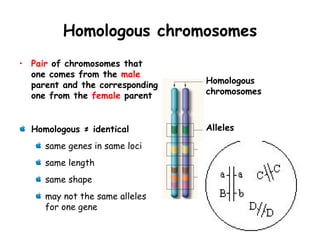
Homologous chromosomes
• Pair of chromosomes that
  one comes from the male
  parent and the corresponding   Homologous
  one from the female parent     chromosomes


  Homologous ≠ identical         Alleles

     same genes in same loci
     same length
     same shape
     may not the same alleles
     for one gene
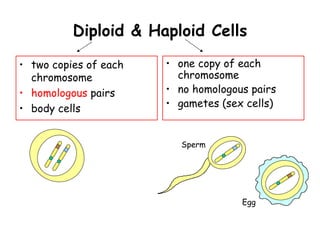
Diploid & Haploid Cells

• two copies of each   • one copy of each
  chromosome             chromosome
• homologous pairs     • no homologous pairs
• body cells           • gametes (sex cells)


                         Sperm


                                     Egg
?
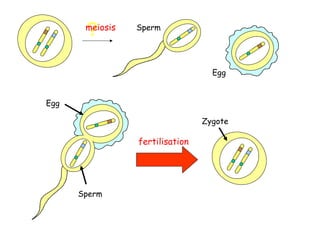
       meiosis   Sperm


                                   Egg


Egg

                                 Zygote

                 fertilisation


      Sperm
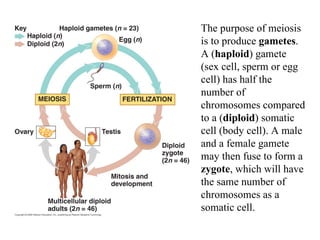
The purpose of meiosis
is to produce gametes.
A (haploid) gamete
(sex cell, sperm or egg
cell) has half the
number of
chromosomes compared
to a (diploid) somatic
cell (body cell). A male
and a female gamete
may then fuse to form a
zygote, which will have
the same number of
chromosomes as a
somatic cell.
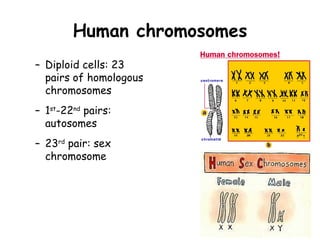
Human chromosomes
– Diploid cells: 23
  pairs of homologous
  chromosomes
– 1st-22nd pairs:
  autosomes
– 23rd pair: sex
  chromosome
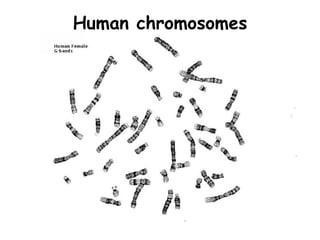
Human chromosomes
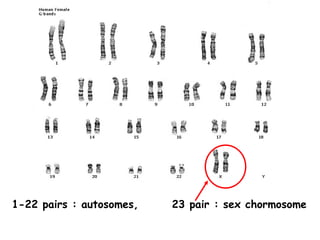
1-22 pairs : autosomes,   23 pair : sex chormosome
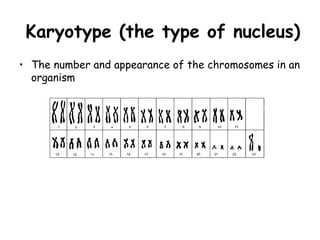
Karyotype (the type of nucleus)
• The number and appearance of the chromosomes in an
  organism
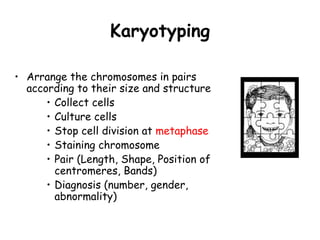
Karyotyping

• Arrange the chromosomes in pairs
  according to their size and structure
      • Collect cells
      • Culture cells
      • Stop cell division at metaphase
      • Staining chromosome
      • Pair (Length, Shape, Position of
        centromeres, Bands)
      • Diagnosis (number, gender,
        abnormality)
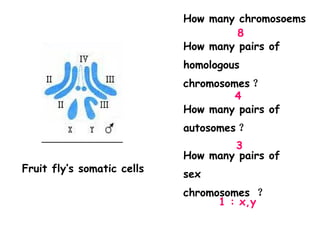
How many chromosoems
                                     8
                            How many pairs of
                            homologous
                            chromosomes ?
                                     4
                            How many pairs of
                            autosomes ?
                                    3
                            How many pairs of
Fruit fly’s somatic cells
                            sex
                            chromosomes ?
                                  1 : x,y
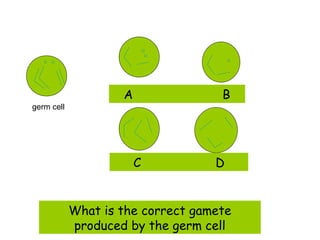
A               B
germ cell


                        C          D


            What is the correct gamete
            produced by the germ cell
Meiosis Overview

• reduction division
• number of chromosomes per cell halved
• separation of homologous chromosomes
• 1 diploid  4 genetically different
  haploid
• DNA copied once, cell divide twice
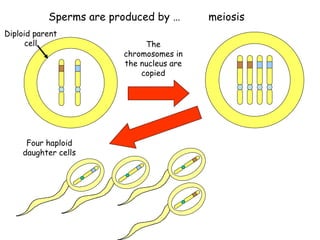
Sperms are produced by …       meiosis
Diploid parent
      cell                   The
                        chromosomes in
                        the nucleus are
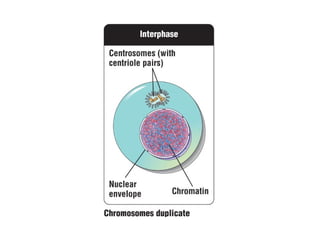
                            copied


     Four haploid
    daughter cells
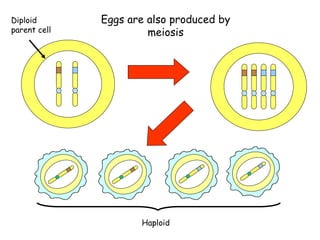
Diploid       Eggs are also produced by
parent cell            meiosis


                     Haploid
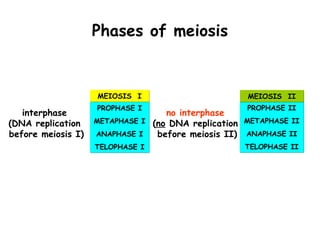
Phases of meiosis


                    MEIOSIS I                       MEIOSIS II
                    PROPHASE I                      PROPHASE II
   interphase                      no interphase
(DNA replication    METAPHASE I (no DNA replication METAPHASE II
before meiosis I)   ANAPHASE I   before meiosis II) ANAPHASE II
                    TELOPHASE I                     TELOPHASE II
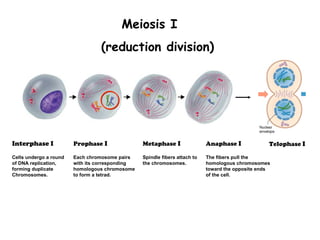
Meiosis I
                                 (reduction division)


Interphase I            Prophase I               Metaphase I                Anaphase I             Telophase I

Cells undergo a round   Each chromosome pairs    Spindle fibers attach to   The fibers pull the
of DNA replication,     with its corresponding   the chromosomes.           homologous chromosomes
forming duplicate       homologous chromosome                               toward the opposite ends
Chromosomes.            to form a tetrad.                                   of the cell.
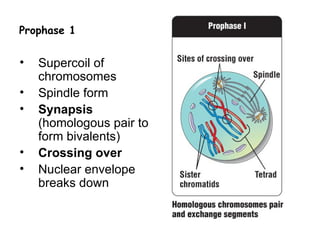
Prophase 1


•   Supercoil of
    chromosomes
•   Spindle form
•   Synapsis
    (homologous pair to
    form bivalents)
•   Crossing over
•   Nuclear envelope
    breaks down
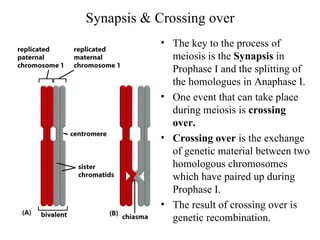
Synapsis & Crossing over
            • The key to the process of
              meiosis is the Synapsis in
              Prophase I and the splitting of
              the homologues in Anaphase I.
            • One event that can take place
              during meiosis is crossing
              over.
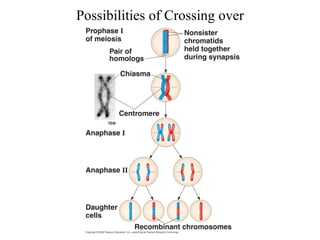
            • Crossing over is the exchange
              of genetic material between two
              homologous chromosomes
              which have paired up during
              Prophase I.
            • The result of crossing over is
              genetic recombination.
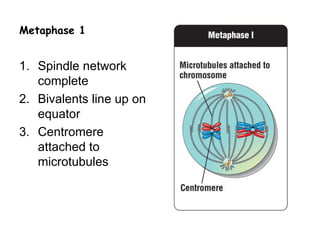
Metaphase 1


1. Spindle network
   complete
2. Bivalents line up on
   equator
3. Centromere
   attached to
   microtubules
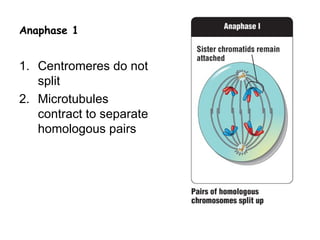
Anaphase 1


1. Centromeres do not
   split
2. Microtubules
   contract to separate
   homologous pairs
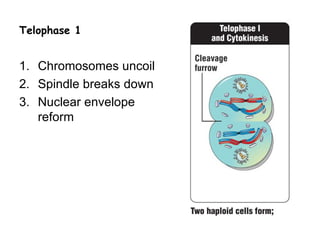
Telophase 1


1. Chromosomes uncoil
2. Spindle breaks down
3. Nuclear envelope
   reform
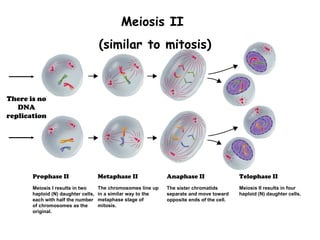
Meiosis II
                                     (similar to mitosis)


There is no
   DNA
replication


       Prophase II                   Metaphase II              Anaphase II                  Telophase II
       Meiosis I results in two      The chromosomes line up   The sister chromatids        Meiosis II results in four
       haploid (N) daughter cells,   in a similar way to the   separate and move toward     haploid (N) daughter cells.
       each with half the number     metaphase stage of        opposite ends of the cell.
       of chromosomes as the         mitosis.
       original.
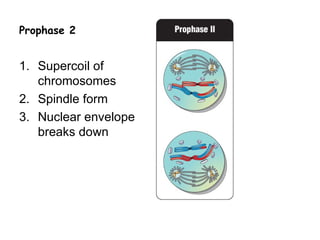
Prophase 2


1. Supercoil of
   chromosomes
2. Spindle form
3. Nuclear envelope
   breaks down
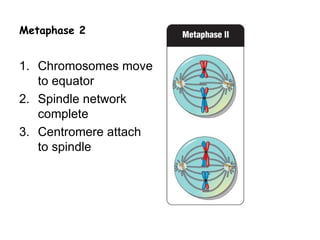
Metaphase 2


1. Chromosomes move
   to equator
2. Spindle network
   complete
3. Centromere attach
   to spindle
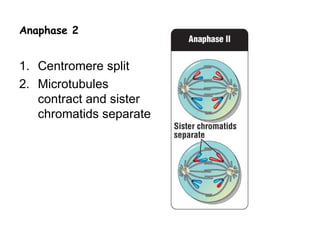
Anaphase 2


1. Centromere split
2. Microtubules
   contract and sister
   chromatids separate
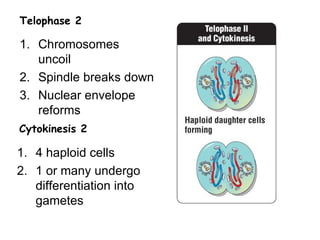
Telophase 2

1. Chromosomes
   uncoil
2. Spindle breaks down
3. Nuclear envelope
   reforms
Cytokinesis 2

1. 4 haploid cells
2. 1 or many undergo
   differentiation into
   gametes
Which steps in meiosis are
 important in producing
    genetic variety?
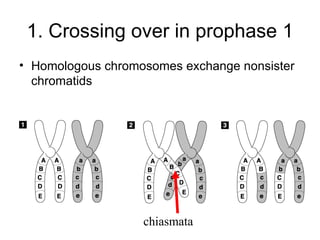
1. Crossing over in prophase 1
• Homologous chromosomes exchange nonsister
  chromatids


                   chiasmata
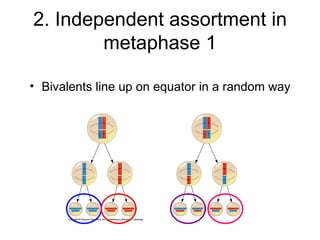
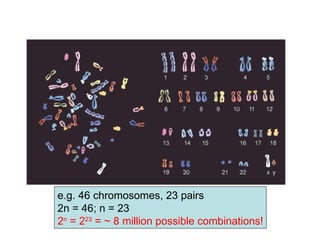
2. Independent assortment in
        metaphase 1

• Bivalents line up on equator in a random way
Possibilities of Crossing over
e.g. 46 chromosomes, 23 pairs
2n = 46; n = 23
2n = 223 = ~ 8 million possible combinations!
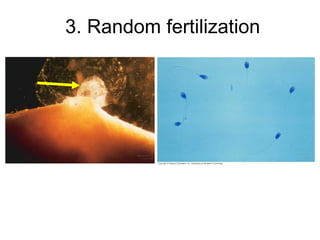
3. Random fertilization
Gamete formation in animals

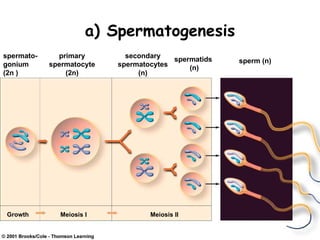
• Male gametes (sperms) are formed through
  spermatogenesis
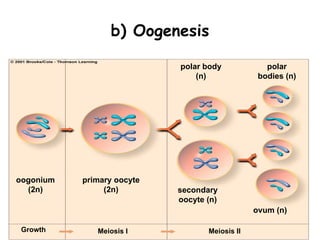
• Female gametes (egg) are formed through oogenesis
a) Spermatogenesis
spermato-     primary        secondary   spermatids
gonium      spermatocyte   spermatocytes              sperm (n)
                                             (n)
(2n )           (2n)            (n)


Growth        Meiosis I            Meiosis II
b) Oogenesis

                            polar body             polar
                                (n)              bodies (n)


oogonium   primary oocyte
  (2n)          (2n)        secondary
                            oocyte (n)
                                                ovum (n)

 Growth       Meiosis I            Meiosis II
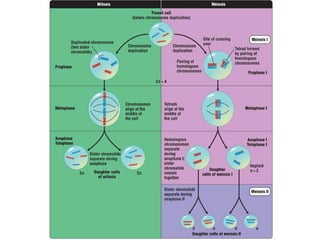
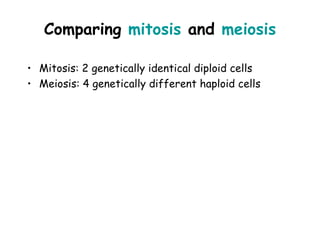
Comparing mitosis and meiosis

• Mitosis: 2 genetically identical diploid cells
• Meiosis: 4 genetically different haploid cells
11_4

11_4

  • 1.
  • 2.
    Homologous chromosomes • Pairof chromosomes that one comes from the male parent and the corresponding Homologous one from the female parent chromosomes Homologous ≠ identical Alleles same genes in same loci same length same shape may not the same alleles for one gene
  • 3.
    Diploid & HaploidCells • two copies of each • one copy of each chromosome chromosome • homologous pairs • no homologous pairs • body cells • gametes (sex cells) Sperm Egg
  • 4.
    ? meiosis Sperm Egg Egg Zygote fertilisation Sperm
  • 5.
    The purpose ofmeiosis is to produce gametes. A (haploid) gamete (sex cell, sperm or egg cell) has half the number of chromosomes compared to a (diploid) somatic cell (body cell). A male and a female gamete may then fuse to form a zygote, which will have the same number of chromosomes as a somatic cell.
  • 6.
    Human chromosomes – Diploidcells: 23 pairs of homologous chromosomes – 1st-22nd pairs: autosomes – 23rd pair: sex chromosome
  • 7.
  • 8.
    1-22 pairs :autosomes, 23 pair : sex chormosome
  • 9.
    Karyotype (the typeof nucleus) • The number and appearance of the chromosomes in an organism
  • 10.
    Karyotyping • Arrange thechromosomes in pairs according to their size and structure • Collect cells • Culture cells • Stop cell division at metaphase • Staining chromosome • Pair (Length, Shape, Position of centromeres, Bands) • Diagnosis (number, gender, abnormality)
  • 11.
    How many chromosoems 8 How many pairs of homologous chromosomes ? 4 How many pairs of autosomes ? 3 How many pairs of Fruit fly’s somatic cells sex chromosomes ? 1 : x,y
  • 12.
    A B germ cell C D What is the correct gamete produced by the germ cell
  • 13.
    Meiosis Overview • reductiondivision • number of chromosomes per cell halved • separation of homologous chromosomes • 1 diploid  4 genetically different haploid • DNA copied once, cell divide twice
  • 15.
    Sperms are producedby … meiosis Diploid parent cell The chromosomes in the nucleus are copied Four haploid daughter cells
  • 16.
    Diploid Eggs are also produced by parent cell meiosis Haploid
  • 17.
    Phases of meiosis MEIOSIS I MEIOSIS II PROPHASE I PROPHASE II interphase no interphase (DNA replication METAPHASE I (no DNA replication METAPHASE II before meiosis I) ANAPHASE I before meiosis II) ANAPHASE II TELOPHASE I TELOPHASE II
  • 18.
    Meiosis I (reduction division) Interphase I Prophase I Metaphase I Anaphase I Telophase I Cells undergo a round Each chromosome pairs Spindle fibers attach to The fibers pull the of DNA replication, with its corresponding the chromosomes. homologous chromosomes forming duplicate homologous chromosome toward the opposite ends Chromosomes. to form a tetrad. of the cell.
  • 20.
    Prophase 1 • Supercoil of chromosomes • Spindle form • Synapsis (homologous pair to form bivalents) • Crossing over • Nuclear envelope breaks down
  • 21.
    Synapsis & Crossingover • The key to the process of meiosis is the Synapsis in Prophase I and the splitting of the homologues in Anaphase I. • One event that can take place during meiosis is crossing over. • Crossing over is the exchange of genetic material between two homologous chromosomes which have paired up during Prophase I. • The result of crossing over is genetic recombination.
  • 22.
    Metaphase 1 1. Spindlenetwork complete 2. Bivalents line up on equator 3. Centromere attached to microtubules
  • 23.
    Anaphase 1 1. Centromeresdo not split 2. Microtubules contract to separate homologous pairs
  • 24.
    Telophase 1 1. Chromosomesuncoil 2. Spindle breaks down 3. Nuclear envelope reform
  • 25.
    Meiosis II (similar to mitosis) There is no DNA replication Prophase II Metaphase II Anaphase II Telophase II Meiosis I results in two The chromosomes line up The sister chromatids Meiosis II results in four haploid (N) daughter cells, in a similar way to the separate and move toward haploid (N) daughter cells. each with half the number metaphase stage of opposite ends of the cell. of chromosomes as the mitosis. original.
  • 26.
    Prophase 2 1. Supercoilof chromosomes 2. Spindle form 3. Nuclear envelope breaks down
  • 27.
    Metaphase 2 1. Chromosomesmove to equator 2. Spindle network complete 3. Centromere attach to spindle
  • 28.
    Anaphase 2 1. Centromeresplit 2. Microtubules contract and sister chromatids separate
  • 29.
    Telophase 2 1. Chromosomes uncoil 2. Spindle breaks down 3. Nuclear envelope reforms Cytokinesis 2 1. 4 haploid cells 2. 1 or many undergo differentiation into gametes
  • 30.
    Which steps inmeiosis are important in producing genetic variety?
  • 31.
    1. Crossing overin prophase 1 • Homologous chromosomes exchange nonsister chromatids chiasmata
  • 32.
    2. Independent assortmentin metaphase 1 • Bivalents line up on equator in a random way
  • 33.
  • 34.
    e.g. 46 chromosomes,23 pairs 2n = 46; n = 23 2n = 223 = ~ 8 million possible combinations!
  • 35.
  • 36.
    Gamete formation inanimals • Male gametes (sperms) are formed through spermatogenesis • Female gametes (egg) are formed through oogenesis
  • 37.
    a) Spermatogenesis spermato- primary secondary spermatids gonium spermatocyte spermatocytes sperm (n) (n) (2n ) (2n) (n) Growth Meiosis I Meiosis II
  • 38.
    b) Oogenesis polar body polar (n) bodies (n) oogonium primary oocyte (2n) (2n) secondary oocyte (n) ovum (n) Growth Meiosis I Meiosis II
  • 39.
    Comparing mitosis andmeiosis • Mitosis: 2 genetically identical diploid cells • Meiosis: 4 genetically different haploid cells