COPD GRADING AND
MANAGEMENT
GUIDELINES
Maryam Majid Al Ezairej
Collage of medicine
RAKMHSU
objectives
 GRADING THE COPD
 MANAGING COPD - GOLD GUIDELINES
DIAGNOSING COPD
DIAGNOSING COPD
 Spirometry should be preformed after the administration
of adequate dose of short acting inhaled bronchodilators
 Post bronchodilator FEV1/FVC <0.7 confirm the presence
of airflow limitation
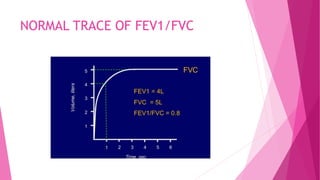
NORMAL TRACE OF FEV1/FVC
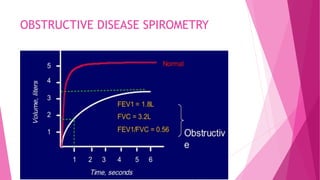
OBSTRUCTIVE DISEASE SPIROMETRY
ASSESSMENT OF COPD
 Symptoms severity
 Degree of airflow limitation
 Risk of exacerbation
 Combined assessment
ASSESSMENT GOALS
• Determine the severity of the disease, its impact on the
patient’s health status and the risk of future events (for
example exacerbations) to guide therapy.
• Comorbidities occur frequently in COPD patients, and
should be actively looked for.
ASSESSMENT OF COPD SYMPTOMS
COPD Assessment Test (CAT)
or
Clinical COPD Questionnaire (CCQ)
or
mMRC Breathlessness scale
ASSESSMENT OF COPD SYMPTOMS
 COPD Assessment Test (CAT): An 8-item measure of health status impairment
in COPD
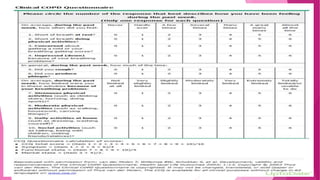
 Clinical COPD Questionnaire (CCQ): Self-administered questionnaire developed
to measure clinical control in patients with COPD
 Modified British Medical Research Council (mMRC) Questionnaire:
Breathlessness Measurement, relates well to other measures of health status
and predicts future mortality risk.
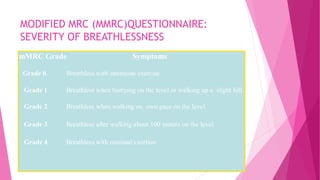
MODIFIED MRC (MMRC)QUESTIONNAIRE:
SEVERITY OF BREATHLESSNESS
mMRC Grade Symptoms
Grade 0. Breathless with strenuous exercise.
Grade 1. Breathless when hurrying on the level or walking up a slight hill.
Grade 2. Breathless when walking on own pace on the level.
Grade 3. Breathless after walking about 100 meters on the level.
Grade 4. Breathless with minimal exertion
CLASSIFICATION OF SEVERITY OF AIRFLOW
LIMITATION IN COPD*
COMBINED ASSESSMENT
 The GOLD therapeutic strategy suggests using
a combination of an individual's symptoms, history of
exacerbations, hospitalizations due to exacerbations
FEV1 to assess the exacerbation risk and guide therapy.
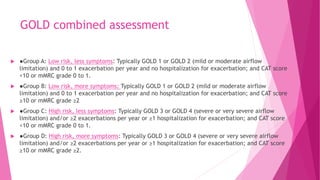
GOLD combined assessment
 ●Group A: Low risk, less symptoms: Typically GOLD 1 or GOLD 2 (mild or moderate airflow
limitation) and 0 to 1 exacerbation per year and no hospitalization for exacerbation; and CAT score
<10 or mMRC grade 0 to 1.
 ●Group B: Low risk, more symptoms: Typically GOLD 1 or GOLD 2 (mild or moderate airflow
limitation) and 0 to 1 exacerbation per year and no hospitalization for exacerbation; and CAT score
≥10 or mMRC grade ≥2
 ●Group C: High risk, less symptoms: Typically GOLD 3 or GOLD 4 (severe or very severe airflow
limitation) and/or ≥2 exacerbations per year or ≥1 hospitalization for exacerbation; and CAT score
<10 or mMRC grade 0 to 1.
 ●Group D: High risk, more symptoms: Typically GOLD 3 or GOLD 4 (severe or very severe airflow
limitation) and/or ≥2 exacerbations per year or ≥1 hospitalization for exacerbation; and CAT score
≥10 or mMRC grade ≥2.
MANAGMENT
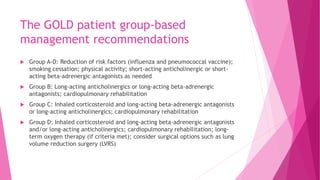
The GOLD patient group-based
management recommendations
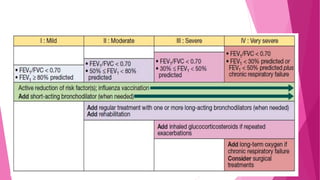
 Group A-D: Reduction of risk factors (influenza and pneumococcal vaccine);
smoking cessation; physical activity; short-acting anticholinergic or short-
acting beta-adrenergic antagonists as needed
 Group B: Long-acting anticholinergics or long-acting beta-adrenergic
antagonists; cardiopulmonary rehabilitation
 Group C: Inhaled corticosteroid and long-acting beta-adrenergic antagonists
or long-acting anticholinergics; cardiopulmonary rehabilitation
 Group D: Inhaled corticosteroid and long-acting beta-adrenergic antagonists
and/or long-acting anticholinergics; cardiopulmonary rehabilitation; long-
term oxygen therapy (if criteria met); consider surgical options such as lung
volume reduction surgery (LVRS)
THERAPEUTIC OPTIONS
THERAPEUTIC OPTIONS
 Smoking cessation influences the natural history of
COPD.
 Regular physical activity should be encouraged to
remain active.
THERAPEUTIC OPTIONS
 Appropriate pharmacologic therapy can reduce COPD
symptoms, reduce the frequency and severity of
exacerbations, and improve health status and exercise
tolerance.
 None of the existing medications has been shown to
modify the long-term decline in lung function.
 Influenza and pneumococcal vaccination should be offered
depending on local guidelines
THERAPEUTIC OPTIONS
Bronchodilator medications are
central to the symptomatic
management of COPD
Bronchodilator medications
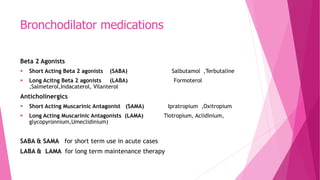
Beta 2 Agonists
 Short Acting Beta 2 agonists (SABA) Salbutamol ,Terbutaline
 Long Acitng Beta 2 agonists (LABA) Formoterol
,Salmeterol,Indacaterol, Vilanterol
Anticholinergics
 Short Acting Muscarinic Antagonist (SAMA) Ipratropium ,Oxitropium
 Long Acting Muscarinic Antagonists (LAMA) Tiotropium, Aclidinium,
glycopyronnium,Umeclidinium)
SABA & SAMA for short term use in acute cases
LABA & LAMA for long term maintenance therapy
THERAPEUTIC OPTIONS
 Regular treatment with inhaled corticosteroids improves
symptoms, lung function and quality of life and reduces
frequency of exacerbations for COPD patients with an
FEV1< 60% predicted.
 Inhaled corticosteroid therapy is associated with an
increased risk of pneumonia.
THERAPEUTIC OPTIONS
Influenza vaccines is recommended for COPD patients
65 years and older and for younger than age 65 with FEV1<
40% predicted.
The use of antibiotics, other than for treating infectious
exacerbations of COPD and other bacterial infections, is
currently not indicated.
THERAPEUTIC OPTIONS
 Oxygen therapy
Take home message 
THANK YOU 

Copd grading and management guidelines

  • 1.
    COPD GRADING AND MANAGEMENT GUIDELINES MaryamMajid Al Ezairej Collage of medicine RAKMHSU
  • 2.
    objectives  GRADING THECOPD  MANAGING COPD - GOLD GUIDELINES
  • 3.
  • 4.
    DIAGNOSING COPD  Spirometryshould be preformed after the administration of adequate dose of short acting inhaled bronchodilators  Post bronchodilator FEV1/FVC <0.7 confirm the presence of airflow limitation
  • 5.
  • 6.
  • 7.
    ASSESSMENT OF COPD Symptoms severity  Degree of airflow limitation  Risk of exacerbation  Combined assessment
  • 8.
    ASSESSMENT GOALS • Determinethe severity of the disease, its impact on the patient’s health status and the risk of future events (for example exacerbations) to guide therapy. • Comorbidities occur frequently in COPD patients, and should be actively looked for.
  • 9.
    ASSESSMENT OF COPDSYMPTOMS COPD Assessment Test (CAT) or Clinical COPD Questionnaire (CCQ) or mMRC Breathlessness scale
  • 10.
    ASSESSMENT OF COPDSYMPTOMS  COPD Assessment Test (CAT): An 8-item measure of health status impairment in COPD  Clinical COPD Questionnaire (CCQ): Self-administered questionnaire developed to measure clinical control in patients with COPD  Modified British Medical Research Council (mMRC) Questionnaire: Breathlessness Measurement, relates well to other measures of health status and predicts future mortality risk.
  • 12.
    MODIFIED MRC (MMRC)QUESTIONNAIRE: SEVERITYOF BREATHLESSNESS mMRC Grade Symptoms Grade 0. Breathless with strenuous exercise. Grade 1. Breathless when hurrying on the level or walking up a slight hill. Grade 2. Breathless when walking on own pace on the level. Grade 3. Breathless after walking about 100 meters on the level. Grade 4. Breathless with minimal exertion
  • 13.
    CLASSIFICATION OF SEVERITYOF AIRFLOW LIMITATION IN COPD*
  • 14.
    COMBINED ASSESSMENT  TheGOLD therapeutic strategy suggests using a combination of an individual's symptoms, history of exacerbations, hospitalizations due to exacerbations FEV1 to assess the exacerbation risk and guide therapy.
  • 15.
    GOLD combined assessment ●Group A: Low risk, less symptoms: Typically GOLD 1 or GOLD 2 (mild or moderate airflow limitation) and 0 to 1 exacerbation per year and no hospitalization for exacerbation; and CAT score <10 or mMRC grade 0 to 1.  ●Group B: Low risk, more symptoms: Typically GOLD 1 or GOLD 2 (mild or moderate airflow limitation) and 0 to 1 exacerbation per year and no hospitalization for exacerbation; and CAT score ≥10 or mMRC grade ≥2  ●Group C: High risk, less symptoms: Typically GOLD 3 or GOLD 4 (severe or very severe airflow limitation) and/or ≥2 exacerbations per year or ≥1 hospitalization for exacerbation; and CAT score <10 or mMRC grade 0 to 1.  ●Group D: High risk, more symptoms: Typically GOLD 3 or GOLD 4 (severe or very severe airflow limitation) and/or ≥2 exacerbations per year or ≥1 hospitalization for exacerbation; and CAT score ≥10 or mMRC grade ≥2.
  • 16.
  • 17.
    The GOLD patientgroup-based management recommendations  Group A-D: Reduction of risk factors (influenza and pneumococcal vaccine); smoking cessation; physical activity; short-acting anticholinergic or short- acting beta-adrenergic antagonists as needed  Group B: Long-acting anticholinergics or long-acting beta-adrenergic antagonists; cardiopulmonary rehabilitation  Group C: Inhaled corticosteroid and long-acting beta-adrenergic antagonists or long-acting anticholinergics; cardiopulmonary rehabilitation  Group D: Inhaled corticosteroid and long-acting beta-adrenergic antagonists and/or long-acting anticholinergics; cardiopulmonary rehabilitation; long- term oxygen therapy (if criteria met); consider surgical options such as lung volume reduction surgery (LVRS)
  • 18.
  • 19.
    THERAPEUTIC OPTIONS  Smokingcessation influences the natural history of COPD.  Regular physical activity should be encouraged to remain active.
  • 20.
    THERAPEUTIC OPTIONS  Appropriatepharmacologic therapy can reduce COPD symptoms, reduce the frequency and severity of exacerbations, and improve health status and exercise tolerance.  None of the existing medications has been shown to modify the long-term decline in lung function.  Influenza and pneumococcal vaccination should be offered depending on local guidelines
  • 21.
    THERAPEUTIC OPTIONS Bronchodilator medicationsare central to the symptomatic management of COPD
  • 22.
    Bronchodilator medications Beta 2Agonists  Short Acting Beta 2 agonists (SABA) Salbutamol ,Terbutaline  Long Acitng Beta 2 agonists (LABA) Formoterol ,Salmeterol,Indacaterol, Vilanterol Anticholinergics  Short Acting Muscarinic Antagonist (SAMA) Ipratropium ,Oxitropium  Long Acting Muscarinic Antagonists (LAMA) Tiotropium, Aclidinium, glycopyronnium,Umeclidinium) SABA & SAMA for short term use in acute cases LABA & LAMA for long term maintenance therapy
  • 23.
    THERAPEUTIC OPTIONS  Regulartreatment with inhaled corticosteroids improves symptoms, lung function and quality of life and reduces frequency of exacerbations for COPD patients with an FEV1< 60% predicted.  Inhaled corticosteroid therapy is associated with an increased risk of pneumonia.
  • 24.
    THERAPEUTIC OPTIONS Influenza vaccinesis recommended for COPD patients 65 years and older and for younger than age 65 with FEV1< 40% predicted. The use of antibiotics, other than for treating infectious exacerbations of COPD and other bacterial infections, is currently not indicated.
  • 25.
  • 27.
  • 28.