MODE OF DELIVERY IN
MONOCHRONIC TWIN
PREGNANCY
MARYAM MAJID AL-EZAIREJ
MEDICAL INTERN
OB/GYN DEPARTMENT
Outcome of monochorionic twin
pregnancy
 What is the outcome of monochorionic compared with
dichorionic twin pregnancies ?
 Clinicians and women should be aware that monochronic
twin pregnancies have higher fetal loss rates than
dichorionic twin pregnancies, mainly due to second
trimester loss and, overall, may have a higher risk of
associated neurodevelopmental morbidity. This should
form part of the parental counselling
MATERNAL COMPLICATION
 Antepartum-
Preterm labor , GDM, PIH, Abruptio placentae
Placenta previa
 Intrapartum-
Fetal distress, malpresentations, increased incidence of
Caesarean
 Post partum-
PPH, Post partum depression
FETAL COMPLICATION: MC
 Amniotic fluid discordance
 Growth discordance ( > 20%)
 Unequal placental sharing
 Selective intrauterine growth restriction (S-IUGR)
in one fetus
 Twin to twin transfusion syndrome (TTTS)
 Twin anaemia polycyathemia sequence (TAPS)
 Twin reverse arterial perfusion (TRAP)
 Anomalies in one fetus
 Intrauterine fetal death
 Congenital anomaly
 Nearly 100% of monochorionic twin placentas have vascular anastomoses but there are marked
variations in the number ,size, and direction
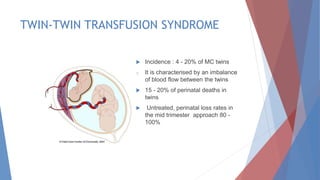
TWIN-TWIN TRANSFUSION SYNDROME
 Incidence : 4 - 20% of MC twins
o It is characterised by an imbalance
of blood flow between the twins
 15 - 20% of perinatal deaths in
twins
 Untreated, perinatal loss rates in
the mid trimester approach 80 -
100%
TWIN-TWIN TRANSFUSION SYNDROME
 TTTS should be managed in conjunction with fetal medicine centres
 TTTS presenting before 26 weeks of gestation should be treated by fetoscopic
laser ablation rather than amnioreduction or septostomy.
 TOD:
Delivery of monochorionic twin pregnancies previously complicated by TTTS
and treated should be between 34+0and 36+6 weeks of gestation.
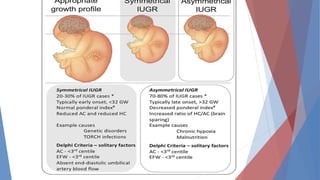
SELECTIVE IUGR
 sIUGR at 18-26 weeks were
classified as:
 Type I (UA Doppler with positive
diastolic flow
 Type II (persistent absent or
reversed end-diastolic flow
 Type III (intermittent absent or
reversed end-diastolic flow
MODE OF DELIVERY
 sGR in monochorionic twins requires evaluation in a fetal medicine centre
with expertise in the management of such pregnancies.
 In type I sGR, planned delivery should be considered by 34–36 weeks of
gestation if there is satisfactory fetal growth velocity and normal umbilical
artery Doppler waveforms.
 In type II and III sGR, delivery should be planned by 32 weeks of gestation,
unless fetal growth velocity is significantly abnormal or there is worsening of
the fetal Doppler assessment.
monochorionic twin pregnancies
complicated by single twin demise
 After a single fetal death in a monochorionic pregnancy, clinicians should be
aware that the risks to the surviving twin of death or neurological abnormality
are of the order of 15% and 26%,respectively.
 Single fetal death in a monochorionic pregnancy should be referred and
assessed in a fetal medicine centre, with multidisciplinary expertise to
manage these cases
 Rapid delivery is usually unwise, unless at term
UNCOMPLICATED MONOCHORIONIC
PREGNANCIES
 For uncomplicated monochorionic pregnancies there may be a higher risk of
unexplained fetal demise despite intensive fetal surveillance
 Women with monochorionic twins should have timing of birth discussed and
be offered elective delivery from 36+0weeks with the administration of
antenatal steroids, unless there is an indication to deliver earlier.
 It is appropriate to aim for vaginal birth of monochorionic diamniotic twins
unless there are other specific clinical indications for caesarean section.
UNCOMPLICATED MONOCHORIONIC
PREGNANCIES
 planned caesarean section delivery did not significantly decrease (or increase)
the risks of fetal or neonatal death, or serious newborn morbidity as
compared with vaginal delivery
 As with all pregnancies, parental views will also be important in reaching a
conclusion about the best, individualized method of monochorionic twin
delivery, including opting for caesarean section.
 In addition to the complexities of twin delivery (i.e. malpresentation) there is
a small risk of acute feto–fetal transfusional events during labour and this is
one of the reasons why continuous electronic fetal monitoring during labour is
recommended
MCMA
 MCMA twins have a high risk of fetal death and should be delivered by
caesarean section between 32+0 - 34+0 weeks
 Related complication:
 Cord entanglement
 Cord accidents
 Stuck twin during delivery
Conjoined twins
 viable conjoined twins should be
delivered by caesarean
References
 Management of Monochorionic Twin
Pregnancy, Green-top Guideline
No. 51, November 2016, RCOG, UK
 A classification system for
selective intrauterine growth
restriction in monochorionic
pregnancies according to
umbilical artery Doppler flow in
the smaller twin,
https://www.ncbi.nlm.nih.gov/pub
med/17542039
 Beckmann’s Obstetrics and
Gynecology-7th Edition
THANK YOU  

mode of delivery in multiple gestation

  • 1.
    MODE OF DELIVERYIN MONOCHRONIC TWIN PREGNANCY MARYAM MAJID AL-EZAIREJ MEDICAL INTERN OB/GYN DEPARTMENT
  • 3.
    Outcome of monochorionictwin pregnancy  What is the outcome of monochorionic compared with dichorionic twin pregnancies ?  Clinicians and women should be aware that monochronic twin pregnancies have higher fetal loss rates than dichorionic twin pregnancies, mainly due to second trimester loss and, overall, may have a higher risk of associated neurodevelopmental morbidity. This should form part of the parental counselling
  • 4.
    MATERNAL COMPLICATION  Antepartum- Pretermlabor , GDM, PIH, Abruptio placentae Placenta previa  Intrapartum- Fetal distress, malpresentations, increased incidence of Caesarean  Post partum- PPH, Post partum depression
  • 5.
    FETAL COMPLICATION: MC Amniotic fluid discordance  Growth discordance ( > 20%)  Unequal placental sharing  Selective intrauterine growth restriction (S-IUGR) in one fetus  Twin to twin transfusion syndrome (TTTS)  Twin anaemia polycyathemia sequence (TAPS)  Twin reverse arterial perfusion (TRAP)  Anomalies in one fetus  Intrauterine fetal death  Congenital anomaly  Nearly 100% of monochorionic twin placentas have vascular anastomoses but there are marked variations in the number ,size, and direction
  • 6.
    TWIN-TWIN TRANSFUSION SYNDROME Incidence : 4 - 20% of MC twins o It is characterised by an imbalance of blood flow between the twins  15 - 20% of perinatal deaths in twins  Untreated, perinatal loss rates in the mid trimester approach 80 - 100%
  • 7.
    TWIN-TWIN TRANSFUSION SYNDROME TTTS should be managed in conjunction with fetal medicine centres  TTTS presenting before 26 weeks of gestation should be treated by fetoscopic laser ablation rather than amnioreduction or septostomy.  TOD: Delivery of monochorionic twin pregnancies previously complicated by TTTS and treated should be between 34+0and 36+6 weeks of gestation.
  • 9.
    SELECTIVE IUGR  sIUGRat 18-26 weeks were classified as:  Type I (UA Doppler with positive diastolic flow  Type II (persistent absent or reversed end-diastolic flow  Type III (intermittent absent or reversed end-diastolic flow
  • 10.
    MODE OF DELIVERY sGR in monochorionic twins requires evaluation in a fetal medicine centre with expertise in the management of such pregnancies.  In type I sGR, planned delivery should be considered by 34–36 weeks of gestation if there is satisfactory fetal growth velocity and normal umbilical artery Doppler waveforms.  In type II and III sGR, delivery should be planned by 32 weeks of gestation, unless fetal growth velocity is significantly abnormal or there is worsening of the fetal Doppler assessment.
  • 11.
    monochorionic twin pregnancies complicatedby single twin demise  After a single fetal death in a monochorionic pregnancy, clinicians should be aware that the risks to the surviving twin of death or neurological abnormality are of the order of 15% and 26%,respectively.  Single fetal death in a monochorionic pregnancy should be referred and assessed in a fetal medicine centre, with multidisciplinary expertise to manage these cases  Rapid delivery is usually unwise, unless at term
  • 12.
    UNCOMPLICATED MONOCHORIONIC PREGNANCIES  Foruncomplicated monochorionic pregnancies there may be a higher risk of unexplained fetal demise despite intensive fetal surveillance  Women with monochorionic twins should have timing of birth discussed and be offered elective delivery from 36+0weeks with the administration of antenatal steroids, unless there is an indication to deliver earlier.  It is appropriate to aim for vaginal birth of monochorionic diamniotic twins unless there are other specific clinical indications for caesarean section.
  • 13.
    UNCOMPLICATED MONOCHORIONIC PREGNANCIES  plannedcaesarean section delivery did not significantly decrease (or increase) the risks of fetal or neonatal death, or serious newborn morbidity as compared with vaginal delivery  As with all pregnancies, parental views will also be important in reaching a conclusion about the best, individualized method of monochorionic twin delivery, including opting for caesarean section.  In addition to the complexities of twin delivery (i.e. malpresentation) there is a small risk of acute feto–fetal transfusional events during labour and this is one of the reasons why continuous electronic fetal monitoring during labour is recommended
  • 14.
    MCMA  MCMA twinshave a high risk of fetal death and should be delivered by caesarean section between 32+0 - 34+0 weeks  Related complication:  Cord entanglement  Cord accidents  Stuck twin during delivery
  • 15.
    Conjoined twins  viableconjoined twins should be delivered by caesarean
  • 16.
    References  Management ofMonochorionic Twin Pregnancy, Green-top Guideline No. 51, November 2016, RCOG, UK  A classification system for selective intrauterine growth restriction in monochorionic pregnancies according to umbilical artery Doppler flow in the smaller twin, https://www.ncbi.nlm.nih.gov/pub med/17542039  Beckmann’s Obstetrics and Gynecology-7th Edition
  • 17.

Editor's Notes

  • #10 At each scan from 20 weeks of gestation (at 2-weekly intervals) onwards, calculate EFW discordance using two or more biometric parameters.