APPROACH TO ABDOMINAL
PAIN IN CHILDREN
Maryam Majid Al-Ezairej
Pediatrics
Collage of medicine, RAKMHSU
introduction
 Abdominal pain is one of the most common complaints in childhood and one
that frequently requires urgent evaluation in the office or emergency
department.
 The challenge is to identify those few patients with abdominal pain who have
potentially life-threatening conditions
 The diagnosis is often suggested by the child's age and clinical features (ie,
associated symptoms and physical examination findings).
Causes of abdominal pain
Acute abdomen
 Appendicitis — The three most predictive clinical features of appendicitis are
pain in the right lower quadrant, guarding, and migration of periumbilical
pain to the right lower quadrant.
 Intussusception — Children with intussusception present with characteristic
pain that develops suddenly, is intermittent, severe, and classically
accompanied by inconsolable crying with drawing up of the legs toward the
abdomen.
 Henoch-Schönlein purpura (HSP [IgA vasculitis (IgAV)]) – Henoch-Schönlein
purpura (HSP [IgA vasculitis (IgAV)]) is a systemic vasculitis affecting small
vessels in skin, gut, and glomeruli that may present with colicky abdominal
pain (presumably due to local vasculitis). Pain typically develops after the
appearance of a characteristic purpuric rash involving predominantly the
lower extremities and buttock
 Hepatitis – Hepatitis typically causes jaundice, mild abdominal pain, and
fever
Acute abdomen
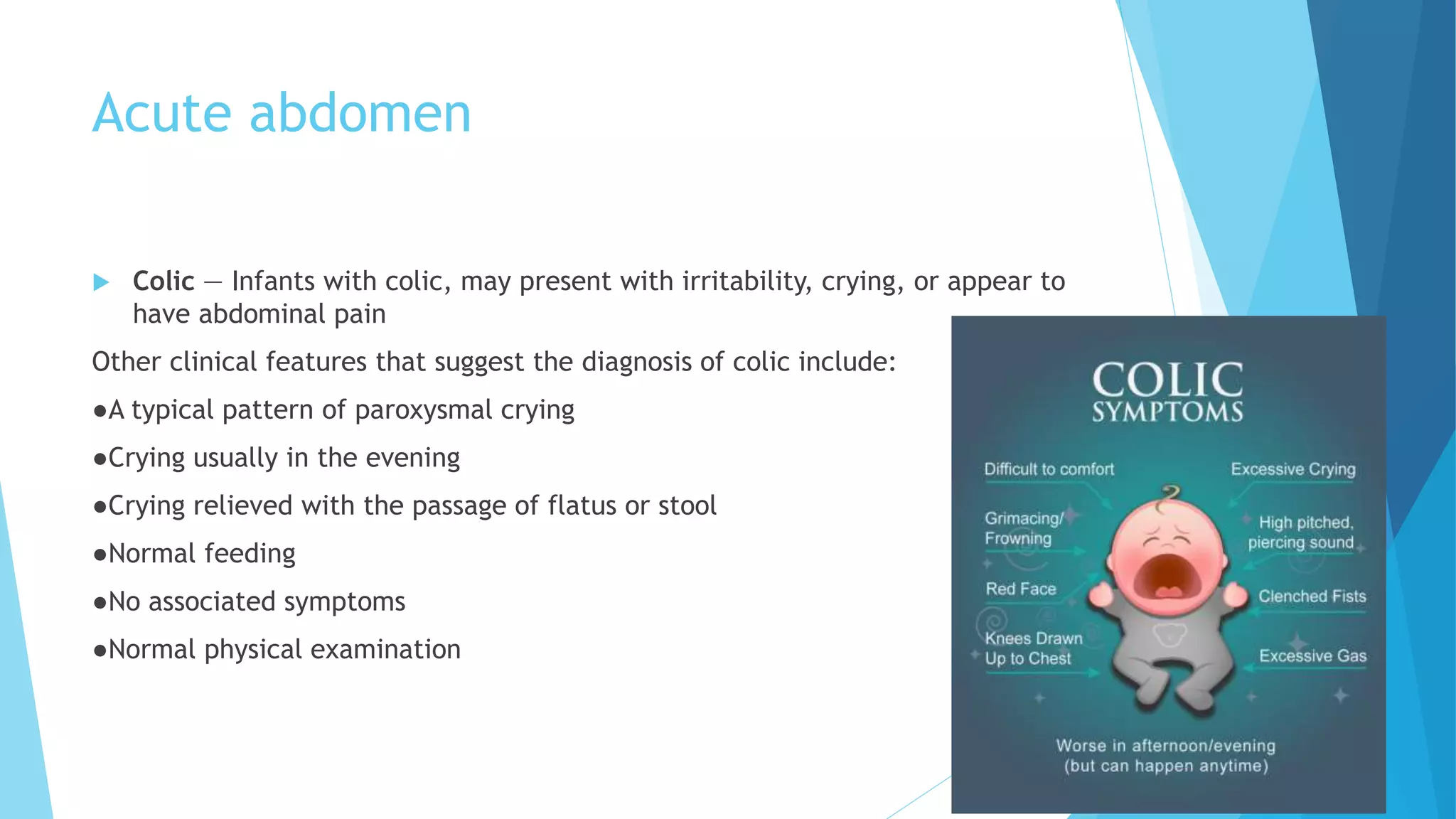
 Colic — Infants with colic, may present with irritability, crying, or appear to
have abdominal pain
Other clinical features that suggest the diagnosis of colic include:
●A typical pattern of paroxysmal crying
●Crying usually in the evening
●Crying relieved with the passage of flatus or stool
●Normal feeding
●No associated symptoms
●Normal physical examination
Recurrent abdominal pain
 Meckel's diverticulum – Meckel's diverticulum usually presents with painless
rectal bleeding. Abdominal pain may develop as the result of mucosal
ulceration
 Meckel's diverticulum – Meckel's diverticulum usually presents with painless
rectal bleeding. Abdominal pain may develop as the result of mucosal
ulceration
 Urolithiasis – Nonspecific abdominal pain is typical as a presenting feature of
urolithiasis among young children.
 Testicular torsion – Testicular torsion causes scrotal pain that may radiate to
the abdomen. Patients may have associated nausea, vomiting, and fever. The
affected testis usually is tender, swollen, and slightly elevated because of
shortening of the cord from twisting
Chronic abdominal pain
 Functional dyspepsia – Dyspepsia is pain or discomfort that is centered in the
epigastric region. Discomfort may be characterized by fullness, early satiety,
bloating, nausea, retching, or vomiting
 Irritable bowel syndrome – Irritable bowel syndrome (IBS) is characterized by
chronic abdominal pain and altered bowel habits (diarrhea or constipation) in
the absence of any alarm findings.
 Functional constipation – Functional constipation is classified as a functional
disorder of defecation, but is a common cause of chronic abdominal pain in
children. Diagnosis requires two of six criteria describing stool frequency,
hardness, size, fecal incontinence, or volitional retention
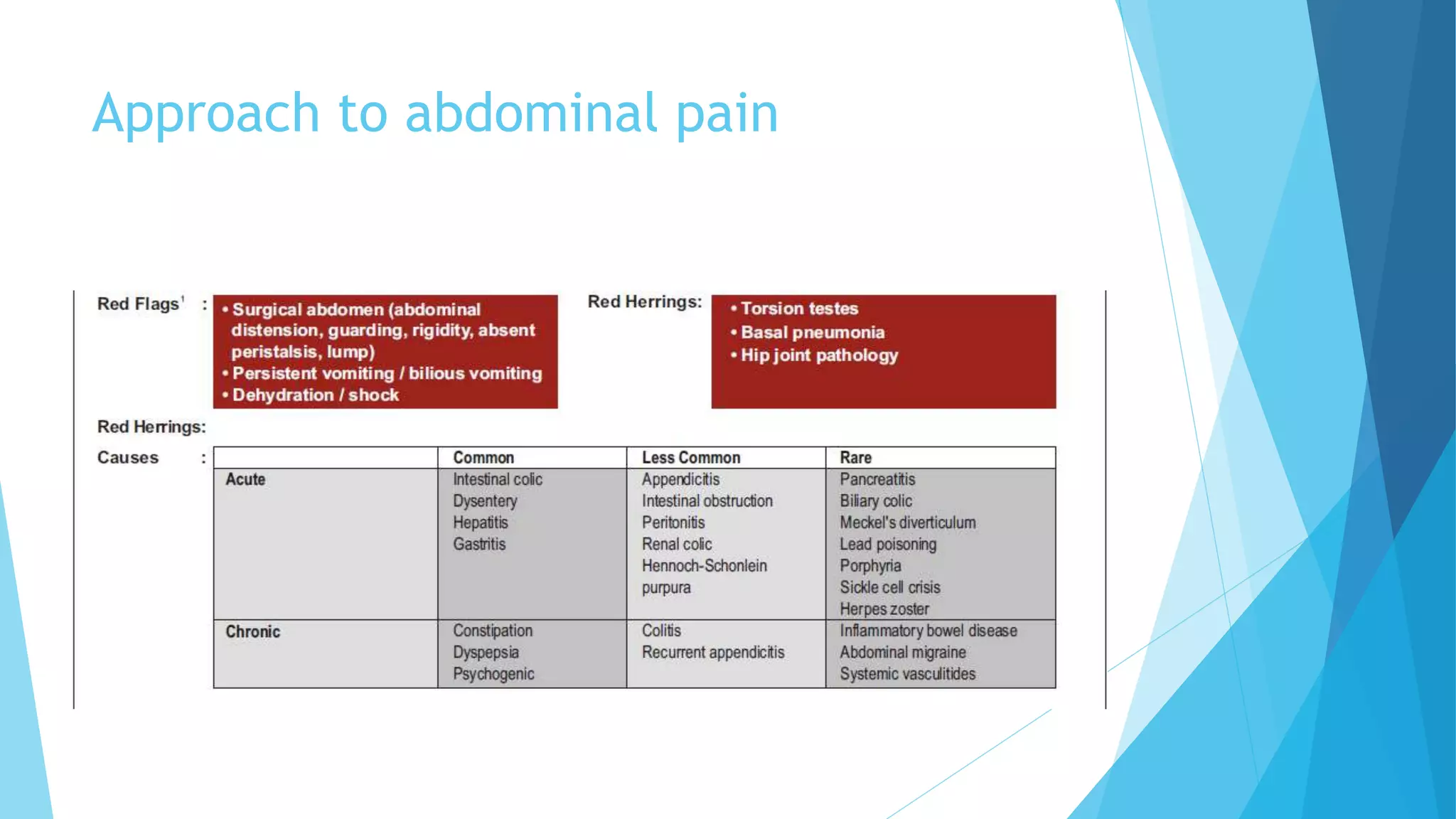
Approach to abdominal pain
Important aspects of the examination
 The general appearance
 Growth parameter
 Abdominal examination
 Hyperextension of the hip psoas muscle disease
 Sexual maturity rating
 Genital examination and DRE
 Laboratory evaluation( CBC, inflammatory markers, stool culture, urine
analysis)
 Imaging (abd X-ray, US)
References
 The Indian Academy of Pediatrics, Approach to Common Symptoms.
 http://www.uptodate.com/contents/causes-of-acute-abdominal-pain-in-
children-and-
adolescents?source=search_result&search=Causes+of+acute+abdominal+pain+i
n+children+and+adolescents&selectedTitle=1~150
 http://www.uptodate.com/contents/chronic-abdominal-pain-in-children-and-
adolescents-approach-to-the-evaluation?source=see_link
ANY QUESTIONS ?

Abdominal pain in pediatrics

  • 1.
    APPROACH TO ABDOMINAL PAININ CHILDREN Maryam Majid Al-Ezairej Pediatrics Collage of medicine, RAKMHSU
  • 2.
    introduction  Abdominal painis one of the most common complaints in childhood and one that frequently requires urgent evaluation in the office or emergency department.  The challenge is to identify those few patients with abdominal pain who have potentially life-threatening conditions  The diagnosis is often suggested by the child's age and clinical features (ie, associated symptoms and physical examination findings).
  • 3.
  • 4.
    Acute abdomen  Appendicitis— The three most predictive clinical features of appendicitis are pain in the right lower quadrant, guarding, and migration of periumbilical pain to the right lower quadrant.  Intussusception — Children with intussusception present with characteristic pain that develops suddenly, is intermittent, severe, and classically accompanied by inconsolable crying with drawing up of the legs toward the abdomen.  Henoch-Schönlein purpura (HSP [IgA vasculitis (IgAV)]) – Henoch-Schönlein purpura (HSP [IgA vasculitis (IgAV)]) is a systemic vasculitis affecting small vessels in skin, gut, and glomeruli that may present with colicky abdominal pain (presumably due to local vasculitis). Pain typically develops after the appearance of a characteristic purpuric rash involving predominantly the lower extremities and buttock  Hepatitis – Hepatitis typically causes jaundice, mild abdominal pain, and fever
  • 5.
    Acute abdomen  Colic— Infants with colic, may present with irritability, crying, or appear to have abdominal pain Other clinical features that suggest the diagnosis of colic include: ●A typical pattern of paroxysmal crying ●Crying usually in the evening ●Crying relieved with the passage of flatus or stool ●Normal feeding ●No associated symptoms ●Normal physical examination
  • 6.
    Recurrent abdominal pain Meckel's diverticulum – Meckel's diverticulum usually presents with painless rectal bleeding. Abdominal pain may develop as the result of mucosal ulceration  Meckel's diverticulum – Meckel's diverticulum usually presents with painless rectal bleeding. Abdominal pain may develop as the result of mucosal ulceration  Urolithiasis – Nonspecific abdominal pain is typical as a presenting feature of urolithiasis among young children.  Testicular torsion – Testicular torsion causes scrotal pain that may radiate to the abdomen. Patients may have associated nausea, vomiting, and fever. The affected testis usually is tender, swollen, and slightly elevated because of shortening of the cord from twisting
  • 7.
    Chronic abdominal pain Functional dyspepsia – Dyspepsia is pain or discomfort that is centered in the epigastric region. Discomfort may be characterized by fullness, early satiety, bloating, nausea, retching, or vomiting  Irritable bowel syndrome – Irritable bowel syndrome (IBS) is characterized by chronic abdominal pain and altered bowel habits (diarrhea or constipation) in the absence of any alarm findings.  Functional constipation – Functional constipation is classified as a functional disorder of defecation, but is a common cause of chronic abdominal pain in children. Diagnosis requires two of six criteria describing stool frequency, hardness, size, fecal incontinence, or volitional retention
  • 8.
  • 9.
  • 10.
    Important aspects ofthe examination  The general appearance  Growth parameter  Abdominal examination  Hyperextension of the hip psoas muscle disease  Sexual maturity rating  Genital examination and DRE  Laboratory evaluation( CBC, inflammatory markers, stool culture, urine analysis)  Imaging (abd X-ray, US)
  • 11.
    References  The IndianAcademy of Pediatrics, Approach to Common Symptoms.  http://www.uptodate.com/contents/causes-of-acute-abdominal-pain-in- children-and- adolescents?source=search_result&search=Causes+of+acute+abdominal+pain+i n+children+and+adolescents&selectedTitle=1~150  http://www.uptodate.com/contents/chronic-abdominal-pain-in-children-and- adolescents-approach-to-the-evaluation?source=see_link
  • 12.