Dr SumitChandak
Asst. Prof, Department of Psychiatry
SKNMC & GH
Management of Alcohol Withdrawal
Objectives:
 Identifying an at risk patient.
 Assessment for severity of withdrawal in at risk
patient.
 Complication’s of alcohol withdrawal and their
assessment.
 Management of alcohol withdrawal and its
complications.
Identify at risk individuals:-
 Need to identify at risk individuals:-
Low detection rates
High rates of Mx/Sx complications when undetected
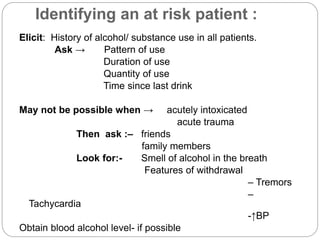
Identifying an at risk patient :
Elicit: History of alcohol/ substance use in all patients.
Ask → Pattern of use
Duration of use
Quantity of use
Time since last drink
May not be possible when → acutely intoxicated
acute trauma
Then ask :– friends
family members
Look for:- Smell of alcohol in the breath
Features of withdrawal
– Tremors
–
Tachycardia
-↑BP
Obtain blood alcohol level- if possible
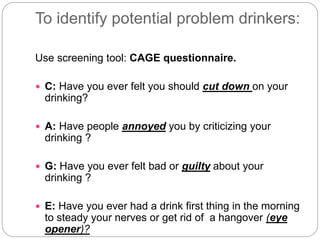
To identify potential problem drinkers:
Use screening tool: CAGE questionnaire.
 C: Have you ever felt you should cut down on your
drinking?
 A: Have people annoyed you by criticizing your
drinking ?
 G: Have you ever felt bad or guilty about your
drinking ?
 E: Have you ever had a drink first thing in the morning
to steady your nerves or get rid of a hangover (eye
opener)?
Assessment in at risk patient:
Primarily for:
 factors predisposing to complications
 severity of withdrawal
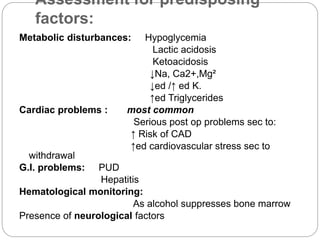
Assessment for predisposing
factors:
Metabolic disturbances: Hypoglycemia
Lactic acidosis
Ketoacidosis
↓Na, Ca2+,Mg²
↓ed /↑ ed K.
↑ed Triglycerides
Cardiac problems : most common
Serious post op problems sec to:
↑ Risk of CAD
↑ed cardiovascular stress sec to
withdrawal
G.I. problems: PUD
Hepatitis
Hematological monitoring:
As alcohol suppresses bone marrow
Presence of neurological factors
For severity of withdrawal :
 Clinical monitoring – intensively for first few days.
 For s/s of alcohol withdrawal
 Sx population : can use scales like CIWA-AI
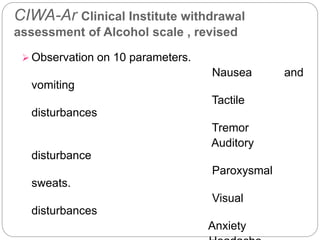
CIWA-Ar Clinical Institute withdrawal
assessment of Alcohol scale , revised
 Observation on 10 parameters.
Nausea and
vomiting
Tactile
disturbances
Tremor
Auditory
disturbance
Paroxysmal
sweats.
Visual
disturbances
Anxiety
CIWA-Ar Clinical Institute
withdrawal assessment of Alcohol
scale , revised
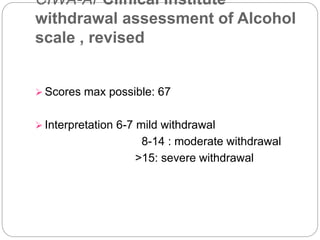
 Scores max possible: 67
 Interpretation 6-7 mild withdrawal
8-14 : moderate withdrawal
>15: severe withdrawal
Complication of withdrawal state:
Delirium: can occur anytime within 7days
Seizures: usually around 3 day of last drink
Other : Wernickes encephalopathy
Psychosis
Depression
Delirium
Definition: The hallmark symptom of delirium is an
impairment of consciousness, usually
accompanied by global impairments of cognitive
functions; generally associated with emotional
labiality, hallucinations or illusions, and
inappropriate, impulsive, irrational, or violent
behavior.
 Generally considered to be an acute reversible
disorder but can become irreversible.
Delirium
 Diagnostic criteria:
A] Disturbance of consciousness (i.e. reduced clarity
of awareness of the environment) with reduced
ability to focus, sustain, or shift attention.
B] A change in cognition (such as memory deficit ,
disorientation, language disturbance) or the
development of a perceptual disturbance that is not
better accounted for by a preexisting, established,
or evolving dementia
.
Delirium:
 Diagnostic criteria:
C] The disturbance develops over a short period of time
(usually hours to days) and tends to fluctuate during
the course of the day.
D] There is evidence from the history, physical
examination, or laboratory findings of either (1) or (2):
1] The symptoms in Criteria A and B developed during
substance intoxication.
2] Medication use is etiologically related to the
disturbance.
Delirium
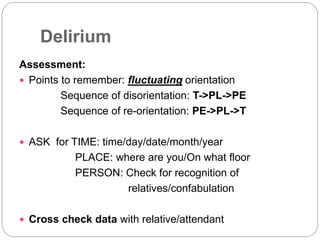
Assessment:
 Points to remember: fluctuating orientation
Sequence of disorientation: T->PL->PE
Sequence of re-orientation: PE->PL->T
 ASK for TIME: time/day/date/month/year
PLACE: where are you/On what floor
PERSON: Check for recognition of
relatives/confabulation
 Cross check data with relative/attendant
Management of alcohol withdrawal /
risk patient:
 In at risk patient promote abstinence for at least 4
weeks of an elective pre-op procedure as it
decreases morbidity from 74% -31%
 Modalities of Intervention:
1]Pharmacotherapy : Substitute
Adjuvant
2] Counseling
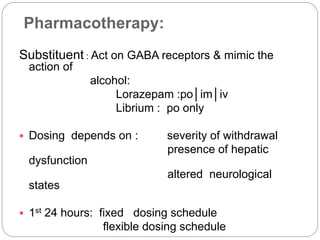
Pharmacotherapy:
Substituent : Act on GABA receptors & mimic the
action of
alcohol:
Lorazepam :po│im│iv
Librium : po only
 Dosing depends on : severity of withdrawal
presence of hepatic
dysfunction
altered neurological
states
 1st 24 hours: fixed dosing schedule
flexible dosing schedule
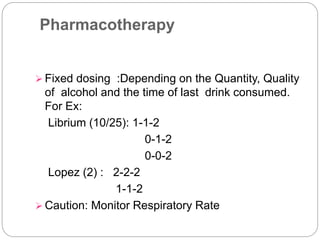
Pharmacotherapy
 Fixed dosing :Depending on the Quantity, Quality
of alcohol and the time of last drink consumed.
For Ex:
Librium (10/25): 1-1-2
0-1-2
0-0-2
Lopez (2) : 2-2-2
1-1-2
 Caution: Monitor Respiratory Rate
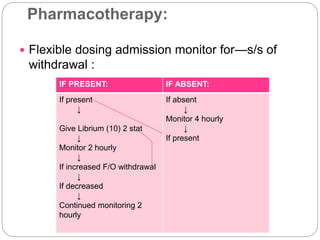
Pharmacotherapy:
 Flexible dosing admission monitor for—s/s of
withdrawal :
IF PRESENT: IF ABSENT:
If present
↓
Give Librium (10) 2 stat
↓
Monitor 2 hourly
↓
If increased F/O withdrawal
↓
If decreased
↓
Continued monitoring 2
hourly
If absent
↓
Monitor 4 hourly
↓
If present
Pharmacotherapy
 Dose obtained at end of 24hours is the total dose
required by that individual
 Continue on the same dose for 48 hours.
 Then taper by 20% every day every day, till
eliminated.
Pharmacotherapy:
Adjuvant :For symptomatic control:
1] Propranolol
2]CBZ
For metabolic parameters :
 Plenty of oral fluids
 Injection Thiamine/MVBC before any I.V. fluids
especially containing sugar
 Tb Thiamine 75/100mg bid
M/M of Delirium :
 Rule out other causes
 Lab: Se Electrolytes, BSL, LFT, RFT
SOS: EEG
 M/M:
 Pharmacotherapy as above
 Restrain the patient
 Keep the lights on at night
 Frequently talk to & reorient the patients
 Correct electrolyte imbalance and underlying
hepatic d/o if any
 When protracted - ECT
THANK YOU
DO’S FOR DELIRIUM:
 Employ environmental interventions to reduce
factors that may
exacerbate delirium.
These interventions include
• changing the lighting to cue day and night,
• reducing monotony and overstimulation and
understimulation,
• correcting visual and auditory impairments (e.g.,
retrieve glasses,
hearing aids), and
• rendering the patient’s environment less alien by
having familiar
people and objects present (e.g., family photographs).
DO’S FOR DELIRIUM
 Reorient the patient to person, place, time, and
circumstances.
 Reorientation should be provided by all who
come into contact with the patient.
 Provide reassurance to patients that the deficits
they are experiencing are common but usually
temporary and reversible.
DONT’S FOR DELIRIUM
 Unnecessarily restrain the patient
 Avoid Anticholinergics drugs like Phenergan in
delirium especially alcohol withdrawal

Alcohol withdrawal mm

  • 1.
    Dr SumitChandak Asst. Prof,Department of Psychiatry SKNMC & GH Management of Alcohol Withdrawal
  • 2.
    Objectives:  Identifying anat risk patient.  Assessment for severity of withdrawal in at risk patient.  Complication’s of alcohol withdrawal and their assessment.  Management of alcohol withdrawal and its complications.
  • 3.
    Identify at riskindividuals:-  Need to identify at risk individuals:- Low detection rates High rates of Mx/Sx complications when undetected
  • 4.
    Identifying an atrisk patient : Elicit: History of alcohol/ substance use in all patients. Ask → Pattern of use Duration of use Quantity of use Time since last drink May not be possible when → acutely intoxicated acute trauma Then ask :– friends family members Look for:- Smell of alcohol in the breath Features of withdrawal – Tremors – Tachycardia -↑BP Obtain blood alcohol level- if possible
  • 5.
    To identify potentialproblem drinkers: Use screening tool: CAGE questionnaire.  C: Have you ever felt you should cut down on your drinking?  A: Have people annoyed you by criticizing your drinking ?  G: Have you ever felt bad or guilty about your drinking ?  E: Have you ever had a drink first thing in the morning to steady your nerves or get rid of a hangover (eye opener)?
  • 6.
    Assessment in atrisk patient: Primarily for:  factors predisposing to complications  severity of withdrawal
  • 7.
    Assessment for predisposing factors: Metabolicdisturbances: Hypoglycemia Lactic acidosis Ketoacidosis ↓Na, Ca2+,Mg² ↓ed /↑ ed K. ↑ed Triglycerides Cardiac problems : most common Serious post op problems sec to: ↑ Risk of CAD ↑ed cardiovascular stress sec to withdrawal G.I. problems: PUD Hepatitis Hematological monitoring: As alcohol suppresses bone marrow Presence of neurological factors
  • 8.
    For severity ofwithdrawal :  Clinical monitoring – intensively for first few days.  For s/s of alcohol withdrawal  Sx population : can use scales like CIWA-AI
  • 9.
    CIWA-Ar Clinical Institutewithdrawal assessment of Alcohol scale , revised  Observation on 10 parameters. Nausea and vomiting Tactile disturbances Tremor Auditory disturbance Paroxysmal sweats. Visual disturbances Anxiety
  • 10.
    CIWA-Ar Clinical Institute withdrawalassessment of Alcohol scale , revised  Scores max possible: 67  Interpretation 6-7 mild withdrawal 8-14 : moderate withdrawal >15: severe withdrawal
  • 11.
    Complication of withdrawalstate: Delirium: can occur anytime within 7days Seizures: usually around 3 day of last drink Other : Wernickes encephalopathy Psychosis Depression
  • 12.
    Delirium Definition: The hallmarksymptom of delirium is an impairment of consciousness, usually accompanied by global impairments of cognitive functions; generally associated with emotional labiality, hallucinations or illusions, and inappropriate, impulsive, irrational, or violent behavior.  Generally considered to be an acute reversible disorder but can become irreversible.
  • 13.
    Delirium  Diagnostic criteria: A]Disturbance of consciousness (i.e. reduced clarity of awareness of the environment) with reduced ability to focus, sustain, or shift attention. B] A change in cognition (such as memory deficit , disorientation, language disturbance) or the development of a perceptual disturbance that is not better accounted for by a preexisting, established, or evolving dementia .
  • 14.
    Delirium:  Diagnostic criteria: C]The disturbance develops over a short period of time (usually hours to days) and tends to fluctuate during the course of the day. D] There is evidence from the history, physical examination, or laboratory findings of either (1) or (2): 1] The symptoms in Criteria A and B developed during substance intoxication. 2] Medication use is etiologically related to the disturbance.
  • 15.
    Delirium Assessment:  Points toremember: fluctuating orientation Sequence of disorientation: T->PL->PE Sequence of re-orientation: PE->PL->T  ASK for TIME: time/day/date/month/year PLACE: where are you/On what floor PERSON: Check for recognition of relatives/confabulation  Cross check data with relative/attendant
  • 16.
    Management of alcoholwithdrawal / risk patient:  In at risk patient promote abstinence for at least 4 weeks of an elective pre-op procedure as it decreases morbidity from 74% -31%  Modalities of Intervention: 1]Pharmacotherapy : Substitute Adjuvant 2] Counseling
  • 17.
    Pharmacotherapy: Substituent : Acton GABA receptors & mimic the action of alcohol: Lorazepam :po│im│iv Librium : po only  Dosing depends on : severity of withdrawal presence of hepatic dysfunction altered neurological states  1st 24 hours: fixed dosing schedule flexible dosing schedule
  • 18.
    Pharmacotherapy  Fixed dosing:Depending on the Quantity, Quality of alcohol and the time of last drink consumed. For Ex: Librium (10/25): 1-1-2 0-1-2 0-0-2 Lopez (2) : 2-2-2 1-1-2  Caution: Monitor Respiratory Rate
  • 19.
    Pharmacotherapy:  Flexible dosingadmission monitor for—s/s of withdrawal : IF PRESENT: IF ABSENT: If present ↓ Give Librium (10) 2 stat ↓ Monitor 2 hourly ↓ If increased F/O withdrawal ↓ If decreased ↓ Continued monitoring 2 hourly If absent ↓ Monitor 4 hourly ↓ If present
  • 20.
    Pharmacotherapy  Dose obtainedat end of 24hours is the total dose required by that individual  Continue on the same dose for 48 hours.  Then taper by 20% every day every day, till eliminated.
  • 21.
    Pharmacotherapy: Adjuvant :For symptomaticcontrol: 1] Propranolol 2]CBZ For metabolic parameters :  Plenty of oral fluids  Injection Thiamine/MVBC before any I.V. fluids especially containing sugar  Tb Thiamine 75/100mg bid
  • 22.
    M/M of Delirium:  Rule out other causes  Lab: Se Electrolytes, BSL, LFT, RFT SOS: EEG  M/M:  Pharmacotherapy as above  Restrain the patient  Keep the lights on at night  Frequently talk to & reorient the patients  Correct electrolyte imbalance and underlying hepatic d/o if any  When protracted - ECT
  • 23.
  • 24.
    DO’S FOR DELIRIUM: Employ environmental interventions to reduce factors that may exacerbate delirium. These interventions include • changing the lighting to cue day and night, • reducing monotony and overstimulation and understimulation, • correcting visual and auditory impairments (e.g., retrieve glasses, hearing aids), and • rendering the patient’s environment less alien by having familiar people and objects present (e.g., family photographs).
  • 25.
    DO’S FOR DELIRIUM Reorient the patient to person, place, time, and circumstances.  Reorientation should be provided by all who come into contact with the patient.  Provide reassurance to patients that the deficits they are experiencing are common but usually temporary and reversible.
  • 26.
    DONT’S FOR DELIRIUM Unnecessarily restrain the patient  Avoid Anticholinergics drugs like Phenergan in delirium especially alcohol withdrawal