Sequences and their Convergence, Infinite
Series
Prerequisite knowledge for the lecture: Basic Arithmetic operations, Number Properties: Integers and
Rational Numbers, Prime Numbers, Identifying Patterns, Concept of limit
School of Basic Sciences
09-10-2024 1
Revision
School of Basic Sciences
09-10-2024 2
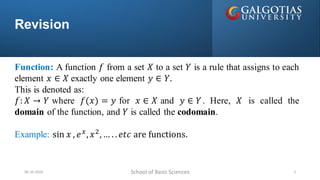
Function: A function 𝑓 from a set 𝑋 to a set 𝑌 is a rule that assigns to each
element 𝑥 ∈ 𝑋 exactly one element 𝑦 ∈ 𝑌.
This is denoted as:
𝑓: 𝑋 → 𝑌 where 𝑓(𝑥) = 𝑦 for 𝑥 ∈ 𝑋 and 𝑦 ∈ 𝑌. Here, 𝑋 is called the
domain of the function, and 𝑌 is called the codomain.
Example: sin 𝑥 , 𝑒𝑥
,𝑥2
,… . .𝑒𝑡𝑐 are functions.
Can the sum of
infinitely many
numbers be
finite?
School of Basic Sciences
09-10-2024 3
Learning outcomes (2-3)
School of Basic Sciences
09-10-2024 4
By the end of this topics students will be able to:
• Understand the concept of limit of sequence and series
• Apply various methods to calculate the limit of sequence
• Evaluate the limit of sequence and series
Here, 1/1 is called the first term, 1/2 is the second term, and so on. We call a(n) = 1/n the general term, since it gives a general
formula for computing all the terms of the sequence.
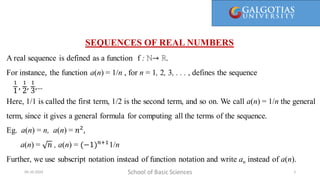
SEQUENCES OF REAL NUMBERS
A real sequence is defined as a function f : ℕ→ ℝ.
For instance, the function a(n) = 1/n , for n = 1, 2, 3, . . . , defines the sequence
Here, 1/1 is called the first term, 1/2 is the second term, and so on. We call a(n) = 1/n the general
term, since it gives a general formula for computing all the terms of the sequence.
Eg. a(n) = n, a(n) = 𝑛2
,
a(n) = 𝑛 , a(n) = (−1)𝑛+1
1/n
Further, we use subscript notation instead of function notation and write an instead of a(n).
School of Basic Sciences
09-10-2024 5
1
1
,
1
2
,
1
3
,…
Here, 1/1 is called the first term, 1/2 is the second term, and so on. We call a(n) = 1/n the general term, since it gives a general
formula for computing all the terms of the sequence.
Set Notation for Sequences
Sequence is written as an where an denotethe nth term of the sequence. The sequencewith general term an =
1/n2 , for n = 1, 2, 3, . . . , be denoted by 𝑎𝑛 =
1
n2 or, equivalently, by listing the terms of the sequence:
1
1
,
1
22
,
1
32
,… ,
1
𝑛2
The Terms of a Sequence
Example: Write out the first four terms of the sequencewhose general term is given by 𝑎𝑛 =
𝑛+1
𝑛
, for n = 1, 2,
3, . . .
Solution:𝑎1 =
1+1
1
= 2,𝑎2 =
2+1
2
=
3
2
, 𝑎3 =
3+1
3
=
4
5
, 𝑎4 =
4+1
4
=
5
4
.
School of Basic Sciences
09-10-2024 6
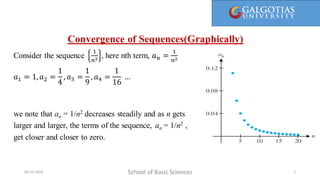
Convergence of Sequences(Graphically)
Consider the sequence
1
𝑛2 , here nth term, 𝑎𝑛 =
1
𝑛2
𝑎1 = 1,𝑎2 =
1
4
, 𝑎3 =
1
9
, 𝑎4 =
1
16
…
we note that an = 1/n2 decreases steadily and as n gets
larger and larger, the terms of the sequence, an = 1/n2 ,
get closer and closer to zero.
School of Basic Sciences
09-10-2024 7
Here, 1/1 is called the first term, 1/2 is the second term, and so on. We call a(n) = 1/n the general term, since it gives a general
formula for computing all the terms of the sequence.
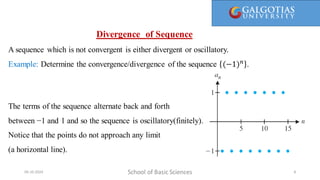
Divergence of Sequence
A sequence which is not convergent is either divergent or oscillatory.
Example: Determine the convergence/divergence of the sequence (−1)𝑛
.
The terms of the sequence alternate back and forth
between −1 and 1 and so the sequence is oscillatory(finitely).
Notice that the points do not approach any limit
(a horizontal line).
School of Basic Sciences
09-10-2024 8
Activity-1
Classify convergent, divergent and
oscillatory sequences using graphical
method.
1) 𝑎𝑛 = 𝑛
2) 𝑎𝑛 =
1
𝑛
3) 𝑎𝑛 =
𝑛−1
𝑛
4) 𝑎𝑛 =
5
𝑛2
School of Basic Sciences
09-10-2024 9
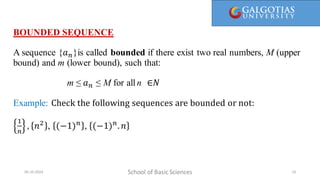
BOUNDED SEQUENCE
A sequence {𝑎𝑛}is called bounded if there exist two real numbers, M (upper
bound) and m (lower bound), such that:
m ≤ 𝑎𝑛 ≤ M for all n ∈𝑁
Example: Check the following sequences are bounded or not:
1
𝑛
, 𝑛2
, (−1)𝑛
, (−1)𝑛
.𝑛
School of Basic Sciences
09-10-2024 10
MONOTONIC SEQUENCE
Increasing (Non-decreasing) Sequence: A sequence 𝑎𝑛 with the
property that 𝑎𝑛 ≤ 𝑎𝑛+1∀𝑛 ∈ ℕ is called increasing (Non-decreasing)
sequence.
Example: 1. 1,2,3, … , 2.
1
2
,
2
3
,
3
4
, … ,
𝑛
n+1
.
Decreasing (Non-increasing) Sequence: A sequence 𝑎𝑛 with the
property that 𝑎𝑛 ≥ 𝑎𝑛+1 ∀𝑛 ∈ ℕ is called decreasing (Non-increasing)
sequence.
Example:
1
1
,
1
2
,
1
3
, …
1
n
, …
School of Basic Sciences
09-10-2024 11
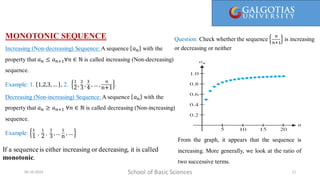
From the graph, it appears that the sequence is
increasing. More generally, we look at the ratio of
two successive terms.
If a sequenceis either increasing or decreasing, it is called
monotonic.
Question: Check whether the sequence
𝑛
𝑛+1
is increasing
or decreasing or neither
Question Time
Construct new convergent,
divergent and oscillatory
sequences? Construct
new convergent,
divergent and
oscillatory
sequences?
School of Basic Sciences
09-10-2024 12
Activity-2 (Think-Pair-
Share)
Can every monotonic
sequence be convergent
and conversely is every
convergent sequence
monotonic?
Explore by examples.
School of Basic Sciences
09-10-2024 13
School of Basic Sciences
09-10-2024 14
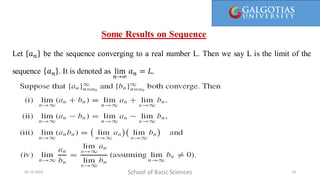
Let 𝑎𝑛 be the sequence converging to a real number L. Then we say L is the limit of the
sequence 𝑎𝑛 . It is denoted as lim
𝑛→∞
𝑎𝑛 = 𝐿.
Some Results on Sequence
Here, 1/1 is called the first term, 1/2 is the second term, and so on. We call a(n) = 1/n the general term, since it gives a general
formula for computing all the terms of the sequence.
School of Basic Sciences
09-10-2024 15
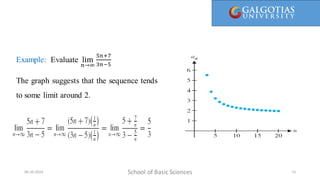
Example: Evaluate lim
𝑛→∞
5𝑛+7
3𝑛−5
The graph suggests that the sequence tends
to some limit around 2.
School of Basic Sciences
09-10-2024 16
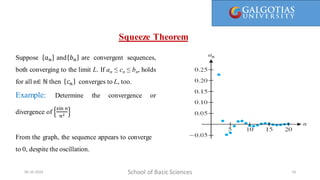
Suppose 𝑎𝑛 and 𝑏𝑛 are convergent sequences,
both converging to the limit L. If an ≤ cn ≤ bn, holds
for all n∈ ℕ then 𝑐𝑛 converges to L, too.
Example: Determine the convergence or
divergence of
sin 𝑛
𝑛2
From the graph, the sequence appears to converge
to 0, despite the oscillation.
Squeeze Theorem
School of Basic Sciences
09-10-2024 17
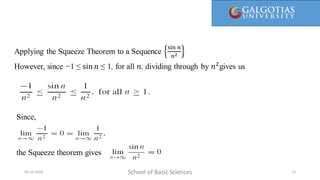
Applying the Squeeze Theorem to a Sequence
sin 𝑛
𝑛2
However, since −1 ≤ sin 𝑛 ≤ 1, for all 𝑛, dividing through by 𝑛2
gives us
Since,
the Squeeze theorem gives
School of Basic Sciences
09-10-2024 18
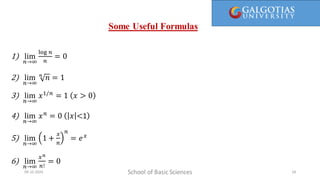
1) lim
𝑛→∞
log 𝑛
𝑛
= 0
2) lim
𝑛→∞
𝑛
𝑛 = 1
3) lim
𝑛→∞
𝑥1/𝑛
= 1 𝑥 > 0
4) lim
𝑛→∞
𝑥𝑛
= 0 𝑥 <1
5) lim
𝑛→∞
1 +
𝑥
𝑛
𝑛
= 𝑒𝑥
6) lim
𝑛→∞
𝑥𝑛
𝑛!
= 0
Some Useful Formulas
Activity-3
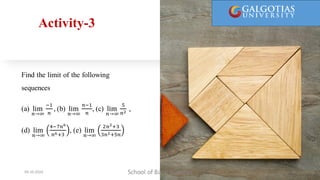
Find the limit of the following
sequences
(a) lim
𝑛→∞
−1
𝑛
, (b) lim
𝑛→∞
𝑛−1
𝑛
, (c) lim
𝑛→∞
5
𝑛2
,
(d) lim
𝑛→∞
4−7𝑛6
𝑛6+3
, (e) lim
𝑛→∞
2𝑛2+3
3𝑛2+5𝑛
School of Basic Sciences
09-10-2024 19
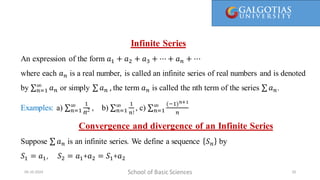
Infinite Series
An expression of the form 𝑎1 + 𝑎2 + 𝑎3 + ⋯ + 𝑎𝑛 + ⋯
where each 𝑎𝑛 is a real number, is called an infinite series of real numbers and is denoted
by 𝑛=1
∞
𝑎𝑛 or simply 𝑎𝑛 , the term 𝑎𝑛 is called the nth term of the series 𝑎𝑛.
Examples: a) 𝑛=1
∞ 1
n2 , b) 𝑛=1
∞ 1
𝑛!
, c) 𝑛=1
∞ (−1)𝑛+1
𝑛
Convergence and divergence of an Infinite Series
Suppose 𝑎𝑛 is an infinite series. We define a sequence 𝑆𝑛 by
𝑆1 = 𝑎1, 𝑆2 = 𝑎1+𝑎2 = 𝑆1+𝑎2
School of Basic Sciences
09-10-2024 20
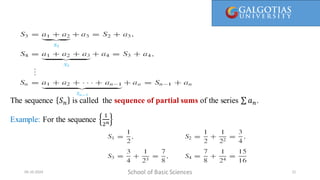
The sequence 𝑆𝑛 is called the sequence of partial sums of the series 𝑎𝑛.
Example: For the sequence
1
2𝑛
School of Basic Sciences
09-10-2024 21
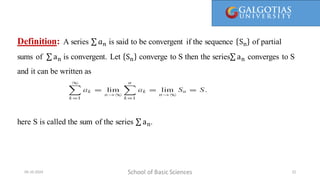
Definition: A series 𝑎𝑛 is said to be convergent if the sequence Sn of partial
sums of an is convergent. Let Sn converge to S then the series an converges to S
and it can be written as
here S is called the sum of the series an.
School of Basic Sciences
09-10-2024 22
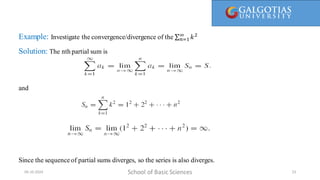
Example: Investigate the convergence/divergence of the 𝑛=1
∞
𝑘2
Solution: The nth partial sum is
and
Since the sequence of partial sums diverges, so the series is also diverges.
School of Basic Sciences
09-10-2024 23
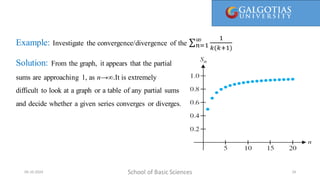
Example: Investigate the convergence/divergence of the 𝑛=1
∞ 1
𝑘(𝑘+1)
Solution: From the graph, it appears that the partial
sums are approaching 1, as n→∞.It is extremely
difficult to look at a graph or a table of any partial sums
and decide whether a given series converges or diverges.
School of Basic Sciences
09-10-2024 24
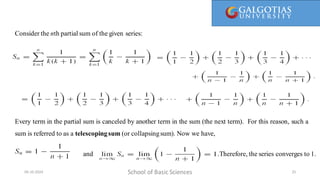
Every term in the partial sum is canceled by another term in the sum (the next term). For this reason, such a sum is referred to as
a telescopingsum (or collapsing sum).
Consider the nth partial sum of the given series:
School of Basic Sciences
09-10-2024 25
Every term in the partial sum is canceled by another term in the sum (the next term). For this reason, such a
sum is referred to as a telescopingsum (or collapsingsum). Now we have,
. .Therefore, the series converges to 1.
and
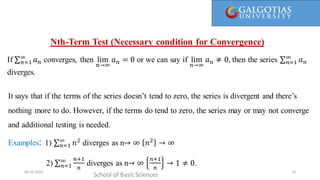
It says that if the terms don’t tend to zero, the series is divergent and there’s nothing more to do.
However, if the terms do tend to zero, the series may or may not converge and additionaltesting is needed.
Nth-Term Test (Necessary condition for Convergence)
School of Basic Sciences
09-10-2024 26
It says that if the terms of the series doesn’t tend to zero, the series is divergent and there’s
nothing more to do. However, if the terms do tend to zero, the series may or may not converge
and additional testing is needed.
Examples: 1) 𝑛=1
∞
𝑛2
diverges as n→ ∞ 𝑛2
→ ∞
2) 𝑛=1
∞ 𝑛+1
𝑛
diverges as n→ ∞
𝑛+1
𝑛
→ 1 ≠ 0.
If 𝑛=1
∞
𝑎𝑛 converges, then lim
𝑛→∞
𝑎𝑛 = 0 or we can say if lim
𝑛→∞
𝑎𝑛 ≠ 0, then the series 𝑛=1
∞
𝑎𝑛
diverges.
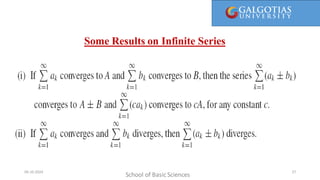
Every term in the partial sum is canceled by another term in the sum (the next term). For this reason, such a sum is referred to as
a telescopingsum (or collapsing sum).
Some Results on Infinite Series
School of Basic Sciences
09-10-2024 27
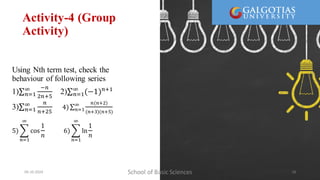
Activity-4 (Group
Activity)
Using Nth term test, check the
behaviour of following series
1) 𝑛=1
∞ −𝑛
2𝑛+5
2) 𝑛=1
∞
(−1)𝑛+1
3) 𝑛=1
∞ 𝑛
𝑛+25
4) 𝑛=1
∞ 𝑛(𝑛+2)
(𝑛+3)(𝑛+5)
5)
𝑛=1
∞
cos
1
𝑛
6)
𝑛=1
∞
ln
1
𝑛
School of Basic Sciences
09-10-2024 28
Slide 29
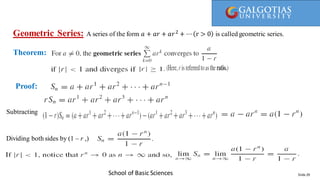
Dividing both sides by (1 – r ,)
School of Basic Sciences
Geometric Series: A series of the form 𝑎 + 𝑎𝑟 + 𝑎𝑟2
+ ⋯ r > 0 is called geometric series.
Theorem:
Proof:
Subtracting
Every term in the partial sum is canceled by another term in the sum (the next term). For this reason, such a sum is referred to as
a telescopingsum (or collapsing sum).
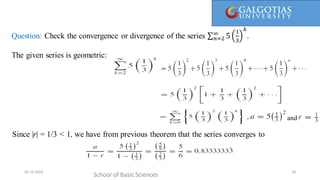
Question: Check the convergence or divergence of the series 𝑛=2
∞
5
1
3
𝑘
.
The given series is geometric:
School of Basic Sciences
09-10-2024 30
Since |r| = 1/3 < 1, we have from previous theorem that the series converges to
, and
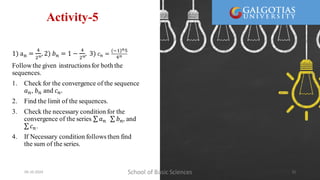
Activity-5
1) an =
4
2𝑛
, 2) 𝑏𝑛 = 1 −
4
2𝑛
, 3) 𝑐𝑛 =
(−1)𝑛5
4𝑛
Followthe given instructionsfor both the
sequences.
1. Check for the convergence of the sequence
𝑎𝑛, 𝑏𝑛 and 𝑐𝑛.
2. Find the limit of the sequences.
3. Check the necessary condition for the
convergence of the series 𝑎𝑛 𝑏𝑛, and
𝑐𝑛.
4. If Necessary condition follows then find
the sum of the series.
School of Basic Sciences
09-10-2024 31
Summary
School of Basic Sciences
09-10-2024 32
• A real sequence is defined as a function f: ℕ→ ℝ.
• A bounded, monotonic sequence is convergent.
• Every convergent sequence is bounded but the converse is not true.
• Every convergent sequence has a unique limit (Uniqueness Theorem).
• The nth-term test only identifies divergence. If the limit of the nth term is not
zero, the series diverges, but if it equals zero, further tests are needed to check for
convergence.
• The geometric series test provides a clear rule for convergence or divergence
based on the absolute value of the common ratio r. A geometric series converges
if the ratio is between -1 and 1 (∣r∣<1); otherwise, it diverges.
Practice Questions for
LMS
School of Basic Sciences
09-10-2024 33
1. Find the nth term of the sequence1, -4, 9, -16, 25, …
2. Express the repeating decimal 5.232323…into ratio of two integers
3. Show that the series 𝑛=1
∞ −𝑛
2𝑛+5
is divergent.
4. Explain that the sequence 𝑎𝑛 = (−1)𝑛+1
is not convergent
graphically.
5. Solve: lim
𝑛→∞
𝑛−11
𝑛
𝑛
6. Solve: lim
𝑛→∞
4−7𝑛6
𝑛6+3
7. Show that series
1
9
+
1
27
+
1
81
+ ⋯ is convergent and find its sum.
8. Show that geometric series 𝑎 + 𝑎𝑟 + 𝑎𝑟2
+ 𝑎𝑟3
+ ⋯ converges to
𝑎
1−𝑟
for 𝑟 < 1.

Engineering mathematics_Sequence and Series.pdf

  • 1.
    Sequences and theirConvergence, Infinite Series Prerequisite knowledge for the lecture: Basic Arithmetic operations, Number Properties: Integers and Rational Numbers, Prime Numbers, Identifying Patterns, Concept of limit School of Basic Sciences 09-10-2024 1
  • 2.
    Revision School of BasicSciences 09-10-2024 2 Function: A function 𝑓 from a set 𝑋 to a set 𝑌 is a rule that assigns to each element 𝑥 ∈ 𝑋 exactly one element 𝑦 ∈ 𝑌. This is denoted as: 𝑓: 𝑋 → 𝑌 where 𝑓(𝑥) = 𝑦 for 𝑥 ∈ 𝑋 and 𝑦 ∈ 𝑌. Here, 𝑋 is called the domain of the function, and 𝑌 is called the codomain. Example: sin 𝑥 , 𝑒𝑥 ,𝑥2 ,… . .𝑒𝑡𝑐 are functions.
  • 3.
    Can the sumof infinitely many numbers be finite? School of Basic Sciences 09-10-2024 3
  • 4.
    Learning outcomes (2-3) Schoolof Basic Sciences 09-10-2024 4 By the end of this topics students will be able to: • Understand the concept of limit of sequence and series • Apply various methods to calculate the limit of sequence • Evaluate the limit of sequence and series
  • 5.
    Here, 1/1 iscalled the first term, 1/2 is the second term, and so on. We call a(n) = 1/n the general term, since it gives a general formula for computing all the terms of the sequence. SEQUENCES OF REAL NUMBERS A real sequence is defined as a function f : ℕ→ ℝ. For instance, the function a(n) = 1/n , for n = 1, 2, 3, . . . , defines the sequence Here, 1/1 is called the first term, 1/2 is the second term, and so on. We call a(n) = 1/n the general term, since it gives a general formula for computing all the terms of the sequence. Eg. a(n) = n, a(n) = 𝑛2 , a(n) = 𝑛 , a(n) = (−1)𝑛+1 1/n Further, we use subscript notation instead of function notation and write an instead of a(n). School of Basic Sciences 09-10-2024 5 1 1 , 1 2 , 1 3 ,…
  • 6.
    Here, 1/1 iscalled the first term, 1/2 is the second term, and so on. We call a(n) = 1/n the general term, since it gives a general formula for computing all the terms of the sequence. Set Notation for Sequences Sequence is written as an where an denotethe nth term of the sequence. The sequencewith general term an = 1/n2 , for n = 1, 2, 3, . . . , be denoted by 𝑎𝑛 = 1 n2 or, equivalently, by listing the terms of the sequence: 1 1 , 1 22 , 1 32 ,… , 1 𝑛2 The Terms of a Sequence Example: Write out the first four terms of the sequencewhose general term is given by 𝑎𝑛 = 𝑛+1 𝑛 , for n = 1, 2, 3, . . . Solution:𝑎1 = 1+1 1 = 2,𝑎2 = 2+1 2 = 3 2 , 𝑎3 = 3+1 3 = 4 5 , 𝑎4 = 4+1 4 = 5 4 . School of Basic Sciences 09-10-2024 6
  • 7.
    Convergence of Sequences(Graphically) Considerthe sequence 1 𝑛2 , here nth term, 𝑎𝑛 = 1 𝑛2 𝑎1 = 1,𝑎2 = 1 4 , 𝑎3 = 1 9 , 𝑎4 = 1 16 … we note that an = 1/n2 decreases steadily and as n gets larger and larger, the terms of the sequence, an = 1/n2 , get closer and closer to zero. School of Basic Sciences 09-10-2024 7
  • 8.
    Here, 1/1 iscalled the first term, 1/2 is the second term, and so on. We call a(n) = 1/n the general term, since it gives a general formula for computing all the terms of the sequence. Divergence of Sequence A sequence which is not convergent is either divergent or oscillatory. Example: Determine the convergence/divergence of the sequence (−1)𝑛 . The terms of the sequence alternate back and forth between −1 and 1 and so the sequence is oscillatory(finitely). Notice that the points do not approach any limit (a horizontal line). School of Basic Sciences 09-10-2024 8
  • 9.
    Activity-1 Classify convergent, divergentand oscillatory sequences using graphical method. 1) 𝑎𝑛 = 𝑛 2) 𝑎𝑛 = 1 𝑛 3) 𝑎𝑛 = 𝑛−1 𝑛 4) 𝑎𝑛 = 5 𝑛2 School of Basic Sciences 09-10-2024 9
  • 10.
    BOUNDED SEQUENCE A sequence{𝑎𝑛}is called bounded if there exist two real numbers, M (upper bound) and m (lower bound), such that: m ≤ 𝑎𝑛 ≤ M for all n ∈𝑁 Example: Check the following sequences are bounded or not: 1 𝑛 , 𝑛2 , (−1)𝑛 , (−1)𝑛 .𝑛 School of Basic Sciences 09-10-2024 10
  • 11.
    MONOTONIC SEQUENCE Increasing (Non-decreasing)Sequence: A sequence 𝑎𝑛 with the property that 𝑎𝑛 ≤ 𝑎𝑛+1∀𝑛 ∈ ℕ is called increasing (Non-decreasing) sequence. Example: 1. 1,2,3, … , 2. 1 2 , 2 3 , 3 4 , … , 𝑛 n+1 . Decreasing (Non-increasing) Sequence: A sequence 𝑎𝑛 with the property that 𝑎𝑛 ≥ 𝑎𝑛+1 ∀𝑛 ∈ ℕ is called decreasing (Non-increasing) sequence. Example: 1 1 , 1 2 , 1 3 , … 1 n , … School of Basic Sciences 09-10-2024 11 From the graph, it appears that the sequence is increasing. More generally, we look at the ratio of two successive terms. If a sequenceis either increasing or decreasing, it is called monotonic. Question: Check whether the sequence 𝑛 𝑛+1 is increasing or decreasing or neither
  • 12.
    Question Time Construct newconvergent, divergent and oscillatory sequences? Construct new convergent, divergent and oscillatory sequences? School of Basic Sciences 09-10-2024 12
  • 13.
    Activity-2 (Think-Pair- Share) Can everymonotonic sequence be convergent and conversely is every convergent sequence monotonic? Explore by examples. School of Basic Sciences 09-10-2024 13
  • 14.
    School of BasicSciences 09-10-2024 14 Let 𝑎𝑛 be the sequence converging to a real number L. Then we say L is the limit of the sequence 𝑎𝑛 . It is denoted as lim 𝑛→∞ 𝑎𝑛 = 𝐿. Some Results on Sequence
  • 15.
    Here, 1/1 iscalled the first term, 1/2 is the second term, and so on. We call a(n) = 1/n the general term, since it gives a general formula for computing all the terms of the sequence. School of Basic Sciences 09-10-2024 15 Example: Evaluate lim 𝑛→∞ 5𝑛+7 3𝑛−5 The graph suggests that the sequence tends to some limit around 2.
  • 16.
    School of BasicSciences 09-10-2024 16 Suppose 𝑎𝑛 and 𝑏𝑛 are convergent sequences, both converging to the limit L. If an ≤ cn ≤ bn, holds for all n∈ ℕ then 𝑐𝑛 converges to L, too. Example: Determine the convergence or divergence of sin 𝑛 𝑛2 From the graph, the sequence appears to converge to 0, despite the oscillation. Squeeze Theorem
  • 17.
    School of BasicSciences 09-10-2024 17 Applying the Squeeze Theorem to a Sequence sin 𝑛 𝑛2 However, since −1 ≤ sin 𝑛 ≤ 1, for all 𝑛, dividing through by 𝑛2 gives us Since, the Squeeze theorem gives
  • 18.
    School of BasicSciences 09-10-2024 18 1) lim 𝑛→∞ log 𝑛 𝑛 = 0 2) lim 𝑛→∞ 𝑛 𝑛 = 1 3) lim 𝑛→∞ 𝑥1/𝑛 = 1 𝑥 > 0 4) lim 𝑛→∞ 𝑥𝑛 = 0 𝑥 <1 5) lim 𝑛→∞ 1 + 𝑥 𝑛 𝑛 = 𝑒𝑥 6) lim 𝑛→∞ 𝑥𝑛 𝑛! = 0 Some Useful Formulas
  • 19.
    Activity-3 Find the limitof the following sequences (a) lim 𝑛→∞ −1 𝑛 , (b) lim 𝑛→∞ 𝑛−1 𝑛 , (c) lim 𝑛→∞ 5 𝑛2 , (d) lim 𝑛→∞ 4−7𝑛6 𝑛6+3 , (e) lim 𝑛→∞ 2𝑛2+3 3𝑛2+5𝑛 School of Basic Sciences 09-10-2024 19
  • 20.
    Infinite Series An expressionof the form 𝑎1 + 𝑎2 + 𝑎3 + ⋯ + 𝑎𝑛 + ⋯ where each 𝑎𝑛 is a real number, is called an infinite series of real numbers and is denoted by 𝑛=1 ∞ 𝑎𝑛 or simply 𝑎𝑛 , the term 𝑎𝑛 is called the nth term of the series 𝑎𝑛. Examples: a) 𝑛=1 ∞ 1 n2 , b) 𝑛=1 ∞ 1 𝑛! , c) 𝑛=1 ∞ (−1)𝑛+1 𝑛 Convergence and divergence of an Infinite Series Suppose 𝑎𝑛 is an infinite series. We define a sequence 𝑆𝑛 by 𝑆1 = 𝑎1, 𝑆2 = 𝑎1+𝑎2 = 𝑆1+𝑎2 School of Basic Sciences 09-10-2024 20
  • 21.
    The sequence 𝑆𝑛is called the sequence of partial sums of the series 𝑎𝑛. Example: For the sequence 1 2𝑛 School of Basic Sciences 09-10-2024 21
  • 22.
    Definition: A series𝑎𝑛 is said to be convergent if the sequence Sn of partial sums of an is convergent. Let Sn converge to S then the series an converges to S and it can be written as here S is called the sum of the series an. School of Basic Sciences 09-10-2024 22
  • 23.
    Example: Investigate theconvergence/divergence of the 𝑛=1 ∞ 𝑘2 Solution: The nth partial sum is and Since the sequence of partial sums diverges, so the series is also diverges. School of Basic Sciences 09-10-2024 23
  • 24.
    Example: Investigate theconvergence/divergence of the 𝑛=1 ∞ 1 𝑘(𝑘+1) Solution: From the graph, it appears that the partial sums are approaching 1, as n→∞.It is extremely difficult to look at a graph or a table of any partial sums and decide whether a given series converges or diverges. School of Basic Sciences 09-10-2024 24
  • 25.
    Every term inthe partial sum is canceled by another term in the sum (the next term). For this reason, such a sum is referred to as a telescopingsum (or collapsing sum). Consider the nth partial sum of the given series: School of Basic Sciences 09-10-2024 25 Every term in the partial sum is canceled by another term in the sum (the next term). For this reason, such a sum is referred to as a telescopingsum (or collapsingsum). Now we have, . .Therefore, the series converges to 1. and
  • 26.
    It says thatif the terms don’t tend to zero, the series is divergent and there’s nothing more to do. However, if the terms do tend to zero, the series may or may not converge and additionaltesting is needed. Nth-Term Test (Necessary condition for Convergence) School of Basic Sciences 09-10-2024 26 It says that if the terms of the series doesn’t tend to zero, the series is divergent and there’s nothing more to do. However, if the terms do tend to zero, the series may or may not converge and additional testing is needed. Examples: 1) 𝑛=1 ∞ 𝑛2 diverges as n→ ∞ 𝑛2 → ∞ 2) 𝑛=1 ∞ 𝑛+1 𝑛 diverges as n→ ∞ 𝑛+1 𝑛 → 1 ≠ 0. If 𝑛=1 ∞ 𝑎𝑛 converges, then lim 𝑛→∞ 𝑎𝑛 = 0 or we can say if lim 𝑛→∞ 𝑎𝑛 ≠ 0, then the series 𝑛=1 ∞ 𝑎𝑛 diverges.
  • 27.
    Every term inthe partial sum is canceled by another term in the sum (the next term). For this reason, such a sum is referred to as a telescopingsum (or collapsing sum). Some Results on Infinite Series School of Basic Sciences 09-10-2024 27
  • 28.
    Activity-4 (Group Activity) Using Nthterm test, check the behaviour of following series 1) 𝑛=1 ∞ −𝑛 2𝑛+5 2) 𝑛=1 ∞ (−1)𝑛+1 3) 𝑛=1 ∞ 𝑛 𝑛+25 4) 𝑛=1 ∞ 𝑛(𝑛+2) (𝑛+3)(𝑛+5) 5) 𝑛=1 ∞ cos 1 𝑛 6) 𝑛=1 ∞ ln 1 𝑛 School of Basic Sciences 09-10-2024 28
  • 29.
    Slide 29 Dividing bothsides by (1 – r ,) School of Basic Sciences Geometric Series: A series of the form 𝑎 + 𝑎𝑟 + 𝑎𝑟2 + ⋯ r > 0 is called geometric series. Theorem: Proof: Subtracting
  • 30.
    Every term inthe partial sum is canceled by another term in the sum (the next term). For this reason, such a sum is referred to as a telescopingsum (or collapsing sum). Question: Check the convergence or divergence of the series 𝑛=2 ∞ 5 1 3 𝑘 . The given series is geometric: School of Basic Sciences 09-10-2024 30 Since |r| = 1/3 < 1, we have from previous theorem that the series converges to , and
  • 31.
    Activity-5 1) an = 4 2𝑛 ,2) 𝑏𝑛 = 1 − 4 2𝑛 , 3) 𝑐𝑛 = (−1)𝑛5 4𝑛 Followthe given instructionsfor both the sequences. 1. Check for the convergence of the sequence 𝑎𝑛, 𝑏𝑛 and 𝑐𝑛. 2. Find the limit of the sequences. 3. Check the necessary condition for the convergence of the series 𝑎𝑛 𝑏𝑛, and 𝑐𝑛. 4. If Necessary condition follows then find the sum of the series. School of Basic Sciences 09-10-2024 31
  • 32.
    Summary School of BasicSciences 09-10-2024 32 • A real sequence is defined as a function f: ℕ→ ℝ. • A bounded, monotonic sequence is convergent. • Every convergent sequence is bounded but the converse is not true. • Every convergent sequence has a unique limit (Uniqueness Theorem). • The nth-term test only identifies divergence. If the limit of the nth term is not zero, the series diverges, but if it equals zero, further tests are needed to check for convergence. • The geometric series test provides a clear rule for convergence or divergence based on the absolute value of the common ratio r. A geometric series converges if the ratio is between -1 and 1 (∣r∣<1); otherwise, it diverges.
  • 33.
    Practice Questions for LMS Schoolof Basic Sciences 09-10-2024 33 1. Find the nth term of the sequence1, -4, 9, -16, 25, … 2. Express the repeating decimal 5.232323…into ratio of two integers 3. Show that the series 𝑛=1 ∞ −𝑛 2𝑛+5 is divergent. 4. Explain that the sequence 𝑎𝑛 = (−1)𝑛+1 is not convergent graphically. 5. Solve: lim 𝑛→∞ 𝑛−11 𝑛 𝑛 6. Solve: lim 𝑛→∞ 4−7𝑛6 𝑛6+3 7. Show that series 1 9 + 1 27 + 1 81 + ⋯ is convergent and find its sum. 8. Show that geometric series 𝑎 + 𝑎𝑟 + 𝑎𝑟2 + 𝑎𝑟3 + ⋯ converges to 𝑎 1−𝑟 for 𝑟 < 1.