42-Infinite Series VU
Lecture No. 42 Infinite Series
© Copyright Virtual University of Pakistan
1
Definition 11.3.1
An Infinite series is an expansion that can be
written in the form
The numbers u1, u2, … are called TERMS of the
series.
......21
1
++++=∑
∞
=
k
k
k uuuu
What does it mean to add infinitely
many terms?
• Can we add
1+2+3+4+…. All the way to
infinity??
This is physically and mentally impossible!
But we can compute an infinite sum using the idea
of limits
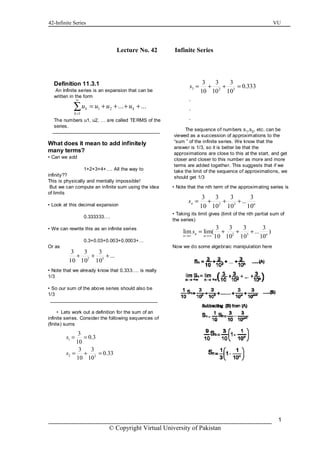
• Look at this decimal expansion
0.333333….
• We can rewrite this as an infinite series
0.3+0.03+0.003+0.0003+…
Or as
• Note that we already know that 0.333…. is really
1/3
• So our sum of the above series should also be
1/3
...
10
3
10
3
10
3
32
+++
• Lets work out a definition for the sum of an
infinite series. Consider the following sequences of
(finite) sums
1
2 2
3
0.3
10
3 3
0.33
10 10
s
s
= =
= + =
3 2 3
3 3 3
0.333
10 10 10
.
.
.
s = + + =
The sequence of numbers s1,s2, etc. can be
viewed as a succession of approximations to the
“sum ” of the infinite series. We know that the
answer is 1/3, so it is better be that the
approximations are close to this at the start, and get
closer and closer to this number as more and more
terms are added together. This suggests that if we
take the limit of the sequence of approximations, we
should get 1/3
• Note that the nth term of the approximating series is
• Taking its limit gives (limit of the nth partial sum of
the series)
Now we do some algebraic manipulation here
nns
10
3
...
10
3
10
3
10
3
32
+++=
2 3
3 3 3 3
lim lim( ... )
10 10 10 10
n nn n
s
→∞ →∞
= + + +
42-Infinite Series VU
© Copyright Virtual University of Pakistan
2
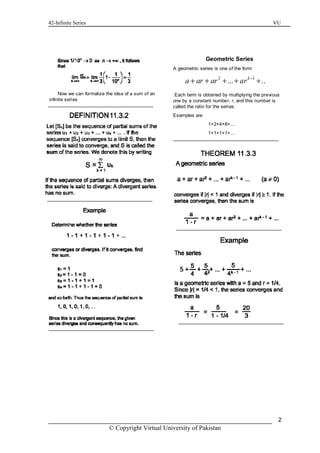
Now we can formalize the idea of a sum of an
infinite series
Geometric Series
A geometric series is one of the form
Each term is obtained by multiplying the previous
one by a constant number, r, and this number is
called the ratio for the series.
Examples are
1+2+4+8+…
1+1+1+1+…
2 1
... ..k
a ar ar ar −
+ + + + +
42-Infinite Series VU
© Copyright Virtual University of Pakistan
3
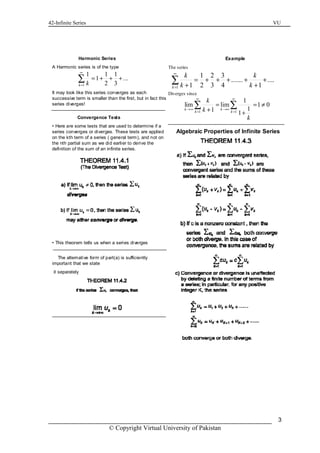
Harmonic Series
A Harmonic series is of the type
It may look like this series converges as each
successive term is smaller than the first, but in fact this
series diverges!
1
1 1 1
1 ...
2 3k k
∞
=
= + + +∑
Convergence Tests
• Here are some tests that are used to determine if a
series converges or diverges. These tests are applied
on the kth term of a series ( general term), and not on
the nth partial sum as we did earlier to derive the
definition of the sum of an infinite series.
• This theorem tells us when a series diverges
The alternative form of part(a) is sufficiently
important that we state
it separately
Example
The series
Diverges since
1
1 2 3
....... ....
1 2 3 4 1k
k k
k k
∞
=
= + + + + +
+ +
∑
1 1
1
lim lim 1 0
11 1
k k
k k
k
k
k
∞ ∞
→∞ →∞
= =
= = ≠
+ +
∑ ∑
Algebraic Properties of Infinite Series
42-Infinite Series VU
© Copyright Virtual University of Pakistan
4
Example
Find the sum of the series
Solution: The series
s a convergent series (a = ¾, r = ¼) and the series
is also a convergent series (a = 2, r = 1/5).
Thus, from Theorem 11.4.3(a) and 11.3.3 the given
series converges and
1
1
3 2
4 5k k
k
∞
−
=
 
− 
 
∑
2 3
1
3 3 3 3
...........
4 4 4 4k
k
∞
=
= + + +∑
1 2 3
1
3 2 2 2
2 ...........
5 5 5 5k
k
∞
−
=
= + + + +∑
1
1 1
3 3 3/ 4 3
4 5 1 1/4 2k k
k k
∞ ∞
−
= =
− = = −
−
∑ ∑
THEOREM 11.4.4
(The Integral Test)
Let be a series with positive terms, and let f(x)
be the function that results when k is replaced by x in the
formula for uk.If f is decreasing and continuous on
the interval , then
both converge or both diverge.
ku∑
[ ],a +∞
1
k
k
u
∞
=
∑ and ( )
a
f x dx
∞
∫
• This theorem allows us to study the convergence of a
series by studying a related integral.
• This integral is the improper integral over the interval
[1,+inf) and the function is the kth term of the series.
• It is interesting that the integral represents a
continuous phenomenon, while the summation a
discrete one!
p-Series
p-series or hyper-harmonic series is an infinite
series of the form.
p=1
p=2
p=1/2
The following theorem tells us whether a p-series
converges or diverges
1
1
1
1 1 1
1 ...
2 3
1 1 1
1 ...
2 3
1 1 1
1 ...
2 3
p p p
k
k
k
k
k
k
∞
=
∞
=
∞
=
= + + +
= + + +
= + + +
∑
∑
∑

MTH101 - Calculus and Analytical Geometry- Lecture 42

  • 1.
    42-Infinite Series VU LectureNo. 42 Infinite Series © Copyright Virtual University of Pakistan 1 Definition 11.3.1 An Infinite series is an expansion that can be written in the form The numbers u1, u2, … are called TERMS of the series. ......21 1 ++++=∑ ∞ = k k k uuuu What does it mean to add infinitely many terms? • Can we add 1+2+3+4+…. All the way to infinity?? This is physically and mentally impossible! But we can compute an infinite sum using the idea of limits • Look at this decimal expansion 0.333333…. • We can rewrite this as an infinite series 0.3+0.03+0.003+0.0003+… Or as • Note that we already know that 0.333…. is really 1/3 • So our sum of the above series should also be 1/3 ... 10 3 10 3 10 3 32 +++ • Lets work out a definition for the sum of an infinite series. Consider the following sequences of (finite) sums 1 2 2 3 0.3 10 3 3 0.33 10 10 s s = = = + = 3 2 3 3 3 3 0.333 10 10 10 . . . s = + + = The sequence of numbers s1,s2, etc. can be viewed as a succession of approximations to the “sum ” of the infinite series. We know that the answer is 1/3, so it is better be that the approximations are close to this at the start, and get closer and closer to this number as more and more terms are added together. This suggests that if we take the limit of the sequence of approximations, we should get 1/3 • Note that the nth term of the approximating series is • Taking its limit gives (limit of the nth partial sum of the series) Now we do some algebraic manipulation here nns 10 3 ... 10 3 10 3 10 3 32 +++= 2 3 3 3 3 3 lim lim( ... ) 10 10 10 10 n nn n s →∞ →∞ = + + +
  • 2.
    42-Infinite Series VU ©Copyright Virtual University of Pakistan 2 Now we can formalize the idea of a sum of an infinite series Geometric Series A geometric series is one of the form Each term is obtained by multiplying the previous one by a constant number, r, and this number is called the ratio for the series. Examples are 1+2+4+8+… 1+1+1+1+… 2 1 ... ..k a ar ar ar − + + + + +
  • 3.
    42-Infinite Series VU ©Copyright Virtual University of Pakistan 3 Harmonic Series A Harmonic series is of the type It may look like this series converges as each successive term is smaller than the first, but in fact this series diverges! 1 1 1 1 1 ... 2 3k k ∞ = = + + +∑ Convergence Tests • Here are some tests that are used to determine if a series converges or diverges. These tests are applied on the kth term of a series ( general term), and not on the nth partial sum as we did earlier to derive the definition of the sum of an infinite series. • This theorem tells us when a series diverges The alternative form of part(a) is sufficiently important that we state it separately Example The series Diverges since 1 1 2 3 ....... .... 1 2 3 4 1k k k k k ∞ = = + + + + + + + ∑ 1 1 1 lim lim 1 0 11 1 k k k k k k k ∞ ∞ →∞ →∞ = = = = ≠ + + ∑ ∑ Algebraic Properties of Infinite Series
  • 4.
    42-Infinite Series VU ©Copyright Virtual University of Pakistan 4 Example Find the sum of the series Solution: The series s a convergent series (a = ¾, r = ¼) and the series is also a convergent series (a = 2, r = 1/5). Thus, from Theorem 11.4.3(a) and 11.3.3 the given series converges and 1 1 3 2 4 5k k k ∞ − =   −    ∑ 2 3 1 3 3 3 3 ........... 4 4 4 4k k ∞ = = + + +∑ 1 2 3 1 3 2 2 2 2 ........... 5 5 5 5k k ∞ − = = + + + +∑ 1 1 1 3 3 3/ 4 3 4 5 1 1/4 2k k k k ∞ ∞ − = = − = = − − ∑ ∑ THEOREM 11.4.4 (The Integral Test) Let be a series with positive terms, and let f(x) be the function that results when k is replaced by x in the formula for uk.If f is decreasing and continuous on the interval , then both converge or both diverge. ku∑ [ ],a +∞ 1 k k u ∞ = ∑ and ( ) a f x dx ∞ ∫ • This theorem allows us to study the convergence of a series by studying a related integral. • This integral is the improper integral over the interval [1,+inf) and the function is the kth term of the series. • It is interesting that the integral represents a continuous phenomenon, while the summation a discrete one! p-Series p-series or hyper-harmonic series is an infinite series of the form. p=1 p=2 p=1/2 The following theorem tells us whether a p-series converges or diverges 1 1 1 1 1 1 1 ... 2 3 1 1 1 1 ... 2 3 1 1 1 1 ... 2 3 p p p k k k k k k ∞ = ∞ = ∞ = = + + + = + + + = + + + ∑ ∑ ∑