1
Md. Mizanur Rahman
MEng(Sweden), PhD (Finland), CEng (UK),
Chartered Energy Engineer (EI, UK)
School of Mechanical Engineering
Universiti Teknologi Malaysia
Energy: Priority area for every country
in the 21st century
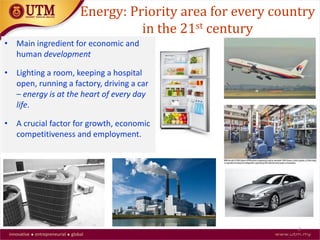
• Main ingredient for economic and
human development
• Lighting a room, keeping a hospital
open, running a factory, driving a car
– energy is at the heart of every day
life.
• A crucial factor for growth, economic
competitiveness and employment.
2
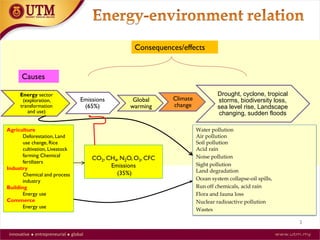
Energy sector
(exploration,
transformation
and use)
Emissions
(65%)
Global
warming
Climate
change
Drought, cyclone, tropical
storms, biodiversity loss,
sea level rise, Landscape
changing, sudden floods
3
Causes
Consequences/effects
Water pollution
Air pollution
Soil pollution
Acid rain
Noise pollution
Sight pollution
Land degradation
Ocean system collapse-oil spills,
Run off chemicals, acid rain
Flora and fauna loss
Nuclear radioactive pollution
Wastes
Agriculture
Deforestation, Land
use change, Rice
cultivation, Livestock
farming Chemical
fertilizers
Industry
Chemical and process
industry
Building
Energy use
Commerce
Energy use
CO2, CH4, N2O, O3, CFC
Emissions
(35%)
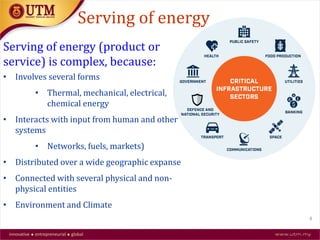
Serving of energy (product or
service) is complex, because:
• Involves several forms
• Thermal, mechanical, electrical,
chemical energy
• Interacts with input from human and other
systems
• Networks, fuels, markets)
• Distributed over a wide geographic expanse
• Connected with several physical and non-
physical entities
• Environment and Climate
Serving of energy
4
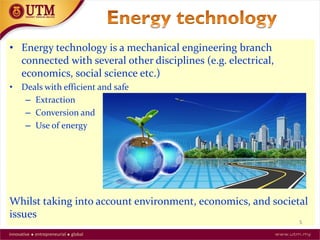
• Energy technology is a mechanical engineering branch
connected with several other disciplines (e.g. electrical,
economics, social science etc.)
• Deals with efficient and safe
– Extraction
– Conversion and
– Use of energy
Whilst taking into account environment, economics, and societal
issues
5
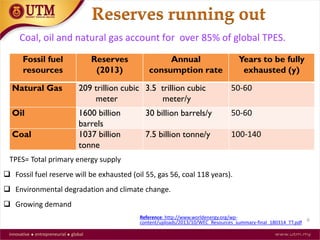
Reserves running out
Fossil fuel
resources
Reserves
(2013)
Annual
consumption rate
Years to be fully
exhausted (y)
Natural Gas 209 trillion cubic
meter
3.5 trillion cubic
meter/y
50-60
Oil 1600 billion
barrels
30 billion barrels/y 50-60
Coal 1037 billion
tonne
7.5 billion tonne/y 100-140
Reference: http://www.worldenergy.org/wp-
content/uploads/2013/10/WEC_Resources_summary-final_180314_TT.pdf
Coal, oil and natural gas account for over 85% of global TPES.
 Fossil fuel reserve will be exhausted (oil 55, gas 56, coal 118 years).
 Environmental degradation and climate change.
 Growing demand
6
TPES= Total primary energy supply
7
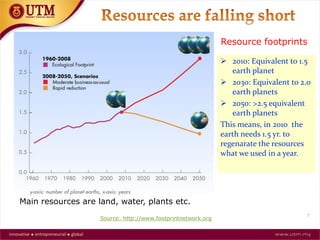
 2010: Equivalent to 1.5
earth planet
 2030: Equivalent to 2.0
earth planets
 2050: >2.5 equivalent
earth planets
This means, in 2010 the
earth needs 1.5 yr. to
regenarate the resources
what we used in a year.
Source: http://www.footprintnetwork.org
Resource footprints
Main resources are land, water, plants etc.
8
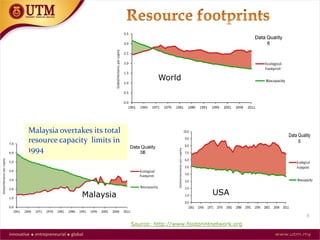
Malaysia overtakes its total
resource capacity limits in
1994
Source: http://www.footprintnetwork.org
Malaysia USA
World
9
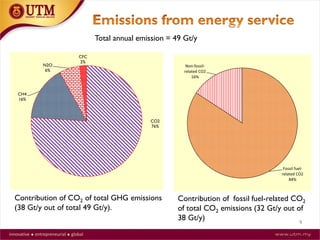
Fossil fuel-
related CO2
84%
Non-fossil-
related CO2
16%
CO2
76%
CH4
16%
N2O
6%
CFC
2%
Contribution of CO2 of total GHG emissions
(38 Gt/y out of total 49 Gt/y).
Contribution of fossil fuel-related CO2
of total CO2 emissions (32 Gt/y out of
38 Gt/y)
Total annual emission = 49 Gt/y
10
11
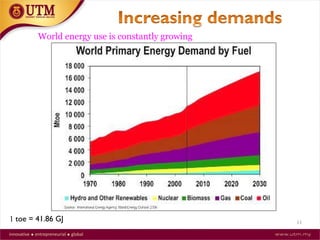
World energy use is constantly growing
1 toe = 41.86 GJ
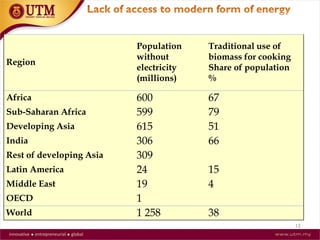
Region
Population
without
electricity
(millions)
Traditional use of
biomass for cooking
Share of population
%
Africa 600 67
Sub-Saharan Africa 599 79
Developing Asia 615 51
India 306 66
Rest of developing Asia 309
Latin America 24 15
Middle East 19 4
OECD 1
World 1 258 38
12
13
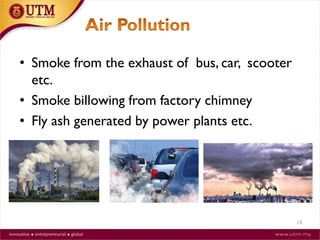
• Smoke from the exhaust of bus, car, scooter
etc.
• Smoke billowing from factory chimney
• Fly ash generated by power plants etc.
14
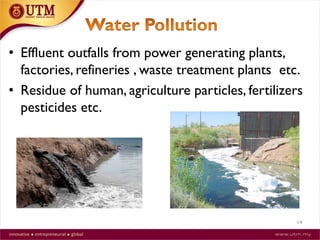
• Effluent outfalls from power generating plants,
factories, refineries , waste treatment plants etc.
• Residue of human, agriculture particles, fertilizers
pesticides etc.
15
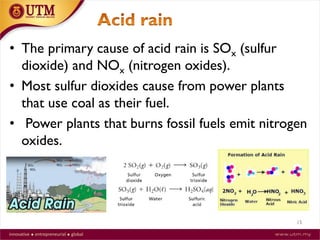
• The primary cause of acid rain is SOx (sulfur
dioxide) and NOx (nitrogen oxides).
• Most sulfur dioxides cause from power plants
that use coal as their fuel.
• Power plants that burns fossil fuels emit nitrogen
oxides.
16
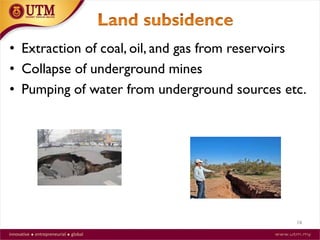
• Extraction of coal, oil, and gas from reservoirs
• Collapse of underground mines
• Pumping of water from underground sources etc.
17
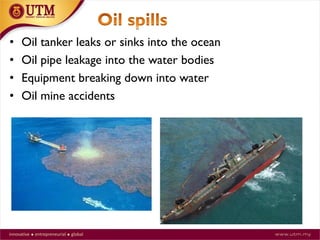
• Oil tanker leaks or sinks into the ocean
• Oil pipe leakage into the water bodies
• Equipment breaking down into water
• Oil mine accidents
18
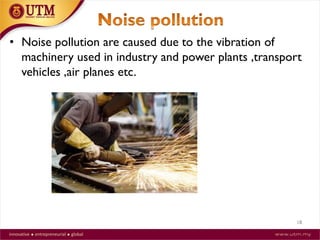
• Noise pollution are caused due to the vibration of
machinery used in industry and power plants ,transport
vehicles ,air planes etc.
19
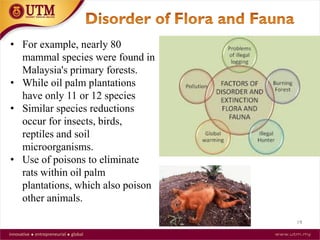
• For example, nearly 80
mammal species were found in
Malaysia's primary forests.
• While oil palm plantations
have only 11 or 12 species
• Similar species reductions
occur for insects, birds,
reptiles and soil
microorganisms.
• Use of poisons to eliminate
rats within oil palm
plantations, which also poison
other animals.
20
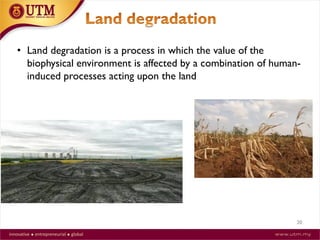
• Land degradation is a process in which the value of the
biophysical environment is affected by a combination of human-
induced processes acting upon the land
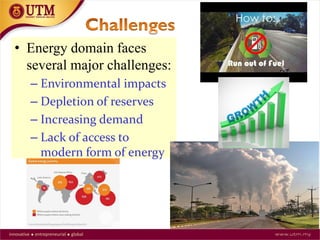
• Energy domain faces
several major challenges:
– Environmental impacts
– Depletion of reserves
– Increasing demand
– Lack of access to
modern form of energy
21
The term ‘sustainability’ has come to the scene as soon as
these challenges are recognized.
 What is sustainability?
Development that meets the needs of the present
without compromising the ability of future generations to
meet their own needs (Bruntland’s report to UN 1987).
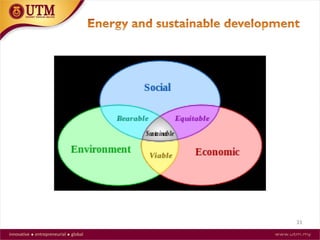
√Development that cares three pillars (P)- planet
(environment), people (society), and profit (economy)
√Development that upholds three A’s- resource availability,
Resource accessibility and resource acceptability.
22
23
Major tools
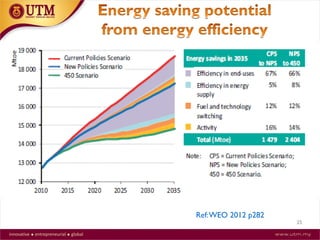
• Energy efficiency
– efficiency in energy technologies, economics,
policy, management, planning etc.
• Utilization of renewable resources.
– technology, modeling, policy, economics, and
systems.
24
25
Ref:WEO 2012 p282
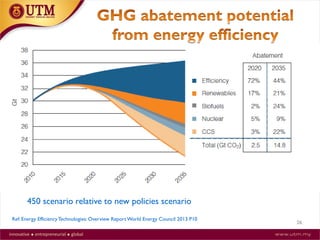
26
Ref: Energy Efficiency Technologies: Overview Report World Energy Council 2013 P10
450 scenario relative to new policies scenario
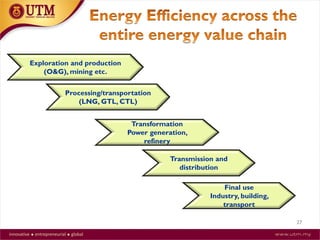
27
Exploration and production
(O&G), mining etc.
Processing/transportation
(LNG, GTL, CTL)
Transformation
Power generation,
refinery
Transmission and
distribution
Final use
Industry, building,
transport
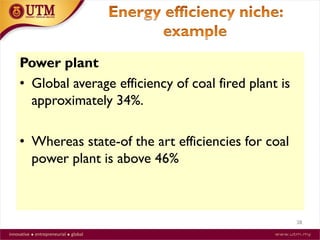
Power plant
• Global average efficiency of coal fired plant is
approximately 34%.
• Whereas state-of the art efficiencies for coal
power plant is above 46%
28
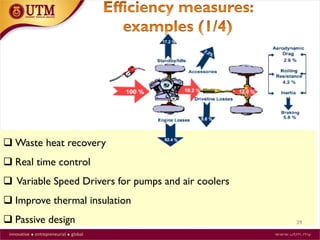
 Waste heat recovery
 Real time control
 Variable Speed Drivers for pumps and air coolers
 Improve thermal insulation
 Passive design 29
30
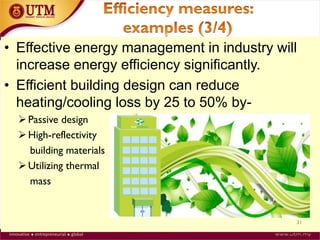
• Effective energy management in industry will
increase energy efficiency significantly.
• Efficient building design can reduce
heating/cooling loss by 25 to 50% by-
Passive design
High-reflectivity
building materials
Utilizing thermal
mass
31
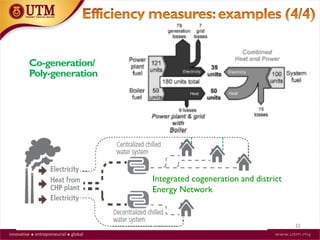
32
Integrated cogeneration and district
Energy Network
Co-generation/
Poly-generation
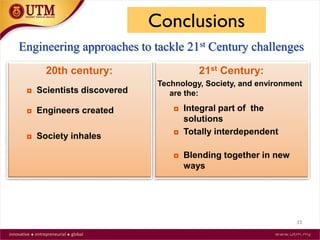
20th century:
◘ Scientists discovered
◘ Engineers created
◘ Society inhales
21st Century:
Technology, Society, and environment
are the:
◘ Integral part of the
solutions
◘ Totally interdependent
◘ Blending together in new
ways
Engineering approaches to tackle 21st Century challenges
Conclusions
33

Energy and environment slide share

  • 1.
    1 Md. Mizanur Rahman MEng(Sweden),PhD (Finland), CEng (UK), Chartered Energy Engineer (EI, UK) School of Mechanical Engineering Universiti Teknologi Malaysia
  • 2.
    Energy: Priority areafor every country in the 21st century • Main ingredient for economic and human development • Lighting a room, keeping a hospital open, running a factory, driving a car – energy is at the heart of every day life. • A crucial factor for growth, economic competitiveness and employment. 2
  • 3.
    Energy sector (exploration, transformation and use) Emissions (65%) Global warming Climate change Drought,cyclone, tropical storms, biodiversity loss, sea level rise, Landscape changing, sudden floods 3 Causes Consequences/effects Water pollution Air pollution Soil pollution Acid rain Noise pollution Sight pollution Land degradation Ocean system collapse-oil spills, Run off chemicals, acid rain Flora and fauna loss Nuclear radioactive pollution Wastes Agriculture Deforestation, Land use change, Rice cultivation, Livestock farming Chemical fertilizers Industry Chemical and process industry Building Energy use Commerce Energy use CO2, CH4, N2O, O3, CFC Emissions (35%)
  • 4.
    Serving of energy(product or service) is complex, because: • Involves several forms • Thermal, mechanical, electrical, chemical energy • Interacts with input from human and other systems • Networks, fuels, markets) • Distributed over a wide geographic expanse • Connected with several physical and non- physical entities • Environment and Climate Serving of energy 4
  • 5.
    • Energy technologyis a mechanical engineering branch connected with several other disciplines (e.g. electrical, economics, social science etc.) • Deals with efficient and safe – Extraction – Conversion and – Use of energy Whilst taking into account environment, economics, and societal issues 5
  • 6.
    Reserves running out Fossilfuel resources Reserves (2013) Annual consumption rate Years to be fully exhausted (y) Natural Gas 209 trillion cubic meter 3.5 trillion cubic meter/y 50-60 Oil 1600 billion barrels 30 billion barrels/y 50-60 Coal 1037 billion tonne 7.5 billion tonne/y 100-140 Reference: http://www.worldenergy.org/wp- content/uploads/2013/10/WEC_Resources_summary-final_180314_TT.pdf Coal, oil and natural gas account for over 85% of global TPES.  Fossil fuel reserve will be exhausted (oil 55, gas 56, coal 118 years).  Environmental degradation and climate change.  Growing demand 6 TPES= Total primary energy supply
  • 7.
    7  2010: Equivalentto 1.5 earth planet  2030: Equivalent to 2.0 earth planets  2050: >2.5 equivalent earth planets This means, in 2010 the earth needs 1.5 yr. to regenarate the resources what we used in a year. Source: http://www.footprintnetwork.org Resource footprints Main resources are land, water, plants etc.
  • 8.
    8 Malaysia overtakes itstotal resource capacity limits in 1994 Source: http://www.footprintnetwork.org Malaysia USA World
  • 9.
    9 Fossil fuel- related CO2 84% Non-fossil- relatedCO2 16% CO2 76% CH4 16% N2O 6% CFC 2% Contribution of CO2 of total GHG emissions (38 Gt/y out of total 49 Gt/y). Contribution of fossil fuel-related CO2 of total CO2 emissions (32 Gt/y out of 38 Gt/y) Total annual emission = 49 Gt/y
  • 10.
  • 11.
    11 World energy useis constantly growing 1 toe = 41.86 GJ
  • 12.
    Region Population without electricity (millions) Traditional use of biomassfor cooking Share of population % Africa 600 67 Sub-Saharan Africa 599 79 Developing Asia 615 51 India 306 66 Rest of developing Asia 309 Latin America 24 15 Middle East 19 4 OECD 1 World 1 258 38 12
  • 13.
    13 • Smoke fromthe exhaust of bus, car, scooter etc. • Smoke billowing from factory chimney • Fly ash generated by power plants etc.
  • 14.
    14 • Effluent outfallsfrom power generating plants, factories, refineries , waste treatment plants etc. • Residue of human, agriculture particles, fertilizers pesticides etc.
  • 15.
    15 • The primarycause of acid rain is SOx (sulfur dioxide) and NOx (nitrogen oxides). • Most sulfur dioxides cause from power plants that use coal as their fuel. • Power plants that burns fossil fuels emit nitrogen oxides.
  • 16.
    16 • Extraction ofcoal, oil, and gas from reservoirs • Collapse of underground mines • Pumping of water from underground sources etc.
  • 17.
    17 • Oil tankerleaks or sinks into the ocean • Oil pipe leakage into the water bodies • Equipment breaking down into water • Oil mine accidents
  • 18.
    18 • Noise pollutionare caused due to the vibration of machinery used in industry and power plants ,transport vehicles ,air planes etc.
  • 19.
    19 • For example,nearly 80 mammal species were found in Malaysia's primary forests. • While oil palm plantations have only 11 or 12 species • Similar species reductions occur for insects, birds, reptiles and soil microorganisms. • Use of poisons to eliminate rats within oil palm plantations, which also poison other animals.
  • 20.
    20 • Land degradationis a process in which the value of the biophysical environment is affected by a combination of human- induced processes acting upon the land
  • 21.
    • Energy domainfaces several major challenges: – Environmental impacts – Depletion of reserves – Increasing demand – Lack of access to modern form of energy 21
  • 22.
    The term ‘sustainability’has come to the scene as soon as these challenges are recognized.  What is sustainability? Development that meets the needs of the present without compromising the ability of future generations to meet their own needs (Bruntland’s report to UN 1987). √Development that cares three pillars (P)- planet (environment), people (society), and profit (economy) √Development that upholds three A’s- resource availability, Resource accessibility and resource acceptability. 22
  • 23.
  • 24.
    Major tools • Energyefficiency – efficiency in energy technologies, economics, policy, management, planning etc. • Utilization of renewable resources. – technology, modeling, policy, economics, and systems. 24
  • 25.
  • 26.
    26 Ref: Energy EfficiencyTechnologies: Overview Report World Energy Council 2013 P10 450 scenario relative to new policies scenario
  • 27.
    27 Exploration and production (O&G),mining etc. Processing/transportation (LNG, GTL, CTL) Transformation Power generation, refinery Transmission and distribution Final use Industry, building, transport
  • 28.
    Power plant • Globalaverage efficiency of coal fired plant is approximately 34%. • Whereas state-of the art efficiencies for coal power plant is above 46% 28
  • 29.
     Waste heatrecovery  Real time control  Variable Speed Drivers for pumps and air coolers  Improve thermal insulation  Passive design 29
  • 30.
  • 31.
    • Effective energymanagement in industry will increase energy efficiency significantly. • Efficient building design can reduce heating/cooling loss by 25 to 50% by- Passive design High-reflectivity building materials Utilizing thermal mass 31
  • 32.
    32 Integrated cogeneration anddistrict Energy Network Co-generation/ Poly-generation
  • 33.
    20th century: ◘ Scientistsdiscovered ◘ Engineers created ◘ Society inhales 21st Century: Technology, Society, and environment are the: ◘ Integral part of the solutions ◘ Totally interdependent ◘ Blending together in new ways Engineering approaches to tackle 21st Century challenges Conclusions 33