Renewable Energy Methods
Unit I
1
Prof. Ravi P Upadhyai
Mechanical Engineering Department
JNU, Jaipur
Why Fossil Fuel?
• Applications need concentrated energy
• i.e. high energy densities.
• Extraction, storage, distribution and service
infrastructure is well established and stable
• Large scale production results in affordable
running cost.
2
R Upadhyai
Why fossil fuel base?
3
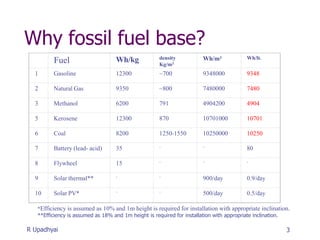
Fuel Wh/kg density
Kg/m3
Wh/m3 Wh/lt.
1 Gasoline 12300 ~700 9348000 9348
2 Natural Gas 9350 ~800 7480000 7480
3 Methanol 6200 791 4904200 4904
5 Kerosene 12300 870 10701000 10701
6 Coal 8200 1250-1550 10250000 10250
7 Battery (lead- acid) 35 - -
80
8 Flywheel 15 - - -
9 Solar thermal** - -
900/day 0.9/day
10 Solar PV* - -
500/day 0.5/day
*Efficiency is assumed as 10% and 1m height is required for installation with appropriate inclination.
**Efficiency is assumed as 18% and 1m height is required for installation with appropriate inclination.
R Upadhyai
Why fossil fuel base?
Petrol/diesel fuel stations infrastructure
is available
LPG gas is distributed at your doorstep
LPG and CNG service infrastructure is
also well established
Customer need not bother about
storage and service infrastructure costs.
Payment is only for running cost of fuel.
4
R Upadhyai
Then why move away from
fossil fuel base?
• Depletion of fossil fuels
• Environmental hazards
- Green house effects, Climate change,
- Depletion of stratospheric ozone layer
• Health hazards
- CO poisoning, Asthma
-
• Life Cycle costs versus running costs
5
R Upadhyai
Green house effect
Green house gases – carbon dioxide,
nitrous oxide, methane, chloro fluoro
carbons.
Green house gases are the temperature
stabilisers of the earth’s atmosphere.
Temperature stabilisation is by trapping
radiated heat from the earth’s surface
by these green house gases.
6
R Upadhyai
Global warming
Due to emissions from the fossil fuel
based systems, the green house gases
in the atmosphere increases.
As a result, the average temperature of
the earth is becoming higher.
7
R Upadhyai
Effects of Global warming
changes in rainfall patterns
rise in sea level
impacts on flora and fauna
impacts on human health
8
R Upadhyai
How long will fossil fuel last?
Let the earth be made of a thin shell that is
filled entirely with fossil fuels.
Consider the earth as a sphere of radius
R=6378.137 kms.
This amounts to about 1.1x10²¹ m3 of fossil
fuel.
take the average energy density of fossil fuel
to be about 10000Wh/lt or 10000 KWh/m3
(refer table on energy densities – slide 03)
9
R Upadhyai
How long will fossil fuel last?
the amount of stored energy within the
earth is 1.1x1025 KWh
The current annual world energy
consumption is about 55x1012 KWh
Considering a 7% growth in energy
consumption annually
10
R Upadhyai
How long will fossil fuel last?
in 372 years with an annual energy
consumption growth rate of 7%, all the
fossil fuel is emptied within the earth
even though we started with earth
being full of fossil fuel. However, earth
is not composed fully of fossil fuel. Only
a fraction of its volume is stored as
fossil fuel.
11
R Upadhyai
How long will fossil fuel last?
The pinnacle of fossil fuel usage is
passed. Its usage will now decay
exponential and in the next 100 years
will gradually die.
12
R Upadhyai
So now a Paradigm shift…
13
“Concentrated usage of energy to
Distributed usage of energy”
R Upadhyai
Non-conventional fuel base
Solar thermal
Solar PV
Wind
Hydro
Biomass
Tidal Energy
Hybrids
14
R Upadhyai
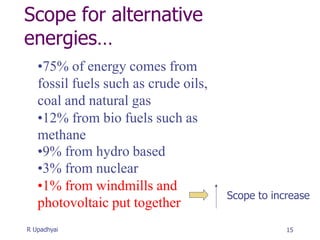
Scope for alternative
energies…
•75% of energy comes from
fossil fuels such as crude oils,
coal and natural gas
•12% from bio fuels such as
methane
•9% from hydro based
•3% from nuclear
•1% from windmills and
photovoltaic put together
Scope to increase
15
R Upadhyai
16
R Upadhyai
Mechanical Energy
• Mechanical energy is the sum of kinetic energy and potential energy in an object that is
used to do a particular work. In other words, it describes the energy of an object because
of its motion or position, or both.
• There are two types of mechanical energy: potential energy and kinetic
energy
• Potential Energy: Potential energy is the force that a body could
potentially develop if it were put into motion. Potential energy is not the
energy of movement. Instead, it is the energy stored in a body due to its
physical properties, such as the mass or position of the object.
• The way to calculate the potential energy and the maximum kinetic
energy of the object is the mgh formula: PE=mgh
• Kinetic Energy: kinetic energy is the mechanical energy of movement or
energy of motion, rather than position. The faster the movement, the
higher the kinetic energy.
17
R Upadhyai
Chemical Energy
Chemical energy is energy stored in the bonds of atoms and molecules. Batteries,
biomass, petroleum, natural gas, and coal are examples of chemical energy.
Chemical energy is converted to thermal energy when people burn wood in a
fireplace or burn gasoline in a car's engine.
18
R Upadhyai
Fuel
Fuels are dense repositories of energy that are consumed to provide energy
services such as heating, transportation and electrical generation.[2] Even though
most fuels ultimately get their energy from the sun they are usually considered to be
a primary energy source.
Types of fuel
When a fuel is used, it undergoes some process that leaves it in a form with less
energy. This means that most fuels are non-renewable, but may be found
extensively enough as to be considered sustainable. Primary flows, like wind, are not
considered fuels and are a class of primary energy supply entirely different from
fuels
19
R Upadhyai
Fuel
Gasoline, kerosene and diesel are also fuels, but are different as they are derived
from primary energy sources. These are secondary fuels as opposed to primary
fuels. These secondary fuels were processed from the form found as a natural
resource and can also be considered energy currencies. Secondary fuels are easier
for engines to burn, so are often made from crude oil as a way of getting the most
energy out as possible.
Furthermore, fuels like methane, butane and propane are found mixed together in
their natural resource (which would be the primary energy source) and are separated
during the fractional distillation process.
Hydrogen is a fuel that can be obtained chemically from water or methane (and other
sources as well), it is considered an energy currency as it doesn't form naturally in
any abundance on Earth.
Fuels vary considerably in energy density, cost, and environmental impact, for
example uranium has a significantly higher energy density than fossil fuels but is
much more expensive. It is also difficult to compare the energy density and
environmental impact of fuels to primary flows due to the nature of how each is
utilized.
R Upadhyai 20
21
R Upadhyai
Fuel
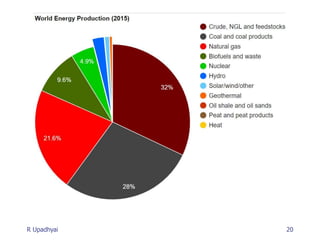
Approximately 95% percent of the primary energy in the world comes from fuels
like oil, coal and natural gas[3] (all of which except nuclear fuels produce
extensive greenhouse gases when used). Most of the rest of the world's primary
energy comes from hydropower, although a small fraction is wind power, solar
power, geothermal energy, and tidal power. The amount of electricity that comes
from flows increases to about 19% (still mostly hydro) because flows don't have the
same limitations of thermal efficiency as heat engines, and flows are used almost
entirely for electricity generation.
22
R Upadhyai
Fuel
Approximately 95% percent of the primary energy in the world comes from fuels
like oil, coal and natural gas[3] (all of which except nuclear fuels produce
extensive greenhouse gases when used). Most of the rest of the world's primary
energy comes from hydropower, although a small fraction is wind power, solar
power, geothermal energy, and tidal power. The amount of electricity that comes
from flows increases to about 19% (still mostly hydro) because flows don't have the
same limitations of thermal efficiency as heat engines, and flows are used almost
entirely for electricity generation.
R Upadhyai 23

Introduction_mod01.pptx

  • 1.
    Renewable Energy Methods UnitI 1 Prof. Ravi P Upadhyai Mechanical Engineering Department JNU, Jaipur
  • 2.
    Why Fossil Fuel? •Applications need concentrated energy • i.e. high energy densities. • Extraction, storage, distribution and service infrastructure is well established and stable • Large scale production results in affordable running cost. 2 R Upadhyai
  • 3.
    Why fossil fuelbase? 3 Fuel Wh/kg density Kg/m3 Wh/m3 Wh/lt. 1 Gasoline 12300 ~700 9348000 9348 2 Natural Gas 9350 ~800 7480000 7480 3 Methanol 6200 791 4904200 4904 5 Kerosene 12300 870 10701000 10701 6 Coal 8200 1250-1550 10250000 10250 7 Battery (lead- acid) 35 - - 80 8 Flywheel 15 - - - 9 Solar thermal** - - 900/day 0.9/day 10 Solar PV* - - 500/day 0.5/day *Efficiency is assumed as 10% and 1m height is required for installation with appropriate inclination. **Efficiency is assumed as 18% and 1m height is required for installation with appropriate inclination. R Upadhyai
  • 4.
    Why fossil fuelbase? Petrol/diesel fuel stations infrastructure is available LPG gas is distributed at your doorstep LPG and CNG service infrastructure is also well established Customer need not bother about storage and service infrastructure costs. Payment is only for running cost of fuel. 4 R Upadhyai
  • 5.
    Then why moveaway from fossil fuel base? • Depletion of fossil fuels • Environmental hazards - Green house effects, Climate change, - Depletion of stratospheric ozone layer • Health hazards - CO poisoning, Asthma - • Life Cycle costs versus running costs 5 R Upadhyai
  • 6.
    Green house effect Greenhouse gases – carbon dioxide, nitrous oxide, methane, chloro fluoro carbons. Green house gases are the temperature stabilisers of the earth’s atmosphere. Temperature stabilisation is by trapping radiated heat from the earth’s surface by these green house gases. 6 R Upadhyai
  • 7.
    Global warming Due toemissions from the fossil fuel based systems, the green house gases in the atmosphere increases. As a result, the average temperature of the earth is becoming higher. 7 R Upadhyai
  • 8.
    Effects of Globalwarming changes in rainfall patterns rise in sea level impacts on flora and fauna impacts on human health 8 R Upadhyai
  • 9.
    How long willfossil fuel last? Let the earth be made of a thin shell that is filled entirely with fossil fuels. Consider the earth as a sphere of radius R=6378.137 kms. This amounts to about 1.1x10²¹ m3 of fossil fuel. take the average energy density of fossil fuel to be about 10000Wh/lt or 10000 KWh/m3 (refer table on energy densities – slide 03) 9 R Upadhyai
  • 10.
    How long willfossil fuel last? the amount of stored energy within the earth is 1.1x1025 KWh The current annual world energy consumption is about 55x1012 KWh Considering a 7% growth in energy consumption annually 10 R Upadhyai
  • 11.
    How long willfossil fuel last? in 372 years with an annual energy consumption growth rate of 7%, all the fossil fuel is emptied within the earth even though we started with earth being full of fossil fuel. However, earth is not composed fully of fossil fuel. Only a fraction of its volume is stored as fossil fuel. 11 R Upadhyai
  • 12.
    How long willfossil fuel last? The pinnacle of fossil fuel usage is passed. Its usage will now decay exponential and in the next 100 years will gradually die. 12 R Upadhyai
  • 13.
    So now aParadigm shift… 13 “Concentrated usage of energy to Distributed usage of energy” R Upadhyai
  • 14.
    Non-conventional fuel base Solarthermal Solar PV Wind Hydro Biomass Tidal Energy Hybrids 14 R Upadhyai
  • 15.
    Scope for alternative energies… •75%of energy comes from fossil fuels such as crude oils, coal and natural gas •12% from bio fuels such as methane •9% from hydro based •3% from nuclear •1% from windmills and photovoltaic put together Scope to increase 15 R Upadhyai
  • 16.
    16 R Upadhyai Mechanical Energy •Mechanical energy is the sum of kinetic energy and potential energy in an object that is used to do a particular work. In other words, it describes the energy of an object because of its motion or position, or both. • There are two types of mechanical energy: potential energy and kinetic energy • Potential Energy: Potential energy is the force that a body could potentially develop if it were put into motion. Potential energy is not the energy of movement. Instead, it is the energy stored in a body due to its physical properties, such as the mass or position of the object. • The way to calculate the potential energy and the maximum kinetic energy of the object is the mgh formula: PE=mgh • Kinetic Energy: kinetic energy is the mechanical energy of movement or energy of motion, rather than position. The faster the movement, the higher the kinetic energy.
  • 17.
    17 R Upadhyai Chemical Energy Chemicalenergy is energy stored in the bonds of atoms and molecules. Batteries, biomass, petroleum, natural gas, and coal are examples of chemical energy. Chemical energy is converted to thermal energy when people burn wood in a fireplace or burn gasoline in a car's engine.
  • 18.
    18 R Upadhyai Fuel Fuels aredense repositories of energy that are consumed to provide energy services such as heating, transportation and electrical generation.[2] Even though most fuels ultimately get their energy from the sun they are usually considered to be a primary energy source. Types of fuel When a fuel is used, it undergoes some process that leaves it in a form with less energy. This means that most fuels are non-renewable, but may be found extensively enough as to be considered sustainable. Primary flows, like wind, are not considered fuels and are a class of primary energy supply entirely different from fuels
  • 19.
    19 R Upadhyai Fuel Gasoline, keroseneand diesel are also fuels, but are different as they are derived from primary energy sources. These are secondary fuels as opposed to primary fuels. These secondary fuels were processed from the form found as a natural resource and can also be considered energy currencies. Secondary fuels are easier for engines to burn, so are often made from crude oil as a way of getting the most energy out as possible. Furthermore, fuels like methane, butane and propane are found mixed together in their natural resource (which would be the primary energy source) and are separated during the fractional distillation process. Hydrogen is a fuel that can be obtained chemically from water or methane (and other sources as well), it is considered an energy currency as it doesn't form naturally in any abundance on Earth. Fuels vary considerably in energy density, cost, and environmental impact, for example uranium has a significantly higher energy density than fossil fuels but is much more expensive. It is also difficult to compare the energy density and environmental impact of fuels to primary flows due to the nature of how each is utilized.
  • 20.
  • 21.
    21 R Upadhyai Fuel Approximately 95%percent of the primary energy in the world comes from fuels like oil, coal and natural gas[3] (all of which except nuclear fuels produce extensive greenhouse gases when used). Most of the rest of the world's primary energy comes from hydropower, although a small fraction is wind power, solar power, geothermal energy, and tidal power. The amount of electricity that comes from flows increases to about 19% (still mostly hydro) because flows don't have the same limitations of thermal efficiency as heat engines, and flows are used almost entirely for electricity generation.
  • 22.
    22 R Upadhyai Fuel Approximately 95%percent of the primary energy in the world comes from fuels like oil, coal and natural gas[3] (all of which except nuclear fuels produce extensive greenhouse gases when used). Most of the rest of the world's primary energy comes from hydropower, although a small fraction is wind power, solar power, geothermal energy, and tidal power. The amount of electricity that comes from flows increases to about 19% (still mostly hydro) because flows don't have the same limitations of thermal efficiency as heat engines, and flows are used almost entirely for electricity generation.
  • 23.