Group 5
12/11/15
MANAGEMENT
And its function
22
Management
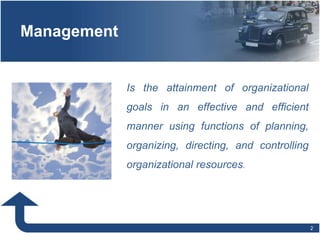
Is the attainment of organizational
goals in an effective and efficient
manner using functions of planning,
organizing, directing, and controlling
organizational resources.
33
The Importance of Management
What Managers Do
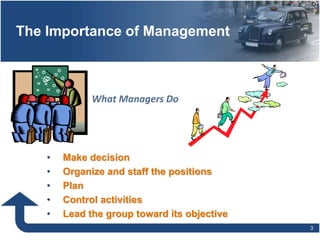
• Make decision
• Organize and staff the positions
• Plan
• Control activities
• Lead the group toward its objective
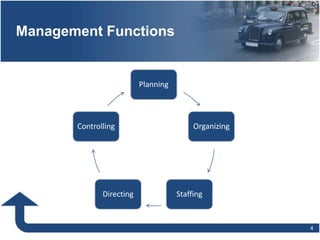
Management Functions
4
Planning
Organizing
StaffingDirecting
Controlling
5
The Importance of Management
What are the
Manager Roles?
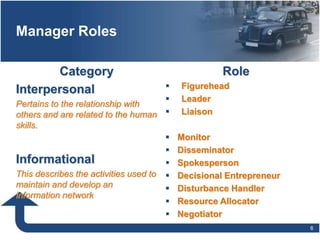
Manager Roles
Category
Interpersonal
Pertains to the relationship with
others and are related to the human
skills.
Informational
This describes the activities used to
maintain and develop an
information network
Role
 Figurehead
 Leader
 Liaison
 Monitor
 Disseminator
 Spokesperson
 Decisional Entrepreneur
 Disturbance Handler
 Resource Allocator
 Negotiator
6
The Importance of Management
7
Resources
• People/Human
• Raw materials
• Equipment
• Money
• Information
8
Management Functions
Planning –
Addresses prospective changes in business
objectives and the forces affecting the company.
Management Functions
9
 Long range planning- this covers five years or
more.
 Intermediate range planning- this is more subject to
change, covering a period from one year to five
years.
 Short-range planning- Also called operational
planning, it covers a period of one year or less.
Timeframes of planning
Management Functions
10
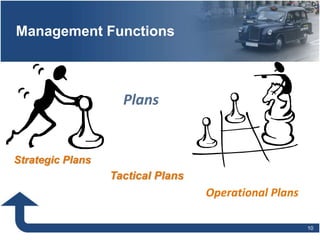
Plans
Strategic Plans
Tactical Plans
Operational Plans
Management Functions
11
Strategic Plans/ Long range
planning
Executive level managers
• Establish the long-range objectives & overall strategy
to fulfill firm’s mission
• 2-10 years forward-looking
• Sustainability
• diversification, divestiture , mergers & acquisitions,
Management Functions
12
Tactical Plans/Intermediate
range planning
Short-range – strategy implementation
• 1 year or less
• Environmental change
• Periodically reviewed & updated
Management Functions
13
Operational Plans/ Short-
term planning
Very short-term – actionable, specific
• Individuals, work groups, departments
• 1 month, 1 week, 1 day
• Achieve tactical plans
Management Functions
14
General approach to
formal planning
• Bottom-up approach
• Top-down approach
• Interactive approach
• Dual approach
Classification of plan according to scope
• Objectives or goal
• Policies
• Procedures
• Rules
• Programs
• Forecast
• Strategies
• Budget
• Schedules
• Projects
15
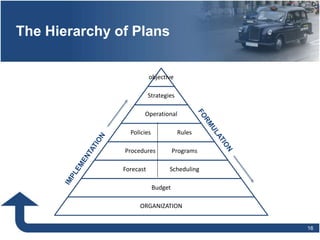
The Hierarchy of Plans
16
objective
Strategies
Operational
Policies Rules
Procedures Programs
Forecast Scheduling
Budget
ORGANIZATION
Management Functions
• Conditions
• Time factor
• Resource available
• Skills and attitudes of
management
• Political, social and
environmental conditions
• Physical facilities
17
Factors Affecting Planning
Management Functions
18
Organizing –
deciding how best to group organizational activities and
resources.
Management Functions
Decisional Roles of Managers
1. Entrepreneur
2. Disturbance handler
3. Resource allocator
4. Negotiator
19
Management functions
The Activities of Real
Managers
• Communicating
• Networking
• Traditional Management
• Human Resource
Management
20
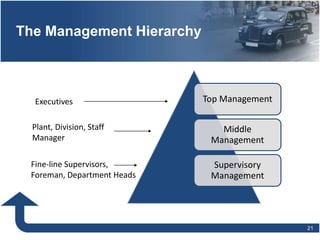
The Management Hierarchy
21
Top Management
Middle
Management
Supervisory
Management
Executives
Plant, Division, Staff
Manager
Fine-line Supervisors,
Foreman, Department Heads
Management Classification
22
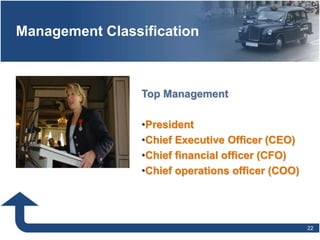
Top Management
•President
•Chief Executive Officer (CEO)
•Chief financial officer (CFO)
•Chief operations officer (COO)
Management Classification
23
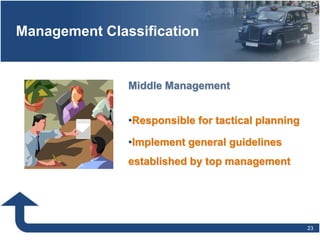
Middle Management
•Responsible for tactical planning
•Implement general guidelines
established by top management
Management Classification
24
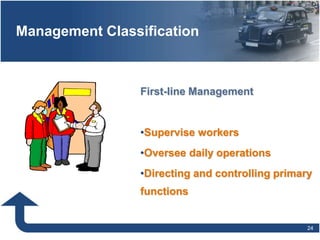
First-line Management
•Supervise workers
•Oversee daily operations
•Directing and controlling primary
functions
Managerial Skills
25
Managerial Skills
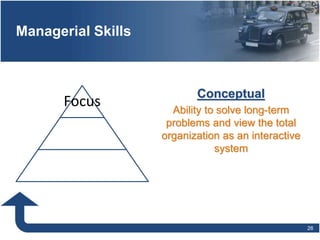
Focus
Conceptual
Ability to solve long-term
problems and view the total
organization as an interactive
system
26
Managerial Skills
27
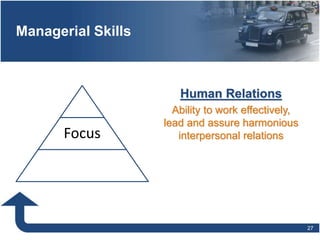
Focus
Human Relations
Ability to work effectively,
lead and assure harmonious
interpersonal relations
Managerial Skills
28
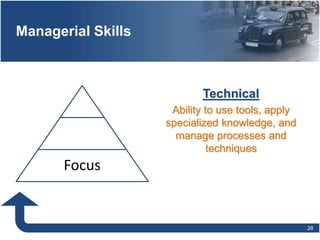
Focus
Technical
Ability to use tools, apply
specialized knowledge, and
manage processes and
techniques
Management Styles
Autocratic Style
A management style characterized by the making all
decisions.
Democratic style
is characterized by the manager making decisions
that takes into account the input of subordinates
Free-rein Style
is characterized by the manager allowing
subordinates to make most decisions.
29
Staffing

Functions of Management