Control Structures

In Visual Basic

Submitted By:
Sakar Chiolunkar
Shashank Baghel
Tushar jain

12C3045
12C3053
LOGO
12C3062
Control Statement

The order in which statements are executed in a program is
called the flow of control. In a sense, the computer is under the
control of one statement at a time. When a statement has been
executed, control is turned over to the next statement (like a
baton being passed in a relay race). Flow of control is normally
sequential. That is, when one statement is finished executing,
control passes to the next statement in the pro- gram. If we
want the flow of control to be nonsequential, you can use
control structure.

Company Logo
Control Flow
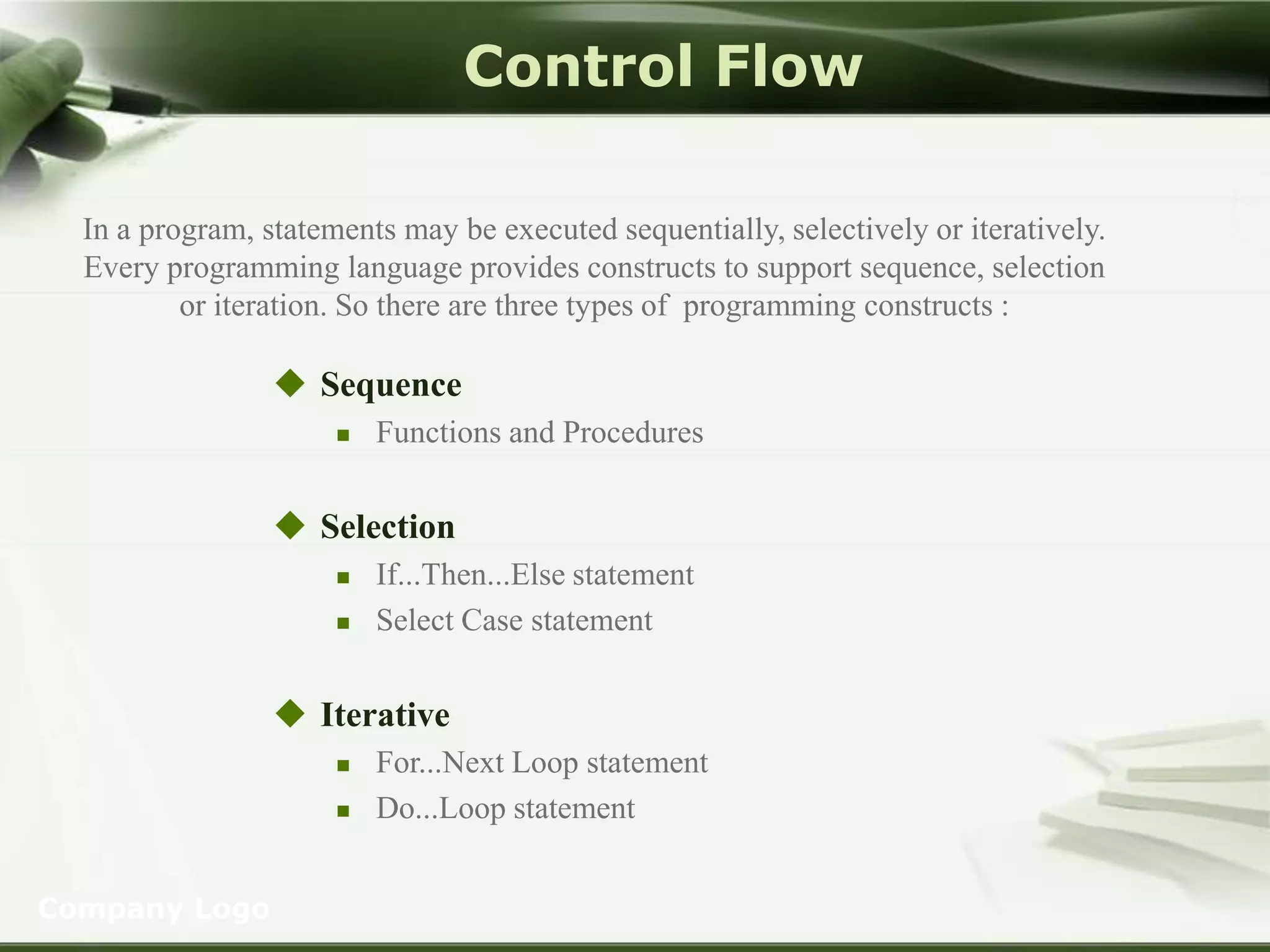
In a program, statements may be executed sequentially, selectively or iteratively.
Every programming language provides constructs to support sequence, selection
or iteration. So there are three types of programming constructs :

 Sequence


Functions and Procedures

 Selection



If...Then...Else statement
Select Case statement

 Iterative




Company Logo

For...Next Loop statement
Do...Loop statement
Sequential Construct

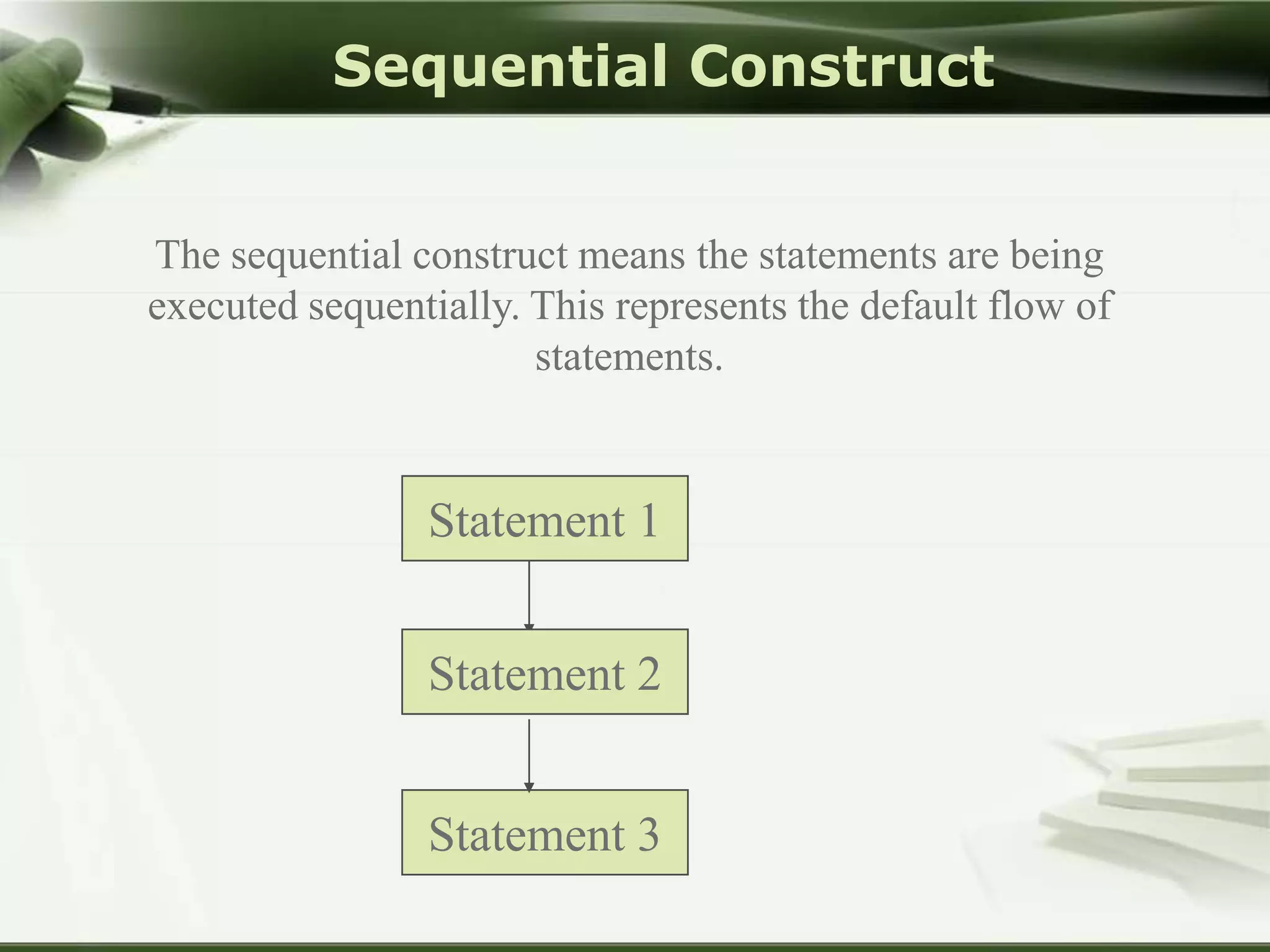
The sequential construct means the statements are being
executed sequentially. This represents the default flow of
statements.

Statement 1
Statement 2
Statement 3
Selection Construct
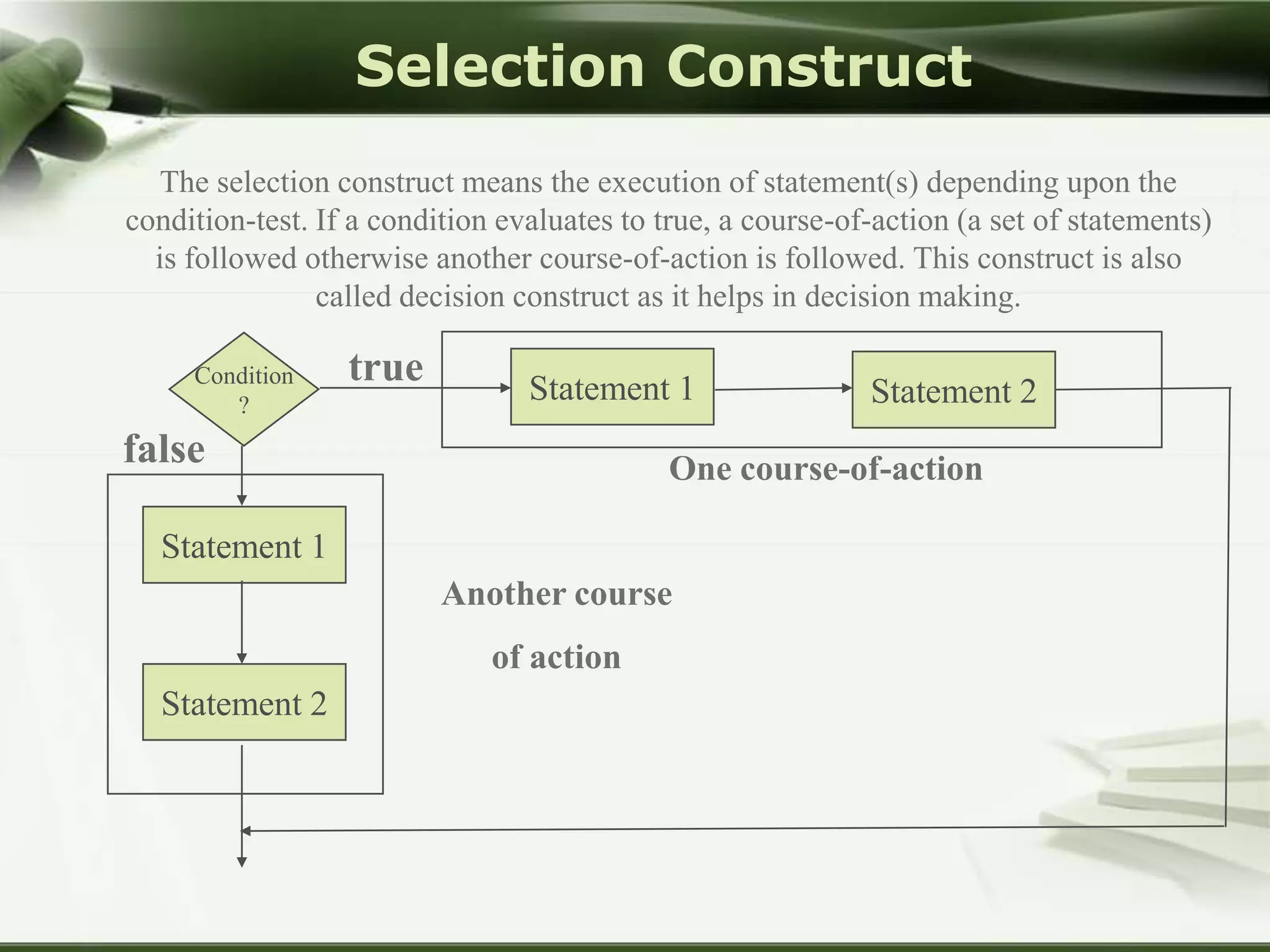
The selection construct means the execution of statement(s) depending upon the
condition-test. If a condition evaluates to true, a course-of-action (a set of statements)
is followed otherwise another course-of-action is followed. This construct is also
called decision construct as it helps in decision making.
Condition
?

true

Statement 1

false

One course-of-action

Statement 1
Another course
of action
Statement 2

Statement 2
If...Then...Else statement
Perhaps the most important statement in a program is the If statement and then its
statements. In other words
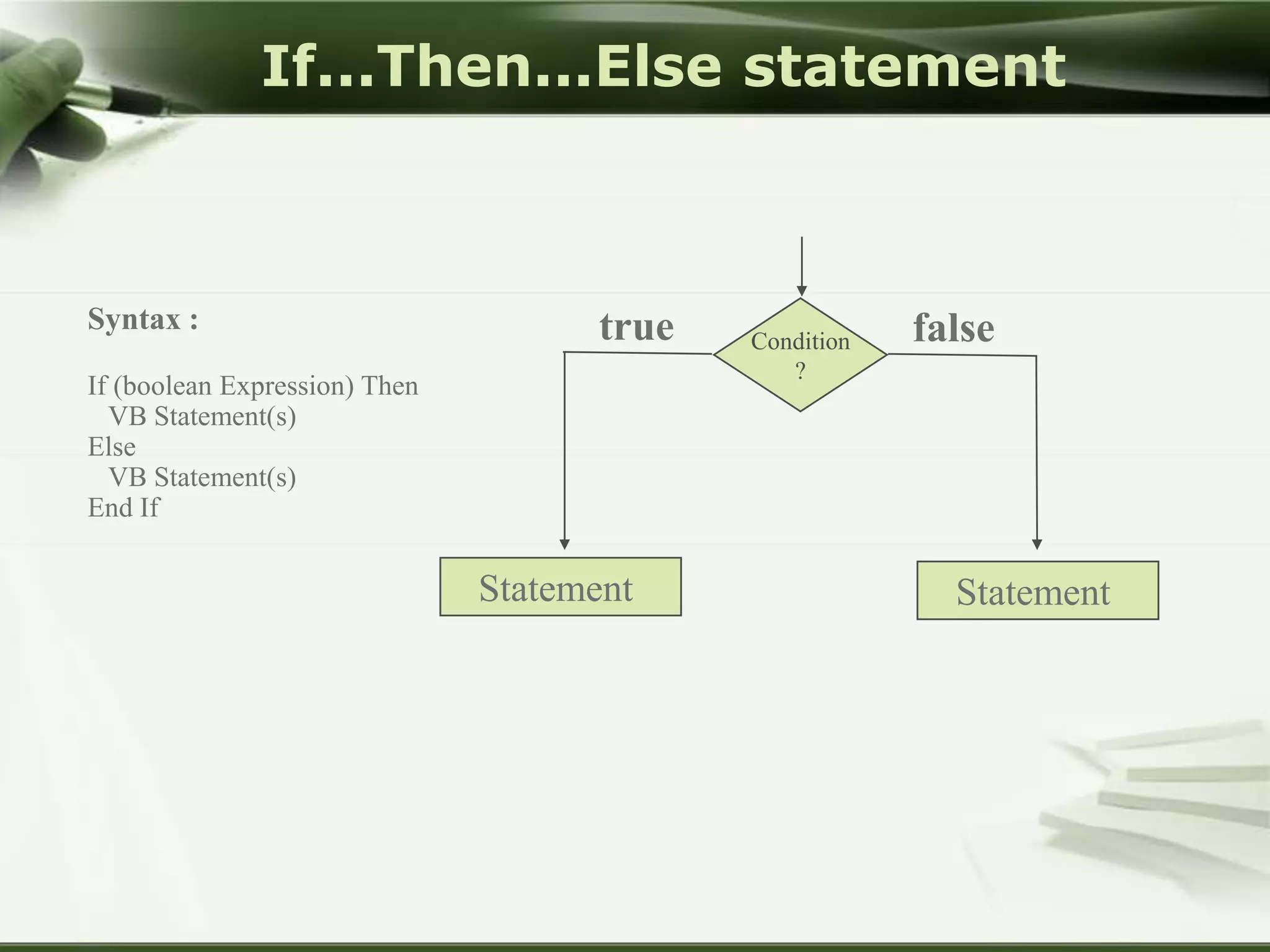
If.. Then.. Else statement provides an alternate choice to the user i.e. if the
condition is true then a set of statements are executed otherwise another set of
statements are executed.
In Visual Basic we use three types of ‘IF’ statements:
1. Simple If
2. If Else
3. Nested If
If...Then...Else statement

Syntax :

true

If (boolean Expression) Then
VB Statement(s)
Else
VB Statement(s)
End If

Statement

Condition
?

false

Statement
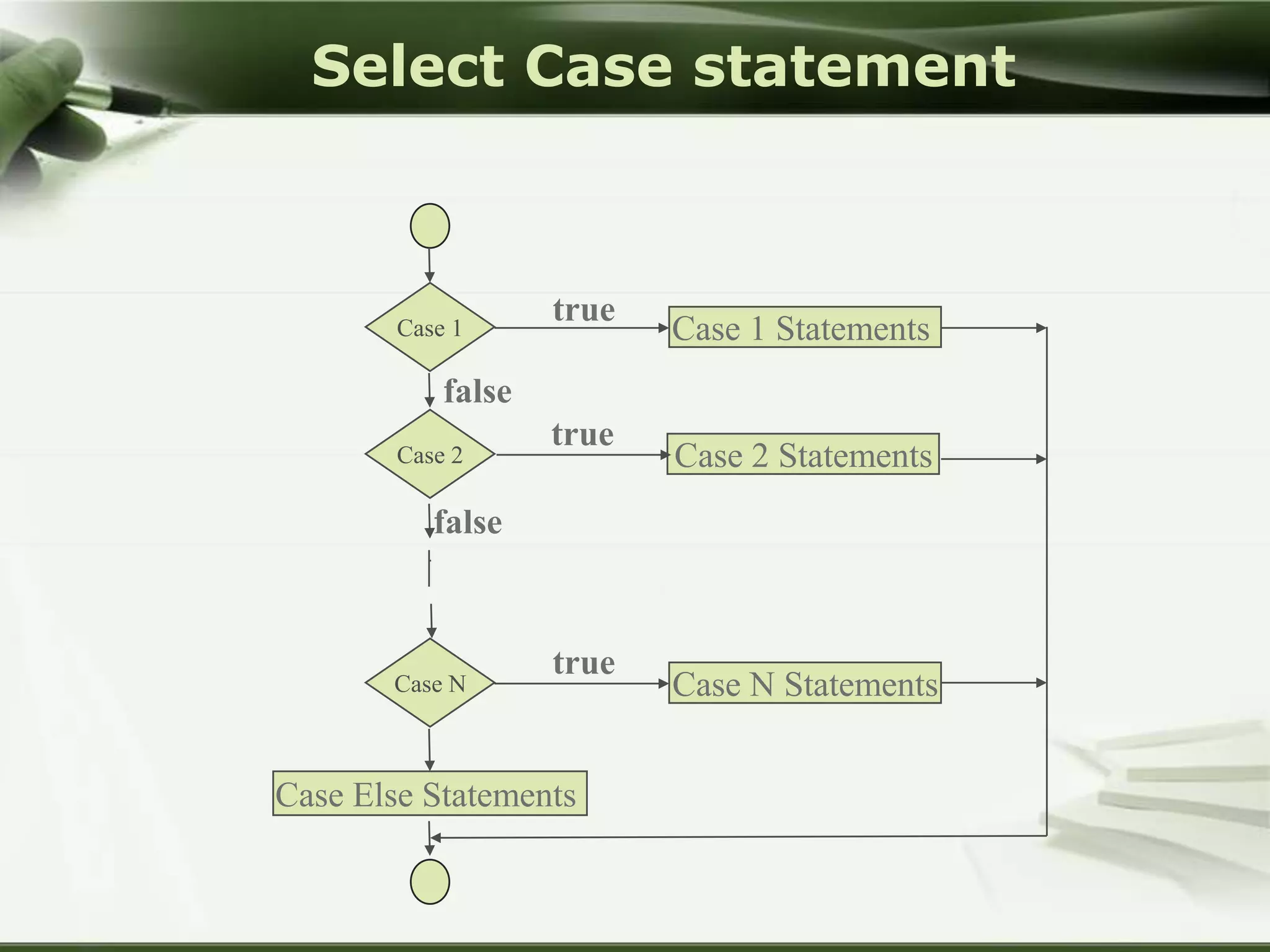
Select Case statement
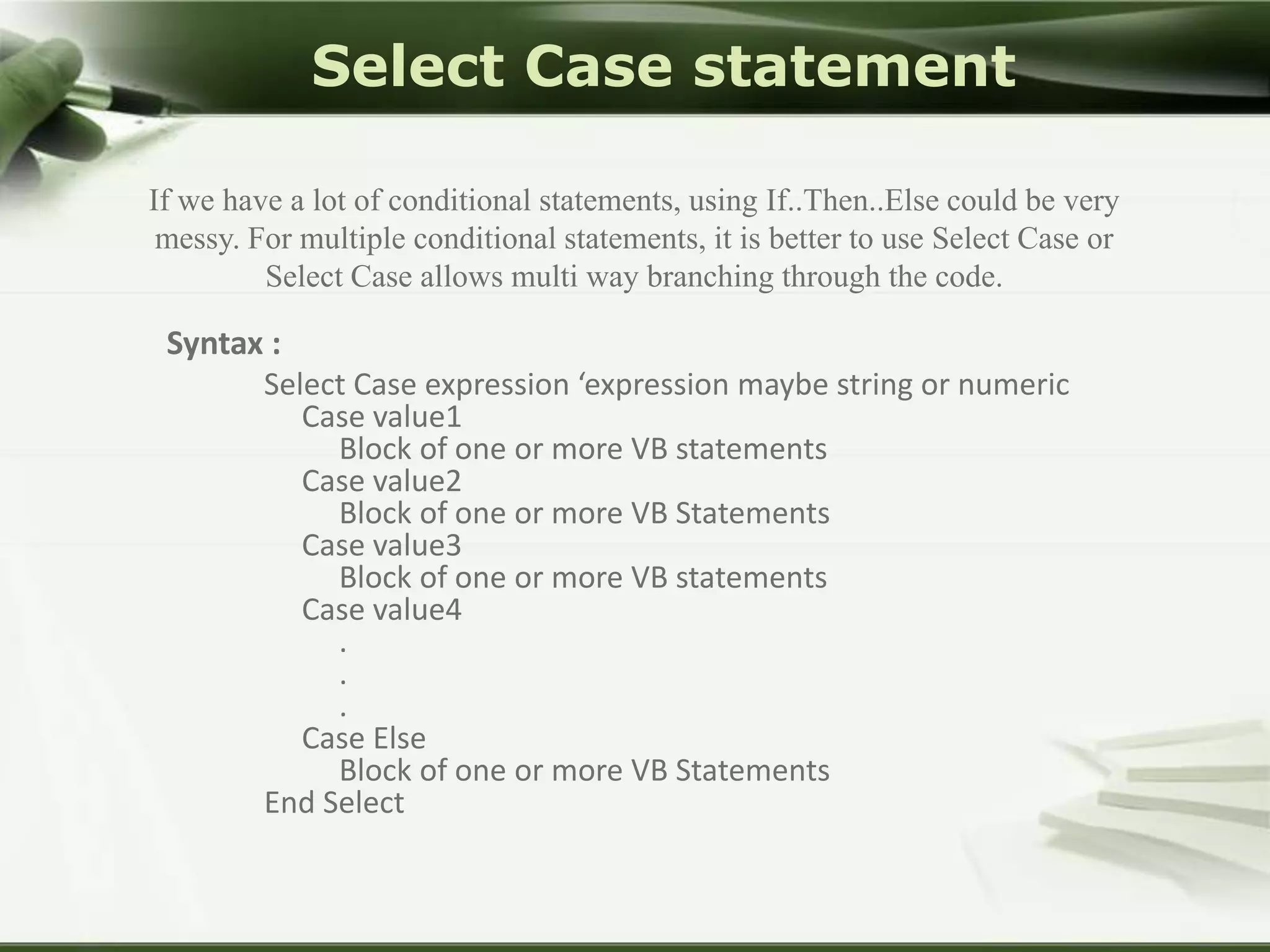
If we have a lot of conditional statements, using If..Then..Else could be very
messy. For multiple conditional statements, it is better to use Select Case or
Select Case allows multi way branching through the code.

Syntax :
Select Case expression ‘expression maybe string or numeric
Case value1
Block of one or more VB statements
Case value2
Block of one or more VB Statements
Case value3
Block of one or more VB statements
Case value4
.
.
.
Case Else
Block of one or more VB Statements
End Select
Select Case statement

Case 1

true

Case 1 Statements

false
Case 2

true

Case 2 Statements

false

Case N

true

Case Else Statements

Case N Statements
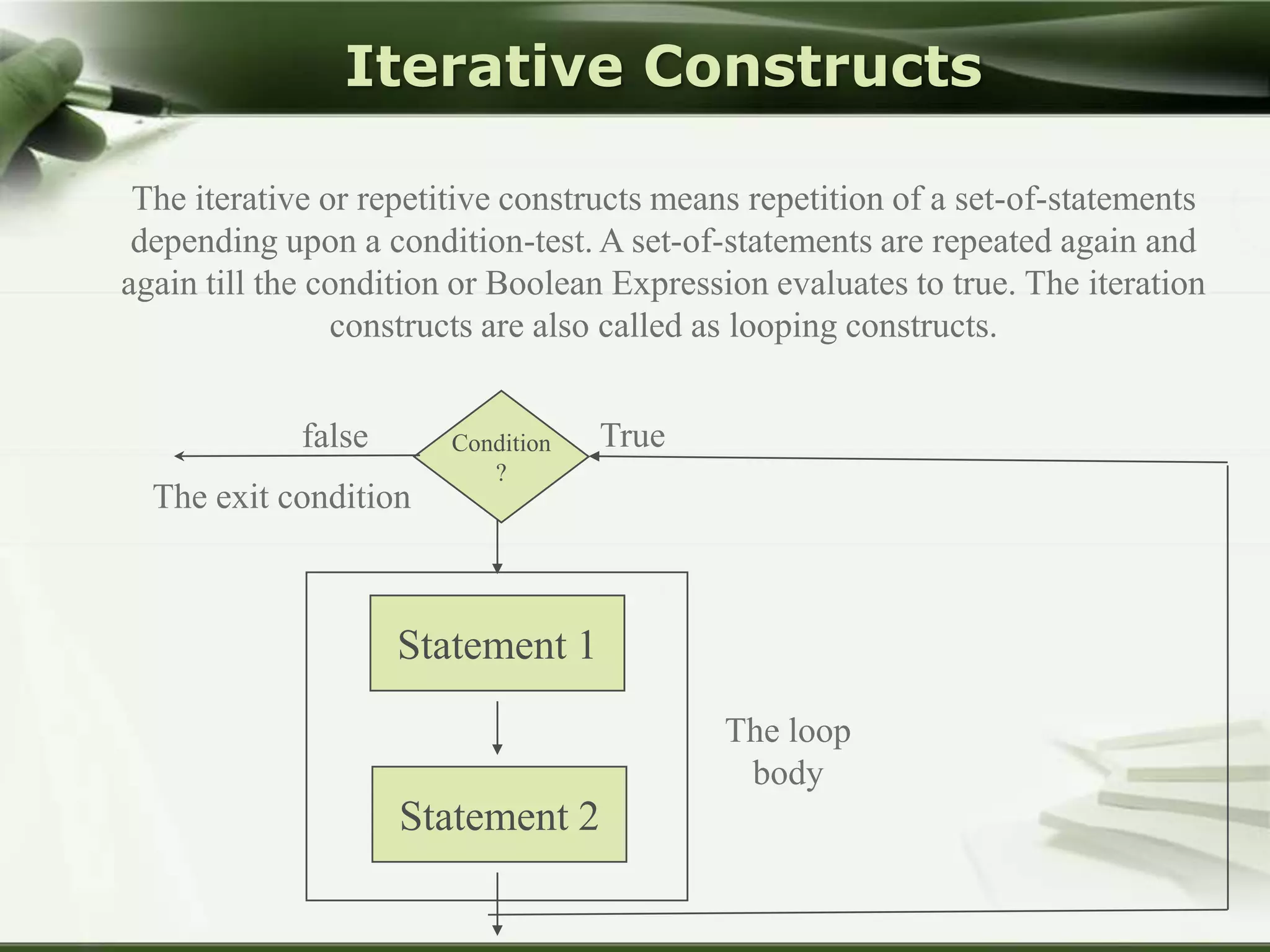
Iterative Constructs
The iterative or repetitive constructs means repetition of a set-of-statements
depending upon a condition-test. A set-of-statements are repeated again and
again till the condition or Boolean Expression evaluates to true. The iteration
constructs are also called as looping constructs.
false
The exit condition

Condition
?

True

Statement 1
The loop
body

Statement 2
For...Next Loop statement
Repeats a group of statements a specified number of times.

Syntax :
For counter [ As datatype ] = start To end [ Step step ]
[ statements ]
[ Continue For ]
[ statements ]
[ Exit For ]
[ statements ]
Next [ counter ]
Do...Loop statement
Repeats a block of statements while a Boolean condition is True or
until the condition becomes True.

Syntax :
Do { While | Until } condition
[ statements ]
[ Continue Do ]
[ statements ]
[ Exit Do ]
[ statements ]
Loop
-orDo
[ statements ]
[ Continue Do ]
[ statements ]
[ Exit Do ]
[ statements ]
Loop { While | Until } condition
Thank You.....

Control Structures in Visual Basic

  • 1.
    Control Structures In VisualBasic Submitted By: Sakar Chiolunkar Shashank Baghel Tushar jain 12C3045 12C3053 LOGO 12C3062
  • 2.
    Control Statement The orderin which statements are executed in a program is called the flow of control. In a sense, the computer is under the control of one statement at a time. When a statement has been executed, control is turned over to the next statement (like a baton being passed in a relay race). Flow of control is normally sequential. That is, when one statement is finished executing, control passes to the next statement in the pro- gram. If we want the flow of control to be nonsequential, you can use control structure. Company Logo
  • 3.
    Control Flow In aprogram, statements may be executed sequentially, selectively or iteratively. Every programming language provides constructs to support sequence, selection or iteration. So there are three types of programming constructs :  Sequence  Functions and Procedures  Selection   If...Then...Else statement Select Case statement  Iterative   Company Logo For...Next Loop statement Do...Loop statement
  • 4.
    Sequential Construct The sequentialconstruct means the statements are being executed sequentially. This represents the default flow of statements. Statement 1 Statement 2 Statement 3
  • 5.
    Selection Construct The selectionconstruct means the execution of statement(s) depending upon the condition-test. If a condition evaluates to true, a course-of-action (a set of statements) is followed otherwise another course-of-action is followed. This construct is also called decision construct as it helps in decision making. Condition ? true Statement 1 false One course-of-action Statement 1 Another course of action Statement 2 Statement 2
  • 6.
    If...Then...Else statement Perhaps themost important statement in a program is the If statement and then its statements. In other words If.. Then.. Else statement provides an alternate choice to the user i.e. if the condition is true then a set of statements are executed otherwise another set of statements are executed. In Visual Basic we use three types of ‘IF’ statements: 1. Simple If 2. If Else 3. Nested If
  • 7.
    If...Then...Else statement Syntax : true If(boolean Expression) Then VB Statement(s) Else VB Statement(s) End If Statement Condition ? false Statement
  • 8.
    Select Case statement Ifwe have a lot of conditional statements, using If..Then..Else could be very messy. For multiple conditional statements, it is better to use Select Case or Select Case allows multi way branching through the code. Syntax : Select Case expression ‘expression maybe string or numeric Case value1 Block of one or more VB statements Case value2 Block of one or more VB Statements Case value3 Block of one or more VB statements Case value4 . . . Case Else Block of one or more VB Statements End Select
  • 9.
    Select Case statement Case1 true Case 1 Statements false Case 2 true Case 2 Statements false Case N true Case Else Statements Case N Statements
  • 10.
    Iterative Constructs The iterativeor repetitive constructs means repetition of a set-of-statements depending upon a condition-test. A set-of-statements are repeated again and again till the condition or Boolean Expression evaluates to true. The iteration constructs are also called as looping constructs. false The exit condition Condition ? True Statement 1 The loop body Statement 2
  • 11.
    For...Next Loop statement Repeatsa group of statements a specified number of times. Syntax : For counter [ As datatype ] = start To end [ Step step ] [ statements ] [ Continue For ] [ statements ] [ Exit For ] [ statements ] Next [ counter ]
  • 12.
    Do...Loop statement Repeats ablock of statements while a Boolean condition is True or until the condition becomes True. Syntax : Do { While | Until } condition [ statements ] [ Continue Do ] [ statements ] [ Exit Do ] [ statements ] Loop -orDo [ statements ] [ Continue Do ] [ statements ] [ Exit Do ] [ statements ] Loop { While | Until } condition
  • 13.