Content
Modelling
Copyright © Joe Gollner 2013

Joe Gollner
Gnostyx Research Inc.
jag@gnostyx.com
www.gollner.ca
@joegollner
Workshop Topics
Core Concepts & Terminology
Perspectives on
Content Modelling
Content Modelling
Technique
The Three Key Sides to
Content Modelling
Content Types
Content Composition
Content Processes
Core Concepts & Terminology
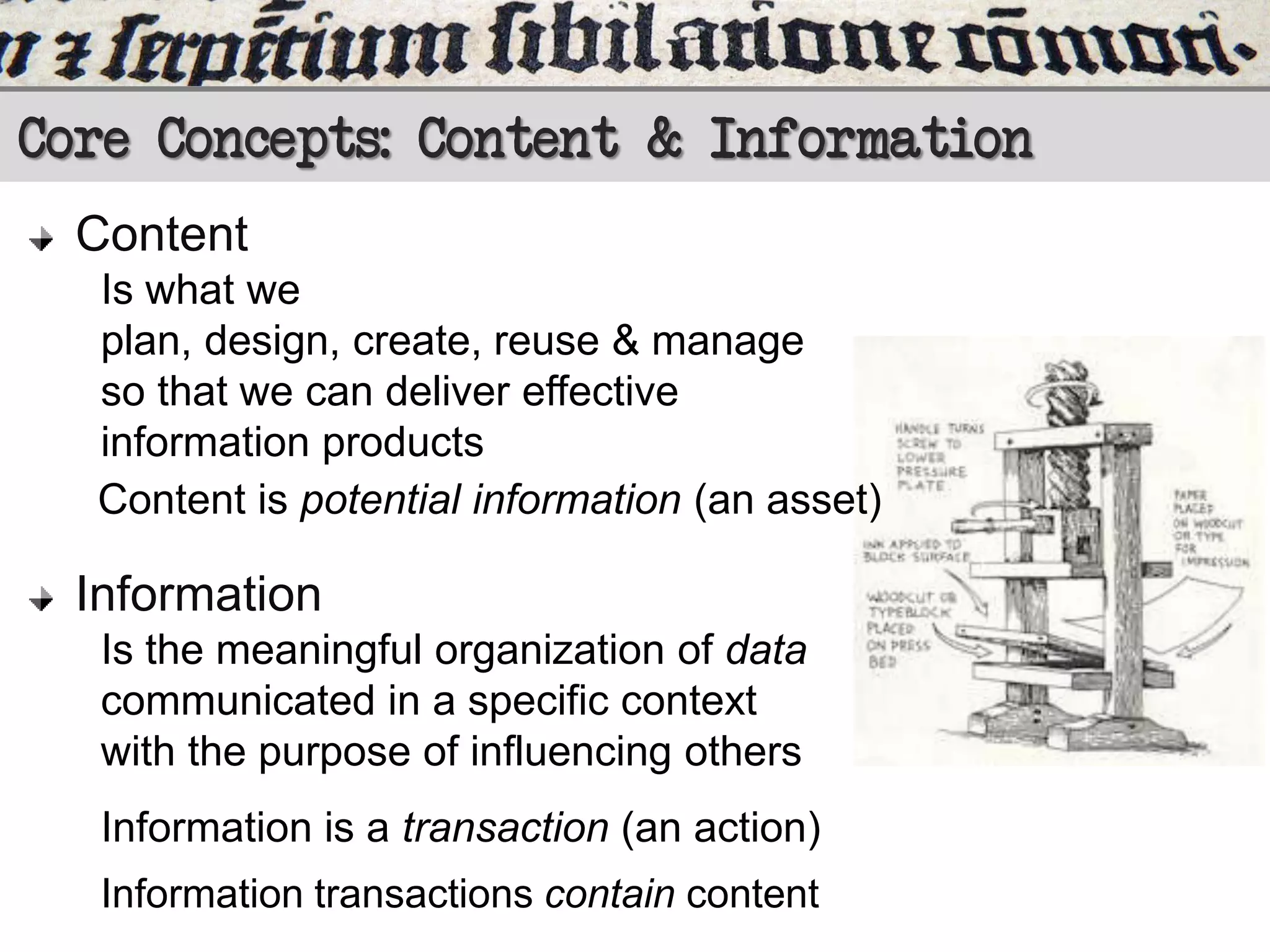
Core Concepts: Content & Information
Content
Is what we
plan, design, create, reuse & manage
so that we can deliver effective
information products
Content is potential information (an asset)

Information
Is the meaningful organization of data
communicated in a specific context
with the purpose of influencing others
Information is a transaction (an action)
Information transactions contain content
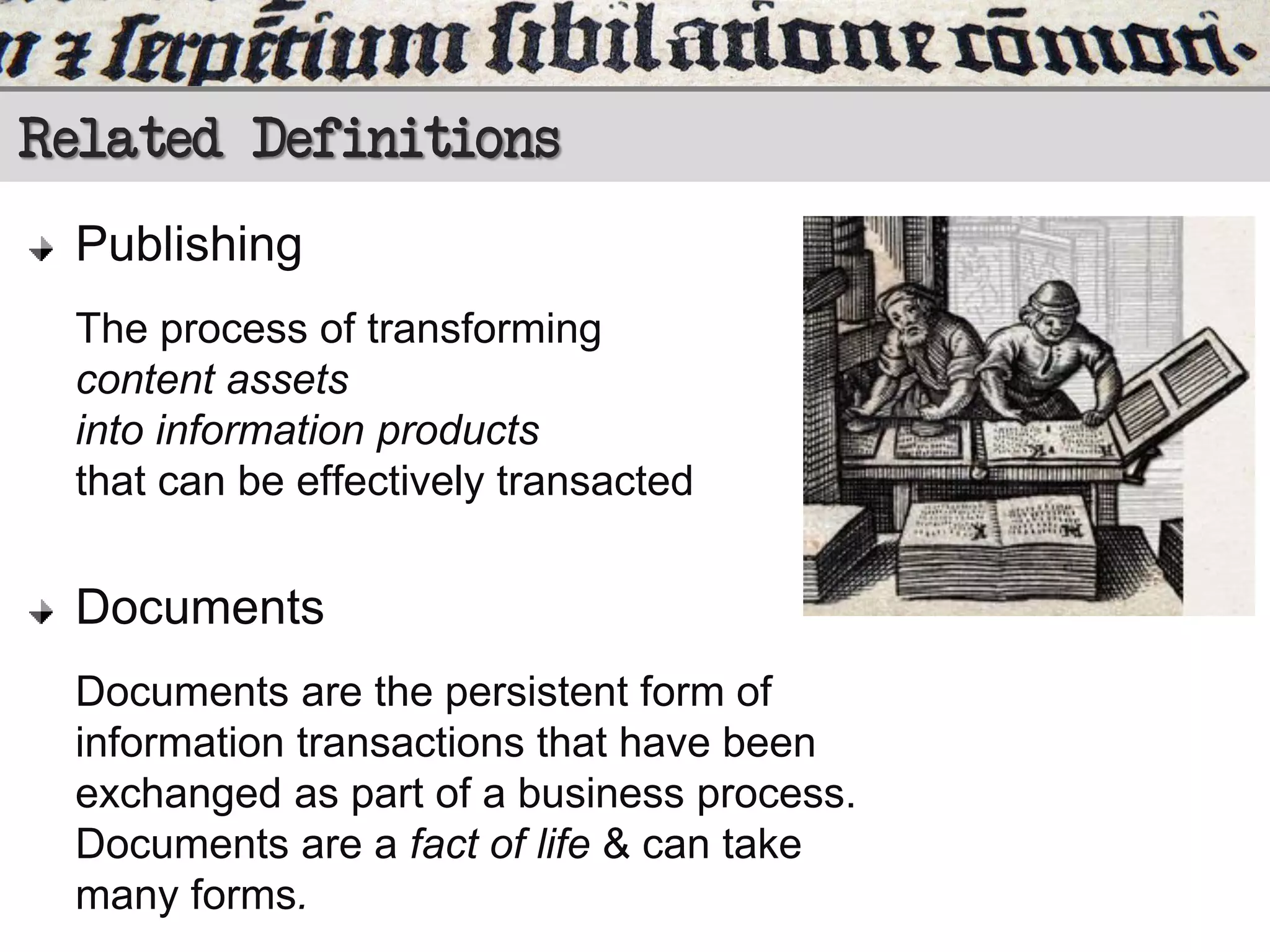
Related Definitions
Publishing
The process of transforming
content assets
into information products
that can be effectively transacted

Documents
Documents are the persistent form of
information transactions that have been
exchanged as part of a business process.
Documents are a fact of life & can take
many forms.
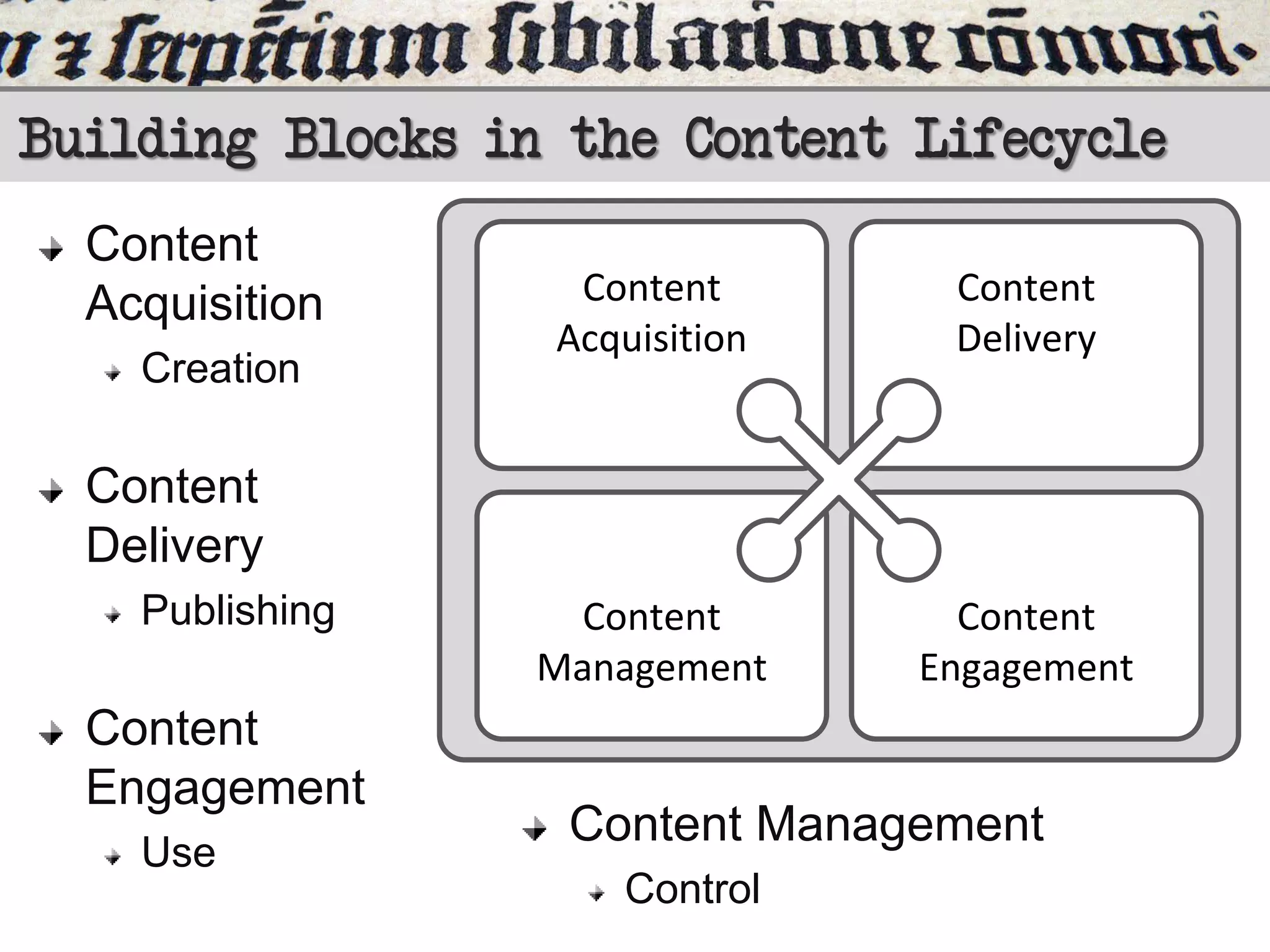
Building Blocks in the Content Lifecycle
Content
Acquisition
Creation

Content
Acquisition

Content
Delivery

Content
Management

Content
Engagement

Content
Delivery
Publishing

Content
Engagement
Use

Content Management
Control
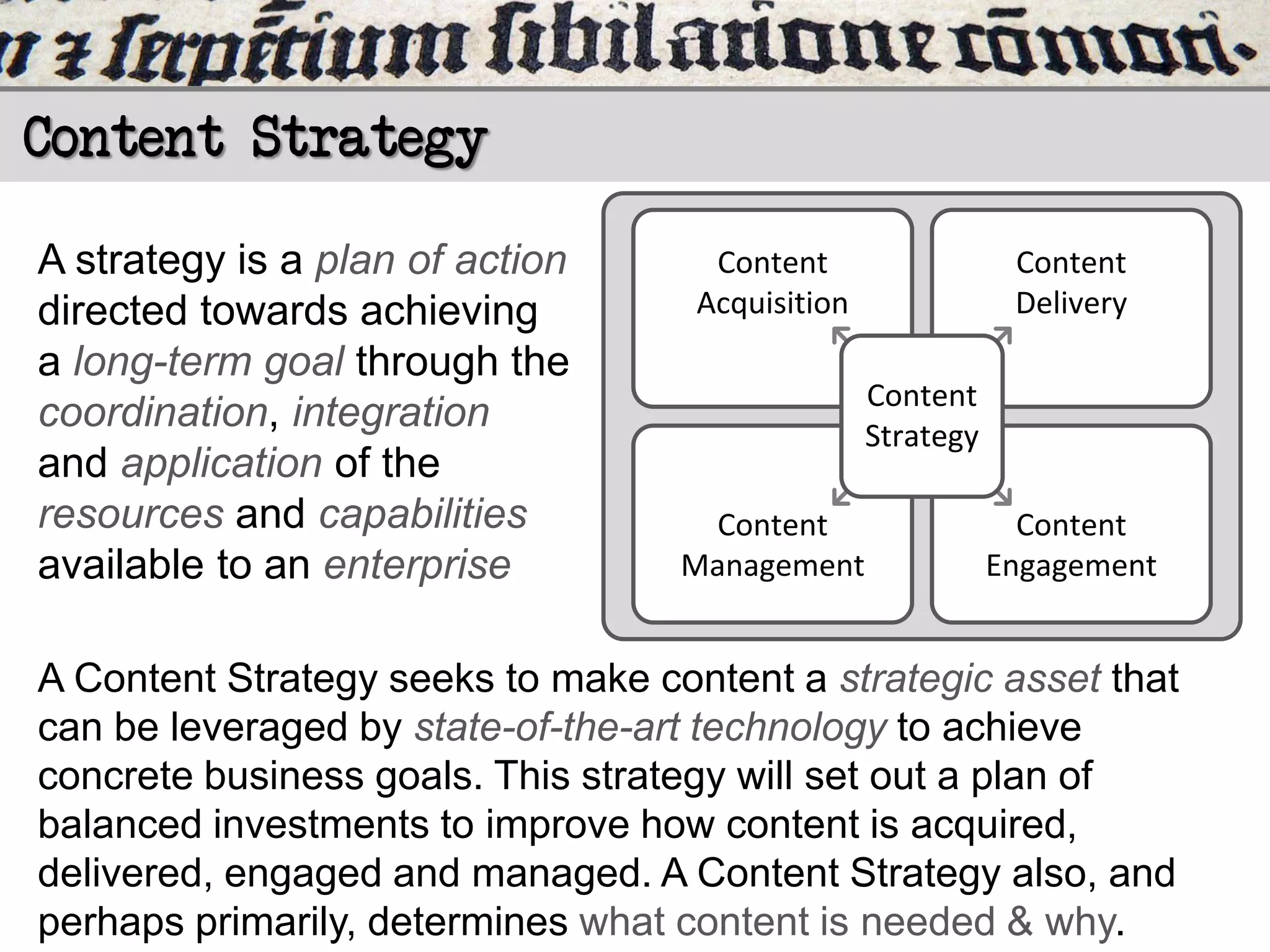
Content Strategy
A strategy is a plan of action
directed towards achieving
a long-term goal through the
coordination, integration
and application of the
resources and capabilities
available to an enterprise

Content
Acquisition

Content
Delivery
Content
Strategy

Content
Management

Content
Engagement

A Content Strategy seeks to make content a strategic asset that
can be leveraged by state-of-the-art technology to achieve
concrete business goals. This strategy will set out a plan of
balanced investments to improve how content is acquired,
delivered, engaged and managed. A Content Strategy also, and
perhaps primarily, determines what content is needed & why.
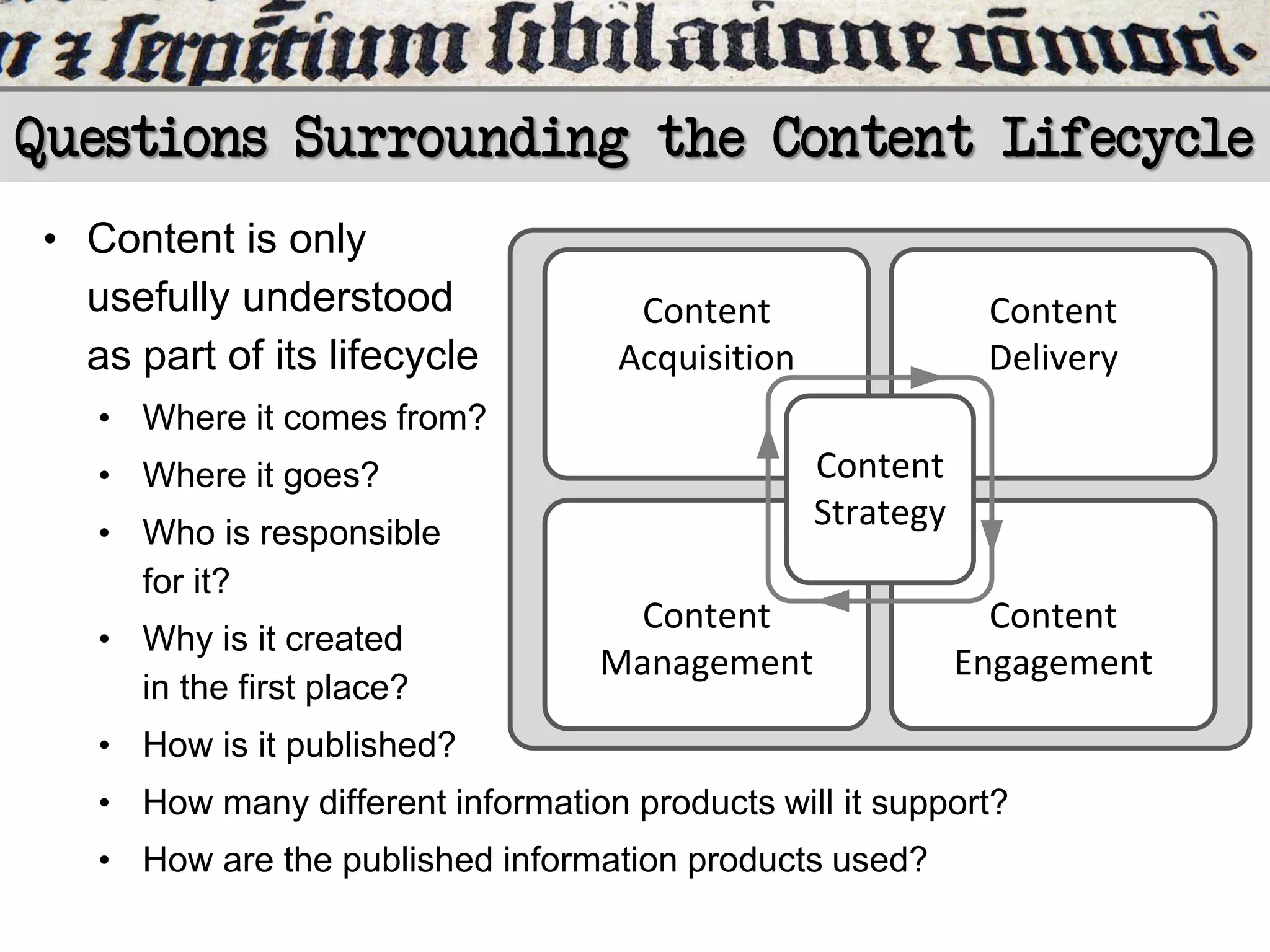
Questions Surrounding the Content Lifecycle
• Content is only
usefully understood
as part of its lifecycle

Content
Acquisition

Content
Delivery

• Where it comes from?

Content
Strategy

• Where it goes?
• Who is responsible
for it?
• Why is it created
in the first place?

Content
Management

Content
Engagement

• How is it published?
• How many different information products will it support?
• How are the published information products used?
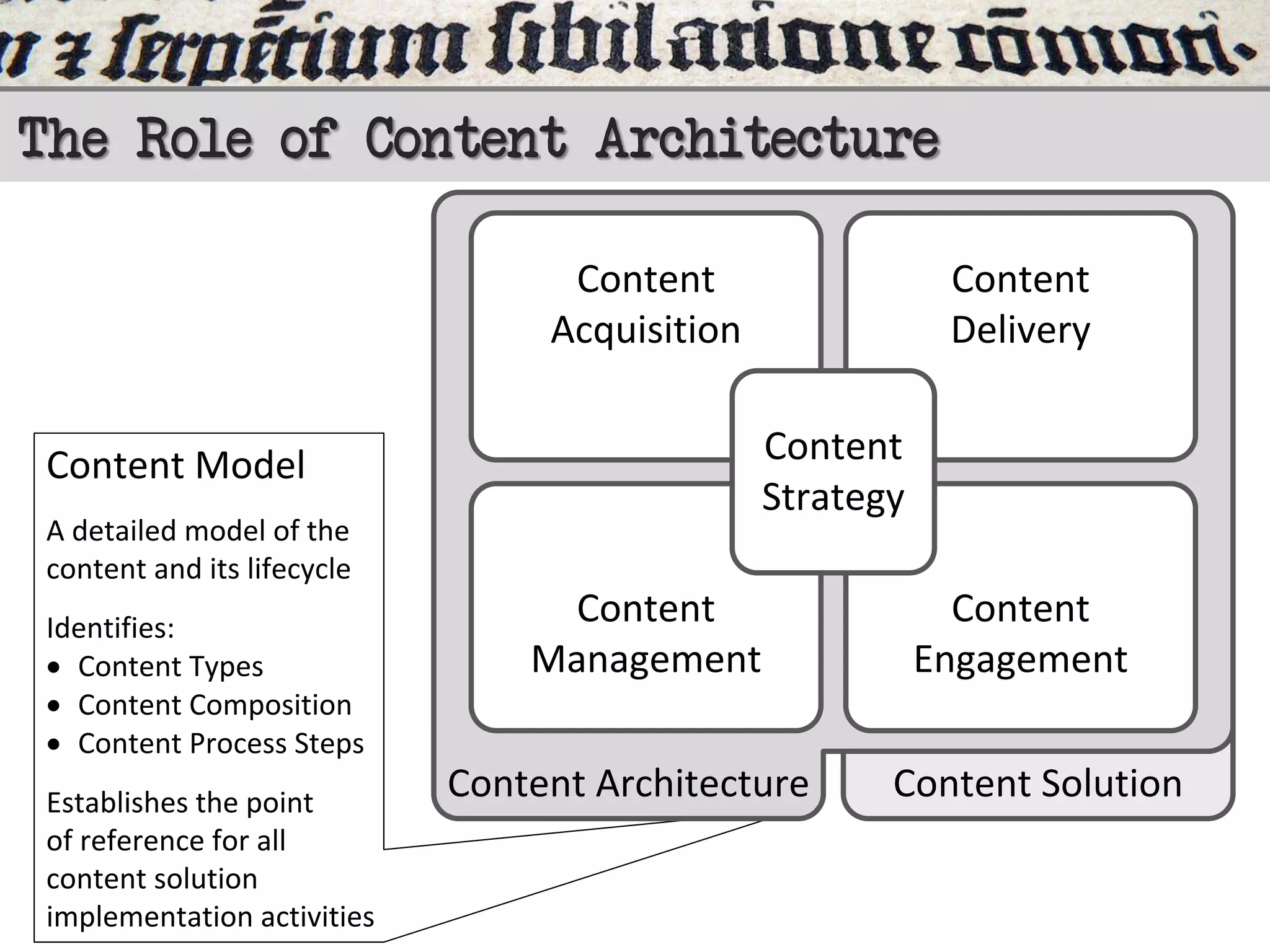
The Role of Content Architecture
Content
Acquisition
Content
Strategy

Content Model
A detailed model of the
content and its lifecycle
Identifies:
· Content Types
· Content Composition
· Content Process Steps
Establishes the point
of reference for all
content solution
implementation activities

Content
Delivery

Content
Management
Content Architecture

Content
Engagement
Content Solution
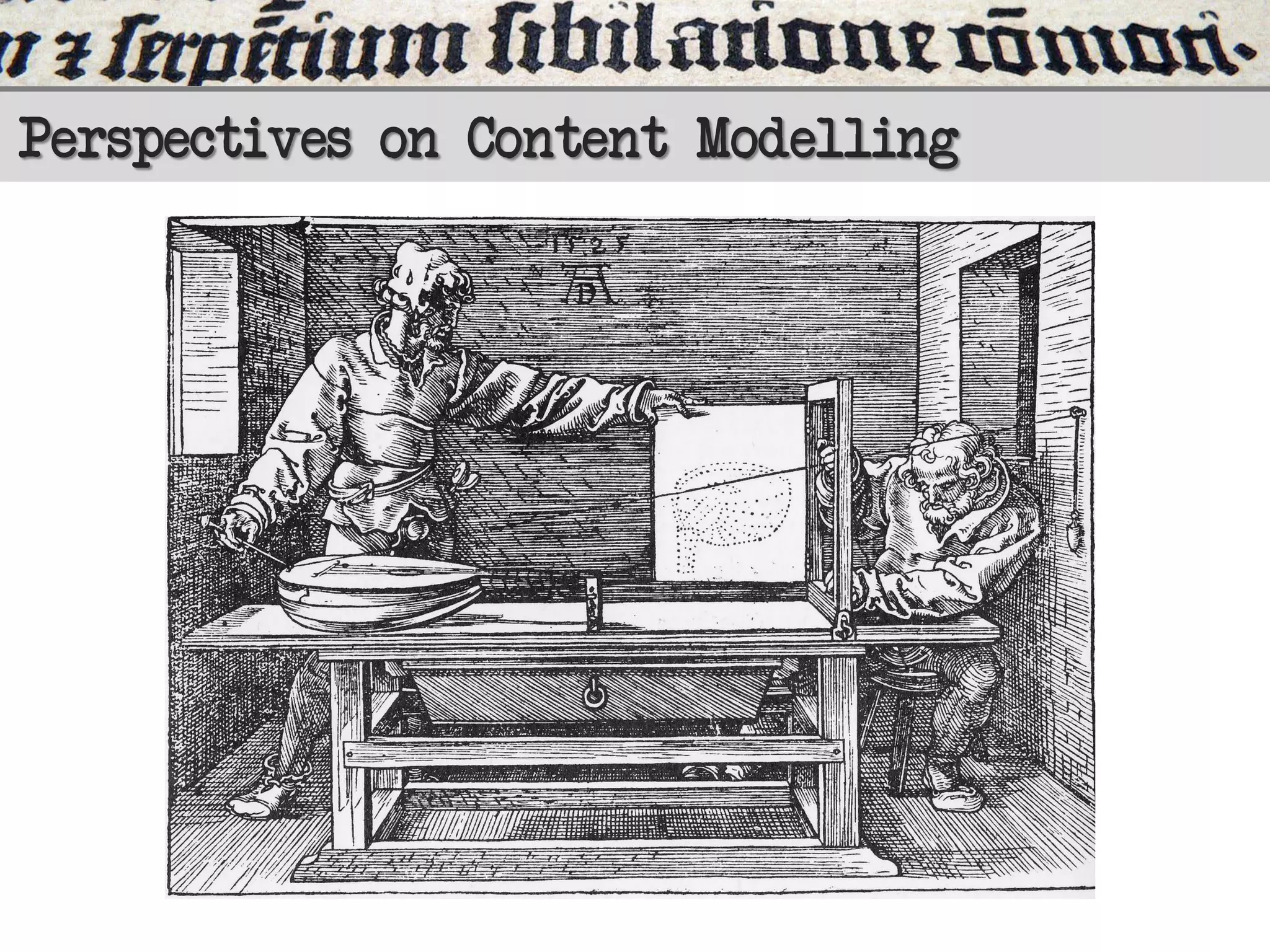
Perspectives on Content Modelling
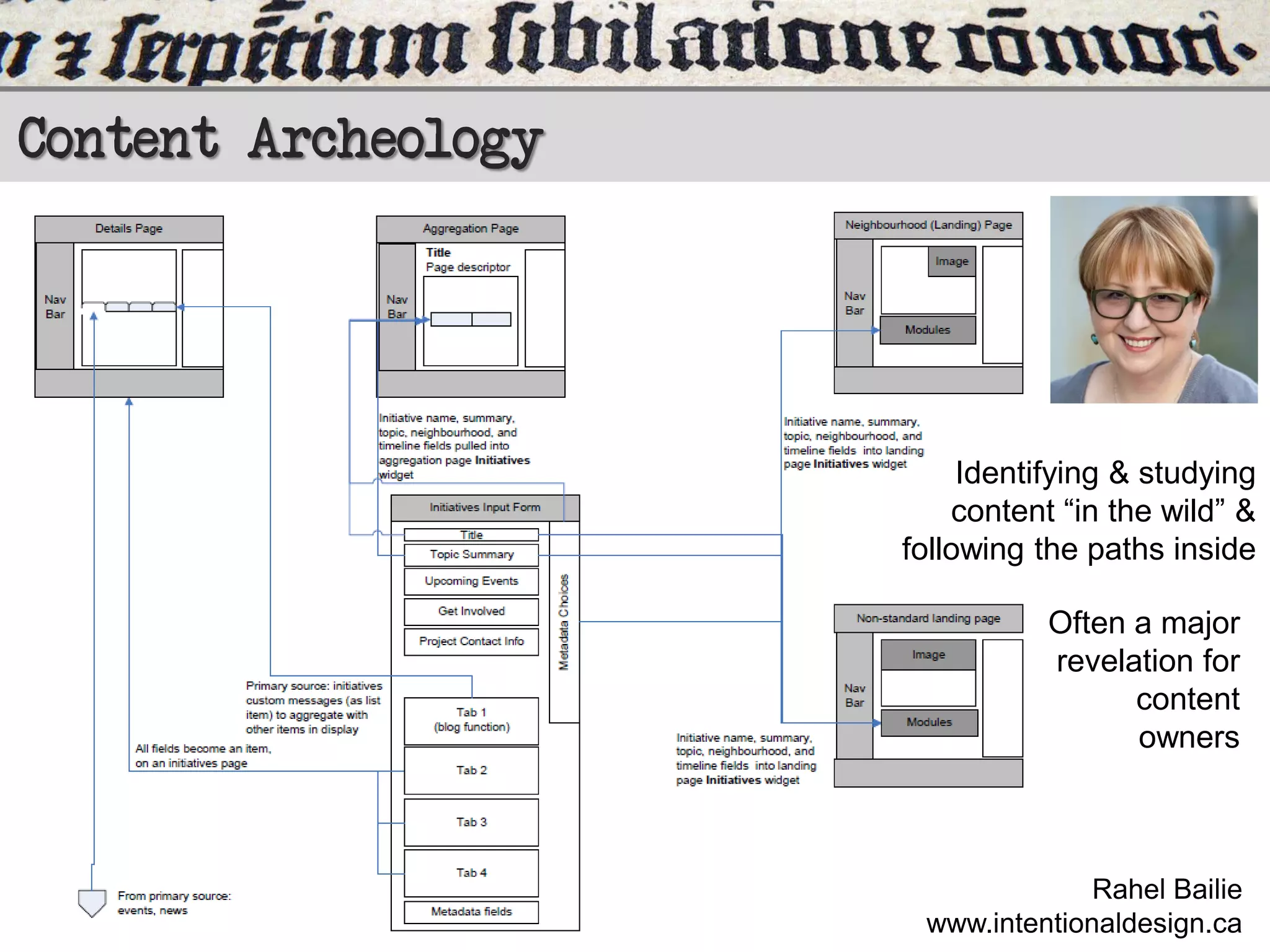
Content Archeology

Identifying & studying
content “in the wild” &
following the paths inside

Often a major
revelation for
content
owners

Rahel Bailie
www.intentionaldesign.ca
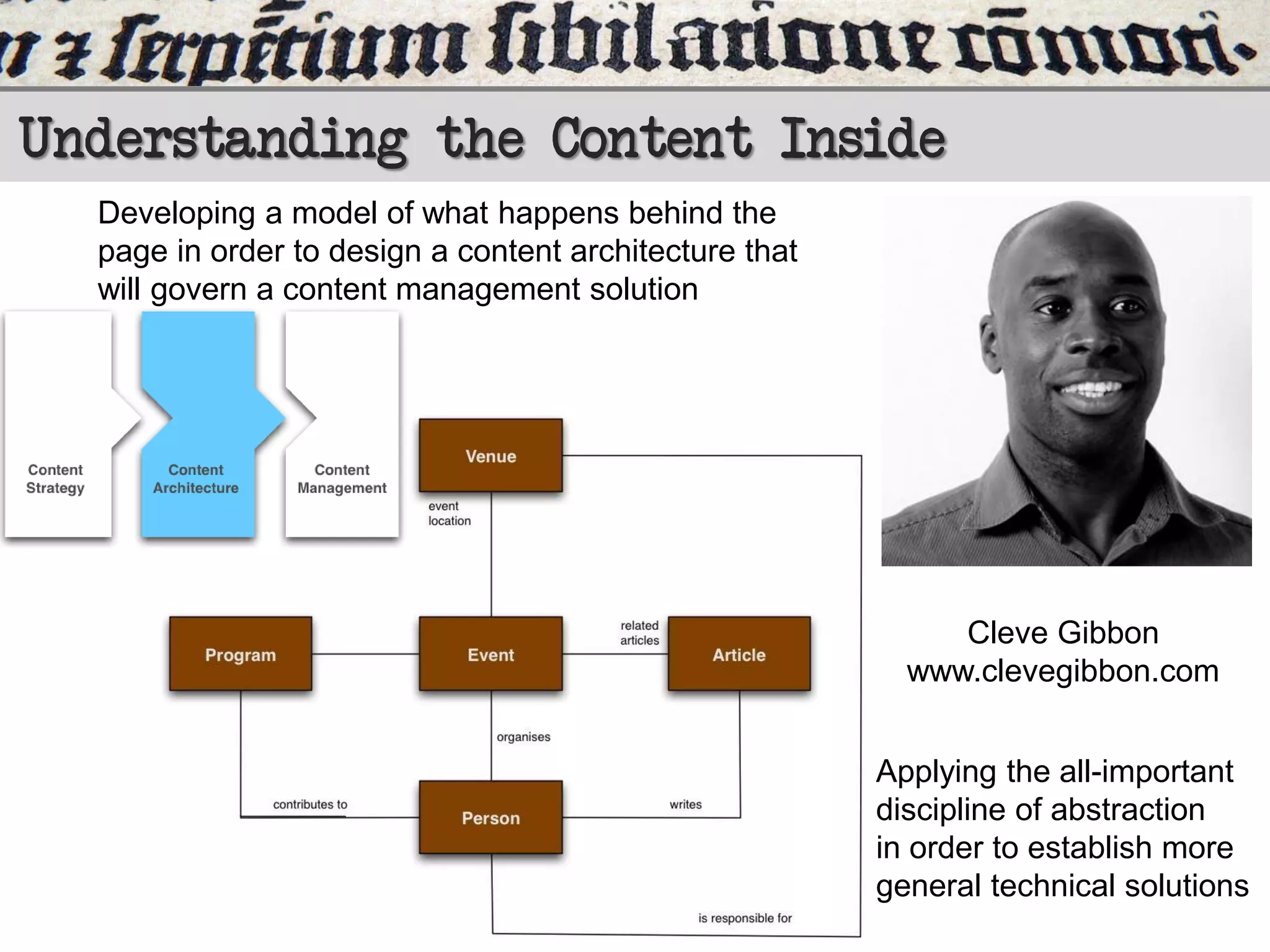
Understanding the Content Inside
Developing a model of what happens behind the
page in order to design a content architecture that
will govern a content management solution

Cleve Gibbon
www.clevegibbon.com
Applying the all-important
discipline of abstraction
in order to establish more
general technical solutions
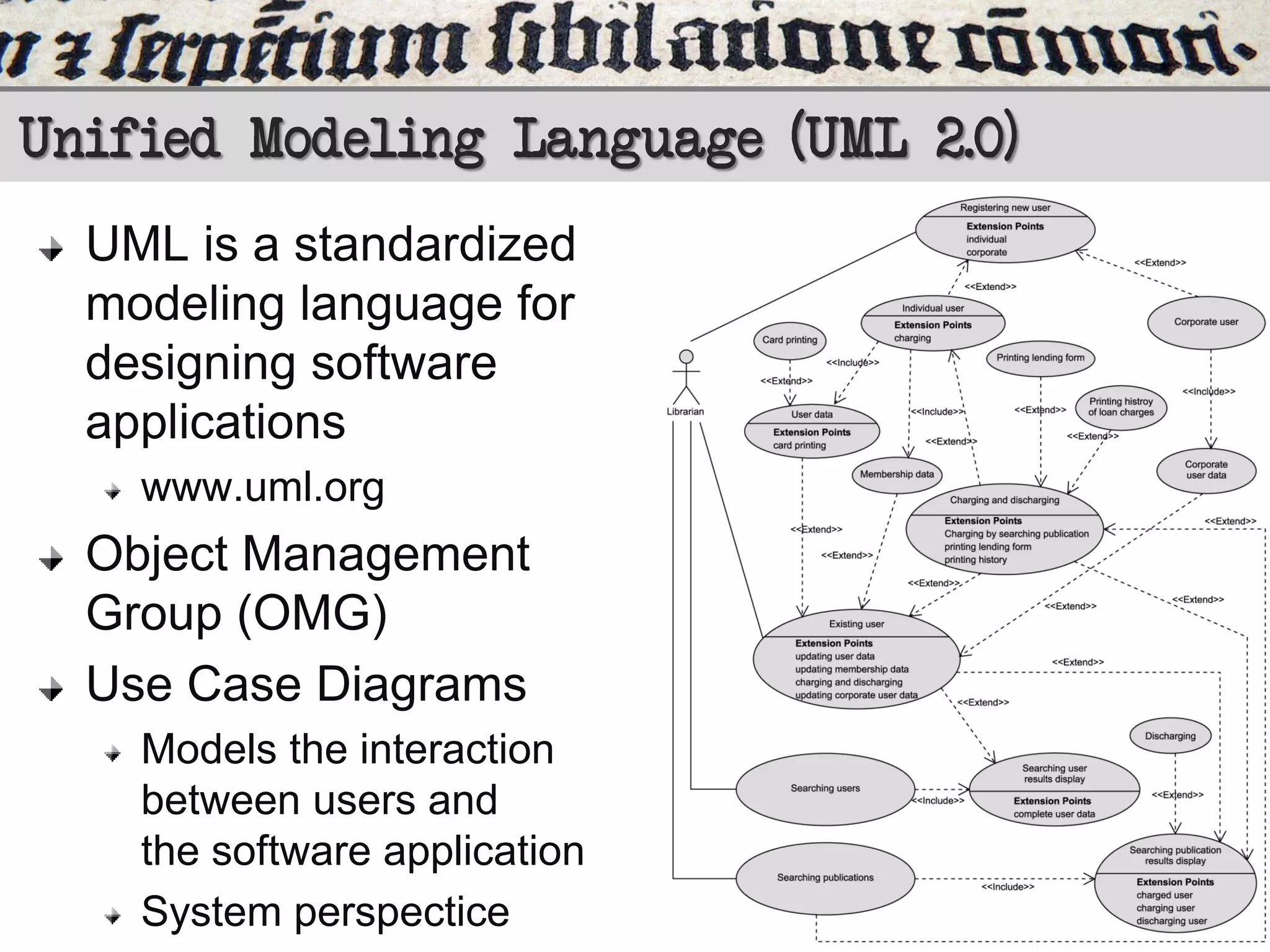
Unified Modeling Language (UML 2.0)
UML is a standardized
modeling language for
designing software
applications
www.uml.org

Object Management
Group (OMG)
Use Case Diagrams
Models the interaction
between users and
the software application
System perspectice
Unified Modeling Language (UML 2.0)
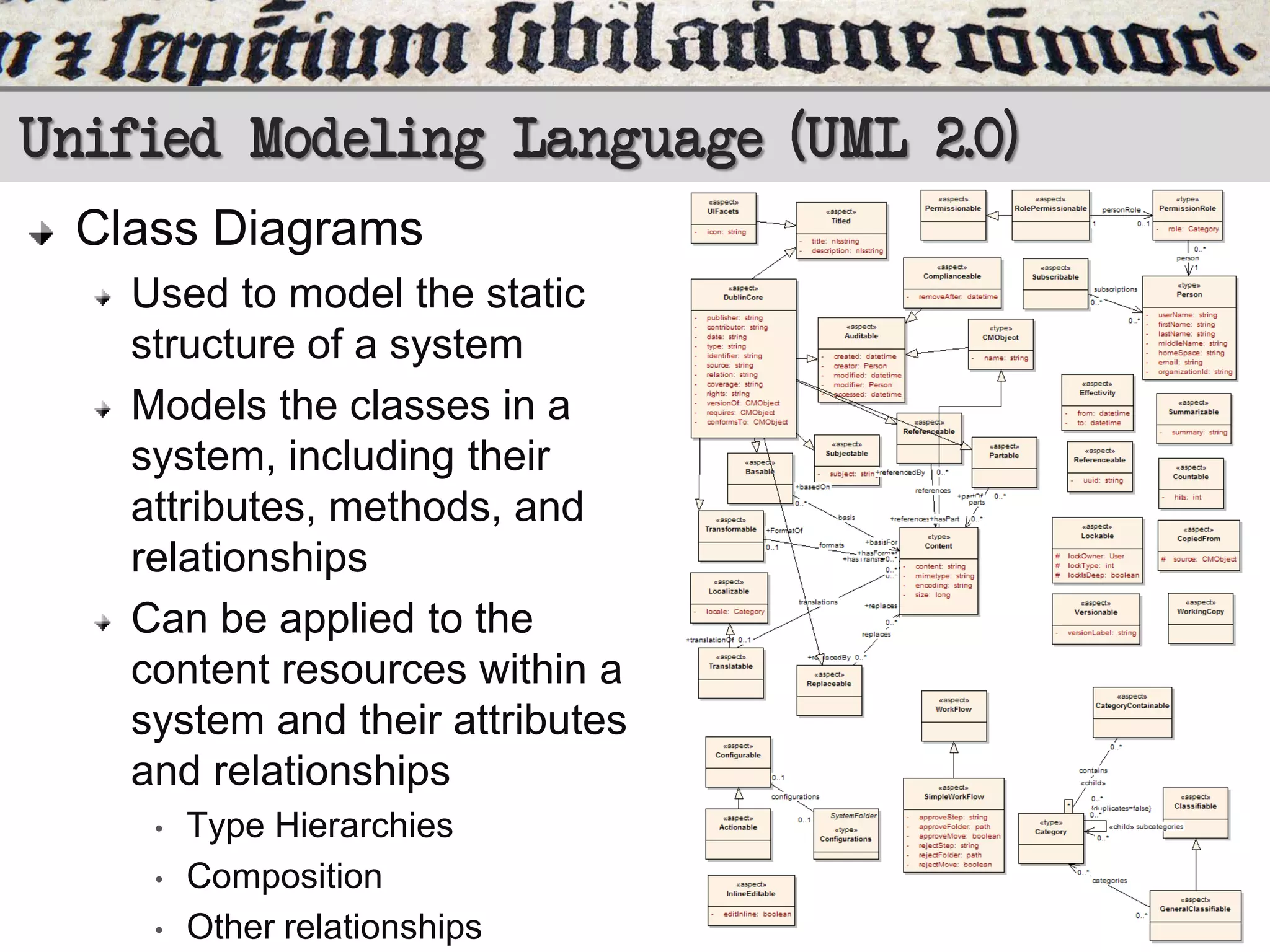
Class Diagrams
Used to model the static
structure of a system
Models the classes in a
system, including their
attributes, methods, and
relationships
Can be applied to the
content resources within a
system and their attributes
and relationships
•
•
•

Type Hierarchies
Composition
Other relationships
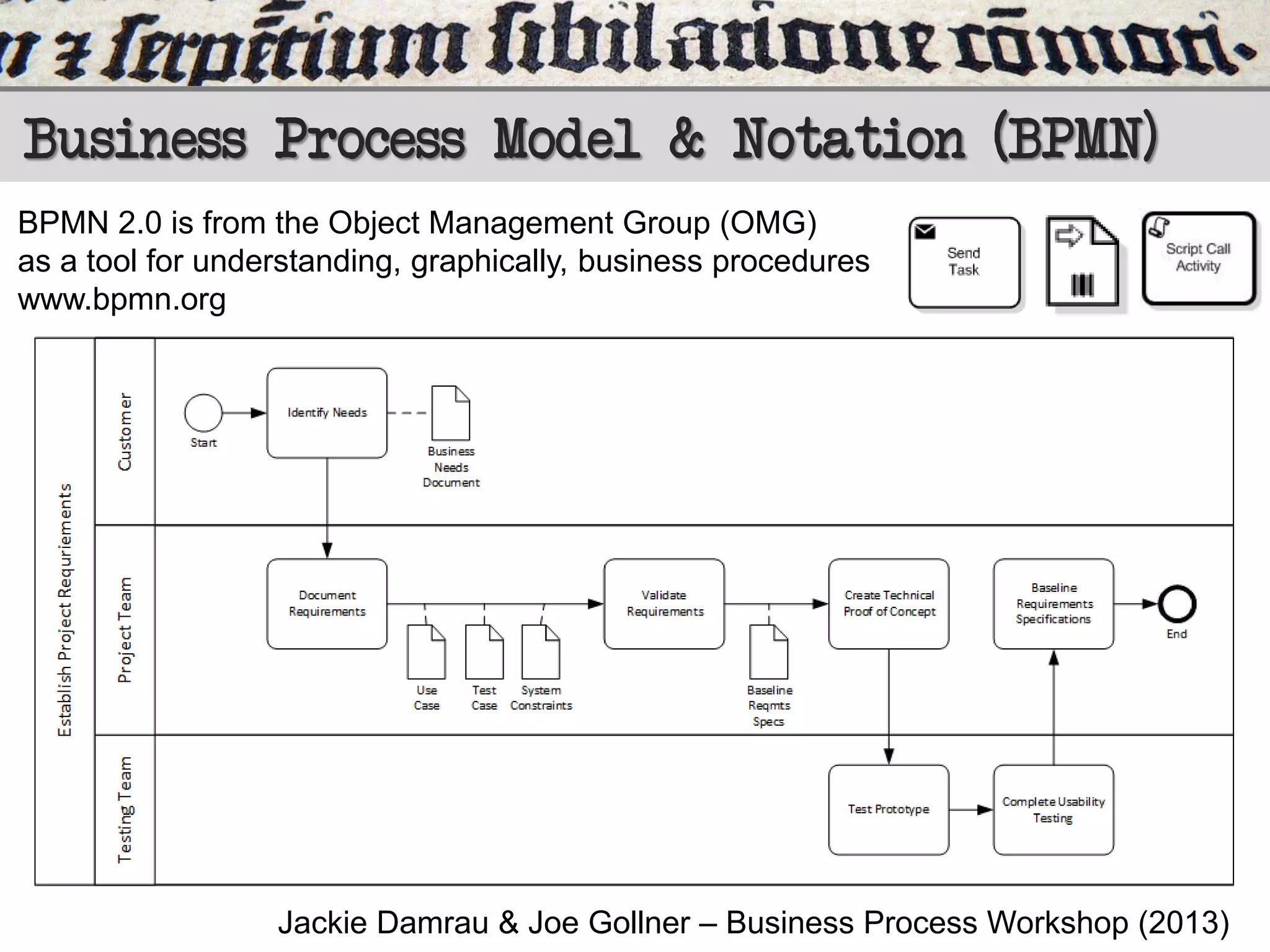
Business Process Model & Notation (BPMN)
BPMN 2.0 is from the Object Management Group (OMG)
as a tool for understanding, graphically, business procedures
www.bpmn.org

Jackie Damrau & Joe Gollner – Business Process Workshop (2013)
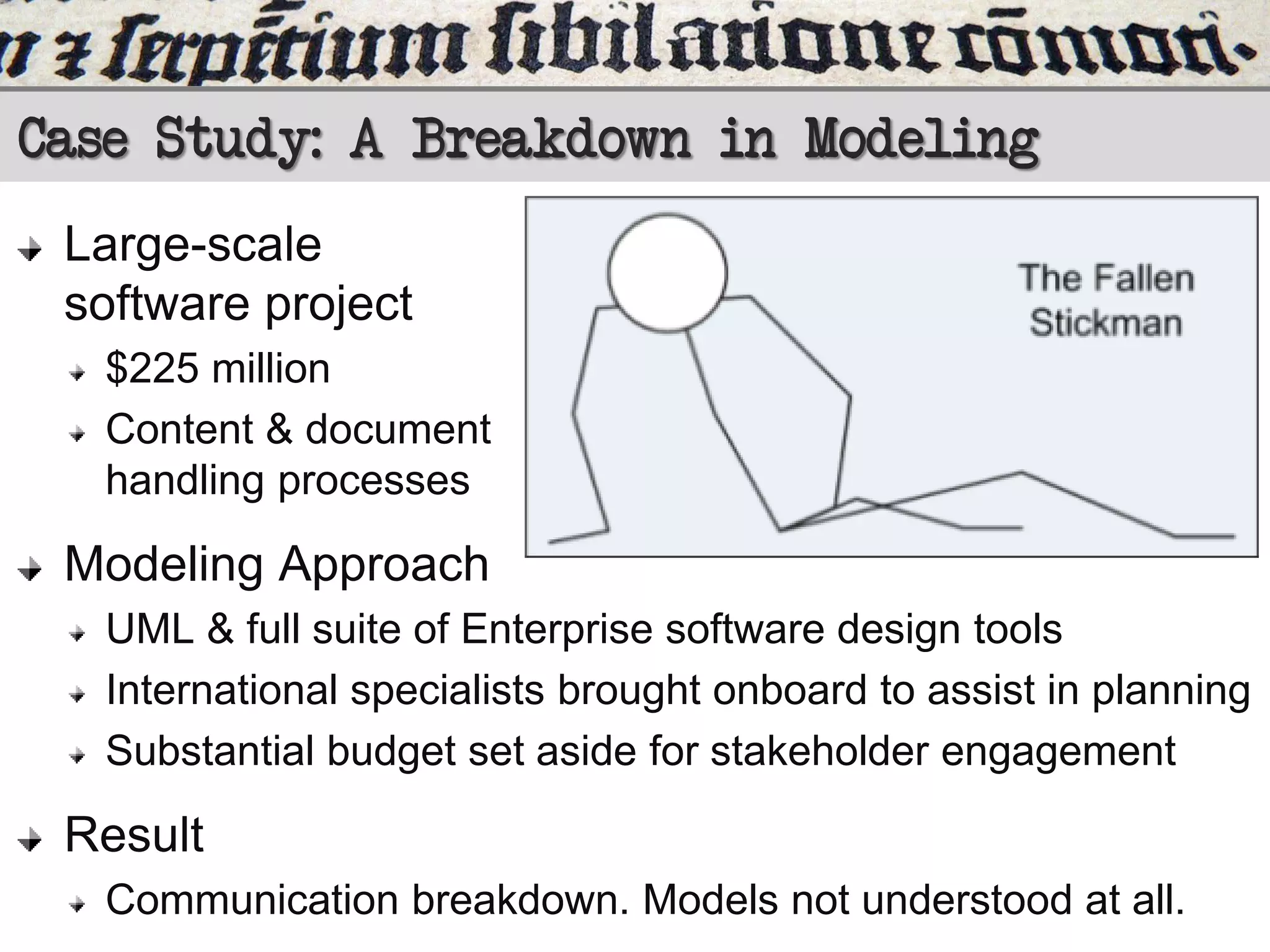
Case Study: A Breakdown in Modeling
Large-scale
software project
$225 million
Content & document
handling processes

Modeling Approach
UML & full suite of Enterprise software design tools
International specialists brought onboard to assist in planning
Substantial budget set aside for stakeholder engagement

Result
Communication breakdown. Models not understood at all.
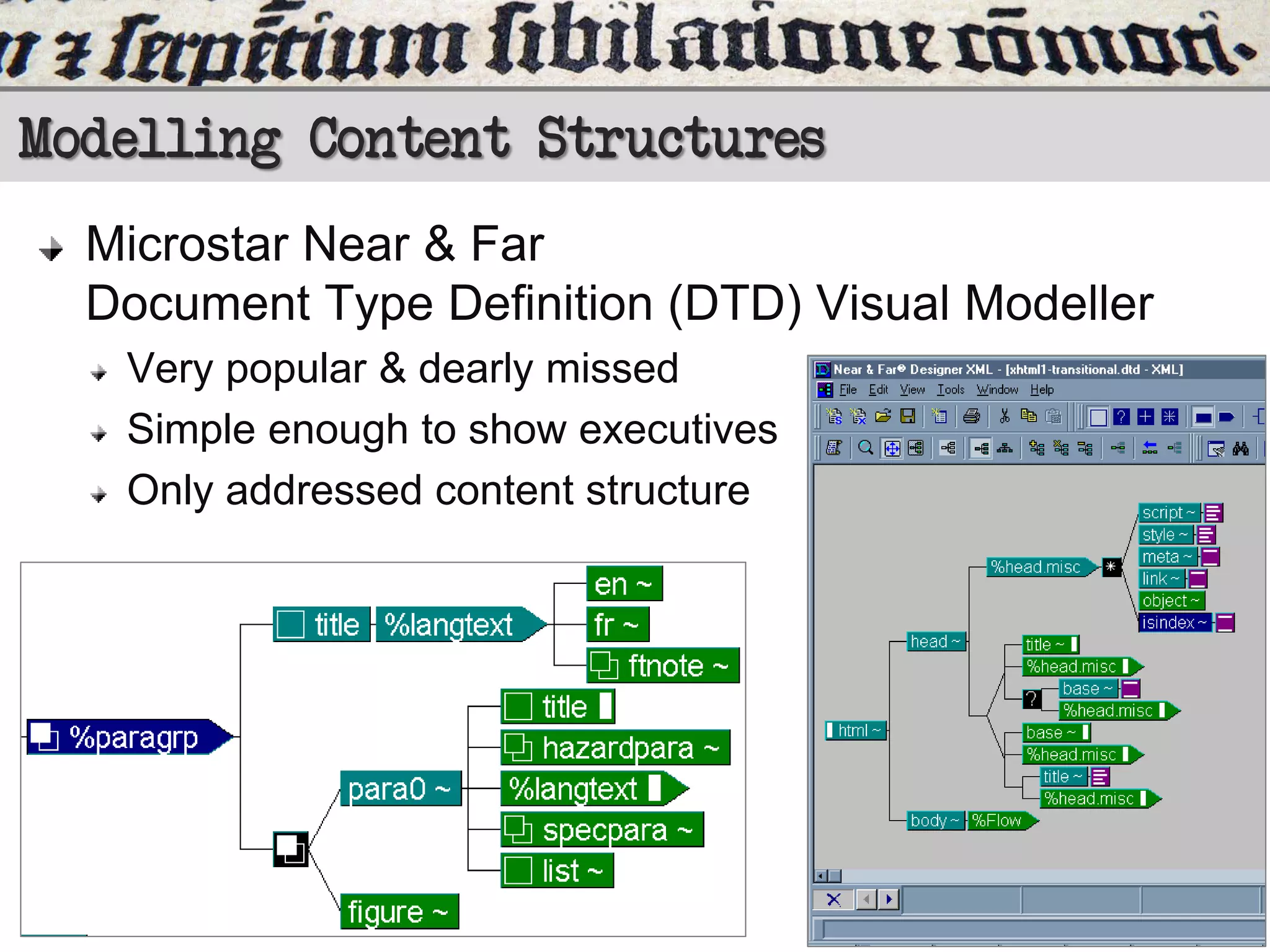
Modelling Content Structures
Microstar Near & Far
Document Type Definition (DTD) Visual Modeller
Very popular & dearly missed
Simple enough to show executives
Only addressed content structure
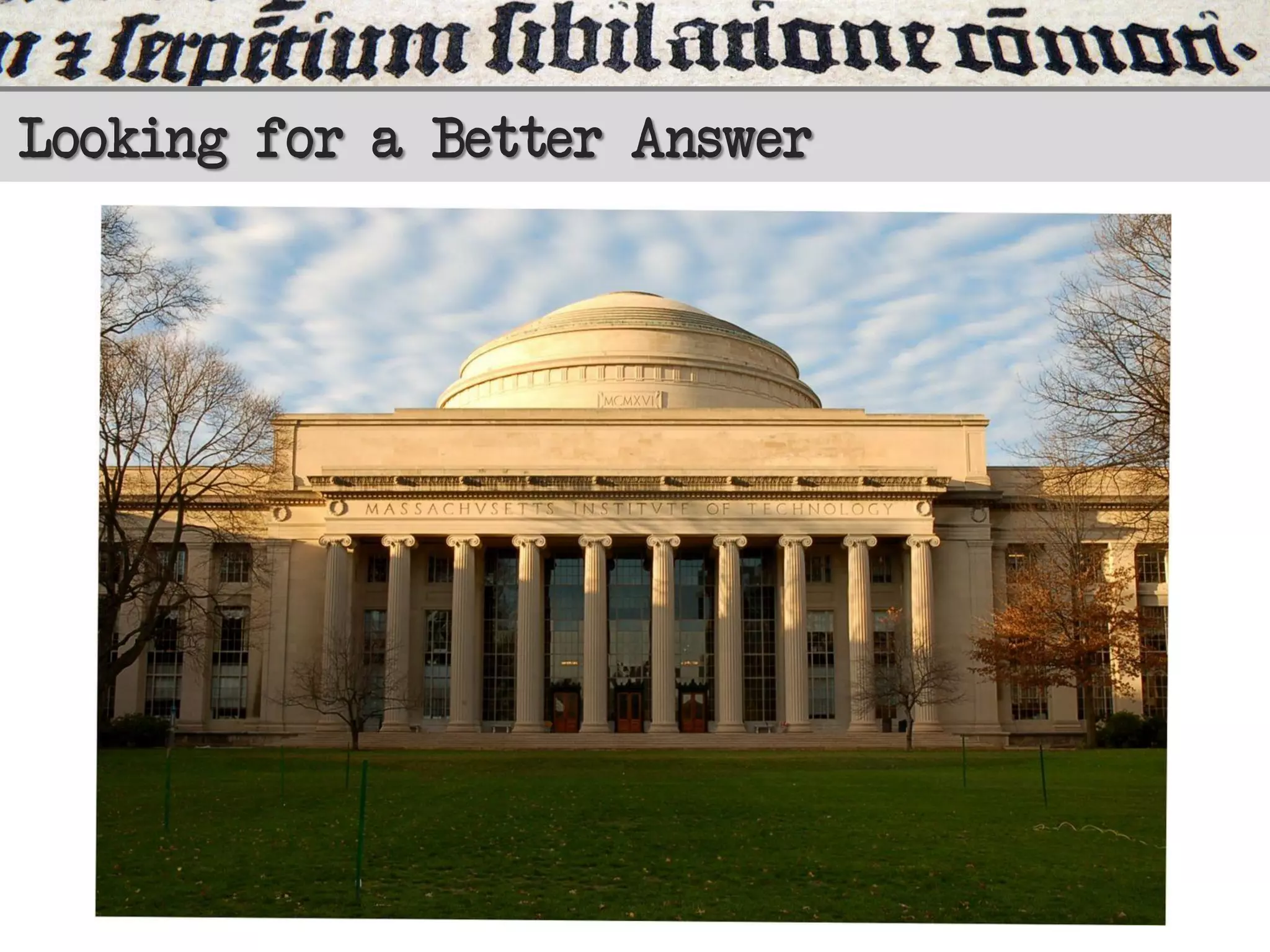
Looking for a Better Answer
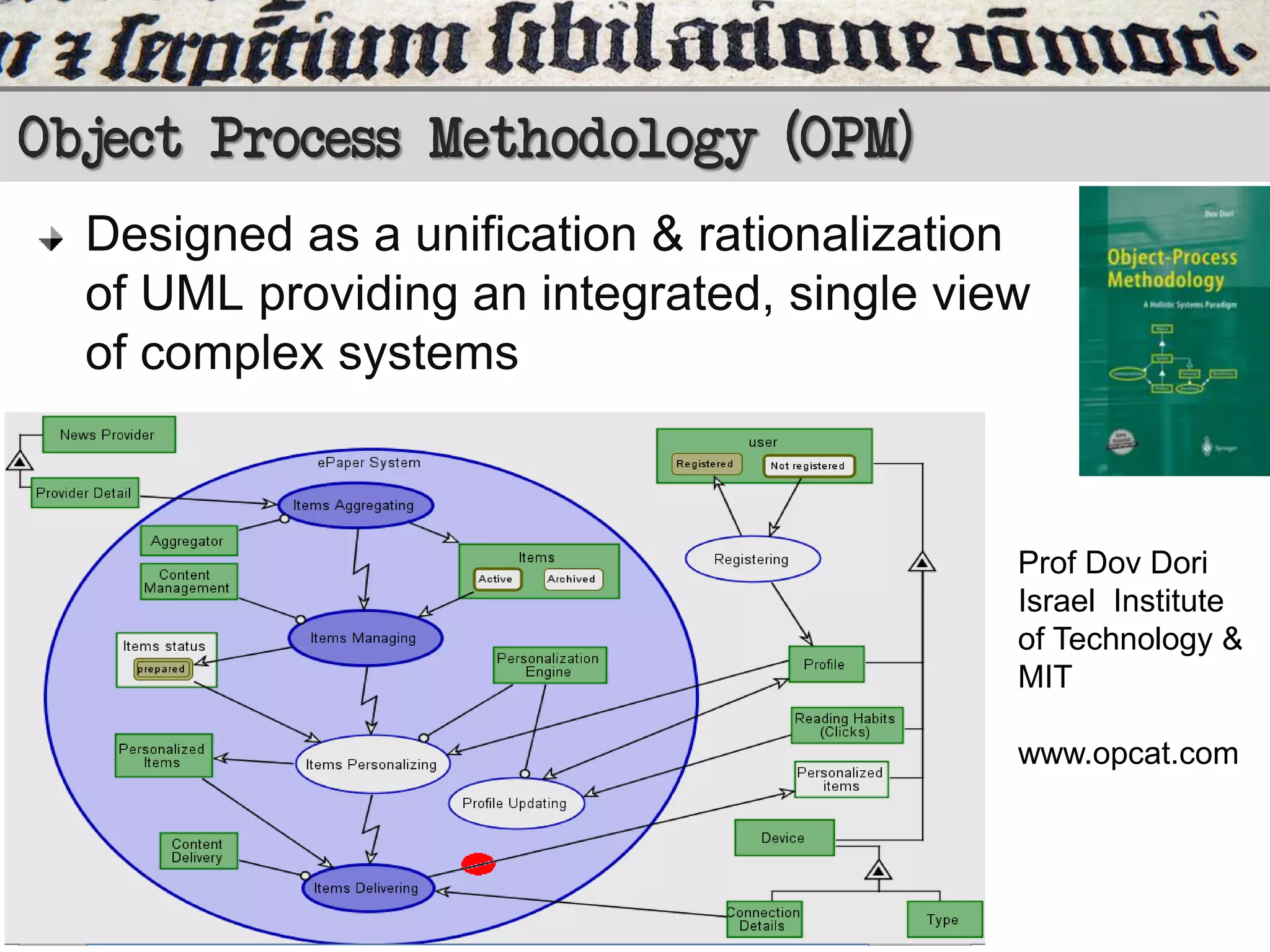
Object Process Methodology (OPM)
Designed as a unification & rationalization
of UML providing an integrated, single view
of complex systems

Prof Dov Dori
Israel Institute
of Technology &
MIT
www.opcat.com
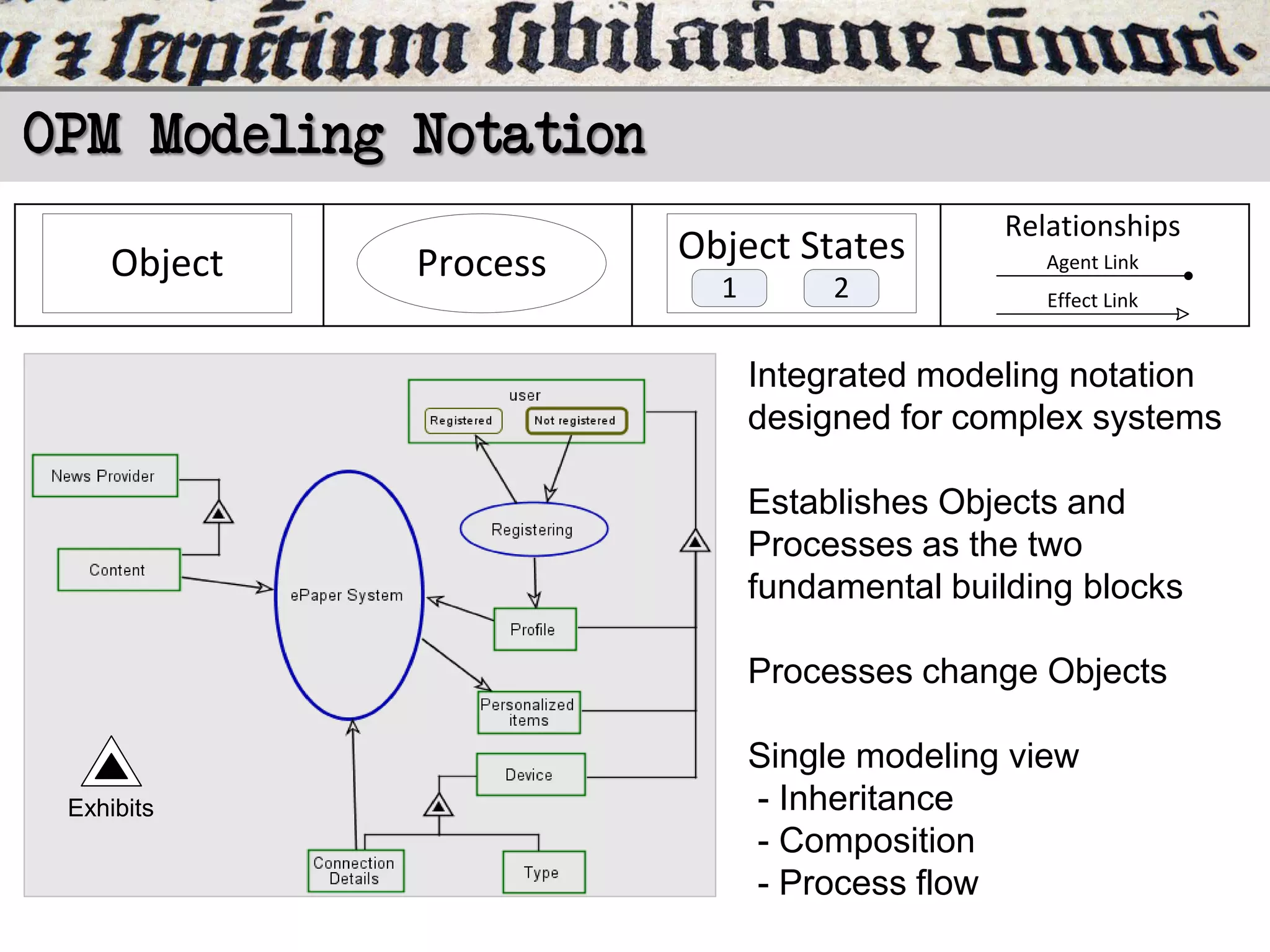
OPM Modeling Notation
Object

Process

Object States
1

2

Relationships
Agent Link
Effect Link

Integrated modeling notation
designed for complex systems
Establishes Objects and
Processes as the two
fundamental building blocks
Processes change Objects

Exhibits

Single modeling view
- Inheritance
- Composition
- Process flow
The Search Continued
Alternatives were unsatisfying in being either:
Too complex to use with executive & business stakeholders
Too oriented towards software design
•

UML / OPM

Too superficial to facilitate a rigorous understanding of
content & content processes for the purposes of automation
•

Flowcharting / BPMN

Too limited in only representing content structures but not
processing events
•

Near & Far / Visual tools for modelling XML Schemas
Content Modelling Technique
The Search for a Content Modelling Technique
A Content Modelling Technique could be
constructed from:
Object Process Methodology (OPM)
•

Basic framework where objects & processes are treated as peers

IDEF0 Function Modelling
•

General principles for representing manufacturing processes

Object Modeling Technique (OMT)
•

Visually elegant precursor to UML

A strict discipline could be applied to limit the visual complexity
of diagrams while addressing the needs of content modelling
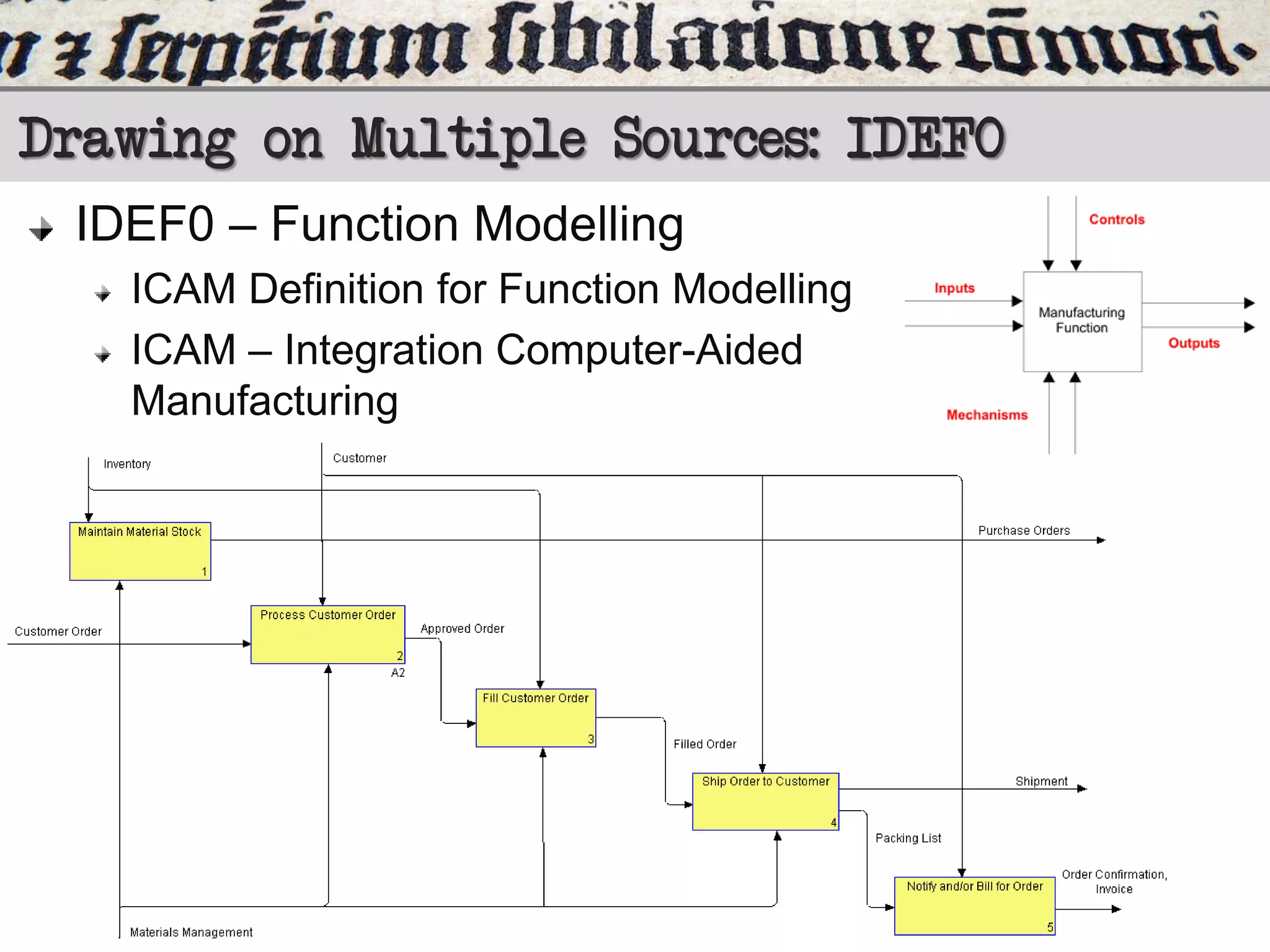
Drawing on Multiple Sources: IDEF0
IDEF0 – Function Modelling
ICAM Definition for Function Modelling
ICAM – Integration Computer-Aided
Manufacturing
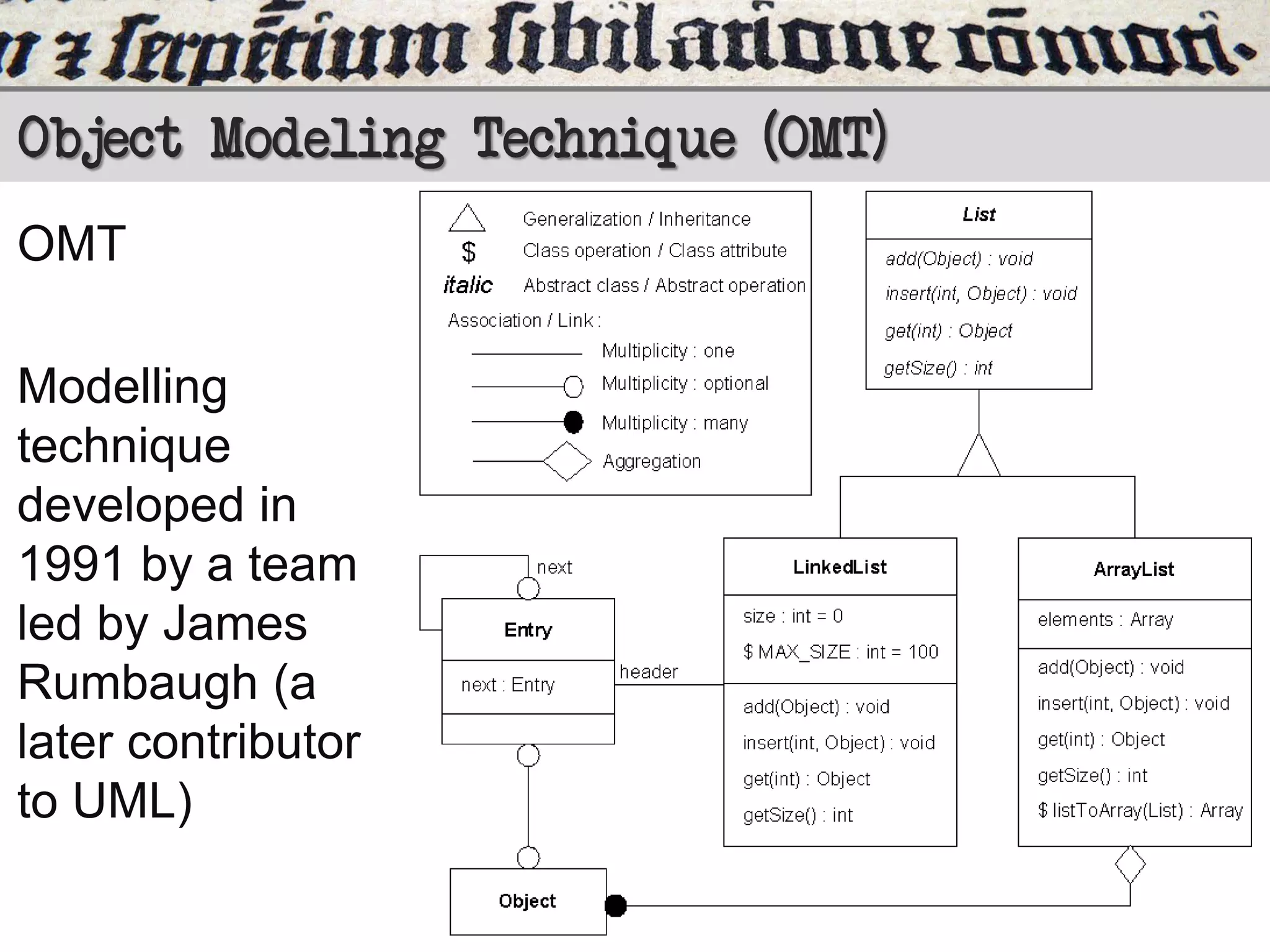
Object Modeling Technique (OMT)
OMT

Modelling
technique
developed in
1991 by a team
led by James
Rumbaugh (a
later contributor
to UML)
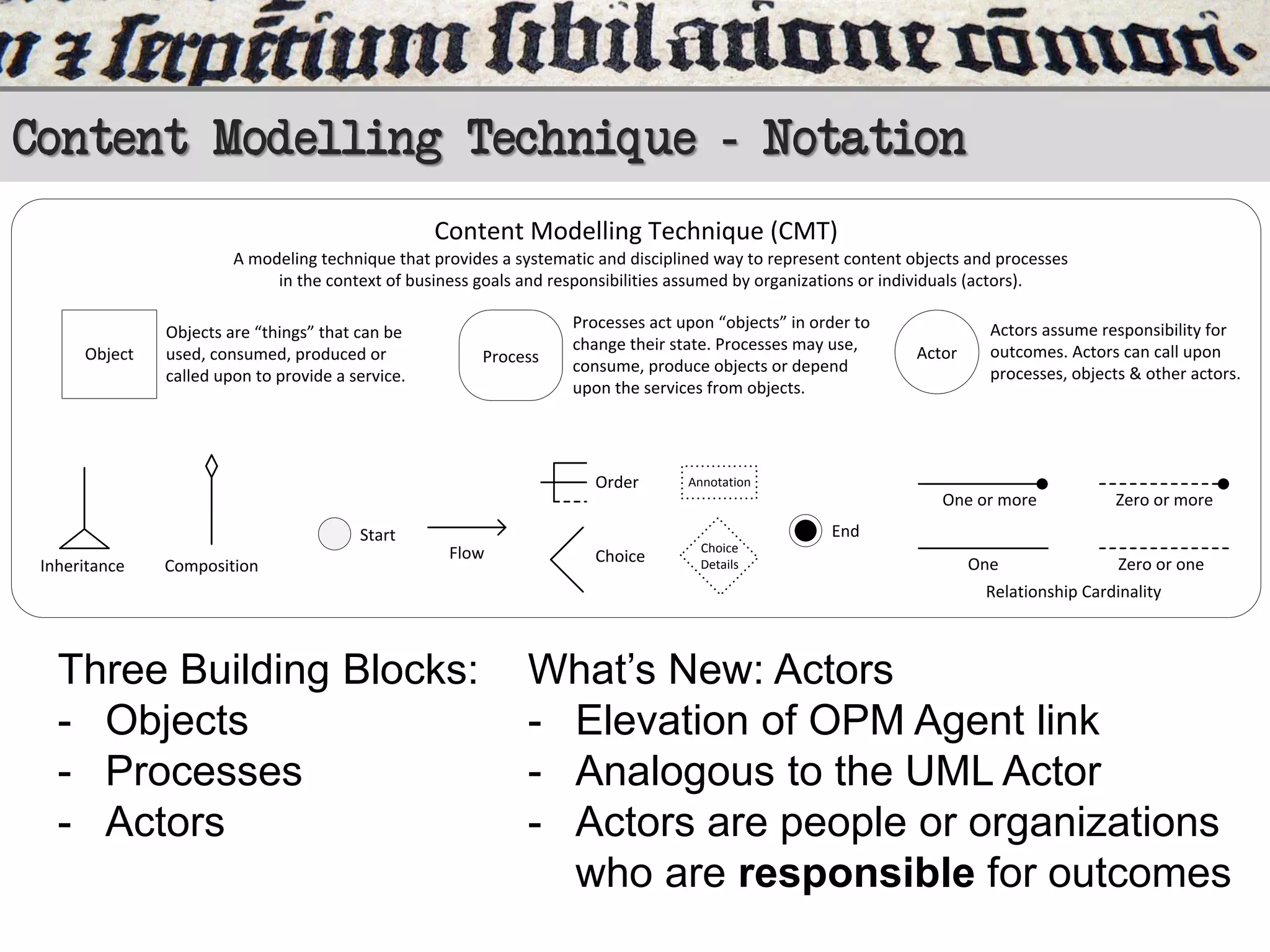
Content Modelling Technique - Notation
Content Modelling Technique (CMT)
A modeling technique that provides a systematic and disciplined way to represent content objects and processes
in the context of business goals and responsibilities assumed by organizations or individuals (actors).

Object

Objects are “things” that can be
used, consumed, produced or
called upon to provide a service.

Process

Processes act upon “objects” in order to
change their state. Processes may use,
consume, produce objects or depend
upon the services from objects.

Order
Start
Inheritance

Composition

Choice
Details

Actors assume responsibility for
outcomes. Actors can call upon
processes, objects & other actors.

Annotation

Choice

Actor

One or more

Zero or more

End
Flow

One

Zero or one

Relationship Cardinality

Three Building Blocks:
- Objects
- Processes
- Actors

What’s New: Actors
- Elevation of OPM Agent link
- Analogous to the UML Actor
- Actors are people or organizations
who are responsible for outcomes
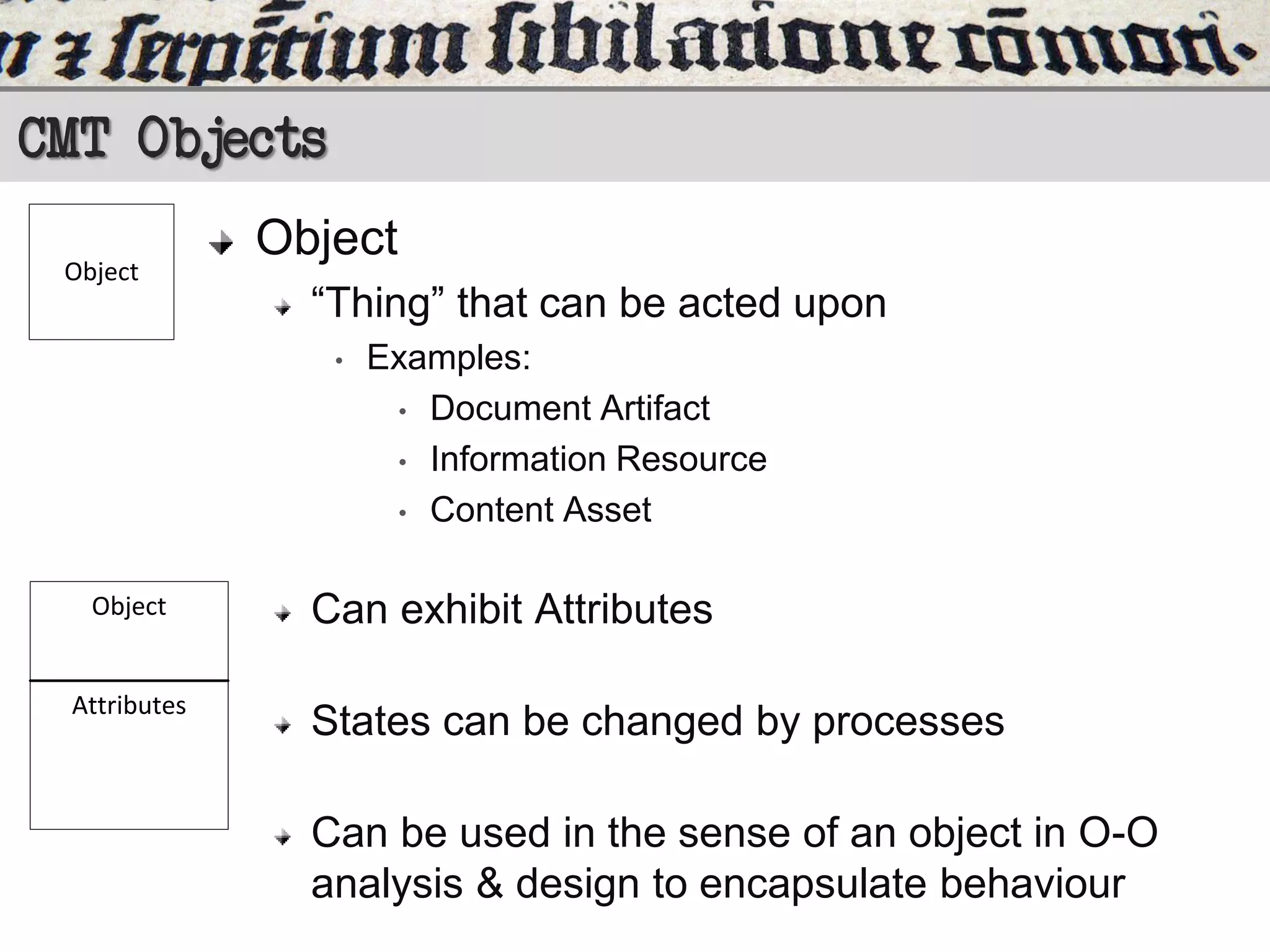
CMT Objects
Object

Object
“Thing” that can be acted upon
•

Object

Attributes

Examples:
• Document Artifact
• Information Resource
• Content Asset

Can exhibit Attributes
States can be changed by processes

Can be used in the sense of an object in O-O
analysis & design to encapsulate behaviour
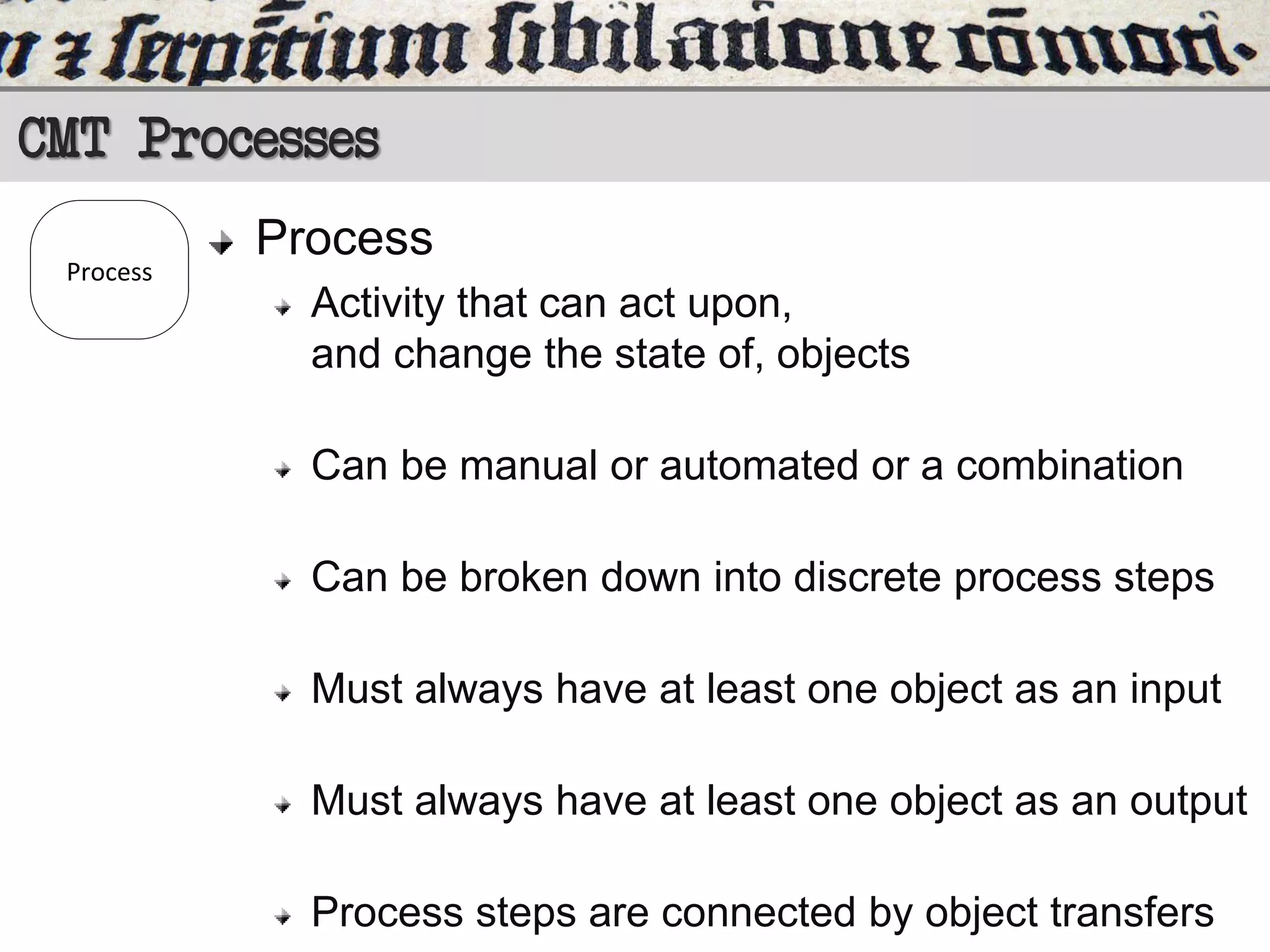
CMT Processes
Process

Process
Activity that can act upon,
and change the state of, objects
Can be manual or automated or a combination
Can be broken down into discrete process steps
Must always have at least one object as an input
Must always have at least one object as an output
Process steps are connected by object transfers
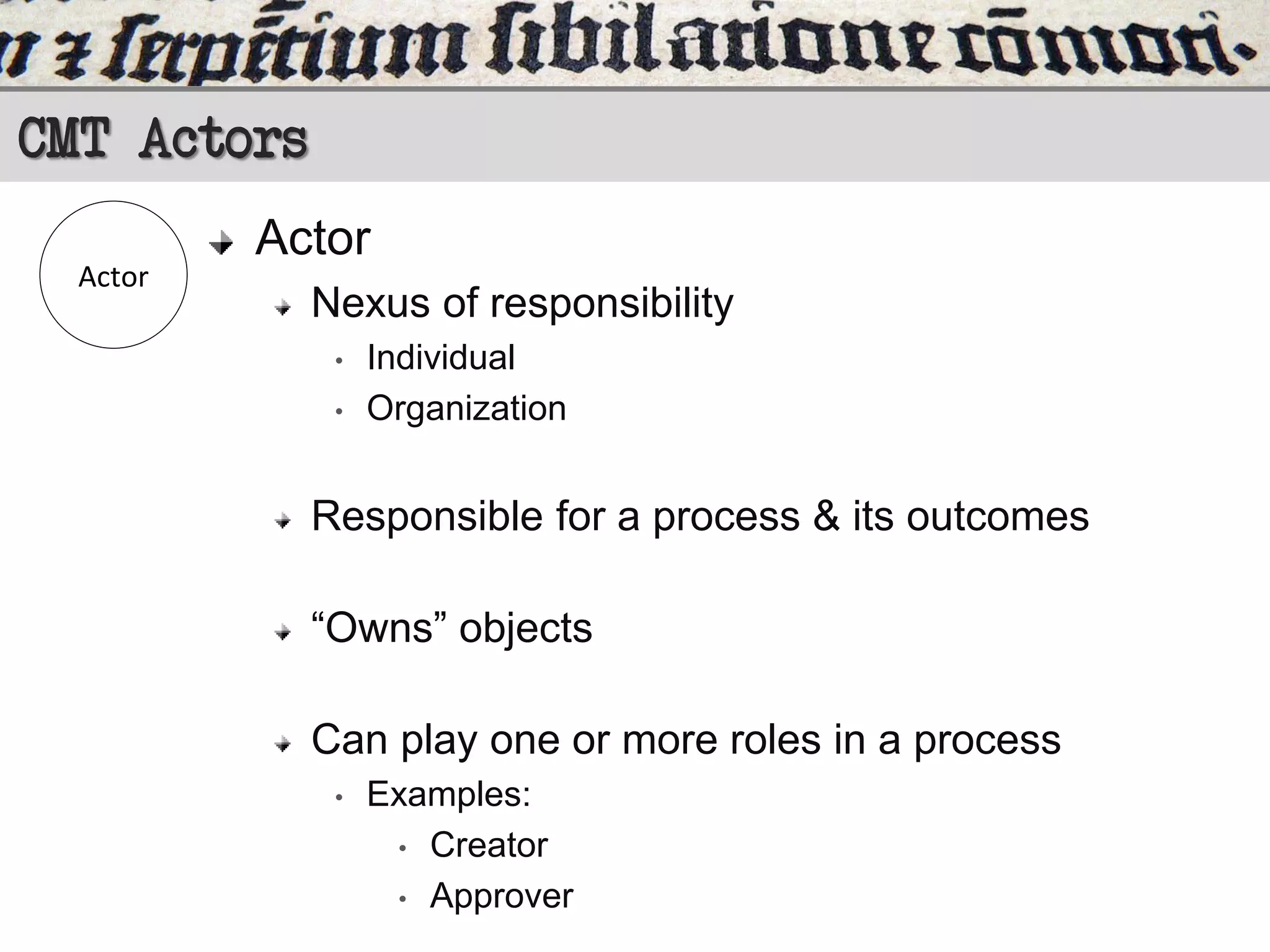
CMT Actors
Actor

Actor
Nexus of responsibility
•
•

Individual
Organization

Responsible for a process & its outcomes
“Owns” objects
Can play one or more roles in a process
•

Examples:
• Creator
• Approver
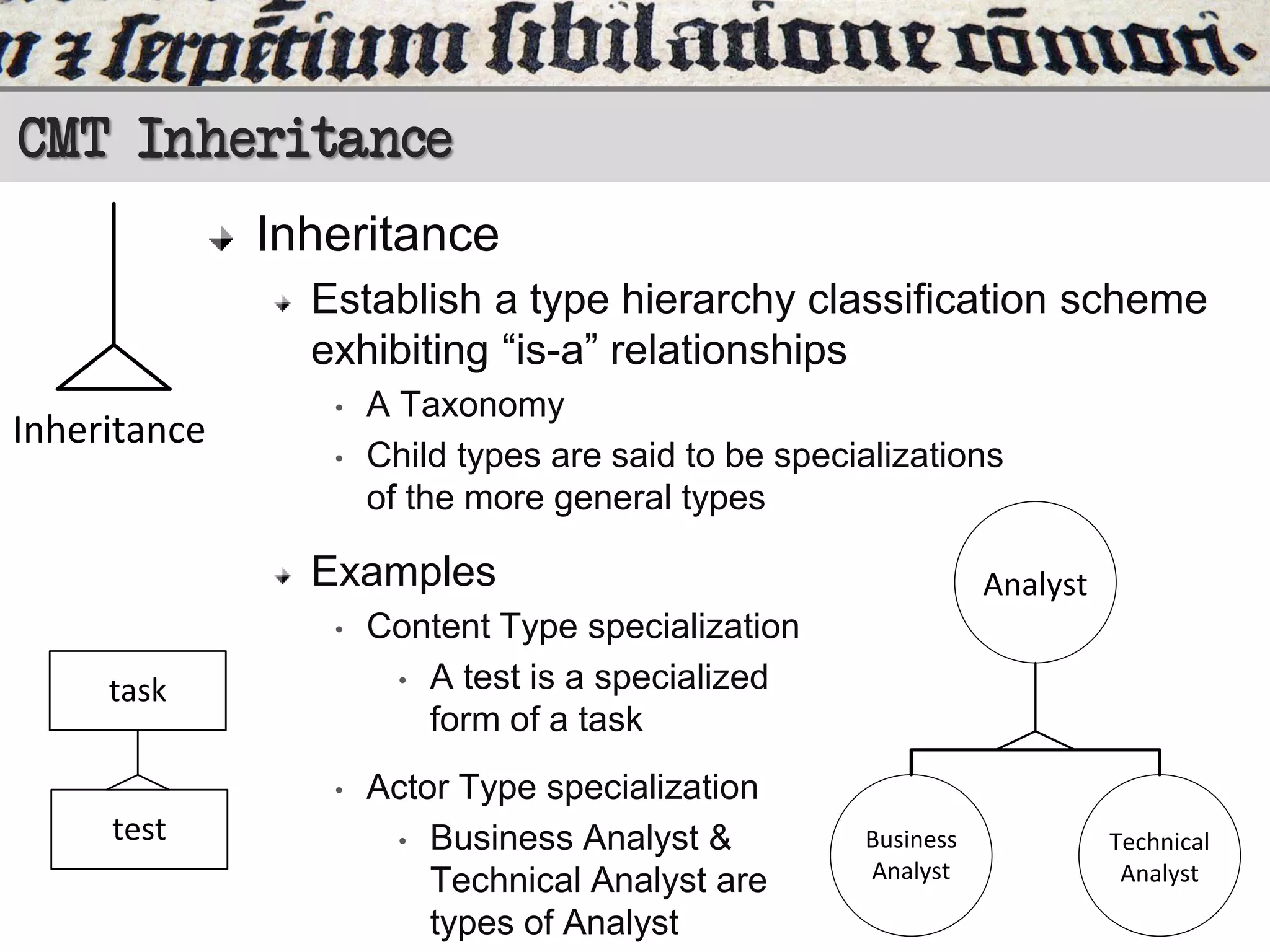
CMT Inheritance
Inheritance
Establish a type hierarchy classification scheme
exhibiting “is-a” relationships
Inheritance

•
•

A Taxonomy
Child types are said to be specializations
of the more general types

Examples
•

Content Type specialization
• A test is a specialized
form of a task

•

Actor Type specialization
• Business Analyst &
Technical Analyst are
types of Analyst

task

test

Analyst

Business
Analyst

Technical
Analyst
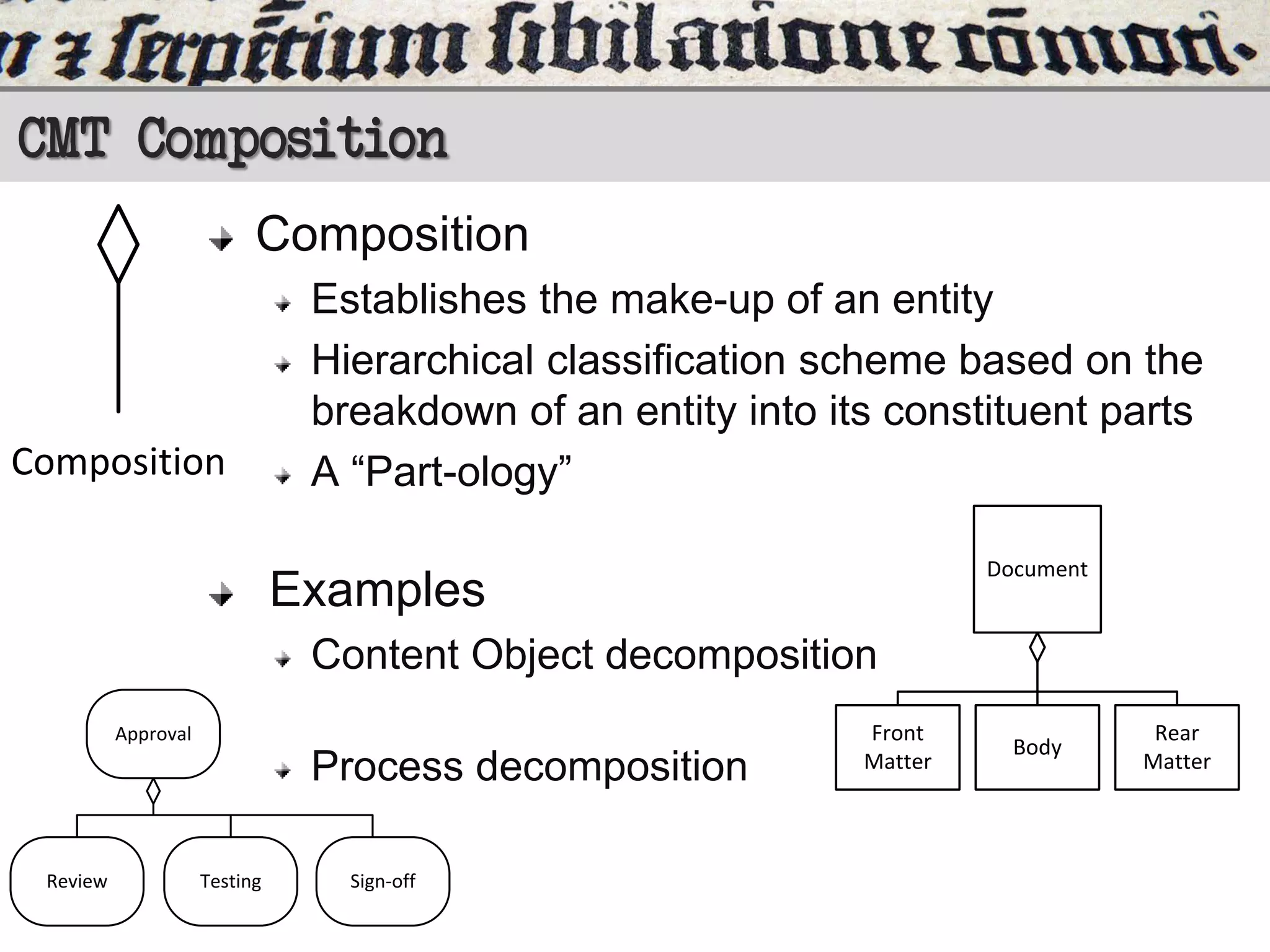
CMT Composition
Composition

Composition

Establishes the make-up of an entity
Hierarchical classification scheme based on the
breakdown of an entity into its constituent parts
A “Part-ology”
Document

Examples
Content Object decomposition
Approval

Process decomposition
Review

Testing

Sign-off

Front
Matter

Body

Rear
Matter
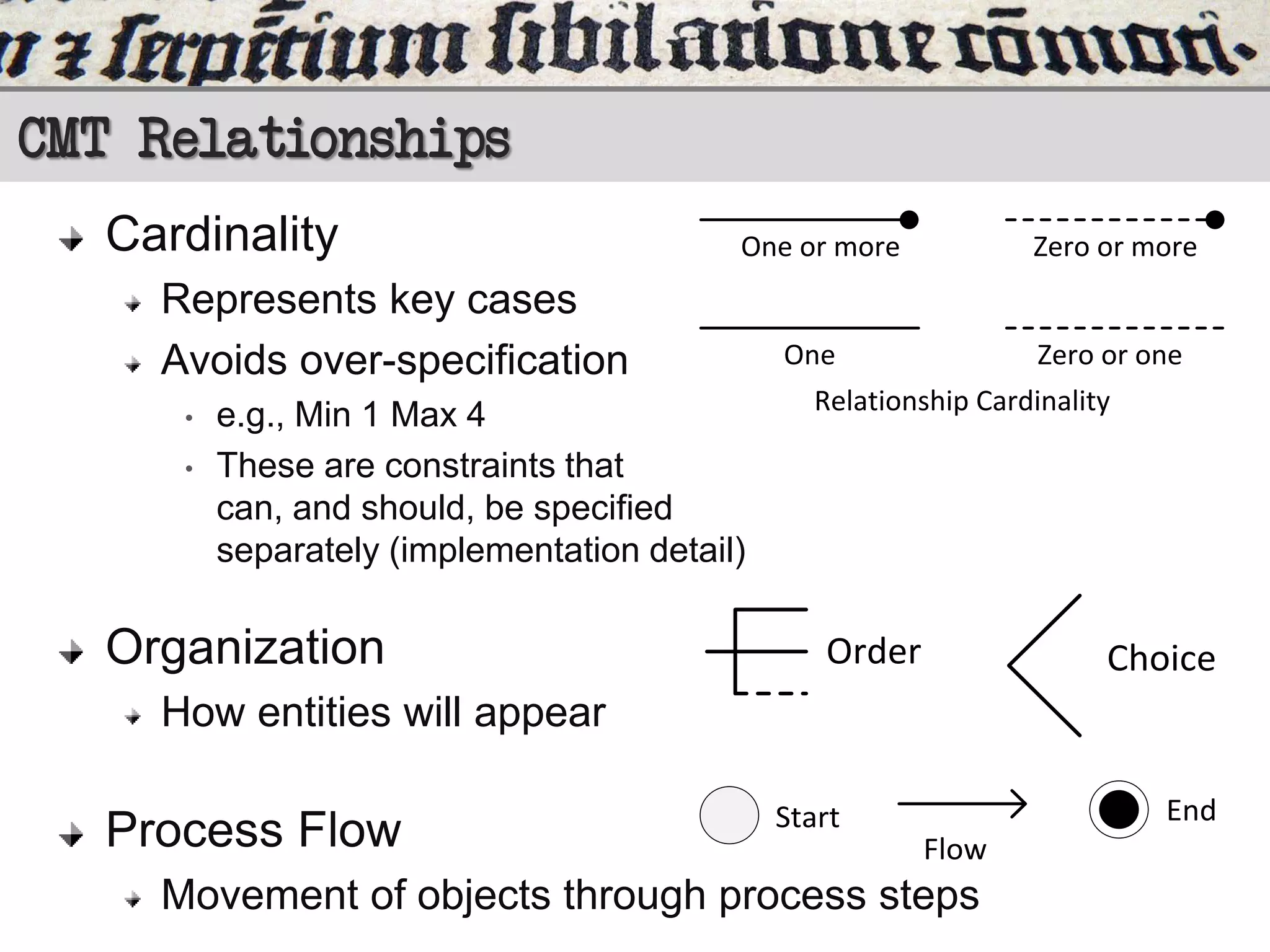
CMT Relationships
Cardinality

One or more

Represents key cases
Avoids over-specification
•
•

e.g., Min 1 Max 4
These are constraints that
can, and should, be specified
separately (implementation detail)

Organization

Zero or more

One

Zero or one

Relationship Cardinality

Order

Choice

How entities will appear

Process Flow

Start

End
Flow

Movement of objects through process steps
CMT in Action: A Simple Example
Establish Project Requirements
Project
Team

Customer

Identify
Needs

Business
Needs
Document

Document
Requirements

Use Case

•
•
•
•

Testing
Team

Draft
Requirements
Specification

Test Case

System
Constraint

Requirements
Validation

Prototyping

Technical
Proof of
Concept

Baseline
Requirements
Specification

Usability
Testing

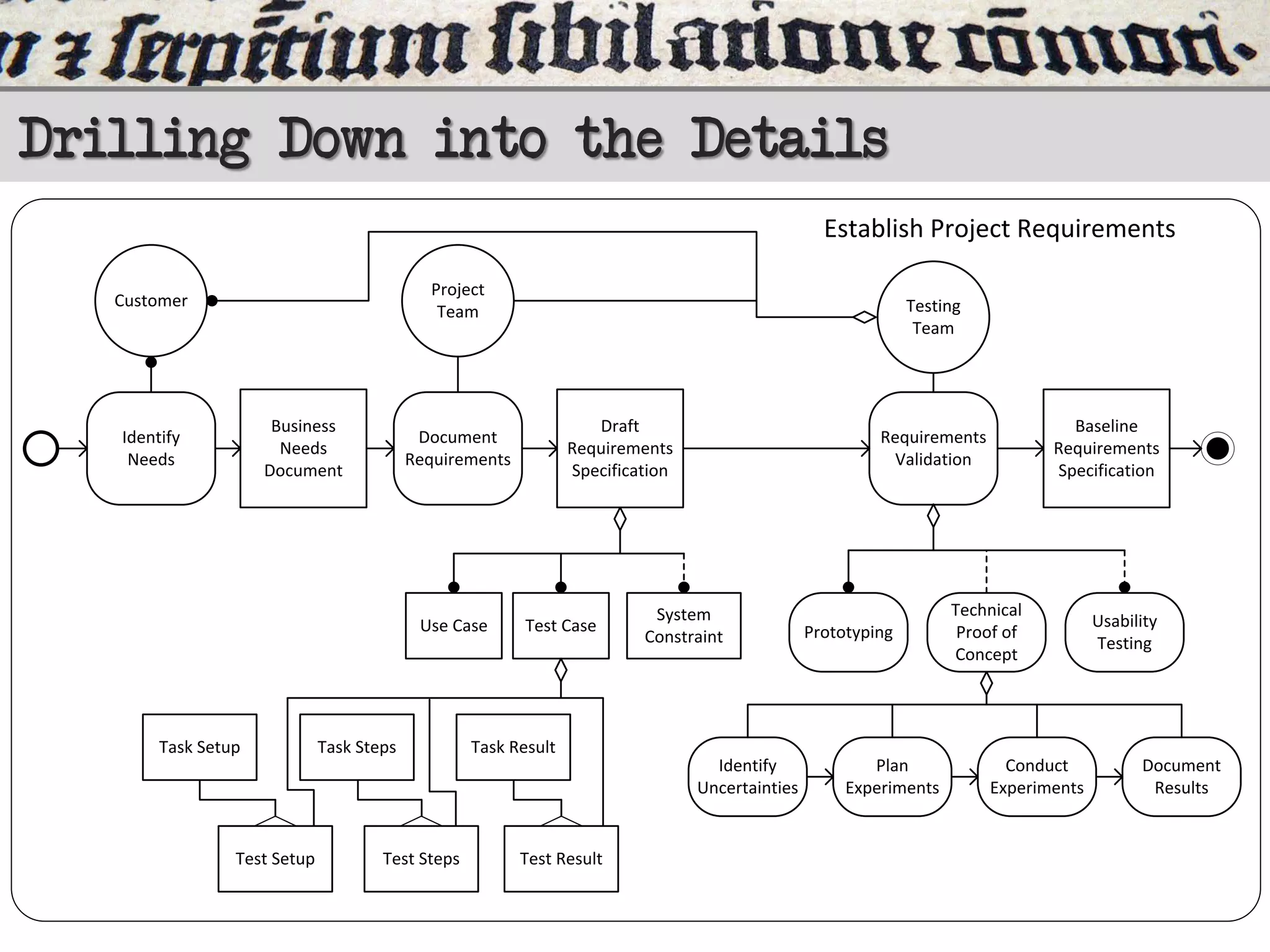
Different types of Actors shown: Customer, Project Team, Testing Team
Content objects connect each process
Decomposition shown for an object, a process & an actor
Different cardinalities are shown:
optional, optional but repeatable, mandatory, mandatory and repeatable
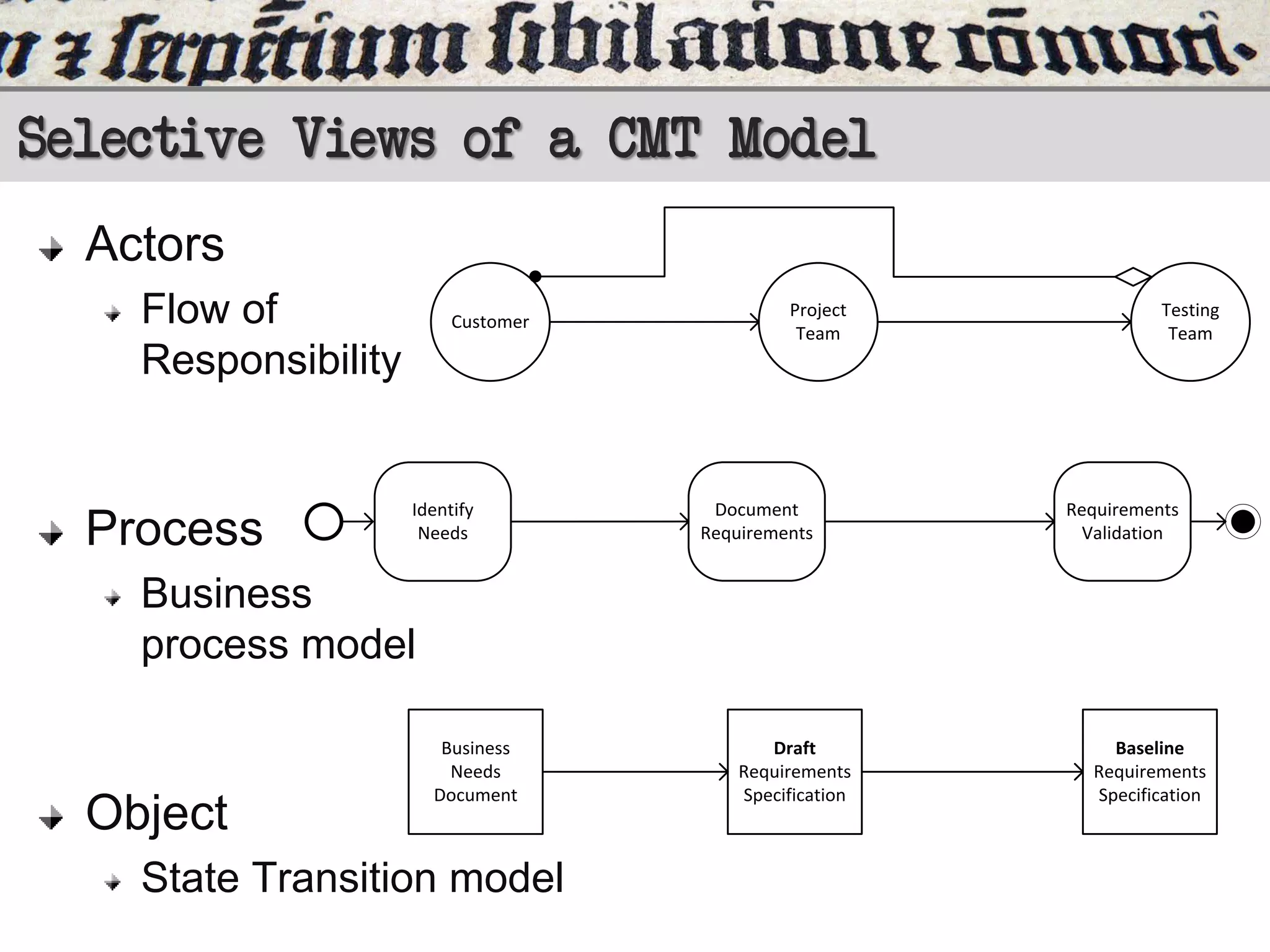
Selective Views of a CMT Model
Actors
Flow of
Responsibility

Process

Customer

Identify
Needs

Project
Team

Document
Requirements

Testing
Team

Requirements
Validation

Business
process model

Object

Business
Needs
Document

State Transition model

Draft
Requirements
Specification

Baseline
Requirements
Specification
Drilling Down into the Details
Establish Project Requirements
Project
Team

Customer

Business
Needs
Document

Identify
Needs

Test Setup

Draft
Requirements
Specification

Document
Requirements

Use Case

Task Setup

Testing
Team

Task Steps

Test Steps

Test Case

Task Result

Test Result

Baseline
Requirements
Specification

Requirements
Validation

System
Constraint

Identify
Uncertainties

Prototyping

Plan
Experiments

Technical
Proof of
Concept

Conduct
Experiments

Usability
Testing

Document
Results
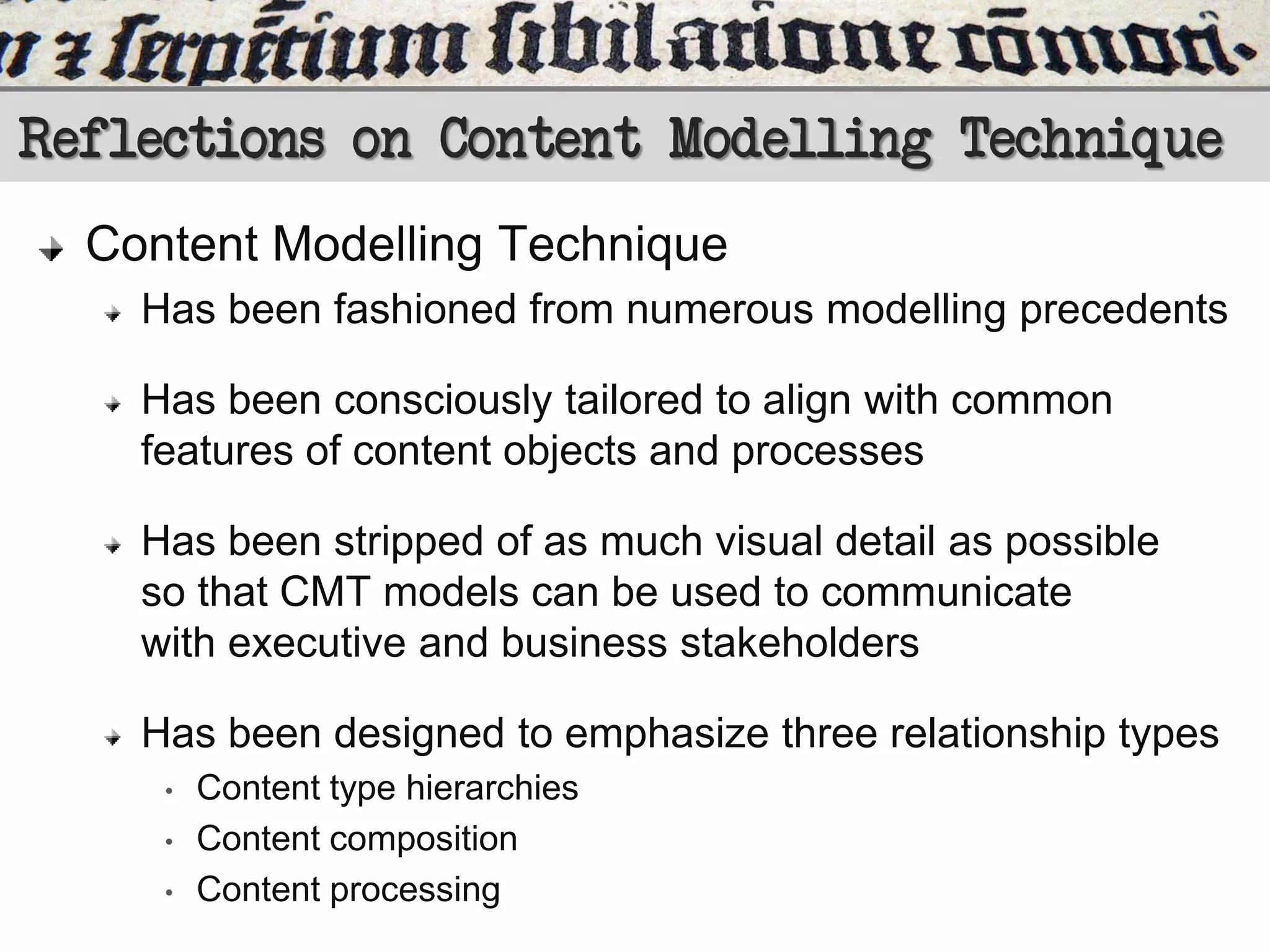
Reflections on Content Modelling Technique
Content Modelling Technique
Has been fashioned from numerous modelling precedents

Has been consciously tailored to align with common
features of content objects and processes
Has been stripped of as much visual detail as possible
so that CMT models can be used to communicate
with executive and business stakeholders

Has been designed to emphasize three relationship types
•
•
•

Content type hierarchies
Content composition
Content processing
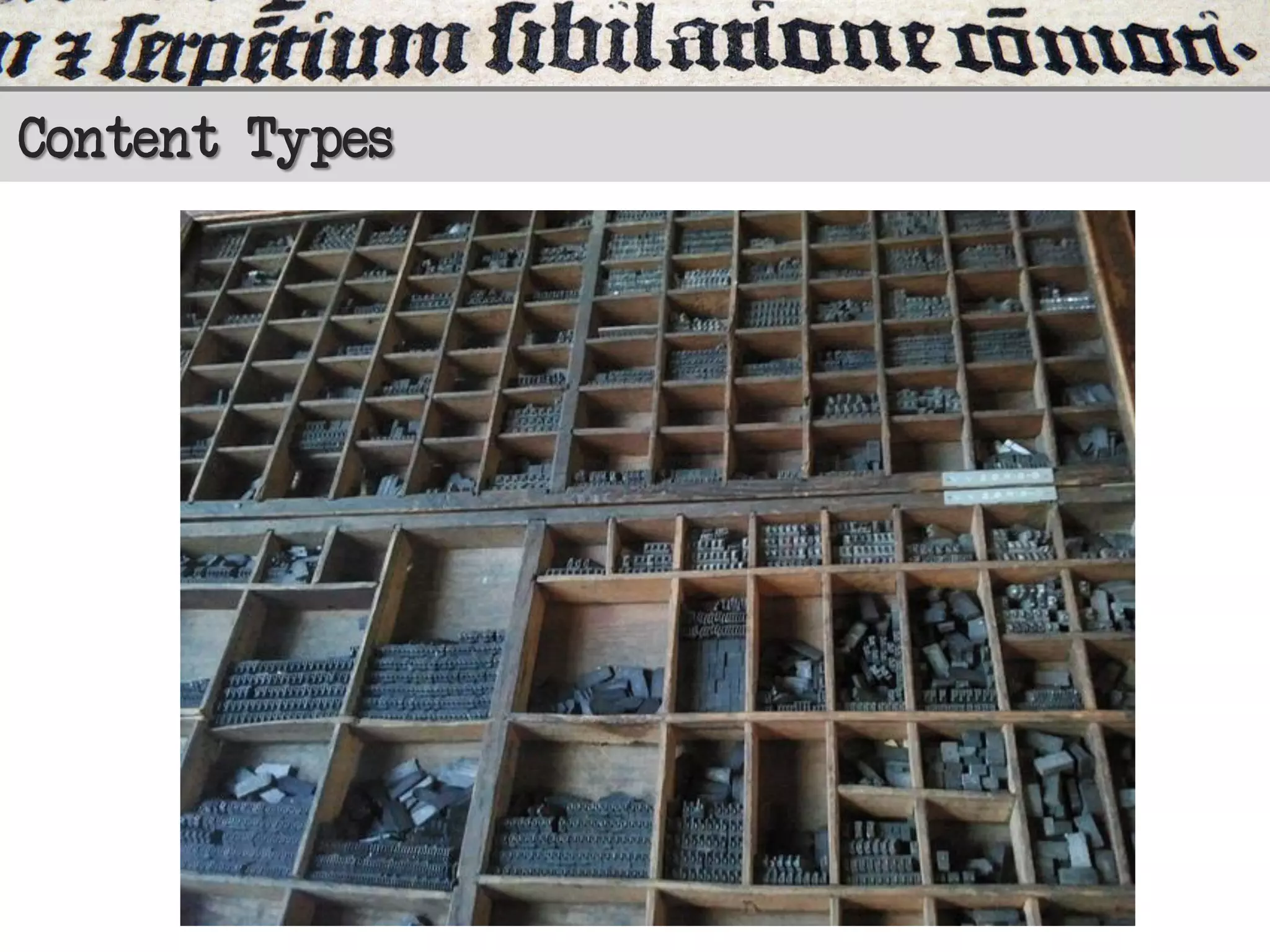
Content Types
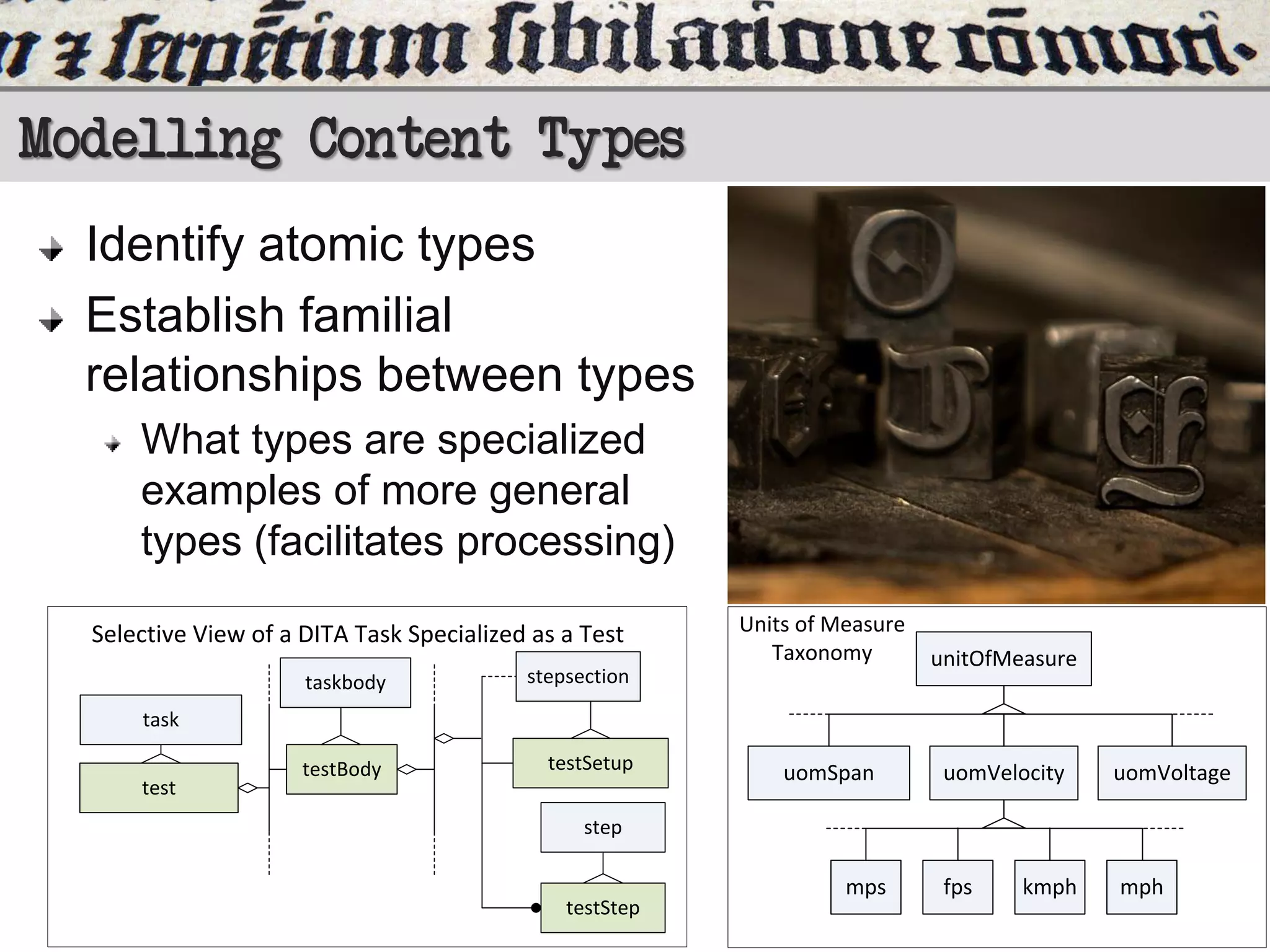
Modelling Content Types
Identify atomic types
Establish familial
relationships between types
What types are specialized
examples of more general
types (facilitates processing)
Selective View of a DITA Task Specialized as a Test
taskbody

testSetup

unitOfMeasure

uomSpan

uomVelocity

uomVoltage

fps

mph

stepsection

testBody

Units of Measure
Taxonomy

task
test

step

testStep

mps

kmph
Content Composition
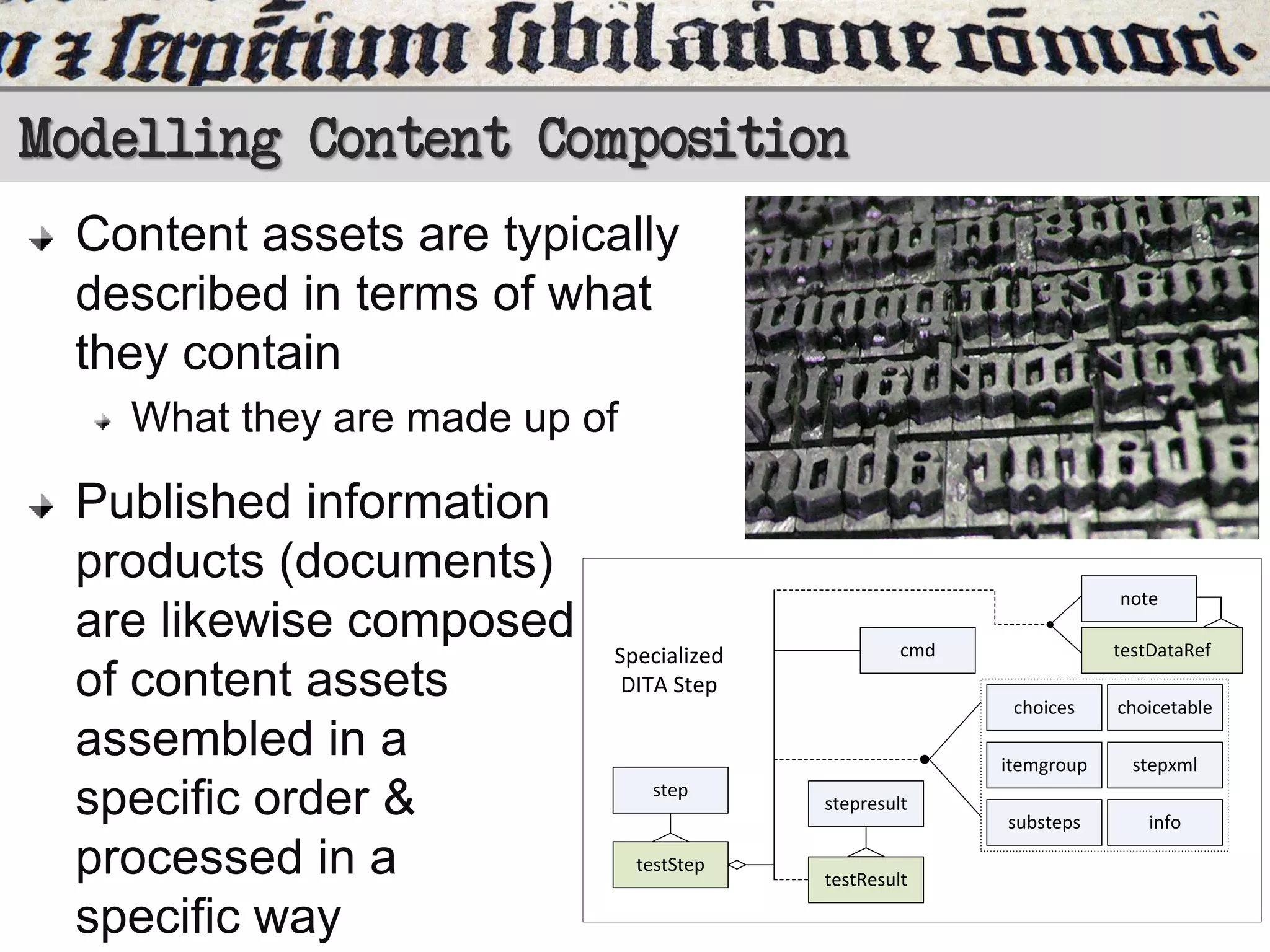
Modelling Content Composition
Content assets are typically
described in terms of what
they contain
What they are made up of

Published information
products (documents)
are likewise composed
of content assets
assembled in a
specific order &
processed in a
specific way

note

Specialized
DITA Step

cmd

testDataRef
choices
itemgroup

step

testStep

stepresult

testResult

choicetable
stepxml

substeps

info
Content Processing
Modelling Content Processes
Processes can be broken
down to as low a level of
detail as is necessary
Processes will encompass
business events (approvals),
tasks performed by people (writing),
and automated steps
(validations, transformations, transmittals,…)
Understanding the processes will ultimately
determine what level of detail must be modelled in
the content assets
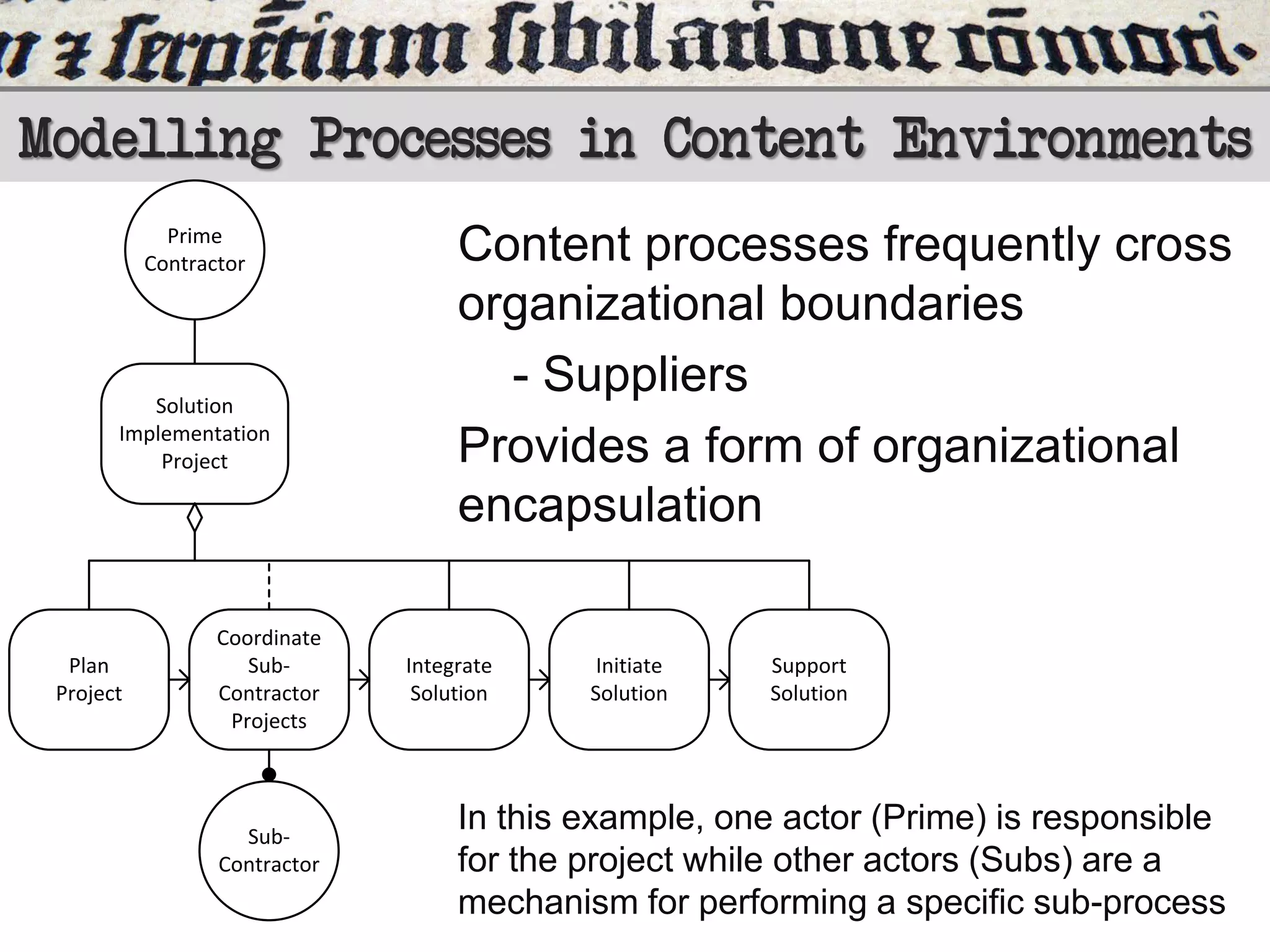
Modelling Processes in Content Environments
Prime
Contractor

Solution
Implementation
Project

Plan
Project

Coordinate
SubContractor
Projects

SubContractor

Content processes frequently cross
organizational boundaries
- Suppliers
Provides a form of organizational
encapsulation

Integrate
Solution

Initiate
Solution

Support
Solution

In this example, one actor (Prime) is responsible
for the project while other actors (Subs) are a
mechanism for performing a specific sub-process
Summary
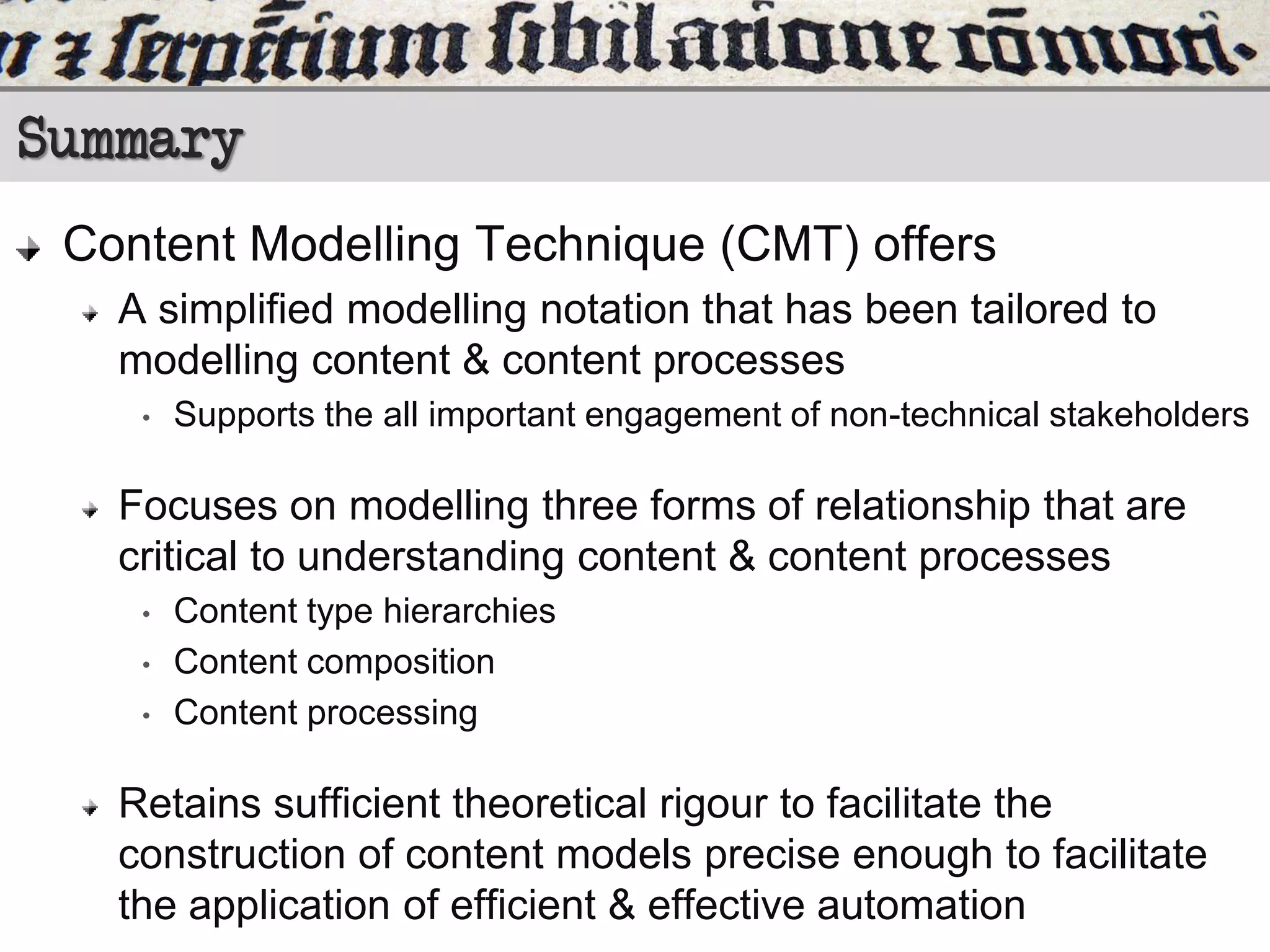
Content Modelling Technique (CMT) offers
A simplified modelling notation that has been tailored to
modelling content & content processes
•

Supports the all important engagement of non-technical stakeholders

Focuses on modelling three forms of relationship that are
critical to understanding content & content processes
•
•
•

Content type hierarchies
Content composition
Content processing

Retains sufficient theoretical rigour to facilitate the
construction of content models precise enough to facilitate
the application of efficient & effective automation
Questions & Comments
Making Connections
Joe Gollner
Gnostyx Research Inc.
www.gnostyx.com
jag@gnostyx.com
Twitter: @joegollner
Blog: The Content Philosopher
www.gollner.ca

Content Modelling Workshop (J Gollner TC World 2013)

  • 1.
    Content Modelling Copyright © JoeGollner 2013 Joe Gollner Gnostyx Research Inc. jag@gnostyx.com www.gollner.ca @joegollner
  • 2.
    Workshop Topics Core Concepts& Terminology Perspectives on Content Modelling Content Modelling Technique The Three Key Sides to Content Modelling Content Types Content Composition Content Processes
  • 3.
    Core Concepts &Terminology
  • 4.
    Core Concepts: Content& Information Content Is what we plan, design, create, reuse & manage so that we can deliver effective information products Content is potential information (an asset) Information Is the meaningful organization of data communicated in a specific context with the purpose of influencing others Information is a transaction (an action) Information transactions contain content
  • 5.
    Related Definitions Publishing The processof transforming content assets into information products that can be effectively transacted Documents Documents are the persistent form of information transactions that have been exchanged as part of a business process. Documents are a fact of life & can take many forms.
  • 6.
    Building Blocks inthe Content Lifecycle Content Acquisition Creation Content Acquisition Content Delivery Content Management Content Engagement Content Delivery Publishing Content Engagement Use Content Management Control
  • 7.
    Content Strategy A strategyis a plan of action directed towards achieving a long-term goal through the coordination, integration and application of the resources and capabilities available to an enterprise Content Acquisition Content Delivery Content Strategy Content Management Content Engagement A Content Strategy seeks to make content a strategic asset that can be leveraged by state-of-the-art technology to achieve concrete business goals. This strategy will set out a plan of balanced investments to improve how content is acquired, delivered, engaged and managed. A Content Strategy also, and perhaps primarily, determines what content is needed & why.
  • 8.
    Questions Surrounding theContent Lifecycle • Content is only usefully understood as part of its lifecycle Content Acquisition Content Delivery • Where it comes from? Content Strategy • Where it goes? • Who is responsible for it? • Why is it created in the first place? Content Management Content Engagement • How is it published? • How many different information products will it support? • How are the published information products used?
  • 9.
    The Role ofContent Architecture Content Acquisition Content Strategy Content Model A detailed model of the content and its lifecycle Identifies: · Content Types · Content Composition · Content Process Steps Establishes the point of reference for all content solution implementation activities Content Delivery Content Management Content Architecture Content Engagement Content Solution
  • 10.
  • 11.
    Content Archeology Identifying &studying content “in the wild” & following the paths inside Often a major revelation for content owners Rahel Bailie www.intentionaldesign.ca
  • 12.
    Understanding the ContentInside Developing a model of what happens behind the page in order to design a content architecture that will govern a content management solution Cleve Gibbon www.clevegibbon.com Applying the all-important discipline of abstraction in order to establish more general technical solutions
  • 13.
    Unified Modeling Language(UML 2.0) UML is a standardized modeling language for designing software applications www.uml.org Object Management Group (OMG) Use Case Diagrams Models the interaction between users and the software application System perspectice
  • 14.
    Unified Modeling Language(UML 2.0) Class Diagrams Used to model the static structure of a system Models the classes in a system, including their attributes, methods, and relationships Can be applied to the content resources within a system and their attributes and relationships • • • Type Hierarchies Composition Other relationships
  • 15.
    Business Process Model& Notation (BPMN) BPMN 2.0 is from the Object Management Group (OMG) as a tool for understanding, graphically, business procedures www.bpmn.org Jackie Damrau & Joe Gollner – Business Process Workshop (2013)
  • 16.
    Case Study: ABreakdown in Modeling Large-scale software project $225 million Content & document handling processes Modeling Approach UML & full suite of Enterprise software design tools International specialists brought onboard to assist in planning Substantial budget set aside for stakeholder engagement Result Communication breakdown. Models not understood at all.
  • 17.
    Modelling Content Structures MicrostarNear & Far Document Type Definition (DTD) Visual Modeller Very popular & dearly missed Simple enough to show executives Only addressed content structure
  • 18.
    Looking for aBetter Answer
  • 19.
    Object Process Methodology(OPM) Designed as a unification & rationalization of UML providing an integrated, single view of complex systems Prof Dov Dori Israel Institute of Technology & MIT www.opcat.com
  • 20.
    OPM Modeling Notation Object Process ObjectStates 1 2 Relationships Agent Link Effect Link Integrated modeling notation designed for complex systems Establishes Objects and Processes as the two fundamental building blocks Processes change Objects Exhibits Single modeling view - Inheritance - Composition - Process flow
  • 21.
    The Search Continued Alternativeswere unsatisfying in being either: Too complex to use with executive & business stakeholders Too oriented towards software design • UML / OPM Too superficial to facilitate a rigorous understanding of content & content processes for the purposes of automation • Flowcharting / BPMN Too limited in only representing content structures but not processing events • Near & Far / Visual tools for modelling XML Schemas
  • 22.
  • 23.
    The Search fora Content Modelling Technique A Content Modelling Technique could be constructed from: Object Process Methodology (OPM) • Basic framework where objects & processes are treated as peers IDEF0 Function Modelling • General principles for representing manufacturing processes Object Modeling Technique (OMT) • Visually elegant precursor to UML A strict discipline could be applied to limit the visual complexity of diagrams while addressing the needs of content modelling
  • 24.
    Drawing on MultipleSources: IDEF0 IDEF0 – Function Modelling ICAM Definition for Function Modelling ICAM – Integration Computer-Aided Manufacturing
  • 25.
    Object Modeling Technique(OMT) OMT Modelling technique developed in 1991 by a team led by James Rumbaugh (a later contributor to UML)
  • 26.
    Content Modelling Technique- Notation Content Modelling Technique (CMT) A modeling technique that provides a systematic and disciplined way to represent content objects and processes in the context of business goals and responsibilities assumed by organizations or individuals (actors). Object Objects are “things” that can be used, consumed, produced or called upon to provide a service. Process Processes act upon “objects” in order to change their state. Processes may use, consume, produce objects or depend upon the services from objects. Order Start Inheritance Composition Choice Details Actors assume responsibility for outcomes. Actors can call upon processes, objects & other actors. Annotation Choice Actor One or more Zero or more End Flow One Zero or one Relationship Cardinality Three Building Blocks: - Objects - Processes - Actors What’s New: Actors - Elevation of OPM Agent link - Analogous to the UML Actor - Actors are people or organizations who are responsible for outcomes
  • 27.
    CMT Objects Object Object “Thing” thatcan be acted upon • Object Attributes Examples: • Document Artifact • Information Resource • Content Asset Can exhibit Attributes States can be changed by processes Can be used in the sense of an object in O-O analysis & design to encapsulate behaviour
  • 28.
    CMT Processes Process Process Activity thatcan act upon, and change the state of, objects Can be manual or automated or a combination Can be broken down into discrete process steps Must always have at least one object as an input Must always have at least one object as an output Process steps are connected by object transfers
  • 29.
    CMT Actors Actor Actor Nexus ofresponsibility • • Individual Organization Responsible for a process & its outcomes “Owns” objects Can play one or more roles in a process • Examples: • Creator • Approver
  • 30.
    CMT Inheritance Inheritance Establish atype hierarchy classification scheme exhibiting “is-a” relationships Inheritance • • A Taxonomy Child types are said to be specializations of the more general types Examples • Content Type specialization • A test is a specialized form of a task • Actor Type specialization • Business Analyst & Technical Analyst are types of Analyst task test Analyst Business Analyst Technical Analyst
  • 31.
    CMT Composition Composition Composition Establishes themake-up of an entity Hierarchical classification scheme based on the breakdown of an entity into its constituent parts A “Part-ology” Document Examples Content Object decomposition Approval Process decomposition Review Testing Sign-off Front Matter Body Rear Matter
  • 32.
    CMT Relationships Cardinality One ormore Represents key cases Avoids over-specification • • e.g., Min 1 Max 4 These are constraints that can, and should, be specified separately (implementation detail) Organization Zero or more One Zero or one Relationship Cardinality Order Choice How entities will appear Process Flow Start End Flow Movement of objects through process steps
  • 33.
    CMT in Action:A Simple Example Establish Project Requirements Project Team Customer Identify Needs Business Needs Document Document Requirements Use Case • • • • Testing Team Draft Requirements Specification Test Case System Constraint Requirements Validation Prototyping Technical Proof of Concept Baseline Requirements Specification Usability Testing Different types of Actors shown: Customer, Project Team, Testing Team Content objects connect each process Decomposition shown for an object, a process & an actor Different cardinalities are shown: optional, optional but repeatable, mandatory, mandatory and repeatable
  • 34.
    Selective Views ofa CMT Model Actors Flow of Responsibility Process Customer Identify Needs Project Team Document Requirements Testing Team Requirements Validation Business process model Object Business Needs Document State Transition model Draft Requirements Specification Baseline Requirements Specification
  • 35.
    Drilling Down intothe Details Establish Project Requirements Project Team Customer Business Needs Document Identify Needs Test Setup Draft Requirements Specification Document Requirements Use Case Task Setup Testing Team Task Steps Test Steps Test Case Task Result Test Result Baseline Requirements Specification Requirements Validation System Constraint Identify Uncertainties Prototyping Plan Experiments Technical Proof of Concept Conduct Experiments Usability Testing Document Results
  • 36.
    Reflections on ContentModelling Technique Content Modelling Technique Has been fashioned from numerous modelling precedents Has been consciously tailored to align with common features of content objects and processes Has been stripped of as much visual detail as possible so that CMT models can be used to communicate with executive and business stakeholders Has been designed to emphasize three relationship types • • • Content type hierarchies Content composition Content processing
  • 37.
  • 38.
    Modelling Content Types Identifyatomic types Establish familial relationships between types What types are specialized examples of more general types (facilitates processing) Selective View of a DITA Task Specialized as a Test taskbody testSetup unitOfMeasure uomSpan uomVelocity uomVoltage fps mph stepsection testBody Units of Measure Taxonomy task test step testStep mps kmph
  • 39.
  • 40.
    Modelling Content Composition Contentassets are typically described in terms of what they contain What they are made up of Published information products (documents) are likewise composed of content assets assembled in a specific order & processed in a specific way note Specialized DITA Step cmd testDataRef choices itemgroup step testStep stepresult testResult choicetable stepxml substeps info
  • 41.
  • 42.
    Modelling Content Processes Processescan be broken down to as low a level of detail as is necessary Processes will encompass business events (approvals), tasks performed by people (writing), and automated steps (validations, transformations, transmittals,…) Understanding the processes will ultimately determine what level of detail must be modelled in the content assets
  • 43.
    Modelling Processes inContent Environments Prime Contractor Solution Implementation Project Plan Project Coordinate SubContractor Projects SubContractor Content processes frequently cross organizational boundaries - Suppliers Provides a form of organizational encapsulation Integrate Solution Initiate Solution Support Solution In this example, one actor (Prime) is responsible for the project while other actors (Subs) are a mechanism for performing a specific sub-process
  • 44.
    Summary Content Modelling Technique(CMT) offers A simplified modelling notation that has been tailored to modelling content & content processes • Supports the all important engagement of non-technical stakeholders Focuses on modelling three forms of relationship that are critical to understanding content & content processes • • • Content type hierarchies Content composition Content processing Retains sufficient theoretical rigour to facilitate the construction of content models precise enough to facilitate the application of efficient & effective automation
  • 45.
  • 46.
    Making Connections Joe Gollner GnostyxResearch Inc. www.gnostyx.com jag@gnostyx.com Twitter: @joegollner Blog: The Content Philosopher www.gollner.ca