Content Mining of Science in Europe
Peter Murray-Rust,
ContentMine.org, University of Cambridge & Open Forum Europe
OFA, Brussels, BE 2015-10-22
What is mining?
Why is it useful?
How YOU can do it without using publishers’ APIs
Copyright and restrictive practices are still a major problem
The Right to Read is the Right to Mine**PeterMurray-Rust, 2011
http://contentmine.org
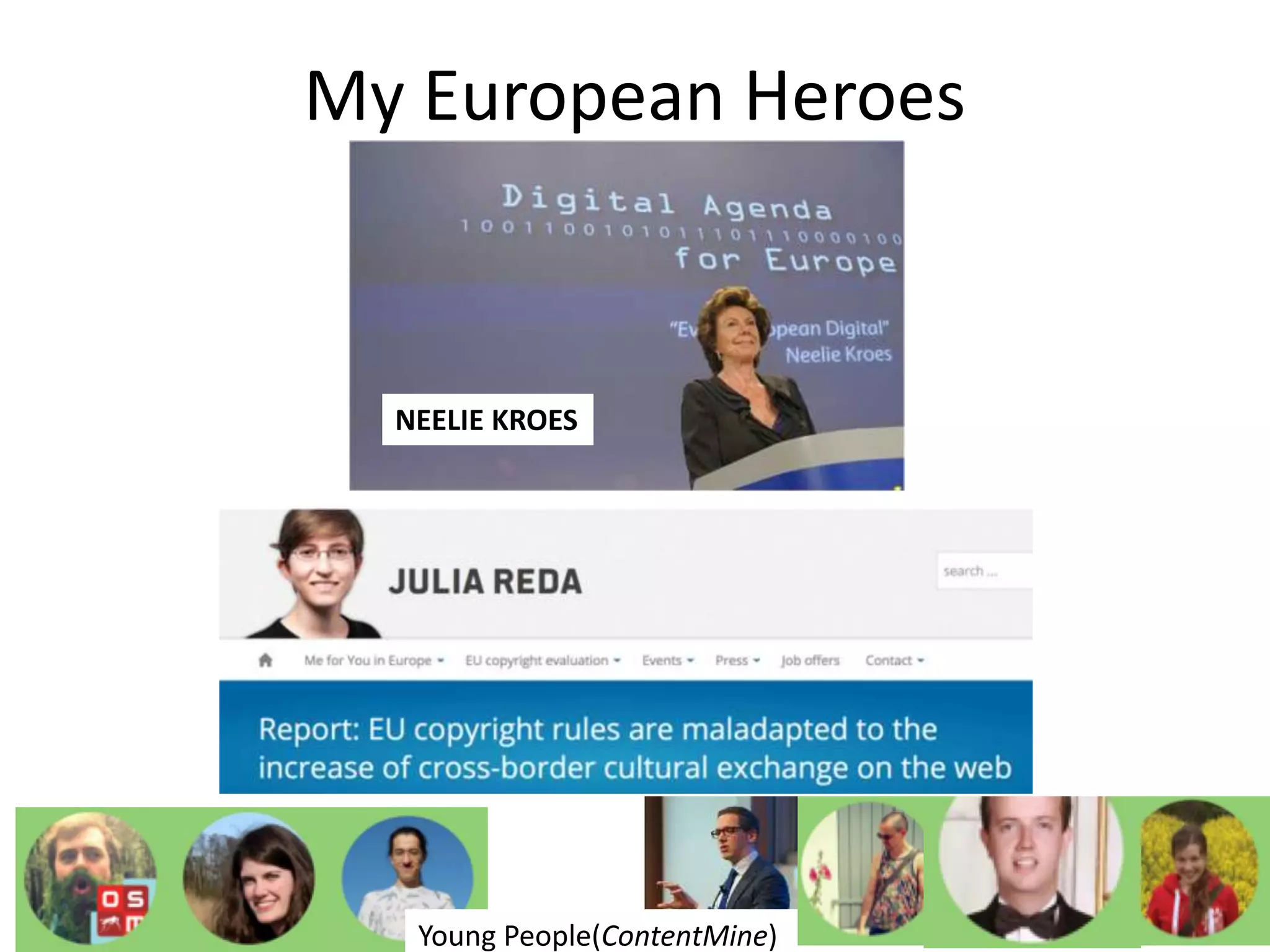
My European Heroes
Young People(ContentMine)
NEELIE KROES
Use Cases of ContentMining
• Epidemiology of obesity (Cambridge U)
• (OKF, OpenTrials) Mapping clinical trials
repositories to reports in scientific literature
• Mining chemical reactions from patents
• Creating a bacterial supertree-of-life from
4500 papers
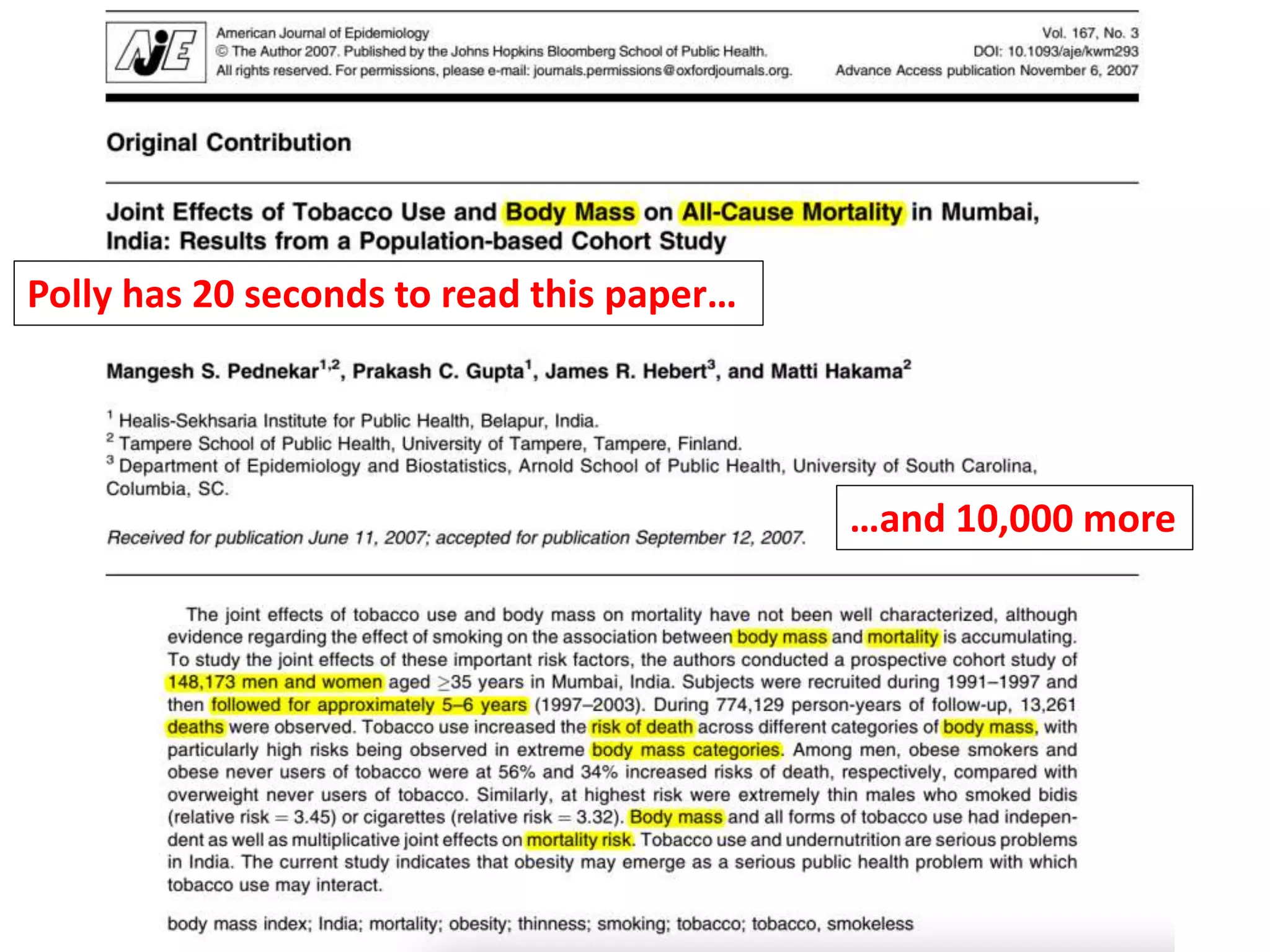
Polly has 20 seconds to read this paper…
…and 10,000 more
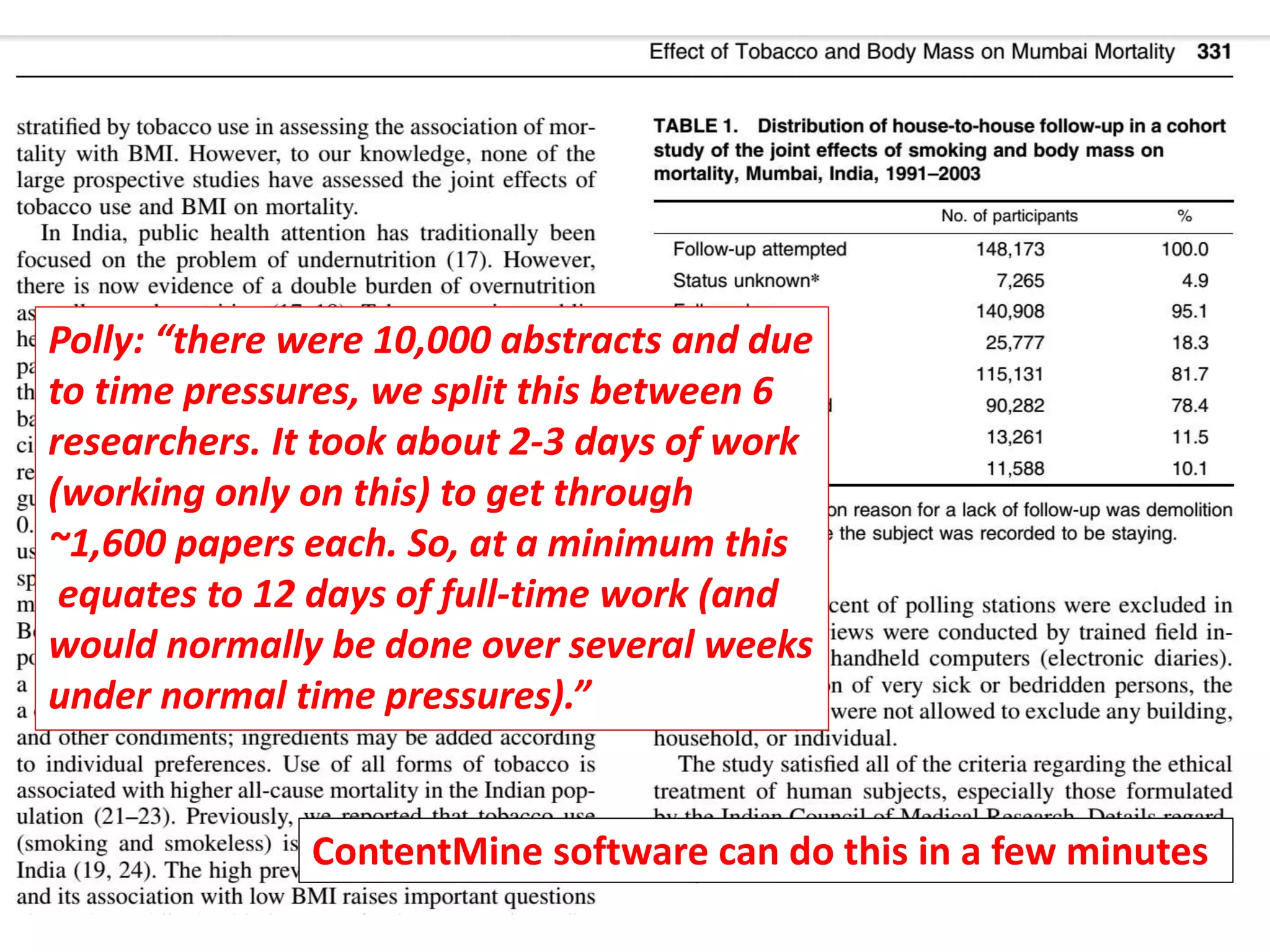
ContentMine software can do this in a few minutes
Polly: “there were 10,000 abstracts and due
to time pressures, we split this between 6
researchers. It took about 2-3 days of work
(working only on this) to get through
~1,600 papers each. So, at a minimum this
equates to 12 days of full-time work (and
would normally be done over several weeks
under normal time pressures).”
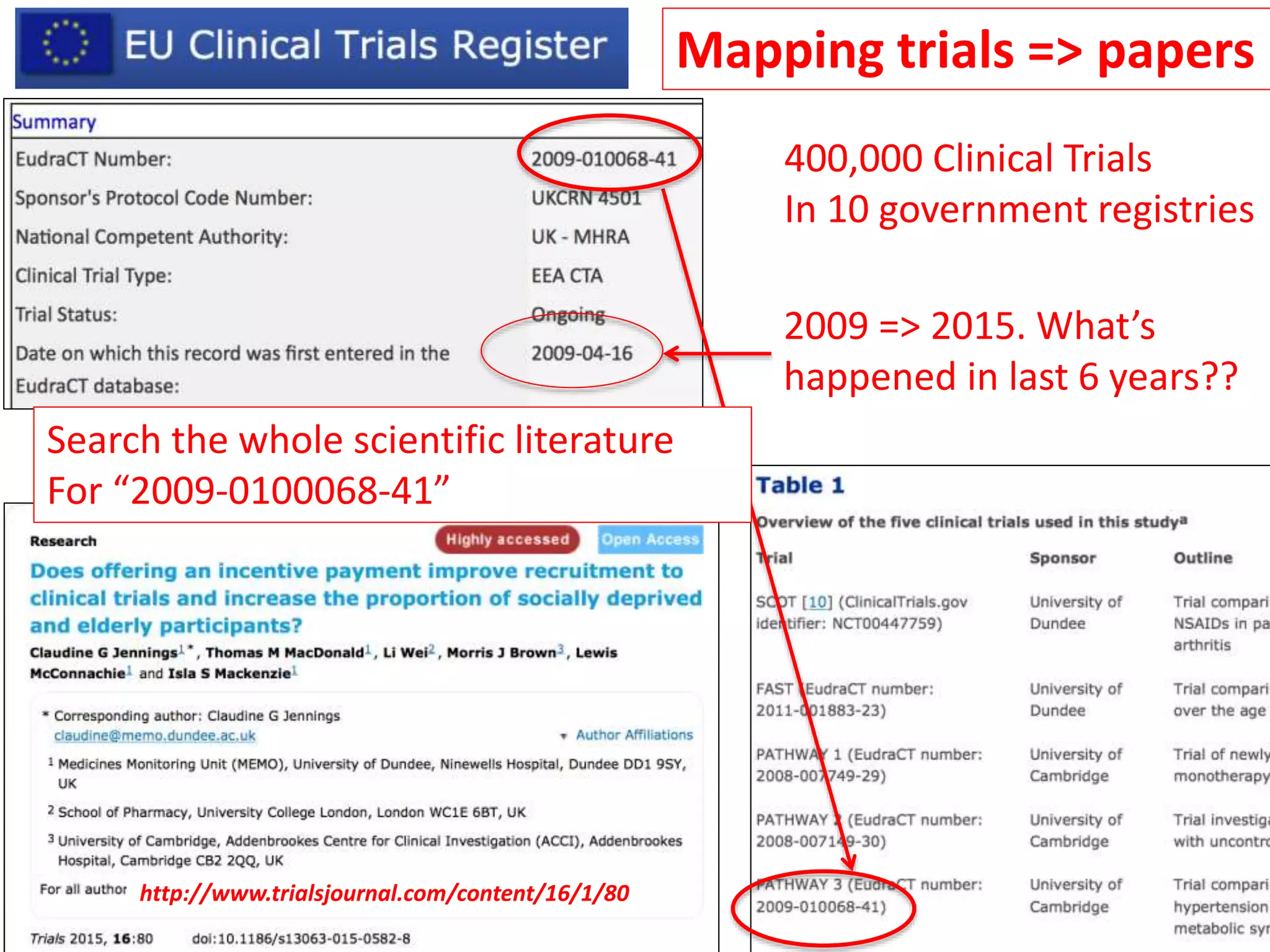
400,000 Clinical Trials
In 10 government registries
Mapping trials => papers
http://www.trialsjournal.com/content/16/1/80
2009 => 2015. What’s
happened in last 6 years??
Search the whole scientific literature
For “2009-0100068-41”
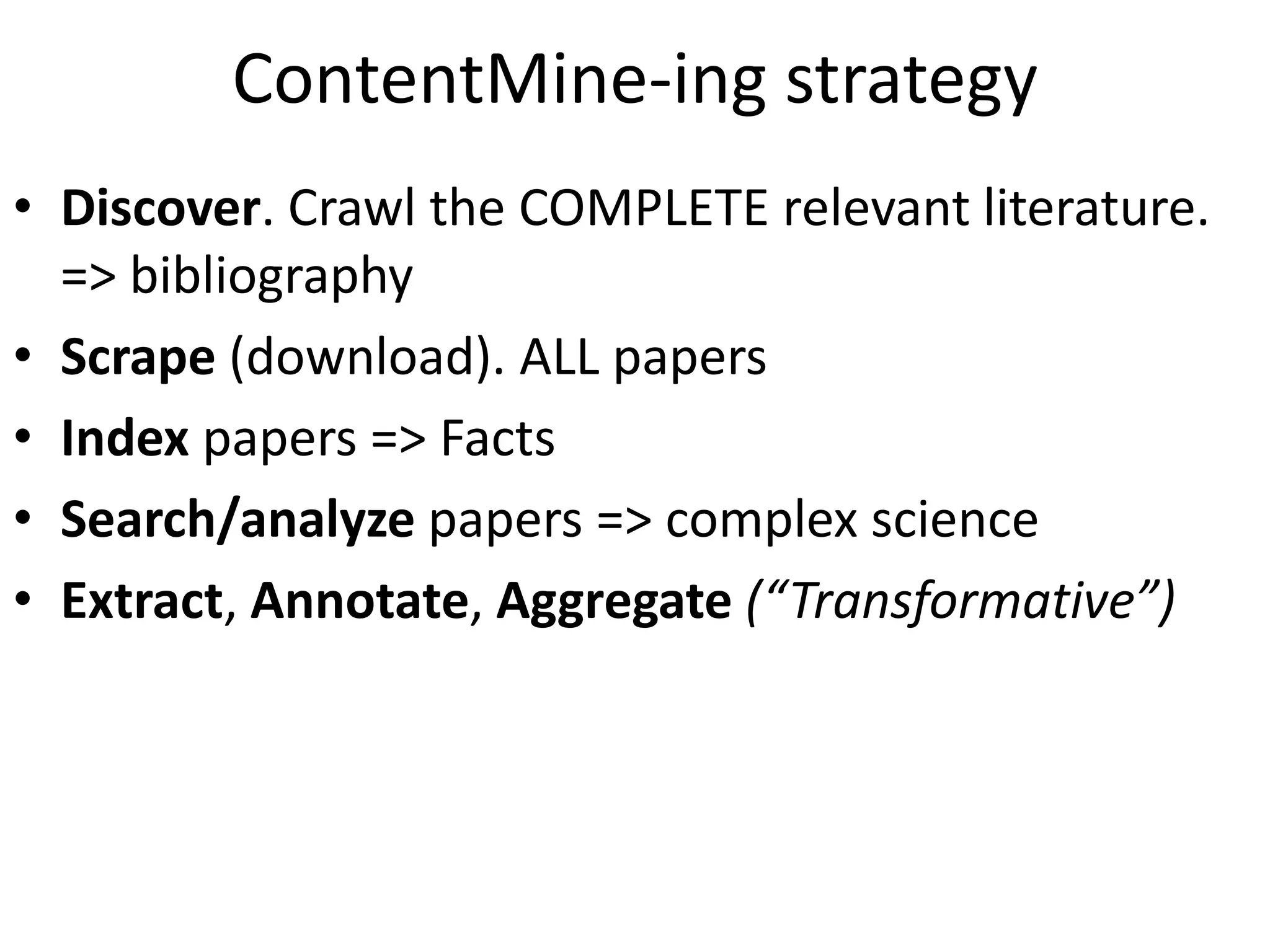
ContentMine-ing strategy
• Discover. Crawl the COMPLETE relevant literature.
=> bibliography
• Scrape (download). ALL papers
• Index papers => Facts
• Search/analyze papers => complex science
• Extract, Annotate, Aggregate (“Transformative”)
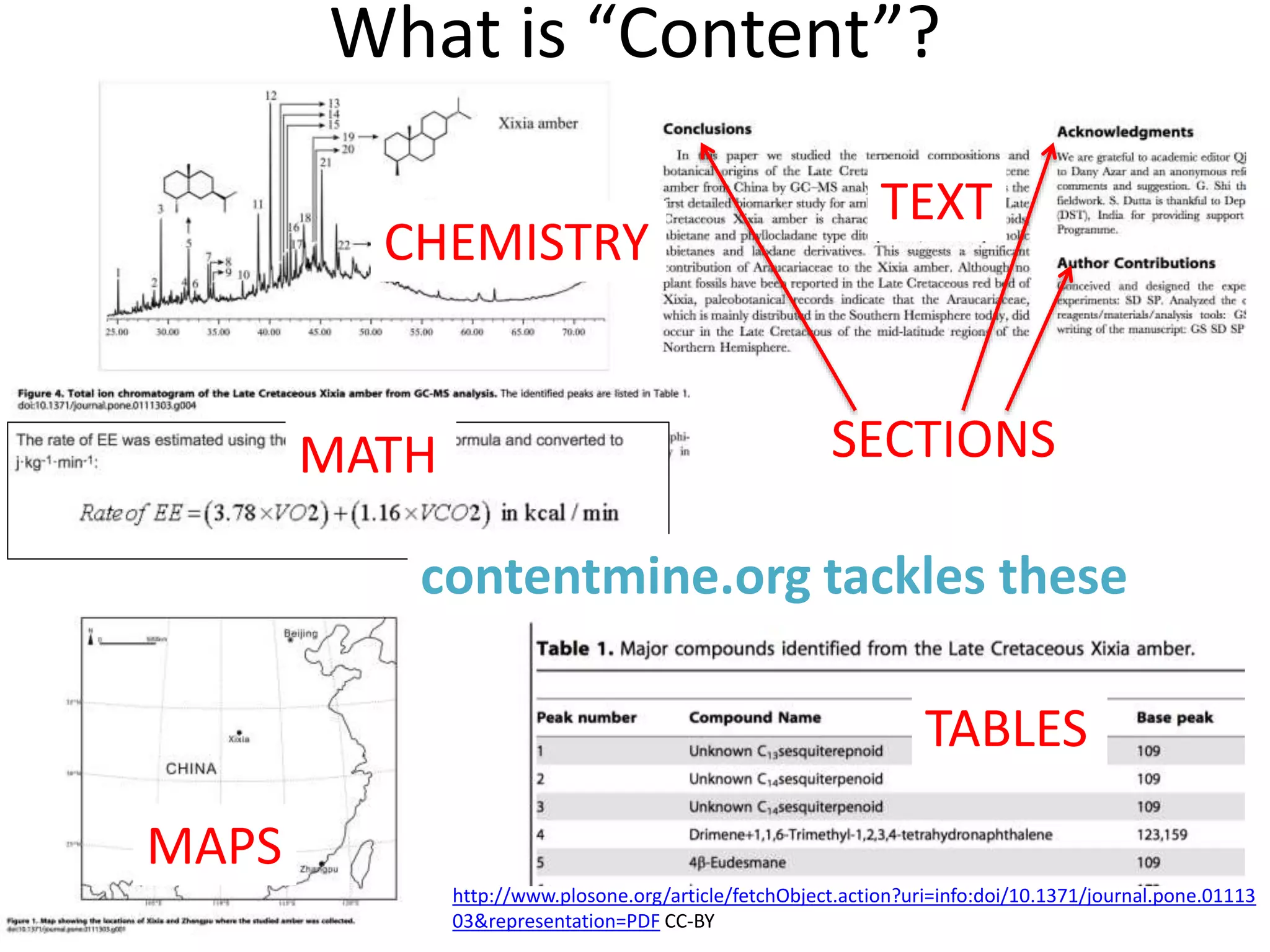
What is “Content”?
http://www.plosone.org/article/fetchObject.action?uri=info:doi/10.1371/journal.pone.01113
03&representation=PDF CC-BY
SECTIONS
MAPS
TABLES
CHEMISTRY
TEXT
MATH
contentmine.org tackles these
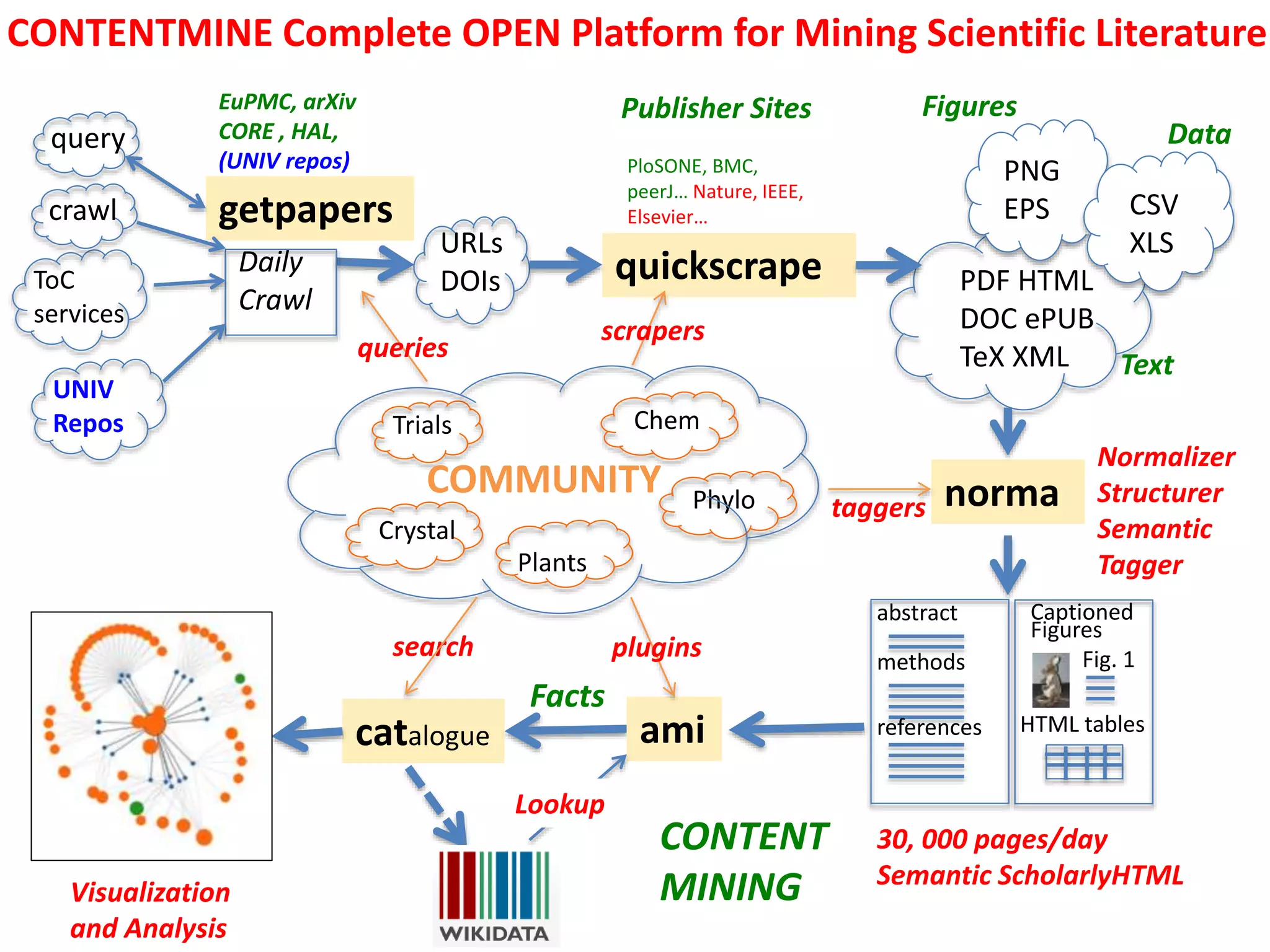
catalogue
getpapers
query
Daily
Crawl
EuPMC, arXiv
CORE , HAL,
(UNIV repos)
ToC
services
PDF HTML
DOC ePUB
TeX XML
PNG
EPS CSV
XLSURLs
DOIs
crawl
quickscrape
norma
Normalizer
Structurer
Semantic
Tagger
Text
Data
Figures
ami
UNIV
Repos
search
Lookup
CONTENT
MINING
Chem
Phylo
Trials
Crystal
Plants
COMMUNITY
plugins
Visualization
and Analysis
PloSONE, BMC,
peerJ… Nature, IEEE,
Elsevier…
Publisher Sites
scrapers
queries
taggers
abstract
methods
references
Captioned
Figures
Fig. 1
HTML tables
30, 000 pages/day
Semantic ScholarlyHTML
Facts
CONTENTMINE Complete OPEN Platform for Mining Scientific Literature
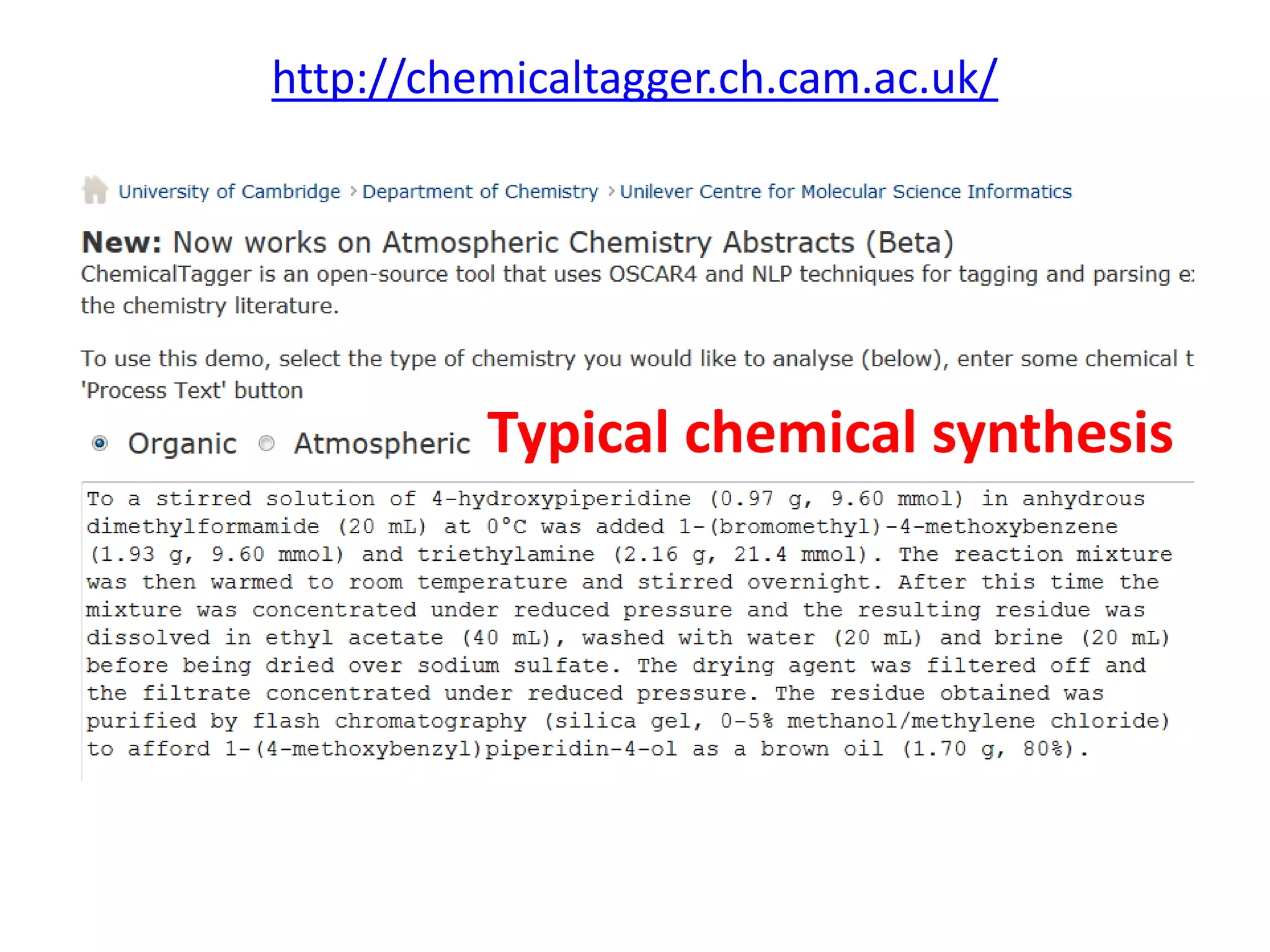
http://chemicaltagger.ch.cam.ac.uk/
• Typical
Typical chemical synthesis
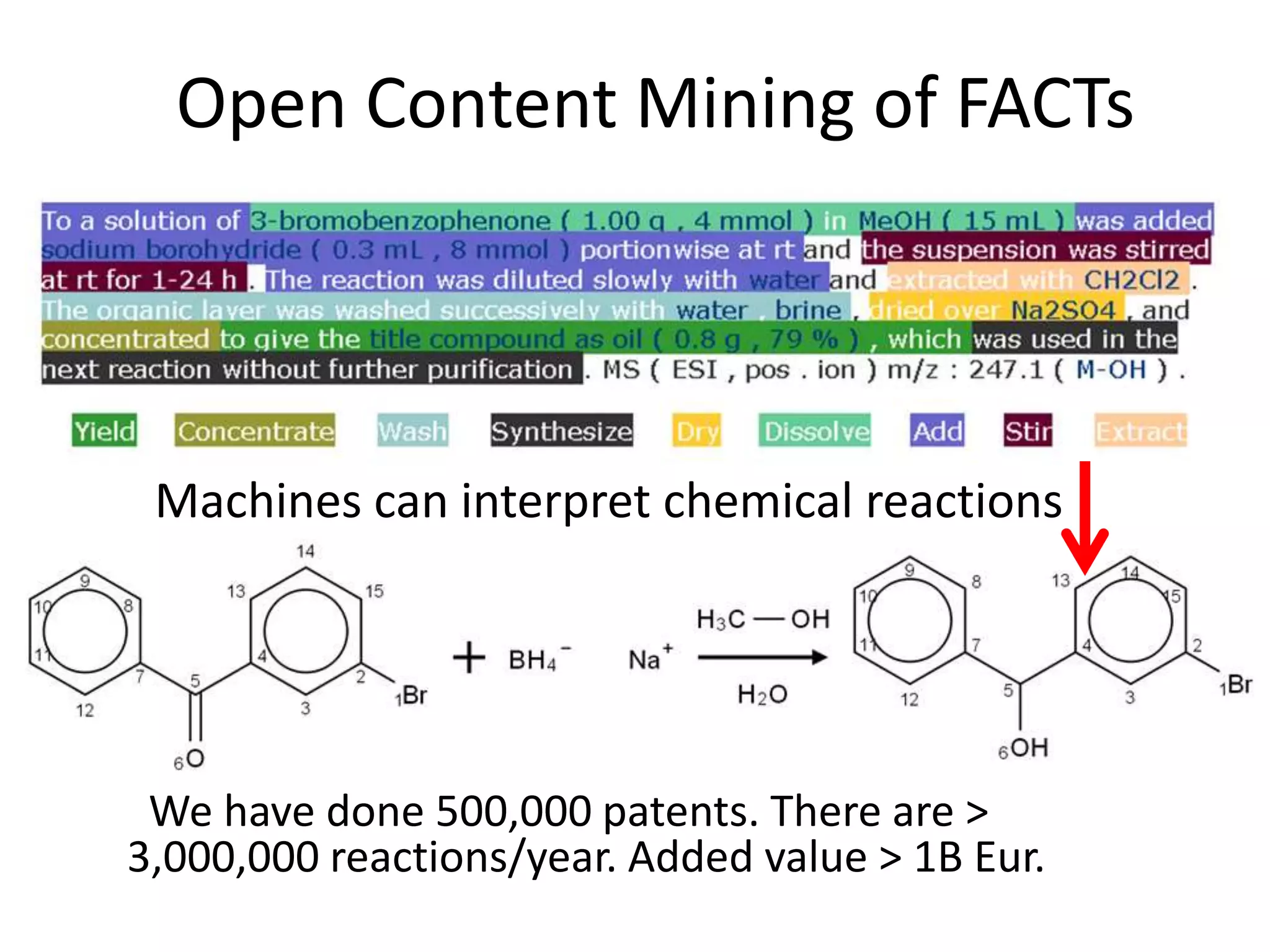
Open Content Mining of FACTs
Machines can interpret chemical reactions
We have done 500,000 patents. There are >
3,000,000 reactions/year. Added value > 1B Eur.
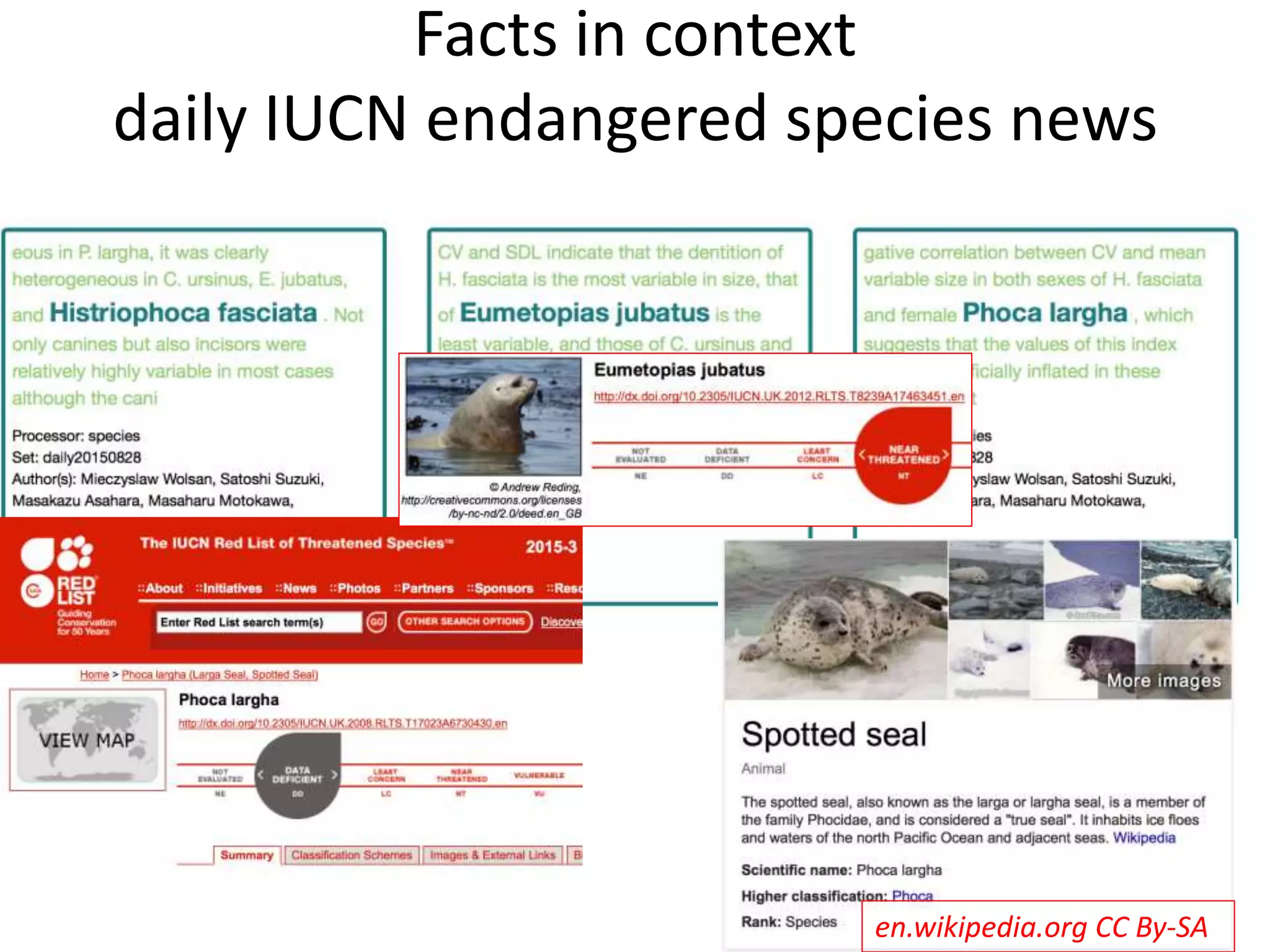
Facts in context
daily IUCN endangered species news
en.wikipedia.org CC By-SA
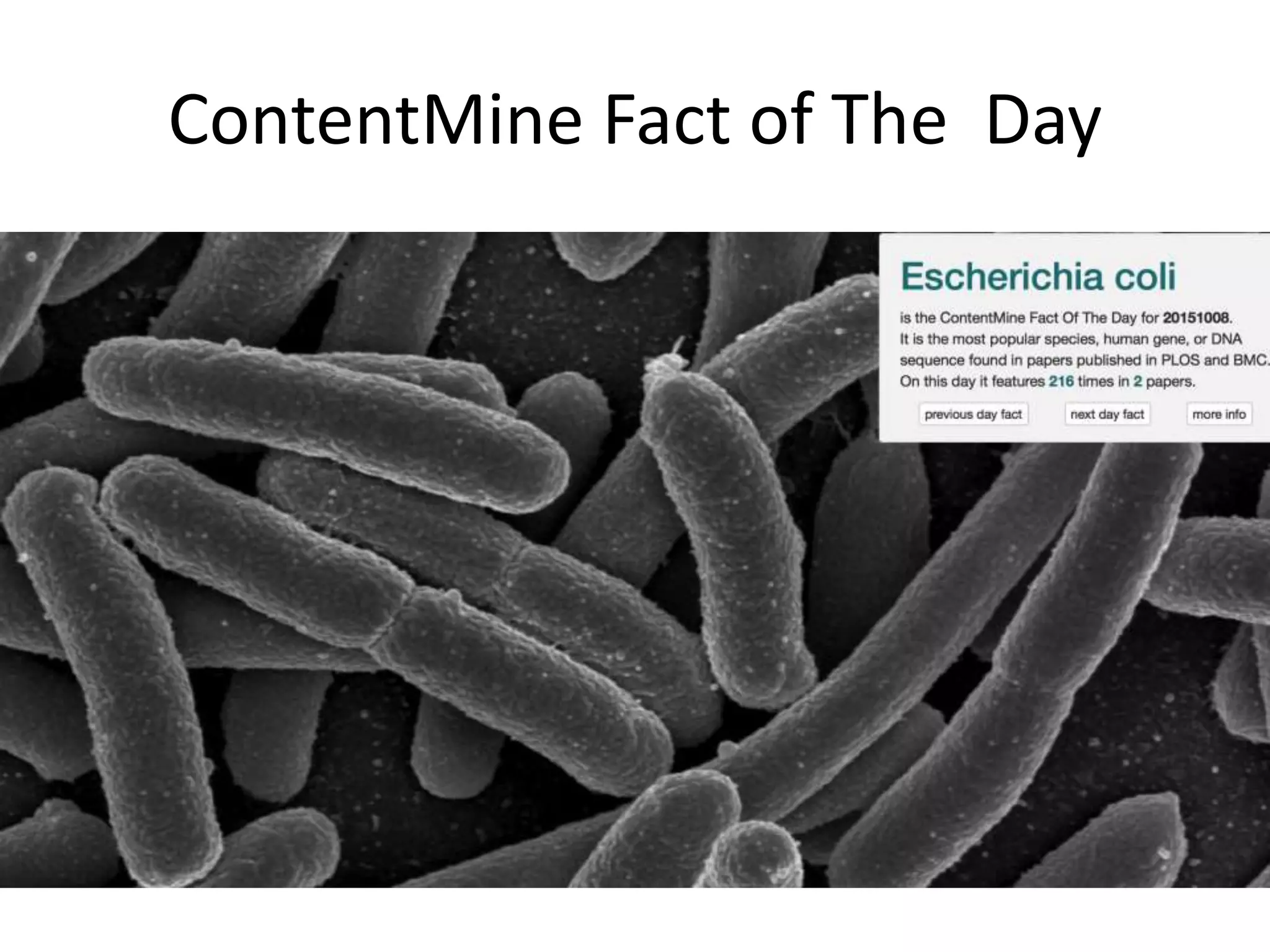
ContentMine Fact of The Day
• Fact of the day
• Endangered species in recent science
• Facts
• Bubbles
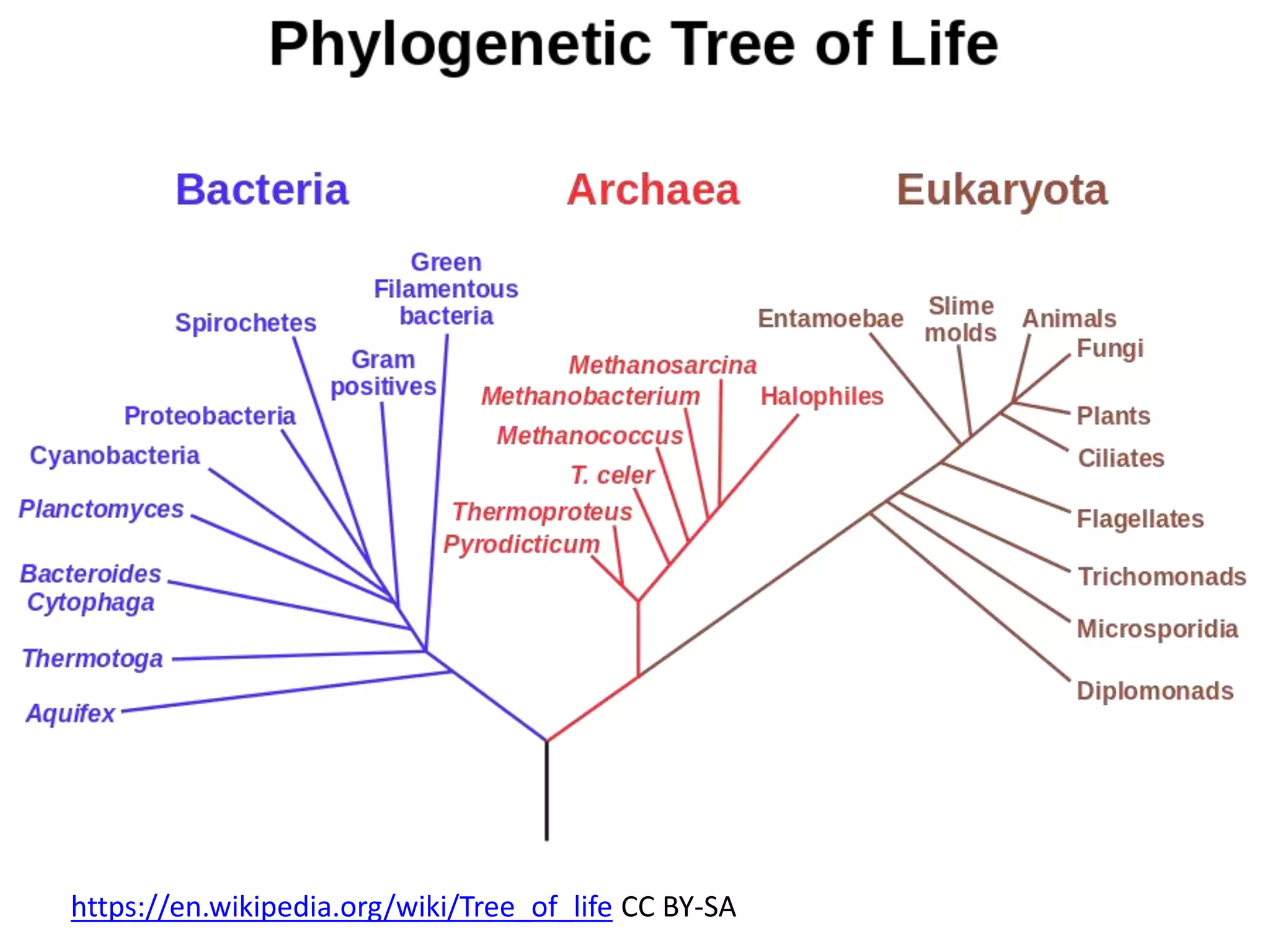
https://en.wikipedia.org/wiki/Tree_of_life CC BY-SA
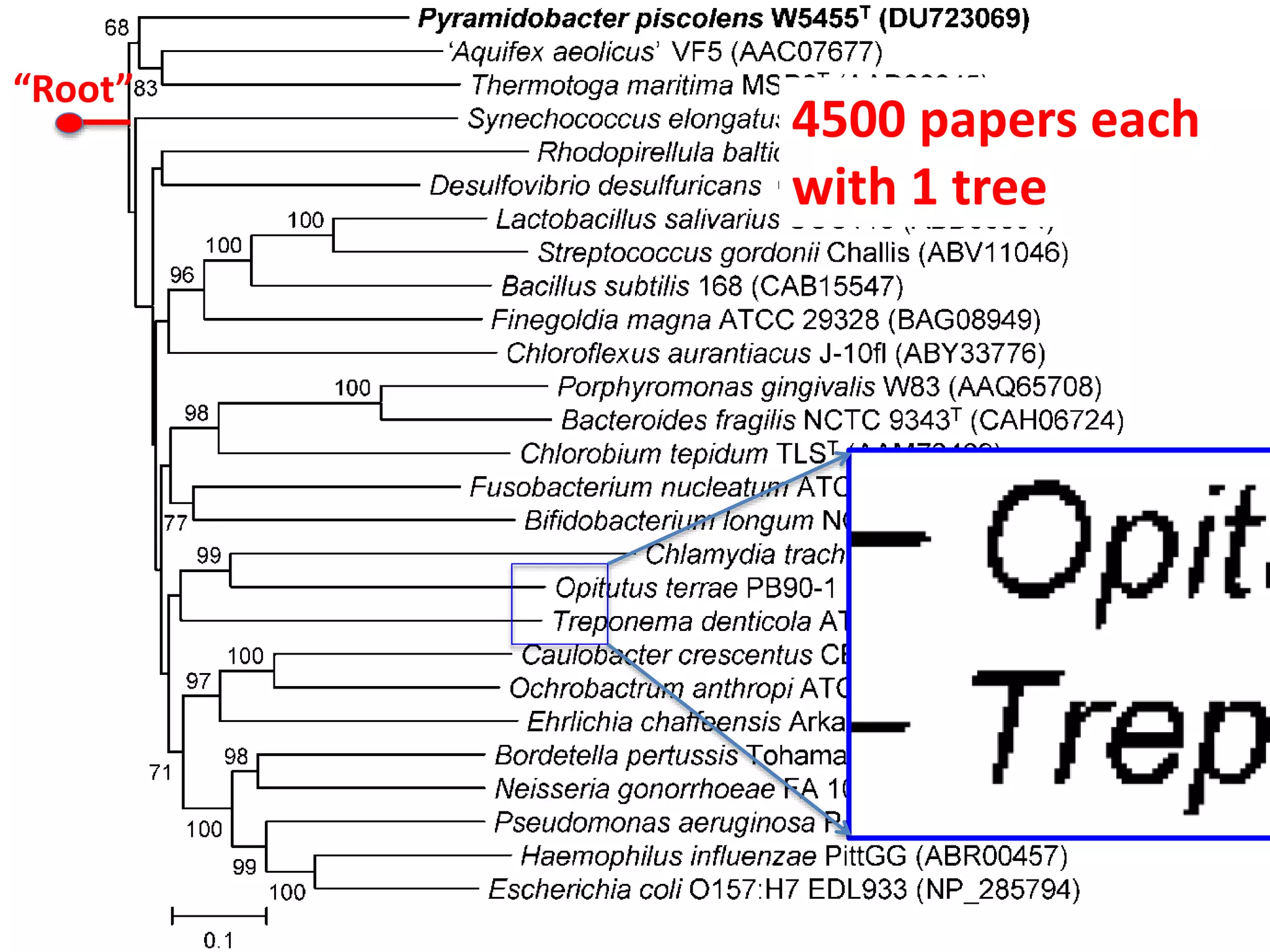
“Root”
4500 papers each
with 1 tree
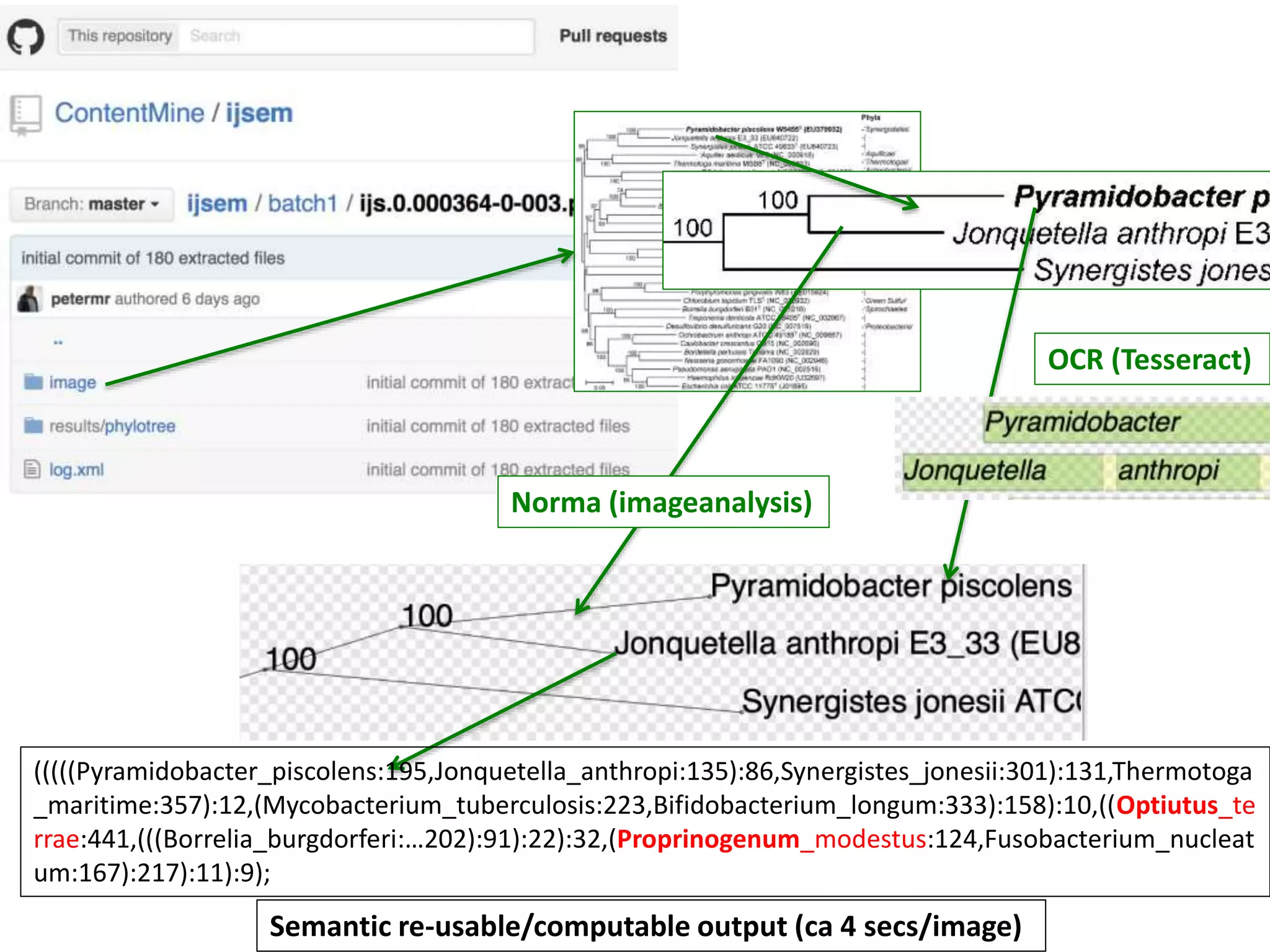
OCR (Tesseract)
Norma (imageanalysis)
(((((Pyramidobacter_piscolens:195,Jonquetella_anthropi:135):86,Synergistes_jonesii:301):131,Thermotoga
_maritime:357):12,(Mycobacterium_tuberculosis:223,Bifidobacterium_longum:333):158):10,((Optiutus_te
rrae:441,(((Borrelia_burgdorferi:…202):91):22):32,(Proprinogenum_modestus:124,Fusobacterium_nucleat
um:167):217):11):9);
Semantic re-usable/computable output (ca 4 secs/image)
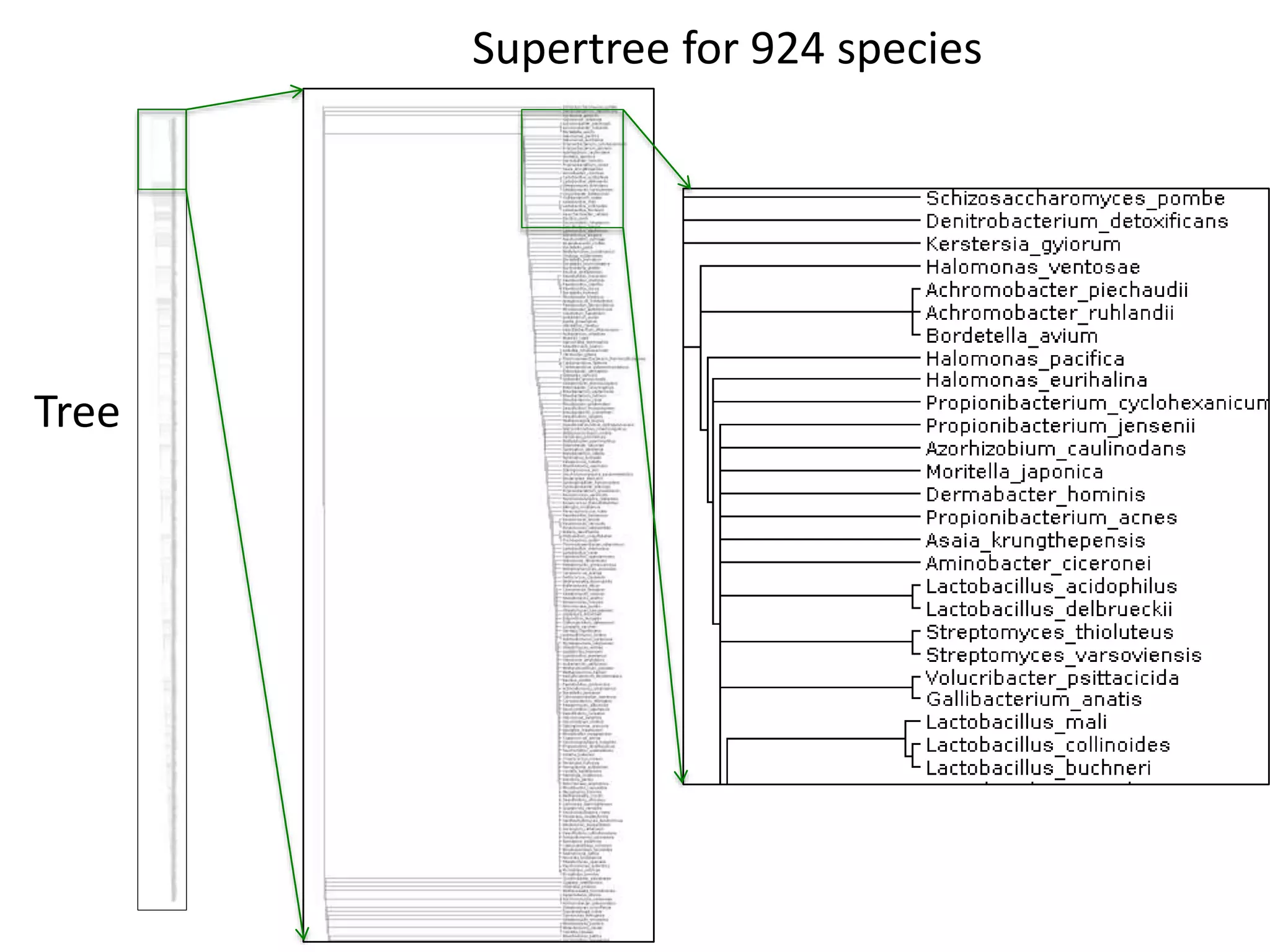
Supertree for 924 species
Tree
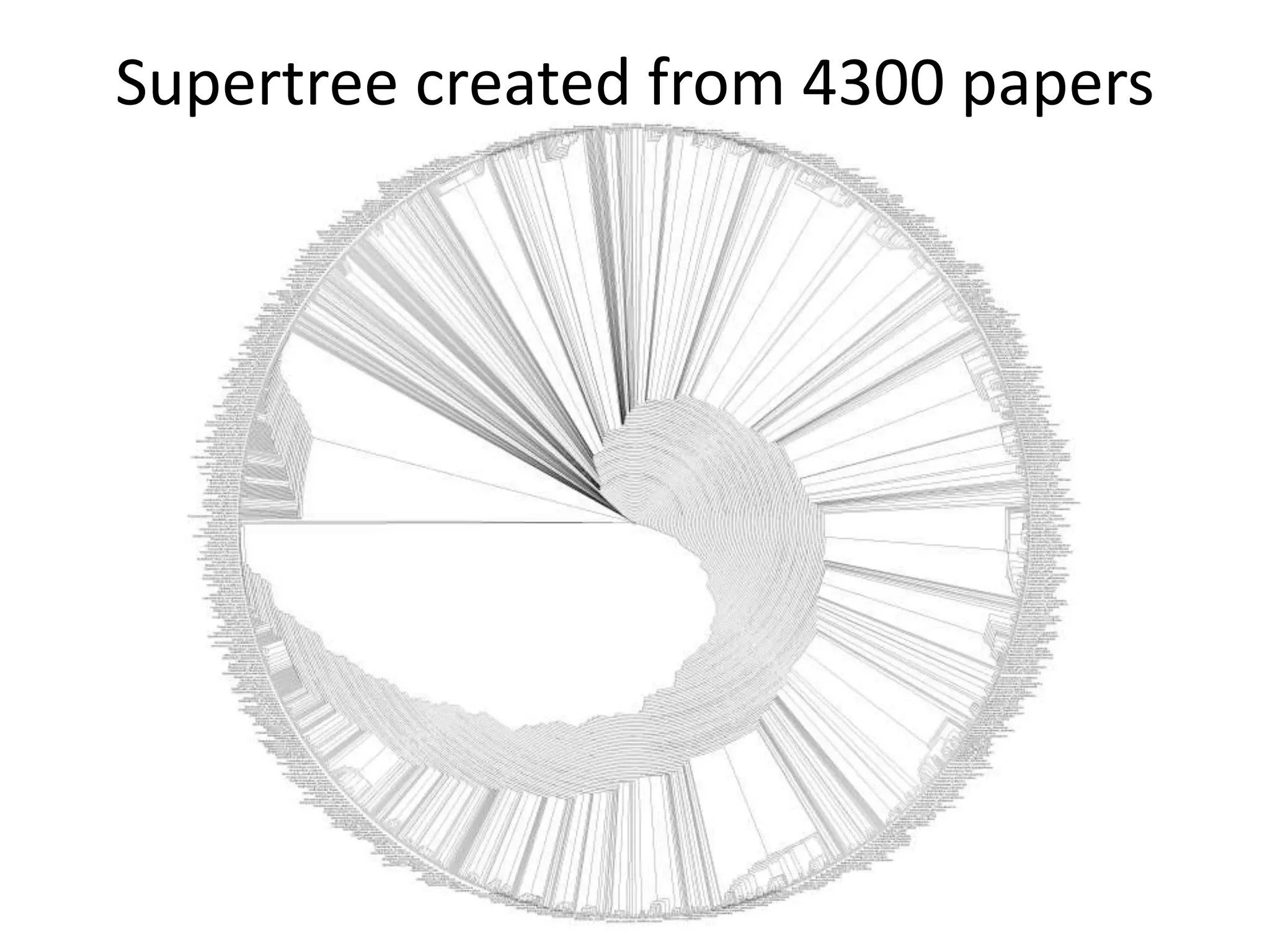
Supertree created from 4300 papers
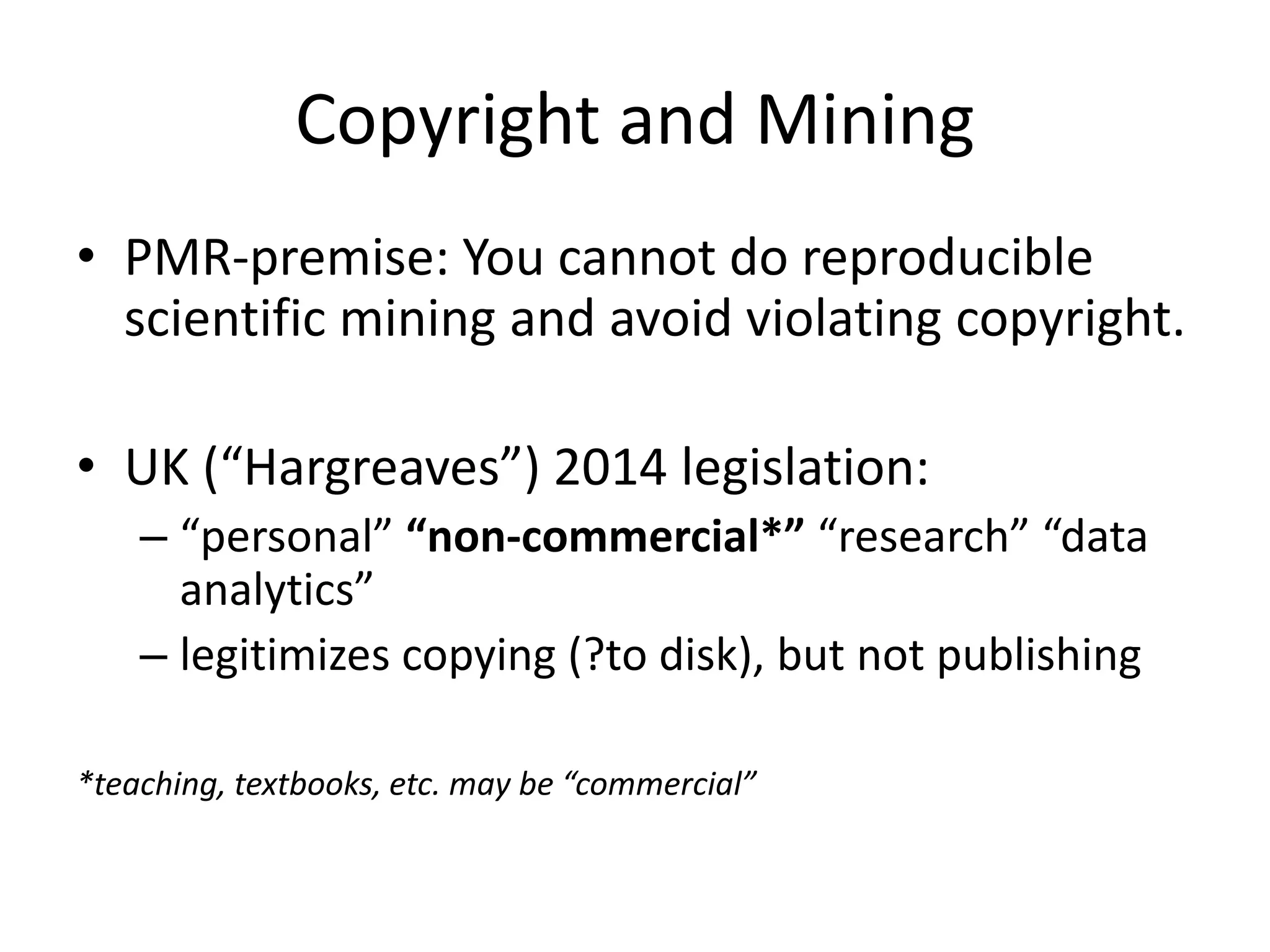
Copyright and Mining
• PMR-premise: You cannot do reproducible
scientific mining and avoid violating copyright.
• UK (“Hargreaves”) 2014 legislation:
– “personal” “non-commercial*” “research” “data
analytics”
– legitimizes copying (?to disk), but not publishing
*teaching, textbooks, etc. may be “commercial”
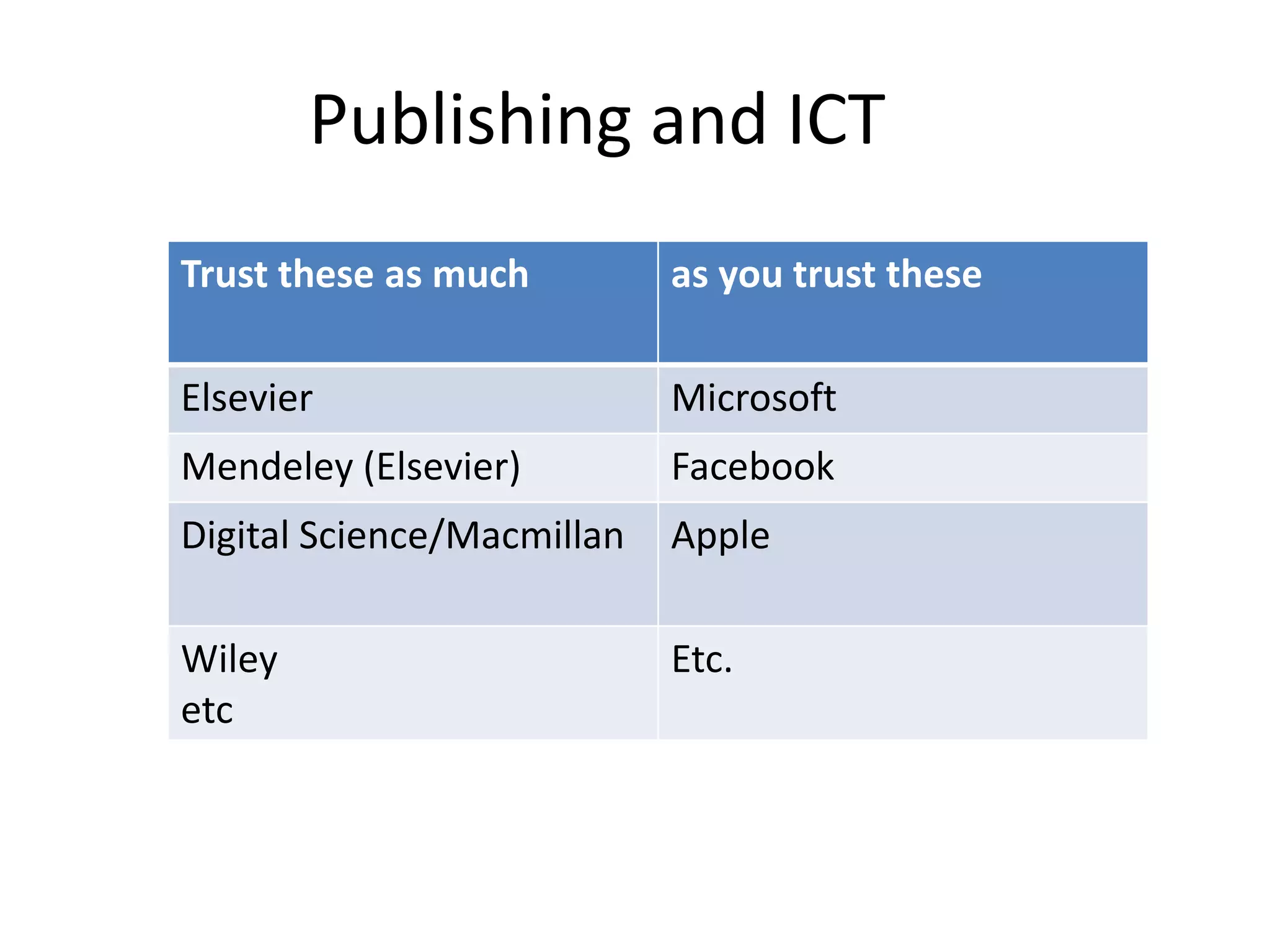
Publishing and ICT
Trust these as much as you trust these
Elsevier Microsoft
Mendeley (Elsevier) Facebook
Digital Science/Macmillan Apple
Wiley
etc
Etc.
STM Publishers prevent Mining
• FUD & disinformation about legality (Elsevier)
• Monopolies on infrastructure (“API”s, CCC
Rightfind)
• Technical obstruction (Wiley Captcha,
Macmillan Readcube)
• Restrictive contracts with libraries (ALL) [1]
• Wasting my/our time (ALL)
[1] [You may not] utilize the TDM Output to enhance … subject repositories
in a way that would [… ] have the potential to substitute and/or replicate
any other existing Elsevier products, services and/or solutions.
WILEY … “new security feature… to prevent systematic download of content
“[limit of] 100 papers per day”
“essential security feature … to protect both parties (sic)”
CAPTCHA
User has to type words
ContentMine working with Libraries
• Cambridge: Library, Plant Sciences,
Epidemiology, Chemistry
• Cochrane Collaboration on Systematic Reviews
of Clinical Trials
• FutureTDM (H2020, LIBER)
• Running workshops and training

Content Mining of Science in Europe

Editor's Notes

  • #2 Hi, I’m here to talk about AMI; a data extraction framework and tool. First, I just want highlight some of key contributors to the projects; Andy for his work on the ChemistryVisitor and Peter for the overall architecture. In this talk, I’m going to impress the importance of data in a specific format and its utility to automated machine processing. Then I’m going to demonstrate AMI’s architecture and the transformation of data as it flows through the process. I’m going to dwell a little on a core format used, Scalable Vector Graphics (SVG) before introducing the concept of visitors, which are pluggable context specific data extractors. Next, I’m going to introduce Andy’s ChemVisitor, for extracting semantic chemistry data, along with a few other visitors that can process non-chemistry specific data. Finally, I will demonstrate some uses of the ChemVisitor, within the realm of validation and metabolism.