“ Building an Information Infrastructure to Support Microbial Metagenomic Sciences " Presentation for the Microbe Project Interagency Team [ www.microbeproject.gov] UCSD La Jolla, CA January 14, 2006 Dr. Larry Smarr Director, California Institute for Telecommunications and Information Technology; Harry E. Gruber Professor,  Dept. of Computer Science and Engineering Jacobs School of Engineering, UCSD
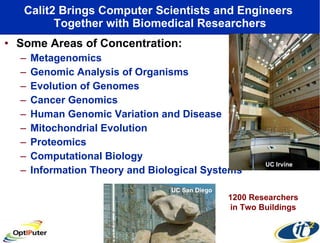
Calit2 Brings Computer Scientists and Engineers  Together with Biomedical Researchers Some Areas of Concentration: Metagenomics Genomic Analysis of Organisms Evolution of Genomes Cancer Genomics Human Genomic Variation and Disease Mitochondrial Evolution Proteomics Computational Biology Information Theory and Biological Systems UC San Diego UC Irvine 1200 Researchers in Two Buildings
PI Larry Smarr
Announcing Tuesday January 17, 2006
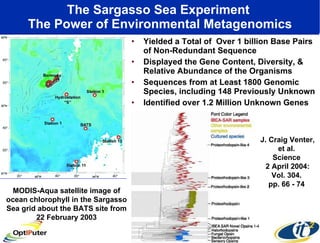
The Sargasso Sea Experiment  The Power of Environmental Metagenomics Yielded a Total of  Over 1 billion Base Pairs of Non-Redundant Sequence Displayed the Gene Content, Diversity, & Relative Abundance of the Organisms  Sequences from at Least 1800 Genomic Species, including 148 Previously Unknown Identified over 1.2 Million Unknown Genes MODIS-Aqua satellite image of ocean chlorophyll in the Sargasso Sea grid about the BATS site from 22 February 2003 J. Craig Venter, et al.  Science  2 April 2004: Vol. 304.  pp. 66 - 74
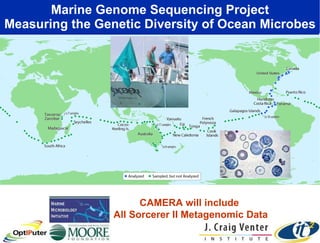
Marine Genome Sequencing Project Measuring the Genetic Diversity of Ocean Microbes CAMERA will include  All Sorcerer II Metagenomic Data
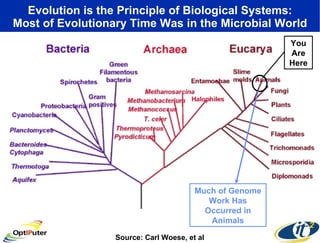
Evolution is the Principle of Biological Systems: Most of Evolutionary Time Was in the Microbial World Source: Carl Woese, et al You Are Here Much of Genome Work Has Occurred in Animals
Major New Science Challenge: Understanding the Transition from Collective to Species Evolution “ Bacteria naturally reside in communities, in ecosystems. It is hard to find a bacterial niche that does not comprise  hundreds or thousands of different species, all interacting in intricate delicate ways, to make a fascinatingly complex  and stable whole.” “ In an era of rampant horizontal gene transfer, organismal evolution would be basically collective.  It is the community of organisms that evolves, not the various individual organismal types.” “ This shift from a primitive genetic free-for-all to modern organisms must by all account have been one of the most profound happenings in the  whole of evolutionary history.” --Carl Woese ,  Evolving Biological Organization  in  Microbial Phylogeny and Evolution , ed. Jan Sapp  (2005)
Genomic Data Is Growing Rapidly,  But  Metagenomics Will Vastly Increase The Scale… GenBank Protein Data Bank www.rcsb.org/pdb/holdings.html www.ncbi.nlm.nih.gov/Genbank 100 Billion Bases! Total Data < 1TB 35,000 Structures
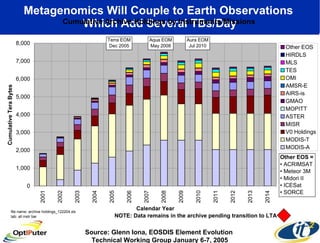
Metagenomics Will Couple to Earth Observations  Which Add Several TBs/Day Source: Glenn Iona, EOSDIS Element Evolution  Technical Working Group January 6-7, 2005
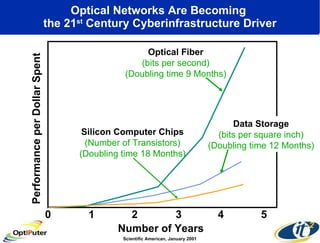
Optical Networks Are Becoming  the 21 st  Century Cyberinfrastructure Driver Scientific American, January 2001 Number of Years 0 1 2 3 4 5 Performance per Dollar Spent Data Storage (bits per square inch) (Doubling time 12 Months) Optical Fiber (bits per second) (Doubling time 9 Months) Silicon Computer Chips (Number of Transistors) (Doubling time 18 Months)
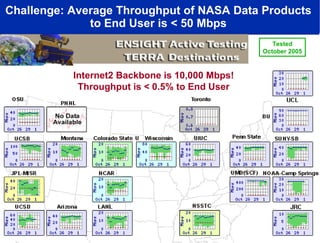
Challenge: Average Throughput of NASA Data Products  to End User is < 50 Mbps  Tested October 2005 http://ensight.eos.nasa.gov/Missions/icesat/index.shtml Internet2 Backbone is 10,000 Mbps! Throughput is < 0.5% to End User
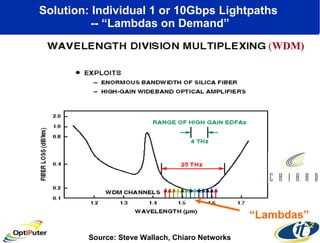
Solution: Individual 1 or 10Gbps Lightpaths  -- “Lambdas on Demand” ( WDM) Source: Steve Wallach, Chiaro Networks “ Lambdas”
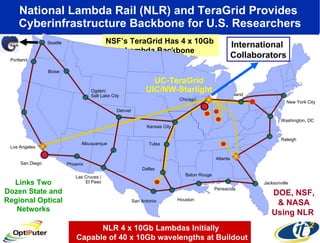
National Lambda Rail (NLR) and TeraGrid Provides  Cyberinfrastructure Backbone for U.S. Researchers NLR 4 x 10Gb Lambdas Initially Capable of 40 x 10Gb wavelengths at Buildout NSF’s TeraGrid Has 4 x 10Gb  Lambda Backbone  Links Two Dozen State and Regional Optical Networks DOE, NSF, & NASA Using NLR  San Francisco Pittsburgh Cleveland San Diego Los Angeles Portland Seattle Pensacola Baton Rouge Houston San Antonio Las Cruces / El Paso Phoenix New York City Washington, DC Raleigh Jacksonville Dallas Tulsa Atlanta Kansas City Denver Ogden/ Salt Lake City Boise Albuquerque UC-TeraGrid UIC/NW-Starlight Chicago International  Collaborators
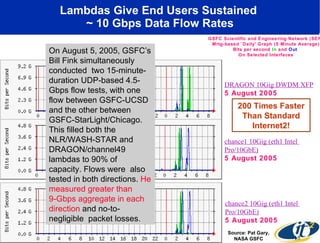
Lambdas Give End Users Sustained  ~ 10 Gbps Data Flow Rates chance2 10Gig (eth1 Intel  Pro/10GbE) 5 August 2005 chance1 10Gig (eth1 Intel  Pro/10GbE) 5 August 2005  DRAGON 10Gig DWDM XFP   5 August 2005 GSFC Scientific and Engineering Network (SEN) Mrtg-based `Daily' Graph (5 Minute Average) Bits per second  In  and   Out  On Selected Interfaces On August 5, 2005, GSFC’s Bill Fink simultaneously conducted  two 15-minute-duration UDP-based 4.5-Gbps flow tests, with one  flow between GSFC-UCSD and the other between GSFC-StarLight/Chicago.  This filled both the NLR/WASH-STAR and DRAGON/channel49  lambdas to 90% of capacity. Flows were  also tested in both directions.  He measured greater than  9-Gbps aggregate in each direction  and no-to-negligible  packet losses. 200 Times Faster Than Standard Internet2! Source: Pat Gary, NASA GSFC
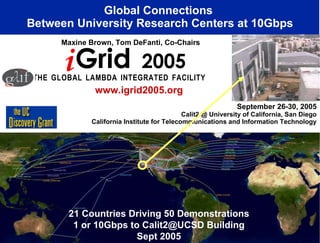
September 26-30, 2005 Calit2 @ University of California, San Diego California Institute for Telecommunications and Information Technology Global Connections  Between University Research Centers at 10Gbps T   H   E  G   L   O   B   A   L  L   A   M   B   D   A  I   N   T   E   G   R   A   T   E   D  F   A   C   I   L   I   T   Y   Maxine Brown, Tom DeFanti, Co-Chairs www.igrid2005.org 21 Countries Driving 50 Demonstrations 1 or 10Gbps to Calit2@UCSD Building Sept 2005 i Grid  2005
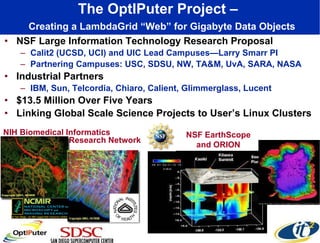
The OptIPuter Project –    Creating a LambdaGrid “Web” for Gigabyte Data Objects NSF Large Information Technology Research Proposal Calit2 (UCSD, UCI) and UIC Lead Campuses—Larry Smarr PI Partnering Campuses: USC, SDSU, NW, TA&M, UvA, SARA, NASA Industrial Partners IBM, Sun, Telcordia, Chiaro, Calient, Glimmerglass, Lucent $13.5 Million Over Five Years Linking Global Scale Science Projects to User’s Linux Clusters NIH Biomedical Informatics NSF EarthScope and ORION Research Network
What is the  OptIPuter? Applications Drivers    Interactive Analysis of Large Data Sets OptIPuter Nodes    Scalable PC Clusters with Graphics Cards IP over Lambda Connectivity   Predictable Backplane  Open Source LambdaGrid Middleware   Network is Reservable Data Retrieval and Mining    Lambda Attached Data Servers High Defn. Vis., Collab. SW    High Performance Collaboratory See Nov 2003 Communications of the ACM  for Articles on OptIPuter Technologies www.optiputer.net
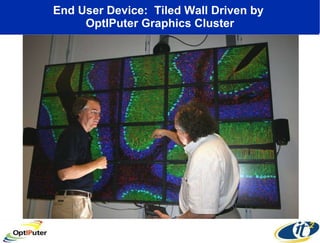
End User Device:  Tiled Wall Driven by  OptIPuter Graphics Cluster
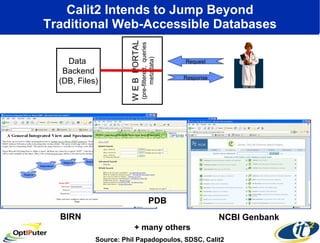
Calit2 Intends to Jump Beyond Traditional Web-Accessible Databases Data  Backend (DB, Files) W E B  PORTAL (pre-filtered,  queries metadata) Response Request + many others Source: Phil Papadopoulos, SDSC, Calit2 BIRN PDB NCBI Genbank
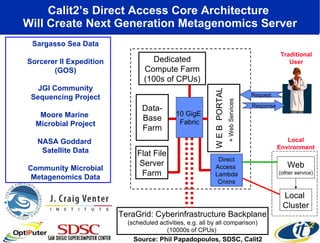
Calit2’s Direct Access Core Architecture  Will Create Next Generation Metagenomics Server Traditional User Response Request Source: Phil Papadopoulos, SDSC, Calit2 + Web Services Sargasso Sea Data Sorcerer II Expedition (GOS) JGI Community Sequencing Project Moore Marine  Microbial Project NASA Goddard  Satellite Data Community Microbial Metagenomics Data Flat File Server Farm W E B  PORTAL Dedicated Compute Farm (100s of CPUs) TeraGrid: Cyberinfrastructure Backplane (scheduled activities, e.g. all by all comparison) (10000s of CPUs)  Web (other service) Local  Cluster Local Environment Direct Access  Lambda Cnxns Data- Base Farm 10 GigE  Fabric
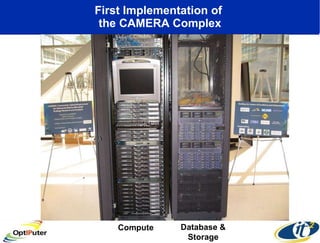
First Implementation of  the CAMERA Complex Compute Database & Storage
Analysis Data Sets, Data Services,  Tools, and Workflows Assemblies of Metagenomic Data e.g, GOS, JGI CSP Annotations Genomic and Metagenomic Data “ All-against-all” Alignments of ORFs Updated Periodically Gene Clusters and Associated Data Profiles, Multiple-Sequence Alignments,  HMMs, Phylogenies, Peptide Sequences Data Services ‘ Raw’ and Specialized Analysis Data Rich Query Facilities Tools and Workflows Navigate and Sift Raw and Analysis Data Publish Workflows and Develop New Ones Prioritize Features via Dialogue with Community Source:  Saul Kravitz Director of Software Engineering J. Craig Venter Institute
CAMERA Timeline Release 1:  Mid-2006 Majority of GOS + Moore Microbe Genome Data 6 Gbp Has Been Assembled Initial Versions of Core Tools BLAST, Reference Alignment Viewer Release 2: Early-2007 Additional Data Additional/Improved Tools Improved Usability Subsequent Move Towards Semantic DB, Direct Access Additional Tools & Data Based on Community Feedback
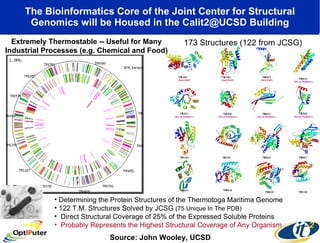
The Bioinformatics Core of the Joint Center for Structural Genomics will be Housed in the Calit2@UCSD Building Extremely Thermostable -- Useful for Many  Industrial Processes (e.g. Chemical and Food)  173 Structures (122 from JCSG) Determining the Protein Structures of the Thermotoga Maritima Genome  122 T.M. Structures Solved by JCSG  (75 Unique In The PDB)   Direct Structural Coverage of 25% of the Expressed Soluble Proteins Probably Represents the Highest Structural Coverage of Any Organism Source: John Wooley, UCSD
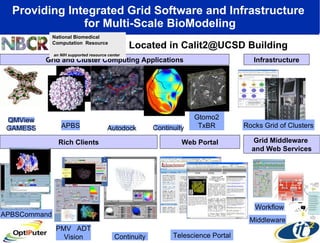
Providing Integrated Grid Software and Infrastructure  for Multi-Scale BioModeling Web Portal Rich Clients Telescience Portal Grid Middleware  and Web Services Workflow Middleware PMV  ADT Vision Continuity APBSCommand Located in Calit2@UCSD Building Grid and Cluster Computing Applications Infrastructure Rocks Grid of Clusters APBS Continuity Gtomo2 TxBR Autodock GAMESS QMView National Biomedical Computation  Resource  an NIH supported resource center
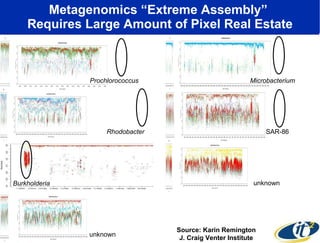
Metagenomics “Extreme Assembly”  Requires Large Amount of Pixel Real Estate Source: Karin Remington J. Craig Venter Institute Prochlorococcus Microbacterium Burkholderia Rhodobacter SAR-86 unknown unknown
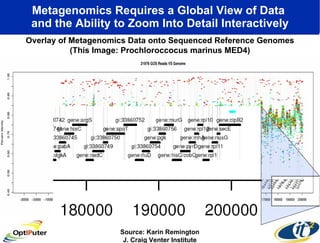
Metagenomics Requires a Global View of Data  and the Ability to Zoom Into Detail Interactively Overlay of Metagenomics Data onto Sequenced Reference Genomes (This Image: Prochloroccocus marinus MED4) Source: Karin Remington J. Craig Venter Institute
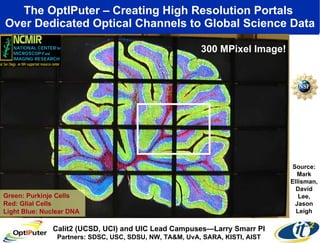
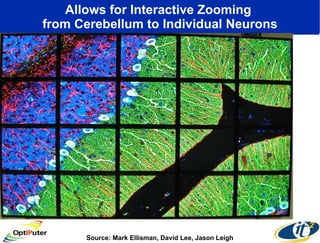
The OptIPuter – Creating High Resolution Portals  Over Dedicated Optical Channels to Global Science Data Green: Purkinje Cells Red: Glial Cells Light Blue: Nuclear DNA Source: Mark Ellisman, David Lee, Jason Leigh 300 MPixel Image! Calit2 (UCSD, UCI) and UIC Lead Campuses—Larry Smarr PI Partners: SDSC, USC, SDSU, NW, TA&M, UvA, SARA, KISTI, AIST
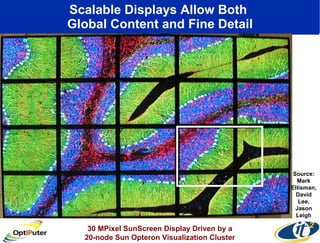
Scalable Displays Allow Both  Global Content and Fine Detail Source: Mark Ellisman, David Lee, Jason Leigh 30 MPixel SunScreen Display Driven by a 20-node Sun Opteron Visualization Cluster
Allows for Interactive Zooming  from Cerebellum to Individual Neurons Source: Mark Ellisman, David Lee, Jason Leigh
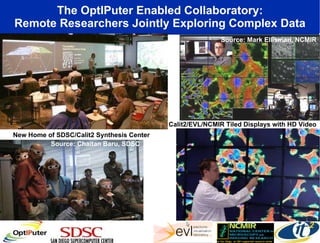
The OptIPuter Enabled Collaboratory: Remote Researchers Jointly Exploring Complex Data New Home of SDSC/Calit2 Synthesis Center Calit2/EVL/NCMIR Tiled Displays with HD Video Source: Chaitan Baru, SDSC Source: Mark Ellisman, NCMIR
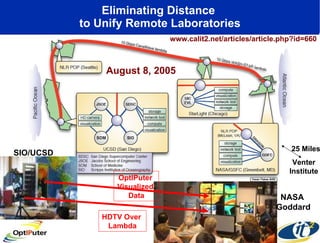
Eliminating Distance  to Unify Remote Laboratories SIO/UCSD NASA  Goddard www.calit2.net/articles/article.php?id=660 August 8, 2005 HDTV Over  Lambda OptIPuter  Visualized  Data 25 Miles Venter Institute
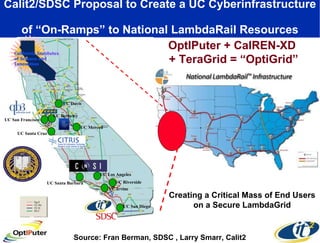
Calit2/SDSC Proposal to Create a UC Cyberinfrastructure  of “On-Ramps” to National LambdaRail Resources OptIPuter + CalREN-XD  + TeraGrid = “OptiGrid” Source: Fran Berman, SDSC , Larry Smarr, Calit2 Creating a Critical Mass of End Users on a Secure LambdaGrid UC San Francisco  UC San Diego  UC Riverside  UC Irvine  UC Davis  UC Berkeley UC Santa Cruz UC Santa Barbara  UC Los Angeles  UC Merced
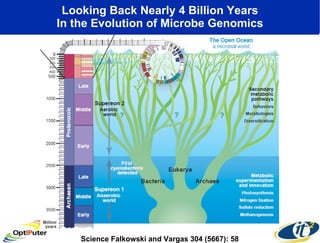
Looking Back Nearly 4 Billion Years In the Evolution of Microbe Genomics Science Falkowski and Vargas 304 (5667): 58

Building an Information Infrastructure to Support Microbial Metagenomic Sciences

  • 1.
    “ Building anInformation Infrastructure to Support Microbial Metagenomic Sciences &quot; Presentation for the Microbe Project Interagency Team [ www.microbeproject.gov] UCSD La Jolla, CA January 14, 2006 Dr. Larry Smarr Director, California Institute for Telecommunications and Information Technology; Harry E. Gruber Professor, Dept. of Computer Science and Engineering Jacobs School of Engineering, UCSD
  • 2.
    Calit2 Brings ComputerScientists and Engineers Together with Biomedical Researchers Some Areas of Concentration: Metagenomics Genomic Analysis of Organisms Evolution of Genomes Cancer Genomics Human Genomic Variation and Disease Mitochondrial Evolution Proteomics Computational Biology Information Theory and Biological Systems UC San Diego UC Irvine 1200 Researchers in Two Buildings
  • 3.
  • 4.
  • 5.
    The Sargasso SeaExperiment The Power of Environmental Metagenomics Yielded a Total of Over 1 billion Base Pairs of Non-Redundant Sequence Displayed the Gene Content, Diversity, & Relative Abundance of the Organisms Sequences from at Least 1800 Genomic Species, including 148 Previously Unknown Identified over 1.2 Million Unknown Genes MODIS-Aqua satellite image of ocean chlorophyll in the Sargasso Sea grid about the BATS site from 22 February 2003 J. Craig Venter, et al. Science 2 April 2004: Vol. 304. pp. 66 - 74
  • 6.
    Marine Genome SequencingProject Measuring the Genetic Diversity of Ocean Microbes CAMERA will include All Sorcerer II Metagenomic Data
  • 7.
    Evolution is thePrinciple of Biological Systems: Most of Evolutionary Time Was in the Microbial World Source: Carl Woese, et al You Are Here Much of Genome Work Has Occurred in Animals
  • 8.
    Major New ScienceChallenge: Understanding the Transition from Collective to Species Evolution “ Bacteria naturally reside in communities, in ecosystems. It is hard to find a bacterial niche that does not comprise hundreds or thousands of different species, all interacting in intricate delicate ways, to make a fascinatingly complex and stable whole.” “ In an era of rampant horizontal gene transfer, organismal evolution would be basically collective. It is the community of organisms that evolves, not the various individual organismal types.” “ This shift from a primitive genetic free-for-all to modern organisms must by all account have been one of the most profound happenings in the whole of evolutionary history.” --Carl Woese , Evolving Biological Organization in Microbial Phylogeny and Evolution , ed. Jan Sapp (2005)
  • 9.
    Genomic Data IsGrowing Rapidly, But Metagenomics Will Vastly Increase The Scale… GenBank Protein Data Bank www.rcsb.org/pdb/holdings.html www.ncbi.nlm.nih.gov/Genbank 100 Billion Bases! Total Data < 1TB 35,000 Structures
  • 10.
    Metagenomics Will Coupleto Earth Observations Which Add Several TBs/Day Source: Glenn Iona, EOSDIS Element Evolution Technical Working Group January 6-7, 2005
  • 11.
    Optical Networks AreBecoming the 21 st Century Cyberinfrastructure Driver Scientific American, January 2001 Number of Years 0 1 2 3 4 5 Performance per Dollar Spent Data Storage (bits per square inch) (Doubling time 12 Months) Optical Fiber (bits per second) (Doubling time 9 Months) Silicon Computer Chips (Number of Transistors) (Doubling time 18 Months)
  • 12.
    Challenge: Average Throughputof NASA Data Products to End User is < 50 Mbps Tested October 2005 http://ensight.eos.nasa.gov/Missions/icesat/index.shtml Internet2 Backbone is 10,000 Mbps! Throughput is < 0.5% to End User
  • 13.
    Solution: Individual 1or 10Gbps Lightpaths -- “Lambdas on Demand” ( WDM) Source: Steve Wallach, Chiaro Networks “ Lambdas”
  • 14.
    National Lambda Rail(NLR) and TeraGrid Provides Cyberinfrastructure Backbone for U.S. Researchers NLR 4 x 10Gb Lambdas Initially Capable of 40 x 10Gb wavelengths at Buildout NSF’s TeraGrid Has 4 x 10Gb Lambda Backbone Links Two Dozen State and Regional Optical Networks DOE, NSF, & NASA Using NLR San Francisco Pittsburgh Cleveland San Diego Los Angeles Portland Seattle Pensacola Baton Rouge Houston San Antonio Las Cruces / El Paso Phoenix New York City Washington, DC Raleigh Jacksonville Dallas Tulsa Atlanta Kansas City Denver Ogden/ Salt Lake City Boise Albuquerque UC-TeraGrid UIC/NW-Starlight Chicago International Collaborators
  • 15.
    Lambdas Give EndUsers Sustained ~ 10 Gbps Data Flow Rates chance2 10Gig (eth1 Intel Pro/10GbE) 5 August 2005 chance1 10Gig (eth1 Intel Pro/10GbE) 5 August 2005 DRAGON 10Gig DWDM XFP 5 August 2005 GSFC Scientific and Engineering Network (SEN) Mrtg-based `Daily' Graph (5 Minute Average) Bits per second In and Out On Selected Interfaces On August 5, 2005, GSFC’s Bill Fink simultaneously conducted two 15-minute-duration UDP-based 4.5-Gbps flow tests, with one flow between GSFC-UCSD and the other between GSFC-StarLight/Chicago. This filled both the NLR/WASH-STAR and DRAGON/channel49 lambdas to 90% of capacity. Flows were also tested in both directions. He measured greater than 9-Gbps aggregate in each direction and no-to-negligible packet losses. 200 Times Faster Than Standard Internet2! Source: Pat Gary, NASA GSFC
  • 16.
    September 26-30, 2005Calit2 @ University of California, San Diego California Institute for Telecommunications and Information Technology Global Connections Between University Research Centers at 10Gbps T H E G L O B A L L A M B D A I N T E G R A T E D F A C I L I T Y Maxine Brown, Tom DeFanti, Co-Chairs www.igrid2005.org 21 Countries Driving 50 Demonstrations 1 or 10Gbps to Calit2@UCSD Building Sept 2005 i Grid 2005
  • 17.
    The OptIPuter Project– Creating a LambdaGrid “Web” for Gigabyte Data Objects NSF Large Information Technology Research Proposal Calit2 (UCSD, UCI) and UIC Lead Campuses—Larry Smarr PI Partnering Campuses: USC, SDSU, NW, TA&M, UvA, SARA, NASA Industrial Partners IBM, Sun, Telcordia, Chiaro, Calient, Glimmerglass, Lucent $13.5 Million Over Five Years Linking Global Scale Science Projects to User’s Linux Clusters NIH Biomedical Informatics NSF EarthScope and ORION Research Network
  • 18.
    What is the OptIPuter? Applications Drivers  Interactive Analysis of Large Data Sets OptIPuter Nodes  Scalable PC Clusters with Graphics Cards IP over Lambda Connectivity  Predictable Backplane Open Source LambdaGrid Middleware  Network is Reservable Data Retrieval and Mining  Lambda Attached Data Servers High Defn. Vis., Collab. SW  High Performance Collaboratory See Nov 2003 Communications of the ACM for Articles on OptIPuter Technologies www.optiputer.net
  • 19.
    End User Device: Tiled Wall Driven by OptIPuter Graphics Cluster
  • 20.
    Calit2 Intends toJump Beyond Traditional Web-Accessible Databases Data Backend (DB, Files) W E B PORTAL (pre-filtered, queries metadata) Response Request + many others Source: Phil Papadopoulos, SDSC, Calit2 BIRN PDB NCBI Genbank
  • 21.
    Calit2’s Direct AccessCore Architecture Will Create Next Generation Metagenomics Server Traditional User Response Request Source: Phil Papadopoulos, SDSC, Calit2 + Web Services Sargasso Sea Data Sorcerer II Expedition (GOS) JGI Community Sequencing Project Moore Marine Microbial Project NASA Goddard Satellite Data Community Microbial Metagenomics Data Flat File Server Farm W E B PORTAL Dedicated Compute Farm (100s of CPUs) TeraGrid: Cyberinfrastructure Backplane (scheduled activities, e.g. all by all comparison) (10000s of CPUs) Web (other service) Local Cluster Local Environment Direct Access Lambda Cnxns Data- Base Farm 10 GigE Fabric
  • 22.
    First Implementation of the CAMERA Complex Compute Database & Storage
  • 23.
    Analysis Data Sets,Data Services, Tools, and Workflows Assemblies of Metagenomic Data e.g, GOS, JGI CSP Annotations Genomic and Metagenomic Data “ All-against-all” Alignments of ORFs Updated Periodically Gene Clusters and Associated Data Profiles, Multiple-Sequence Alignments, HMMs, Phylogenies, Peptide Sequences Data Services ‘ Raw’ and Specialized Analysis Data Rich Query Facilities Tools and Workflows Navigate and Sift Raw and Analysis Data Publish Workflows and Develop New Ones Prioritize Features via Dialogue with Community Source: Saul Kravitz Director of Software Engineering J. Craig Venter Institute
  • 24.
    CAMERA Timeline Release1: Mid-2006 Majority of GOS + Moore Microbe Genome Data 6 Gbp Has Been Assembled Initial Versions of Core Tools BLAST, Reference Alignment Viewer Release 2: Early-2007 Additional Data Additional/Improved Tools Improved Usability Subsequent Move Towards Semantic DB, Direct Access Additional Tools & Data Based on Community Feedback
  • 25.
    The Bioinformatics Coreof the Joint Center for Structural Genomics will be Housed in the Calit2@UCSD Building Extremely Thermostable -- Useful for Many Industrial Processes (e.g. Chemical and Food) 173 Structures (122 from JCSG) Determining the Protein Structures of the Thermotoga Maritima Genome 122 T.M. Structures Solved by JCSG (75 Unique In The PDB) Direct Structural Coverage of 25% of the Expressed Soluble Proteins Probably Represents the Highest Structural Coverage of Any Organism Source: John Wooley, UCSD
  • 26.
    Providing Integrated GridSoftware and Infrastructure for Multi-Scale BioModeling Web Portal Rich Clients Telescience Portal Grid Middleware and Web Services Workflow Middleware PMV ADT Vision Continuity APBSCommand Located in Calit2@UCSD Building Grid and Cluster Computing Applications Infrastructure Rocks Grid of Clusters APBS Continuity Gtomo2 TxBR Autodock GAMESS QMView National Biomedical Computation Resource an NIH supported resource center
  • 27.
    Metagenomics “Extreme Assembly” Requires Large Amount of Pixel Real Estate Source: Karin Remington J. Craig Venter Institute Prochlorococcus Microbacterium Burkholderia Rhodobacter SAR-86 unknown unknown
  • 28.
    Metagenomics Requires aGlobal View of Data and the Ability to Zoom Into Detail Interactively Overlay of Metagenomics Data onto Sequenced Reference Genomes (This Image: Prochloroccocus marinus MED4) Source: Karin Remington J. Craig Venter Institute
  • 29.
    The OptIPuter –Creating High Resolution Portals Over Dedicated Optical Channels to Global Science Data Green: Purkinje Cells Red: Glial Cells Light Blue: Nuclear DNA Source: Mark Ellisman, David Lee, Jason Leigh 300 MPixel Image! Calit2 (UCSD, UCI) and UIC Lead Campuses—Larry Smarr PI Partners: SDSC, USC, SDSU, NW, TA&M, UvA, SARA, KISTI, AIST
  • 30.
    Scalable Displays AllowBoth Global Content and Fine Detail Source: Mark Ellisman, David Lee, Jason Leigh 30 MPixel SunScreen Display Driven by a 20-node Sun Opteron Visualization Cluster
  • 31.
    Allows for InteractiveZooming from Cerebellum to Individual Neurons Source: Mark Ellisman, David Lee, Jason Leigh
  • 32.
    The OptIPuter EnabledCollaboratory: Remote Researchers Jointly Exploring Complex Data New Home of SDSC/Calit2 Synthesis Center Calit2/EVL/NCMIR Tiled Displays with HD Video Source: Chaitan Baru, SDSC Source: Mark Ellisman, NCMIR
  • 33.
    Eliminating Distance to Unify Remote Laboratories SIO/UCSD NASA Goddard www.calit2.net/articles/article.php?id=660 August 8, 2005 HDTV Over Lambda OptIPuter Visualized Data 25 Miles Venter Institute
  • 34.
    Calit2/SDSC Proposal toCreate a UC Cyberinfrastructure of “On-Ramps” to National LambdaRail Resources OptIPuter + CalREN-XD + TeraGrid = “OptiGrid” Source: Fran Berman, SDSC , Larry Smarr, Calit2 Creating a Critical Mass of End Users on a Secure LambdaGrid UC San Francisco UC San Diego UC Riverside UC Irvine UC Davis UC Berkeley UC Santa Cruz UC Santa Barbara UC Los Angeles UC Merced
  • 35.
    Looking Back Nearly4 Billion Years In the Evolution of Microbe Genomics Science Falkowski and Vargas 304 (5667): 58

Editor's Notes

  • #27 Biology driven Science has top priority Infrastructure support Portable solution package Balance technology development and scientific discovery Mix production software and new technology framework Productive and future proof APBS image: CCMV capsid electrostatic potential mapped on the solvent-accessible molecular surface Zhang, D., R. Konecny, N.A. Baker, J.A. McCammon. Electrostatic Interaction between RNA and Protein Capsid in CCMV Simulated by a Coarse-grain RNA model and a Monte Carlo Approach. Biopolymers, 75(4), 325-337 (2004). [ link ] Abstract: Although many viruses have been crystallized and the protein capsid structures have been determined by x-ray crystallography, the nucleic acids often cannot be resolved. This is especially true for RNA viruses. The lack of information about the conformation of DNA/RNA greatly hinders our understanding of the assembly mechanism of various viruses. Here we combine a coarse-grain model and a Monte Carlo method to simulate the distribution of viral RNA inside the capsid of cowpea chlorotic mottle virus. Our results show that there is very strong interaction between the N-terminal residues of the capsid proteins, which are highly positive charged, and the viral RNA. Without these residues, the binding energy disfavors the binding of RNA by the capsid. The RNA forms a shell close to the capsid with the highest densities associated with the capsid dimers. These high-density regions are connected to each other in the shape of a continuous net of triangles. The overall icosahedral shape of the net overlaps with the capsid subunit icosahedral organization. Medium density of RNA is found under the pentamers of the capsid. These findings are consistent with experimental observations. Figure 3. The electrostatic potential mapped on the solvent-accessible molecular surface of the capsid viewed from outside (a) and inside (b). The color bar is the same for both images. GAMESS/QMView Lepitopterene Molecule Autodock: Andy’s lab new paper using APBS, Autodock in J. Med. Chem. 2004. Nonhomogeneous Epicardial Strain Measurements of Anterior LV During Acute Myocardial Ischemia