Content Delivery
Networks (CDN)
CS4262 Distributed Systems
Dilum Bandara
Dilum.Bandara@uom.lk
Some slides extracted from Dr. Srinath Perera & Dr. Rajkumar Buyya’s
Presentation Deck
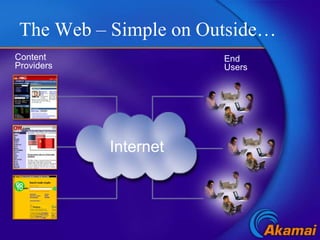
Internet
Content
Providers
End
Users
The Web – Simple on Outside…
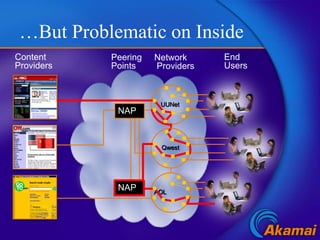
NAP
NAP
UUNet
Qwest
AOL
Network
Providers
Content
Providers
End
Users
Peering
Points
…But Problematic on Inside
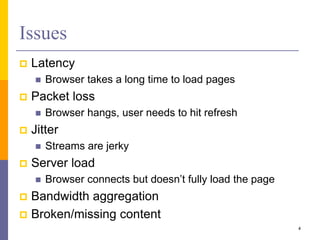
Issues
 Latency
 Browser takes a long time to load pages
 Packet loss
 Browser hangs, user needs to hit refresh
 Jitter
 Streams are jerky
 Server load
 Browser connects but doesn’t fully load the page
 Bandwidth aggregation
 Broken/missing content
4
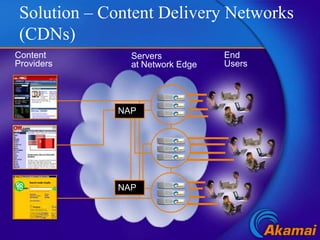
Solution – Content Delivery Networks
(CDNs)
Servers
at Network Edge
Content
Providers
End
Users
NAP
NAP
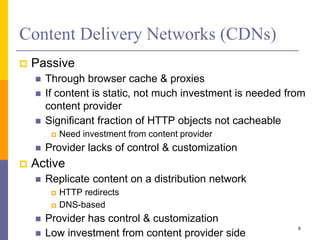
Content Delivery Networks (CDNs)
 Passive
 Through browser cache & proxies
 If content is static, not much investment is needed from
content provider
 Significant fraction of HTTP objects not cacheable
 Need investment from content provider
 Provider lacks of control & customization
 Active
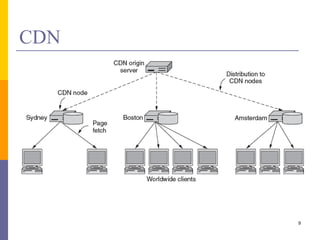
 Replicate content on a distribution network
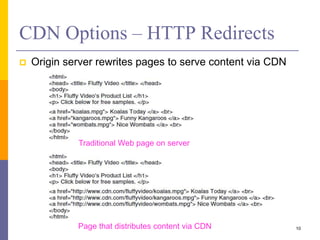
 HTTP redirects
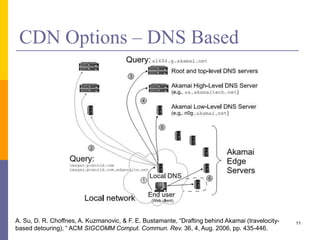
 DNS-based
 Provider has control & customization
 Low investment from content provider side
6
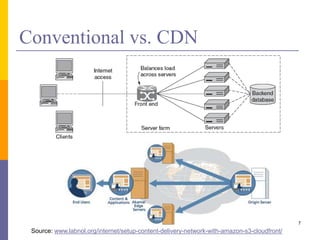
Conventional vs. CDN
7
Source: www.labnol.org/internet/setup-content-delivery-network-with-amazon-s3-cloudfront/
CDN Challenges
 How to replicate content?
 Where to replicate content?
 How to find replicated content?
 How to choose among known replicas?
 How to direct clients towards a replica?
8
CDN
9
CDN Options – HTTP Redirects
 Origin server rewrites pages to serve content via CDN
10Page that distributes content via CDN
Traditional Web page on server
CDN Options – DNS Based
11A. Su, D. R. Choffnes, A. Kuzmanovic, & F. E. Bustamante, “Drafting behind Akamai (travelocity-
based detouring), “ ACM SIGCOMM Comput. Commun. Rev. 36, 4, Aug. 2006, pp. 435-446.
CDN Options
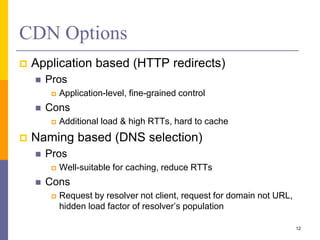
 Application based (HTTP redirects)
 Pros
 Application-level, fine-grained control
 Cons
 Additional load & high RTTs, hard to cache
 Naming based (DNS selection)
 Pros
 Well-suitable for caching, reduce RTTs
 Cons
 Request by resolver not client, request for domain not URL,
hidden load factor of resolver’s population
12

Content Delivery Networks (CDN)

  • 1.
    Content Delivery Networks (CDN) CS4262Distributed Systems Dilum Bandara Dilum.Bandara@uom.lk Some slides extracted from Dr. Srinath Perera & Dr. Rajkumar Buyya’s Presentation Deck
  • 2.
  • 3.
  • 4.
    Issues  Latency  Browsertakes a long time to load pages  Packet loss  Browser hangs, user needs to hit refresh  Jitter  Streams are jerky  Server load  Browser connects but doesn’t fully load the page  Bandwidth aggregation  Broken/missing content 4
  • 5.
    Solution – ContentDelivery Networks (CDNs) Servers at Network Edge Content Providers End Users NAP NAP
  • 6.
    Content Delivery Networks(CDNs)  Passive  Through browser cache & proxies  If content is static, not much investment is needed from content provider  Significant fraction of HTTP objects not cacheable  Need investment from content provider  Provider lacks of control & customization  Active  Replicate content on a distribution network  HTTP redirects  DNS-based  Provider has control & customization  Low investment from content provider side 6
  • 7.
    Conventional vs. CDN 7 Source:www.labnol.org/internet/setup-content-delivery-network-with-amazon-s3-cloudfront/
  • 8.
    CDN Challenges  Howto replicate content?  Where to replicate content?  How to find replicated content?  How to choose among known replicas?  How to direct clients towards a replica? 8
  • 9.
  • 10.
    CDN Options –HTTP Redirects  Origin server rewrites pages to serve content via CDN 10Page that distributes content via CDN Traditional Web page on server
  • 11.
    CDN Options –DNS Based 11A. Su, D. R. Choffnes, A. Kuzmanovic, & F. E. Bustamante, “Drafting behind Akamai (travelocity- based detouring), “ ACM SIGCOMM Comput. Commun. Rev. 36, 4, Aug. 2006, pp. 435-446.
  • 12.
    CDN Options  Applicationbased (HTTP redirects)  Pros  Application-level, fine-grained control  Cons  Additional load & high RTTs, hard to cache  Naming based (DNS selection)  Pros  Well-suitable for caching, reduce RTTs  Cons  Request by resolver not client, request for domain not URL, hidden load factor of resolver’s population 12