UNIT VIII


   CONTEMPORARY
MANAGEMENT PRACTICES
MIS
MIS – Management Information Systems.
     MIS refer to the process of covering the
 application of people, technologies and procedures
 to solve business problems.
     It is defined as ‘research in the information
 systems field which examines more than just
 the technological system, or just the social
 system or even both.’
END USER COMPUTING
It is a group of approaches to computing
that aims at better integrating end users into
the computing environment.
The goal of EUC is to allow unskilled staff to
use expensive and highly skilled knowledge in
their jobs, by putting the knowledge and
expertise into the computer and teaching the
end user how to access it.
MATERIALS REQUIREMENT
        PLANNING (MRP)
 MRP is a software based production
 planning and inventory control system used
 to manage manufacturing processes.
The main objectives of MRP system are:
   To ensure the availability of materials and
    products for production and delivery to customers.
    To maintain the lowest possible level of inventory
    To plan manufacturing activities, delivery
    schedules and purchasing activities.
OUTPUTS OF MRP

   Recommended Production schedule
   Recommended Purchasing schedule
   Messages and reports
Benefits of MRP
   Significantly decreased inventory levels and
    corresponding decrease in inventory carrying
    costs.
   Few stock shortages which cause production
    interruptions and time consuming schedule.
   Savings of labour, material cost, premium
    transportation charges.
   Increased effectiveness of production
    supervisors.
   Better customer service, meet delivery schedules.
JUST IN TIME (JIT)
    Pioneered by Japanese, JIT is an integrated
set of activities designed to achieve high volume
production using minimal inventories of parts
that arrive at the workstation exactly when they
are needed.
    When the components arrive as and when
required in a manufacturing operation, it is
called JIT.
BENEFITS OF JIT
   Quality consciousness
   Reduced scrap
   Reduced cycle times
   Smoother flow of production]
   Low inventory
   High productivity
   High worker participation
   Reduced space requirements
TOTAL QUALITY
     MANAGEMENT (TQM)
    TQM is a management philosophy that seeks
to integrate all organizational functions to focus
on meeting customer needs and other
organization objectives.
    In a TQM effort, all members of the
organization participate in improving processes,
products, services and the culture in which they
work.
How products are developed in
                TQM?
    Customer driven
    Quality
    process oriented
    Interaction
        To achieve TQM, it is necessary that things
    are done right the first time and that defects and
    waste are eliminated from operations.
SIX SIGMA
    Six Sigma is a set of practices developed by
Motorola to systematically improve processes by
eliminating defects.
    It refers to the ability of highly capable processes
to produce output within specification. To achieve six
sigma a process must not produce more than 3.4
defects per million opportunities. A six sigma defect is
defined as anything outside of customer specifications.
METHODOLOGIES


   DMAIC
   DMADV
CAPABILITY MATURITY MODEL
Capability Maturity Model is a collection of
instructions an organization can follow with the
purpose to gain better control over its software
development process.

The CMM ranks software development
organizations in a hierarchy of five levels. Each level
has a progressively greater capability of producing
quality software.
LEVELS OF CMM

   Level 1: Initial
   Level 2: Repeatable
   Level 3: Defined
   Level 4: Managed
   Level 5: Optimizing
SUPPLY CHAIN MANAGEMENT
    SCM is the process of planning,
implementing and controlling the operations of
the supply chain as efficiently as possible.

    The purpose of supply chain management is
to improve trust and collaboration among
supply chain partners, thus improving inventory
visibility and inventory velocity.
ENTERPRISE RESOURCE
      PLANNING (ERP)
   ERP integrates all data and processes of an
organization into a unified system. It uses
multiple components of computer software and
hardware to achieve the integration.

     ERP delivers a single database that contains
all data for the software modules, which include
manufacturing, SCM, financials, projects, HR,
CRM, data warehousing etc.
PERFORMANCE MANAGEMENT


     PM is a strategic and integrated approach to
 delivering sustained success to organizations by
 improving the performance of the people who
 work in them and by developing their
 capabilities as teams and individuals.
BUSINESS PROCESS
     OUTSOURCING (BPO)
   When some or all non core processes are
subcontracted, it is called BPO.

    The main aim of BPO is to allow the
company to invest more time, money and
human resources into core activities and
building strategies which fuel company growth.
BUSINESS PROCESS
      REENGINEERING (BPR)
     It is a management approach aiming at
  improvements by means of elevating efficiency
  and effectiveness of the processes that exist
  within and across organizations.

Clean slate perspective
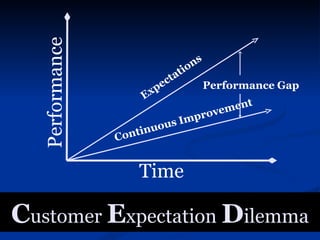
Performance                                o ns
                                       a ti
                                e ct                 Performance Gap
                         E xp
                                              m ent
                                         rove
                                  us Imp
                              o
                     on t in u
                 C


                        Time

Customer Expectation Dilemma
BENCH MARKING
     It is the process of comparing an
     organization’s operations and internal
     processes against those of other organizations
     within or outside its industry.
2.   Internal
3.   Competitive
4.   Functional
5.   Generic
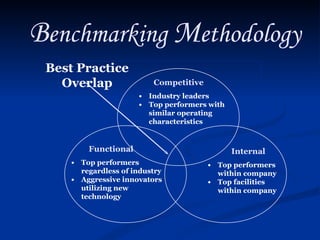
Benchmarking Methodology
 Best Practice
   Overlap                Competitive
                      • Industry leaders
                      • Top performers with
                        similar operating
                        characteristics


         Functional                           Internal
     • Top performers                   • Top performers
       regardless of industry             within company
     • Aggressive innovators            • Top facilities
       utilizing new                      within company
       technology
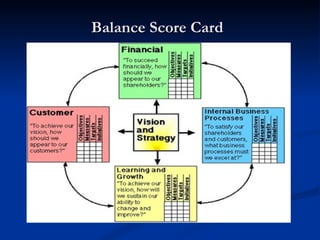
BALANCED SCORE CARD
    It is a strategic feedback system that enables
program managers to make better decisions
faster, smarter and easier than ever before.
    Strategy cannot be implemented just with a
system designed for tactics. There is a need for a
tool that can balance among various factors
which share a view of the organization strategy
for its future development. This tool is BSC.
BENEFITS
    It focuses on few key things needed to create
    break through performance in the entire
    organization.
    It helps to integrate various corporate programs
    It breaks down strategic measures to local levels
    so that unit managers, operators and employees
    can see what’s required at their level to bring
    about excellent performance.
Balance Score Card

Unit viii

  • 1.
    UNIT VIII CONTEMPORARY MANAGEMENT PRACTICES
  • 2.
    MIS MIS – ManagementInformation Systems. MIS refer to the process of covering the application of people, technologies and procedures to solve business problems. It is defined as ‘research in the information systems field which examines more than just the technological system, or just the social system or even both.’
  • 3.
    END USER COMPUTING Itis a group of approaches to computing that aims at better integrating end users into the computing environment. The goal of EUC is to allow unskilled staff to use expensive and highly skilled knowledge in their jobs, by putting the knowledge and expertise into the computer and teaching the end user how to access it.
  • 4.
    MATERIALS REQUIREMENT PLANNING (MRP) MRP is a software based production planning and inventory control system used to manage manufacturing processes. The main objectives of MRP system are:  To ensure the availability of materials and products for production and delivery to customers.  To maintain the lowest possible level of inventory  To plan manufacturing activities, delivery schedules and purchasing activities.
  • 5.
    OUTPUTS OF MRP  Recommended Production schedule  Recommended Purchasing schedule  Messages and reports
  • 6.
    Benefits of MRP  Significantly decreased inventory levels and corresponding decrease in inventory carrying costs.  Few stock shortages which cause production interruptions and time consuming schedule.  Savings of labour, material cost, premium transportation charges.  Increased effectiveness of production supervisors.  Better customer service, meet delivery schedules.
  • 7.
    JUST IN TIME(JIT) Pioneered by Japanese, JIT is an integrated set of activities designed to achieve high volume production using minimal inventories of parts that arrive at the workstation exactly when they are needed. When the components arrive as and when required in a manufacturing operation, it is called JIT.
  • 8.
    BENEFITS OF JIT  Quality consciousness  Reduced scrap  Reduced cycle times  Smoother flow of production]  Low inventory  High productivity  High worker participation  Reduced space requirements
  • 9.
    TOTAL QUALITY MANAGEMENT (TQM) TQM is a management philosophy that seeks to integrate all organizational functions to focus on meeting customer needs and other organization objectives. In a TQM effort, all members of the organization participate in improving processes, products, services and the culture in which they work.
  • 10.
    How products aredeveloped in TQM?  Customer driven  Quality  process oriented  Interaction To achieve TQM, it is necessary that things are done right the first time and that defects and waste are eliminated from operations.
  • 11.
    SIX SIGMA Six Sigma is a set of practices developed by Motorola to systematically improve processes by eliminating defects. It refers to the ability of highly capable processes to produce output within specification. To achieve six sigma a process must not produce more than 3.4 defects per million opportunities. A six sigma defect is defined as anything outside of customer specifications.
  • 12.
    METHODOLOGIES  DMAIC  DMADV
  • 13.
    CAPABILITY MATURITY MODEL CapabilityMaturity Model is a collection of instructions an organization can follow with the purpose to gain better control over its software development process. The CMM ranks software development organizations in a hierarchy of five levels. Each level has a progressively greater capability of producing quality software.
  • 14.
    LEVELS OF CMM  Level 1: Initial  Level 2: Repeatable  Level 3: Defined  Level 4: Managed  Level 5: Optimizing
  • 15.
    SUPPLY CHAIN MANAGEMENT SCM is the process of planning, implementing and controlling the operations of the supply chain as efficiently as possible. The purpose of supply chain management is to improve trust and collaboration among supply chain partners, thus improving inventory visibility and inventory velocity.
  • 16.
    ENTERPRISE RESOURCE PLANNING (ERP) ERP integrates all data and processes of an organization into a unified system. It uses multiple components of computer software and hardware to achieve the integration. ERP delivers a single database that contains all data for the software modules, which include manufacturing, SCM, financials, projects, HR, CRM, data warehousing etc.
  • 17.
    PERFORMANCE MANAGEMENT PM is a strategic and integrated approach to delivering sustained success to organizations by improving the performance of the people who work in them and by developing their capabilities as teams and individuals.
  • 18.
    BUSINESS PROCESS OUTSOURCING (BPO) When some or all non core processes are subcontracted, it is called BPO. The main aim of BPO is to allow the company to invest more time, money and human resources into core activities and building strategies which fuel company growth.
  • 19.
    BUSINESS PROCESS REENGINEERING (BPR) It is a management approach aiming at improvements by means of elevating efficiency and effectiveness of the processes that exist within and across organizations. Clean slate perspective
  • 20.
    Performance o ns a ti e ct Performance Gap E xp m ent rove us Imp o on t in u C Time Customer Expectation Dilemma
  • 21.
    BENCH MARKING It is the process of comparing an organization’s operations and internal processes against those of other organizations within or outside its industry. 2. Internal 3. Competitive 4. Functional 5. Generic
  • 22.
    Benchmarking Methodology BestPractice Overlap Competitive • Industry leaders • Top performers with similar operating characteristics Functional Internal • Top performers • Top performers regardless of industry within company • Aggressive innovators • Top facilities utilizing new within company technology
  • 23.
    BALANCED SCORE CARD It is a strategic feedback system that enables program managers to make better decisions faster, smarter and easier than ever before. Strategy cannot be implemented just with a system designed for tactics. There is a need for a tool that can balance among various factors which share a view of the organization strategy for its future development. This tool is BSC.
  • 24.
    BENEFITS  It focuses on few key things needed to create break through performance in the entire organization.  It helps to integrate various corporate programs  It breaks down strategic measures to local levels so that unit managers, operators and employees can see what’s required at their level to bring about excellent performance.
  • 25.