High
Performance
Work System
(HPWS)
Manvi (170234)
Introduction
• HPWS is defined as a system of HRM practices
that increase the employee’s empowerment,
knowledge, skills and incentives that ultimately
motivate them to achieve greater performance.
• According to Tomar, “the main idea of HPWS is
to create an organization based on employee
involvement, commitment and empowerment,
not employee control”
• Its aim is to create workplaces that are both
highly productive and offer employees high level
of job satisfaction.
Basic Practices
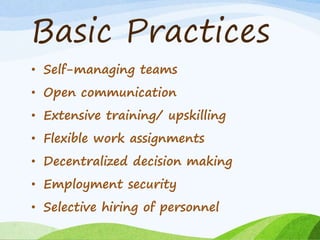
• Self-managing teams
• Open communication
• Extensive training/ upskilling
• Flexible work assignments
• Decentralized decision making
• Employment security
• Selective hiring of personnel
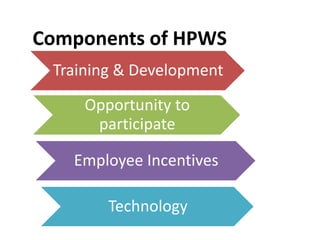
Components of HPWS
Training & Development
Opportunity to
participate
Employee Incentives
Technology
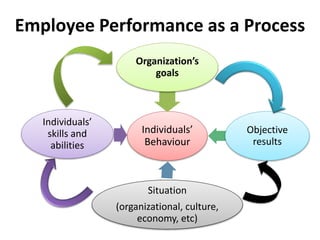
Employee Performance as a Process
Individuals’
Behaviour
Organization’s
goals
Objective
results
Situation
(organizational, culture,
economy, etc)
Individuals’
skills and
abilities
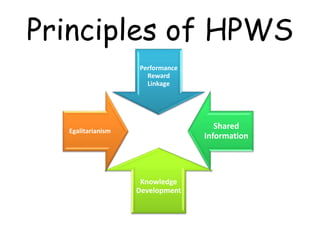
Principles of HPWS
Performance
Reward
Linkage
Shared
Information
Knowledge
Development
Egalitarianism
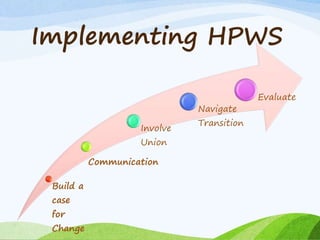
Implementing HPWS
Build a
case
for
Change
Communication
Involve
Union
Navigate
Transition
Evaluate
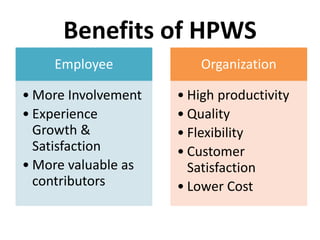
Benefits of HPWS
Employee
• More Involvement
• Experience
Growth &
Satisfaction
• More valuable as
contributors
Organization
• High productivity
• Quality
• Flexibility
• Customer
Satisfaction
• Lower Cost
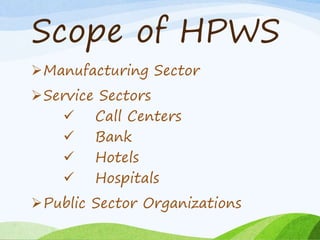
Scope of HPWS
Manufacturing Sector
Service Sectors
 Call Centers
 Bank
 Hotels
 Hospitals
Public Sector Organizations
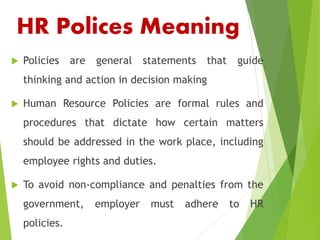
HR Polices Meaning
 Policies are general statements that guide
thinking and action in decision making
 Human Resource Policies are formal rules and
procedures that dictate how certain matters
should be addressed in the work place, including
employee rights and duties.
 To avoid non-compliance and penalties from the
government, employer must adhere to HR
policies.
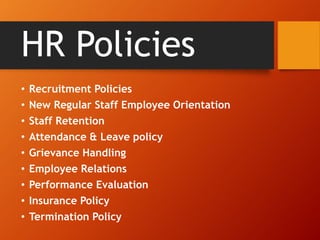
HR Policies
• Recruitment Policies
• New Regular Staff Employee Orientation
• Staff Retention
• Attendance & Leave policy
• Grievance Handling
• Employee Relations
• Performance Evaluation
• Insurance Policy
• Termination Policy
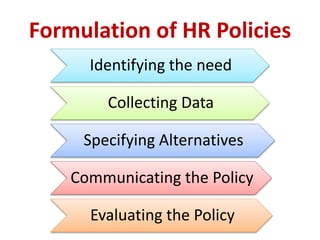
Formulation of HR Policies
Identifying the need
Collecting Data
Specifying Alternatives
Communicating the Policy
Evaluating the Policy
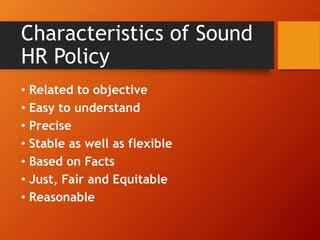
Characteristics of Sound
HR Policy
• Related to objective
• Easy to understand
• Precise
• Stable as well as flexible
• Based on Facts
• Just, Fair and Equitable
• Reasonable
Significance of HR
Policies
• Establishing consistency
• Time Saving
• Establish a standard
• Curbing Litigation
• Communication with managers and
supervisors
• Communication with employees
High performance work system (hpws)

High performance work system (hpws)

  • 1.
  • 2.
    Introduction • HPWS isdefined as a system of HRM practices that increase the employee’s empowerment, knowledge, skills and incentives that ultimately motivate them to achieve greater performance. • According to Tomar, “the main idea of HPWS is to create an organization based on employee involvement, commitment and empowerment, not employee control” • Its aim is to create workplaces that are both highly productive and offer employees high level of job satisfaction.
  • 3.
    Basic Practices • Self-managingteams • Open communication • Extensive training/ upskilling • Flexible work assignments • Decentralized decision making • Employment security • Selective hiring of personnel
  • 4.
    Components of HPWS Training& Development Opportunity to participate Employee Incentives Technology
  • 5.
    Employee Performance asa Process Individuals’ Behaviour Organization’s goals Objective results Situation (organizational, culture, economy, etc) Individuals’ skills and abilities
  • 6.
  • 7.
  • 8.
    Benefits of HPWS Employee •More Involvement • Experience Growth & Satisfaction • More valuable as contributors Organization • High productivity • Quality • Flexibility • Customer Satisfaction • Lower Cost
  • 9.
    Scope of HPWS ManufacturingSector Service Sectors  Call Centers  Bank  Hotels  Hospitals Public Sector Organizations
  • 10.
    HR Polices Meaning Policies are general statements that guide thinking and action in decision making  Human Resource Policies are formal rules and procedures that dictate how certain matters should be addressed in the work place, including employee rights and duties.  To avoid non-compliance and penalties from the government, employer must adhere to HR policies.
  • 11.
    HR Policies • RecruitmentPolicies • New Regular Staff Employee Orientation • Staff Retention • Attendance & Leave policy • Grievance Handling • Employee Relations • Performance Evaluation • Insurance Policy • Termination Policy
  • 12.
    Formulation of HRPolicies Identifying the need Collecting Data Specifying Alternatives Communicating the Policy Evaluating the Policy
  • 13.
    Characteristics of Sound HRPolicy • Related to objective • Easy to understand • Precise • Stable as well as flexible • Based on Facts • Just, Fair and Equitable • Reasonable
  • 14.
    Significance of HR Policies •Establishing consistency • Time Saving • Establish a standard • Curbing Litigation • Communication with managers and supervisors • Communication with employees